Original Research Article
Depression in cancer patients undergoing chemotherapy in a tertiary
care hospital: a cross-sectional study
Shivani S. Vaidya, Sarita K. Sharma*
INTRODUCTION
Cancer comprises a group of diseases characterised by the uncontrolled cell growth, having potential to invade or spread to other parts of body.1,2 Over 100 types of cancers affect human body.2According to estimates from International Agency for Research on Cancer (IARC), in 2018 there were 17.0 million new cancer cases and 9.5 million cancer deaths worldwide.3 Globally, nearly 1 in 6 deaths is due to cancer. Approximately 70% of deaths from cancer occur in low and middle income countries.1 In Asia, the incidence of cancer is expected to increase from 6.1 to 10.7 million in 2030, with an estimated increase in mortality rate from 4.1 to 7.5 million in 2030.4 The data of National Cancer Registry Programme
(2012-2014) of Indian Council of Medical Research revealed that 1300 Indians succumb to cancer everyday. The total number of new cancer cases in India is expected to reach nearly 17.3 lakhs by 2020.5
The diagnosis of cancer itself is catastrophic for the patients and the relatives. The long course of treatment, repeated hospitalizations, and the side effects of chemotherapy along with the trauma of being diagnosed with cancer has a significant effect on psyche of cancer patient.6 Other than the symptoms arising due to the type of cancer, the cancer patients face many psychological
problems such as stress, anxiety, depression;
physiological side-effects such as nausea, vomiting, pain; and some social side-effects such as social isolation, role
ABSTRACT
Background: Cancer is the second most common cause of death after heart diseases and it accounted for 8.8 million deaths worldwide in 2015. The long course of treatment, repeated hospitalisations, and the side effects of chemotherapy along with the trauma of being diagnosed with cancer has a significant effect on psyche of cancer patient. Depression is the most frequent cancer related symptom and 15-25% of cancer patients are affected by depression. The aim of this study is to determine the levels of depression in cancer patients undergoing chemotherapy.
Methods: Present cross-sectional study was conducted amongst cancer patients undergoing chemotherapy at Day Care Centre, Department of Radiation Therapy and Oncology, Government Medical College and Hospital, Nagpur. 95 participants were interviewed using predesigned and pretested questionnaire based on the Beck’s Depression Inventory.
Results: Among the study subjects, 70 (73.69%) had depression of which 15 (21.42%) had borderline clinical depression, 44 (62.85%) had moderate depression and 11 (15.73%) had severe depression. None of the study subjects had extreme depression.
Conclusions: Majority of the study subjects receiving chemotherapy were depressed.
Keywords: Depression, Cancer patients, Chemotherapy, Tertiary care hospital
Department Community Medicine, Government Medical College and Hospital, Nagpur, Maharashtra, India
Received: 01 May 2019
Revised: 09 June 2019
Accepted: 11 June 2019
*Correspondence:
Dr. Sarita K. Sharma,
E-mail: [email protected]
Copyright: © the author(s), publisher and licensee Medip Academy. This is an open-access article distributed under the terms of the Creative Commons Attribution Non-Commercial License, which permits unrestricted non-commercial use, distribution, and reproduction in any medium, provided the original work is properly cited.
and function loss; and eventually worsened quality of life.7-9
The most frequent cancer related symptom is “depression” which worsens with chemotherapy and persists for a long time even after completion of chemotherapy. It also manifests with recurrence of disease and ultimately is an independent prognostic factor in morbidity and mortality.10 The National Cancer Institute report (2008) suggests that 15-25% of cancer patients are affected by depression. Cancer related depression is a pathological affective response to loss of normality and one’s personal life as a result of cancer diagnosis, treatment and impending complications.6 Several studies have indicated that such depression not only causes great suffering but also diminishes the quality of life, amplifies pain and other symptoms, decreases adherence to anti-cancer treatment, leads to suicide and acts as a psychological burden on the family.11-14
Although there have been remarkable progressions in biomedical care for cancer it has not been complemented by progressions in providing good quality care for psychological effects of cancer.15With this background and considering the fact that very few studies have been carried out on depression in patients receiving chemotherapy in India, more so in Central India, present study was undertaken with the aim of determining the levels of depression in cancer patients undergoing chemotherapy.
METHODS
The present cross-sectional study was conducted in Day Care Centre, Department of Radiation Therapy and Oncology, Government Medical College and Hospital, Nagpur. The duration of the study was two months, from 1st May 2018 to 30th June 2018.
Based on the study of S Bhattacharyya et al considering the prevalence of depression in patients undergoing chemotherapy to be 55.7% the estimated sample size comes out to be 95 (95% confidence interval and 10% absolute precision).16 The study subjects were selected by systematic random sampling. There were approximately 330 patients undergoing chemotherapy every month, so every 7th patient was selected.
Inclusion criteria
Age 18 years and above.
Exclusion criteria
Patients who were very sick.
Patients who refused to give consent.
Approval from Institutional Ethics Committee was obtained and informed consent of subjects was taken after apprising them about the purpose of the study. The data
was collected by interview technique using predesigned and pretested questionnaire based on the Beck’s Depression Inventory.
General information regarding socio-demographic data such as gender, age, marital status, occupation, level of education was noted. Socio-economic status was assessed using Modified Kuppuswamy classification and BG Prasad classification (corrected as per current CPI) for patients residing in urban and rural areas respectively.
Beck’s Depression Inventory
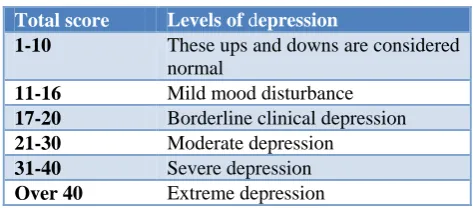
Beck’s Depression Inventory has 21 questions.17 The score for each of the 21 questions is added by counting the number to the left of each question marked. The highest possible total for the whole test is 63 (this means the score is 3 for all the 21 questions). Since, the lowest possible score for each question is 0, the lowest possible score for the test is 0 (this means the score is 0 on each question). The level of depression is evaluated according to Table 1.
Table 1: Scoring of Beck's Depression Inventory.
Total score Levels of depression
1-10 These ups and downs are considered normal
11-16 Mild mood disturbance
17-20 Borderline clinical depression
21-30 Moderate depression
31-40 Severe depression
Over 40 Extreme depression
Data entry was done in Microsoft Excel version 2007 and analysis was done in Epi Info version 7.2. Descriptive statistics such as mean, standard deviation, range were used to summarise baseline characteristics of the study subjects.
RESULTS
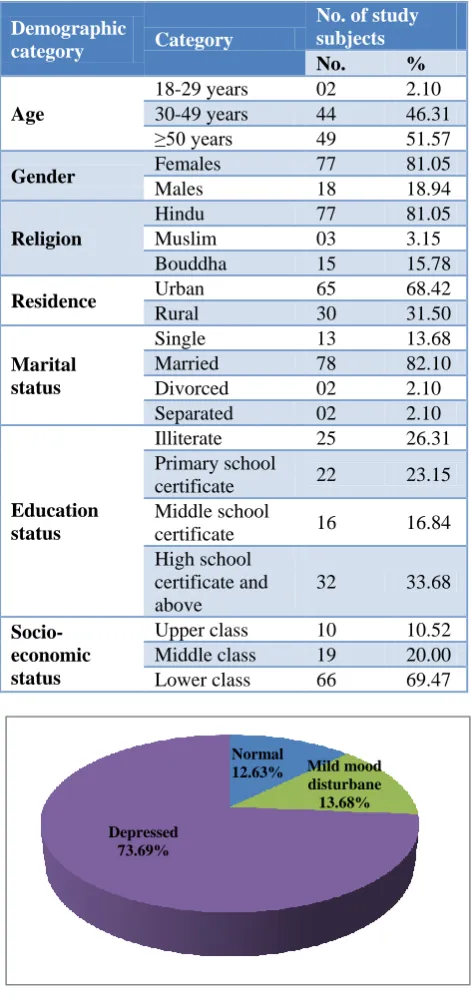
Total 95 patients undergoing chemotherapy were enrolled in the study. The demographic variables of the study subjects are shown in Table 2. The age of study subjects varied between 25-80 years, the mean age being 49.35±11.75 years. 77 (81.05%) of the study subjects were females and 18 (18.95%) were males. Majority of them 77 (81.05%) were Hindu by religion, most 65 (68.42%) were from urban area and majority 78 (82.10%) were married. Most of the them were of low education levels, 25 (26.13%) were illiterate. Majority of the study subjects 66 (69.47%) belonged to lower socio-economic class.
Table 2: Demographic variables of study subjects.
Demographic
category Category
No. of study subjects
No. %
Age
18-29 years 02 2.10
30-49 years 44 46.31
≥50 years 49 51.57
Gender Females 77 81.05
Males 18 18.94
Religion
Hindu 77 81.05
Muslim 03 3.15
Bouddha 15 15.78
Residence Urban 65 68.42
Rural 30 31.50
Marital status
Single 13 13.68
Married 78 82.10
Divorced 02 2.10
Separated 02 2.10
Education status
Illiterate 25 26.31
Primary school
certificate 22 23.15
Middle school
certificate 16 16.84
High school certificate and above
32 33.68
Socio- economic status
Upper class 10 10.52
Middle class 19 20.00
Lower class 66 69.47
Figure 1: Depression in study subjects.
Table 3: Distribution of study subjects by levels of depression.
Levels of depression Study subjects
Number Percentage (%)
Borderline clinical
depression 15 21.42
Moderate depression 44 62.85
Severe depression 11 15.73
Total 70 100
Table 3 shows the distribution of study subjects by levels of depression. Among the study subjects, 70 (73.69%) had depression of which 15 (21.42%) had borderline clinical depression, 44 (62.85%) had moderate depression and 11 (15.73%) had severe depression. None of the study subjects had extreme depression.
DISCUSSION
Cancer is a major public health problem causing a large number of deaths. Most of the patients with cancer have psychological disorders and are in dire need of appropriate treatment. The mere knowledge of diagnosis with ongoing ambiguity regarding the course of illness add up to considerable distress.18 Depression is one of the commonest psychological problem among these patients. Till now very less attention has been paid to cancer patients’ mental status. Hence, this cross-sectional study was aimed at throwing more light on this subject.
Depression is a common symptom in cancer patients, often because of the psychological impact of having a life-threatening illness and the side effects of the treatments.19-21 Depression in cancer patients can interfere with treatment and recovery and may subsequently increase their morbidity and mortality.22 In the present study, the proportion of depression was found to be quite high (73.69%) as compared to most of the other studies conducted by Bhattacharyya et al (55.7%), Mansoor et al (26.8%), Nakaguchi et al (8-9%), Pandey et al (16.23%).6,16,23,24 However, similar findings were reported by Jadoon et al who found the prevalence of depression to be 66%.25 In the present study significantly higher proportion of depression can be attributed to greater number of female study subjects who are usually willing to express depression and tend to apply emotional approach for coping.
The present study revealed that, among the study subjects 15.78% had borderline clinical depression, 46.31% had moderate depression and 11.57% had severe depression. Similar findings were observed by Yusof et al and Jang et al.26,27 However, de Souza et al in their study found that 12.5% and 1.78% of the patients experienced moderate and severe depression respectively.28 Polikandrioti et al in their study noted that 21.5% patients had mild depression, 10.2% had moderate depression and 0.6% had severe depression.29 These variations in the prevalence of depression can be due to use of different scales, different study population and different study setting.
CONCLUSION
As the proportion of depression in cancer patients receiving chemotherapy is quiet high, physicians can be made aware, encouraged and empowered to recognize the depression at an early stage and determine the appropriate level of intervention for a better quality of life in these patients. Thus, health care professionals can initiate timely screening and treatment (personal counselling,
Normal
12.63% Mild mood disturbane
13.68%
group sessions and medications) of depression at an early stage to ensure a greater compliance and better prognosis in such patients.
Present study has all the limitations inherent in a cross-sectional study. More studies with large sample size and varied study designs need to be carried out on this oft neglected topic.
ACKNOWLEDGEMENTS
The authors are grateful to Dean, Government Medical College and Hospital, Nagpur and Professor and Head, Department of Radiation Therapy and Oncology for their cooperation and providing necessary research facilities.
Funding: No funding sources Conflict of interest: None declared
Ethical approval: The study was approved by the Institutional Ethics Committee
REFERENCES
1. "Cancer Fact Sheet N°297". World Health Organization. February 2018.
2. "Defining Cancer". National Cancer Institute.
3. American Cancer Society. Global Cancer Facts and
Figures, 2018.
4. Sankaranarayanan R, Ramadas K, Qiao YL.
Managing the changing burden of cancer in Asia. BMC Med. 2014;12:1-17.
5. Press Release: Report to the nation on the status of cancer in India. Based on Consolidated Cancer Registry Reports by Indian Council of Medical Research through its National Cancer Registry Programme. 2014.
6. Pandey M, Sarita GP, Devi N, Thomas BC, Hussain
BM, Krishna R. Distress, anxiety, and depression in cancer patients undergoing chemotherapy. World J Surg Oncol. 2006;4:68.
7. Burgess C, Cornelius V, Love S, Graham J,
Richards M, Ramirez A. Depression and anxiety in women with early breast cancer: Five year observational cohort study. BMJ. 2005;330:702-5.
8. Reich M, Lesur A, Pedrizet-Chevallier C.
Depression, quality of life and breast cancer: A review of the literature. Breast Cancer Res Treat. 2008;110:9-17.
9. Shapiro SL, Lopez AM, Schwart GE, Bootzin R, Fiqueredo AJ, Braden CJ, et al. Quality of life and
breast cancer relationships to psychosocial
variables. J Clin Psychol. 2001;57:501-19.
10. Morris T, Greer HS, White P. Psychological and
social adjustment to mastectomy. Cancer.
1997;40:2381-7.
11. Grassi L, Indelli M, Marzola M, Maestri A, Santini A, Piva E, et al. Depressive symptoms and quality of life in home-care-assisted cancer patients. J Pain Symptom Manage. 1996;12:300-7.
12. Spiegel D, Bloom JR. Pain in metastatic breast cancer. Cancer. 1983;52:341-5.
13. Colleoni M, Mandala M, Peruzzotti G, Robertson C, Bredart A, Goldhirsch A. Depression and degree of acceptance of adjuvant cytotoxic drugs. Lancet. 2000;356:1326-7
14. McLean LM, Jones JM. A review of distress and its management in couples facing end-of-life cancer. Psychooncology. 2007;16:603-16.
15. Adler NE, Page AEK (eds). Cancer Care for the Whole Patient: Meeting Psychosocial Health Needs,
Institute of Medicine (US) Committee on
Psychosocial Services to Cancer Patients/Families in a community Setting. Washington, DC, USA: Academics Press; 2008.
16. Mansoor S, Jehangir S. Anxiety, depression in patients receiving chemotherapy for solid tumors. Pak Armed Forces Med J. 2015;65(1):89-93.
17. http://www.med.navy.mil/NMCP2/PatientServices/
SleepClinicLab/
Documents/Beck_Depression_Inventory.pdf. 18. Tavoli A, Mohagheghi MA, Montazeri A, Roshan
R, Tavoli Z, Omidvari S, et al. Anxiety and depression in patients with gastrointestinal cancer: does knowledge of cancer diagnosis matter? BMC Gastroenterol. 2007;7:28.
19. Maguire GP, Julier DL, Hawton KE, Bancroft JH. Psychiatric morbidity and referral on two general medical wards. Br Med J. 1974;1(5902):268-270. 20. Moffic HS, Paykel ES. Depression in medical
in-patients. Br J Psychiatry. 1975;126:346-53.
21. Massie MJ, Holland JC. Depression and the cancer patient. J Clin Psychiatr. 1990;50(suppl):12-7.
22. Katon WJ. Epidemiology and treatment of
depression in patients with chronic medical illness. Dialogues Clin Neurosci. 2011;13:7-23.
23. Bhattacharyya S, Bhattacharjee S, Mandal T, Das DK. Depression in cancer patients undergoing chemotherapy in a tertiary care hospital of North Bengal, India. Indian J Public Health. 2017;61:14-18.
24. Nakaguchi T, Okuyama T, Uchida M, Ito Y,
Komatsu H, Wada M, et al. Oncology nurses’ recognition of supportive care needs and symptoms of their patients undergoing chemotherapy. Jpn J Clin Oncol. 2013;43(4)369-76.
25. Jadoon NA, Shahzad MA, Munir W, Choudhary ZS.
Assessment of depression and anxiety in adult cancer outpatients. BMC cancer. 2010;10(1):594. 26. Yusof S, Zakaria FN, Hashim NK, Dasiman R.
Depressive symptoms among cancer patients undergoing chemotherapy. Procedia Soc Behav Sci. 2016;34:185-92.
27. Jang S, Ackler J, Braitman L, Tester W. Depression and quality of life in cancer undergoing chemotherapy: relation between Zung self-rating depression scale and functional assessment of
cancer therapy-general. Commun Oncol.
28. de Souza BF, de Moraes JA, Inocenti A, dos Santos MA, de Camargo Silva AEB, Miasso AI. Women with breast cancer taking chemotherapy: depression symptoms and treatment adherence. Rev. Latino-Am. Enfermagem. 2014;22(5):1518-8345.
29. Polikandrioti M, Evaggelou E, Zerva S, Zerdila M, Koukoularis D, Kyritsi E. Evaluation of depression in patients undergoing chemotherapy. Health Sci J. 2008;2(3):162-72.