Original Research Article
A cross sectional study to assess the oral health knowledge, attitude and
practice among school children in rural field practice area of Bangalore
Medical College and Research Institute, Bengaluru
D. B. Padmini, Selvi Thangaraj*, T. S. Ranganath, Netravati Ambiger
INTRODUCTION
Oral health is an integral part of the general health and well being of an individual. A good oral health is the state of mouth free of any disease affecting the oral cavity and its surrounding structures.1 A healthy mouth enables an individual to converse, eat and socialize without any distress and embarrassment.
The practice of maintaining the mouth clean and healthy by brushing and flossing to prevent tooth decay and gum
disease is described as Oral hygiene. Maintaining good oral hygiene is considered a lifelong habit. These oral health habits are said to begin in an early stage of life. It is important to have good knowledge and attitude toward oral health, to follow health oral habits. The knowledge is derived from information and the information, when accepted and believed will be translated into an action which in turn becomes a habit. Parents, siblings and schoolteachers play an important role in grooming healthy habits in young children.1
ABSTRACT
Background: Oral health is an integral part of the general health and well being of an individual. Dental caries, periodontal disease and oral mucosal disease constitute the major oral health problems in developing countries. To follow healthy oral habits it is essential to have good oral health knowledge and attitude. Good oral health related knowledge among school children is considered to be an essential prerequisite for improving oral health in a community. The objective of the study was to assess the oral health knowledge, attitude and practice among school children in rural field practice area of Bangalore Medical College and Research Institute (BMCRI), Bengaluru.
Methods: A cross sectional study was conducted among 140 middle school children choosen randomly from government schools of Nelamangala, Rural field practice area of BMCRI, during September - November 2016. Data was collected using semi- structured questionnaire by interview method and was analyzed by descriptive statistics.
Results: Out of 140 students, 67 were males, 73 were females. 49 (35%) students knew that sweetened food or drinks causes dental caries. 60 (42.86%) of them knew that there can be decay of tooth if they do not brush daily. 120 (85.71%) agreed that self care is important to prevent dental problems. 82 (58.57%) had a practice of brushing teeth twice daily.
Conclusions: In the present study, there is a gap in the oral health knowledge and practice among school children, which needs to be filled up by regular oral health education to children, parents and teachers as well.
Keywords: Oral health, Knowledge, Attitude, Practice, Middle school children
Department ofCommunity Medicine, Bangalore Medical College and Research Institute, Bengaluru, Karnataka, India
Received: 28 September 2018
Revised: 13 November 2018
Accepted: 16 November 2018
*Correspondence:
Dr. Selvi Thangaraj,
E-mail: [email protected]
Copyright: © the author(s), publisher and licensee Medip Academy. This is an open-access article distributed under the terms of the Creative Commons Attribution Non-Commercial License, which permits unrestricted non-commercial use, distribution, and reproduction in any medium, provided the original work is properly cited.
Dental caries, periodontal disease and oral mucosal disease constitute the major oral health problems in developing countries.1 About 90% of school children and adults worldwide would have experienced dental caries, which could be due to various factors, important among them are lack of oral health knowledge, consumption of refined carbohydrates. Oral health problems can have impact on physical, mental, social and financial well being of an individual.2
Adolescence has been identified as a time when personal oral health behaviours may be internalized and become habits, as parents become increasingly less directly involved in their children's care. Their increased autonomy may also mean that they fail to practice adequate oral health care. They may tend to consume more snacks, and beverages between meals. Oral care during adolescence is important for several reasons, including the eruption of permanent dentition which increases the number of tooth surfaces that may decay and also results in increased early periodontal disease. Thus, adolescents may be at greater risk for dental disease during a developmental period when they are establishing oral care habits.3
The burden of oral disease in young children restricts activities in school, work, and home leading to loss of many potential working hours. Children who suffer from poor oral health are 12 times more likely to have restricted activity than those who do not.4 A greater incidence of caries and periodontal diseases is seen in rural children due to poor oral hygiene, care and lack of dental check-ups. Also due to junk foods and experimental consumption of alcohol, smoking during adolescence.4
It is important to consider the fact that students can contribute in health promotion and in spreading preventive information among their family and the society. The change to healthy attitude and practice can be brought about by giving adequate information, motivation and practice to the subjects. In order to create such health education, the assessment of knowledge, attitude and practice is essential.5
Hence this study was taken up to assess the knowledge, attitude and practice on oral health in middle school children in rural field practice area.
Objective
To assess the oral health knowledge, attitude and practice among school children in rural field practice area of Bangalore Medical College and Research Institute (BMCRI), Bengaluru.
METHODS
A Cross Sectional study was conducted in Nelamangala, the rural field practice area of Bangalore Medical College
& Research Institute (BMC&RI), Bengaluru during the period September 2016-November 2016 among middle school children of Government schools of Nelamangala. In the study done by Harikiran, 75.1% of middle school children knew that brushing teeth can prevent dental caries.6 With 10% relative precision and 95% confidence interval, using the formula n=z2pq/ d2, the sample size obtained was 140.
Middle school children (studying in 5th, 6th and 7th standard) from government schools of Nelamangala (both boys and girls) were included in the study. Children who were absent on the day of study were excluded from the study. Multistage random sampling technique was used to select the study population. There are 5 government schools in an area limited to rural field practice area of Nelamangala, randomly 3 schools were chosen by lottery method. 50, 50 and 40 students were chosen randomly from first, second and third school respectively after obtaining permission from Block Education Officer. The objective of the study was explained and an assent was obtained from the principle of the school. Socio-demographic details and the data on the Knowledge, Attitude and Practice on Oral health was collected by one to one interview method using a Semi-structured questionnaire containing multiple choice questions. Data was entered in the excel sheet and was analysed using Descriptive statistics.
RESULTS
Figure 1: Age-sex distribution of study population (mean age=12.5 yrs) (n=140).
Figure 1 shows that out of 140 children, 67 were males and 73 were females. Maximum children (113) belong to the age group of 12-13 years. 111 children belong to Hindu religion, 28 were Muslims and 1 was Christian.
Table 1 show that about 137 (97.86%) children knew that teeth are an important part of our body. Only 108 (77.14%) knew that oral disease have an impact on general health. About 136 (97.14%) children knew that daily cleaning of teeth can prevent dental caries. About 136 (97.14%) children knew that regular visit to dentist helps to keep their teeth in a healthy state.
9
29
23
6 11
34
27
1 0
5 10 15 20 25 30 35 40
11 Years 12 Years 13 Years 14 Years
Male (67)
Table 1: Assessment of knowledge on oral health (n=140).
Assessment of knowledge No of children (N) Percentage (%)
1. Teeth are an important part of your body.
Yes 137 97.86
No 3 2.14
2. Do oral diseases have an impact on general health?
Yes 108 77.14
No 32 22.86
3. Daily cleaning of teeth can prevent dental caries.
Yes 136 97.14
No 4 2.86
4. Do regular visit to dentist helps to keep your teeth in a healthy state?
Yes 136 97.14
No 4 2.86
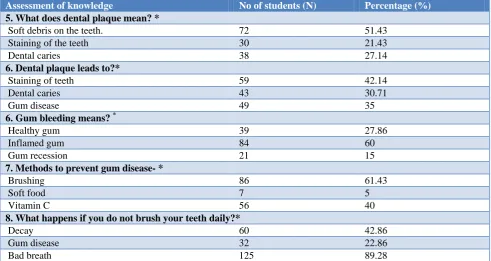
Table 2: Assessment of knowledge on oral health (n=140).
Assessment of knowledge No of students (N) Percentage (%)
5. What does dental plaque mean? *
Soft debris on the teeth. 72 51.43
Staining of the teeth 30 21.43
Dental caries 38 27.14
6. Dental plaque leads to?*
Staining of teeth 59 42.14
Dental caries 43 30.71
Gum disease 49 35
6. Gum bleeding means? *
Healthy gum 39 27.86
Inflamed gum 84 60
Gum recession 21 15
7. Methods to prevent gum disease- *
Brushing 86 61.43
Soft food 7 5
Vitamin C 56 40
8. What happens if you do not brush your teeth daily?*
Decay 60 42.86
Gum disease 32 22.86
Bad breath 125 89.28
* Multiple response.
Figure 2: Assessment of knowledge on oral health (n=140).
Figure 2 shows that- 138 (98.57%) students knew that dental caries mainly caused by bacteria. Only 49 (35%) students knew that sweetened food or drinks causes dental caries. About 117 (83.57%) students knew that fluoride toothpaste prevent dental caries. About 137 (97.86%) students knew tobacco causes oral cancer.
Table 2 shows that- only 72 (51.23%) students knew that dental plaque is a soft debris on the teeth. 59(42.14%) students were of the opinion that dental plaque leads to staining of teeth. Only 43 (30.71%) students knew that dental plaque leads to dental caries and 49 (35%) students knew it can lead to gum disease. 39 (27.86%) students told bleeding gum is normal. 84 (60%) students knew that bleeding gum is a sign of inflamed gum.
3 23
91(45%) 2
137(97.86%) 117(83.57%) 49(35%)
138(98.57%)
0 50 100 150
Usage of tobacco causes oral cancer Fluoride toothpaste prevent dental caries Sweetened food or drinks
causes dental caries Dental caries mainly
caused by bacteria
Yes
About 86 (61.43%) children knew that brushing can prevent gum disease. 56 (40%) children knew that vitamin C can prevent gum disease. Only 60 (42.86%) children knew that there can be dental decay if they do not brush their teeth daily. 32 (22.86%) children knew that it can lead to gum disease and 125 (89.28%) students knew that it can lead to bad breath if they do not brush their teeth daily.
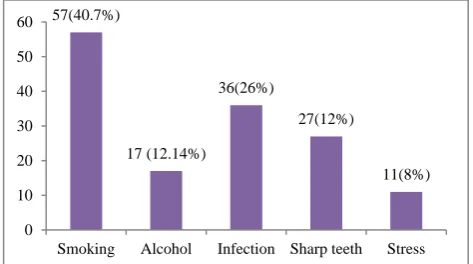
Figure 3 shows that- About 57 (40.71%) children knew that smoking causes oral cancer. Only 17 (12.1%) children knew that alcohol causes oral cancer. 36 (26%) children knew oral infection can cause oral cancer. 27 (12%) children knew sharp tooth can cause oral cancer. 11 (8%) children knew that it could be induced by stress.
Figure 3: Knowledge on causes of oral ulcer (multiple response question).
Table 3: Assessment of attitude on oral health (n=140).
Assessment of attitude N %
1. State of my teeth is important to me.
Agree 140 100
Disagree 0
2. Self care is important to prevent dental problems.
Agree 120 85.71
Disagree 20 14.29
3. Regular dental check up prevent dental problems.
Agree 135 96.43
Disagree 5 3.57
4. 55 students never visited dentist- Reason for not visiting the doctor? (n=55)
Fear of dental treatment 27 19.28
No dentist available nearby. 4 2.86
Cost of treatment is high 10 7.14
No pain or discomfort in teeth or gum. 14 10
Table 4: Assessment of practice on oral health (n=140).
Assessment of practice N %
1. How often do you brush your teeth?
Once a day 52 37.14
Twice a day 82 58.57
More than twice a day 5 3.57
When I get toothache 1 0.71
2. Which of the following material do you use to clean your teeth?
Finger 1 0.71
Neem twig 7 5
Tooth powder 3 2.14
Tooth brush and Tooth paste 127 90.71
Salt and Charcoal 2 1.43
3. Frequency of eating junk foods / sweetened liquids / sticky sweets
Once daily 96 68.57
Twice daily Occasionally
19 25
13.57 17.86
4. How long do you brush your teeth?
Less than 1 minute 9 6.43
Upto 2 minutes 56 40
More than 2 minutes 75 53.57
57(40.7%)
17 (12.14%)
36(26%)
27(12%)
11(8%)
0 10 20 30 40 50 60
Table 3 shows that all children agreed that condition of their teeth is important to them. About 120 (85.71%) children reported self care is important to prevent dental problems. 135 (96.43%) children agreed that regular dental check up prevent dental problems. About 55 students had never visited dentist. 27 (19.28%) children reported fear of dental treatment. 4 students reported no dentist available nearby. 10 students reported cost of treatment high. 14 reported as there was no pain or discomfort in teeth or gum.
Table 4shows that, 52 (37.14%) children had an habit of brushing teeth once daily, 82 (58.57%) children had an habit of brushing teeth twice daily. 127 (90.71%) children used to brush their teeth using tooth brush and tooth paste. 7 children were using neem twig, 3 were using tooth powder and 2 of them were using salt and charcoal to brush their teeth. About 96 (68.57%) children eat junk foods / sweetened liquids / sticky sweets once daily, about 19 (13.57%) children eat twice daily, 25 (17.86%) children eat occasionally. 9 students (6.43%) had an habit of brushing teeth for less than one minute. Upto 56 (40%) students had an habit of brushing teeth for upto 2 minutes. 75 students (53.57%) had an habit of brushing teeth for more than 2 minutes.
Figure 4: Frequency of visiting dentist among study group (n=140).
Figure 4 shows about 20 (14.28%) children visit dentist once in 6- 12 months, 65 (46.43%) children when there is dental pain, 55 (39.28%) children had never visited dentist.
DISCUSSION
In the present study, 137 (97.86%) children knew that teeth are an important part of our body. Only 108 (77.14%) knew that oral disease have an impact on general health. In the study done by Gopikrishna et al, 71.7% knew health of teeth and mouth had an impact on the health of the body.7 About 136 (97.14%) children knew that daily cleaning of teeth can prevent dental caries and in the study done by Priya et al about 73.50% and 55.60% children knew brushing their teeth and usage of fluoride can prevent dental decay respectively, whereas in Mehta et al study it was 83.2% and 17.6% respectively.4,5
In our study, about 136 (97.14%) children knew that regular visit to dentist helps to keep their teeth in a healthy state, whereas in Gao et al study about 73.4% knew importance of regular dental visits.8
In the present study, almost 138 (98.57%) students knew that dental caries mainly caused by bacteria, whereas only 41.5% knew in Gao et al study.8 Only 49 (35%) students knew that sweetened food or drinks causes dental caries. In the study done by Punitha et al, 58% of children knew that sweets causes dental caries.9 In the Gao et al study, 76.6% children told sugar causes dental caries.8 In the Priya et al study, 81.8% and 77.7% students were of the opinion that sweets and fizzy drinks causes dental caries respectively.5 In the present study, 117 (83.57%) students knew that fluoride toothpaste prevent dental caries, whereas only 3.7% knew in Gao et al study.8 In the present study, 137 (97.85%) students knew tobacco causes oral cancer.
In the present study, about 72 (51.23%) students knew that dental plaque is a soft debris on the teeth, 43 (30.71%) children related dental plaque to dental caries and 49 (35%) related it to gum disease. In the study done by Priya et al 27.20% and 14.90% related dental plaque to dental caries and gum disease respectively.5 In the present study, 84 (60%) students knew that bleeding gum is a sign of inflamed gum. In the study done by Priya et al, only 35.60% students knew the correct answer that it meant inflamed gums.5
In the present study, about 86 (61.43%) children knew that brushing can prevent gum disease. Only 56 (40%) children knew that Vitamin C can prevent gum disease whereas in the study done by Priya et al it was 31.10% and 31.30% respectively.5 In Gao et al study only 46.8% reported brushing can prevent gum disease.8
Only 60 (42.86%) children knew that there can be dental decay if they do not brush their teeth daily. Only 32 (22.86%) children knew that it can lead to gum disease and 125 (89.28%) students knew that it can lead to bad breathe if they do not brush their teeth daily. Only 57 (40.71%) children knew that smoking causes oral cancer. Only 17 (12.1%) children knew that alcohol causes oral cancer. 11 children knew that it could be induced by stress.
All children agreed that state of their children is important to them, whereas only 83.2% children agreed in Gao et al study.8 About 120 (85.71%) children reported self care is important to prevent dental problems. 135 (96.43%) children agreed that regular dental check up prevent dental problems. About 55 students had never visited dentist. In the present study, 27 (19.28%) children reported fear of dental treatment, whereas in Mehta et al study it was 15.5%.4 4 students reported no dentist available nearby. 10 students reported cost of treatment high, in Mehta et al study 12.3% reported so.4 14 reported as there was no pain or discomfort in teeth or gum. In 20(14.28%)
65(46.43%) 55(39.28%)
Every 6-12 months
Occasionally when they have dental pain
Priya et al study, 30.20% reported that they have never visited the dentist and in Gao et al study it is 51.6%.5,8
In the present study, 52 (37.14%) children had an habit of brushing teeth once daily and 82 (58.57%) children had an habit of brushing teeth twice daily, which was similar to study done by Priya et al among Chennai school children where it was 36.10% had an habit of brushing once daily and 58.30% twice daily.5 In Zhu et al study, 44.4% of children had an habit of brushing teeth twice daily.10 In the present study, 127 (90.71%) children used to brush their teeth using tooth brush and tooth paste, whereas in the study done by Priya et al it was 98% and in Mehta et al study it was 71.4%.4,5 About 7 (5%) children were using neem twig in our study, whereas it was 17.3% in Mehta et al study.4 3 (2.14%) were using tooth powder, whereas in Mehta et al study it was 8.6%.4 About 2 of them were using salt and charcoal and 1 was using finger to clean their teeth in our study, in Mehta et al study 1.4% using finger to clean teeth.4 About 96 (68.57%) children eat junk foods / sweetened liquids / sticky sweets once daily, about 19 (13.57%) children eat twice daily, 25 (17.86%) children eat occasionally.
9 students (6.43%) had a habit of brushing teeth for less than one minute. Upto 56 (40%) students had an habit of brushing teeth for upto 2 minutes and in the study done by Priya et al it was 41.90%.5 In the present study, 75 students (53.57%) had an habit of brushing teeth for more than 2 minutes and in the Priya et al study it was found to be in 45.30% of students.5
About 20 (14.28%) children visit dentist once in 6- 12 months, 65 (46.43%) children when there is dental pain, 55 (39.28%) children had never visited dentist. Only 21.1% children went to dentist regularly in Gao et al study.8
CONCLUSION
Improvement in oral health knowledge is considered to
be an important prerequisite for improving the oral health of the community. In the present study, there is a gap in the oral health knowledge and practice among school children, which needs to be filled up by regular oral health education to children, parents and teachers as well. Oral health programmes can be organized at school level. Knowledge, attitude and practice on oral health can also be improved by introducing in school curriculum. Along with that, the accessibility to dentist need to be improved, cost of treatment needs to be reduced.
Limitations
As the study was done on a small population of school children and the practice on oral health was not observed directly, the results cannot be generalized to whole school children population.
Information was collected by questionnaire and subjects
might have mentioned positive practices and
underestimated negative practices. Recall bias are possible regarding past dental visits and dietary habits.
ACKNOWLEDGEMENTS
The author would like to thank Dr. Sacchidananda, Director cum Dean, Bangalore Medical College & Research Institute for the support, Dr. Ranganath TS, Prof and Head for providing the opportunity, Dr. Selvi Thangaraj, Professor for guiding throughout the study, all the faculties and post graduates of Department of Community Medicine, Bangalore Medical College & Research Institute for their support. Most importantly, special thanks to the school children for their cooperation without whom this study would not have been possible.
Funding: No funding sources Conflict of interest: None declared
Ethical approval: The study was approved by the Institutional Ethics Committee
REFERENCES
1. Abeer A, Subaita A, Alousaiminia M. Oral health knowledge, attitude and behaviour among students of age 10-18 years old attending Jenadriyah festival Riyadh; a cross sectional study. Saudi J Dent Res. 2016;7(1):45-50.
2. Naeem M, Umar A, Makhdoom S, Ahmad S.
Comparison of oral health related knowledge, attitude and practice among school children, from 6 to 12 years, of rural areas with non-school children of district Malakand, Khyber Pukhtunkhwa. JKCD. 2016;6(2):25.
3. Reddy V, Bennadi D, Gaduputi S, Kshetrimayum N,
Siluvai S, Reddy CV. Oral health related knowledge, attitude, and practice among the preuniversity students of Mysore city. J Int Soc Prev Community Dent. 2014;4(3):154-8.
4. Mehta A, Kaur G. Oral health-related knowledge, attitude, and practices among 12-year-old school children studying in rural areas of Panchkula, India. Indian J Dent Res. 2012;23(2):293.
5. Priya M, Devdas K, Amarlal D, Venkatachalapathy
A. Oral health attitudes, knowledge and practice among school children in Chennai, India. J Educ Ethics Dent. 2013;3(1):26-33.
6. Harikiran AG, Pallavi SK, Hariprakash S, Ashutosh,
Nagesh KS. Oral health-related KAP among 11- to 12-year-old school children in a government-aided missionary school of Bangalore city. Indian J Dent Res. 2008;19:236-42.
7. Gopikrishna V, Bhaskar NN, Kulkarni SB, Jacob J,
8. Gao J, Raun J, Zhoa L, Zhou H,Huang R, Tian J. Oral health status and oral health knowledge, attitudes and behaviour among rural children in Shaanxi, western China: a cross-sectional survey. BMC Oral Health. 2014;14:144.
9. Punitha VC, Sivaprakasam P. Oral hygiene status, knowledge, attitude and practices of oral health among rural children of Kanchipuram District. Indian J Multidiscip Dent. 2011;1:115-8.
10. Zhu L, Petersen PE, Wang HY, Bian JY, Zhang BX.
Oral health knowledge, attitudes and behaviour of
children and adolescents in China. Int Dent J. 2003;53(5):289-98.