Original Research Article
Prevalence of non-communicable diseases among the rural
population in Maharashtra: a descriptive study
Pothiraj Pitchai
1*, Anulucia Augustine
2, Hiloni R. Badani
3,
Namrataa H. Anarthe
3, Aiyshwarya Avasare
3INTRODUCTION
Prevalence of non-communicable diseases (NCDs) is alarmingly increasing along with a rise in population especially in developing countries like India. An Indian today has over twice the odds of dying of a non-communicable disease, giving rise to a high mortality rate in the country.1-3 As 70% of the Indian population resides in rural and rural healthcare as one of the biggest
challenges faced by the Health Ministry of India thus puts the rural population at a higher risk.4 According to the World Health Organization (WHO), NCDs is a medical condition of long duration and generally slow in progression also known as chronic diseases. The four major types of NCDs are cardiovascular diseases, diabetes mellitus, chronic obstructive respiratory diseases and cancer. These NCDs share common behavioural risk factors such as unhealthy diet, lack of physical activity, ABSTRACT
Background: Prevalence of non-communicable diseases (NCDs) is alarmingly increasing along with a rise in population especially in rural India. The objectives of this study are to find out prevalence as well as awareness of NCDs among the rural populations.
Methods: This community-based cross-sectional study was conducted in six rural area of Panvel Taluka. One –stage cluster sampling technique was used to recruit participants from each cluster. WHO STEPS questionnaire tool (STEP I and II) was used to measure NCDs risk factors. Face validated pre-designed questionnaire was used to assess participant’s awareness, attitude, and behavior towards NCDs. The target population was classified into different age groups and gender. Data were analyzed using SPSS Software and a descriptive statistics were applied.
Results: A total of 483 males and 417 females participated in this study. Among males, 34.8% consumed smoked tobacco whereas 21.8% of females consumed smokeless tobacco. Only 9.32% of male participants were reported as current alcohol drinkers. Both the genders did not meet the recommended amount of fruit consumption. Insufficient physical activity amongst males was 45.21% and females 60.49%. Based on BMI categories 19.04% males were overweight and 27.12% obese and in females 23.02% and 21.34% respectively. Risk of high waist circumference and diabetes was demonstrated more by males whereas females subjected to raised blood pressure. Awareness of NCDs among total subjects found as low as 28%.
Conclusions: Awareness about NCDs is alarmingly low among the rural population thus corresponding to an increased prevalence of risk factors.
Keywords: Non-communicable diseases, Prevalence, Awareness, Risk factors, Rural health, India
Department of Community Physiotherapy, 1MGM College of Physiotherapy, Maharashtra University of Health
Sciences, 3MGM School of Physiotherapy, MGM Institute of Health Sciences, Maharashtra, India
2
Department of Cardio Physiotherapy, Manipal University, Maharashtra, India
Received: 12 September 2018
Accepted: 08 October 2018
*Correspondence:
Dr. Pothiraj Pitchai,
E-mail: [email protected]
Copyright: © the author(s), publisher and licensee Medip Academy. This is an open-access article distributed under the terms of the Creative Commons Attribution Non-Commercial License, which permits unrestricted non-commercial use, distribution, and reproduction in any medium, provided the original work is properly cited.
use of tobacco and alcohol. Lack of address of these behavioural risk factors at an early phase, might result in development of metabolic changes termed as metabolic risk factors such as obesity, raised blood pressure, raised blood glucose and raised blood total cholesterol levels thus leading to the development of NCDs and resulting in not only healthcare burden but also socio-economic burden of the country.5
According to the NCD country profiles by WHO in 2015, NCDs are the biggest global killers accounting 39.5 million of deaths and that accounts for 70% of total global deaths however 30.7 millions of this death occurred in low and middle-income countries, including India. Moreover in India over 5.87 million deaths are accounted from NCDs according to Global Status Report in 2014.6-8 This makes it indispensable to survey and quantify the risk factors for NCDs.
WHO’s approach to surveillance of NCDs risk factors (STEPS) was developed as a part of a global surveillance strategy in response to the growing need for country-level trends in non-communicable diseases.9 Furthermore, insufficient physical activity is one of the key risk factors for the development of NCDs and considered as one of the 10 leading risk factors for death worldwide which require urgency in this regard. Hence it is imperial to identify the current status of NCDs, their risk factors and level of awareness which can contribute to reversing their rising trend in rural India. According to the Annual Status of Education Report in 2015, the rural literacy rate is very poor in Maharashtra due to several setbacks, owing to extremely high dropout rate at the secondary school level in villages there is a lack of, if not the absence of health literacy. A Transition of the rural population from manual labour to electro-mechanical dependence through industrialization, increased socio-economic development, unplanned urbanization and a change in lifestyle likely to influence behavioural risk factors for the development of NCDs.10 Does the level of awareness and changes in lifestyle influence the risk of development of NCDs in rural population? Hence this study aims to find out the level of awareness and behaviour risk factors for the development of NCDs among the rural population with the primary objective is to find out the prevalence of NCDs by WHO STEPS instrument. Secondary objective is to find out the attitude and behavioural of people towards lifestyle modification to combat NCDs by pre-designed questionnaire.
METHODS
This is community-based cross-sectional study,
conducted between January 2017 to June 2017. The study was carried out in Panvel taluka of Raigad district of Konkan division of Maharashtra which is the field practice area of the institute. Panvel taluka consists of 157 villages out of which Ajivali, Jite, Naupada, Dongrepada, Taloja and Kalamboli were randomly selected.
To calculate sample size, OpenEpi, online software, version 3 was used. Considering the prevalence of alcohol as 37.7% in the rural area of Nagpur, as one of the NCD risk factors, with 99% confidence interval, 5% confidence limit and accounting 25% of rejection rate, estimated a sample size was arrived at 789 and thus rounded off to 800 people, above 16 years of age. Institutional ethical committee approval was obtained to conduct this study. Permission and cooperation from village heads of the selected area were sought. A survey was conducted in the morning as well evening in all the days to get the maximum participants. Subjects who declined to give consent and who missed three scheduled appointments in one-week interval were considered as non-respondents. One–stage cluster sampling technique was used and 175 questionnaires was distributed in each of six clusters. Participants of both genders between the age group of 16-60 years having no previous history of NCD were recruited through a door to door survey and subjects with serious illness were excluded from the study. Consent from the screened participants was obtained, purpose and method of the study were explained in their own language. All the investigators were trained in administrating the WHO STEPS instrument. Responses to the questionnaire were recorded based on the interview method.
WHO STEP wise approach to surveillance- Instrument v.3.2 was used to measure NCDs risk factors.9 STEP 1 and STEP 2 of the questionnaire were used for this study and measured in accordance with the WHO STEPS
manual.11 STEP 1 gives information about the
demographic data and behavioural risk factors include tobacco use, alcohol consumption, diet, physical activity and medical history of hypertension and diabetes mellitus. STEP 2 provides information on physical measurements which includes height, weight, heart rate, waist and hip circumference. A portable stadiometer was used to measure the height with non-elastic inch tape, a well calibrated digital standard weighing scale was used to measure weight, similarly sphygmomanometer for blood pressure.
Current daily smokers were defined as those who were currently smoking cigarettes, bidis or hookah daily and smokeless tobacco as those who were currently using chewable tobacco products of gutka, naswar, and khaini or zarda paan daily. Current alcohol drinkers were defined as those who reported to consuming alcohol within the past one year. Participants consuming ≤3 servings/day of fruits and vegetables and those consuming fruits and vegetables for ≤4 days/week were
considered as persons not meeting dietary
index (BMI) was graded based on revised Asian Indian
guidelines.12 Waist circumference more than 80
centimetres in women and 90 centimetres in men was considered as cut-off points for abdominal obesity. The National Nutrition Monitoring Bureau (NNMB) and the National Institute of Nutrition (NIN), Hyderabad has carried out extensive diet and nutrition surveys in the nation.13 A predesigned questionnaire was used to find out participant’s awareness, attitude about NCDs and lifestyle modifications for the same.
The target population was classified into different age groups and by gender thus collected data was analysed using SPSS Statistical Software version 17 [SPSS Inc., Chicago, IL, USA] and a descriptive statistics were applied. Continuous variables were stated as a mean and standard deviation. Categorical variables and the prevalence were expressed in frequencies and percentage.
RESULTS
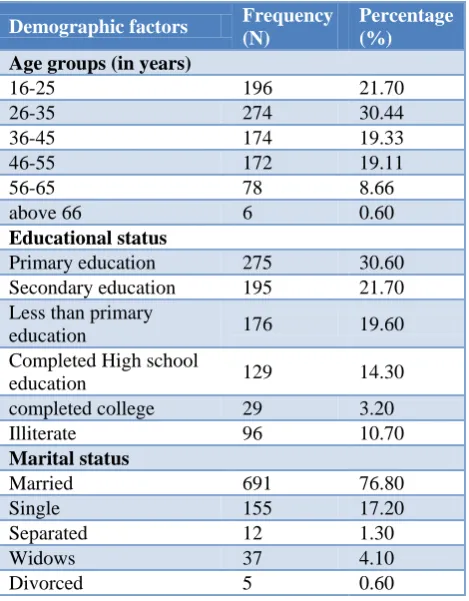
In this study, 1050 participants were screened and the obtained response rate was 85.71%. Thus, data were analysed for 900 participants. A total of 46.2% females and 53.7% males participated with the mean age of 36.8±12.64 years. The demographic details of the target population are presented in Table 1.
Table 1: Demographic details of study participants.
Demographic factors Frequency
(N)
Percentage (%)
Age groups (in years)
16-25 196 21.70
26-35 274 30.44
36-45 174 19.33
46-55 172 19.11
56-65 78 8.66
above 66 6 0.60
Educational status
Primary education 275 30.60
Secondary education 195 21.70
Less than primary
education 176 19.60
Completed High school
education 129 14.30
completed college 29 3.20
Illiterate 96 10.70
Marital status
Married 691 76.80
Single 155 17.20
Separated 12 1.30
Widows 37 4.10
Divorced 5 0.60
Among 483 men, 34.8% consumed smoked tobacco and 18.2% consumed smokeless tobacco. Subjects who consumed smoked tobacco, 74.5% were daily consumers
and the majority of (38%) of them were in the age group of 26-35 years. Men (56.2%) started consuming tobacco at the age of 20 with the maximum (58.8%) use of hand-rolled tobacco pipes. Amongst smokeless tobacco consumers, 98.8% were daily consumers with the highest rate was seen in the age group of 26-35 years. In 417 women participants, 3.84% consumed smoked tobacco
whereas 21.8% consumed smokeless tobacco.
Participants who consumed smoked tobacco, 62.5% were of daily consumers and 40% of them were found in the age group of 26-35 yrs. Moreover, 75% of women started consuming tobacco at the age of 20 with the maximum (75%) use of hand-rolled pipes. Out of 21.8% who consumed smokeless tobacco 64.8% were daily consumers with the maximum number found in the age group of 26-35 yrs.
Among male participants, 30.64% consumed alcohol out of which 27% consumed it in the past 12 months, a majority of 47.5% found in the age group of 26-35 yrs and thereafter a decline was noted. Those who consumed alcohol for the past 12 months, 65% consumed it for 1-4 days/week. However, among women participants, 2.88% consumed alcohol and none of them consumed it for the past 12 months.
Figure 1: Level of physical activity among rural populations.
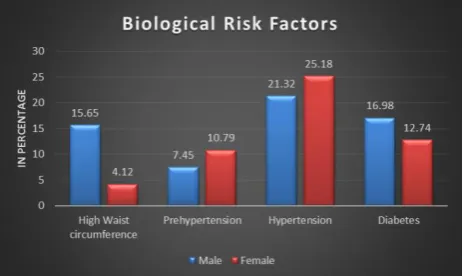
categories, 6.83% of men were underweight, 46.99% normal weight, 19.04% overweight and 27.12% were obese. The various biological risk factors of the participants shown in Figure 2.
Figure 2: Biological risk factors among rural populations.
Awareness of NCD among total subjects was 28% and 5.46% considered themselves as well informed about NCD and 58.59% as minimally aware. Their main source of awareness was media and healthcare professional that accounts for 36.48% and 29.27% respectively. Majority of 85.77% agreed that NCDs are controllable and 73.12% said a change of lifestyle modification helps it. Among the total population, 92% of people agreed that tobacco use is harmful to health and 70% showed readiness to quit tobacco. Similarly 18% of study participants who consumed alcohol, 66% showed readiness to quit due to the various ill effects caused by it.
DISCUSSION
This study has assessed awareness and prevalence of NCDs among rural populations in Maharashtra. Accounting significant mortality worldwide, earlier NCD was considered as a problem of the rich urban population, however, the poor and the rural populace also have been found to be more vulnerable to NCDs.10,14 In this study, awareness about NCDs was found to be as much as 28% although the information is not easily accessible to the subjects primarily due to the low literacy rate of the region. Thippeswamy et al found that awareness and knowledge regarding the risk factors of NCDs among rural were not satisfactory as compared to the urban population. Because of poor social determinants of health, a severe shortage of healthcare personnel at the rural area it warrants need and scope for health education and interventions to improve the awareness about NCDs and their risk factors through healthcare volunteers.
The consumption of tobacco in the Indian subcontinent is alarmingly high especially in the rural region.15 The form of tobacco consumption differs from region to region and the personal preference of the targeted individual. The participants in our study were found to be consuming more of smoking tobacco which is in contrast with
Bhardwaj et al, where Nagpur rural population consumed more of smokeless tobacco.16 This could be due to the easy availability of both the products and the general preference of the rural population. Participants of this study denied quitting tobacco mainly because they did not consider it as important and disregarded its ill effects on their health but rather felt that quitting tobacco may, in fact, deteriorate their health. However, a study by Gavarasana et al showed that after being imparted health education on the harmfulness of tobacco, 83.6% of smoker’s attitude was changed and they were willing to quit smoking.17 Thus concluding that illiteracy is not an impediment in motivating smokers to quit provided the information gap is bridged. Although Cigarettes and
Other Tobacco Products Act (COTPA-2003)
implemented throughout India and The National Control program is in implementation, the necessity is to formulate more stringent anti-smoking laws and more voluntary supports of health care providers for its effective implementation.18,19
India has witnessed a dramatic rise in the per capita consumption of alcohol in the last few decades especially in the rural populace. India once had a reputation as having a culture that promoted abstinence towards intoxication agents like alcohol. Things have changed and the use of alcohol has passed on to become its abuse. Alcohol abuse is becoming a serious problem, especially in low literacy areas.20 In our study, about 27% of the population was found to be consuming alcohol with a greater percent amongst the working class. This may be due to the traditional concept of alcohol consumption caused by familial, social influence, peer pressure and low self-esteem.21 Moreover, the heavy duty workers of the demographics confessed to drinking as a mode of stress relief. They did not feel the need to quit as they are habituated to the besotting effects of alcohol consumption which is similar to study by Bhardwaj et al where only 1% of the population was ready to quit alcohol for health-related reasons.
The nutritional transition in India, leading to excessive consumption of calories, saturated fats, trans-fats, simple sugars, salt and low intake of fibre-rich foods. Data from our study revealed that very low consumption of fruits and vegetables was found across all age groups by both genders. This is in similar agreement with other studies that are carried out in India.14,16,22,23 Decreased consumption of fruits and vegetables could be due to low socio-economic status, lack of transportation facilities hinders the supply of fruits and vegetables and lack of knowledge. Moreover, on a general market value of fruits tend to be more expensive than common vegetables and
considering the average income of the core
Institute of Nutrition (NIN), Hyderabad revealed that the diet of the rural population is inadequate and deficient in most of the nutrients.24 Mass media campaign and health literacy on the importance of consumption of recommended fruits and vegetables in averting diseases can be of great help.
Physical activity is a key modifiable risk factor for chronic diseases. It is also a key determinant of energy expenditure and thus fundamental to energy balance and weight control.25 Majority of males in our study demonstrated a moderate and high level of physical activity as they were involved in labour as a profession and so does their job demands. Furthermore, lack of transportation and occupational needs results in people performing walking and bicycling for longer durations on an average of 5.3±2.8 days and 35 mins. Though the females were predominant, the reported number of low level of physical activity was seen above the age of 50 years as this population comprises more of non-working class and their age-related physical health does not permit them to perform high-level physical activities. The frequency of physical inactivity in our study is inconsistency with other studies.14,16,22,23
According to Asian Indian guidelines, the observed overweight among the study participants was more in the age group of 26-35 years, on the account of unemployment, sedentary lifestyle, decreased physical activity and also due to unequal sample distribution in each age group categories. Since physiotherapy is an integral part of a healthcare professionals, not limiting to curative and rehabilitative approaches also preventing diseases and embraces health promotion. Their approach in reversing and modifying lifestyle-related disorders, in
minimizing NCDs burden is often overlooked.26-28 Many
studies in the past have shown that structured physical exercises are of help not only in increasing the level of physical activity but to decrease the development of chronic diseases. Based on the reports of numerous studies on the incremental rise in the development of NCDs in India, can physiotherapist be part of primary health management that are rendered at sub-centers for an effective disease prevention and health promotion for NCDs?29.30 Due to time and resources constraint simple random sampling for selecting participants from each cluster was not possible. Moreover, financial restriction did not allow to carry out biochemical analysis thus couldn’t correlate between behavioural risk factors to biochemical risk factors.
CONCLUSION
This study has shown a prevalence of behavioural and biological risk factors of NCDs among the rural population of Panvel Taluka. High prevalence of smoked tobacco and alcohol was observed among male participants whereas smokeless tobacco and hypertension in females. However, risk factors such as physical inactivity, overweight, obese and poor dietary habits were
equally distributed in both genders. Awareness about NCDs is alarmingly low among the rural population thus corresponding to an increased prevalence of risk factors. The reported insufficient and uneven progress to combat NCDs can be overcome by improving health literacy through multidisciplinary and multi-sectoral approach, shifting the paradigm from passive beneficiaries to active community participation, strategy to emphasizing on primordial prevention and focusing research more on Socio-epidemiology, health system and social policy.
ACKNOWLEDGEMENTS
We would like to thank all the study participants who agreed to be part of this study. We sincerely thank the director of MGM Department of Physiotherapy for permitting us to conduct this study. We also express our gratitude towards village heads, friends and family members for their untiring support to complete this study.
Funding: No funding sources Conflict of interest: None declared
Ethical approval: The study was approved by the Institutional Ethics Committee
REFERENCES
1. India’s Speedy–And Ominous–Disease Transition,
June 2015. Available at: http://www.indiaspend. com/cover-story/indias-speedy-and-ominous-disease-transition-64225. Accessed on 6th January 2017.
2. Shah B, Mathur P. Multi-centric study on risk
factors for Non Communicable diseases in India. Final Report. NICD-ICMR. 2005.
3. Murthy NS, Nandakumar BS, Pruthvish S, George
PS, Mathew A. Disability Adjusted Life Years for Cancer Patients in India. Asian Pacific J Cancer Prevention. 2010;11:633-40.
4. 70% Indians live in rural areas: Census. Available
at: http://www.business-standard.com/article/
economy-policy/70-indians-live-in-rural-areas-census-111071500171_1.html. Accessed on 23rd December 2016.
5. Non communicable diseases. Available from:
http://www.who.int/news-room/fact-sheets/detail/noncommunicable-diseases. Accessed on 18th December 2016.
6. World Health Organization. Non-communicable
Diseases mortality and morbidity, 2015. Available
from: http://www.who.int/gho/ncd/mortality_
morbidity/en/. Accessed on 4th January 2017.
7. World Health Organization. Global Status report on
Non-communicable Diseases, 2014. Available at: http://www.who.int/nmh/publications/ncd-status-report-2014/en/. Accessed on 4th January 2017. 8. Allen LN, Pullar J, Wickramasinghe KK, Williams
middle-income countries: a systematic review from 1990 to 2015. BMJ Glob Health. 2018;3:e000535.
9. World Health Organization. WHO STEPwise
approach to surveillance. Available at:
http://www.who.int/ncds/surveillance/steps/instrume nt/en/. Accessed on 10th December 2016.
10. Thippeswamy T, Chikkegowda P. Basic Risk
Factors Awareness in Non-Communicable Diseases (BRAND) Study Among People Visiting Tertiary Care Centre in Mysuru, Karnataka. J Clin Diagn Res. 2016;10(4):4–7.
11. World Health Organization. STEPS manual: Using
STEP manual. Geneva: WHO; 2005. Available at: http://www.who.int/ncds/surveillance/steps/manual/ en/. Accessed on 10th February 2017.
12. World Health Organization. The Asia-Pacific
perspective: redefining obesity and its treatment. Geneva, Switzerland: World Health Organization; 2000. Available at: http://www.who.int/nutrition/
publications/obesity/09577082_1_1/en/. Accessed
on 4th December 2016.
13. Chobanian AV, Bakris GL, Black HR, Cushman
WC, Green LA, Izzo JL, et al. Seventh report of the Joint National Committee on Prevention, Detection, Evaluation, and Treatment of High Blood Pressure. Hypertension. 2003;42(6):1206-52.
14. Bhagyalaxmi A, Atul T, Shikha J. Prevalence of Risk Factors of Non-communicable Diseases in a District of Gujarat, India. J Health Population Nutr. 2013;31(1):78–85.
15. Ray CS, Gupta P, Beyer J. Economics of Tobacco Control paper no 9. Research on tobacco in India (including betel quid and areca nut) an annotated bibliography of research on use, health effects, economics, and control efforts of tobacco. 2003: 25.
16. Bhardwaj SD, Shewte MK, Bhatkule PR, Khadse
JR. Prevalence of risk factors for NCDs in a rural area of Nagpur District, Maharashtra: A WHO STEP wise approach. International Journal of Biological and Medical Research. 2012;3(1):1413-8.
17. Gavarasana S, Gorty PV, Allam A. Illiteracy,
ignorance, and willingness to quit smoking among
villagers in India. Jpn J Cancer Res.
1992;83(4):340-3.
18. Mishra GA, Pimple SA, Shastri SS. An overview of
the tobacco problem in India. Indian J Med Paediatric Oncol. 2012;33(3):139–45.
19. Kaur J, Jain DC. Tobacco Control Policies in India:
Implementation and Challenges. Indian J Public Health. 2011;55:220-7.
20. Dutta R, Sivaranjini S, Subitha S, D’cruze L. A Population Based Study on Alcoholism in Adult
Males in a Rural Area in Tamil Nadu: J Clin Diagnos Res. 2014;8(6):1-3.
21. Goswami A, Kapoor SK, Singh B, Dwivedi SN.
Tobacco and Alcohol use in rural elderly population. Indian J Psychiatry. 2005;47(4):192-7. 22. Tripathy JP, Thakur JS, Jeet G, Chawla S, Jain S
and Prasad R. Urban rural differences in diet, physical activity and obesity in India: are we witnessing the great Indian equalisation? Results from a cross-sectional STEPS survey. BMC Public Health. 2016;16:816.
23. Thankappan KR, Shah B, Mathur P, Sarma PS,
Srinivas G, Mini GK. Risk factor profile for chronic
non-communicable diseases: Results of a
community-based study in Kerala, India. Indian J Med Res. 2010;131:53-63.
24. Diet and Nutritional Status of Rural Population. National Nutrition Monitoring Bureau. 2002. Available at: http://nnmbindia.org/nnmbreport2001-web.pdf. Accessed on 25 July 2017.
25. Booth FW, Roberts CK, Laye MJ. Lack of exercise
is a major cause of chronic diseases. Comprehensive Physiol. 2012;2(2):1143-211.
26. Dean E, Al-Obaidi S, De Andrade AD, Gosselink R,
Umerah G, Al-Abdelwahab S, et al. The First Physical Therapy Summit on Global Health: implications and recommendations for the 21st
century. Physiotherapy Theory Pract.
2011;27(8):531-47.
27. World Confederation of Physical Therapy. Draft
policy statement: non-communicable diseases. 2014. Available at: http://www.wcpt.org/policy/ps-ncd. Accessed on 25 August 2017.
28. Ketkar AR, Veluswamy SK, Prabhu N, Maiya AG.
Screening for non-communicable disease risk factors at a workplace in India: A physiotherapy initiative in a healthcare setting. Hong Kong Physiotherapy J. 2015;33(1):3-9.
29. Bury T, Moffat M. Non-communicable diseases.
Physiotherapy. 2014;100:94–6.
30. Frantz JM. Physiotherapy in the management of
non-communicable diseases: facing the challenge. SA J Physiotherapy. 2005;61(2):8-10.