Original Research Article
Awareness and knowledge of breast cancer and its screening methods
among female undergraduate Allied Health Science students of a college
in semi urban Chennai
M. Afsar Safrina
1*
, G. Rakesh Maiya
1, G. Waseem Akram
2, Timsi Jain
1INTRODUCTION
The term “breast cancer” refers to a malignant tumor that has developed from cells in the breast due to their uncontrolled growth.1 Breast cancer occurs almost entirely in women, men can get breast cancer too but rare.2 Breast cancer can spread when the cancer cells get into the blood or lymph system and are carried to other parts of the body.
Breast cancer is the most commonly occurring cancer in women and the second most common cancer overall. There were over 2 million new cases in 2018 diagnosed worldwide.3 The Indian Council of Medical Research
cancer were reported in 2016, of which 70,000 succumb every year making it the most common cancer among Indians.4 Breast cancer is now occurring increasingly in younger age groups in India when compared with western countries and a more aggressive nature of the disease strikes Indian women in their reproductive period.5,6
According to study published in Asia-Pacific Journal of Clinical Oncology, breast cancer was found as high as 41 per 100,000 women for Delhi, followed by Chennai (37.9), Bangalore (34.4) and Thiruvananthapuram district (33.7) in 2017. According to this study number of cases of breast cancer will become almost double (17,97,900) by 2020.5 According to health ministry of India, breast
ABSTRACT
Background: Breast cancer is the most commonly occurring cancer in women and the second most common cancer overall. There were over 2 million new cases in 2018 diagnosed worldwide. The Indian Council of Medical Research found that an estimated 1.5 lakh new cases of breast cancer were reported in 2016, making it the most common cancer among Indians.
Methods: A cross sectional study was conducted with the total sample size of 256 female participants which includes first year to interns. Pre-designed semi structured questionnaire was given to the students. The knowledge was assessed in terms of risk factors, symptoms, methods of diagnosis and self-breast examination. The statistical analysis used was MS Excel 2019.
Results: Out of 256 female undergraduate Allied health science students, 142 (55.47%) had good knowledge while 114 (44.53%) had poor awareness and knowledge about breast cancer and its screening methods.
Conclusions: As many of the students have low knowledge on breast cancer and its screening techniques. Hence some activities on breast cancer should be planned to improve the awareness among Allied health science students.
Keywords: Awareness, Knowledge, Breast cancer, Screening methods 1
Department of Community Medicine, Saveetha Medical College, Chennai, Tamil Nadu, India 2Department of Community Medicine, Nimra Medical College, Vijayawada, Andhra Pradesh, India
Received: 06 September 2019
Accepted: 09 October 2019
*Correspondence:
Dr. M. Afsar Safrina,
E-mail: [email protected]
Copyright: © the author(s), publisher and licensee Medip Academy. This is an open-access article distributed under the terms of the Creative Commons Attribution Non-Commercial License, which permits unrestricted non-commercial use, distribution, and reproduction in any medium, provided the original work is properly cited.
females with rate as high as 25.8 per 100,000 women and mortality of 12.7 per 100,000 women. India continues to have a low survival rate 66.1% whereas US and Australia had survival rates as has 90%, according to the study.7
Breast cancer is a progressive malignant disease and can easily undergo metastasis. Detection of small tumors, which are more likely to be in the early stage of the disease would improve prognosis. As one of the health care worker general awareness among Allied health science students about breast cancer, associated risk factors, and procedure to identify any abnormality in the breast are important, as they can identify the high risk women, and guide them appropriately. So this study was carried out to assess the level of awareness and knowledge of breast cancer among female undergraduate Allied health science students of a college in Chennai.
METHODS
This study was a cross sectional study about breast cancer awareness among female undergraduate Allied health science students in a college in Chennai, Tamil Nadu. All the three years (1st, 2nd, 3rd) and undergraduate internship students were included. Simple random sampling was used to select the female students of respective year. The sample size is 256 (prevalence 60%, relative error 10%, confidence level 95%). The study period was 3 months (June-August 2019).
A self-administered pre-designed and pre-validated semi-structured questionnaire was given to 92 (out of 140 first year girls), 81 (out of 128 second year girls), 58 (out of 96 third year girls) and 25 (out of 56 interns) to evaluate the awareness and knowledge on breast cancer (risk factors, symptoms and screening test). There were two sections containing questions on awareness of breast cancer and knowledge of screening methods. The questions included both (yes/no/I don’t know) and multiple choices. Each correct answer assigned a score
of 1. Some questions were given score of 2 depending upon the importance (e.g., clinical breast examination is recommended for family history of breast cancer), while an incorrect answer or “don't know” scored zero. A total score for each participant was computed by summation of the number of correct answer.
Students who had a total score from 0 to 29 out of 60 marks were considered to have poor awareness and knowledge, those who acquired a score between 30 to 60 were considered to have good awareness and knowledge respectively. Data was analyzed by using MS Excel. Informed consent was obtained from the participants and the study was started after getting approval from the ethics committee of Saveetha Medical College, Chennai.
RESULTS
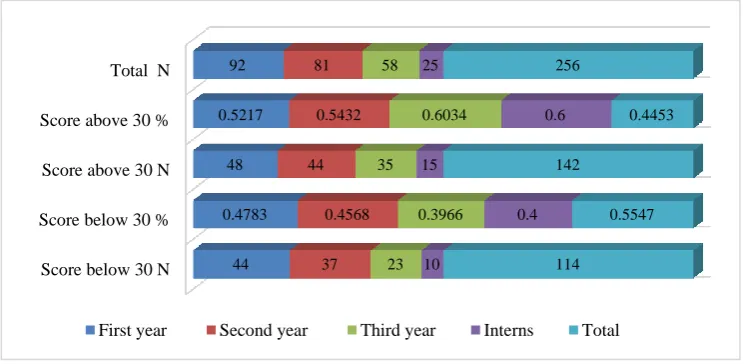
Figure 1 depicts that 142 (55.47%) had good awareness and knowledge while 114 (44.53%) had poor awareness and knowledge and total number of students participated in study was 256.
Figure 1: Level of awareness and knowledge of breast
cancer among femaleundergraduate Allied health
health science students.
Figure 2: Level of awareness and knowledge on breast cancer among 1st, 2nd, 3rd year and internship students.
142
114 55.47%
44.53%
0.00% 10.00% 20.00% 30.00% 40.00% 50.00% 60.00%
0 20 40 60 80 100 120 140 160
Good knowledge Poor knowledge Frequency Percentage
Score below 30 N Score below 30 % Score above 30 N Score above 30 % Total N
44 0.4783
48 0.5217
92
37 0.4568 44
0.5432 81
23 0.3966 35
0.6034 58
10
0.4 15
0.6 25
114
0.5547 142
0.4453 256
Figure 2 shows that similar level of awareness and knowledge is found among all the three years of students and interns.
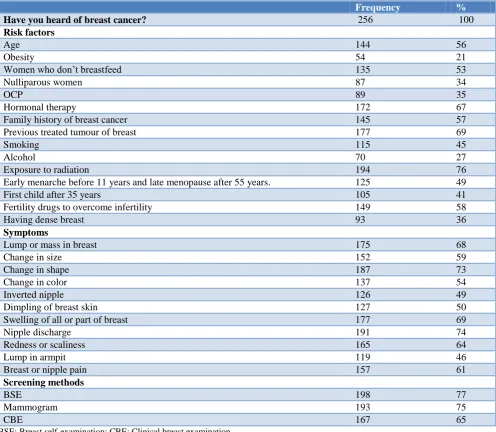
In Table 1, 100% of students are heard of breast cancer. A large percentage of students were unaware of obesity (21%), drinking alcohol (27%), oral contraceptive pills (35%), first child after 35 years (41%) are risk factors of breast cancer. Students were moderately aware of the
symptoms of breast cancer. 49% were aware that lump in armpit is due to spread of breast cancer. Regarding screening methods, awareness is satisfactory.
Table 2shows that only small percent of students know when breast self-examination (BSE) should be started (20%) and when should be done during every month (21%). Surprisingly only 13% know clinical breast examination is done by hand others believe it is done using machines like ultra sound and mammogram.
Table 1: Level of awareness on risk factor, symptoms and screening tests of breast cancer.
Frequency %
Have you heard of breast cancer? 256 100
Risk factors
Age 144 56
Obesity 54 21
Women who don’t breastfeed 135 53
Nulliparous women 87 34
OCP 89 35
Hormonal therapy 172 67
Family history of breast cancer 145 57
Previous treated tumour of breast 177 69
Smoking 115 45
Alcohol 70 27
Exposure to radiation 194 76
Early menarche before 11 years and late menopause after 55 years. 125 49
First child after 35 years 105 41
Fertility drugs to overcome infertility 149 58
Having dense breast 93 36
Symptoms
Lump or mass in breast 175 68
Change in size 152 59
Change in shape 187 73
Change in color 137 54
Inverted nipple 126 49
Dimpling of breast skin 127 50
Swelling of all or part of breast 177 69
Nipple discharge 191 74
Redness or scaliness 165 64
Lump in armpit 119 46
Breast or nipple pain 157 61
Screening methods
BSE 198 77
Mammogram 193 75
CBE 167 65
BSE: Breast self-examination; CBE: Clinical breast examination.
Table 2: Level of knowledge on breast self-examination, mammogram and clinical breast examination.
Frequency %
BSE
BSE should be started at 20 years of age. 50 20
BSE done by observation, feeling of breast, feeling of armpit 104 41
BSE should be done during 5-7 days after the mensuration 57 22
Frequency %
During palpation special attention should be given to armpit 55 21 During palpation right breast should be felt by left and vice versa 99 39
Part of hand used to palpate the breast-finger pad 56 22
Methods of breast palpation-circles, wedges, lines 93 37
Mammogram (American Cancer Society Guidelines for the early detection of cancer)
For women of age 45-54 years mammogram should be done once in a year 107 42
Mammogram can be started above 40 years 77 30
CBE
CBE is done by hand 34 13
CBE should be done by doctors and trained nurses 144 56
CBE is recommended for family history of breast cancer 114 45
BSE: Breast self-examination; CBE: Clinical breast examination.
Figure 3depicts that 106 (41%) of 256 are aware of all the treatment modalities of breast cancer.
Figure 3: Level of awareness on treatment of breast cancer among the female undergraduate students.
DISCUSSION
This study was carried out to assess the level of awareness and knowledge of breast cancer among female undergraduate Allied health science student’s students of a college in Chennai.
It was found that 55.47% of the study participants were having good level knowledge about breast cancer. This finding is comparatively low when compared to the results of another study conducted in Annamalai University, Chidambaram i.e., before intervention if considering both good and average level of knowledge as good knowledge.8
There was less knowledge regarding various risk factors especially of reproductive and contraceptive history of among students. A study conducted on urban population in Mumbai reveals the same.9
The percent awareness of risk factors, such as age at birth of first child, age at menarche, family history, alcohol
consumption and obesity was observed to have increased with each successive year for the studies conducted over the 4-year period (2008-2012) in nursing students indicating a possible increase in cancer literacy in this group.10
Regarding the awareness of risk signs and symptoms is slightly higher when compared to study conducted among females in a hospital in North India and a study conducted among basic science students in Bengaluru in pretest.11,12 Additionally two knowledge questions were asked in our study in which 48% know about painless nodules on breast are earliest sign of breast cancer and 37% known that palpable axillary lymph node along with lump in the breast is warning sign of breast cancer.
In our study overall awareness on screening methods is good i.e., 72% but knowledge regarding individual screening methods and overall i.e., 32% is not satisfactory. The knowledge in BSE is 30% which is very low when compared to pre-test of a study conducted in Udupi, Karnataka.13 But it is much higher than a study done on basic science students in Bengaluru in pre-test which was 18%.12
Two attitude questions were asked in which 70% of them agree breast cancer is curable when detected early. 73% of them will see doctor immediately if they see any lump in breast or armpit. In a study conducted among nurses in a tertiary care hospital in sub Himalayan region 88.3% agree breast cancer is curable and 59.7% will consult doctor on developing lump on breast.14 In a study conducted on breast cancer awareness in South India 43% of the study group believe that breast cancer is curable. 85% of the study group is confident that early diagnosis increases longevity.15
Male breast cancer is rare and constitutes 0.5-1% of all patients with breast cancer. Male breast cancer imitate the behavioral pattern of post-menopausal female breast cancer.In countries like USA, Turkey rate of male breast cancer is increasing.16 In our study 32% of students aware that breast cancer occurs in both sexes.
43 30
77
106
17% 12% 30% 41%
0 20 40 60 80 100 120
Regarding treatment modalities 41% are aware of all three treatments of breast cancer.
53% of the study group is aware of the treatment modalities such as surgery, radiotherapy, and chemotherapy in a study in South India.15
CONCLUSION
From our study the overall awareness on breast cancer is average. But knowledge is inadequate especially in BSE and other screening methods and on risk factors. Breast cancer is increasing among Indian reproductive women especially in Chennai, Allied health science students as a health care worker should be well known about breast cancer from the undergraduate level so that they can promote awareness among patients and public and especially helpful in identifying the high risk women which may decrease the morbidity and mortality rates of breast cancer. So Steps should be taken especially like activities and guest lectures to increase knowledge about breast cancer and demonstration classes should be organized on breast self- examination.
ACKNOWLEDGEMENTS
The author thanks Dr. Gunapriya Raghunath, Chief Person of Allied Health Science College, Chennai who gave permission to conduct this study in the college.The author also thanks all the authorities and study participants.
Funding: No funding sources Conflict of interest: None declared
Ethical approval: The study was approved by the Institutional Ethics Committee
REFERENCES
1. Breastcancer.org. What is breast cancer?. Available at: https://www.breastcancer.org/symptoms/ understand_bc/what_is_bc. Accessed on 31 August 2019.
2. American Cancer Society.What is breast cancer?. cancer.org. Available at:https://www.cancer.org/ cancer/breast-cancer/about/what-is-breast-cancer. html. Accessed on 31 August 2019.
3. World Cancer Research Fund/American Institute for Cancer Reasearch. Breast Cancer Statistics. Available at: https://www.wcrf.org/dietandcancer /cancer-trends/breast-cancer-statistics. Accessed on 31 August 2019.
4. Indian Council of Medical Research (ICMR) Media report. High cost, low awareness tied to rise in breast cancer cases? (ICMR) press release on February 4, 2019/The Times of India. Available at:
https://icmr.nic.in/sites/default/files/ICMR_News_1. pdf. Accessed on 31 August 2019.
5. Statistics of breast cancer in India.breastcancerindia. net. Available at: http://www.breastcancerindia.net /statistics/trends.html Accessed on 31 August 2019. 6. Chopra B, Kaur V, Singh K, Verma M, Singh S,
Singh A. Age shift: Breast cancer is occurring in younger age groups- Is it true?. Clin Cancer Investig J. 2014;3:526-9.
7. Malvia S, Bagadi SA, Dubey US, Saxena S. Epidemiology of breast cancer in Indian women. Asia-Pacific J Clin Oncol. 2017;13(4):289-95. 8. Swarnapriya V, Srinivasan N, Felix AJW, Arjun L,
Boornema AR. Effectiveness of intervention on breast cancer among select students of Annamalai University,Tamil Nadu. Int J Community Med Public Health. 2019;6(2):555-60.
9. Singh R, Turuk A. A study to assess the knowledge regarding breast cancer and practices of breast self-examination among women in urban area. Int J Community Med Public Health. 2017;4(11):4341-7. 10. Gupta A, Shridhar K, Dhillon PK. A review of
breast cancer awareness among women in India: Cancer literate or awareness deficit?. Europ J Cancer. 2015;51:2058-66.
11. Nabi MG, Ahangar A, Akhtar H, Akbar A, Mustafa SA. Awareness and knowledge of breast cancer risk factors, symptoms and screening among females in a hospital in North India. J Evolution Med Dent Sci 2016;5(32):1719-24.
12. Madhukumar S, Thambiran UR, Basavaraju B, Bedadala MR. A study on awareness about breast carcinoma and practice of breast self-examination among basic sciences' college students, Bengaluru. J Family Med Prim Care. 2017;6:487-90.
13. Shalini, Varghese D, Nayak M. Awareness and impact of education on breast self-examination among college going girls. Indian J Palliat Care. 2011;17(2):150-4.
14. Negi RR, Singh M, Kaushal A, Raina SK. Breast cancer awareness and attitude among nurses of a tertiary care centre of Sub-Himalayan region. J Evolution Med Dent Sci. 2017;6(33):2710-13. 15. Subramanian L, Salini VU, Anandan H, Insuvai U.
Breast cancer awareness in South India. Int J Sci Stud. 2018;6(5):39-42.
16. Yalaza M, Inan A, Bozer M. Male breast cancer. J Breast Health. 2016;12:1-8.