Original Research Article
Status of healthcare waste management in small and medium sized
healthcare facilities in Nakuru East Sub County, Kenya
Reuben Kebati
1, Ramadhan L. Mawenzi
2*
, Osero Justus
3INTRODUCTION
Health care waste (HCW) represents all forms of solid trash and liquid wastes that emanate from a myriad of the noble activities undertaken by health care facilities (HCFs). The major producers of HCW are hospitals, nursing homes, laboratories, and research centres.1 HCW is categorised into general waste, infectious waste and
hazardous waste. General waste is comparable to domestic waste and represents about 85% of all HCW.1 This type of HCW is not necessarily associated with health risks but is a menace. It is comprised of litter from offices, kitchens and stores, such as discarded papers, food stuffs, plastics, and clothes.1 Over and above general HCW, hospitals produce wastes that are harmful to the health of communities. These include infectious, toxic
ABSTRACT
Background: Health care waste (HCW) is unwanted materials produced from hospitals, laboratories and research centres. HCW is of public health importance because hazardous HCW carries significant health risks. If poorly handled, it can lead to significant public health crises. Consequently, guidelines for proper management of HCW have been legislated. Unfortunately, not all healthcare facilities adhere to the guidelines. Diseases spread by inadequately disposed HCW are becoming increasingly prevalent especially in developing nations. This study was therefore conducted to establish the status of HCW management in six purposefully selected healthcare facilities in Nakuru East Sub-County (NESC), Kenya.
Methods: A cross sectional study design was used to conduct this study. Six healthcare facilities (HCFs) in NESC, Kenya were purposefully selected. The HCFs were selected based on level and patient volumes and categorised as small or medium sized. HCW from each of the HCFs was weighed and categorised. Observation checklists and interviews were used to determine techniques used in HCW management.
Results: The total weekly weight of HCW was 187.65 kg (mean 31.3 kg). Small sized HCF produced 49.55 kg/week while medium sized HCFs produced 138.1 kg/week. Total weekly weight of general HCW was 143.7 kg (76.5%); 33.8 kg (18%) was infectious while 10.2 kg (5.4%) was sharps.
Conclusions: Healthcare facilities in NESC produce significant quantities of HCW. General HCW was predominant, followed by infectious waste and sharps. A considerable proportion of the HCFs did not comply with the stipulated guidelines for safe management of HCW. Concerned authorities in all HCFs should be alert and proactive regarding proper management of HCW.
Keywords: Healthcare waste, Management, Segregation, Techniques, Kenya
1
Ministry of Health, County Government of Nakuru, Kenya
2Department of Community Health, Faculty of Health Sciences, Egerton University, Kenya 3Department of Community Health,School of Public Health, Kenyatta University, Kenya
Received: 07 July 2019
Revised: 19 August 2019
Accepted: 20 August 2019
*Correspondence:
Dr. Ramadhan L. Mawenzi, E-mail: [email protected]
Copyright: © the author(s), publisher and licensee Medip Academy. This is an open-access article distributed under the terms of the Creative Commons Attribution Non-Commercial License, which permits unrestricted non-commercial use, distribution, and reproduction in any medium, provided the original work is properly cited.
and radioactive materials.1 It is estimated that about 15% of all HCW generated is hazardous waste which can lead to serious infections.2 Blood borne infections such as Hepatitis B and C are mediated through poorly disposed HCW such as scalpels, broken vials and hypodermic needles.
The type and amount of HCW generated from HCFs is dependent on the size and dominant activities of those facilities.3 Nevertheless, every operational HCF produces HCW albeit of different load sizes and types. The amount of HCW also depend on nations where hospitals belong; hospitals in rich nations generate more waste than those from poor nations.4 The weight of HCW however, should not be calculated solely from services offered to inpatients. Many studies have calculated HCW based on weight per bed yet even services offered to outpatients also contribute to the total HCW generated. Other sources of HCW include hospital stores, kitchens and administrative offices which generally produce general waste which add to the total weight of HCW produced. The amount and type of HCW further depend on the size of hospitals and the volume of patients visiting them. Small sized hospitals and those with minimal patient volumes produce HCW which can significantly distabilise the health of the community even if the size is comparatively small.5 Even though small and medium sized hospitals produce comparatively small amounts of HCW the component of hazardous HCW in it can sicken an entire community and should not therefore be ignored. Due to this concern, this study investigated HCW management in small and medium sized hospitals. Studying HCW management in small and medium sized HCFs is important because it seeks to address existing research gaps since many HCW studies mostly focus on large and referral hospitals.
Hazardous HCW is associated with diverse health risks, especially if it is not properly handled, apart from blood borne infections, injuries such as cuts inflicted by sharps, chemical and radioactive burns and inhalation of noxious gases emitted by incinerators are other consequences of poorly managed HCW.6 Populations at an increased risk of diseases associated with poor handling of HCW include hospital workers, patients, and communities living near disposal sites, garbage collectors and rummagers. Any preventive strategies shall therefore prioritise such populations.
Since HCW generation occurs in HCFs and since not all HCFs handle HCWs as stipulated in existing guidelines, illnesses associated with HCW are almost inevitable. Nevertheless, such diseases can be substantially minimised or even eliminated if HCFs commit to manage their waste according to internationally recognised standards. For this reason, precise rules and regulations aimed at improving HCW management have been ratified in different countries.7 Nevertheless, it is expensive to strictly adhere to the guidelines; some resource strained
institutions therefore skip important aspects of the guidelines and thus expose their populations to health hazards. Small hospitals may fail to observe due diligence in the disposal of HCW due to their impecuniousness and also probably because they consider their small load of HCW insignificant. This situation is rife in Kenya and studies targeting small hospitals and clinics are therefore clearly warranted.
Proper waste management involves the use of a meticulous and systematic stepwise approach from generation to disposal.8 Fundamentally, all HCW is first segregated at site of production-this means, it is sorted into hazardous and non-hazardous wastes. This procedure represents the first step in the management of HCW.9 Properly segregated HCW significantly reduces risks posed to handlers since the hazardous waste is clearly marked for avoidance. After segregation, waste is put in colour-coded, clearly labelled collection bags or containers and stored in designated areas in the facilities. Collection of HCW is usually done when the bags are three quarters full and sealed properly to avoid spillage.10 To further minimise spillage, HCW is transported using purpose built, tightly-sealed waste carriage vehicles.
Stored HCW is then disposed either onsite or offsite: disposal of infectious waste is best done after the HCW has been adequately sterilised by disinfection, autoclave or incineration. However, these approaches are often too expensive to implement in many poor countries. Therefore, many low and medium income countries struggle to keep pace with the stringent requirements; management of HCW is therefore unacceptably poor in LMICs.11 Actually, majority of the HCFs in LMICs have been found to be poor in collection, segregation, transportation and disposal of HCW.12 Kenya is similarly disadvantaged; with scarce resources allocated for HCW management, many HCFs in Kenya face challenges in managing HCW as required by international conventions.
METHODS
The main aim of this study was to establish the health care waste management practices among selected health care facilities in Nakuru East sub-county, Kenya. Specifically, the study sought to determine the types and quantities of healthcare waste generated by each of the selected HCFs and to establish the techniques each HCF used to manage their HCW. To investigate these objectives, a descriptive cross-sectional study design was used. The study was conducted from August 2018 to December 2018. The study population consisted of healthcare staff and sanitary workers in the six healthcare facilities.
Purposive sampling method was used to select the health care facilities. The facilities were mainly categorised into public, private and faith based facilities. Public HFCs included Langalanga Hospital, Lanet Health Centre and Bondeni Health Centre, private facilities included Baraka Hospital and Valley Hospital while faith based facilities were represented by St. Elizabeth Health Centre. Other criteria which were considered in the selection of the HCFs were patient volumes and bed occupancy. Bed occupancy was also used to categorise facilities into small and medium size hospitals: for purposes of this study, facilities with 2 to 20 beds were categorised as small sized while those with over 20 but less than 90 beds were categorised as medium sized hospitals.
A total of 105 healthcare workers comprising doctors, clinical officers, nurses and laboratory technologists were interviewed on the production rates and techniques used to manage HCW in their respective departments. Nine sanitary personnel were interviewed on the manner in which they handled HCW from site of production to storage sites. A researcher administered questionnaire and an observation checklist were used to collect relevant data. The questionnaire administered to health care professionals was based on WHO standards of HCW
management regarding generation, segregation, collection, transportation, storage and disposal of HCW. Observation checklist was used to appraise the existence and status of facilities used to manage HCW such as incinerators, trolleys, collection bags or containers and storage facilities. Analysis of data was done using descriptive statistics with the aid of Statistical package for social sciences (SPSS) version 20.0.
RESULTS
Total weight of HCW
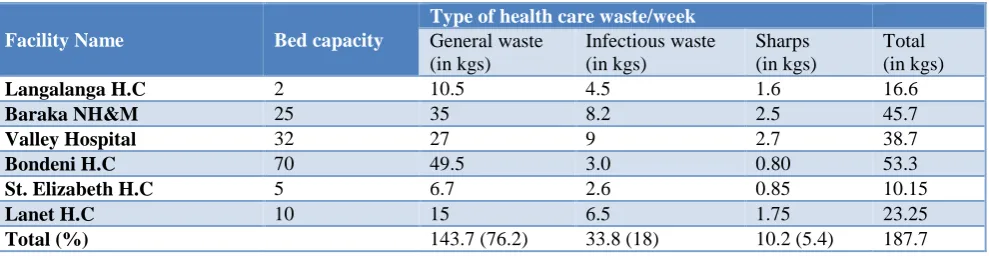
All six HCFs had both outpatient departments and inpatient departments. The inpatient bed capacity ranged from 2 to 70. All six HCFs produced significant amounts of HCW. The total weight of HCW produced weekly by all the selected HCFs was 187.65 kg (mean 31.3 kg/week; 4.5 kg/day). The weights ranged from 10.15 kg/week at St. Elizabeth Health Centre to 53.3 kg/week at Bondeni Health Centre. Small sized HCF produced a total of 49.55 kg/week while medium sized HCFs produced 138.1 kg/week of HCW. The proportions of different categories of HCW were as follows- general HCW=143.7 kg/week (mean 23.95 kg/week); infectious wastes=33.8 kg/week (mean 5.6 kg); sharps=10.2 kg/week (mean 1.7 kg/week). The proportions of each category of HCW were as follows: general waste 76.5%; infectious waste 18% and sharps 5.4%. Table 1 summarises the categories of waste and their weights as recorded from different HCFs.
Segregation of HCW
Five HCFs (83%) said they segregated waste. Of those who said they segregated waste, two HCFs (33%) did not have the recommended colour bins. One facility did not adequately comply with the recommended segregation techniques.
Table 1: Bed capacity, type of waste and weight of HCW from each facility.
Facility Name Bed capacity
Type of health care waste/week
General waste (in kgs)
Infectious waste (in kgs)
Sharps (in kgs)
Total (in kgs)
Langalanga H.C 2 10.5 4.5 1.6 16.6
Baraka NH&M 25 35 8.2 2.5 45.7
Valley Hospital 32 27 9 2.7 38.7
Bondeni H.C 70 49.5 3.0 0.80 53.3
St. Elizabeth H.C 5 6.7 2.6 0.85 10.15
Lanet H.C 10 15 6.5 1.75 23.25
Total (%) 143.7 (76.2) 33.8 (18) 10.2 (5.4) 187.7
Key: HCFs with bed capacity of ≤10 were categorised small sized and >10 medium sized HCF.
Collection of HCW
Recommended collection techniques of HCW were not observed in two HCF (33%). One did not adequately comply with collection time and frequency while the
other did not comply with bag sealing requirement after collection.
Storage and transportation of HCW
Five HCFs (83%) did not store HCW in a secure place; HCW containers were stashed at some corner without regard to accidental contact. Five of the six HCFs (83%) did not transport HCW using specially designated transportation means within the facility; four HCFs (67%) used wheelbarrows while the other employed people to carry containers of HCW by hand to disposal sites. Only one HCF (17%) utilised purpose built HCW disposal trolley.
Regarding transportation of HCW for offsite disposal, one HCF used wooden handcart to transport HCW while the rest used private garbage disposal vans and the county garbage disposal van when available.
Disposal of HCW
Four (67%) of the six HCFs studied did not dispose HCW in accordance with the Kenya National Guidelines for safe management of HCW. All the six HCFs said they used incinerators to dispose hazardous waste, but only two were functional at the time of the study.
DISCUSSION
Health care waste (HCW) is a by-product of well-intentioned health care provisions. Every health care facility (HCFs) generates waste albeit of different weights and proportions. The amount of health care waste produced depends on the size and category of a particular hospital as well as its patient volumes. Nevertheless, even small quantities of hazardous HCW generated by small health care facilities can upset the health of a population: HCW from small and medium sized HCFs shall therefore also receive attention. Before this study, the bulk of HCW studies done in the world predominantly focused on big high volume hospitals. This study therefore represents a paradigm shift; purposefully conducted to investigate HCW management in small and medium sized HCFs. The bed capacity of the HCFs that were investigated in this study ranged from 2 to 70 beds.
Quantities and proportions of HCW
According to findings of this study, the six HCFs produced a total weight of 187.74 kg per week. This translates into a mean weight of 31.3 kg per day. This amount of HCW is comparable to that which was found in Ethiopia where a ten health centres produced a total weekly load of HCW amounting to 190.1 kg.13 The importance of appreciating the weights of HCW lies in the fact that heavier loads call for heavier investments in their management and vice versa.
The production rates of waste in this study differed per facility. Bondeni Health Centre, a medium sized HCFs according to this study produced a weekly load of HCW amounting to 53.3kg while Langalanga Health Centre
with a bed capacity of 2 produced 16.6 kg. There was a discrepancy noted in this study-St Elizabeth Health Centre with a bed capacity of 5 produced less HCW compared with Langalanga Health Centre which produced more HCW yet it has only 2 beds. However, Langalanga Health Centre has a comparably busier outpatient department than St Elizabeth Health Centre. Langalanga Health Centre is located in a busy metropolitan estate along a busy road while St Elizabeth is peri-urban. The number of patients treated at the outpatient department therefore has an impact on the amount of HCW produced. A study in Nigeria compared weights of HCW from large, small and medium sized HCFs; it showed an incremental load size commensurate with the size of the hospital, nevertheless the total load of HCW was 10 kg/day which is rather small compared to findings in this study.14 The differences noted between these studies may denote different methodology.
In this study, the proportion of the HCW was as follows- general waste accounted for 70.5% of all HCW; while infectious waste and sharps accounted for 23% and 7% respectively. The distribution of HCW in this study compareswell with a study in Nepal, India where 75.4% of the HCW produced was general waste, and 8.8% was hazardous waste while sharps formed 5.8% of the total HCW produced although in this study the weight was computed on daily basis.15
Transportation of healthcare waste in the HFCs
Most of the HCFs in this study did not comply with the required transport standards. Most of them used wheelbarrows to carry HCW to onsite disposal siteswhile open pickups were used to transport HCW to off-site disposal areas. Transporting HCW using undesignated vehicles inevitably leads to spilling and contamination of corridors and roads as HCW is transported to dumpsite. Use of unaccustomed transportation means was also found in Ethiopia where hospitals in Adama province transported HCW in open or unprotected vehicles by the time of their study.16
Segregation of healthcare waste
The importance of segregating HCW cannot be overemphasised: unsegregated healthcare waste represents the most efficient way to induce, spread and sustain diseases. Since HCW was not adequately segregated in this study, it can be extrapolated that HCW play an additional role in the spread and acquisition of communicable diseases currently experienced in the region. To enforce segregation of HCW, all HCFs should have healthcare waste management committees to oversee the proper management of HCW. All concerned workers in HCFs in Bahati Sub-county in Nakuru, Kenya and beyond need to be regularly sensitised to adhere to proper techniques of waste segregation.
Storage, collection and disposal techniques
This study found out that five HCFs (83%) did not store HCW in a secure place. Most of HCW containers were unsecured and stashed in a heap at some corner without regard to accidental contact. Poor storage of HCW is insalubrious since unsecured garbage containers provide breeding sites for vermin and vectors that spread diseases while leakage of liquid waste fouls the air resulting in widespread pollution.
In this study, four (67%) HCFs did not dispose HCW in accordance with the WHO guidelines and did not also comply with the Kenya National Guidelines for safe management of HCW. Although all six HCFs said they used incinerators to dispose hazardous waste, only two were functional at the time of the study. This means that HCW which was supposed to be incinerated is disposed unsterilized in dumpsites-a fertile nidus for disease causing microorganisms. Although incineration of HCW is discouraged because of emission of toxic smoke into the environment (Lee, 1992), it is better than dumping unsterilized HCW. This trend is worrying because poor disposal of HCW will doubtlessly lead to a myriad of health and environmental problems. Many nations in Africa do not dispose their HCW as required; study in Nigeria and South Africa found a low compliance of disposal of HCW.19,20
CONCLUSION
Healthcare facilities in Nakuru East Sub-county produce HCW load totalling to 187.7 kg/week. The HCW generated is not handled according to standards proffered by WHO and Kenya guidelines for safe management of HCW. The poor management of HCW in NESC healthcare facilities could have occurred due to lack of resources and low awareness levels among staff in those facilities. Concerned authorities in Nakuru County ought, therefore, to prioritise HCW management by providing resources and capacity building. Periodic surveillance of HCW management in the whole of Nakuru County is needed to constantly appraise HCW management in the county.
ACKNOWLEDGEMENTS
We acknowledge the assistance accorded us by health workers in the respective health care facilities.
Funding: No funding sources Conflict of interest: None declared
Ethical approval: The study was approved by the National Commission for Science, Technology and Innovation (NACOSTI), Kenya
REFERENCES
1. WHO. Health-care waste. Fact sheets: February 2018. Available at: www.who,int/news-room /fact-sheets/detail/health-care-waste. Accessed on 1 July 2019.
2. WHO. In: Chartier Y, Emmanuel J, Pieper U, Pruss A, Rushbrook P, Stinger R, et al, eds. Safe management of wastes from health-care activities. 2nd ed. Geneva, Switzerland: World Health Organization; 2014: 329.
3. Cheng YW, Sung FC, Yang Y, Lo YH, Chung YT, Li KC. Medical waste production at hospitals and associated factors. Waste Manag. 2009;29(1):440-4. 4. Tabasi R, Marthandan G. Clinical Waste Management: A Review on Important Factors in Clinical Waste Generation Rate. Int J Sci Technol. 2013;3:194–200.
5. Giacchetta G, Marchetti B. Medical waste management: a case study in a small size hospital of central Italy. Strat Outsourcing: Int J. 2013;6(1):65-84.
6. Abor PA, Bouwer A. Medical waste management practices in a Southern African hospital. Int J Health Care Qual Assur. 2008;21(4):356-64.
7. United Nations Environment Programme/SBC. World Health Organization. National Health-Care Waste Management Plan Guidance Manual; 2005. 8. Johannesse LM, Dijkman M, Bartone C, Hanraban
D, Boyer G, Chandra C. Healthcare waste management guidance note. Washington, DC: Health Nutrition and Population; 2000: 4.
9. Olaniyi FC, Ogola JS, Tshitangano TG. A Review of Medical Waste Management in South Africa. Open Environ Sci. 2018;10.
10. World Health Organization Management of solid healthcare waste at primary healthcare centres. Geneva, Switzerland: A Decision-Making Guide; 2005; 36-37.
11. Kumar R, Shaikh BT, Somrongthong R, Chapman RS. Practices and challenges of infectious waste management: A qualitative descriptive study from tertiary care hospitals in Pakistan. Pak J Med Sci. 2015;31(4):795-8.
13. Meleko A, Tesfaye T, Henok A. Assessment of Healthcare Waste generation rate and its management system in health centers of Bench Maji Zone. Ethiop J Health Sci. 2018;28(2):125-34. 14. Ogbonna DN. Characteristics and waste
management practices of medical wastes in healthcare institutions in Port Harcourt, Niger J Soil Sci Environ Manag. 2011;2(5):132-41.
15. Paudel R, Pradhan B. Health care waste management practice in a hospital. J Nepal Health Res Counc. 2010;8(2):86-90.
16. Hayleeyesus SF, Cherinete W. healthcare waste generation and management in public healthcare facilities in Adama, Ethiopia. J Health Pollut. 2016;6(10):64-73.
17. Patil AD, Shekdar AV. Health-care waste management in India. J Environ Manag. 2001;63(2):211-20.
18. Paudel R, Pradhan BJ. Health care waste management practice in a hospital. Nepal Health Res Counc. 2010;8(2):86-90.
19. Oyekale AS, Oyekale TO. Healthcare waste management practices and safety indicators in Nigeria. BMC Public Health. 2017;17:740.
20. Kumar R, Shaikh BT, Somrongthong R, Chapman RS. Practices and challenges of infectious waste management: a qualitative descriptive study from tertiary care hospitals in Pakistan. Pak J Med Sci. 2015;31(4):795-8.