Original Research Article
What do mothers of urban slum know about worm infestation?
Does literacy play a role?
Bharati L. Makwana, Kalpita S. Shringarpure*, Samarth A. Shihora
INTRODUCTION
According to the World Health Organization (WHO) estimates, 870 million children live in the area of high prevalence of worm infestations. Africa, South Asia and South America are the most affected regions of the world.1 In a developing country like India, intestinal parasitic infestation still remains as the most important problem of public health concern. Intestinal parasitic infestation is the most leading cause of morbidity and mortality especially among the children. India alone contributes nearly 25% to the total global cases with 220.6 million children in need of preventive chemotherapy.1
In Gujarat, 39.3% of children below five years are undernourished as per the National Family Health Survey–IV data.2 Parasitic worm infestation among children is one of the established causes of undernourishment. The prevalence of intestinal parasitic infections was detected in 20.68% of the participants of age group below four years, in a study conducted in Vadodara during 2008 and multiple parasitic infestations were detected in 34.57% of stool samples.3 The WHO report states that amoebiasis caused by the protozoan parasite Entamoeba histolytica is most common parasitic cause of morbidity and mortality, with an estimate of about 50 million infections worldwide.4
ABSTRACT
Background: In India, intestinal parasitic infestation is the most important problem of public health concern. Parasitic worm infestation among children is one of causes of undernourishment. The high prevalence may be due to poor sanitation, lack of awareness regarding transmission and treatment of disease and poor hygiene.
Methods: This was a cross-sectional study, conducted during the month of December 2016. All women having at-least one child below six years of age residing in the field practice area attached to urban health training centre of our medical college were interviewed. Data collected were entered in Microsoft Office Excel 2007.
Results: A total of 361 mothers were interviewed of whom, 81% were aware of the disease. Those mothers who had
ever heard of the disease were further interviewed. Of these, 54% of them were literate and 46% were illiterate. Comparing the literacy status, 26% literate mothers and 36% of the illiterate gave correct answers. Twelve percent of the literate mothers had correct attitude toward prevention of worm infestation. Almost three-fourths (71%) of the women had incorrect attitude for prevention of the disease. Eighty eight percent mothers consulted doctors.
Conclusions: Majority of the mothers was aware about occurrence of intestinal worm infestations but they had incorrect knowledge about its causes, symptoms, preventive measures and treatment. The literacy status of mothers does not make any difference in knowledge and practice regarding worm infestation.
Keywords: Intestinal worm infestation, Literacy, Illiteracy
Department ofPreventive and Social Medicine, Medical College, Baroda, Gujarat, India
Received: 01 November 2019
Revised: 19 November 2019
Accepted: 20 November 2019
*Correspondence:
Dr. Kalpita S. Shringarpure, E-mail: [email protected]
Copyright: © the author(s), publisher and licensee Medip Academy. This is an open-access article distributed under
the terms of the Creative Commons Attribution Non-Commercial License, which permits unrestricted non-commercial use, distribution, and reproduction in any medium, provided the original work is properly cited.
Intestinal parasites are widely prevalent in developing countries, due to poor sanitation, lack of awareness regarding transmission and treatment of disease and poor hygiene.3,5,6
Children are infected more commonly and more heavily than adults. This is because children are more likely to come in direct contact with locally contaminated soil that contains infective larvae. Children with physiologically low iron reserves may suffer greater complications from intestinal worm infestation. In children, prevalence of worm infestation prevalence is found to be 30% in urban and 68% in rural areas. Intestinal worm infestations rarely cause mortality with diarrhea, abdominal pain and low hemoglobin levels as the immediate outcome, however, the long term effects of these infections are far more sinister as those with infections show reduced cognitive abilities, intellectual capacity and lower work productivity.7 The warm and moist climate of tropical and subtropical countries provides the ideal environment for the survival of parasitic eggs or larvae of intestinal helminths.
Primary prevention is most effective way to break the chain of transmission and thus reduce the worm load among children in community. Some of these preventive measures are sanitary disposal of human excreta, provision of safe drinking water and habits of hygienically handling the food.8 To bring a change in the life of individual, group of people and society, education is a powerful tool.9 Health education can bring change in behavior, which is required for implementation of primary prevention.
It would be prudent to understand the community’s existing knowledge, attitude and practice around the topic before embarking on any health education activities in community. This will help in making the health education content suitably tailor made for the local needs. A thorough literature search did not reveal any studies on the knowledge, attitudes, and practices of the urban community from Gujarat on worm infestations. Hence, we undertook this study to document the existing knowledge and practices of the members of urban field practice area attached to the urban health training center of department of community medicine.
The study aimed to assess knowledge regarding causes, preventive measures and treatment for intestinal worm infestation and to identify the practice they had adopted for treatment and prevention of worm infestation in their children. We also tried to find out the association of literacy status of mothers with knowledge and practice for the disease.
METHODS
This is a cross-sectional study conducted during the month of December 2016. All women having at-least one child below six years of age residing in the field practice
area attached to Kalyan Nagar urban health training centre (UHTC) of the department of preventive and social medicine, Medical College Baroda. Data collection was done using pre-tested structured questionnaire which included the questions related to knowledge regarding causes of worm infestation, symptoms of the disease and preventive practices for same. Questionnaire included the practice they followed during worm infestation to their children.
Inclusion criteria
Women having children aged below six years of age, residing in the slum area of UHTC and those giving consent for participation in study were interviewed.
Exclusion criteria
Those women not willing to participate or non-residents of the study area were excluded from the study.
All collected data were entered in Microsoft Office Excel 2007. Descriptive (proportions) and analytical statistics (for associations) were done using Epi-Info 7.0.8.0. p value of 0.05was considered statistically significant.
RESULTS
Table 1: Response to ever heard of worm infestation.
Status of literacy of mothers
Mothers’ response whether ever heard of worm infestation
Total
Yes No
N (%) N (%) N (%)
literate 159 (83) 31 (16) 190 (52)
Illiterate 136 (80) 35 (20) 171 (48)
Total 295 66 361
Table 2: Perception of causes of worm infestation among mothers of an urban slum of Vadodara city.
Status of literacy
Perception of causes of worm infestation
Correct answers Incorrect answers Total
N (%) N (%) N (%)
Literate 42 (26) 117 (74) 159 (54)
Illiterate 50 (37) 86 (63) 136 (46)
Total 92 (31) 203 (69) 295
Chi-square: 3.65; p=0.05.
Table 3: Level of literacy and health seeking options for worm infestations.
Status of literacy
Treatment option availed
Total
Doctor Others
N (%) N (%) N (%)
Literate 52 (88) 07 (12) 59
Illiterate 46 (88) 06 (12) 52
Total 98 (88) 13 (12) 111
Thirty-nine percent of mothers answered that passing worms in stool was the symptom of worm infestation, 45% knew that pain in abdomen could be due to worms while 25 mothers answered that peri-anal itching; dribbling saliva could be due to worm infestations. Vomiting, fullness of abdomen and worms in vomitus could also be there. Four mothers told that asking for more food and crying excessively was also a symptom of worm infestation.
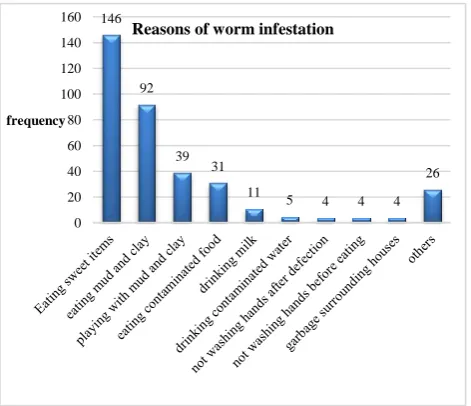
Figure 1: Reasons of worm infestation as perceived by mothers in an urban slum of Vadodara.
Majority of the mothers (90%) believed that, for the complaint of worm infestation, they should consult doctors. Four mothers responded that Aganwadi worker can provide some medicines. Seven mothers had faith in home remedies like butter milk and were of the faith that spicy food can be helpful in curing the disease.
Figure 2: Knowledge regarding symptoms of worm infestation among mothers in an urban slum of
Vadodara city.
On asking whether their children ever suffered from worm infestation, 37% gave positive response. Of these 110 incidences, 53 mothers answered positive for their children having passed worms in stool. Pain in abdomen
146
92
39 31
11
5 4 4 4
26
0 20 40 60 80 100 120 140 160
frequency
Reasons of worm infestation
was the complaint by 63 mothers, peri-anal itching was answered by 11 mothers. Other complaints were vomiting, asking for more food, eating more, grinding teeth, weakness and weight loss. Eighty eight percent mothers consulted doctors for the treatment of worm infestation of their children irrespective of their literacy status. Children were taken to Anganwadi workers by four mothers for treatment. Four took medicine from medical-store without doctor’s prescription. Four did not perceive the need of treatment (Table 3).
Almost 95% mothers stopped giving sweet food to their children and 49% mothers started washing hands before eating. Four mothers did not allow their children to eat from food wanders, milk and tea. Some had misbelief that eating spicy food; buttermilk could kill the worms in intestinal gut.
Out of 295 mothers who had ever heard about worm infestation, 54% were literate and 46% were illiterate. Thirty-one percent of mothers gave correct answer when asked about the cause of worm infestation. Out of literate mothers, 26% mothers gave correct causes of the disease occurrence and transmission compared to 36% mothers who were illiterate.
Literacy has made no difference in health seeking behavior. Eighty-eight percent of mothers went to doctor for treatment regardless of their literacy status whereas other 12% opted for over the counter treatment, home remedies and one mother felt it as harmless.
DISCUSSION
In developing countries, significant causes of morbidity are attributed to soil transmitted helminthes. Though many studies have been conducted worldwide to study prevalence of helminthes none to our knowledge have studied the knowledge, attitude and practice regarding intestinal helminths in India.9-12
This study was conducted in our field area to assess the baseline knowledge, attitude and practice of the community mother, who are mostly involved in care of their children. A similar approach has been illustrated by Friedman et al.13 This would help in preparing counseling guidelines and awareness programs regarding intestinal helminthes. This adds community health approach to our study. This approach is helpful to understand the baseline knowledge and practice, and take actions accordingly.14 In this study, majority of the mothers were aware of intestinal worm infestation. The finding that literacy has less role in prevention of worm infestation has also been found in the study conducted by Salam et al.1 It is a usual hypothesis that literacy improves knowledge regarding health issues. However, in the study, it was observed that illiterate mothers had similar understanding regarding intestinal helminthes, the related knowledge and awareness.
Thus, awareness campaign can be targeted towards all groups, irrespective of their literacy levels. Similar findings have been observed in the study conducted at Amalapuram.1 We observed that many misconception were present regarding attitude and practice towards health care and treatment of intestinal worm infestations.
CONCLUSION
Majority of the mothers were aware about occurrence of intestinal worm infestations but they had incorrect knowledge about its causes, symptoms, preventive measures and treatment. The literacy status of mothers does not make any difference in knowledge and practice regarding worm infestation. However, most of them adopted good practices for treatment and prevention in their children.
Recommendations
There is need to see the impact of health education regarding prevention and treatment of worm infestation in this urban slum area of Vadodara city for reducing the burden of worm infestation.
Funding: No funding sources Conflict of interest: None declared
Ethical approval: The study was approved by the Institutional Ethics Committee
REFERENCES
1. Salam N, Azam S. Prevalence and distribution of soil-transmitted helminth infections in India. BMC Public Health. 2017;17(1).
2. National Family Health Survey. Available at: http://rchiips.org/nfhs/factsheet_nfhs-4.shtml. Accessed on 16 November 2019.
3. Shobha M, Bithika D, Bhavesh S. The prevalence of intestinal parasitic infections in the urban slums of a city in Western India. J Infect Public Health. 2013;6(2):142–9.
4. WHO/PAHO/UNESCO report. A consultation with experts on amoebiasis. Mexico City, Mexico 28-29, 1997. Epidemiol Bull. 1997;18(1):13–4.
5. Kobayashi J, Hasegawa H, Forli AA, Nishimura NF, Yamanaka A, Shimabukuro T, et al. Prevalence of intestinal parasitic infection in five farms in Holambra, São Paulo, Brazil. Rev Inst Med Trop Sao Paulo. 1995;37(1):13–8.
6. Yusof AM, Md Isa ML. Intestinal helminths and protozoa infection among parents of school children in Malaysia. J Biotechnol Strateg Heal Res. 2017;1(2):75–82.
8. Park K. Park’s Textbook of Preventive and Social Medicine. Jabalpur: Banarsidas Bhanot; 2015. 9. Sachdeva S, Taneja N, Dwivedi N. Knowledge,
attitude and practices studies conducted amongst medical students of India. Int J Community Med Public Health. 2018;5(9):3913.
10. Acka CA, Raso G, N’Goran EK, Tschannen AB, Bogoch II, Séraphin E, et al. Parasitic worms: Knowledge, attitudes, and practices in western côte d’ivoire with implications for integrated control. PLoS Negl Trop Dis. 2010;4(12):1–14.
11. AlYahya IA, Almohsen HA, AlSaleem IA, Al-Hamid MM, Arafah AM, Turki YA, et al. Assessment of knowledge, attitude, and practice about first aid among male school teachers and administrators in Riyadh, Saudi Arabia. J Fam Med Prim Care. 2017;6(2):169–70.
12. Mekonnen HS, Ekubagewargies DT. Prevalence and factors associated with intestinal parasites among
under-five children attending Woreta Health Center, Northwest Ethiopia. BMC Infect Dis. 2019;19(1):1– 8.
13. Friedman SL, Allhusen V, Belsky J, Booth-laforce C. Child care and mother-child interaction in the first 3 years of life. NICHD Early Child Care Research Network. Dev Psychol. 1999;35(6):1399– 413.
14. Dongre AR, Deshmukh PR, Garg BS. A community based approach to improve health care seeking for newborn danger signs in rural wardha, India. Indian J Pediatr. 2009;76(1):45–50.
Cite this article as: Makwana BL, Shringarpure KS,