Original Research Article
Citizen engagement in social health insurance purchasing, in selected
counties in Kenya
Eunice M. Mwangi
1*
, Wanja M. Tenambergen
1, Job O. Mapesa
2, Isaac K. Mutai
1INTRODUCTION
Strategic purchasing should be looked at from a broad perspective beyond contracting health care providers it includes the role played by citizens, providers, governments and the purchasers.1 If policy makers and implementers are to realize desired results, they need act upon all the different components of the purchasing function. National hospital insurance fund (NHIF) is undertaking strategic purchasing of primary care health services under the National scheme. As such the authors
saw it necessary to evaluate the engagement of citizens in purchasing of these services, as they are key stakeholders in strategic purchasing.
NHIF is the sole social insurer in Kenya, other purchasers within the Kenyan Health Financing System are households, the government (National and Country), private health insurance and community based health insurance. However NHIF has been identified as one of the organizations that will purchase health care services for Kenyans under universal health coverage (UHC) reforms.2 Focus on NHIF is justified by the fact that
ABSTRACT
Background: National hospital insurance fund (NHIF) uses capitation as a strategic purchasing model to provide primary care health services (PCHS). This study sought information on citizen knowledge of PCHS benefit package, NHIF communication to citizens, determination of citizen views and values, NHIF accountability to citizens, citizen choice of PCHS provider and how these factors influence citizen access to NHIF, PCHS.
Methods: This was a cross sectional research conducted between March 2017 to March 2018. 426 patients were sampled from Nyandarua and Nakuru Counties.
Results: 366 (93%) patients knew the PCHS benefit package, 226 (57%) said NHIF communication to them was adequate, 280 (71%) said NHIF does not take into account their view and values, 272 (69%) said NHIF is not accountable to them, 269 (68%) knew how to select an outpatient facility, 111 (28%) said they did not receive NHIF, PCHS. Multivariate logistics regression analysis of citizen engagement factors and access to PCHS, indicate that NHIF communication to citizens (p<0.05, OR=2.358, 95% CI [1.399-3.975]), purchaser accountability (p<0.05, OR=2.073, 95% CI [1.017-4.226]) and provider choice (p<0.05, OR=2.990, 95% CI [1.817-4.920]) added significantly to the regression model.
Conclusions: There is inadequate engagement of citizens in NHIF decision making which may hinder access to NHIF PCHS, therefore NHIF should establish citizens’ needs and preference through public forums, elicit citizens’ feedback, act on complains when raised, inform citizens on how the capitation system works and NHIF should visit health facilities regularly to establish if patients are accessing PCHS.
Keywords: Universal health coverage, Social insurance, Primary care health services, National scheme, Citizens, Kenya
1
Department of Health Systems Management, 2Department of Public Health, Kenya Methodist University, Kenya
Received: 20 August 2019
Revised: 04 September 2019
Accepted: 05 September 2019
*Correspondence:
Eunice M. Mwangi,
E-mail: [email protected]
Copyright: © the author(s), publisher and licensee Medip Academy. This is an open-access article distributed under the terms of the Creative Commons Attribution Non-Commercial License, which permits unrestricted non-commercial use, distribution, and reproduction in any medium, provided the original work is properly cited.
NHIF insures more than 15% of Kenya’s total population which is about 88.4% of 17% of persons with health insurance in Kenya. Private insurance covers 9.4%, community-based insurance 1.3%, and other forms of insurance covers 1.0%, of 17% of persons with health insurance in Kenya.
NHIF being the only social health insurer in Kenya has made strides to meet the criteria of prepayment and pooling of resources and risks which are basic principles in financial-risk protection. This is in line with the fifty-eighth World Health Assembly resolutions on sustainable health financing, UHC and social insurance. There is therefore need to assess how NHIF purchasing mechanism is organized, since purchasing creates a link between pooled funds and effective services. If any country is going to achieve universal access, they ought to move from passive to active or strategic purchasing. Strategic purchasing aims to increase health systems’ performance through effective allocation of financial resources to providers.3
One of the central elements in strategic purchasing theory is that a purchaser represents the wishes and needs of the citizens. Key strategic purchasing actions in relation to citizens or population served are assessing the service needs, preferences and values of the population and use to specify service entitlements or benefits, inform the population of their entitlements and obligations, ensuring population can access their entitlements, establishing effective mechanisms to receive and respond to complaints and feedback from the population, and publicly report on use of resources and other measures of performance.4 Further resilient and responsive health systems outlined the specific strategic purchasing actions of NHIF towards the citizens.5 In determining whether NHIF is undertaking these actions, citizens were asked on their experiences as members of the social insurance. This study aimed to establish the extent of citizen engagement in NHIF purchasing of PCHS. Specifically, the study sought information on citizen knowledge of benefit package, NHIF communication to citizens, determination of citizen views and values, NHIF accountability to citizens, citizen choice of PCHS provider and how they all influence access to NHIF, PCHS.
METHODS
Research design
This was a descriptive cross sectional research. Data was collected using structured questionnaires from the patients under the Social Insurer’s National Scheme.
Sampling procedures and sample size
The study focused on urban (Nakuru County) from rift valley region and rural (Nyandarua County) from Central
Kenya region. The two were chosen due to the variations in social economic status of the populations, which influences how populations access primary care health services.6 Given that the target population registered under the National Scheme is more than 10,000 people in the two counties, a sample of 384 respondents plus an additional 10% adding to 426 respondents was drawn for the study. Out of 89 health facilities accredited by NHIF to provide PCHS, a sample of 72 was drawn using multistage sampling.
Data analysis
Out of 426 patients only 395 questionnaires were responded to. These patients were drawn from 66 out of 72 health facilities. Data was analysed using both descriptive and inferential statistics using SPSS version 21. Bivariate analysis using Pearsons Chi-square was used to compare the variables for factor analysis between the each independent and the dependent variable. An adjusted odds ratio at 95% confidence was used to test the strength of association. The threshold for statistical significance (p value) was set at p˂0.05. Logistic regression was used to correlate the independent variables and the dependent variable. In this study, psychometric Likert scale of 5 (5-strongly agree, 4-agree, 3-not sure, 2-disagree, 1-strongly disagree) based questions were recoded from five point Likert scale to binary variables. This was guided by the dependent variable which is access to NHIF primary care health services. It was assumed that the patients can have access or no access to primary care health services. The 3-not sure, 2-disagree, and 1-strongly disagree responses were recoded into no access, while else 5-strongly agree, 4-agree responses were recoded into access. Perceived access was used to measure implementation of the primary care health services. Similar recoding was done for all the independent variables.
Ethical approval
This was obtained from the Kenya Methodist University Scientific, Ethics and Review Committee and from the National Commission of Science and Technology and Innovation (NACOSTI/P/17/79210/15823). Approval was also obtained from the County Director of Health in both counties and Health facility in charges of the 66 health facilities. Informed consent was sought from the patients, and participation in this study was on voluntary basis.
RESULTS
Access to NHIF primary care health services
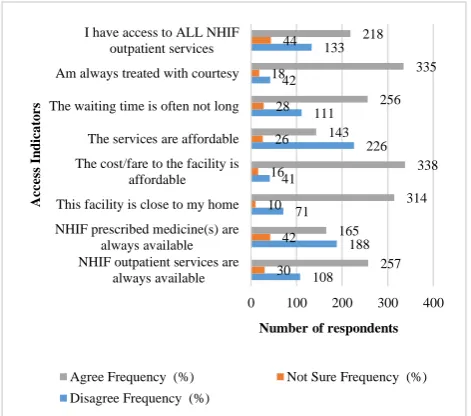
services and the cost incurred in accessing the NHIF outpatient facility. Responses are indicated in Figure 1. The results show that majority 257 (65%) of the respondent agreed to NHIF outpatient services being available, however majority 188 (48%) indicated that NHIF prescribed medicine (s) were not always available, or they were not sure of drugs availability 42 (11%). Most 314 (79%) of the respondent agreed that the health facility they had chosen was close to their home and that the cost or fare to the facility was affordable 338 (86%). However most 226 (57%) said the NHIF outpatient service were not affordable, since they were charged for services such as drugs, laboratory tests and X-rays. Most indicated that the waiting time is often not long 256 (65%) and that they were always treated with courtesy 335 (74%). Despite lacking drugs and being charged for services, most 208 (56%) of the respondents indicated that they had access to all NHIF outpatient services.
Figure 1: Citizens’ perception on access to NHIF primary care services (n=395).
Citizens’ knowledge of the benefit package
The study sought to establish the citizens’ knowledge of the health benefit package under NHIF National Scheme, as this was deemed to influence the citizens’ access to primary care services. Majority of the patients were knowledgeable on their entitlement to general consultation 377 (95%), treatment of local disease 373 (94%), basic laboratory investigations 326 (82%), prescription and administration of drugs 336 (86%), health education, counseling, ongoing support 236 (60%), management of uncompleted STIs 246 (62%) and minor surgical procedures 263 (67%). However it was evident that some of respondents were not sure of their entitlement in three areas i.e., health education, counseling and ongoing support 99 (25%), management of uncompleted STIs 105 (27%) and minor surgical procedures, 84 (21%). This information was further
simplified through binary coding of the responses to those who agreed to know the NHIF health benefit package under the national scheme and those who did not know the health benefit package. This is as presented in the Figure 2.
Figure 2: Citizens' knowledge of NHIF primary care services benefit package.
Majority of the patients 366 (93%) indicated that they knew the NHIF health benefit package and only 29 (7%) did not know.
Citizens’ perception on communication by NHIF
The study sought to establish the information sharing mechanisms by NHIF to the citizens. The results are shown in Figure 3.
Figure 3: NHIF communication to citizens.
Most of the respondents 226 (57%) indicated that NHIF provides them with information they require to make informed decisions and that NHIF explains to them the health services they are covered for. However, the number of those who did not agree 169 (43%), was a result of NHIF not making the communication to the citizens regular. Some of the mechanisms that NHIF uses to communicate included, short mobile messages, television, print media, face to face when the patients visit the NHIF’s office and through pamphlets.
108 188 71 41
226 111 42
133
30 42 10
16 26 28 18
44
257 165
314 338 143
256 335 218
0 100 200 300 400 NHIF outpatient services are
always available NHIF prescribed medicine(s) are
always available This facility is close to my home
The cost/fare to the facility is affordable The services are affordable The waiting time is often not long Am always treated with courtesy I have access to ALL NHIF
outpatient services
Number of respondents
A
c
c
e
ss
I
n
dic
a
to
r
s
Agree Frequency (%) Not Sure Frequency (%) Disagree Frequency (%)
Dont know (7%)
Know (93%)
NHIF doesn't Communicate (43%) NHIF
Communicates
(57%) Disagree
Citizens’ views and values under NHIF National Scheme
The respondents’ perceptions were sought on whether NHIF takes into account their views and values by engaging the citizens in the community or if there are any feedback mechanisms that NHIF has set to collect their views and values. Nearly a third 253 (64%) disagreed that NHIF often visits the community to enquire on their needs. Majority of the respondents also disagreed that NHIF has feedback mechanisms that they can use to give their views and values to NHIF. More than half of the respondents, 231 (58%) disagreed to the fact that they have a chance to give feedback to NHIF on services that they receive. Moreover, a third 267 (68%) of the respondents indicated that they have never given any feedback and therefore most 216 (55%) did not know if feedback given can be used to improve the health services in the facility. Further simplification of this information by recoding the data into binary variables of whether the patients agreed to their views and values being taken into account by NHIF or if they disagreed. The results are shown in Figure 4.
Figure 4: Citizens' views and values ascertained.
Majority of the respondents 280 (71%) are of the view that NHIF does not take into account their view and values, given that the patients are not aware of any feedback mechanisms available for them to give their opinions on the services they receive under NHIF national scheme. Further most disagreed with the statement on NHIF visiting the community to enquire on their needs.
NHIF’s accountability to citizens under National Scheme
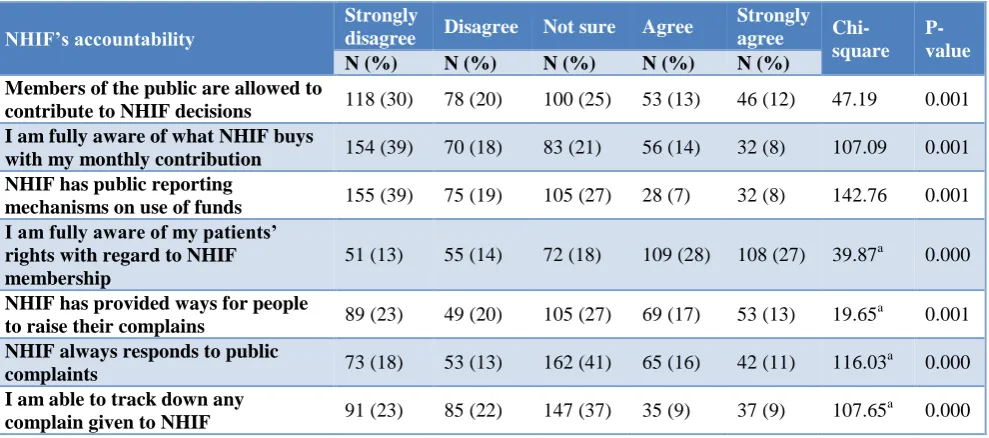
The respondents were asked to evaluate their opinion on whether NHIF is accountable to them in the areas of there being any mechanisms to report on use of funds, members of the public being allowed to contribute to NHIF decisions, members being aware of what NHIF buys with their monthly contribution, members being fully aware of their patients’ rights with regard to NHIF membership, NHIF providing ways for people to raise their complaints and responding to these complains. Majority 196 (50%) of the respondents disagreed to members of the public being allowed to contribute to NHIF decisions. While citizen representation in NHIF board is there in Kenya, citizen seems not to be aware of how they are represented. Majority of the respondents 224 (57%) were not fully aware of what NHIF buys with their monthly contribution, neither 230 (58%) were they aware of any mechanism NHIF has to publicly declare the use of citizens’ funds. Majority 217 (55%) were however aware of their patients’ rights with regard to NHIF membership, however they disagreed 138 (43%) or were not sure 105 (27%) of NHIF having ways for people to rise complaints. Majority 162 (41%) were not sure as to whether NHIF responds to public complaints.
Table 1: Enforcing NHIF’s accountability by citizens (n=395).
NHIF’s accountability
Strongly
disagree Disagree Not sure Agree
Strongly agree
Chi-square P-value N (%) N (%) N (%) N (%) N (%)
Members of the public are allowed to
contribute to NHIF decisions 118 (30) 78 (20) 100 (25) 53 (13) 46 (12) 47.19 0.001 I am fully aware of what NHIF buys
with my monthly contribution 154 (39) 70 (18) 83 (21) 56 (14) 32 (8) 107.09 0.001 NHIF has public reporting
mechanisms on use of funds 155 (39) 75 (19) 105 (27) 28 (7) 32 (8) 142.76 0.001 I am fully aware of my patients’
rights with regard to NHIF membership
51 (13) 55 (14) 72 (18) 109 (28) 108 (27) 39.87a 0.000
NHIF has provided ways for people
to raise their complains 89 (23) 49 (20) 105 (27) 69 (17) 53 (13) 19.65
a 0.001
NHIF always responds to public
complaints 73 (18) 53 (13) 162 (41) 65 (16) 42 (11) 116.03
a 0.000
I am able to track down any
complain given to NHIF 91 (23) 85 (22) 147 (37) 35 (9) 37 (9) 107.65
a 0.000
Views not taken into account
(71%) Views taken
into account (29%)
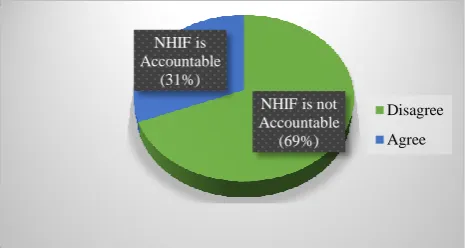
This information was further simplified by recoding the variables from five Likert scale to two variables of whether NHIF is accountable to the citizens or not. The results are indicated in Figure 5.
Majority 272 (69%) of the respondents were of the opinion that NHIF is not accountable to them.The reason would have been that the citizens were not aware of how they can be involved in NHIF’s decision making process, the respondents were also not aware of what NHIF buys with their monthly contributions, neither were they aware onany public reporting mechanisms available for NHIF to report on the use of funds.
Figure 5: Citizens enforcing NHIF accountability.
Citizens’ choice of health provider under National Scheme
Perception of the respondents was also sought on whether NHIF communicates to the citizens on the rules of
selecting health care facilities, and whether citizens understand these rules. In addition respondents were asked if they selected the NHIF contracted/outpatient facilities at their own free will. Most respondents 257 (65%) agreed that NHIF communicates to them the rules of selecting a health facility and that they 256 (64%) understand these rules. Majority 369 (94%) also agreed to have chosen the health facility at their free will. Majority 210 (53%) agreed that a person cannot choose more than one health facility under NHIF, this confirmed that they knew the rules of selecting health facility. Majority 235 (59%) confirmed that NHIF provides adequate number of health facility for the patient to choose from and majority 201 (51%) also indicated that they have never changed their outpatient facility under NHIF.
Hypothesis testing of citizens responses
Chi-square measure of association
The Chi-square statistic was used to establish whether there was a relationship between each independent variable and the dependent variable. The data recoded from Likert scale to binary variables was used to test the independence of the variables. The results are presented Table 2.
The results indicate that NHIF communication to the citizens, determining citizens’ views, and values, NHIF accountability to the citizens and Citizens’ choice of primary providers were significantly associated with access to primary care health in the two counties of study. The results were significant at p<0.05.
Table 2: Relationship between citizen engagement factors access to PCHS in NHIF National scheme.
Variable Sample Size (n) χ2 Df P-value
NHIF benefits 395 1.50 1 0.221
NHIF communication 395 33.31 1 0.001
Citizen views and values 395 22.65 1 0.001
NHIF accountability to citizens 395 24.71 1 0.001
Citizens choice of health provider 395 40.79 1 0.001
Bivariate analysis of citizens variables
Holding other factors constant, a bivariate analysis was carried out to determine the effect of each independent variable on the dependent variable, assuming there was no interaction between the independent variables. The results are presented in Table 3.
Table 3 shows that citizen engagement factors had a significant relationship with access to primary care health services under NHIF national scheme. The study found that NHIF communication with citizens (p<0.001), citizen views and values (p<0.001), NHIF accountability to citizens (p<0.001) and Citizens choice of primary care provider (p<0.001), all had a p value less than 0.05 level of significance and therefore there was a significant
association of each of the independent variables with access to primary care health services, in the two counties. Indeed, where there was NHIF communication patients were 3.762 times more likely to access primary care health services than where there was no communication. Where citizens’ views and values were taken into account patients were 4.225 times more likely to access primary care health services than where their views and values were not taken into account. Where citizens viewed NHIF to be accountable patients were 4.316 times more likely to access primary care health services than where they viewed NHIF not to be accountable. Where citizens understood the rules for selecting a primary care provider, patients were 4.349 times more likely to access primary care health services than where there the patients did not know the rules.
NHIF is not Accountable
(69%) NHIF is
Accountable (31%)
Disagree
Multivariate analysis
Logistic regression was performed to determine the effects of NHIF benefits, NHIF communication, citizen views and values, NHIF accountability, provider choice on the likelihood that a citizen will have access to primary care. Hosmer and Lemeshow Goodness-of-fit test (GOF) was used to decide whether the study model was correctly specified. The results indicate that the logistic regression model was statistically significant,
χ2 (6)=5.412, p>0.05. If a GOF result is a p-value below
0.05, you fail to accept the prediction model, and vice versa, if the GOF results p value is higher than 0.05, the regression model passes the test. The regression model explained 23% (Nagelkerke) of the variations of access to primary care health services and correctly classified 74% of those who had access. Results of the odds ratio and the levels of significance are presented in Table 3. Result with a p value of less than 0.05 were interpreted to be significant.
Table 3: Bivariate analysis of citizens’ engagement variables.
Variable B SE Odds
ratio
P
value R
2 NHIF benefits
Citizens don’t know of benefit (ref)
0.486 0.400 1.000
0.225 0.005
Citizens know benefits 1.626
NHIF communication with citizens Citizen disagree on communication (ref)
1.325 0.236 1.000
0.001 0.116
Citizen agree on communication 3.762
Citizen views and values
NHIF does not takes into account (ref)
1.441 0.320 1.000
0.001 0.090
NHIFs take into account 4.225
NHIF accountability to citizens
NHIF is not accountable (ref)
1.462 0.311 1.000
0.001 0.097
NHIF is accountable 4.316
Citizens choice of primary care provider Citizens don’t know rules (ref)
1.470 0.238 1.000 0.001 0.136
Citizens know rules 4.349
Significance- p<0.05; sample size=395.
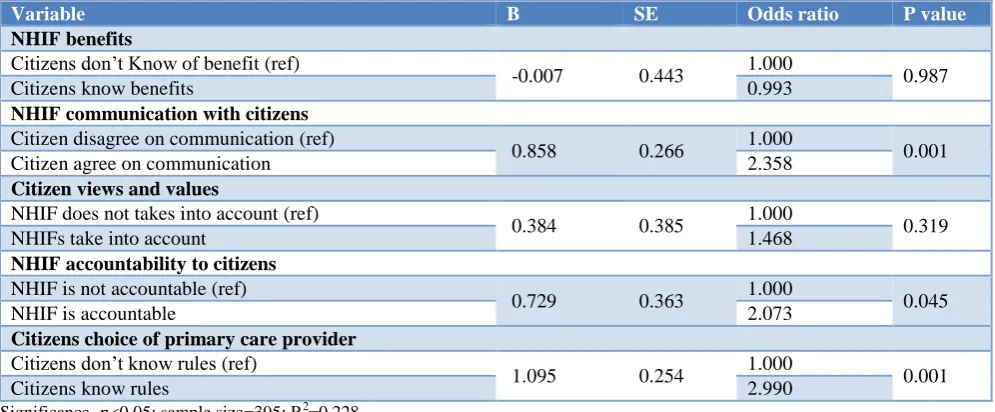
From these results communication (p=0.001), accountability (p=0.045) and provider choice (p=0.001) added significantly to the regression model. The variables
in the equation table can be used to predict the probability of an event occurring based on a one unit change in an independent variable when all other independent variables are kept constant.
Table 4: Multivariate analysis of citizens’ engagement variable.
Variable B SE Odds ratio P value
NHIF benefits
Citizens don’t Know of benefit (ref)
-0.007 0.443 1.000 0.987
Citizens know benefits 0.993
NHIF communication with citizens
Citizen disagree on communication (ref)
0.858 0.266 1.000 0.001
Citizen agree on communication 2.358
Citizen views and values
NHIF does not takes into account (ref)
0.384 0.385 1.000 0.319
NHIFs take into account 1.468
NHIF accountability to citizens
NHIF is not accountable (ref)
0.729 0.363 1.000 0.045
NHIF is accountable 2.073
Citizens choice of primary care provider
Citizens don’t know rules (ref)
1.095 0.254 1.000 0.001
Citizens know rules 2.990
Significance- p<0.05; sample size=395; R2=0.228.
The results showed a 2.358 fold increase in the odds of accessing primary care services among those who
accessing primary care services for patients who perceived NHIF to be accountable than those who did not. A 2.990 fold increase in the odds of accessing primary care health services among patients who understood the rules of selecting a facility, than those who did not was observed in this study. The study results indicate that knowledge of NHIF primary care benefits package (p=0.987) and citizens views and values (p=0.319) did not contribute significantly to the model.
DISCUSSION
Access to primary care health services should be guaranteed for every member of the social health insurance. However not all respondents perceived the services to be accessible, as some cited that drugs were not available and that patients were being charged for services at point of access despite prepayment for the primary care services. Similar findings were found in a study on challenges of strategic purchasing of healthcare services in Iran Health Insurance Organization, where participants perceived issues affecting strategic purchasing to be lack of accessibility, affordability and availability of services.1 One of the incentives for providers under capitation payment is to underprovide services in order to maximize profits.7 Furthermore in a research on social insurance uptake in Nyeri County, it was established that patients who had ceased being enrollees of NHIF were willing to rejoin the scheme if they would be guaranteed availability of drugs and if the quality of care would be improved.8 Some of the respondents in this study cited bad staff attitude as one of the reasons for dissatisfaction with the social health insurance.
Respondents were asked questions to determine their knowledge of the benefit package. Majority were aware of the components of the benefit package under study however the results indicate low knowledge on entitlement in three areas these were entitlement to management of uncompleted STIs, ongoing support, health education and counselling and minor surgical procedures under local anesthesia. Citizens’ pooled contributions of a social health insurance system are used to purchase a set of health benefits or interventions, which the insured members are all entitled to.9 The authors stated that often the beneficiaries are not aware of their entitlement and patients always rely on the health care provider to establish the kind of services they should receive, as they recognize the health care provider to be better informed to make such an establishment. Knowledge of benefit package seem not to be associated with patients accessing health services, this is because, patients knowledge of their entitlement does not guarantee access to health services, as the actual access to the services is also influenced by other factors such as the actual encounter with the health provider.8
Effective and efficient communication is crucial in healthcare management. poor communication from NHIF
may inhibit clients' understanding on services covered by NHIF, or inhibit knowledge of requirements for coverage of their dependents or how the primary provider system worked under the outpatient capitation scheme.10 Key strategic purchasing actions in relation to citizens or population served include informing the population of their entitlements and obligations, this may be implied to have taken place as majority of the respondents confirmed to have received information from NHIF despite saying that it was not regular.11 NHIF communication to citizens is through published detailed information on the NHIF website and advertisements widely in the media, however NHIF’s use of its website, newspapers and media pronouncements to inform the populace of its service entitlements limits the reach of its messages to those who had access to these media, and this may explain the 43% respondents who indicated NHIF does not communicate to them.2 NHIF communication strategies must address context specific issues and dynamics. Progress toward UHC requires local ownership and tailored made strategies for particular settings. Each audience requires tailored communication approaches to change their knowledge, attitudes, and behaviors. These actions may engage stakeholders in information sharing, conversation, and/or shared learning, with the aim of making decisions or influencing behavior changes.12
Perception on whether citizen’s views and values are taken into account by NHIF the purchaser was established in this study. The results of this study are also in agreement with another study that indicated that with indicated that though importance of population needs assessment is highly recognized, this function is not often carried out and where it exists, results are often not included into purchasing decisions.3 NHIF Act doesn’t have provision for eliciting feedback form citizens, and although, NHIF has a phone line which is free for the public to call, this line is operated for 24 hours a day, any attempts to call the number by the authors, during the study period was not successful.2 This may hinder feedback to NHIF and further improvement of services. No formal needs assessment activities were undertaken in designing NHIF benefit package, in fact, NHIF used a variety of means to determine health needs of the population and inform the design of the benefit package, including customer satisfaction surveys; feedback received from board members and analysis of claims data, these authors recognized that citizen engagement required improvement.2 There is need for inclusion of citizens’ preferences in designing the benefit package.9
A study in Nyeri County on uptake of social insurance cited that (104) participants in the study had never been invited to Social Health Insurance and Community Health Insurance meetings, this meant their views and values were not often sought by the insurance scheme.8
complain mechanisms by NHIF were not known by the respondents, the respondents were also not aware on how they were represented in NHIF board. Many European countries, consumers have a formal representation in purchaser organizations, though there challenges in determining which is the best group to represent consumers in purchasers’ boards.13 One of the
accountability mechanisms is public reporting by the purchaser on its use of funds.9 Lack of sufficient transparency in financial resources is a major challenge in strategic purchasing.1 Further, a study in China established that though accountability mechanisms, such as reporting and complaints systems have been established some mechanisms do not function effectively and further improvement is required if members’ needs and preferences are to be met.13 The authors also established that in the Philippines, systems to allow members to articulate preferences, needs and complaints are not well established. NHIF Act does not provide for feedback or complaints mechanisms for beneficiaries or members, however the board of directors is composed of key stakeholders including labor unions who represent the citizens.2 Furthermore, NHIF has no public forum for reporting performance. While there was evidence that these feedback mechanisms did work, for example resulting in the redesign of the enrolment form, it was unclear what processes were in place to regularly incorporate this feedback in benefit package design and other aspects of purchasing performance. Though changes to the benefit package and premium rates were based on member feedback, the process of implementation of these changes is met with stiff opposition from labor unions and the general population. One of the ways to enhance the role of consumers in purchasing and to hold the purchaser accountable is to specify the consumers’ and purchasers' roles.13 These
authors also indicate that one way to hold the purchaser accountable and be responsive to consumers is through putting in place complain and feedback mechanisms, so as to influence the purchasers decisions. There was a gap in the area of complaint mechanisms as most respondent indicated that they were not aware of any complain mechanism in place, neither were they aware if NHIF responds to public complains. Most National health systems have put in place complaint mechanisms however, there lacks legally enforceable enforcements in most of them, thus reducing the scope for consumers to declare whether provision or non-provision of health services is appropriate.14 The results on NHIF accountability establishes an existing gap in accountability.
Citizens in this study understood the rules of selecting their primary care health services provider. When consumers have a number of health facilities to choose from, it may increase responsiveness.1 A major concern was also noted among respondents who indicated that they did not know the rules of selecting a primary provider. These are respondents who indicated that they can choose more than one primary care provider. The
reason for inadequate knowledge of provider choice may be as a result of predisposition of their education background or socio-economics status. Evidence show that choice of a health provider tends to benefit the higher (and usually better-informed) social classes and thus may lead to increasing health inequalities, policy response should focus efforts to ensure wider access to information and to support choice among the underprivileged.13 NHIF publishes information about providers and the benefit package through its website and through advertisement on media, this are ways through which NHIF creates and promotes awareness of the citizen entitlements and accredited providers.2,15 There are a few respondent who indicated that they did not chose the facilities they were access primary services from, the question remains who chose for them these facilities?. Social Health Insurance (SHI) patients terminated their enrolment with SHI after finding they were allocated facilities they never chose.8
CONCLUSION
Results indicate that the citizens are not fully engaged by the social health insurer. Despite majority indicating that they knew the primary care benefits and entitlements, entitlement to treatment of uncomplicated STIs and minor surgery under local anaesthesia scored low. Information and communication from NHIF was inadequate, indeed information on NHIF services was cited to emanate from friends and relatives. Citizens’ views and values are not fully determined, neither are citizens engaged in determining their own needs. Citizens also felt that NHIF is not accountable to the public. Rules of selecting facilities were not known by all respondents as some indicated that they can choose more than one primary care provider. Services were not guaranteed thus limiting access, this was occasioned by medicines not always being available and sometimes the patients were asked to pay for services. Patients indicated not having trust with the system as providers often mention that NHIF pays them too little capitation, and therefore the patient must pay for some basic services including those covered under NHIF National Scheme. Instances of patients taking home inadequate prescriptions were a common phenomenon. Patients don’t know their rights as it was seen that they were satisfied with taking home a written prescription as what mattered to some was the presence of a consultant regardless of whether drugs were there or not. Though all the variables seemed to influence access in a binary relationship, in a combined relationship, communication with citizens, NHIF accountability to citizens and choice of provider were seen to influence access of patients to primary care health services.
Recommendations
visit health care providers, to meet with the patients and ask them on their experience with the health services. In addition, NHIF should visit the community to establish public needs and preference through public forums that must be organised and the public informed on the same. Furthermore NHIF should establish means of eliciting citizens’ feedback, complain mechanisms and also act on these complains when raised. Finally, the citizens need to be trained more on how to select a facility and to be informed on how the capitation system works.
ACKNOWLEDGEMENTS
I wish to recognise all those who have supported me in the course of this research. My sincere appreciation goes to Luke, Larry, Lash awn, Lindsey, Lucy, Grace, Samson, Esther and Mary for encouraging me through the research journey, and for the relenting support both emotional and material.
Funding: No funding sources Conflict of interest: None declared
Ethical approval: The study was approved by the Institutional Ethics Committee
REFERENCES
1. Gorji HA, Mousavi SMSP, Shojaei A, Keshavarzi A, Zare H. The challenges of strategic purchasing of healthcare services in Iran Health Insurance Organization: a qualitative study. Electron Physician. 2008;10(2):6299-306.
2. Munge K, Mulupi S, Barasa EW, Chuma J. A Critical Analysis of Purchasing Arrangements in Kenya: The Case of the National Hospital Insurance Fund. Int J Health Policy Manag. 2017;7(3):244-54. 3. World Health Organization. In: Etienne C,
Asamoa-Baah A, Evans DB, eds. The World health report: health systems financing: the path to universal coverage. Geneva: World Health Organization; 2010.
4. Figueras J, Robinson R, Jakubowski E, eds. Purchasing to improve health systems performance. Maidenhead: Open University Press; 2005.
5. Resilient and Responsive Health Systems, 2014. What is Strategic Purchasing? RESYST and Asia-Pacific Observatory on Health Systems and Policies. Available at: http://resyst.lshtm.ac.uk/sites/resyst .lshtm.ac.Uk/files/docs/reseources/Purchasing%20 brief.pdf. Accessed on 18 November 2016.
6. Government of Kenya, and Kenya National Beureau of Statistics, 2012. 2009 Kenya Population and Housing Census;Analytical Report on Urbanization (“Counting Our People for Implementation of
Vision 2030”. Available at: https://www.google.com/search?q=Urbanisation+ by+County+in+Central+Kenya&ie=utf-8&oe=utf-8&client=firefox-b. Accessed on 18 November 2016.
7. Mbau R, Barasa E, Munge K, Mulupi S, Nguhiu PK, Chuma J. A critical analysis of health care purchasing arrangements in Kenya: A case study of the county departments of health. International J Health Planning Management. 2018;33(4):1159–77. 8. Gathu B, Mwangi ME, Oluoch M, 2016. Factors influencing uptake of social health insurance in Kenya: a case of Nyeri County. Research Gate. Available at: https://www.researchgate.net/publica tion/330542225_Factors
_Influencing_Uptake_Of_Social_Health_Insurance_ In_Kenya_A_Case_Of_Nyeri_County. Accessed on 18 November 2016.
9. Busse R, Figueras J, Robinson R, Jakubowski E. Strategic purchasing to improve health system performance: Key Issues And International Trends. Healthcare Papers. 2007;8:62-76.
10. Sieverding M, Onyango C, Suchman L. Private healthcare provider experiences with social health insurance schemes: Findings from a qualitative study in Ghana and Kenya. Plos One. 2018;13(2):e0192973.
11. Carrin G, Chris J. Reaching universal coverage via social health insurance: key design features in the transition period. Geneva: Eldis, World Health Organization. 2004; 54.
12. Joint Learning Network for UHC, Universal Health Coverage, Health Finance and Governance, and Project, Abt Associates, Results for Development. Strategic Communication for Universal Health Coverage: Practical Guide; 2018.
13. Honda A, McIntyre D, Hanson K, Tangcharoensathien V, eds. Strategic Purchasing in China, Indonesia and the Philippines. Comparative Countries Studies; 2016:2(1).
14. Obadha M, Chuma J, Kazungu J, Barasa E. Health care purchasing in Kenya: Experiences of health care providers with capitation and fee-for-service provider payment mechanisms. Int J Health Planning Manag. 2019;34(1):917-33.
15. National Hospital Insurance Fund, 2015. NHIF: Afya Yetu. Bima Yetu. Available at: http://www.nhif.or.ke/healthinsurance/. Accessed on 18 November 2016.