http://www.ijcmph.com pISSN 2394-6032 | eISSN 2394-6040
Original Research Article
Psychosocial problems, chronic illness and welfare service utilization
among elderly population in urban areas of Vijayapur, Karnataka
Vidya V. Patil
1*, Rekha Udgiri
2INTRODUCTION
Population ageing is a major demographic issue for India in the 21st century with wide implications for economy and society in general. With the rapid changes in demographic indicators over the last few decades, India with 7.7% of its population being more than 60 years has been labelled as “an ageing nation”. Presently India has around 90 million elderly and by 2050, the number is expected to increase to 315 million, constituting 20% of the total population.1 Expectation of life at birth has been increased more in recent years. In India it is projected to be 67 years in 2011-2016.2 The term “demographic burden” is used to connote the increase in the total dependency ratio during any period of time, mostly
caused by increased old age dependency ratio, this is an inevitable consequences of demographic transition, and the country has to face this problem.3
Morbidity among elderly has an important influence on their physical functioning and psychological well- being. Psychosocial problems that confront older persons are the result of priorities, policies and practices of societies associated with social isolation, apparent reduction in
family support, inadequate housing, impaired
functioning, mental illness, widowhood, limited options for living arrangement and dependent life.4
The loneliness among elderly has effect on their health status and it leads to progressive spontaneous reduction ABSTRACT
Background: Aging is a universal process. In India, the elderly account for 7.7% of the total population and the United Nations defines a country as “ageing” where the proportion of people over 60 years reaches 7.7%. Morbidity among elderly has an important influence on their physical functioning and psychological well-being. The objectives of the study were to assess the psychosocial problems associated with the elderly and to describe the chronic illness and utilization of welfare services among elderly.
Methods: A cross sectional study was conducted in the urban field practice area of Shri B M Patil Medical College, Vijayapur. House to house survey was conducted for a period of 3 months from September to November 2014.
Results: Total of 372 elders were interviewed, 54.5% were males, 45.4% were females. Majority were Hindus 78.8%. 46% were illiterate. Majority 79% were financially dependent. 53% were working. Around 32% were feeling lonely Most common chronic illness is joint pain (66.66%), visual problem (50%), dental and chewing problem (48%).
Conclusions: Financial dependence was high among the participantsand majorities were suffering from one or the other chronic illness which needs attention and knowledge about geriatric welfare services should be given.
Keywords: Psychosocial, Chronic illness, Elderly, Urban area, Welfare services
Department of Community Medicine, 1S.S. Institute of Medical Sciences Davangere, 2Shri B.M. Patil Medical College, Vijayapur, Karnataka, India
Received: 26 April 2018
Revised: 05 June 2018
Accepted: 08 June 2018
*Correspondence:
Dr. Vidya V. Patil,
E-mail: [email protected]
Copyright: © the author(s), publisher and licensee Medip Academy. This is an open-access article distributed under the terms of the Creative Commons Attribution Non-Commercial License, which permits unrestricted non-commercial use, distribution, and reproduction in any medium, provided the original work is properly cited.
of daily milieu and social requirements as well as an impression of dependence that cannot be easily overcome.5 Thus adding life to years that have been added to life is a significant challenge. Yet, ageing is not to be viewed from a problem perspective, its potential must be recognised and realised.
Objectives
To assess the psychosocial problems associated with the elderly.
To describe the chronic illness and utilization of welfare services among elderly.
METHODS
Study design
Cross sectional study
Study place
The present study was undertaken among the elderly population in the urban field practice area of Shri B M Patil Medical College, Hospital and research centre Vijayapur.
Study duration
September to November 2014.
Study population
Elderly aged 60 and above.
Methodology
Some areas were randomly selected which come under Urban Health training centre covering the population of around 5000 where house to house survey was conducted to enumerate all those who were aged 60 and above and those who were available at home during the visit were
included in the study. A total of 372 elders were interviewed. The questionnaire was developed by reviewing related Indian studies. The purpose of the study was explained to them and informed consent was taken. The data collected was tabulated and analysed using SPSS version 16. Findings were described using proportions, percentages and chi square test was applied wherever applicable.
Inclusion criteria
All persons aged 60 and above
Exclusion criteria
Those not willing to participate, those who were severely ill were excluded.
RESULTS
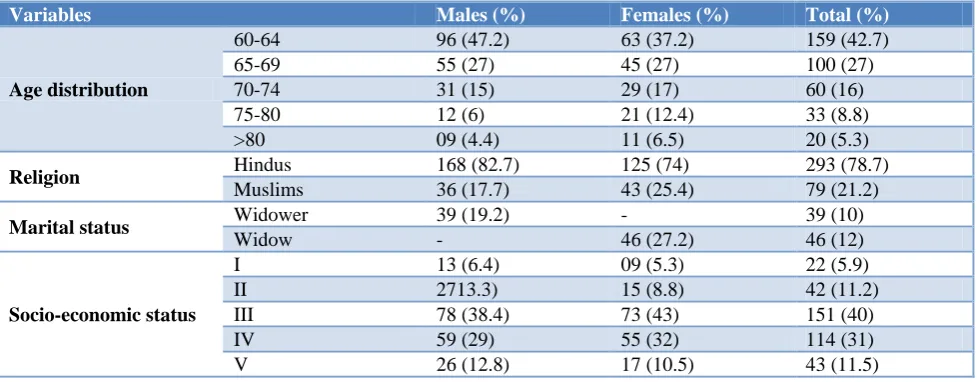
Major proportion of the study population was in the age group 60-64, while a small proportion were 80 years and above. Around 54.5% were men and 45.4% were women. Majority were Hindus (79%). 19.2% of the men were widower and 27.2% of the women were widow. 46% of the men and 57% of the women were illiterate. 62% of them were involved in only routine household work and not involved in regular exercise, yoga or walking. More than 3/4th of the participants were financially dependent. Half of the respondents (52.68%) were working. Half of the respondents were living with children, spouse and grandchildren but 70% of the elderly reported that they want to live along with their children and grandchildren (Table 1).
Around 32% felt lonely and 25.26% were sad presently, and the reason quoted was they felt that there advice is not taken into consideration at home and they did not have regular social contacts. Among the study population around 20% faced emotional ill treatment and 18% of them faced verbal ill treatment and the majority of the perpetrators were within the family (Table 2).
Table 1: Socio-demographic variables.
Variables Males (%) Females (%) Total (%)
Age distribution
60-64 96 (47.2) 63 (37.2) 159 (42.7)
65-69 55 (27) 45 (27) 100 (27)
70-74 31 (15) 29 (17) 60 (16)
75-80 12 (6) 21 (12.4) 33 (8.8)
>80 09 (4.4) 11 (6.5) 20 (5.3)
Religion Hindus 168 (82.7) 125 (74) 293 (78.7)
Muslims 36 (17.7) 43 (25.4) 79 (21.2)
Marital status Widower 39 (19.2) - 39 (10)
Widow - 46 (27.2) 46 (12)
Socio-economic status
I 13 (6.4) 09 (5.3) 22 (5.9)
II 2713.3) 15 (8.8) 42 (11.2)
III 78 (38.4) 73 (43) 151 (40)
IV 59 (29) 55 (32) 114 (31)
Variables Males (%) Females (%) Total (%)
Education
Illiterate 74 (36.4) 97 (57.3) 171 (45.9)
Primary school High school
49 (24) 53 (26)
47 (27.8) 18 (10.6)
96 (25.8) 71 (19)
PUC 19 (9.3) 07 (4) 26 (6.9)
Degree 08 (3.9) 0 08 (2)
Habits
Smoking 31 ( 15) 0 31 (8.3)
Tobacco 32 ( 16) 18 ( 10.6) 50 (13.4)
Alcohol 08 ( 3.9) - 8 (2.1)
No addictive habits 132 (65) 151 (89) 283 (76)
Physical activity*
Regular walk 43 (21.1) 12 (7.1) 55 (14.7)
Yoga 08 (3.9) 02 (1.2) 10 (3)
Only routine work 134 (66) 98 (58) 232 (62.3)
Only household 18 (8.86) 104 (61) 122 (32.7)
No activity 23 (11.3) 45 (26) 68 (18.2)
Financial dependence Yes 162 (80) 133 (79) 295 (79)
No 41 (20) 36 (21) 77 (21)
Working Yes 134 (66) 62 (37) 196 (53)
No 69 (34) 107 (63) 176 (47)
Living with
Spouse 65 (32) 36 (21) 101 (27)
Children and spouse 99 (49) 87 (51) 186 (50)
Children only 26 (13) 43 (25) 69 (19)
Relatives 11 (5.4) 03 (2) 14 (4)
Alone 02 (1) 0 2 (0.53)
Prefers to live with Only spouse 54 (27) 51 (30) 105 (28)
Children and spouse 149 (73) 118 (70) 267 (72)
Total 203 (100) 169 (100) 372 (100)
*multiple choices
Table 2: Psycho social factors among the participants.
Variables Males (N%) Females (N%) Total (N%)
Feeling lonely 77 (37.9) 42 (25) 119 (32) χ2=7.25; p=0.007
Feel whether there advice considered 151 (74) 81 (48) 232 (62) χ2=27.5; p=0.0001
With regular social contacts 196 (96) 74 (44) 270 (73) χ2=129; p=0.0001
Sad attitude towards life 55 (27) 39 (23) 94 (25) χ2=0.788; p=0.375
Ill treatment
a)Verbal 23 (11.33) 44 (26) 67 (18) χ2
=2.38; P=0.123
b) Emotional 17 (8.37) 58 (34.31) 75 (20.1)
Perpetrators
Outside family 16 (7.88) 33 (19.52) 49 (13.17) χ2
=0.743; P=0.389
Within family 24 (11.82) 69 (40.82) 93 (25)
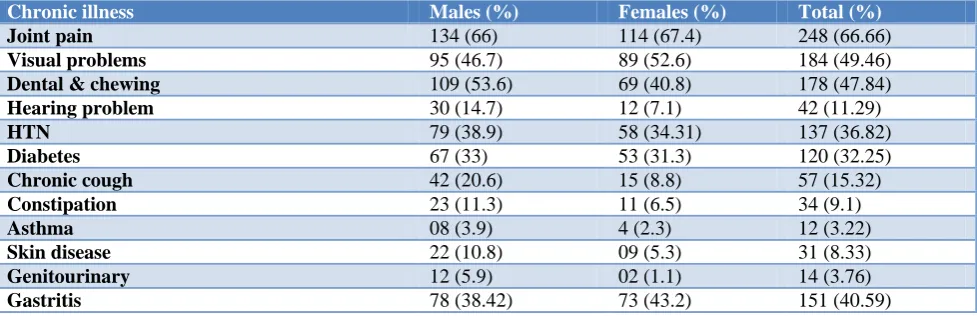
Table 3: Chronic illness among elderly.
Chronic illness Males (%) Females (%) Total (%)
Joint pain 134 (66) 114 (67.4) 248 (66.66)
Visual problems 95 (46.7) 89 (52.6) 184 (49.46)
Dental & chewing 109 (53.6) 69 (40.8) 178 (47.84)
Hearing problem 30 (14.7) 12 (7.1) 42 (11.29)
HTN 79 (38.9) 58 (34.31) 137 (36.82)
Diabetes 67 (33) 53 (31.3) 120 (32.25)
Chronic cough 42 (20.6) 15 (8.8) 57 (15.32)
Constipation 23 (11.3) 11 (6.5) 34 (9.1)
Asthma 08 (3.9) 4 (2.3) 12 (3.22)
Skin disease 22 (10.8) 09 (5.3) 31 (8.33)
Genitourinary 12 (5.9) 02 (1.1) 14 (3.76)
Gastritis 78 (38.42) 73 (43.2) 151 (40.59)
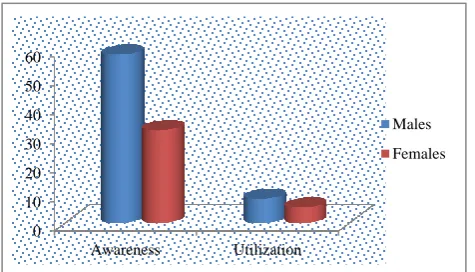
Figure 1: Awareness and utilization of geriatric welfare services.
Among the study participants 67% complained of joint pain, followed by visual problems (49%) and 48% of them complained of dental and chewing problem and 41% had gastritis problem (Table 3).
DISCUSSION
Major proportion of the study participants in our study belonged to 60-69 years of age group which is similar to a study conducted by Madhu et al.6 Our study reported that around 27% were widow and 19% were widower. In a similar study conducted by Lena et al.7 12% were widower and 68% were widow. Illiteracy was among 46% of the elderly which is comparatively less when compared to the study results conducted by Niranjan et al were percentage of illiteracy was 74%.8 In the present study 24% of the elderly had one or more addictive habits which is less when compared to study conducted by Niranjan, et al.8
Our results showed that 79% of the elderly were financially dependent, in a similar study conducted by Purohit et al reported 66% were financially dependent.9 Around 32% felt lonely and 25.3% were sad presently, and the reason quoted was that they felt that there advice is not taken into consideration at home and they did not have regular social contacts. In a similar study conducted by Prakash et al.2 23% of study participants reported lonliness and 17% of them felt that they were neglected at home.
66.66% complained of joint pain which is similar to study done by Padda et al.10 The proportion of chronic non communicable diseases was less when compared to study conducted by Prakash et al, who reported 48% of hypertension, 14% of asthma.2
Our study showed that 46% of the elderly were aware of the geriatric welfare services and only 7% of them utilized one or the other services. In a similar study conducted by Goel et al,reported 45% of the respondents had utilized geriatric welfare services which is high when compared to our results this could be due to the fact that majority in our study were illiterate.11
CONCLUSION
With on-going economic development and the
consequent changes in family structure and relationships, the elderly lose their relevance and their significance in their own households and face problems. The findings from the study clearly highlight that income insecurity, illiteracy, age related morbidity, psycho-social factors, less utilization and awareness about welfare services tend to make the elderly vulnerable.
Recommendations
There is a need to highlight the medical, psycho social and socio economic problems that are being faced by the elderly in India, and strategies for bringing about an improvement in their quality of life also need to be explored. The information can help and has important role in improving the well-being and quality of life of the elderly. Social security schemes should be more flexible to cover larger population.
Funding: No funding sources Conflict of interest: None declared
Ethical approval: The study was approved by the Institutional Ethics Committee
REFERENCES
1. Gopal KI, Anitha N. Geriatric Health in India: Concerns and solutions. Indian J Com Med. 2008;33(4):214-8.
2. Prakash R, Choudhary SK, Singh VS. A Study of morbidity pattern among Geriatric Population in an Urban area of Udaipur. Rajasthan. Indian J Com Med. 2004;29:35-9.
3. Park K. Park’s Text book of Preventive and Social
Medicine. 23rd edition. Banarsidas Bhanot
publishers, Jabalpur. 2015
4. Chandwani HR, Jivarajani PJ, Jivarajani HP. Health and Social Problems of Geriatric Population of Gujarat, India. Internet J Geriatr Gerontol. 2009;5(1):1-6.
5. Bhatia S, Swami HM, Thakur JS, Bhatia V. A Study of Health Problems and lonliness among elderly in Chandigarh. Indian J Com Med. 2007;32:255-8.
6. Madhu T, Sreedevi A. A study of
Socio-demographic profile of geriatric population in the field practice area of Kurnool Medical College. Int J Res Dev Health. 2013;1(2): 69-70.
7. Lena A, Ashok K, Padma M, Kamath V, Kamath A.
Health and Social problems of the elderly: A Cross- sectional Study in Udupi Taluk, Karnataka. Indian J Com Med. 2009;34:131-4.
8. Niranjan GV, Vasundhara MK. A study of Health Status of aged persons in slums of Urban field practice area Bangalore. Indian J Com Med. 1996;21;1-4.
9. Purohit CK, Sharma R. A Study of general health status of persons aged 60 years and above in RHTC
area, Naila. Indian J Med Research. 1976;38(6):117-22.
10. Padda AS, Mohan V, Singh J, Deepti SS, Singh G, Dillin HS. Health profile of aged persons in urban field practice areas of Medical college Amritsar. Indian J Community Med. 1998;23:72-6.
11. Goel PK, Garg SK, Singh JV, Bhatnagar M, Chopra H, Bajpai SK. Unmet needs of the elderly in rural
population of Meerut. Indian J Community Med. 2003;28:165-6.
Cite this article as: Patil VV, Udgiri R.Psychosocial problems, chronic illness and welfare service