Original Research Article
Utilization of maternal and child health services among migratory/slum
dwellers in Udupi municipality area, Karnataka, India
Divya V. Pai
1, Zari Anjum
2, Ashwini Kumar
1*, Avinash Shetty
1,
Surabhi Mishra
3, Uttam Kumar
4, Ashita Agrawal
5INTRODUCTION
Worldwide maternal mortality has dropped by 44% in the last 25 years i.e. from 385 in 1990 to 216 in 2015. A similar receding trend has been witnessed in India during
the same period where the MMR dropped by 68.7%.1 Considering the likelihood of accelerating this decline the countries have united behind one target under Sustainable Development Goal 3 i.e. to reduce global MMR to less than 70 per 1,00,000 live births with no country having ABSTRACT
Background: Irrespective of the tremendous efforts made by Government of India the utilization of MCH services continues to be very low among women belonging to lower socio economic status particularly among slum and migratory population. This significantly upsets country’s declining trend of maternal and infant mortality rate. Therefore a study was undertaken to assess the utilization of maternal and child health services among migratory/slum dwellers in a municipality area.
Methods: A community based cross- sectional study was conducted for a period of one month among two hundred eligible women of the study population.
Results: Study targeted 1200 households in 16 localities and we obtained information from 200 eligible mothers. Amongst them 74% availed antenatal services from government facilities and only 67% were registered in the first trimester. All mothers received antenatal services. Mother and child protection card was not received by 8.5% of women. 86.1% of them had institutional delivery. 13.9% of mothers delivered at home and 10% of the deliveries were unattended or assisted by friends and relatives. JSY benefits were not availed by 55% of the women.41.5% babies delivered had low birth weight. 14.7% of the children were either partially immunized or not immunized at all. Amongst women belonging to target couple 68% were not using any form of contraception.
Conclusions: Utilization of Maternal and Child Health services among the migratory and slum dwellers living in the Municipality area is not satisfactory.
Keywords: Utilization, Maternal and child health services, Slums, Migratory population
1
Department of Community Medicine, Kasturba Medical College, Manipal Academy of Higher Education, Manipal, Karnataka, India
2
Flight Lieutenant, Air Force Station, Jalahalli, Karnataka, India
3
Department of Community and Family Medicine, All India Institute of Medical Sciences, Rishikesh, Uttarakhand, India
4
Government Medical College, Churu, Rajasthan, India
5
Kasturba Medical College, Manipal Academy of Higher Education, Manipal, Karnataka, India
Received: 10 July 2018
Revised: 26 July 2018
Accepted: 27 July 2018
*Correspondence:
Dr. Ashwini Kumar,
E-mail: [email protected]
Copyright: © the author(s), publisher and licensee Medip Academy. This is an open-access article distributed under the terms of the Creative Commons Attribution Non-Commercial License, which permits unrestricted non-commercial use, distribution, and reproduction in any medium, provided the original work is properly cited.
MMR of more than twice the global average by 2030.2 With this vision in mind, Government of India launched the National Rural Health mission in 2005 to provide affordable and quality health care to the poorest households in the remotest regions of the country thereby paving way for increased institutional deliveries.3
Public health system in India is more focused to the rural areas thereby creating a huge lacunae of such services in the urban areas. In addition to this rapid urbanization has overburdened existing health care system.4,5 Health of the urban poor is as worse as the rural population.6 Various studies have shown that inadequate utilization of maternal and child health services (MCH) among urban poor particularly the slum dwellers leads to high MMR, under nutrition, poor immunization and infant morbidity and mortality.7-10 Therefore, this study has been conducted to assess the utilization pattern of MCH services among slum dwellers of Udupi municipality area.
METHODS
A community based cross sectional study was conducted in households of urban slums in Udupi municipality area for a period of one month (December 2015). Udupi Municipality area covers a population of 1, 25,306 within a geographical area of 69.28 square km. It consists of a various health facilities in its proximity such as the two thousand bedded Kasturba Medical College Hospital which is a private hospital and a government run District Hospital and Maternal and Child Health hospital (400 bedded). Apart from this there are 15-20 private hospitals and nursing homes. Furthermore there are around five hundred general and specialist private practitioners offering services. All these health facilities are located within 5- 10 kms radius.
Inclusion criteria
All married women who had delivered between the period of 30th November 2013 to 30th November 2015 were included in the study.
Exclusion criteria
Women who were not available at the time of house visit/revisit or those who were pregnant for the first time were not taken into consideration as ours was not a follow up study.
Sample size
All eligible women who gave consent were included in the study. So our sample size came up to 200.
Sampling technique
Purposive sampling was employed for the study.
Data collection
A house-to-house survey of all the previously identified slums in the Udupi Municipality area was done with the help of ten Community Medicine Post graduates, eight field ANMs, four Medico Social Workers (MSWs) under the daily supervision of the investigators for ten days. We visited 1200 households and obtained information from 200 women. During house visits, information was collected using a predesigned, pretested semi-structured questionnaire. Main domains of the questionnaire covered were details related to socio-demographic details of the mother and utilization of mother and child services of recently delivered mother. Socio economic status was assessed based on the availability of APL or BPL card. A second visit was made in case the mother or informer was not available at the time of first visit
Data analysis
Data was compiled and analyzed using Statistical Package for Social Sciences (SPSS VER. 15). Results were summarized as percentages and proportions with 95% confidence interval.
RESULTS
This study was conducted among 200 mothers who had delivered within two years. Their mean age was 23.8±3.96 years. Majority of mothers were in the age group of 18-30 years (82.1%). About half of the mothers were illiterate (46.5%). Around three fourth of the mothers possessed BPL card (77.4%) which is essential for availing different card linked services. Most of them resided in a nuclear family (82%). Teen age pregnancy was still prevalent i.e. about 17.6% as almost half (43%) of them were married before 18 years. More than one third of them were residing in the area for more than five years (37.4%) (Table 1).
Three fourth (74%) of the mothers were utilizing government health facilities for their antenatal checkup. More than half of them directly went to the health centre and got themselves registered (56.7%). Only two third (67%) of the antenatal mothers registered in the first trimester. Mother and child protection card was not received by 8.5% of the mothers. Most of the mothers (82%) had 4 or more antenatal visits Majority of mothers underwent blood tests and mandatory urine tests (99% and 98% respectively). However details of the tests could not be ascertained. A greater proportion of the mothers had taken adequate doses of Tetanus toxoid injection and IFA tablets (94% and 85.6% respectively) (Table 2).
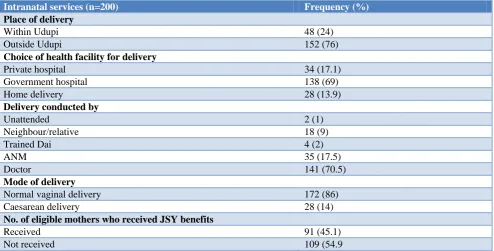
friends and relatives. Majority of women, i.e. 86% delivered by normal vaginal delivery. Even though 77.4% of women possessed BPL card, only 45% received Janani
Suraksha Scheme Benefit and 55% were deprived of the benefit on various occasions for different reasons (Table 3).
Table 1: Socio demographic characteristics of the mothers who delivered within the last 2 years.
Socio-demographic characteristics (n=200) Frequency (%)
Age of the mother (in years)
<18 08 (4)
18-30 164 (82.1)
>30 28 (13.9)
Literacy status
Illiterate 93 (46.5)
Class 1st – 4th 12 (6)
Class 5th – 10th 85 (42.5)
Class 11th and above 10 (5.0)
Possession of BPL card
Yes 155 (77.4)
No 45 (22.6)
Type of family
Nuclear 164 (82)
Joint 25 (12.5)
Three generation 11 (5.5)
Duration of stay in Udupi (in years)
<1 63 ( 31.7)
1-5 62 (30.9)
>5 75 (37.4)
Age at marriage ( in years)
<18 86 (43)
18-25 112 (56)
25-30 2 (1)
Age at first pregnancy (in years)
<18 35 (17.6)
18-30 164 (81.9)
>30 1 (0.5)
Table 2: Utilization of antenatal services by the mothers.
Antenatal services (n=200) Frequency (%)
Source of antenatal check-up
Government hospital 148 (74)
Private hospital 52 (26)
Mode of registration
By ANM during house visit 86 (42.8)
Self-registration 113 (56.7)
Indirect-registration 1 (0.5)
Timings of registration (Trimester)
First 134 (67.2)
Second 61 (30.3)
Third 5 (2.5)
Possession of mother and child protection card (MCP)
Yes 183 (91.5)
No 17 (8.5)
Number of antenatal visit
<4 visit 36 (18)
4-8 visit 129 (64.5)
>8 visit 35 (17.5)
Antenatal services (n=200) Frequency (%)
Blood test done
Yes 198 (99)
No 2 (1)
Urine test done
Yes 196 (98)
No 4 (2)
Two doses of tetanus toxoid injection
Adequate 188 (94)
Inadequate 9 (4.5)
Not received 3 (1.5)
Iron and folic acid tablets received
Adequate 171 (85.6)
Inadequate 25 (12.4)
Not received 4 (2)
Table 3: Utilization of intranatal services by mothers.
Intranatal services (n=200) Frequency (%)
Place of delivery
Within Udupi 48 (24)
Outside Udupi 152 (76)
Choice of health facility for delivery
Private hospital 34 (17.1)
Government hospital 138 (69)
Home delivery 28 (13.9)
Delivery conducted by
Unattended 2 (1)
Neighbour/relative 18 (9)
Trained Dai 4 (2)
ANM 35 (17.5)
Doctor 141 (70.5)
Mode of delivery
Normal vaginal delivery 172 (86)
Caesarean delivery 28 (14)
No. of eligible mothers who received JSY benefits
Received 91 (45.1)
Not received 109 (54.9
Table 4: Utilization of child health and family planning services by mothers.
Child health and family planning services Frequency (%)
Birth weight of the child (n=200)
Don’t know 17 (8.5)
<2.5 kg 83 (41.5)
2.5–3 kg 63 (32.8)
>3 kg 37 (18.5)
Immunization status of children (n=195)
Fully immunized 166 (85.3)
Partially immunized 29 (14.7)
Utilization of family planning (n=200)
Yes 64 (32)
No 136 (68)
Utilization of family planning by target couple (n=114)
Yes 56 (49.1)
No 58 (50.9)
Type of family planning utilized (n=64)
OCP 5 (7.81)
IUCD 9 (14.06)
Tubectomy 50 (78.13)
Out of 200 deliveries almost half (41.5%) of the babies were less than 2.5kg and can be called as low birth weight babies. 14.7% of children less than two years were found to be partially immunized or not immunized at all. Majority of the eligible couples were not utilizing any family planning methods (68%). Almost half of the mother belonging to target couple (50.9%) reported they were not using any method of contraception. Majority of the women i.e., 78.13% reported tubectomy as the most common contraceptive method used to space pregnancy (Table 4).
DISCUSSION
The present study included 200 mothers who delivered in the past two years. 82% of mothers were in the age group of 18-30 years and their mean age was 23.8±3.96 years. Similar findings were found in the study conducted by Budimelli et al in urban slums at East Godavari District Andhra Pradesh.11 Whereas a study conducted by Neyaz et al in the urban slums of Aligarh, 36.8% of women were in the age group of 26-30 years and 50% of them were in the age group of 20-25 years in the study conducted by Sharma et al in the urban slums of Amritsar.12,13
In our study teenage pregnancy was seen in 17.6% of women. Almost similar findings were seen in the study conducted by Budimelli et al (12.7%). Whereas a double number of teenage pregnancies were seen in a study conducted by Shukla et al In the slums of Lucknow (36.8%).7,11
In the present study 43% of women were married before 18 years. Analogous findings were seen in the study conducted by Kumar, Bharadwaj in the urban slums of Lucknow (55.6%).14
In our study about half of the mothers were illiterate (46.5%). These findings were alike to those found by Neyaz et al (56%), Singhal et al (50%) and Kumar et al (52.2%).11,14,15 Contradictory findings were seen in a study conducted by Kulkarni and Durga in the urban slums of Nagpur where only 5.62% of the women were illiterate.16 Whereas a relatively higher number of women were illiterate in a study conducted by Sharma et al at Amritsar (74.7%).13
Most of the women resided in a nuclear family (82%). Comparable findings were seen in a study conducted by Neyaz et al (67.4%) and Budemelli et al (66%).11,12
Around three fourth of the mothers possessed BPL card (77.4%) which is essential for availing different card
linked services. Similar findings were seen in a study conducted by Pahwa (74%). Whereas in a study conducted by Neyaz et al (35.8%) and Budimelli et al (27%) lesser proportion of women belonged to lower socio economic status.9,11,12
Almost two third (67%) of the antenatal mothers registered in the first trimester. Similar findings were seen in the study conducted by Kumar et al (67.2%) and Shukla et al (63.5%).7,14 Contrasting finding were seen in the study conducted by Singhal et al (22.22%).15
Three fourth (74%) of the mothers were utilizing government health facilities for their antenatal visits which was analogous to the observations made by Neyaz (72.4%), Kumar et al (70.5%).12,14 Whereas a higher proportion of mothers used government facilities in a study conducted by Badge et al (81%).17
Majority of the mothers (82%) had 4 or more antenatal visits. Very poor findings were seen in a study conducted by Sharma et al at Amritsar (10.4%), Shukla et al at Lucknow, Badge et al (1.7%) and Singhal (16.67%).7,13,15,17 Whereas a relatively lower percentage of women had more than 3 vists in a study conducted by Neyaz et al (51.4%), Sarode et al (52.2%), Kumar et al (50%),), and Kulkarni et al (25%).12,14,16,18 While a greater proportion of women had more than 3 ANC visits (93%) in a study conducted by Budimelli et al.11
In this study, Mother and child protection card was not received by 8.5% of the mothers. Whereas in a study conducted by Devasenapathy et al, 30% of women did not receive the antenatal card.18
The present study displayed that most of mothers underwent blood tests and mandatory urine tests.( 99% and 98% respectively). This was very high as compared to a study conducted by Sarode in urban slums of Mumbai where only 78% women underwent blood tests and 75.3% women underwent urine tests.19
In our study 94% of the mothers had taken adequate doses of tetanus toxoid injection. However a greater proportion of mothers had taken two doses of tt in studies conducted by Kulkarni et al and Budimelli et al.11,16 A paradoxical finding was observed in the study conducted by Kumar et al (25.9%), Sharma et al (65.5%), Singhal et al (58.8%), Sarode et al (68.8%).13-15,19
consumption of IFA tablets by the mothers.7,13,16,17,19 While a study conducted by Budimelli et al. showed a higher proportion of consumption of IFA tablets among the mothers. (93.3%).11
In our study majority of mothers had institutional deliveries (86%) but there were still 13.9% of mothers who delivered at home. These findings are comparable to the study conducted by Budimelli et al.11 Whereas a study conducted by Shukla et al (40%), Singhal et al (48.9%) and Pahwa et al (49.3%) showed greater number of home deliveries.7,9,15 Comparatively fewer home deliveries were seen in a study conducted by Kulkarni et al (5.62%).16
In the present study around 10% of the deliveries were either unattended or assisted by friends and relatives. Study conducted by Singhal et al (67.87%) and Kulkarni et al (44.45%) outnumbered the deliveries conducted by untrained persons.15,16 Whereas a study conducted by Budimellis et al showed that 6.7% of the deliveries were assisted by untrained persons.11
In the present study only 45% received Janani Suraksha Scheme Benefit and 55% were deprived of the benefit on various occasions. When asked for the reasons they stated that they did not know about the scheme, there was no one to guide, lack of bank account to encash the cheque received and due to frequent travel she was denied of any such kind of government services. Conflicting findings were seen in a study performed by Pahwa et al where only 11.7% of the eligible mothers received JSY benefits. Those who did not use the benefits stated that JSY cards were not issued by ANMs (40%), hospital staff were not co-operative (24%), paper work was not complete (20%) and they were unaware of the scheme (16%). 9 In a study conducted by Mahopatra only 3% of mothers were not using JSY benefit although all of them were aware of the scheme due to lack of counselling and unpreparedness.20
In this study almost half (41.5%) of the babies were less than 2.5kg whereas a lesser proportion of newborns were having low birth weight in a study conducted by Paul et al (28.3%) Chabbra (39.1%) and Chowdary (36.2%).21-23
In the present study, 14.7% of children less than two years were found to be partially immunized or not immunized at all. Whereas a greater proportion of children were not immunized in a study conducted by Pahwa et al (56.7%) and Singhal et al (44.99%).9,15
In the present study it was observed that most of the eligible couples were not utilizing any family planning methods (68%) and among those using contraceptives 78.13% had undergone tubectomy. However in a study conducted by Singhal et al only 24.02% used contraceptives and among them condom was the most common form of contraceptive used (65.46%). While in a study conducted by Sarode et al almost half of them were using contraceptives (49%). A greater proportion of couples were using contraceptives in a study conducted
by Taklikar in the urban slums of Pune (69.5%) with tubectomy being the most common form of contraceptive (75.%). Also 87.7% were using contraceptives in a study conducted by Makade in the urban slums of Mumbai with oral contraceptives being the most common form of contraceptive (35.9%).15,19,24,25
CONCLUSION
Utilization of MCH services among slum population is not satisfactory in spite of physical accessibility to health care facilities by study population. Home deliveries and unsafe delivery practices are still prevalent. Nearly half of the babies were born with low birth weight taking them ahead with its own health and development related consequences. Around half of the target couples were not protected by any of the family planning methods. Therefore there is an urgent need to take into account the health care services of slum/migrant population in district health planning process. In addition to this seasonal movement of this population needs to be monitored and accounted for preventive, curative and promotive services. Adequate health force must be created, trained, sensitized and motivated to take on the urban poor health challenges.
Limitations
Large proportion of these migrant dwellers stay part of the year (seasonal) in the study area and rest somewhere else (native place). Even though we attempted to cover all the mothers delivered in municipality year in previous two years all of them were not available at the time of our visit and revisit. Quality of services provided to them was not ascertained.
ACKNOWLEDGEMENTS
We sincerely thank Dr. Rohini, District Health Officer, Udupi district, Dr. M.G. Rama, R.C.H Officer, Udupi District and all the staffs of Municipality Commissioner for their constant support throughout the study. We would also like to thank the ANMs and postgraduates for their help during data collection.
Funding: No funding sources Conflict of interest: None declared Ethical approval: Not required
REFERENCES
1. World Health Organization. Trends in maternal mortality: 1990 to 2015. Estimates by WHO, UNICEF, UNFPA, World Bank Group and the United Nations Population Division. Geneva. World Health Organization. 2015.
3. Government of India. National Rural Health Mission. Meeting people's health needs in rural areas. Framework for implementation 2005-2012. New Delhi: Ministry of Health and Family Welfare. 2005-2012.
4. Ahluwalia IJ. Report on Indian Urban Infrastructure and Services. The High Powered Expert Committee (HPEC) for Estimating the Investment Requirements for Urban Infrastructure Services. Indian Council for Research on International Economic Relations. 2011. Available at: http://icrier.org/pdf/FinalReport-hpec.pdf. Accessed on 18 July 2018.
5. Yadav K, Nikhil SV, Pandav CS. Urbanization and health challenges: need to fast track launch of the National Urban Health Mission. Indian J Community Med. 2011;36:3–7.
6. Shetty P. Health care for urban poor falls through the gap. Lancet. 2011;377(9766):627–8.
7. Shukla M, Agarwal M, Imchen T, Rehman HM, Yadav K, Singh S. Utilization of maternal health care services in slums of Lucknow, capital of Uttar Pradesh. Int J Interdisciplinary Multidisciplinary Studies. 2015;2(11):23-7.
8. Srivastava A, Mahmood SE, Srivastava PM, Shrotriya VP, Kumar B. Nutritional status of school-age children - A scenario of urban slums in India. Arch Public Health. 2012;70(1):8.
9. Pahwa P, Sood A. Existing practices and barriers to acess of MCH services- a case study of residential urban slums of district Mohali, Punjab, India. Global J Med Public Health. 2013;2(4):1-7.
10. Kyu HH, Shannon HS, Georgiades K, Boyle MH. Association of Urban Slum Residency with Infant Mortality and Child Stunting in Low and Middle Income Countries. BioMed Research Int. 2013;604974:12.
11. Budimelli S, Chebrolu K, Utilization of maternal health care services in slums of east Godavari district of Andhra Pradesh. International J Med Health Sci. 2013;2(2):141-8.
12. Neyaz A, Sahu PC, Ahmed MS. Utilization of antenatal services in slum areas of Aligarh. Int J Reprod Contracept Obstet Gynecol. 2015;4:678-82. 13. Sharma N, Kumar HVK, Devgan S. A study on
utilization of antenatal care services in urban slums of Amritsar city, Punjab, India. Int J Community Med Public Health. 2017;4:698-703.
14. Kumar A, Bharadwaj P. To Estimate The Extent of Utilization of Maternal Health Services in The Urban Slums of Lucknow City Uttar Pradesh. IOSR J Humanities Social Sci. 2016;21(6):1-6.
15. Singhal A. Utilization of Maternal Health Services in Slums of Rajasthan. Int J New Tech Res. 2015;1(8):76-81.
16. Kulkarni MV, Durga PM. Utilization of Maternal Health Care Services in an Urban Slum in Nagpur. Indian J Matern Child Health. 2013;15(2):1-7. 17. Badge VL, Pandey M, Solanki MJ, Shinde RR. A
cross-sectional study of migrant women with reference to their antenatal care services utilization and delivery practices in an urban slum of Mumbai. J Family Med Prim Care. 2016;5:759-64.
18. Devasenapathy N, Jerath S G, Allen E, Sharma S, Shankar AH, Zodpey S. Reproductive healthcare utilization in urban poor settlements of Delhi:Baseline survey of ANCHUL (Ante Natal and Child Health care in Urban Slums) project. BMC Pregnancy and Childbirth. 2015;15:212.
19. Sarode VM. Does Non-ANC Influence Complications while delivery among Women in Slums in Greater Mumbai? Int J Humanities Social Sci Edu. 2014;1(1):12-25.
20. Mohapatra I. A Study on Utilisation of Janani Suraksha Yojana (JSY) Services in an Urban Slum in Bhubaneswar, Odisha. J Med Sci Clin Res. 2017;5(1):15859-64.
21. Chhabra P, Sharma AK, Grover VL, Aggarwal OP. Prevalence of Low Birth Weight and its Determinants in an Urban Resettlement Area of Delhi. Asia Pac J Public Health. 2004;16(2):95-8. 22. Choudhary AK, Choudhary A, Tiwari SC, Dwivedi
R. Factors associated with low birth weight among newborns in an urban slum community in Bhopal. Indian J Public Health. 2013;57:20-3.
23. Paul B, Saha I, Mukherjee A, Biswas R, Roy S, Chaudhuri RN. Morbidity pattern of low-birth-weight infants in an urban slum of Kolkata, India. J Egypt Public Health Assoc. 2011;86(3-4):39-43. 24. Taklikar CS, More S, Kshirsagar V, Gode V.
Prevalence of contraceptive practices in an urban slum of Pune city, India. Int J Med Sci Public Health. 2015;4:1772-7.
25. Makade K, Padhyegurjar M, Padhyegurjar S B, Kulkarni RN. Study of Contraceptive Use among Married Women in a Slum in Mumbai. National J Community Med. 2012;3(1):40-3.
Cite this article as: Pai DV, Anjum Z, Kumar A, Shetty A, Mishra S, Kumar U, et al. Utilization of maternal and child health services among