Review Article
Laparoscopic versus open ventral hernia repair
Rayan Alsadiqi
1*, Abdullah Albishri
2, Ahmad Almaghrabi
2, Badr Aljedaani
2,
Khalid Alghamdi
3, Fatimah Alhijab
4, Mohammed Alsulami
2, Abdullah Hussain
2,
Mohammad Alshaikh
5, Nafisah Jaad
6INTRODUCTION
Ventral and incisional hernia repair is one of the most mutual operations implemented in daily clinical practice. Incisional hernia is a common long-term complication of abdominal surgery and is estimated to occur in 11–20% of laparotomy incisions.1 Almost 50% of incisional hernias develop within the first 2 years after the primary surgery, and 74% develop after 3 years.2 The reappearance rate of incisional hernia after primary suture repair is more than 50% and has been reduced to 10–23%
after the introduction of prosthetic materials (meshes) in hernia repair.3,4
A vast majority of open surgical repair of incisional hernias are achieved using a prosthetic mesh. Even though it is a tensionless repair, it is still associated with early or late complications such as mesh infection, surgical site infection, chronic pain, seroma, hematoma, mesh shrinkage, etc. The recurrence rate following mesh repair is still as high as approximately 32 % over a 10-year follow-up period.5 A number of factors can influence these complication rates, comprising the position and site
ABSTRACT
From the patient’s perspective, a ventral hernia can cause pain, adversely affect function, increase size, cosmetically distort the abdomen, and incarcerate/strangulate abdominal contents. The only known cure for a ventral hernia is surgical repair
.
The purpose of the current analysis was to review the published randomized controlled trials (RCTs) of the surgical care of ventral hernia. We conducted this meta-analysis using a comprehensive search of EMBASE, MEDLINE, PubMed, Cochrane Database of Systematic Reviews, and Cochrane Central Register of Controlled Trials till 01 March 2018 for randomized controlled trials on the use of mesh reinforcement in abdominal wall hernia repair. 15 studies met the search criteria, laparoscopic repair (OR 0.59; 95% CI 0.02–6.71) had the highest probability of having the lowest rate of surgical site infection. Among open mesh repair techniques, sublay repair (OR 1.41; 95% CI 0.01–5.99) had the highest probability of being the best treatment. Among patients experiencing ventral hernia repair, mesh reinforcement ought to be used regularly when there is no infection. Sublay mesh might outcome in fewer reappearances and surgical site infections. The quality of evidence to support these recommendations is moderate to high.Keywords: Laparoscopic, Open, Hernia, Randomized controlled trial, Ventral hernia
1
Imam Mohammed Bin Saud University, Riyadh, KSA
2King Abduaziz University, Rabigh, KSA 3Albaha Universty, Albaha, KSA
4King Faisal University, Alahsa, KSA 5
Prince Saud Bin Jalawi Hospital, Ahsa, KSA
6Umm Al-Qura University, Makkah, KSA
Received: 25 May 2018
Accepted: 11 June 2018
*Correspondence:
Dr. Rayan Alsadiqi,
E-mail: [email protected]
Copyright: © the author(s), publisher and licensee Medip Academy. This is an open-access article distributed under the terms of the Creative Commons Attribution Non-Commercial License, which permits unrestricted non-commercial use, distribution, and reproduction in any medium, provided the original work is properly cited.
in which the mesh is placed and the type of mesh used. It is extensively recognized that mesh ought to be utilized for Ventral hernia repair in a clean setting; nevertheless, the type of mesh that ought to be used and where the mesh ought to be placed are still argued.
Open hernia repair can be a main operation with significant morbidity affected by infectious complications. An increasing interest in laparoscopic surgery and the availability of new materials have encouraged the adoption of laparoscopic techniques in ventral hernia repair. In order to improve upon the recurrence rate of open mesh repair of incisional hernia, LeBlanc, in 1993, reported the first case of laparoscopic incisional hernia repair using a synthetic mesh.6 This procedure apparently decreases the surgical offense, permitting better visualization of the defect, decreasing the risk of bleeding, infectious complications, seroma formation and recurrence rate. Since the introduction of this technique, a number of randomized control trials (RCTs) comparing laparoscopic and open methods have been published analyzing various aspects of these approaches. The purpose of the current analysis was to review the published randomized controlled trials (RCTs) of the surgical care of ventral hernia.
METHODS
Data sources and searches
We conducted this meta-analysis using a comprehensive search of EMBASE, MEDLINE, PubMed, Cochrane Database of Systematic Reviews, and Cochrane Central Register of Controlled Trials till 01 March 2018 for randomized controlled trials on the use of mesh reinforcement in abdominal wall hernia repair. Both semiparametric and parametric methods were used. No language restrictions were imposed. We followed the standard guidelines for conducting and reporting meta-analyses of observational studies.7
Selection criteria
Studies were included in this meta-analysis if they satisfied the following criteria: randomized controlled trials studies on ventral hernia repair among adult patients in which there was reporting of incision infection, surgical site infection, or hernia recurrence., and the investigators reported relative risks (RRs) with 95% Ci, all studies with at least one arm evaluating open ventral hernia repair with mesh placed in the onlay, sublay, or underlay position were included. Exclusion criteria were failure to define the location in which meshes were placed or the use of mixed techniques without reporting the stratified results.
Data extraction
The final data were abstracted from each study using standardized form: the first author’s name, year of
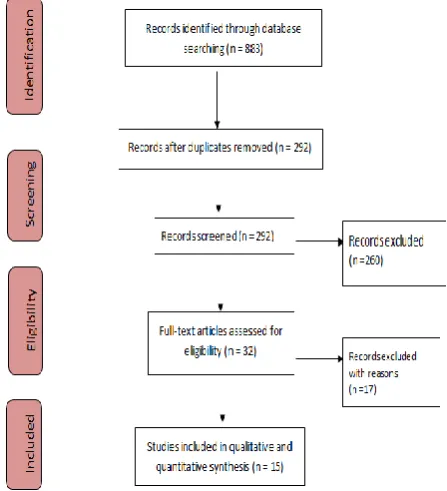
publication, number of patients, hernia type and size, age, study location, body mass index (BMI), follow-up duration, mesh material and density, and elective/emergency nature of the operation. These factors were chosen because they represent the most important variables for classifying ventral hernias, assessing patient risk, and treatment of patients. The outcomes assessed were hernia recurrence and surgical site infection. Flow diagram showing the selection criteria of assessed studies.8
Statistical analysis
The present meta-analysis utilized Stata version 12.0 software for statistical analysis. Mean difference (MD) were calculated for continuous variables. Pooled odds ratios (OR) were calculated for discrete variables. Heterogeneity amongst the trials was determined by means of the Cochrane Q value and quantified using the I2 inconsistency test with a significance set at the P-value <0.10 or I2 score >50%.9 DerSimonian-Laird random-effect meta-analysis was adopted when obvious heterogeneity existed.10.
RESULTS
We recognized 883 citations using the search strategy. Of these, we excluded 292 after examining the title and abstract including removal of duplicates. We retrieved and evaluated 32 articles in more detail, of which 17 articles were excluded, leaving 15 studies that were eligible for inclusion (Figure 1). Main characteristics of included studies have been summarized in Table 1.
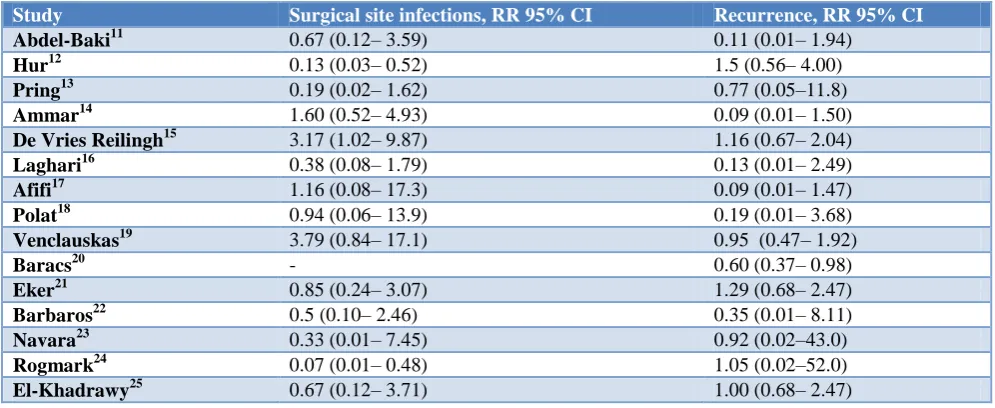
All studies compared locations for mesh placement and met the criteria for evaluation (Table 2). The studies were adequately comparable to produce the data. Suture-only and laparoscopic ventral hernia repair characterize the controls. It is expected that the suture-only group will
have the highest risk of hernia recurrence while both groups (suture-only and laparoscopic) will have the lowest risks of surgical site infection. Cases of infection were stated in the studies; though, the results related with these cases were not described individually.
Table 1: Characteristics of included studies.
Study Year N Control/intervention Hernia type
Abdel-Baki11 2007 48 Suture onlay Mixed
Hur12 2010 146 Onlay lap Incisional
Pring13 2008 54 Underlay/lap Mixed
Ammar14 2010 80 Suture onlay Primary
De Vries Reilingh15 2007 37 Suture underlay Incisional
Laghari16 2012 62 Suture onlay Incisional
Afifi17 2005 41 Onlay underlay Incisional
Polat18 2005 32 Suture onlay Primary
Venclauskas19 2010 161 Suture onlay sublay Incisional
Baracs20 2010 370 Sublay onlay Mixed
Eker21 2013 194 Sublay lap Incisional
Barbaros22 2007 46 Onlay lap Mixed
Navara23 2007 24 Sublay lap Incisional
Rogmark24 2013 131 Sublay/ lap Incisional
El-Khadrawy25 2015 60 Onlay sublay Primary
Table 2: Mesh placement outcomes.
Study Surgical site infections, RR 95% CI Recurrence, RR 95% CI
Abdel-Baki11 0.67 (0.12– 3.59) 0.11 (0.01– 1.94)
Hur12 0.13 (0.03– 0.52) 1.5 (0.56– 4.00)
Pring13 0.19 (0.02– 1.62) 0.77 (0.05–11.8)
Ammar14 1.60 (0.52– 4.93) 0.09 (0.01– 1.50)
De Vries Reilingh15 3.17 (1.02– 9.87) 1.16 (0.67– 2.04)
Laghari16 0.38 (0.08– 1.79) 0.13 (0.01– 2.49)
Afifi17 1.16 (0.08– 17.3) 0.09 (0.01– 1.47)
Polat18 0.94 (0.06– 13.9) 0.19 (0.01– 3.68)
Venclauskas19 3.79 (0.84– 17.1) 0.95 (0.47– 1.92)
Baracs20 - 0.60 (0.37– 0.98)
Eker21 0.85 (0.24– 3.07) 1.29 (0.68– 2.47)
Barbaros22 0.5 (0.10– 2.46) 0.35 (0.01– 8.11)
Navara23 0.33 (0.01– 7.45) 0.92 (0.02–43.0)
Rogmark24 0.07 (0.01– 0.48) 1.05 (0.02–52.0)
El-Khadrawy25 0.67 (0.12– 3.71) 1.00 (0.68– 2.47)
Laparoscopic repair (OR 0.59; 95% CI 0.02–6.71) had the highest probability of having the lowest rate of surgical site infection. Among open mesh repair techniques, sublay repair (OR 1.41; 95% CI 0.01–5.99) had the highest probability of being the best treatment. Evidence indicates that mesh reinforcement in clean cases can decrease hernia recurrence but increase risk of surgical site infection. Placing mesh in the sublay position (as opposed to the onlay or underlay position) may decrease the risk of hernia recurrence and surgical site infection.
DISCUSSION
be operated rather than low-density mesh. Mesh ought to be located as a sublay (in the retrorectus or preperitoneal space) when this is harmless and possible. These suggestions signify the most comprehensive combination of high-quality RCTs on the role of mesh reinforcement throughout ventral hernia repair. There was no difference in the demographics of the patient population included in the present analysis. The mean patients’ age in the laparoscopic and open repair groups displayed little variation.
Patient characteristics that increase the risk of surgical site infection include smoking, old age, steroid use, obesity, diabetes, malnutrition, and remote site infection. Before surgery, any known risk factors for surgical site infection should be treated if feasible. To reduce the risk of perioperative infection, the operative time and the hospital stay should be as short as possible.27 Studies have shown that generally the size of hernia defects and size of mesh used were bigger with laparoscopy, and just wider coverage of the anterior abdominal wall with mesh can hence also be hypothesized to result in reduced recurrence rates with laparoscopy.28 Laparoscopic repair is a form of underlay repair, however, open underlay repair had a significantly higher recurrence rate while a lower surgical site infection rate than laparoscopic underlay repair. Adjustments among these results must be reflected. Additional studies can measure different procedures and materials for each of these repair types to optimize both strategies and to determine the best setting for each.
Several studies use less postoperative pain or neuralgia as strong supportive indication for laparoscopic technology.
6,26 Extensive tissue dissection in open repair and
transfacial sutures might be accountable for more pain in open repair while direct tacking of the mesh on to the peritoneum may be accountable for pain in laparoscopic repair. Liberal use of local anesthesia or infiltration of the same in the abdominal cavity may reduce the occurrence of this complication.
Limitations of the analysis is that though ventral hernias are between the most common pathology perceived by the surgeons, few RCTs exist to direct the treatment of these patients. A few challenges must be faced. There is restricted regularization of terminology to define hernia type and outcome measurements. Lately, classification system for ventral hernias been developed, the field of ventral hernia repair is intimately associated with industry, which often drives and supports low-quality studies at high risk for bias.29
CONCLUSION
Among patients experiencing ventral hernia repair, mesh reinforcement ought to be used regularly when there is no infection. Sublay mesh might outcome in fewer reappearances and surgical site infections. The quality of evidence to support these recommendations is moderate
to high. To confirm these results, further studies should be made to make a better understanding comparing different mesh locations directly and mesh type.
Funding: No funding sources Conflict of interest: None declared Ethical approval: Not required
REFERENCES
1. Bloemen A, van Dooren P, Huizinga BF, Hoofwijk AG. Randomized clinical trial comparing polypropylene or polydioxanone for midline abdominal wall closure. Br J Surg. 2011;98:633–9. 2. Anthony T, Bergen PC, Kim LT, Henderson M,
Fahey T, Rege RV, et al. Factors affecting recurrence following incisional herniorrhaphy. World J Surg. 2000;24:95–100.
3. Shell DH, de la Torre J, Andrades T, Vasconez LO. Open repair of ventral hernia incisions. Surg Clin North Am. 2008;88:61–83.
4. Luijendijk R, Hop W, Van den Tol MP, de Lange DC, Braaksma MM, IJzermans JN, et al. A comparison of suture repair with mesh repair for incisional hernia. N Eng J Med. 2000;343:392–8. 5. Burger JW, Luijendijk RW, Hop WC, Halm JA,
Verdaasdonk EG, Jeekel J. Long-term follow-up of a randomized controlled trial of suture versus mesh repair of incisional hernia. Ann Surg. 2004;240:578-85
6. Leblanc KA, Booth WV. Laparoscopic repair of incisional abdominal hernias using polytetrafluoroethylene: preliminary findings. Surg Laparosc Endosc. 1993;3:39–41.
7. Stroup DF, Berlin JA, Morton SC, Olkin I, Williamson GD, Rennie D, et al. Meta-analysis of observational studies in epidemiology: a proposal for reporting. Meta-analysis Of Observational Studies in Epidemiology (MOOSE) group. JAMA 2000;283:2008–2012
8. Moher D, Liberati A, Tetzlaff J, Altman DG. Preferred reporting items for systematic reviews and meta-analyses: the PRISMA statement 2007. 9. Higgins JP, Thompson SG, Deeks JJ. Altman DG.
Measuring inconsistency in meta-analyses. BMJ. 2003;327(7414):557-60.
10. DerSimonian R, Laird N. Meta-analysis in clinical trials. Control Clin Trials. 1986;7(3):177-88. 11. Abdel-Baki NA, Bessa SS, Abdel-Razek AH.
Comparison of prosthetic mesh repair and tissue repair in the emergency management of incarcerated para-umbilical hernia: A prospective randomized study. Hernia. 2007;11:163–7.
13. Pring CM, Tran V, O’Rourke N, Martin IJ. Laparoscopic versus open ventral hernia repair: A randomized controlled trial. Aust NZ J Surg 2008;78:903–6.
14. Ammar SA. Management of complicated umbilical hernias in cirrhotic patients using permanent mesh: Randomized clinical trial. Hernia 2010;14:35–8. 15. de Vries Reilingh TS, van Goor H, Charbon JA,
Rosman C, Hesselink EJ, van der, et al. Repair of giant midline abdominal wall hernias: Components separation technique versus prosthetic repair: Interim analysis of a randomized controlled trial. World J Surg. 2007;31:756–63.
16. Laghari ZH, Lal K, Laghari AA, Soomro E. A comparative study of anatomic repair versus mesh repair in paraumbilical hernia. Med Channel. 2012;19:110–3.
17. Afifi RY. A prospective study between two different techniques for the repair of a large recurrent ventral hernia: A double mesh intraperitoneal repair versus onlay mesh repair. Hernia. 2005;9:310–5.
18. Polat C, Dervisoglu A, Senyurek G, Bilgin M, Erzurumlu K, Ozkan K. Umbilical hernia repair with the Prolene hernia system. Am J Surg. 2005;190:61–4.
19. Venclauskas L, Maleckas A, Kiudelis M. One-year follow-up after incisional hernia treatment: Results of a prospective randomized study. Hernia. 2010;14:575–82.
20. Baracs J, Weber G, Horva´th OP. [‘‘Onlay’’ mesh provides significantly better results than sublay reconstruction: Prospective randomized multicenter study of abdominal wall reconstruction with sutures only, or with surgical mesh—Results of a five-years follow-up] (Hun). 2010;63:302–11.
21. Eker HH, Hansson BM, Buunen M, Janssen IM, Pierik RE, Hop WC, et al. Laparoscopic vs. open incisional hernia repair: A randomized clinical trial. JAMA Surg. 2013;148:259–63.
22. Barbaros U, Asoglu O, Seven R, Erbil Y, Dinccag A, Deveci U, et al. The comparison of laparoscopic and open ventral hernia repairs: A prospective randomized study. Hernia. 2007;11:51–6.
23. Navarra G, Musolino C, De Marco ML, Bartolotta M, Barbera A, Centorrino T. Retromuscular sutured incisional hernia repair: A randomized controlled trial to compare open and laparoscopic approach. Surg Laparosc Endosc Percutan Tech A. 2007;17:86–90.
24. Rogmark P, Petersson U, Bringman S, Eklund A, Ezra E, Sevonius D, et al. Short-term outcomes for open and laparoscopic midline incisional hernia repair: A randomized multicenter controlled trial: The ProLOVE (Prospective Randomized Trial on Open versus Laparoscopic Operation of Ventral Eventrations) trial. Ann Surg. 2013;258:37–45. 25. El-Khadrawy OH, Abo-Ryia MH, Moussa GI, Saleh
AM. Prospective randomized evaluation of open preperitoneal versus preaponeurotic primary elective mesh repair for paraumbilical hernias. Surg Today. 2015;45:429–433.
26. Rosen M, Brody F, Ponsky J, Walsh RM, Rosenblatt S, Duperier F, Fanning A, Siperstein A. Recurrence after laparoscopic ventral hernia repair. Surg Endosc. 2003;17:123–8.
27. Bittner R, Bingener-Casey J, Dietz U, Fabian M, Ferzli GS, Fortelny RH, et al. Guidelines for laparoscopic treatment of ventral and incisional abdominal wall hernias (International Endohernia Society [IEHS]), Part 2. Surg Endosc. 2014;28:353– 79.
28. Misra MC, Bansal VK, Kulkarni MP, Pawar DK. Comparison of laparoscopic and open repair of incisional and primary ventral hernia: results of a prospective randomized study. Surg Endosc. 2006;20(12):1839–45.
29. Amiri AR, Kanesalingam K, Cro S, Casey AT. Does source of funding and conflict of interest influence the outcome and quality of spinal research? Spine J. 2014;14:308–14.
Cite this article as: Alsadiqi R, Albishri A,