Original Research Article
Assessment of knowledge, attitude, and practice regarding hepatitis B
among medical students in a private medical college in Kochi
Arun Jacob, Teena Mary Joy, Sreelakshmi Mohandas*, Harsha Lais, Nimitha Paul
INTRODUCTION
Hepatitis B is a chronic liver infection caused by a partially double stranded DNA virus, the hepatitis B virus. Viral hepatitis takes a heavy toll on lives, communities and health systems.1 Known globally and regionally for its high mortality and morbidity, hepatitis B infection resulted in 47% of the 1.4 million viral hepatitis deaths and 42 million DALY’s globally, as per
WHO and GBD 2015 reports.2,3
The death tolls due to viral hepatitis has shown a steady rise and these are comparable to the deaths due to HIV and tuberculosis.2
Among the many routes of transmission of HBV to humans, the most predominant one is horizontal rather than vertical transmission, in India.4 Around 257 million people live with chronic hepatitis B infections around the globe and in India, there are around 40 million HBV carriers.3,5 In India, professional blood donors and blood transfusions constitute a major risk group for HBV infection.6
Certain groups are at higher risk of hepatitis B infection. They include recipients of blood transfusions and organ transplantations, health care and laboratory personnel, homosexuals, prostitutes, percutaneous drug abusers, infants of HBV carrier mothers and immune-compromised person.7 Among this, healthcare workers are at the highest risk of HBV infection due to
ABSTRACT
Background: Hepatitis B virus is transmitted by body fluids, such as blood and serum. Sexual transmission, vertical transmission, and unsafe injections, including intravenous drug use, are the most common routes of infection for Hepatitis B infection. Medical students have a very important role in preventing the disease by improving the disease knowledge among themselves and the patients they will eventually treat.
Methods: A cross sectional study was conducted to assess the KAP among medical students of the first three academic years regarding hepatitis B virus infection. The sample size was 222 students. Data were collected from 230 students using a semi structured questionnaire and analyzed using SPSS v20.
Results: Among 230 medical students, 79.1% students had good knowledge about hepatitis B whereas 84.3% of the respondents had the right attitude towards hepatitis B. The practice component was low with only 44.8% of the respondents having correct practice regarding hepatitis B infection.
Conclusions: Although the knowledge and attitude regarding hepatitis B infection is high, the practice levels are low indicating the need to encourage proper practices among the medical students.
Keywords: Hepatitis B, Medical students, Knowledge, Attitude, Practice
Department ofCommunity Medicine, Amrita Institute of Medical Sciences, Kochi, Kerala, India
Received: 28 March 2019
Revised: 13 April 2019
Accepted: 15 April 2019
*Correspondence:
Dr. Sreelakshmi Mohandas,
E-mail: [email protected]
Copyright: © the author(s), publisher and licensee Medip Academy. This is an open-access article distributed under the terms of the Creative Commons Attribution Non-Commercial License, which permits unrestricted non-commercial use, distribution, and reproduction in any medium, provided the original work is properly cited.
occupational exposure to blood-borne pathogens also they are individuals who play an important role in the transmission chain. Globally, approximately 2 million healthcare workers are infected with HBV infection.8,9 The risk of HBV infection is four times higher among health care providers compared to the general population.10,11 In India, the prevalence of hepatitis B infection among health care workers ranges from 10% in Bombay to 1% in Delhi.10 The lack of knowledge about the virus, inadequate precautions and failure to take vaccination are some of the major reasons for the high prevalence of HBV among health care workers.10,12
Medical students are also part of this high risk community. When involved in patient care they should have significant knowledge regarding the various aspects of the disease process so as to remain protected and prevent the infection among the persons they treat. This study was conducted to assess the level of knowledge, attitude, and practices about hepatitis B infection among undergraduate medical students.
METHODS
A cross sectional study was conducted to assess the knowledge, attitude and practices regarding Hepatitis B among first, second and third year undergraduate medical students at Amrita Institute of Medical Sciences. This medical college has an annual intake of 100 students per year and is one among the reputed colleges in South India. The study was conducted for a period of one month in November 2017. The minimum calculated sample size using the formula 4pq/d2 and with an absolute precision of 6 was 222 based on a study conducted in Tamil Nadu.13
A semi structured questionnaire was developed after literature search and the opinion of experts were also
included to collect the data. The questionnaire had a section on socio demographic details of the respondent and 3 other sections of questions to assess knowledge, attitude, and practice of the study participants towards Hepatitis B infection. A group of 3 post graduate residents from the department of Community Medicine were trained for data collection. The questionnaire was designed to be self administered. The name lists of the students of the three years were obtained from the college office and the roll numbers of the students were selected randomly by lottery method. Undergraduate students were approached for data collection during their free hours and any doubts that arose regarding the questions were cleared by the post graduate residents. Data were collected from 230 students who consented for the study.
Data were tabulated using MS Excel and analysed by SPSS version 20. Qualitative variables are expressed as percentages and chi square test was used to check the association. Institutional Ethical Committee clearance was obtained before the start of the study.
RESULTS
Among 230 medical students, 79.1% of students had good knowledge about hepatitis B infection whereas 84.3% of the respondents had the right attitude towards hepatitis B infection. The practice component was low with only 44.8% of the respondents having correct practice towards hepatitis B prevention.
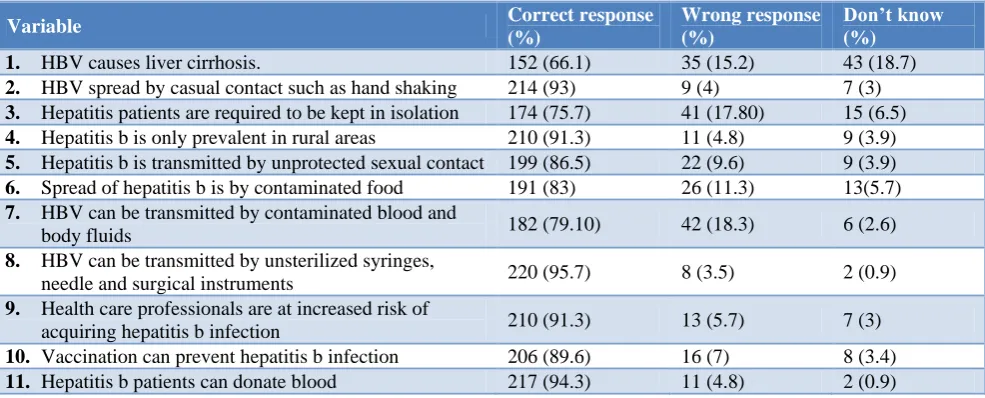
A total of 11 questions were used to assess the knowledge domain as presented in Table 1. A score of +1 was given to every correct answer. Score of 9 or above was considered as Good, score between 4 and 9 were considered as Average and a score of 3 or below considered as Poor.
Table 1: Knowledge regarding hepatitis B (n=230).
Variable Correct response
(%)
Wrong response (%)
Don’t know (%)
1. HBV causes liver cirrhosis. 152 (66.1) 35 (15.2) 43 (18.7)
2. HBV spread by casual contact such as hand shaking 214 (93) 9 (4) 7 (3)
3. Hepatitis patients are required to be kept in isolation 174 (75.7) 41 (17.80) 15 (6.5)
4. Hepatitis b is only prevalent in rural areas 210 (91.3) 11 (4.8) 9 (3.9)
5. Hepatitis b is transmitted by unprotected sexual contact 199 (86.5) 22 (9.6) 9 (3.9)
6. Spread of hepatitis b is by contaminated food 191 (83) 26 (11.3) 13(5.7)
7. HBV can be transmitted by contaminated blood and
body fluids 182 (79.10) 42 (18.3) 6 (2.6)
8. HBV can be transmitted by unsterilized syringes,
needle and surgical instruments 220 (95.7) 8 (3.5) 2 (0.9)
9. Health care professionals are at increased risk of
acquiring hepatitis b infection 210 (91.3) 13 (5.7) 7 (3)
10. Vaccination can prevent hepatitis b infection 206 (89.6) 16 (7) 8 (3.4)
Table 2: Attitude of study participants regarding hepatitis B (n=230).
Statement Agree (%) Disagree (%) Not sure (%)
1. Hepatitis b patients may be allowed to continue with their
normal work 159 (69.1) 27 (11.7) 44 (19.1)
2. Used needles can be sterilized and reused in emergency
condition 24 (10.4) 189 (82.2) 17 (7.4)
3. Not likely to complete the hepatitis b vaccination schedule 22 (9.6) 177 (77) 31 (13.4)
Table 3: Preventive practices of students towards hepatitis B (n=230).
Practices Yes (%) No (%) Not sure (%)
1. Will you share lancet with your friends in practical session? 16 (7) 213( 92.6) 1 (0.4)
2. Do you ask the barber to change blade or for safe equipment
during ear or nose piercing? 176 (76.5) 40 (17.4) 14 (6.1)
3. Do you ask about the screening status of blood used for
transfusion? 171 (74.3) 55 (23.9) 4 (1.8)
4. In case you your sibling is diagnosed with hepatitis b do
you share food/ utensils/ water with him/her? 128 (55.7) 94 (40.9) 8 (3.4)
5. Have you ever participated in health education program
related to hepatitis b? 41 (17.8) 187 (81.3) 2 (0.9)
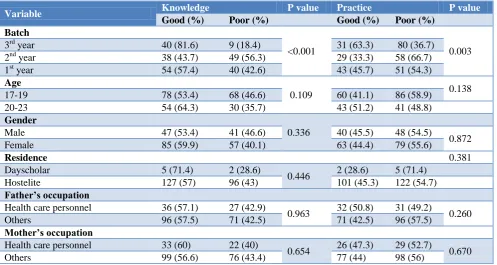
Table 4: Factors associated with knowledge and practice (n=230).
Variable Knowledge P value Practice P value
Good (%) Poor (%) Good (%) Poor (%)
Batch
<0.001 0.003
3rd year 40 (81.6) 9 (18.4) 31 (63.3) 80 (36.7)
2nd year 38 (43.7) 49 (56.3) 29 (33.3) 58 (66.7)
1st year 54 (57.4) 40 (42.6) 43 (45.7) 51 (54.3)
Age
0.109 0.138
17-19 78 (53.4) 68 (46.6) 60 (41.1) 86 (58.9)
20-23 54 (64.3) 30 (35.7) 43 (51.2) 41 (48.8)
Gender
0.336
Male 47 (53.4) 41 (46.6) 40 (45.5) 48 (54.5)
0.872
Female 85 (59.9) 57 (40.1) 63 (44.4) 79 (55.6)
Residence 0.381
Dayscholar 5 (71.4) 2 (28.6)
0.446 2 (28.6) 5 (71.4)
Hostelite 127 (57) 96 (43) 101 (45.3) 122 (54.7)
Father’s occupation
Health care personnel 36 (57.1) 27 (42.9)
0.963 32 (50.8) 31 (49.2) 0.260
Others 96 (57.5) 71 (42.5) 71 (42.5) 96 (57.5)
Mother’s occupation
Health care personnel 33 (60) 22 (40)
0.654 26 (47.3) 29 (52.7) 0.670
Others 99 (56.6) 76 (43.4) 77 (44) 98 (56)
Table 2 represents the distribution of students based on their attitude towards hepatitis B. A total 3 questions were asked. A score of +1 was given to every correct answer. Score between 2 and 3 considered as positive. In our study 84.3% of the students had a positive attitude but 9.2% of them admitted that they were unlikely to complete the vaccination schedule.
A total of 5 questions were asked to assess the preventive practices of students towards hepatitis B (Table 3). One mark was given to each correct answer and zero mark to
each wrong answer. Scores more than or equal to 6 falls under GOOD category & score <6 falls under Poor category. 44.8% had good level and 55.2% had poor level of practice respectively.
students whose mothers were non health care personals had better attitude (87.4%) towards hepatitis B as compared to Health care personals (p<0.01) (Table 4).
DISCUSSION
This cross sectional study was done to assess the knowledge, attitude and preventive practices regarding Hepatitis B infection among medical students since Hepatitis B is one of the most important blood borne infection that they may be faced with in their medical career.
In this study, 79.1% of the students had good level of knowledge regarding hepatitis B. A study conducted in a similar setting in Delhi reported low level of knowledge among the students.14 In a study conducted in Odisha 98.8% of medical students had correct knowledge regarding hepatitis.
In the present study 84.3% of the students had a positive attitude but 9.2% of them admitted that they were unlikely to complete the vaccination schedule. In a study conducted in Northwest Ethiopia, the health science students had a comparable level (83.3%) of positive attitude.15
In the current study, only 44.8% of the students had good preventive practices against Hepatitis B. Since a good number of students were aware about various aspects of Hepatitis B, preventive practices were expected to be followed by a higher percentage of them. Better strategies need to be found so as to translate the level of knowledge into better preventive practices among the medical students.
In the present study 45.2% of the students were partially vaccinated against hepatitis B. All three doses were taken by 42.6% of the students and 12.2% were unvaccinated. They cited lack of time due to the busy academic schedule and fear of side effects as reasons for non-completion of the schedule. In a study conducted among dental students in Mysore 64% of them had got vaccinated against hepatitis B. According to a study done in Odisha, 26.7% were fully vaccinated and 36.4% were partially vaccinated and 37% were unvaccinated and in the Delhi study, full vaccination was attained by only 8%.
The fact that among the students in the current study, 24.8% had already experienced a needle prick injury demands attention as the unvaccinated students might have had an exposure. In a study from North east Ethiopia 16, 49.8% of the students reported needle stick injury which was similar to 48% among Nigerian medical students.17 The prevalence of needle stick injuries being high among students, they need to be familiarised with proper infection control practices and insisted upon completing their hepatitis B vaccination schedule early in the student period.
CONCLUSION
As per the study conducted, it is seen that while the knowledge and attitude towards hepatitis B is high, the practice levels are low indicating the need to encourage proper practices. Initiating hepatitis B campaigns to increase awareness on practice methods and vaccination drives would help increase practice levels and significantly reduce the incidence of hepatitis B viral infections in the student community. Limitation: all responses were self reported and the students were not observed for their practices.
ACKNOWLEDGEMENTS
The authors wish to thank the R2 2013 MBBS students and the field staff who helped in data collection.
Funding: No funding sources Conflict of interest: None declared
Ethical approval: The study was approved by the Institutional Ethics Committee
REFERENCES
1. Hepatitis B. Available at: https://www.who.int/ news-room/fact-sheets/detail/hepatitis-b. Accessed on 21 February 2019.
2. WHO. Global health sector strategy on viral
hepatitis 2016-2021. WHO. Available at:
http://www.who.int/hepatitis/strategy2016-2021/ ghss-hep/en/ Accessed on 21 February 2019.
3. Aaron D, Nagu TJ, Rwegasha J, Komba E. Hepatitis
B vaccination coverage among healthcare workers at national hospital in Tanzania: how much, who and why? BMC Infect Dis. 2017;17:786.
4. Gupta S, Gupta R, Joshi YK, Singh S. Role of Horizontal Transmission in Hepatitis B Virus Spread among Household Contacts in North India. Intervirology. 2008;51(1):7-13.
5. Anand AC, Puri P. Indian Guidelines and Protocols:
Hepatitis B.pdf. Available at: http://www.apiindia.
org/medicine_update_2013/chap53.pdf. Accessed
on 21 February 2019.
6. Tandon BN, Acharya SK, Tandon A. Epidemiology
of hepatitis B virus infection in India. Gut. 1996;38(Suppl 2):S56–9.
7. Park’s Textbook of Preventive and Social Medicine
23rd edition.pdf, 2015.
8. Qin YL, Li B, Zhou YS, Zhang X, Li L, Song B, et
al. Prevalence and associated knowledge of hepatitis B infection among healthcare workers in Freetown, Sierra Leone. BMC Infect Dis. 2018;18:315. 9. Coppola N, De Pascalis S, Onorato L, Calò F,
Sagnelli C, Sagnelli E. Hepatitis B virus and hepatitis C virus infection in healthcare workers. World J Hepatol. 2016;8(5):273–81.
11. H Muljono D, Wijayadi T, Sjahril R. Hepatitis B Virus Infection among Health Care Workers in
Indonesia. Euroasian J Hepato-Gastroenterol.
2018;8(1):88–92.
12. Ayalew MB, Horsa BA. Hepatitis B Vaccination Status among Health Care Workers in a Tertiary
Hospital in Ethiopia. Hepat Res Treat.
2017;2017:6470658.
13. Velvzhi G, Senthil K, Sucilathangam G, Revathy C.
Knowledge and Attitude of Medical Students towards Hepatitis B Infection. Int J Curr Microbiol App Sci. 2016;5(6):570-6.
14. Rathi A, Kumar V, Majhi J, Jain S, Lal P, Singh S. Assessment of knowledge, attitude, and practices toward prevention of hepatitis B infection among medical students in a high-risk setting of a newly established medical institution. J Lab Physicians. 2018;10(4):374-9.
15. Abdela A, Woldu B, Haile K, Mathewos B, Deressa
T. Assessment of knowledge, attitudes and practices toward prevention of hepatitis B virus infection
among students of medicine and health sciences in
Northwest Ethiopia. BMC Res Notes.
2016;9(1):410.
16. Demsiss W, Seid A, Fiseha T. Hepatitis B and C: Seroprevalence, knowledge, practice and associated factors among medicine and health science students
in Northeast Ethiopia. PLoS One.
2018;13(5):e0196539.
17. Okeke EN, Ladep NG, Agaba EI, Malu AO.
Hepatitis B vaccination status and needlestick injuries among medical students in a Nigerian University. Niger J Med. 2008;17(3):330–2.