RESEARCH ARTICLE
Application of Modified ACO Meta heuristic in
Spray and Wait Routing
Vinuraj.R
National Institute of Technology, Bhopal, India.
Sweta Jain
National Institute of Technology, Bhopal, India.
Abstract – Routing decision plays a vital role in delivering amessage to its destination in a network, especially in an opportunistic network where connectivity between nodes is unpredictable i.e. intermittent connectivity; routing decision dominates in measuring the network performance parameters. Delay Tolerant Networking (DTN) was proposed to address the technical communication problems in heterogeneous networking ranging from extreme terrestrial environments to planned networks in space. Designing a routing policy for such a network should ideally feature proper handling of the implementation risk and must increase the delivery ratio maintaining a cost of minimum overhead. This paper elucidates a new routing policy based on Swarm intelligence specifically Ant colony optimization technique. An existing routing algorithm in DTN called Spray and Wait (SnW) Routing has been modified by changing the spray phase where the ant colony algorithm will make decisions about the number of copies to be sprayed at each relay node. Proposed method gives much more effective results when compared to existing spray and wait mechanism and Ant colony based protocol in DTN. Spray and wait mechanism lags behind in terms of overhead ratio while the latter lingers with regard to both; delivery ratio as well as overhead ratio. The results obtained through simulations open the gates of great opportunities for the successful implementation and desired performance of the proposed algorithm in real life scenarios as well.
Index Terms - DTN, ACO, SnW, BSnW, SnF.
1. INTRODUCTION
Delay Tolerant networking (DTN) is an architecture that addresses the technical issues in heterogeneous networks lacking continuous network connectivity. Communication establishment in such environments has to confront many challenges including large delay in transmissions as a result of either physical link properties or extended periods of network partitioning, routing capable of operating efficiently with frequently disconnected/prescheduled/opportunistic link availability, high per-link error rates making end-to-end reliability difficult, heterogeneous underlying network technologies (including non IP-based internet) and application structure and security mechanisms capable of limiting network access prior to data transit in an environment where round-trip-time may be long [1]. Networks operating for Mobile, Extreme Terrestrial environments and planned
networks in space are a few examples that symbolize the above mentioned properties. According to the studies on routing protocols till date, swarm intelligence based routing policies are considered to be ideal in their performance. Among all those, the Ant Colony based routing strategies have been proved to be the best.
Swarm intelligence has emerged as a key protagonist for routing in different types of networks [2][3][4][5]. Existing works consider global knowledge about the network for implementing the strategy [6]. The Delay Tolerant Network slack end to end connectivity and nodes do not have global knowledge about the network [7] [8] [9] [10].
RESEARCH ARTICLE
retrace the original path due to the frequent connectivity issues with the network [9] [10]. Hence for applying ACO in DTN, a new heuristic is to be introduced without modifying the basic idea of ACO.
In CGrAnt [6], A Swarm Intelligence-based Routing Protocol for Delay Tolerant Networks, Ana Cristina B. KochemVendramin, AneliseMunaretto, Myriam R. Delgado and AlineCarneiroViana et al. proposed a greedy ant based routing. According to this the forward ants are encapsulated into message packets and then sent to destination to discover the best path from source to destination. The backward ant then retraces the path to the source to inform about the best route so far. The assumptions include that (i) the individuals are often linked by a short chain of acquaintances, (ii) some encounters have repetitive behavior, and (iii) nodes have routines that result in frequently visited locations and encounters [6].
Since these cases may not be true always in DTN, backward ants may starve (wait infinitely) to meet those nodes in the best path mentioned by forward ants. The mechanism proposed in this paper incorporates ant colony optimization technique into DTN by considering the node to node communication instead of the end-end path. The solutions is generated by the “ant colonies” in a greedy fashion by tracing the best encounter locally and eventually adding up these to get the global optimum solution. In this paper Spray and wait routing protocol and application of ant colony optimization in this area is taken into consideration.
The skeleton of this paper comprises of a routing solution, detailed explanation of how Ant Colony Optimization contributes towards this and problems to be dealt with while applying ACO in DTN. The Basic idea of Spray and wait routing and some of its existing variations is given in section II. Section III includes the proposed ACO Meta heuristic and the relevant details. Simulation set-up and result analysis are discussed in Section IV. Section V concludes this paper.
2. RELATED WORK : SPRAY AND WAIT AND IT’S VARIARIATIONS
In order to overcome the shortcomings of flooding based routing schemes, a new set of controlled replication routing algorithms have been proposed for DTN[14] [15]. Among those, SnW has got its own advantages like fewer transmissions, low contention under high traffic loads, better delivery rate, scalability etc. [15].
Spray phase:
For every message originating at a source node, L message copies are initially forwarded by the source. Other nodes receive a copy to L distinct relays [14].
Wait phase:
In case of the destination being unidentified in the spraying phase, each of the L nodes carrying a message copy performs direct transmission (i.e. forward the message only to its destination).
Disadvantage of SnW is that only source node is allowed to spray copies. Thus, it incurs considerable delay in delivering the messages.
To overcome this shortcoming, T.Spyropoulos et al. modified SnW scheme and introduced Binary spray and wait scheme (BSnW) [14]. In BSnW, if the sender has L copies of a message, as soon as a node A (having L>1 copies of a message) meets another node B (having no copy of that message), the node A will forward L/2 copies of its message to node B holding back the remaining L/2 copies [14]. When a node is left with only one copy, it switches to direct transmission mode.
Binary spray and wait acts optimally in the environment where all the nodes move in an IID manner, i.e. homogenous environment. But in most of the cases some nodes may better relay for a given destination. Such cases demand modifications in binary spray and wait so as to improve the efficiency.
Thrasyvoulos Spyropoulos et al. proposed another variation of BSnW called Spray and Focus method (SnF). In this scheme the only change that has been included is the forwarding wait phase i.e. incorporating a focus in wait phase where instead of waiting for destination, a node which is carrying only one copy will forward that copy to another node if and only if its utility value, i.e. the history of encounters with destination is greater than a threshold value. Despite many pros, a con of the method is that in spray phase when two nodes meet each other they will spray the message copies without considering the delivery probabilities.
Later Guizhu Wang, Bingting Wang et al. proposed Dynamic Spray and Wait using Quality of Node [16]. In that work authors associated metric called quality of node with each node. This metric specifies the total message transferring ability of that node. In spray phase this metric is used to spray the message copies i.e. a pair of nodes will calculate a ratio of their quality and according to that they will share the copies left. But while calculating the quality of node, the destination to where the message is to be delivered is not taken into consideration. Thus the delivery of a message remains independent of the quality of node to which the message is being sent.
RESEARCH ARTICLE
selecting message to be sprayed during an encounter using priority based fuzzy inference rules. Even though messages are selected based on priority, the problem discussed above i.e. forwarding message to a node which is never going to meet the destination still persists.
Longbo Zhang, Chen Yu et al. revised BSnW by dynamically controlling the number of replicas at each node. This Dynamic Spray and Wait Routing Protocol (DS&W) [18] is based on multi-copy routing protocol and predicts the probability of delivering a message using history of encounters and transitivity.
DS&W uses the total probability of nodes carrying the message to dynamically control the number of copies. The delivery probability of each node is only related to the history of encounters.
Later El Mastapha Sammou proposed an improvement of SnW (Spray and Dynamic [19]) by combining the two protocols called MaxProp and the model of Transfer by delegation. It defines broadcasting the packets as soon as possible and then forwarding the packets according to routing metrics that include likelihood of delivery, spare battery and mobility of nodes etc.
QaisarAyub, Sulma Rashid et al. proposed the optimization of Spray and Wait routing Protocol by prioritizing the message forwarding order [20]. Message forwarding strategy called as “Smallest Message First” optimizes the performance of spray and wait routing protocol. The spraying of messages still occurs blindly
3. PROPOSED WORK
The proposed algorithm assumes that each node of DTN has a pair of forward and backward ants. A pheromone table is maintained by each individual node. The forward and backward ants are responsible for updating this table.
3.1. Maintaining Pheromone Table
Assume two distinct nodes i and j that belong to a DTN. The pheromone table of both of these nodes will be updated as soon as they are intact. The forward ants update each other’s pheromone table for the entries corresponding to i and j respectively. This is known as local pheromone updating. Quality of the contact between a pair of nodes is determined by the shared pheromone intensity. Here each node will maintain a table with entries corresponding to the quality of contact between itself and the other nodes encountered so far. Quality of contact between any two nodes is a measure of closeness between these nodes. Therefore this value is directly influenced by a variety of metrics including the frequency with which the two nodes meet each other, the duration for which the contact lasts and is inversely proportional to average time lag between each contacts. Hence the quality of contacts can be defined using equations 1, 2 and 3.
In the above equations, Fijis an intermediate variable used for the calculation of µij. The quality of a path is directly
proportional to average contact duration between the encountered nodes and inversely proportional to average meeting time duration of those nodes. When two nodes meet for first time their qfi value will be zero. So the quality of that
path will be evaluated using equation 1. If multiple encounters occur between these nodes, then the previous pheromone value should be updated using pheromone evaporation factor. Hence in this case equation 2 is used. Fij is divided by ti to make the pheromone intensity value fall in a range of 0 to 1. 3.2. Pheromone Evaporation
While updating the pheromone, the natural phenomenon called physical evaporation of biological substances is taken into consideration. Missing out this factor while simulating ant colony behavior may lead to the pheromone values getting accumulated for each path periodically which will create probability values greater than 1 for selecting a path by the ant colonies. To deal with this situation, a factor qf is introduced
which determines the pheromone evaporation rate in a DTN node. Technically this factor unveils the fact that the nature of contact existing between two nodes may change with respect to time. So the overall significanceof this factor is to check whether the quality of contact is still maintained between the nodes since the last encounter. This is done at regular interval of time. Equation 4 gives the rule to update pheromone intensity.
F
ij= (n
ij× c
ij) / G
ij…(1)
µ
ij=
{
µ
ij(old) × qf
i+ (F
ij/ t
i), if qf
i!= 0
…(2)
(F
ij/ t
i), otherwise
…(3)
Where,
µij= Pheromone intensity between node “i” and “j” qfi = The pheromone evaporation factor
nij = No. of times node “i” met node “j”
cij = Average contact duration of node “i” with “j”
Gij = Average meeting time durationof node “i” and “j”
RESEARCH ARTICLE
3.3. Global Pheromone Updating
As soon as the intended message is transmitted to the connection, node i will collect the pheromone intensity value with node jin order to refresh the pheromone values globally following the transitive rule. This is known as global pheromone updating. Since there is no end to end connectivity in DTN, it takes a number of relays for a message to be forwarded to its destination. So in case of DTN, quality of the path between two nodes has to be specified even though there is no direct contact between them. To implement this, it needs to specify pheromone intensity values for those paths between nodes which have never been in direct contact. To overcome this, transitive pheromone updating rule has been introduced. The rule follows simple transitive property for delivering messages to a node using another node having high pheromone intensity paths along with the frequent meetings. This can more precisely be explained considering the following scenario: Let there be two nodes A and B having high pheromone intensity path assuming that they meet often. The pheromone intensity value for the path between node A and another node D is very less but that of B and D is high. From the above mentioned assumptions we can deduce that B will act as a great relay for the messages to be transferred from A to D. Thus A will transfer the messages to B so that B delivers the messages with a high probability. Hence delivery of messages to node D from node A relies on quality of path between node B and node D when node A and B have no or less contact. This rule is simulated using equation 5.
3.4. Spray Phase
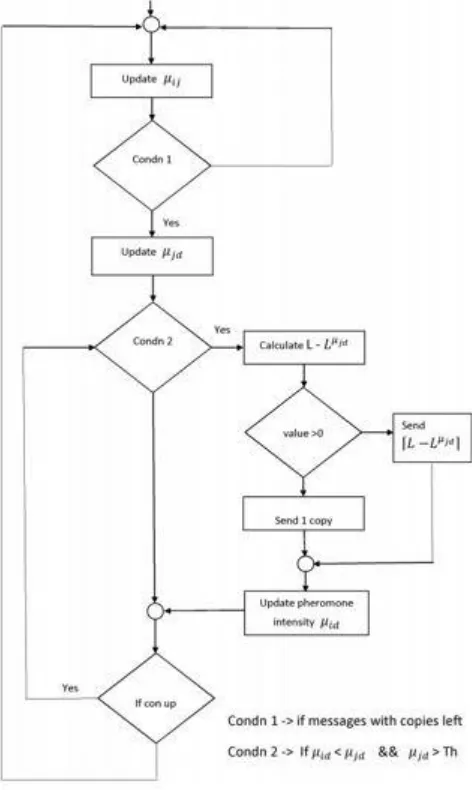
A node i will select the next message to be forwarded as per the buffering policy. Let the destination of this message be D. When node i meets node j, node i’s forward ant will retrieve the pheromone intensity for node D from j‘s pheromone Table. The value 𝐿 − 𝐿𝜇𝑗𝑑determines the next step since it
will spray less number of copies to a node having higher
probability to meet destination (Assuming that message will reach destination soon by relaying to less number of intermediate hops) and higher number of copies to nodes which have average probability to meet the destination (Assuming that the message needs to be relayed to more number of intermediate hops in order to reach the destination). The same (𝐿 − 𝐿𝜇𝑗𝑑) copies of message are
forwarded to a connected node only if the calculated value is greater than a predefined threshold (greater than zero).Otherwise no copy is forwarded until the next connection. If the calculated value of 𝐿 − 𝐿𝜇𝑗𝑑is less than or
equal to zero, only a single copy is forwarded invoking the receiver node to enter the wait phase. Flow Chart for the proposed algorithm is given below in Figure 1.
Figure 1 Algorithm Flow
µ
jd(new) = µ
jd(old) × qf
j…(4)
Update µ
jd, iff qf
j!= 0
Where,
qfj = (1 – [(Tj – Tdj) / Tj])
Tj = Total no. of nodes that have met “j”
Tdj = No. of encounters of “j” after its last meeting with “d”
RESEARCH ARTICLE
4. RESULT ANALYSIS 4.1. Performance Parameters
Following are the parameters that are used for evaluating the performance of proposed algorithms [21][22].
• Delivery ratio: It is the ratio of number of messages
delivered to their intended destinations to the total number of messages created.
• Average delay: It is defined as the average time taken by a
message to get delivered.
Overhead Ratio: It is defined as the ratio of the total
number of messages relayed to the total number of messages delivered.
An ideal routing strategy should have high delivery ratio and low average delay and overhead ratio. Thus the strategies defined in this work focus on the aspects mentioned above in order to guarantee high success rate.
4.2. Simulation parameters and Result Analysis
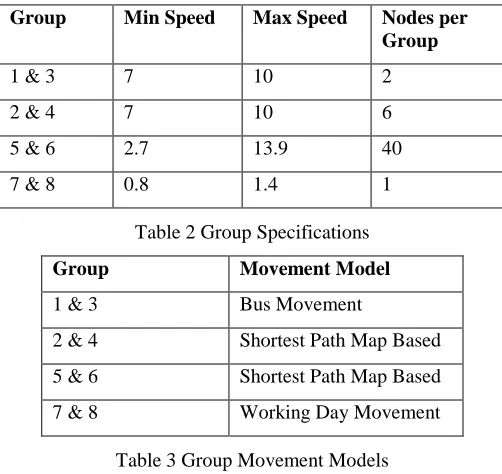
The scenario given in Table 1, Table 2 and Table 3 was encountered with ONE [23] so as to observe the results. The scenario considered for analysis consists of 8 groups with different movement models so that the performance can be judged as an average of all the selected movement models. The movement models differ in terms of movement speed as well as the waiting time. The working day movement model has distinct meeting points and office locations. A specific route file is defined for bus movement models.
Parameter Value
Network Size 4500×3400 Simulation Time 43200 seconds Network Interface Bluetooth Interface No of Nodes 128
No of Groups 8 (Bus (Group 1 & 3), Trams(2 & 4), Cars(5 & 6), Pedestrian(7& 8))
Default Movement Model
Shortest Path Based
Transfer Speed 250K Transfer Range 10m
Message Size 500KB-1MB Message TTL 300 Minutes
Table 1 Simulation Parameters
Group Min Speed Max Speed Nodes per
Group
1 & 3 7 10 2
2 & 4 7 10 6
5 & 6 2.7 13.9 40
7 & 8 0.8 1.4 1
Table 2 Group Specifications
Group Movement Model
1 & 3 Bus Movement
2 & 4 Shortest Path Map Based 5 & 6 Shortest Path Map Based 7 & 8 Working Day Movement
Table 3 Group Movement Models
4.3. Effect of number of message copies on performance of proposed Algorithm
Here Number of message copies (L) is used as a parameter to evaluate Algorithm performance. ’L’ denotes the initial number of message copies created at any Source node. Since the spraying of message is restricted to the nodes having better probability, flooding of the message is mitigated. Observations reveal that the threshold value and delivery ratio exhibit an inversely proportional relationship because a high value of probability earns a very low number of message carriers. The graph in Figure 2 shows that a threshold value of 0.1 gives an improved delivery ratio as compared to binary spray and wait. A threshold value of 0.1 depicts better delivery results following the ACO algorithm. Further analysis reveals that the ACO algorithm out performs the SNW algorithm with an improvement of 5% in delivery ratio.
RESEARCH ARTICLE
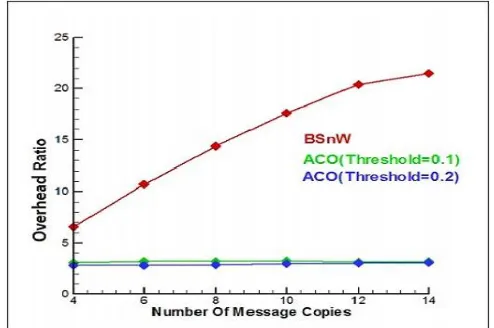
ACO allows limited number of spray copies to an encountered node depending upon the quality of contact the node maintains with the destination. Thus this selective spraying does not grant the algorithm to achieve more than 5% increase in its delivery performances. With the increasing number of message copies, the overhead ratio also rises owing to the increase in the number of redundant copies. The simulation results show that the overhead ratio will remain as it is in the case of binary spray and wait when the threshold value is small because a large number of copies are sprayed. From the graph shown in Figure 3, the optimum value of threshold for better delivery ratio and overhead ratio is found to be 0.1. With a threshold value of 0.1, proposed algorithm could reduce the overhead ratio up to 85%, which shows the eminence and significance of the presented work in real life scenarios.
Figure 3 Variation of Overhead Ratio vs. Number of Message Copies
There is always an additional cost of overhead ratio while searching for such a routing algorithm in DTN which minimizes the delivery ratio. ACO based routing in DTN yields a 5% improvement in delivery ratio compared to naive BSNW scheme with 85% reduction in overhead ratio. Figure 3 gives a comparison between SNW and proposed scheme by varying the initial number of message copies. Thus it clearly proves that the algorithm maintains a consistent overhead ratio even with the increasing number of message copies. 4.4. Effect of TTL on performance of proposed Algorithm TTL gives the exact life time of a message in the Network. Study of the behavior of proposed method under varying TTL values is given in Figures 4 &5. Figure 4 shows the variation in delivery ratio with respect to TTL values. As far as smaller TTL values are concerned, BSnW shows improved results than ACO. This happens because at the initial stages, ACO routing nodes follow a seek phase where nodes will search for better candidates having good contact quality with the destination.
Figure 4 Variation of Delivery Ratio vs. TTL
By the time nodes avail such contacts, the nodes with smaller TTL values will expire. But as TTL value increases, it is clearly visible that ACO routing scheme starts out performing BSNW. Figure 5 shows the variation of overhead ratio with TTL values. There Both SNW and ACO methods give lesser overhead ratios with the increase in TTL values, but ACO shows around 71-72% improvement in the result as compared to Binary SNW. The reason behind this is that the proposed method will spray only limited number of copies of a message in its life time.
Figure 5 Variation of Overhead Ratio vs. TTL 4.5. Evaluation of ACO based SnW for Scalability
RESEARCH ARTICLE
and Figure 10. Figure 6, Figure 7 and Figure 9 show the performance analysis of proposed algorithm based on buffer size.
Figure 6 Variation of Delivery Ratio vs. Buffer Size As per the results obtained, even with increase in number of nodes or increase in buffer size, ACO routing could achieve 5% of growth in its performance. But the factor strengthening the proposed work is the amendment of its overhead ratio. Scrutinizing the change in overhead ratio reveals that the percentage reduction obtained in overhead with ACO persists even with the increasing network size.
Figure 7 Variation of Overhead Ratio vs. Buffer Size Figure 7 throws light on the pattern of changes taking place in the value of percentage of reduction in overhead ratio as calculated against the increasing buffer size. There is a considerable increment in the percentage of reduction in overhead ratio in ACO as compared to BSnW.
Figure 8 Variation of Delivery Ratio vs. Number of Nodes Figure 8 shows the variation in delivery ratio by varying the node density. From the results obtained it is visible that the proposed algorithm ACO_SnW maintains a consistent performance even if the network size grows.
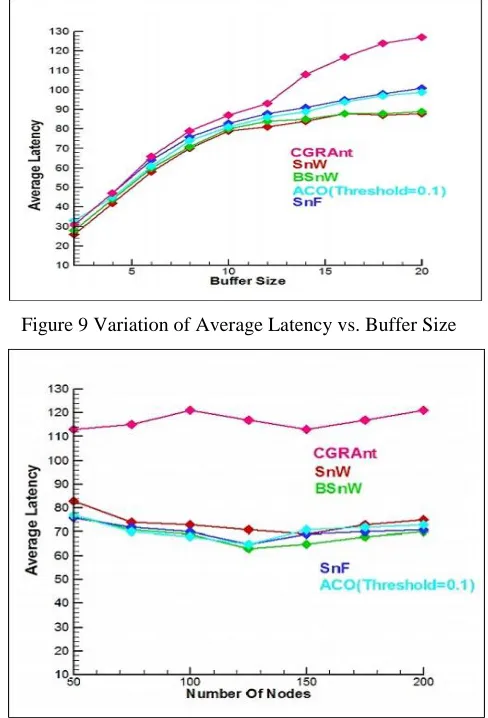
Figure 9 Variation of Average Latency vs. Buffer Size
RESEARCH ARTICLE
Figure 9 depicts the variation in average latency with respect to buffer size of nodes. The average increase in latency of proposed algorithm with respect to other variants like CGRAnt, SnW and SnF is found to be less since the ACO_SNW chooses relay nodes which can carry the message to the destination as early as possible. Figure 10 shows the analysis of average latency of proposed algorithm with respect to node density. Compared to CGRAnt, BSnW and SnF, ACO_SnW has low latency and is consistent even if network size grows.
4.6. Comparison of ACO_SnW and CGR Ant
For further analysis, the proposed method has been compared against another improvement of binary spray and wait called Spray and Focus. The proposed method exhibits great performance, as the spray and focus scheme will not stop spraying the messages even in wait phase. Thus in case of overhead ratio, ACO_SnW based algorithm outperforms spray and focus method. As a known fact, all the relay nodes in spray and focus spray the message copies blindly and even in focus phase nodes spray single copy of the message to better relays. Thus in the result analysis when number of message copies were 8 and 10, Spray and focus behaves better than the proposed method in case of delivery ratio. Performance analysis of proposed algorithm by varying number of message copies is shown in Figure 11 and Figure 12.
Figure 11 Variation of Delivery ratio vs. Number of Message Copies
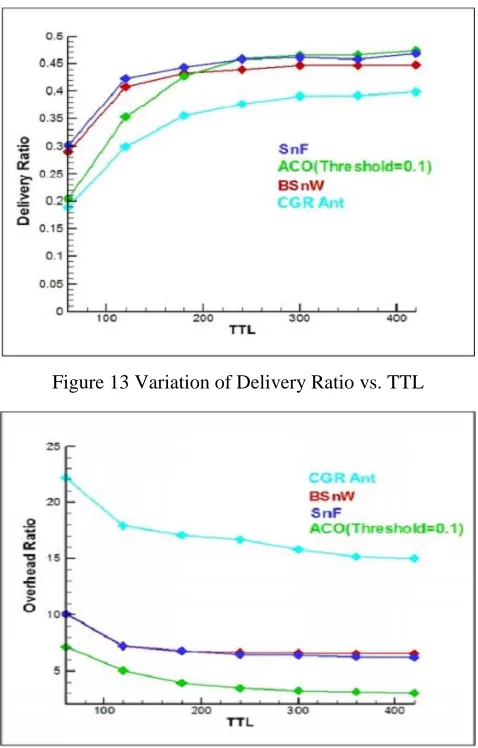
The proposed routing strategy ACO_SnW has been able to achieve a significant performance improvement in terms of both; the delivery ratio and the overhead ratio, as compared to CGR Ant. ACO_SnW achieves a 12% increase in delivery ratio and a reduction of 81% in the overhead ratio as compared to CGRAnt since ACO_SnW selects relay nodes and forwards message copies according to the quality of contact they maintain. This improvement proves the eminence
of the modified ant colony optimizationstrategy ascompared to the CGR Ant and other spray and wait variants.
Figure 12 Variation of Overhead Ratio vs. Number of Message Copies
Figure 13 Variation of Delivery Ratio vs. TTL
RESEARCH ARTICLE
Figure 13 and Figure 14 shows the performance analysis based on different TTL values. The graph of simulation results show that the proposed algorithm showcases more than 85% reduction in overhead ratio as compared to spray and focus variation of SnW. Even though the parameters used to evaluate Figure 2 and 12, Figure 3 and 13, and Figure 4 and 14 are same, the algorithms selected to compare are different. Figure 2, 3 and 4 were introduced for basic evaluation of ACO_SnW and Figure 12, 13 and 14 were introduced for further evaluations with SnF and CGR Ant Protocols because number of message copies is not a parameter to evaluate CGRAnt protocol.
5. CONCLUSION
The paper proposes an enhancement inspired by the ant colony optimization which galvanizes the basic spray and wait algorithm in terms of performance. The idea is to maintain a pheromone table at each individual node that helps to identify the virtue of the path shared between any pair of nodes. A node is allowed to spray any number of copies if and only if the connected node has a pheromone intensity value greater than a given threshold for the destination. All counts and results depict remarkable improvement in terms of two basic factors; the delivery ratio and the overhead ratio, latter being the vanquisher. Since the algorithm restricts the relay nodes in spraying the copies, the number of redundant copies in the network will be less. So it has very less overhead ratio as compared to any other spray and wait variations. A memorized version of ant colony optimization can be implemented as an extension to this protocol where each node maintains a memory vector to keep track of the previous path taken for each destination in order to check the existence of such a path for a later time.
REFERENCES
[1] Feyza Altunbey and Bilal Alatas. Overlapping community detection in
social networks using parliamentary optimization algorithm.
International journal of computer networks and applications(IJCNA), Volume 2, Issue 1, January 2015.
[2] Gunes M, Sorges U, Bouazizi I. ARA-the ant colony based routing
algorithm for MANETs. Parallel Processing Workshops, International Conference on18-21 Aug, 2002:79-85 Research of Multipath Routing Protocol Based on Parallel Ant Colony Algorithm Optimization in Mobile Ad hoc Networks, Fifth International Conference on Information Technology: New Generations.
[3] A. Martinoli, R. Poli, and T. Stutzle, ed.Ant Colony Optimization and Swarm Intelligence, 5th International Workshop,ANTS 2006, volume 4150 of Lecture Notes inComputerSciences,Berlin,Germany,Sep 2006. Springer-Verlag.
[4] Siva Kumar.D, Bhuvaneswaran.R.S. Proposal on Multi agent Ants
based Routing Algorithm for Mobile Ad-Hoc Networks. International Journal of Computer Science and Network Security, VOL.7 No.6, June 2007:260-267
[5] KwangMongSim and Weng Hong Sun. Ant Colony Optimization for
Routing and Load-Balancing: Survey and New Directions. IEEE TRANSACTIONS ON SYSTEMS, MAN, AND CYBERNETICS PART A: SYSTEMS AND HUMANS, VOL. 33, NO. 5, SEPTEMBER 2003.
[6] Ana Cristina B. KochemVendramin, AneliseMunaretto, MyriamR.
Delgado, AlineCarneiroViana. CGrAnt: A Swarm Intelligencebased Routing Protocol for Delay Tolerant Networks. GECCO12, July 711, 2012.
[7] Dr. B. Ramakrishnan, S.R Sreedivya, M.Selvi,”Adaptive Routing
protocol based on cuckoo search algorithm (ARP-CS) for secured vehicular Ad hoc network (VANET)”, International Journal of computer networks and applications(IJCNA), 2 (4), 2015, PP: 173-178 .
[8] ArunaBalasubramanian, Brian Neil Levine and ArunVenkataramani.
DTN Routing as a Resource Allocation Problem. SIGCOMM07, August 2731, 2007
[9] Yue Cao and Zhili Sun. Routing in Delay Disruption Tolerant
Networks: A Taxonomy, Survey and Challenges. IEEE
COMMUNICATIONS SURVEYS & TUTORIALS, 2012.
[10] Adrian Rumpold. Transmission Protocols for Delay-Tolerant Networks.
Network Architectures and Services, July 2011.
[11] T. White and B. Pagurek, Toward multi-swarm problem solving in net-
works, in Proc. 3rd Int. Conf. Multi-Agent Systems, July 1998, pp. 333340.
[12] G. D. Caro and M. Dorigo, AntNet: A Mobile Agents Approach to
Adaptive Routing, Univ. Libre de Bruxelles, Brussels, Belgium,Tech. Rep. IRIDIA/97-12, 1997.
[13] B. Baran and R. Sosa, A new approach for AntNet routing, presented at
the Proc. 9th Int. Conf. Computer CommunicationsNetworks, Las Vegas, NV, 2000.
[14] T.Spyropoulos, K.Psounis, and C.S.Raghavendra. Spray and wait:
Efficientrouting in intermittently connected mo-bile networks. In Proceedings of ACM SIGCOMM workshop on Delay Tolerant Networking (WDTN), 2005.
[15] Hemal Shah and Yogeshwar P. Kosta. Exploiting Wireless Networks,
through creation of Opportunity Network-Wireless-MobileAdhoc-Network (W-MAN) Scheme. International Journal of Ad hoc, Sensor & Ubiquitous Computing (IJASUC) Vol.2, No.1, March 2011
[16] Guizhu Wang, Bingting Wang and YongzhiGao. Dynamic Spray and
Wait Routing algorithm with Quality of Node in Delay Tolerant Network. International Conference on Communications and Mobile Computing, 2010.
[17] JadMakhlouta, HamzaHarkous, Farah Hutayt, Hassan Artail. Adaptive
Fuzzy Spray and Wait: Efficient Routing for Opportunistic Networks. IEEE 2011.
[18] Longbo Zhang, Chen Yu, and Hai Jin. Dynamic Spray and Wait
Routing Protocol for Delay Tolerant Networks IFIP International Federation for Information Processing, 2012.
[19] EL MastaphaSammou.Spray and Dynamic:Advanced Routing in Delay
Tolerant Networks.Int.J. Communications,Network and System Sciences, 2012.
[20] QaisarAyub, Sulma Rashid, M. SoperiMohdZahid, and Abdul Hanan
Abdullah. The optimization of Spray and Wait routing Protocol by prioritizing the message forwarding order. International Journal of Innovation and Applied Studies ISSN 2028-9324 Vol. 3 No. 3 July 2013
[21] PavanYadav, Sweta Jain. Modified Spray Phase to Improve
Performance of Binary Spray and Wait Routing Protocol in Delay Tolerant Network. International Journal of Computer Applications (0975
8887) Volume 97 No.4, July 2014
[22] AnjulaMehto, MeenuChawla, Ph.D. Modified Different Neighbor
History Spray and Wait using PROPHET in Delay Tolerant Network. International Journal of Computer Applications (0975 8887) Volume 86 No 18, January 2014
[23] The ONE(The Opportunistic Network Environmentsimulator),
http://www.netlab.tkk.fi/tutkimus/dtn/theone/
[24] ThrasyvoulosSpyropoulos, KonstantinosPsounis and Cauligi S.
RESEARCH ARTICLE
Authors
Vinuraj R was born in kerala, India, in 1990. He received the B.Tech. degree in Computer Science and Engineering from the University of Calicut, Kerala, India, in 2012, and M.Tech. degree from the National Institute of Technology (NIT) Bhopal, India. His current research interests include Delay Tolerant Networks, Robotics and Application on computer chips in electrical systems etc.