Original Research Article
Prevalence and socio-demographic status on kidney stone patients
in Thanjavur district, Tamil Nadu, India
Ram Prakash
1*, Arunachalam
2, Narayanasamy
3INTRODUCTION
In the world urolithiasis is the most common urological disease in living beings. Kidney stone, is the most painful and prevalent urological disorders of the urinary system.1 During the present century, its prevalence has drastically increased in all industrialized countries. About 3–20% of the overall population of the world has the tendency to form one urinary stone during the life time of 70 years.2 Urolithiasis (urinary calculi) formation occurs in kidney, bladder and in the urinary tract.3,4 Kidney stones are a
common urological condition that has been prevalent since ancient times. In India urolithiasis affects about 2 million people every year.5 Stone analysis is of great importance to the therapy and metaphylaxis of residual and recurrent stones.6 The composition of urinary stone in India is different from that in the Western countries where calcium oxalate is the predominant component. It affects about 3% of people of the productive age group.7 The increasing incidence of crystal deposition diseases in organs such as urinary tract, kidney, gall stones etc., in people of all ages affect a considerable number of the
ABSTRACT
Background: The formations of human kidney stones are affecting large number of peoples in various age groups in worldwide. The deposition of few minerals, crystalline materials in the kidney and urinary bladder are during the process of metabolism. Stone analysis is of great importance to the therapy and metaphylaxis of residual and recurrent stones.
Methods: A cross-sectional study carried out among 150 populations in rural/urban field practice area of department of community medicine, Thanjavur Government Medical College, Thanjavur, Tamil Nadu, India. The objectives of the study were to estimate the prevalence of risk factors for kidney stone patients. Data was analyzed using the SPSS version 20.0 software.
Results: Among the 150 people were studied in age group of 20–80. Majority (46%) were more than 60 years of age. In this study, the majority of female 56% than men were representing 45% of the sample. It observed that the kidney stone patients were higher in the age group of 21-60 (46%) and lower <20 (1%) and >60 (7%) which was statistically significant (15.33±8.74; p=0.01).
Conclusions: The results suggest that calcium oxalate stones are predominant in the selected study area. Kidney stone formation may be due to the food habits (diet), age, sex, obesity, genetics and environmental factors, geographical location, climate and lifestyle. The present investigation aims to assess the status of kidney stone diseases and risk factors in and around Thanjavurand the results have been discussed.
Keywords: Epidemiology, Kidney stone, Stone diseases, Risk factors
Department of Community Medicine, 1Thanjavur Government Medical College, Thanjavur, Tamil Nadu, 2Aarupadai Vedu Medical College and Hospital, State of Puducherry, India
3
Department ofPharmacology, Aarupadai Vedu Medical College and Hospital, State of Puducherry, India
Received: 02 April 2019
Revised: 17 April 2019
Accepted: 18 April 2019
*Correspondence:
Dr. Ram Prakash,
E-mail: [email protected]
Copyright: © the author(s), publisher and licensee Medip Academy. This is an open-access article distributed under the terms of the Creative Commons Attribution Non-Commercial License, which permits unrestricted non-commercial use, distribution, and reproduction in any medium, provided the original work is properly cited.
total population, it is a major social and economic problem, considering the number of days lost from work and cost of hospitalization.8-10
Urinary stone is one of the oldest and common afflictions of humans and remains a major public health burden. A large number of people are suffering from urinary stone problem all over the globe. Not only the humans but animals and birds also suffer from the urinary stone problem. Generally, three terms, i.e., incidence, prevalence, and lifetime prevalence, are frequently used in the epidemiological studies of urolithiasis.11 The incidence of stone disease is defined as the number of new stone patients in a given population over a defined period of time. The prevalence is defined as the number of stones present in a screened population at a particular point in time. Finally, the lifetime prevalence is defined as the presence of a stone at any point in a patient’s history. Urolithiasis is a global problem spanning all geographic regions with an estimated annual incidence of 1%, prevalence of 3–5% and a lifetime risk of 15–25%. Once afflicted, urolithiasis tends to be recurrent in the majority of cases. The 50% of kidney patients have reappearance within 10 years. In a recent study the recurrence rates are estimated at about 10% per year, totaling 50% over a 5–10 years period and 75% over 20 years.12
The incidence of urolithiasis varies in different countries. In India, the "stones belt" occupies parts of Maharashtra, Gujarat, Rajasthan, Punjab, Haryana, Delhi and states of north-east. Fewer occurrences of urinary calculi are found in southern India, which may be due to regular dietary intake of tamarind. In India, 12% of the people is estimated to have urinary stones, out of which 50% may end up with loss of kidneys or renal damage. Also, near 15% of the people of northern India affected from urinary stones.13 Singh et al have reported that the rate of incidence of urolithiasis, particularly staghorn calculi in Manipur is very high.14 In urolithiasis in the recent past indicates that in India, there is an increased prevalence of the urolithiasis in north-western region.
Kidney stone formation may be due to the food habits (diet), age, sex, obesity, genetics and environmental factors, geographical location, climate and lifestyle. The prevalence of this disease has been increasing among males and females of all ages, indicating a possible environmental cause in addition to genetic predisposition. Furthermore, the incidence of stone disease is increasing worldwide.15 The lifetime risk of kidney stones is 6% for women and 12% for men.16,17 For those with untreated stones, the risk at 5 years for forming another stone is 30% to 40%. Since all the epidemiological data show an increase in incidence and prevalence rates, the prevention and techniques for the medical management of urolithiasis requires further attention. The present investigation aims to assess the status of kidney stone diseases and risk factors in and around Thanjavur and the results have been discussed.
METHODS
Sample collection and preparation
The present study intends to measure the kidney stone diseases and risk factors. The randomly selected 100 symptomatic patients are involved in this study. 50 Controls are in the same area and have not previous history of abdominal pain or the symptoms of kidney stones. This study was carried out from six month in the duration of May 2018-October 2018. Samples were collected from ThanjavurGovernment Medical College, Thanjavur district, State of Tamil Nadu, India by specialist doctors as urinary infection. The printed form of questionnaire was used. Some of the relevant information about the patients was obtained from medical case history.
Healthy volunteers
Details of the questionnaire included age, sex, marital status, smoking habit, food habit, family socio-economic status, educational status, residing area (urban/rural), and previous history of kidney stone and heredity of kidney stone disease. These details were obtained by medical officers working the respective hospitals and prior to study consent was obtained from all study subjects. The controls were volunteers, similar socio-economic and demographic characteristics. The volunteers were from the same demographic region with no history of kidney stone disease. The method of interviewing was carefully standardized so that the required information could be obtained and interpreted in a uniform way. Partially filled in questionnaire from the participants were excluded from this study. The same questionnaire was used for both cases and controls.
Statistical analysis
Statistical analysis was performed using SPSS software program, version 20.0. The results were expressed as mean and standard deviation. The patient’s data were analyzed by analysis of variance test. The results were considered significant when the p value was found to be <0.05 in a confidence interval of 95%. The ANOVA tests were applied to determine the differences between one group (kidney stone patient) and another (Healthy people).
RESULTS
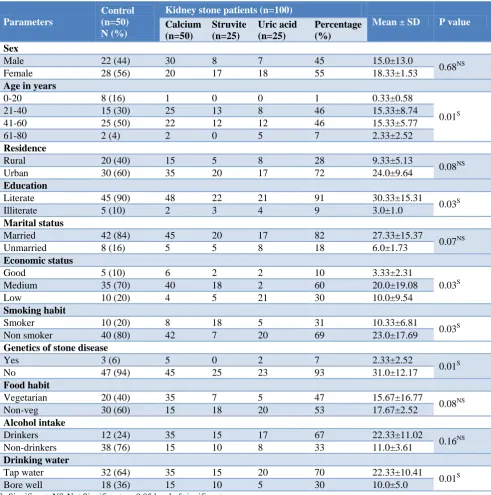
predominant risk factor. Kidney stone prevalence in men (44.35%) and in women (55.65%) patients i.e. women have a greater risk of kidney stone disease than men at all ages. The slightly lower than the mean age of 15.0±13.0 were found in male. Out of 50 healthy peoples, majority
female 56% than 44% were found in male. In relation to residence area, 72% were urban kidney stone patients and 28% were rural patients. The factors associated with the prevalence of kidney stone patients and control study is shown in Table 1.
Table 1: Factors associated with the prevalence of kidney stone patients and control.
Parameters
Control (n=50) N (%)
Kidney stone patients (n=100)
Mean ± SD P value
Calcium (n=50)
Struvite (n=25)
Uric acid (n=25)
Percentage (%) Sex
Male 22 (44) 30 8 7 45 15.0±13.0
0.68NS
Female 28 (56) 20 17 18 55 18.33±1.53
Age in years
0-20 8 (16) 1 0 0 1 0.33±0.58
0.01S
21-40 15 (30) 25 13 8 46 15.33±8.74
41-60 25 (50) 22 12 12 46 15.33±5.77
61-80 2 (4) 2 0 5 7 2.33±2.52
Residence
Rural 20 (40) 15 5 8 28 9.33±5.13
0.08NS
Urban 30 (60) 35 20 17 72 24.0±9.64
Education
Literate 45 (90) 48 22 21 91 30.33±15.31
0.03S
Illiterate 5 (10) 2 3 4 9 3.0±1.0
Marital status
Married 42 (84) 45 20 17 82 27.33±15.37
0.07NS
Unmarried 8 (16) 5 5 8 18 6.0±1.73
Economic status
Good 5 (10) 6 2 2 10 3.33±2.31
0.03S
Medium 35 (70) 40 18 2 60 20.0±19.08
Low 10 (20) 4 5 21 30 10.0±9.54
Smoking habit
Smoker 10 (20) 8 18 5 31 10.33±6.81
0.03S
Non smoker 40 (80) 42 7 20 69 23.0±17.69
Genetics of stone disease
Yes 3 (6) 5 0 2 7 2.33±2.52
0.01S
No 47 (94) 45 25 23 93 31.0±12.17
Food habit
Vegetarian 20 (40) 35 7 5 47 15.67±16.77
0.08NS
Non-veg 30 (60) 15 18 20 53 17.67±2.52
Alcohol intake
Drinkers 12 (24) 35 15 17 67 22.33±11.02
0.16NS
Non-drinkers 38 (76) 15 10 8 33 11.0±3.61
Drinking water
Tap water 32 (64) 35 15 20 70 22.33±10.41
0.01S
Bore well 18 (36) 15 10 5 30 10.0±5.0
S- Significant; NS-Not Significant. p<0.05 level of significant.
The distribution of the stone patients based on education and there are 91% patients with literate levels and 9% patients with illiterate levels. Out of 50 healthy peoples 90% are high education levels, 10 are Low education levels. It reveals that the stone patients based on marital status. There are 82% patients are married and 18% patients are unmarried. Out of 50 healthy people 84% are married, 16% are unmarried. In economic status, Out of
appearance. The majority of patients 70% were usage for tap water than 30% patients are used for bore well water.
DISCUSSION
Among the 150 people were studied in age group of 20– 80. Majority (46%) were more than 60 years of age. In this study, the majority of female 56% than men were representing 45% of the sample. It observed that the kidney stone patients were higher in the age group of 21-60 (46%) and lower <20 (1%) and >21-60 (7%) which was statistically significant (15.33±8.74; p=0.01). Men were at larger risk of producing calcium oxalate stones (73% were in men) and uric acid stones (79% were in men). Women were at greater risk of infection stones (58% occur in women).18 In this study, Majority of calcium stone were found in male (60%) than female (40%).19 Baker et al have found that the peak age for the development of calcium oxalate stones was between 50 and 60 years.20 Uric acid stones tended to occur in an older population with an average age of 60–65 years. Infection stones, however, occurred in younger people, most commonly in women between the ages of 20 and 55 years. The frequencies of different stone types in men were calcium 60%, uric acid 14% and struvite. In women, the compositions of stones were calcium 40%, uric acid 36% and struvite 1.334%.21,22 The non-veg food intake is associated with a higher risk of stone formation. High fluid intake is associated with a lower risk of developing kidney stones in men and women.23 The urban patients were (24.0±9.64) in higher than rural area (9.33±5.13) as compared with the healthy people, which is statistically not significant (p=0.08). The education status showed a higher proportion of kidney stone patients with control (91% vs. 90%; 30.33±15.31; p=0.03) and a lower proportion (9% vs. 5%; 3.0±1.0) were observed. The married patients (27.33±15.37; p=0.07) were infected with stone disease than unmarried (6.0±1.73) as compared with the non-stone infection patients. The good economic status of patients with control (10% vs. 10%; 3.33±2.31; p=0.03) and a lower status of (30% vs. 20%; 10.0±9.54) were presented. The value of 31% smokers and 69% non-smokers had stone infection. Stone patients were at drinkers (67%) more than non-drinkers (33%) getting risk of stone infection. A probability level (p value) of greater than 0.05 is considered statistically not significant between kidney stone patients and control.
CONCLUSION
In conclusion, calcium stones are predominantly present in the study area. Kidney stone formation may be due to the food habits (diet), age, sex, obesity, genetics and environmental factors, geographical location, climate and lifestyle. The present investigation aims to assess the status of kidney stone diseases and risk factors in and around Thanjavur. The average age of uric acid stone patients is less compared to other stone patients. Kidney stone formation is a multifactorial disease that can be influenced both positively and negatively by diet. The
strongest studies, on the importance of diet and stone disease in humans, are epidemiological; and more intervention studies in humans are needed to clarify the biological processes involved in these interesting associations. Some risk factors are age, sex, residing area, ethnicity, smoking habit, beverage consumption, food habit etc., can be modified; due to change in westernized food, low fibre and high-fat may lead to formation of kidney stone disease. Reducing the detriments such as high fat intake, calorie, decrease fibre, caffeinated coffee may useful to reduce the risk of stone formation. We believe that the investigation of the kidney stone and risk factors is difficult task; however it could be minimized by controlling such risk factors.
Funding: No funding sources Conflict of interest: None declared Ethical approval: Not required
REFERENCES
1. Machoy P. Analytical evaluation of urinary calculi mineral composition. Ann Acad Med Stetin. 1995;41:259–71.
2. Chauhan CK, Joshi MJ, Vaidya ADB. Growth inhibition of struvite crystals in the presence of herbal extract Boerhaavia diffusa Linn. Am J Infectious Dise. 2009;5(3):177-86.
3. Moe OW. Kidney stones: Patho-physiology and medical management. Lancet. 2006;28;333-44. 4. Pearle MS, EA Calhoun, Curhan GC. Urologic
Diseases in America, NIH Publication No. 07–5512. 2007;283-319.
5. Taylor EN, MJ Stampfer, Curhan GC. Obesity, weight gain, and the risk of kidney stones. J Ame Med Asc. 2005;293(4):455-62.
6. Safaa Khalil KH, Mohamad A. Application of vibrational spectroscopy in identification of the composition of the urinary stones. J Appl Sci Res. 2007;3:387–91.
7. Ping DS, Zheng H, Ouyang M. Morphology, particle size distribution, aggregation, and crystal phase of nanocrystallites in the urine of healthy persons and lithogenic patients. J Mater Sci Eng C. 2006;26:683–7.
8. Ali AM, Raj NAN, Kalainathan S, Palanichamy P. Microhardness and acoustic behavior of calcium oxalate monohydrate urinary stone. Mater Lett. 2008;62:2351–4.
9. Kalkura SN, Vaidyan VK, Kanakavel M, Ramasamy P. Crystallization of Uric acid. J Cryst Growth. 1993;1:617–20.
10. Wilson EV, Bushiri MJ, Vaidyan VK. Characterization and FTIR spectral studies of human urinary stones from Southern India. Spectrochim Acta. A, 2010;77:442–445.
12. Moe OW, Pearle MS, Sakhaee K. Pharmacotherapy of urolithiasis: evidence from clinical trials. Kidney Int. 2011;79:385-9.
13. Srivastava T, Alon US. Pathophysiology of hypercalciuria. Pediatr. Nephrol. 2005;22:1659–73. 14. Singh P, Pendse A, Rathore V, Dashora P. Urinary
biochemical profile of patients with ureteric calculi in Jodhpur region (north-western India). Urol Res. 1998;16:101-109.
15. Wang W, Jingyuan F, Guifeng H, Jun L, Xi Z, Ye T, Li S. Prevalence of kidney stones in mainland China:A systematic review. Scientific Reports, 2017;10:1-9.
16. Pearle MS. Prevention of nephrolithiasis. Curr Opin Nephrol Hypertens. 2001;10:203–9.
17. Pearle MS, Calhoun EA, Curhan GC. Urologic Diseases of America Project. Urologic diseases in America project: Urolithiasis. J Urol. 2005;173:848–57.
18. Lavan JN, Neale FC, Posen S. Urinary calculi. Clinical, biochemical and radiological studies in 619 patients. Med J Aust. 1971;2:1049–61.
19. Coe FL, Evan A, Worcester E. Kidney stone disease. J Clin Invest. 2005;116(10):2598-8.
20. Baker PW, Coyle P, Bais R, Rofe AM. Influence of season, age, and sex on renal stone formation in South Australia. Med J Aust. 1993;159:390–392. 21. Curhan GC, Willett WC, Speizer FE. Comparison of
dietary calcium with supplemental calcium and other nutrients as factors affecting the risk for kidney stones in women. Ann Intern Med. 1997;126:497–504.
22. Curhan GC, Willett WC, Rimm EB. A prospective study of dietary calcium and other nutrients and the risk of symptomatic kidney stones. N Engl J Med. 1993;328:833–8.
23. Curhan GC, Willett WC, Knight EL. etary factors and the risk of incident kidney stones in younger women:Nurses' Health Study II. Arch Intern Med. 2004;164:885–91.