Original Research Article
Socio-demographic profile and reasons for previous partial and
unimmunization among children attending Mission Indradhanush
session: a cross sectional study
Chandrashekhar R., Shashidhar S. Basagoudar*, Shivappa Hatnoor, Rahul C. Kirte
INTRODUCTION
India’s universal immunization programme (UIP) launched in 1985, is one of the largest health programmes of its kind in the world catering to a birth cohort of 2.7 crore children annually. The programme provides vaccination against seven life-threatening diseases (diphtheria, whooping cough, tetanus, polio, tuberculosis, measles and hepatitis B) in the entire country. In addition, vaccination against haemophilus influenzae type B (Hib) and Japanese encephalitis (JE) is provided in selected
districts/states of the country. Despite being operational for the past more than 30 years, only 65% children in India receive all vaccines during their first year of life. It is estimated that annually, more than 89 lakh children in the country do not receive all vaccines that are available under the UIP–the highest number compared with any other country in the world.1
The extremely poor often lack resources, which are essential for preventing or treating diseases. They lack access to basic health services, lack awareness of the
ABSTRACT
Background: In December 2014, Ministry of Health and Family Welfare of India launched Mission Indradhanush
with the aim to ensure that all children are fully vaccinated against seven vaccine-preventable diseases before they reach an age of two years.
Methods: A cross sectional, community based study was conducted among parents attending Indradhanush
Vaccination Centre (IVC) along with their partial and unimmunized children aged 0-23 months. Study was conducted during Mission Indradhanush (MI) 2nd Phase from November 2015 to January 2016. Data consisting of information regarding the various demographic variables, immunization history, and reasons for partial and unimmunization was collected by interviewing the parents through a pre-tested, structured questionnaire.
Results: A total of 153 children were studied involving 63 session sites. 50 (32.7%) children were residing in low coverage areas, 4 (2.6%) children in villages with migratory population, 4(2.6%) children in areas with missed session and 87(56.9%) children residing in village with vacant sub centre. Common reasons for not vaccination were, child was sick on the day of vaccination (32%), child migrated to other place (27.5%), Fear of AEFI (11.8%), ignorance (11.1%). Only 92 (60.1%) children were having MCP card.
Conclusions: The reasons for partial and un immunization were mainly lack of awareness of parents, sickness of children, fear of AEFI and migration to other places which would be solved by taking all efforts to raise the awareness of community about need of immunization along with providing complete information about the immunization services being provided to them.
Keywords: Mission Indradhanush, Partial immunization, Unimmunization
Department ofCommunity Medicine, Raichur Institute of Medical Sciences, Raichur, Karnataka, India
Received: 13 October 2018
Accepted: 14 November 2018
*Correspondence:
Dr. Shashidhar S Basagoudar, E-mail: [email protected]
Copyright: © the author(s), publisher and licensee Medip Academy. This is an open-access article distributed under
the terms of the Creative Commons Attribution Non-Commercial License, which permits unrestricted non-commercial use, distribution, and reproduction in any medium, provided the original work is properly cited.
importance of their timely use, lack the time and money needed to use health services, and often need to address other more pressing issues.2 Worldwide every year 130 million children are being born, of which 91 million are in the developing countries. However, around 10 million children under the age of five years die each year and over 27 million infants globally do not get complete immunization.3 Childhood vaccination is the most cost-effective public health interventions to prevent vaccine preventable diseases.4
The government of India in December 2014, launched Mission Indradhanush with the aim to vaccinate all pregnant women against tetanus and ensure that all children are fully vaccinated against seven vaccine-preventable diseases before they reach an age of two years.5 Reduction of mortality and morbidities from vaccine preventable diseases in developing countries involve successfully implementing strategies that ensure high coverage and minimize drop-outs and missed opportunities.6
Government identified 6 high focused districts in Karnataka includes Gulbarga, Yadgir, Raichur, Bellari, Koppal and Bangalore Urban. Launched Mission Indradhanush 1st Phase from April 2015 to July 2015. Government Launched 2nd phase of Mission indradhanush from October 2015 to January 2016 in remaining high focused districts. It also identified Yadgir as high focused district due to high percentages of partial and unimmunized children and again launched the second phase to improve the immunization coverage. For the success of the programme it is also essential to know the reason for partial and unimmunization so that they can be better tackled. But there is no component in programme to identify the reasons behind the high percentages of partial and unimmunization status. Therefore this study was taken with the objective to identify the reasons for partial and unimmunization among children aged 0-23 months attending Mission Indradhanush vaacination in Yadgir district.
METHODS
A cross sectional, community based study was conducted among parents attending Indradhanush Vaccination Centre (IVC) along with their partial and unimmunized children aged 0-23 months. Study was conducted after institutional ethical clearance. Study was conducted during Mission Indradhanush (MI) 2nd Phase from Nov 2015 to January 2016. During these three months three rounds of MI vaccination sessions were held in Yadgir district and each round lasting for 7 days. On these days of MI vaccination, three IVC sites were selected every day randomly (total of 63 IVC sites) and all children attended to those selected sites on that day with partial or un immunization and aged 0-23 months were included in the study. Those parents who were not willing to
demographic variables, immunization history, and reasons for partial and unimmunization was collected by interviewing the parents through a pre-tested, structured questionnaire. All participants were briefed about objective of the study and were assured confidentiality in collection of personal data. All data was analyzed using statistical Epi info package. Chi square test applied to find the association between demographic factors, risk factors and partial immunization and unimmunization.
RESULTS
A total of 153 children were studied involving 63 session sites. In that 50 (32.7%) children were residing in low vaccination coverage areas, 4 (2.6%) children in villages with migratory population, 4 (2.6%) children in areas with missed session and 87 (56.9%) children residing in village with vacant sub centre.
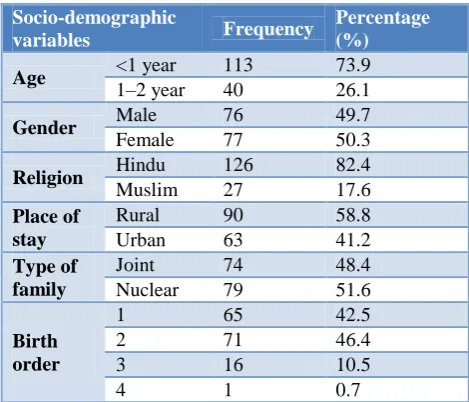
Among the children studied 113 (73. 9%) were aged less than 1 year and 40 (26.1%) were aged between 1 to 2 years. 76 (49.7%) children were male and 77 (50.3%) were female. Majority (82.4%) of the children were Hindu and 17.6% were Muslim. 58.8% of study children were residing at rural area and 41.2% were residing at urban area. 48.4% of children were staying in joint family and 51.6% were staying in nuclear family. 42.5% children were of the birth order 1, 46.4% were birth order two, 10.5% were birth order three and 1 child was birth order four (Table 1).
Table 1: Distribution of children based on socio-demographic profile.
Socio-demographic
variables Frequency
Percentage (%) Age <1 year 113 73.9 1–2 year 40 26.1
Gender Male 76 49.7
Female 77 50.3
Religion Hindu 126 82.4
Muslim 27 17.6 Place of
stay
Rural 90 58.8 Urban 63 41.2 Type of
family
Joint 74 48.4 Nuclear 79 51.6 Birth
order
1 65 42.5
2 71 46.4
3 16 10.5
4 1 0.7
Table 2: Distribution of children based on the due vaccine.
Vaccine Frequency Percentage (%)
BCG 1 0.7
DPT booster 6 3.9
LPV1 & OPV 1 12 7.8
LPV2 & OPV 2 43 28.1
LPV3 & OPV 3 55 35.9
LPV3 & Measles 2 1.3
Measles 19 12.4
unvaccinated 15 9.8
Total 153 100.0
Most common reason for non-vaccination was, child was sick on the day of vaccination (32%). Next common reason for non-vaccination was child migrated to other place (27.5%). 11.8% of children were not vaccinated because of fear for AEFI, 11.1% children were not vaccinated because of ignorance towards vaccination. 10.5% parents said they didn’t know where to go for vaccination. 3.9% children were in mothers place on the vaccination day, 1 parent said child was not vaccinated because no session was held. Among 4 others, 1 child was travelling, 1 was taken late to session (session was closed), 1 non availability of card, 1 non availability of vaccine (Table 3).
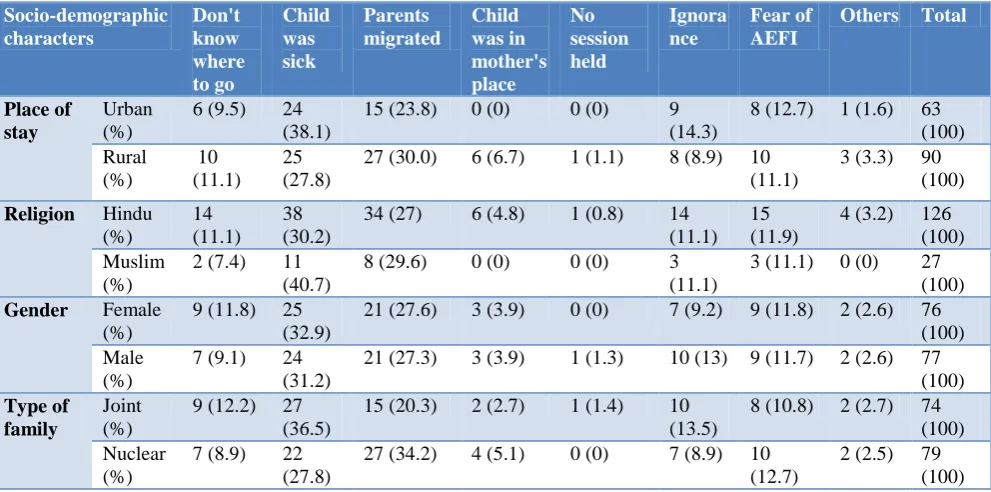
There was not much difference for reason for un-immunization or partial un-immunization with respect to the various socio-demographic characterstics (Table 4). 13 (8.5%) said one or more of their family members have advised them not to vaccinate. 7 (4.6%) said father, 1
(0.3%) said mother, 2 (1.3%) said both father and mother, 3 (2%) denial by grandparents. 83 (54.2%) parents said ASHA worker informed them about vaccination, 62 (40.5%) said AWW informed them about vaccination, 3 (2%) said both ANM and ASHA informed and 5 (3.3%) said ANM has informed.
Table 3: Distribution of children based on reason for non-vaccination.
Reason for non-vaccination
Frequency Percentage
(%)
Child was sick 49 32
Didn’t know where to go
16 10.5
Migrated to other place
42 27.5
Child went to mothers place
06 3.9
No sessions held 01 0.7
Ignorance for vaccination
17 11.1
Fear for AEFI 18 11.8
Others 04 2.6
Total 153 100.0
Among the children studied only 92 (60.1%) children were having Mother and child protection (MCP) card and 61 (39.9%) were not having MCP card. There was no difference in the presence of MCP card with respect to the gender of child, religion, place of stay, type of family literacy of father and mother (Table 5).
Table 4: Socio-demographic characters vs. reason for unimmunization.
Socio-demographic characters Don't know where to go Child was sick Parents migrated Child was in mother's place No session held Ignora nce Fear of AEFI
Others Total
Place of stay
Urban (%)
6 (9.5) 24 (38.1)
15 (23.8) 0 (0) 0 (0) 9 (14.3)
8 (12.7) 1 (1.6) 63 (100) Rural (%) 10 (11.1) 25 (27.8)
27 (30.0) 6 (6.7) 1 (1.1) 8 (8.9) 10 (11.1)
3 (3.3) 90 (100)
Religion Hindu
(%)
14 (11.1)
38 (30.2)
34 (27) 6 (4.8) 1 (0.8) 14 (11.1)
15 (11.9)
4 (3.2) 126 (100) Muslim
(%)
2 (7.4) 11 (40.7)
8 (29.6) 0 (0) 0 (0) 3 (11.1)
3 (11.1) 0 (0) 27 (100)
Gender Female
(%)
9 (11.8) 25 (32.9)
21 (27.6) 3 (3.9) 0 (0) 7 (9.2) 9 (11.8) 2 (2.6) 76 (100) Male
(%)
7 (9.1) 24 (31.2)
21 (27.3) 3 (3.9) 1 (1.3) 10 (13) 9 (11.7) 2 (2.6) 77 (100) Type of
family
Joint (%)
9 (12.2) 27 (36.5)
15 (20.3) 2 (2.7) 1 (1.4) 10 (13.5)
8 (10.8) 2 (2.7) 74 (100) Nuclear
(%)
7 (8.9) 22 (27.8)
27 (34.2) 4 (5.1) 0 (0) 7 (8.9) 10 (12.7)
Table 5: Socio-demographic characters vs. availability of MCP card.
Socio -demographic characters MCP card P value
Present Absent
Gender of child Female 47 (61.8%) 29 (38.2%) 0.668
Male 45 (58.4%) 32 (41.6%)
Religion Hindu 79 (62.7%) 47 (37.3%) 0.161
Muslim 13 (48.1%) 14 (51.9%)
Place of stay Urban 35 (55.6%) 28 (44.4%) 0.334
Rural 57 (63.3%) 33 (36.7%)
Type of family Joint 42 (56.8%) 32 (43.2%) 0.409
Nuclear 50 (63.3%) 29 (36.7%)
Literacy of father Illiterate 39 (56.5%) 30 (43.5%) 0.409
Literate 53 (63.1%) 31 (36.9%)
Literacy of mother Illiterate 62 (60.2%) 41 (39.8%) 0.982
Literate 30 (60.0%) 20 (40.0%)
DISCUSSION
As government of India launched mission Indradhanush to increase the immunization coverage by 2020 by immunizing all un immunized and partially immunized children, we have tried to bring out the reasons for the partial and un immunization among the children attending these Mission Indradhanush vaccination centres in Yadgir district. In present study it was observed that 87 (56.9%) children residing in village with vacant sub centre. A vacant post of ANM will lead to decreased vaccination coverage because parents will not be educated regarding vaccination, no vaccination sessions held etc.
In the present study 76 (49.7%) children were male and 77 (50.3%) were female which is similar to study done by Dindod et al Routine immunization. (49% were males and 51% were females).7 Majority (82.4%) of the children were Hindu and 17.6% were Muslim. This findings were in line with the population distribution and these findings were comparable to the study done by Duraimurugan et al (Out of 210 study population, 115 (55%) children were from Hindu community, 47 (22%) Muslims and 48 (23%) Christians).8 In the present study 35.9% children were due for LPV 3 and OPV 3, 28.1% children were due for LPV 2 OPV 2, 7.8% children were due for LPV 1 and OPV 1. These findings were similar to the findings of Kurane et al.9 Birth to DPT 1ST dose overall has 42% drop out. So, progressive increase in the missing the dose of LPV2 and LPV3 is because of unawareness of subsequent doses, Fear of AEFI and sickness status of the child. Hence it is very important to give a heavy emphasis on importance of follow up visits for subsequent vaccines by health worker or vaccinator. In our study most common reason for not vaccination was, child was sick on the day of vaccination (32%). Next common reason for non-vaccination was child
findings of Rajeev et al study on immunization status of anganwadi children in a rural area of north Kerala, India.10
In the present study 11.1% children were not vaccinated because of ignorance towards vaccination. 10.5% parents said they didn’t know where to go for vaccination. 3.9% children were in mothers place on the vaccination day, 1 parent said child was not vaccinated because no session was held. Present study findings are similar to the study done Rahman et al. Reasons for dropout of immunization in children in slum areas.11
Regarding the source of information about immunization in the present study 83 (54.2%) parents said ASHA worker informed them about vaccination, 62 (40.5%) said AWW informed them about vaccination, 3 (2%) said both ANM and ASHA informed and 5 (3.3%) said ANM has informed. Similar to the study done by Sharma et al in which 13.6 % of ANM, 16% of ASHA and 50% of AWW informed the parents about the immunization.12
Among the children studied only 92 (60.1%) children were having MCP card and 61 (39.9%) were not having MCP card. Various socio-demographic characters were not having any influence on having the MCP card. Vaccination was not denied because of absence of MCP card.
ACKNOWLEDGEMENTS
Authors would like to thank all the children and their parents who have participated in the study. The authors are also grateful to authors, editors, and publishers of all those articles, journals and books from where the literature for this article has been reviewed and discussed.
Funding: No funding sources Conflict of interest: None declared
Ethical approval: The study was approved by the Raichur Institute of Medical Sciences, Raichur
REFERENCES
1. Mission Indradhanush operational guidelines. Ministry of Health and family welfare, Government of India. 2015; 1:1-54.
2. Uddin MJ, Larson CP, Oliveras E, Khan IA, Quaiyum M A. Effectiveness of Combined Strategies to Improve Low Coverage of Child Immunization in Urban Slums of Bangladesh. ICDDR. 2008;8:978-84.
3. Kulkarni P, Hamid HSS, Shah M. Immunisation coverage status and reasons for underimmunisation in urban slums of Hyderabad city, Telangana state. Indian Journal of Basic and Applied Medical Res. 2014;3(4):152-7.
4. Murhekar MV, Kamaraj P, Kanagasabai K, Elavarasu E, Rajasekar TD, Boopathi K, Mehendale S. Coverage of childhood vaccination among children aged 12-23 months,Tamil Nadu, 2015. Indian J Med Res March 2017;145: 377-86.
5. Goyal S, Kumar V, Garg R. Evaluation of primary immunization coverage among children in a rural block of district Rohtak, Haryana, India. Int J Community Med Public Health 2017;4:1612-9.
6. Zewdie A, Letebo M, Mekonnen T. Reasons for defaulting from childhood immunization program: A qualitative study from Hadiya zone, Southern Ethiopia. BMC Public Health 2016;16:1240-9. 7. Dindod SM, Makwana NR, Yadav SB. Knowledge
of caretakers about routine immunization and reasons for partial immunization in rural areas of Jamnagar District. Int J Med Public Health 2014;4:57-61.
8. Duraimurugan M, Ramasubramanian R. A study on immunization coverage of 12-23 months children in urban areas of Kanchipuram district, Tamil Nadu. Int J Community Med Public Health. 2017;4:4096-100.
9. Kurane AB, Swathi D. A study of immunization status of children in the age group 2-5 years. Int J Contemp Pediatr. 2018;5:922-7.
10. Rajeev SV, Radhamani KV. A cross sectional study on immunization status of anganwadi children in a rural area of north Kerala, India. Int J Res Med Sci. 2016;4:2039-43.
11. Rahman L, Biswas H, Hossain T, Khan AM, Khan IA. Reasons for dropout of immunization in children in slum areas. South East Asia J Public Health. 2012;2(1):64-7.
12. Sharma S, Kohli C, Sharma N, Mehra D. Incomplete Immunization Coverage in Delhi: Reasons and Solutions. Primary Health Care. 2016;6:240.
Cite this article as: Chandrashekhar R, Basagoudar