Original Research Article
Clinical and histopathological pattern of colorectal malignancies, the
experience in a tertiary hospital in south-western region, Saudi Arabia
Majed Saleh M. Aldayhum
1*, Anas Abdullah R. Alshehri
1, Dlaim H. AlQahtani
2,
Eman Yahia Alfussaily
3, Suha Abdulrahman S. Althibait
1, Ziyad Abdullah R. Alshehri
1INTRODUCTION
Colorectal malignancy is a disease where malignant cells are growing in the colon tissues and it’s in the third place among most common cancer all over the world.1,2 This cancer is considered the second leading cause among cancer deaths in both sexes combined in the United States of America. The American Cancer Society estimates that
annually 136,830 people will be diagnosed and 50,310 will die from this disease.3 Research identified people with those risk factors including: age over 50, Family history of polyps, Family history of colon cancer, Genetic alterations, Hereditary non-polyposis colon cancer (HNPCC), Familial adenomatous polyposis (FAP), Ulcerative colitis or Crohn’s disease. Those are more likely than others to develop colorectal malignancies.4
ABSTRACT
Background: Colorectal cancer is the third most common cancer all over the world and the second leading cause of the cancer death in both sexes. CRC is the second most common cancer in Kingdom Saudi Arabia. However, this aspect was not recently studied.
Methods: This is a retrospectively cohort based study. We collected and analyzed the records of the patients with CRC diagnosed at Aseer Central Hospital, Abha, Saudi Arabia from January 2008 to June 2016. A pre-specified data sheet was used to collect information regarding socio-demographics, age, Altitude, site of tumor, clinical presentation, outcome and prognosis as well as histopathological pattern of cancer and the stages of disease. Descriptive statistics was performed using SPSS.
Results: A total of 291 cases of CRC were registered in the Aseer Central Hospital. 171 cases 58.87% were males while 120 cases 41.2% were females. The mean age of patients (SD) at the time of diagnosis was 59.38 years. At the time of diagnosis, 219 patients 84.6% presented with early stage disease and 40 15.4% had distant metastasis advanced stage. The most frequent CRC located in sigmoid 26.5%, rectal 23.7%and 14% in ascending. The moderately differentiate adenocarcinoma grade of tumor is being the most common grade among all variants 75.6%.
Conclusions: In this study, we have nearly similar results found in previously published study by Alshehri et al. Males considered most affected, most of the patients were more than 50 years, 84.6% of the patients came with early stage disease. Left side colon were the most common site of CRC.
Keywords: Colorectal cancer, Aseer, Histopathology, Clinical and KSA 1
College of Medicine, King Khalid University, Abha, Saudi Arabia 2
King Fahad Armed Forces Hospital, Jeddah, KSA 3
King Faisal Armed Forces Hospital, KSA
Received: 11 September 2018
Revised: 11 October 2018
Accepted: 12 October 2018
*Correspondence:
Dr. Majed S. Aldayhum, E-mail: [email protected]
Copyright: © the author(s), publisher and licensee Medip Academy. This is an open-access article distributed under the terms of the Creative Commons Attribution Non-Commercial License, which permits unrestricted non-commercial use, distribution, and reproduction in any medium, provided the original work is properly cited.
Previous study has shown that healthy food habits specially vegetables intake reduce the risk of having colorectal malignancies.5
In spite of the relatively low incidence, colorectal malignancy is the second most common cancer in Saudi Arabia, ranking first among men (10.6%) and third among women (8.9%).6 Women in Saudi Arabia have a higher incidence and mortality rate, as compared to other populations in less developed areas of the world.7 The survival is nearly related to the clinical and pathological stage at diagnosis, and a lots of reports suggest that colorectal malignancies occurring at a young age is associated with much severe disease and high mortality rate, which has a similar relevance to the Saudi population.6 A study was done in 1996 at Aseer central hospital showed that in colorectal carcinoma and the age of the highest incidence is shown between 51 and 60 years and the most common presenting symptom was rectal bleeding. Left sided colon carcinoma was more commonly seen (67%) than right sided colon carcinoma. Most of the lesions were seen in Dukes B and C stages. No significant sex difference was detected.8 No recent publication regarding the condition in Aseer region was found. However, according to the last report of Saudi General Authority of Statistics, Aseer region is considered the fourth most populated area in KSA and its Central Hospital (ACH) is a referral hospital for Aseer region and for other southern regions.
Based on above we would like to identify the clinical and Histopathological pattern of colorectal malignancies in a tertiary hospital in southwestern region, Saudi Arabia.
METHODS
We conducted this retrospective -cohort study in Aseer Central Hospital, Saudi Arabia
Study population
We included 291 patients, 171 cases (58.87%) were males while 120 cases (41.2%) were females giving a male to female ratio of 1.4: 1. with colorectal cancer admitted to Aseer Central Hospital during the period of 2006 to 2016.
Study tools and data collection
Data was collected through pre-specified questionnaire and the collected data included patients attended to Aseer Central Hospital during the period of 2006 to 2016 and it was traced from hospital records and the Histopathological Registry after we obtained the ethical approval from the local medical ethical committee, in addition to the permission from the medical director of Asser Central Hospital.
Data included patients’ demographics, clinical symptomatology, investigative modality, therapeutic
intervention, histopathological results and long-term out-comes were assessed.
Plan of data analysis
Statistical Package for Social Sciences (SPSS) software version 18.0 was used for data analysis. Descriptive statistics were presented as number and percentage for categorical data and mean and standard deviation for continuous data. Chi-square tests (χ2) were used for the association between categorical variables. Student t-test was used to compare continuous variables. P value equal or less than 0.05 was considered statistically significant.
RESULTS
A total of 271 cases of CRC were registered during the period from January 2008 and June 2016. The data revealed a general increase in CRC incidence (Figure 1). The annual number of CRM admitted to Aseer central hospital was increased from 2008 (12 patients only) to 2015 (53 patients) and the first half of the years 2016, the registered patients was reached to 29 patients. The highest percentage were in 2015 (n=53, 18.2%) then in 2012 (n=41, 14.1%) while the lowest percentage of registered patients was in year 2008 (n=12, 4.1%).
Figure 1: Annual number of colorectal malignancies admitted to Aser central hospital during the period
from 2008 to 2016.
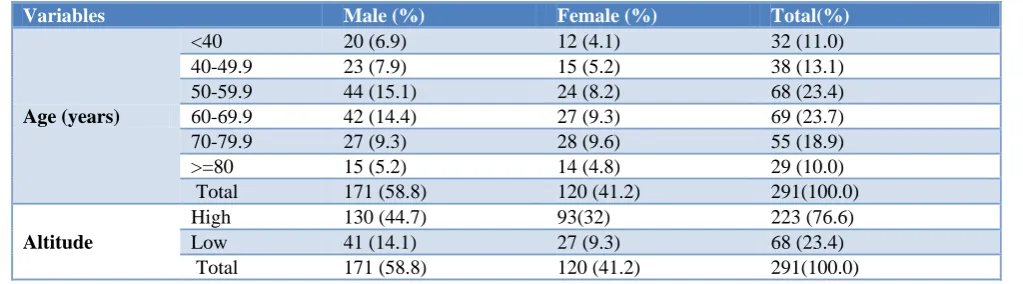
Table 1 shows the histopathological features of CRC cases in relation to patient’s gender, there were 171 cases (58.8%) males and 120 cases (41.2%) females giving a male to female ratio of 1.4: 1. The age of the studied cases ranged from 11to 100 years with a mean age 59.38 year with standard deviation 15.79 years. The age is grouped into 6 categories, the peak age range was 50-69 years. A total of 32 (11%; male=20; female=12 (were below 40 years of age; while 29 patients (10%; male=15; female=14) were aged above 80 years. The highest number of patients was between the ages of 60 and 69 (n=69; 23.7%; male=42; female=27). For altitude 223 of cases (76.6% male=130; female=93) have high altitude while 68 of cases have low altitude (23.4% male=41; female=27). It is obvious that male have higher altitude than female.
12 29
35 28
41 40
24 53
29
0 10 20 30 40 50 60
2008 2009 2010 2011 2012 2013 2014 2015 2016
num
ber
o
f
ca
ses
Table 1: Distribution of CRM according to demographic characteristics.
Variables Male (%) Female (%) Total(%)
Age (years)
<40 20 (6.9) 12 (4.1) 32 (11.0)
40-49.9 23 (7.9) 15 (5.2) 38 (13.1)
50-59.9 44 (15.1) 24 (8.2) 68 (23.4)
60-69.9 42 (14.4) 27 (9.3) 69 (23.7)
70-79.9 27 (9.3) 28 (9.6) 55 (18.9)
>=80 15 (5.2) 14 (4.8) 29 (10.0)
Total 171 (58.8) 120 (41.2) 291(100.0)
Altitude
High 130 (44.7) 93(32) 223 (76.6)
Low 41 (14.1) 27 (9.3) 68 (23.4)
Total 171 (58.8) 120 (41.2) 291(100.0)
Table 2: Pathology features of CRM cases in relation to patient’s gender.
Variables Male Female Total
TNM stages
Stage I 39 (23.5) 30 (18.1) 69 (41.6)
Stage II 10 (6) 3 (1.8) 13 (7.8)
Stage III 47 (28.3) 28 (16.9) 75 (45.2)
Stage IV 5 (3) 4 (2.4) 9 (5.4)
Total 101 (60.8) 65 (39.2) 166 (100)
Lymph node size
≥12 LN 19 (18.1) 14 (13.3) 33 (31.4)
< 12 LN 49 (46.7) 23 (21.9) 72 (68.6)
Total 68 (64.8) 37 (35.2) 105 (100)
Table 2 summarizes the TNM stages and lymph node size. Tumor stage, size and lymph nodes status were available for 166 cases and 105 cases, respectively. The majority of patients i.e. 47.8% were diagnosed in stage III (n= 75; male=47; female=28) and 41.6% in stage I (n= 69; male=39; female=27), whereas 7.8% (n=13) and 5.4% (n=9) of patients were in stage I and stage IV respectively. The size of the tumor was less than 12 cm in 72 cases (68.6%; male=49; female=23), while equal to or more than 12 cm in 33 cases (31.4%; male=19; female=14).
Out of 69 (41.6%) cases are in stage I.
Table 3: Number and percentage of presence clinical presentation.
Count N (%) Altered bowel habits 34 11.7
Anemia 30 10.3
Weight loss 77 26.5
Abdominal pain 192 66
Rectal pain 12 4.1
Rectal mass 23 7.9
Rectal bleeding 115 39.5
Abdominal mass 14 4.8
Sudden discovered using usual
screening 1 0.3
Obstruction: Vomiting,
constipation, distention 131 45.0
Table 3 presents the presence of common sigma mf symptom for CRC in Asir hospital, 192 (66%) patients had abdominal pain, 131 (45%) had obstruction vomiting constipation distention115 (39.5%) had rectal bleeding. 26.5% (77) had weight loss sign. Only 0.3% had sudden discovered using usual screening.
Figure 2: Frequency of colorectal malignancy by location.
From Figure 2 represents the percentage of cases by colorectal malignancies (CRM) location. The most common location in order was the sigmoid (26.5%), rectal (23.7%), ascending (14%) and cecal (10.4%). while no appearance in anal (0%).
Table 4 describe the stage of CRM patients where 219 (84.6%) out of 259 cases were in early stage and 40 cases
10.4%
4.3% 14.0%
26.5%
2.5% 2.5%
7.9% 6.5%
23.7%
0.0% .4% 1.4%
(15.4%) were in advanced stage (metastatic). The most frequent pathological variant was adenocarcinoma (95%). 249 cases (85.6%) were elective operated and 37 (12.9%) were reoffered. 83 (50.6%) cases of available recorded data were positive LN and 81 (49.4) were LN noninvolved.
Table 4: Distribution of colorectal malignancy by stage, pathological type, action taken and pathology
details.
Variables No (%)
Stage
Early stage 219 (84.6)
Advanced stage (metastatic) 40 (15.4)
Pathological type
Adenocarcinoma 274 (95.9)
Lymphoma 9 (3.2)
Neuroendocrine (carcinoid) 1 (0.3)
Others 2 (0.6)
Action Taken
Operated (timing?) elective 249 (85.6)
Operated emergency 1 (0.3)
Referred 37 (12.9)
Pathology details
Positive LN 83(50.6)
LN noninvolved 81(49.4)
Figure 3: Frequency of colorectal malignancy by grade of tumor.
From Figure 3, overall histologically, the differentiation characteristics of tumors were: 5.7% well differentiated, 75.6% moderately differentiated, 15.8% poorly differentiated and 2.9% Signet ring cell adenocarcinoma. From Table 5, there a significant relation between grades of tumor and age (p<0.05), altitude, TNM stages (p<0.05), while there is significant relation between tumor grades and gender (p>0.05).
Table 5: Test the association between grades of tumor and age, gender, altitude and TNM stages.
Chi- square P value
Age 26.33 0.035
Gender 5.36 0.147
Altitude 7.038 0.041
TNM stages 19.71 0.020
Figure 4: Frequency of colorectal malignancy by location.
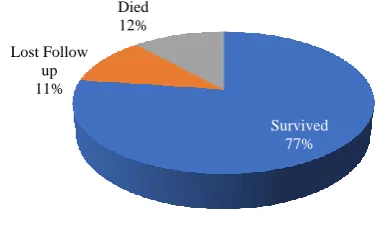
From Figure 4, 77% of CRM cases are survived, 12% died 11% lost follow up.
DISCUSSION
Gastrointestinal tract (GIT) cancer in general and colorectal carcinoma (CRC) in particular, have been addressed in many reports in the medical literature through the last few years.9-14 Previous reports from Aseer area have shown colorectal carcinoma incidence as 21% of all gastrointestinal tract cancer,and GIT cancer to be the second leading cause of malignant tumors after skin cancer.15,16
There's an obvious tendency in incidence of CRC to increase with advanced age especially in western countries. Colon and rectum cancer is most frequently diagnosed among people aged 65-74 with median age of 67.17 This tendency in age is seen in this study as well with <50 of patients above age of 60. However, a significant percentage young patient (24%) has been diagnosed with CRC below age of 50. This percentage is far higher than those reported form Western populations.18,19 However, these finding are similar to other studies done in Saudi Arabia while it was 31% in Riyadh Central Hospital, 21% in King Faisal Specialist Hospital, and 8% in the West.20-22
These rates in Saudi population suggesting the association of a familial risk factors for the development of CRC for which more controlled and validated studies are needed.23,24 Similarly, Jaberi et al. reported that 68% of CRC patients were >40 years and also had advanced lesions (Duke’s C or D) compared to only 40.0% of those patients >40 years.24 This should make the reliability of the current recommendation of screening at age of 50 very questionable which will cause high proportion of those patients to misdiagnosis at the right time.25,26 There are some but non-significant differences in gender regarding incidence and can staging. On the other hand, there was a significant impact of altitude on incidence with 76.6% of patients are of high altitude.
Most of the patients in this study were of adenocarcinoma type (95.9%) are at advanced stage III (45%). Mansoor et
5.7%
75.6%
15.8%
2.9% 0.0%
10.0% 20.0% 30.0% 40.0% 50.0% 60.0% 70.0% 80.0%
Well differentiated adenocarcinoma
Moderately differentiated
adenocarc
Poorly differentiated adenocarcinoma
Signet ring celladenocarcinoma
Survived 77%
Lost Follow up 11%
al.23 reported in their study done at urban center of Jeddah, 28.9% of patients as Duke’s C. Isbister compared the CRC between Saudi and New Zealand patients and reported more aggressive pattern in Saudi Arabia.27 Similarly, Rozen et al also reported this changing trend with more aggressive pattern in Arabs.28 The emphasize the significance of early screening for better detection and prognosis of CRC in Arab populations. Unfortunately, there is a lack of proper screening program in Saudi Arabia. Therefore, it seems reasonable that changing dietary pattern especially with genetic predisposition is necessity. However, CRC screening in Saudi Arabia could be improved by information systems identifying patients with higher risk for earlier screening and track their results. Primary care physicians, may also play an important rule by educating patients about cancer with different benefits and options for screening to detect early lesions.
CONCLUSION
In conclusion, this study shows that the age of the highest incidence is above 50 years which is coinciding with other reports from other parts of Saudi Arabia, UK, USA, and Africa. The most common presenting symptom was abdominal pain. Most of cases are seen in advanced stages with no significant gender difference detected.
ACKNOWLEDGEMENTS
This research was supported by Health Research Consultancy Office awarded to Dr. Hassan Alzahrani.
Funding: No funding sources Conflict of interest: None declared
Ethical approval: The study was approved by the Institutional Ethics Committee of King Khalid University
REFERENCES
1. National Cancer Institute. Colon Cancer Treatment. Available at: http://www.cancer.gov/types/ colo-rectal/patient/colon-treatment-pdq#section/all. Accessed 21 July 2017.
2. Worldwide data, World Cancer Research Fund International. Available at: http://www.wcrf.org/int/ cancer-facts-figures/worldwide-data. Accessed 21 July 2017.
3. Statistics - Colon Cancer Alliance - Prevention, Research, Patient Support. Available at: http://www.ccalliance.org/get-information/what-is-colon-cancer/statistics/. Accessed 21 July 2017. 4. Risk Factors - Colon Cancer Alliance - Prevention,
Research, Patient Support. Available at: http://www.ccalliance.org/get-information/what-is-colon-cancer/risk-factors/. Accessed 21 July 2017. 5. van Breda S. Altered vegetable intake affects pivotal
carcinogenesis pathways in colon mucosa from adenoma patients and controls. Carcinogenesis. 2004;25(11):2207-16.
6. Zubaidi A, AlHumaid A, AlKhayal K, AlObeed O, AlSubaie N and Shaik S. Public awareness of colorectal cancer in Saudi Arabia: A survey of 1070 participants in Riyadh. Saudi J Gastroenterol. 2015;21(2):78.
7. Khayyat Y, Ibrahim E. Public awareness of colon cancer screening among the general population: A study from the Western Region of Saudi Arabia. Qatar Med J. 2014;(1):3.
8. Al-Shehri MY. Colorectal carcinoma: review of 63 cases at Asir Central Hospital, Saudi Arabia. Emirates Med J. 1996;14:21-6.
9. Bedikian A. Survey of alimentary malignancies at King Faisal Specialist Hospital and Research Centre. Ann Saudi Med. 1987;7(4):277-81.
10. Rabadi J. Cancer at Dahran Health Centre, Saudi Arabia. Ann Saudi Med, 1987;7(4):288-93.
11. Koreich M, Karawi M. Gastrointestinal tract malignancies: Pattern of disease at the Riyadh Armed Forces Hospital (Abstract). Ann Saudi Med, 1988;8(1):75.
12. Mofarreh MA, Afzal M, Kraida AA, Al-Qasabi QO, Fakunle YM, Quasem SMA, et al. Pattern of primary gastrointestinal tract malignancy among Saudi nationals a retrospective study, Ann Saudi Med. 1991:11(1):15-8.
13. Mohamed E, Al-Karawi A, Koreich M. Incidence of colorectal cancer and colonic polyps in Saudi patients. Ann of Saudi Med. 1990;10(1):19-21. 14. Alsayel M, Aldohayan A, Alqasabi OF. Colorectal
carcinoma: review of 110 cases. Ann Saudi Med. 1990;10(6):646-9.
15. Morad N, Khan R, Alsaigh A, Malatani T, Hussain N. Pattern of primary gastrointestinal tract cancer in the southern province. Ann Saudi Med. 1991;12(3):259-63.
16. Khan AR, Hussain NK, Alsaigh A, Sheikha AK. Pattern of cancer in Asir Central Hospital, Abha, Saudi Arabia. Ann Saudi Med. 1991;11(3):285-8. 17. Ponz de Leon M, Marino M, Benatti P, Rossi G,
Menigatti M, Pedroni M, et al. Trend of incidence, subsite distribution and staging of colorectal neoplasms in the 15-year experience of a specialized cancer registry. Ann Oncol. 2004;15, 940-6.
18. SEER Cancer Stat Facts: Colon and Rectum Cancer. National Cancer Institute. Bethesda, MD. Available at: http://seer.cancer.gov/statfacts/html/colorect. html. Accessed on 21 July 2017.
19. Ries LA, Wingo PA, Miller DS, Howe HL, Weir HK. The annual report to the nation on the state of cancer, 1973-1997 with special section on colorectal cancer. Cancer. 2000;88, 2398-424.
20. Alsebayel M, Aldohayan A, Alqasabiq O. Colorectal carcinoma: review of 110 cases. Ann Saudi Med. 1990;10(6):646-9.
21. Bedikian AY, Bakhsh K, Deniord R, Elakkads. Colorectal carinoma during the first four decades of life, Ann Saudi Med. 1987;7(4):282-7.
23. Mansoor I, Zahrani IH, AbdulAziz S. Colorectal cancers in Saudi Arabia. Saudi Med J. 2002;23:322-7.
24. Al Jebri TM, Ammari F, Charieybeh K, Khammash M, Yaghan RJ, Heis H, et al. Colorectal adenocarcinoma in a defned Jordanian population form 1990-1995. Dis Colon Rectum. 1997;40:1089-94.
25. Al Jabreen AM. Clinico-pathological pattern of colorectal cancer in Suadi Arabia Younger with advanced stage presentation. Saudi J Gastroentrol. 2007;13:84-7.
26. Ibrahim EM, Zeeneldin AA, El Khodary TR. Past, present and future of colorectal cancer in the Kingdom of Saudi Arabia. Saudi J Gastroenterol. 2008;14:178-82.
27. Isbister WH. Colorectal cancer below age 40 in the Kingdom of Saudi Arabia. Aust N Z J Surg. 1992;62:468-72.
28. Rozen P, Rosner G, Liphshitz I, Barchana M. The changing incidence and sites of colorectal cancer in the Israeli Arab population and their clinical implications. Int J Cancer. 2007;120:147-51.
Cite this article as: Aldayhum MSM, Alshehri AAR, AlQahtani DH, Alfussaily EY, Althibait SAS, Alshehri ZAR. Clinical and histopathological pattern of