R E S E A R C H A R T I C L E
Open Access
Making medical student course evaluations
meaningful: implementation of an intensive
course review protocol
Patrick Fleming
1,2,6*, Olga Heath
3, Alan Goodridge
4and Vernon Curran
5Abstract
Background:Ongoing course evaluation is a key component of quality improvement in higher education. The complexities associated with delivering high quality medical education programs involving multiple lecturers can make course and instructor evaluation challenging. We describe the implementation and evaluation of an“intensive course review protocol”in an undergraduate medical program.
Methods:We examined pre-clerkship courses from 2006 to 2011 - prior to and following protocol implementation. Our non-parametric analysis included Mann-Whitney U tests to compare the 2006/07 and 2010/11 academic years. Results:We included 30 courses in our analysis. In the 2006/07 academic year, 13/30 courses (43.3 %) did not meet the minimum benchmark and were put under intensive review. By 2010/11, only 3/30 courses (10.0 %) were still below the minimum benchmark. Compared to 2006/07, courses ratings in the 2010/11 year were significantly higher (p = 0.004). However, during the study period mean response rates fell from 76.5 % in 2006/07 to 49.7 % in 2010/11.
Conclusion:These results suggest an intensive course review protocol can have a significant impact on pre-clerkship course ratings in an undergraduate medical program. Reductions in survey response rates represent an ongoing challenge in the interpretation of student feedback.
Background
Ongoing course evaluation is a key component of quality improvement in higher education and an accreditation requirement for Canadian medical schools [1, 2]. The lit-erature recommends a comprehensive approach to evaluation that is directly linked to curricular develop-ment and modification [3]. However, there is no identi-fied best practice for achieving this goal [4]. The complexities associated with delivering high quality medical education programs involving multiple lecturers can make course and instructor evaluation quite challen-ging [5].
The most common evaluation model in medical edu-cation involves student course evaluation questionnaires completed at the conclusion of a course [4, 6]. Previous
research has demonstrated that students are discriminat-ing judges of instructional effectiveness, providdiscriminat-ing rat-ings that are quite stable [6] and valid indicators of teaching effectiveness [7, 8].
The majority of medical schools in both Canada and the United States have course evaluation systems in place based on student-completed questionnaires [4]. However, there is very little in the literature to help guide medical schools in creating evaluation system frameworks to maintain the quality of their undergradu-ate medical education programs. In particular, it is un-clear how medical schools use student feedback to enhance course curriculum and if such changes improve future curriculum delivery [9, 10].
Educational environment
The Faculty of Medicine at Memorial University of New-foundland in St. John’s, Canada has a four-year doctor of medicine (MD) program requiring a bachelor’s degree for entry. During the study period, 60-64 students were
* Correspondence:[email protected]
1Faculty of Medicine, Memorial University of Newfoundland, St. John’s,
Canada
2Division of Dermatology, University of Toronto, Toronto, Canada
Full list of author information is available at the end of the article
admitted each year of which 52-56 were residents in the provinces of Newfoundland & Labrador, New Brunswick, or Prince Edward Island in Canada.
The first two years of the undergraduate medicine pro-gram are referred to as “pre-clerkship”. At the time, courses in pre-clerkship involved a combination of di-dactic lectures, case-based learning, small-group discus-sion, e-learning, and clinical skills sessions. These courses include subject areas such as biochemistry, car-diology, neurology, and community health. They average around three weeks in length with a range of two to six weeks depending on the topic. Course activities typically occupy four to six hours of instructional time daily dur-ing these periods. The final two years are referred to as
“clerkship”and involve six to twelve week rotations core rotations in disciplines such as family medicine, internal medicine, and general surgery that are delivered at either urban or rural teaching sites. Two to four week elective rotations may be taken at external sites.
The Program Evaluation Subcommittee (PESC) at Memorial University of Newfoundland is the internal curriculum evaluation oversight committee for the undergraduate medical program. PESC examines a variety of data including student feedback surveys, Canadian li-censing exam results, residency match reports, standardized
exam results (e.g., National Board of Medical Examiners), student exit interviews at graduation, medical graduate sur-veys, and faculty opinion in a holistic assessment of the medical curriculum. It is also evaluated externally at regular intervals by an accreditation process. This is conducted by the joint Canadian/American body known as the Committee on the Accreditation of Canadian Medical Schools/Liaison Committee on Medical Education.
Objective
The primary objective of our study is to describe the“ in-tensive course review” protocol that is triggered by stu-dent course evaluation feedback. Our secondary objective is to report a retrospective analysis of the ef-fectiveness of this intensive course review in improving overall course ratings (defined by number of courses ex-ceeding an overall rating >3.5/5).
Intensive course review protocol
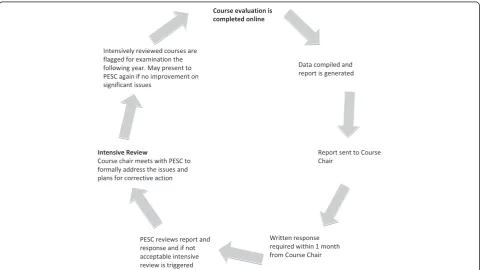
The intensive course review protocol for examining stu-dent course evaluations is illustrated in Fig. 1. We circu-late course evaluation questionnaires electronically to students after completion of a course. Students evaluate
their courses on a variety of dimensions using a 5-point Likert scale (see Additional file 1).
Those courses not meeting established standards undergo an“intensive course review”. Three criteria de-termine when an intensive review of a course is neces-sary. These include: 1) an overall mean rating below 3.5/ 5.0; 2) a decrease in overall mean course rating of >0.5/ 5.0 over one year; or 3) a committee-identified critical course issue (e.g., chronic recurring issues or poor stan-dardized exam results in courses otherwise meeting the benchmark). The <3.5 threshold and the decrease of 0.5 was established based upon the observation of marked increases in negative comments with these course rat-ings below this level.
When undergoing an intensive review, the course chair presents an action plan in person to PESC address-ing course deficiencies and detailaddress-ing steps to resolve identified problems. This provides an avenue for course chair, faculty, and student discussion of the proposed ac-tion plan. Student liaisons provide input to the commit-tee on strategies for course improvement. Results of medical licensing exams and standardized exams are considered. Courses requiring an intensive review are flagged for reassessment to track the impact of any im-plemented changes. PESC may require a course chair to meet with the committee again if critical issues remain or if course ratings do not improve. In courses not re-quiring intensive review, both positive and negative feed-back is communicated to course chairs to aid in ongoing curriculum enhancement. This model for student evalu-ation of curriculum was implemented during the 2006/ 07 academic year.
Methods
Ethics approval is not required for secondary use of non-identifiable data or program evaluation at our insti-tution as per the local Health Research Ethics Authority [11] and Canadian Tri-Council Policy Statement guide-lines (articles 2.4-2.5) [12]. Completion of the question-naire was considered implied consent to provide course evaluation feedback. All responses were anonymous and no identifiable information was collected. We examined student ratings for pre-clerkship courses from 2006 to 2011. Course surveys were distributed on paper in the 2006/07 and 2007/08 years during the final lecture of a course. Starting in the 2008/09 year they were released via email and completed online after a course was fin-ished. The content of the surveys remained identical. In addition, medical school admissions criteria, course chairs, and course instructors remained consistent dur-ing the study period. Most of the courses were un-changed, although a small number of courses were discontinued or restructured early in the study period. Such courses with incomplete data were excluded from
the analysis. We excluded feedback data from clerkship rotations since none required an intensive course review during our study period. The proportion of courses below the 3.5 benchmark and their median ratings were calculated from 2006 to 2011.
To examine the differences in the course ratings across academic years, a non-parametric analysis using Kruskall-Wallis test (SPSS V21) was conducted with alpha set at 0.05. Post-hoc tests were conducted using Mann-Whitney U tests with the Bonferroni correction (alpha set at 0.01). Response rates for student evalua-tions of each course included in the analysis were also calculated.
Results
We included 30 independent units of coursework per academic year in our analysis (total sample n = 150). We excluded 4 courses due to missing data–none of which required an intensive review. In the 2006/2007 academic year, 13/30 courses (43.3 %) did not meet the minimum benchmark and were placed under intensive review. By 2010/2011, only 3/30 courses (10.0 %) were still below the minimum benchmark (Fig. 2). Median course ratings have trended upward since implementing our protocol (Table 1). The only criterion utilized to trigger an inten-sive course review during our study period was our <3.5 benchmark. The 3 courses that remained below the benchmark were consistent during follow-up.
A Kruskall-Wallis test revealed statistically significant differences in course ratings across five academic years (2006/07, n = 30, 2007/08, n = 30, 2008/09, n = 30, 2009/ 10, n = 30, 2010/11, n = 30), ×2= 31.798, n = 150, degrees of freedom = 4, p < 0.001. Mann-Whitney U Tests re-vealed that course ratings, compared to 2006/07, were significantly higher in 2008/09, 2009/10, and 2010/11 (Table 1).
Since the 2006/07 academic year, there has been a steady decline in student response rates. In 2006/07 the response rate was 76.5 % and this decreased to 49.7 % in 2010/11.
Discussion
There is little practical information in the literature on how medical schools respond to poor course ratings or the impact of any intervention. We describe the inten-sive course review protocol used at Memorial University of Newfoundland in St. John’s, Canada. Our analysis sug-gests that implementing an intensive course review protocol can have a substantial and significant influence on improving pre-clerkship student course evaluation in an undergraduate medical program.
for responding to negative student evaluations using pre-determined benchmarks for comprehensive course review. The pre-clerkship and clerkship student repre-sentatives are full voting members of the committee and provide a valuable liaison between the PESC and stu-dents. This ensures that students are informed about the impact of their evaluations on courses. They can also provide input directly to the committee on student con-cerns and suggestions for improvement. The PESC com-mittee centralizes monitoring of course ratings and provides evaluation data to course chairs. This gives stu-dent course evaluation a higher profile within the ad-ministrative structure of the medical school. But perhaps most importantly, the intensive course review protocol has a high level of accountability built in for course chairs through the requirement to develop and present a formal action plan. It also allows PESC to consider course chair opinion when assessing course evaluation feedback. Together, these factors help to ensure a trans-parent and effective process for managing negative course evaluations.
Improvement in course ratings may be due to a num-ber of factors. We believe changes in the course content
and delivery resulting from intensive course reviews likely plays a substantial role in improved student rat-ings. The intensive course review also typically includes improved communication on course objectives and structure that may improve student ratings. The“cohort effect” whereby students in one academic year may over or undervalue certain aspects of the teaching style and curriculum compared to prior years may explain some of our results. However, the admissions policies, curricu-lum structure, course objectives and key faculty were consistent during our study period. As well, the im-provements in student course evaluations were main-tained over three consecutive cohorts following two consecutive cohorts with lower median ratings making it less likely that cohort effects are a significant factor in the improved scores. In addition, the timing of the im-provements is consistent with the introduction of the in-tensive course review protocol suggesting that it is having an impact.
There remain a number of challenges in implementing the course evaluation process. The most critical is main-taining acceptable response rates. There is conflicting evidence concerning the use of electronic surveys for
Fig. 2Percentage of courses below benchmark by academic year. Courses below the minimum benchmark of a 3.5/5 rating from 2006 to 2011. The intensive course review protocol was initiated in the 2006/07 year. A Kruskall-Wallis test revealed statistically significant differences across all five academic years (p < 0.001)
Table 1Median ratings for courses by academic year and mann whitney u tests comparing academic years to the pre-intensive course review perioda
Academic Year Enrolled Pre-clerkship studentsc Median rating (interquartile range) P-value Effect size (η2) U score Z score R score
2006/07b 120 3.50 (3.20, 4.00) - - - -
-2007/08 120 3.50 (3.30, 3.70) 0.614 NS NS NS NS
2008/09 124 4.10 (3.80, 4.30) <0.001 0.222 200.0 −3.705 0.676
2009/10 128 4.15 (3.70, 4.30) 0.001 0.246 221.5 −3.386 0.618
2010/11 128 4.00 (3.80, 4.20) 0.004 0.283 255.0 −2.890 0.528
a
Mann Whitney U, compared to 2006/07 b
Pre-Intensive Course Review Protocol c
course evaluations and whether they increase or de-crease response rates [13]. However, since the imple-mentation of electronic course evaluations by PESC, response rates for the pre-clerkship courses have steadily dropped from 74.8 % in 2006/07 to 49.7 % in 2010/11. When student participation falls below 50 %, there is a real threat to the validity and reliability of the evalua-tions that may result in faculty disregarding them [14]. Improved course ratings could be due to bias introduced by lower response rates. However, it is possible that stu-dents who dissatisfied with courses tend to respond to surveys and therefore results underestimate improve-ments. PESC is currently exploring options to increase response rates such as incentive programs or a return to paper evaluations.
There are several limitations to this descriptive study. Firstly, it relies primarily on survey data from students that may not accurately capture all curriculum deficien-cies. We only examine the effect on pre-clerkship courses since no clerkship rotations required an intensive review during our study period limiting the generalizability of our findings to upper years. Another limitation is that outcome-based measures are not directly used to trigger an intensive course review. However, PESC does consider results of Canadian medical licensing exams and other ob-jective measures when examining courses undergoing an intensive review. There is also the risk of regression to the mean given the low values of many courses at baseline. We did take repeated measures of all of the courses over time with consistent improvement that suggests our data is valid. As well, visual inspection of individual course data reveals that the median course ratings for most courses remained the same or increased over the study period sug-gesting that regression to the mean is not having a large impact. Unfortunately, we did not have access to within-subject data and therefore cannot complete an analysis of covariance to rule out regression to the mean bias.
Conclusion
Our analysis demonstrates that the intensive course re-view protocol has significantly and meaningfully (η2: 0.222-0.283) improved pre-clerkship course ratings at our institution. Our success is likely related to having a trans-parent and systematic process to address course feedback with input from multiple stakeholders. Our results may be not generalizable beyond pre-clerkship courses because we were unable to examine clinical rotations since none required a review. Declining student response rates repre-sent an ongoing challenge to interpreting data.
Additional file
Additional file 1:Sample Student Feedback Survey.
Competing interests
The authors declare that they have no competing interests.
Authors’contributions
PF, Drafted the methods, results, and discussion sections, conducted data analysis and data interpretation, critical revision of the manuscript. OH, Designed the study, critical revision of the manuscript, study supervisor. AG, Study conception, data collection, critical revision of manuscript. VC, Drafted background section, critical revision of manuscript. All authors reviewed and approved the final version of the manuscript.
Acknowledgements
We wish to thank the Program Evaluation Subcommittee (PESC) at Memorial University of Newfoundland in St. John’s, Canada for its contribution to the protocol described in this article. We also wish to acknowledge the Medical Education Scholarship Center for their assistance in preparing this paper.
Author details
1Faculty of Medicine, Memorial University of Newfoundland, St. John’s,
Canada.2Division of Dermatology, University of Toronto, Toronto, Canada.
3Center for Collaborative Health Professional Education and Division of
Community Health & Humanities, Faculty of Medicine, Memorial University of Newfoundland, St. John’s, Canada.4Department of Medicine, Faculty of
Medicine, Memorial University of Newfoundland, St. John’s, Canada.5Center for Collaborative Health Professional Education and Faculty of Education, Memorial University of Newfoundland, St. John’s, Canada.6Centre for Collaborative Health Professional Education, Faculty of Medicine, Memorial University of Newfoundland, Room 2901, Health Sciences Centre, St. John’s, NL A1B 3V6, Canada.
Received: 8 May 2014 Accepted: 29 May 2015
References
1. Hendry GD, Cumming RG, Lyon PM, Gordon J. Student-centred course evaluation in a four-year, problem based medical programme: issues in collection and management of feedback. Assess Eval High Educ. 2007;26(4):327–39.
2. Krantz Girod C, Raphael Bonvin R, Lanares J, Cuenot S, Feihl F, Bosman F, et al. Stability of repeated student evaluations of teaching in the second preclinical year of a medical curriculum. Assess Eval High Educ. 2004;29(1):123–33.
3. Snell L, Tallett S, Haist S, Hays R, Norcini J, Prince K, et al. A review of the evaluation of clinical teaching: new perspectives and challenges. Med Educ. 2000;34(10):862–70.
4. Abrahams MB, Friedman CP. Preclinical course-evaluation methods at U.S. and Canadian medical schools. Acad Med. 1996;71(4):371–4.
5. Kogan JR, Shea JA. Course evaluation in medical education. Teaching Teacher Educ. 2007;23:251–64.
6. Aleamoni LM. Student rating myths versus research facts from 1924 to 1998. J Person Eval Educ. 1999;13(2):153–66.
7. Copeland HL, Hewson MG. Developing and testing an instrument to measure the effectiveness of clinical teaching in an academic medical center. Acad Med. 2000;75(2):161–6.
8. Rudland JR, Pippard MJ, Rennie SC. Comparison of opinions and profiles of late or non-responding medical students with initial responders to a course evaluation questionnaire. Med Teach. 2005;27(7):644–6.
9. Gibson KA, Boyle P, Black DA, Cunningham M, Grimm MC, McNeil HP. Enhancing evaluation in an undergraduate medical education program. Acad Med. 2008;83(8):787–93.
10. Watson S. Closing the feedback loop: ensuring effective action from student feedback. Tert Educ Manag. 2003;9(2):145–57.
11. Health Research Ethics Authority. Ethics Review Required? May 6, 2015. Available at http://www.hrea.ca/Ethics-Review-Required.aspx. Accessed May 6, 2015.
13. Moss J, Hendry G. Use of electronic surveys in course evalution. Br J Educ Technol. 2002;33(5):583–92.
14. Gravestock P & Gregor-Greenleaf E. Student Course Evaluations: Research, Models and Trends Report. The Higher Education Quality Council of Ontario: 2008 Accessed 10/1/2012, 2012 from http://www.heqco.ca/SiteCollection Documents/Student%20Course%20Evaluations.pdf.
15. Canadian Medical Education Statistics. The Association of Faculties of Medicine of Canada. 2014. Accessed December 28, 2014 from https:// www.afmc.ca/pdf/CMES2014-Complete-Optimized.pdf.
Submit your next manuscript to BioMed Central and take full advantage of:
• Convenient online submission
• Thorough peer review
• No space constraints or color figure charges
• Immediate publication on acceptance
• Inclusion in PubMed, CAS, Scopus and Google Scholar
• Research which is freely available for redistribution