S H O R T R E P O R T
Open Access
Effects of live yeast on differential genetic
and functional attributes of rumen
microbiota in beef cattle
Ibukun M. Ogunade
*, Jerusha Lay, Kenneth Andries, Christina J. McManus and Frederick Bebe
Abstract
Several studies have evaluated the effects of live yeast supplementation on rumen microbial population; however, its effect on differential microbial genes and their functional potential has not been described. Thus, this study applied shotgun metagenomic sequencing to evaluate the effects of live yeast supplementation on genetic and functional potential of the rumen microbiota in beef cattle. Eight rumen-cannulated Holstein steers were randomly assigned to two treatments in a cross-over design with two 25-day experimental periods and a 10-day wash-out between the two periods. The steers were housed in individual pens and fed 50% concentrate-mix and 50% red clover/orchard hayad libitum. Treatments were (1) control (CON; basal diet without additive) and (2) yeast (YEA; basal diet plus 15 g/d of live yeast product). Rumen fluid samples were collected at 3, 6, and 9 h after feeding on the last d of each period. Sequencing was done on an Illumina HiSeq 2500 platform. Dietary yeast supplementation increased the relative abundance of carbohydrate-fermenting bacteria (such asRuminococcus albus,R.
champanellensis,R. bromii, andR. obeum) and lactate-utilizing bacteria (such asMegasphaera elsdenii,Desulfovibrio desulfuricans, andD. vulgaris). A total of 154 differentially abundant genes (DEGs) were obtained (false discovery rate < 0.01). Kyoto Encyclopedia of Genes and Genomes (KEGG) annotation analysis of the DEGs revealed that 10 pathways, including amino sugar and nucleotide sugar metabolism, oxidative phosphorylation, lipopolysaccharide biosynthesis, pantothenate and coenzyme A biosynthesis, glutathione metabolism, beta-alanine metabolism, polyketide sugar unit biosynthesis, protein export, ribosome, and bacterial secretory system, were enriched in steers fed YEA. Annotation analysis of the DEGs in the carbohydrate-active enzymes (CAZy) database revealed that the abundance of genes coding for enzymes belonging to glycoside hydrolases, glycosyltransferases, and carbohydrate binding modules were enriched in steers fed YEA. These results confirm the effectiveness of a liveS. cerevisiae
product for improving rumen function in beef steers by increasing the abundance of cellulolytic bacteria, lactic acid-utilizing bacteria, and carbohydrate-active enzymes in the rumen.
Keywords:Functional potential, Live yeast, Rumen
Background
Live yeast products containingSaccharomyces cerevisiae are feed additives used to alter rumen fermentation for improved performance, health, and feed efficiency of ruminants [1]. Yeast products favor the growth of fiber-degrading bacteria, stabilize rumen pH by stimulating the population of lactate-consuming bacteria, and in-crease abundance of rumen microbes by reducing the rumen’s redox potential [1].
Given the role of live yeast product on rumen func-tion, earlier studies utilized culture-based methods to assess the effects of live yeast in the rumen [2]; however, this technique is unable to cultivate most naturally oc-curring species in the rumen [3]. In recent years, several 16S ribosomal ribonucleic acid (rRNA) gene-based se-quencing studies have advanced our knowledge of rumi-nal bacterial diversity and have reported the effects ofS. cerevisiae products in the rumen [4]. However, 16S rRNA gene sequencing reveals the bacterial diversity without any insight into the functional potential of mi-crobial communities [5]. In our recent companion study,
© The Author(s). 2019Open AccessThis article is distributed under the terms of the Creative Commons Attribution 4.0 International License (http://creativecommons.org/licenses/by/4.0/), which permits unrestricted use, distribution, and reproduction in any medium, provided you give appropriate credit to the original author(s) and the source, provide a link to the Creative Commons license, and indicate if changes were made. The Creative Commons Public Domain Dedication waiver (http://creativecommons.org/publicdomain/zero/1.0/) applies to the data made available in this article, unless otherwise stated. * Correspondence:[email protected];[email protected]
belonging to the same feeding experiment as the current study [6], we integrated 16S rRNA gene sequencing and liquid chromatography-mass spectrometry-based metabo-lomics. Our results revealed that some bacterial genera that responded to treatment with a liveS. cerevisiae-based additive showed positive correlations with metabolites in-volved in amino acid metabolism and biosynthesis as well as metabolism of energy substrates. Therefore, this study applied a shotgun metagenomic sequencing approach to offer taxonomic classification of sequences at the species level and reveal, for the first time, the effects of live yeast supplementation on differentially abundant genes and their functional potential.
Methods
All experimental animals were managed according to guidelines approved by the Institutional Animal Care and Use Committee of Kentucky State University (proto-col number 18–001). Detailed information about cows and feeding have been reported in our companion paper [6]. Briefly, eight rumen-cannulated Holstein steers were assigned randomly to one of two treatments in a cross-over design with two 25-day experimental periods and a 10-day wash-out between periods. The steers were housed in individual pens and fed 50% concentrate-mix and 50% red clover/orchard hayad libitum. Mineral mix (Hubbard Feeds; Mankato, MN) was fed free-choice. Diet-ary treatments were (1) control (CON; basal diet without additive) and (2) yeast (YEA; basal diet plus 15 g/d of Peloton live yeast product; PMI, Arden Hills, MN, USA). The yeast additive was top-dressed on the concentrate mix from d 1 to 25 of each period.
Rumen fluid collection
On d 25 of each experimental period, representative samples (100 mL) of the ruminal contents were col-lected via the cannula at approximately 3, 6, and 9 h after feeding. At the time of collection, the samples were hand-strained through 4 layers of sterile cheese-cloth to separate the liquid and solid samples. Daily composited samples (solid and liquid samples) were mixed 1:1 (w/w) and stored at −80 °C for subsequent shotgun metagenomic sequencing.
Shotgun metagenomic sequencing
Deoxyribonucleic acid (DNA) extraction and sequencing were performed as reported by Ogunade et al. [7]. Briefly, rumen fluid samples were thawed at room temperature and centrifuged at 15,000×g. DNA was extracted and purified from the pellets using a PowerSoil DNA Isolation Kit (MO BIO Laboratories Inc., Carlsbad, CA). The integrity of the DNA was verified by agarose (0.7%) gel electrophoresis and the DNA was stored at −20 °C until further use. The se-quencing library was constructed by DNA fragmentation
[8]. The sheared DNA fragments were then sequenced on an Illumina HiSeq 2500 platform using an Illumina HiSeq – paired-end 150 base pair (bp) strategy. Quality control was performed at each step of the procedure to guarantee the reliability of the sequence data.
Bioinformatics and statistical analysis
The raw sequence data files were demultiplexed and stored as fastq format. Quality filtering, such as removal of low-quality (Q-score≤10) and contaminative reads, was performed. Thereafter, the quality-filtered sequence data were assembled using Iterative De Bruijn Graph De Novo Assembler [9]. The resulting contig sequences (≥ 500 bp) were evaluated using Quality Assessment Tool for Genome Assemblies (QUAST) software [10]. There-after, the contig sequences were aligned to National Center for Biotechnology Information’s reference se-quence database using Kraken software [11] to obtain taxonomic composition and relative abundance informa-tion. Differences in the relative abundance of taxa at the species level (> 0.1% of total sequences) were analyzed using the generalized linear mixed model procedure in SAS version 9.4 (SAS Institute Inc., Cary, NC, USA); the model included the effects of treatment, period, and their interaction. Differences between means were deter-mined using the Fisher’s test and significant differences were declared at P≤0.05 and tendency was declared at 0.05 <P≤0.10. Normality was tested by examining the distribution of residuals.
The open reading frames in the assembled contigs were predicted using GeneMark software [12]. Redundancy was removed and all predicted genes were clustered using Cluster Database at High Identity with Tolerance (CD-HIT) software (http://www.bioinformatics.org/cd-hit/) with the following parameters: 90% similarity, 90% coverage threshold [13]. Differential gene abundance analysis
be-tween CON and YEA was performed using DESeq [14].
Fold change (the ratio of abundance between CON
and YEA treatments)≥2 and false discovery rate
(FDR) < 0.01, obtained using the Benjamini-Hochberg calibration method, were set as screening criteria to obtain differential gene sets. The differential gene sets were annotated in Kyoto Encyclopedia of Genes and Genomes database (KEGG) pathways to reveal informa-tion on differential gene funcinforma-tional potential and the carbohydrate-active enzymes (CAZy) database (http:// www.cazy.org/) to obtain information on carbohydrate-ac-tive enzymes.
Results and discussion
studies require caution and clarification [6]. The product used in this study is a thermal-stable live S. cerevisiae (5.7 × 10⁶ colony forming units/g) with high levels of mannan oligosaccharides and beta-glucans, which were sourced from human-grade food plant (PMI, Arden Hills, MN, USA).
After sequencing of the 16 samples and assembly of the quality-controlled sequence data, 4,333,577 contigs, with an average read length of approximately 1,000 bp, were generated (see Additional file 1). Dietary yeast supplementation increased the relative abundance of 37 microbial species (see Additional file 2). The microbial species (> 1% of the total community) that responded to dietary treatment are shown in Table 1. Ruminococcus albusandR. flavefaciensare cellulose-degrading bacteria [15],R. bromiidegrades resistant starch and xylan, while R. obeumdegrades complex deoxy sugars, such as rham-nose and fucose [16]. Several studies have reported the effectiveness of certain strains ofS. cerevisiae at increas-ing the abundance and activities of dominant fiber-de-grading rumen microorganisms, such as Fibrobacter and Ruminococcus spp. [4]. This study also revealed that the abundance of relatively unknown and less abundant rumi-nal cellulolytic microbial species, such as Rhodopseudomo-nas palustris and Sorangium cellulosum, responded to YEA treatment (see Additional file2). Some of the micro-bial species such asR. obeum,Faecalibacterium prausnit-zii, andEnterococcus casseliflavus, that responded to YEA treatment are common human gut microbes and are not often detected in the rumen at high abundance (> 1%), therefore, further studies are needed to quantify these bacteria via quantitative polymerase chain reaction.
Yeast additives maintain efficient rumen function neces-sary for the growth and activities of cellulolytic bacteria by increasing ruminal pH [1]. Yeast additives stimulate the growth of lactate-fermenting bacteria via supply of
vitamins and amino acids essential for their growth [4] and/or outcompeting lactate-producers (such as Strepto-coccus bovis) for sugar utilization, thereby preventing ruminal lactate accumulation [1]. In this study, the relative abundance of Megasphaera elsdenii, a lactate-fermenting bacterium, and two species ofDesulfovibrio(D. desulfuri-cans and D. vulgaris; see Additional file 2) known to oxidize lactate to acetate [17], were increased by YEA. It is important to note that lactate concentration was not influ-enced, probably because the diet fed was non-acidotic (as reported in our companion paper [7]).
The increased relative abundance of Methanobrevibac-ter ruminantium, a prominent member of methanogenic archaea, observed in this study is probably due to the in-creased abundance of fiber-degrading bacteria, especially Ruminococcus albus,a carbohydrate-fermenting, H2
-pro-ducing organism [18]. This might be linked to H2
trans-fer between H2-producing cellulolytic bacteria and
methanogenic archaea [19]. Fiber is fermented to volatile fatty acids, ammonia, H2, and CO2 in the rumen [20].
Rumen methanogens, such as M. ruminantium, use H2
as a substrate to reduce CO2to methane [21]. Results of
studies on the effects of strains ofS. cerevisiaeon rumi-nal methane production have been conflicting. An in vitro study by Chaucheyras-Durand et al. [22] revealed that a certain live yeast strain increased growth of aceto-genic bacteria that can outcompete methanogens by
util-izing H2 and CO2 to produce acetate. Newbold and
Rode [23] evaluated the effects of several yeast strains on methane production and reported either no effect or decreased methane production. Our results suggest that YEA treatment might increase the amount of ruminal
CH4 produced due to the increased abundance of M.
ruminantium; however, we believe that CH4production
per unit of milk or meat will probably be reduced through improved ruminal fiber degradation and feed conversion efficiency.
To our knowledge, this study is the first to evaluate the influence of dietary treatment with yeast product on differentially abundant gene (DEG). A total of 154 DEGs were obtained (fold change > 2; FDR < 0.01). Exactly 139 genes were upregulated in the YEA treatment whereas 15 genes were upregulated in CON. The details of the DEGs, including gene IDs and statistical information,
are shown in Additional file 3. None of the genes
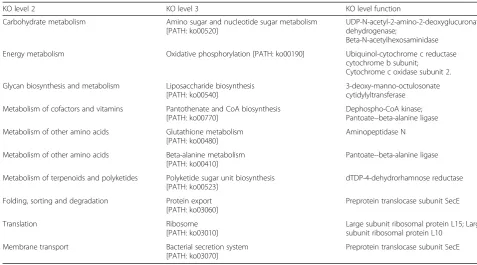
enriched in CON were annotated in KEGG. KEGG annotation analysis of the upregulated genes in YEA re-vealed that 10 pathways were enriched (Table 2). These 10 pathways were related to folding, sorting and degrad-ation, transldegrad-ation, membrane transport, and metabolisms of vitamins and co-factors, energy, terpenoids and poly-ketides, amino acids, and carbohydrate pathways at KEGG orthology level 2 (Table2). These confirm the re-sults of our companion paper [6] in which we reported Table 1Relative abundance of microbial species (> 1% of total
sequences) affected by dietary treatment in beef steers fed no or 15 g/d of live yeast product
Microbial species Treatmenta SE P-value
CON YEA
Faecalibacterium prausnitzii 0.83 1.45 0.08 0.01
Ruminococcus flavefaciens 0.28 1.21 0.13 0.01
Oscillibacter valericigenes 0.56 1.16 0.13 0.01
Ruminococcus bromii 0.70 1.66 0.18 0.01
Methanobrevibacter ruminantium 0.55 1.01 0.14 0.04
Ruminococcus obeum 0.35 1.22 0.10 0.01
Enterococcus casseliflavus 0.31 1.04 0.27 0.05
Megasphaera elsdenii 0.29 1.13 0.20 0.05
Ruminococcus albus 0.26 1.36 0.09 0.01
a
positive correlations between some bacterial genera that responded to yeast treatment and metabolites involved in metabolism of carbohydrates and amino acids. The DEGs related to carbohydrate metabolism were UDP-N-acetyl-2-amino-2-deoxyglucuronate dehydrogenase and β-N-acetylhexosaminidase, both of which are involved in metabolism of amino and nucleotide sugars, which are components of structural polysaccharides. The DEGs related to oxidative phosphorylation were ubiquinol-cyto-chrome c reductase cytoubiquinol-cyto-chrome b subunit and cytoubiquinol-cyto-chrome c oxidase subunit 2, both of which are components of the mitochondrial respiratory chain of S. cerevisiae that cata-lyzes the reduction of oxygen to water [24]. This indicates an oxygen-scavenging activity, one of the modes of action by whichS. cerevisiaeimproves rumen function. Oxygen is toxic to rumen microbes; therefore, lowering the redox po-tential in the rumen improves the growing conditions for anaerobic rumen microbes [25]. This probably explains in-creased relative abundance of strictly anaerobic bacteria, such as Oscillibacter valericigenes and F. prausnitzii, observed in this study.
Lipopolysaccharides are components of gram-nega-tive bacterial cell walls and are required for growth, virulence, and drug resistance of these bacteria [26]. The population of gram-negative bacteria accounts for up to 80%–90% of the total ruminal bacterial population [27]. In this study, increased lipopolysac-charide biosynthesis probably indicates improved ruminal bacterial growth. Feeding live yeast creates favorable condi-tions for growth and activities of ruminal bacteria through
increased pH, lower redox potential, and supply of growth factors [25].
Rumen microbes are able to synthesize pantothenic acid and other B vitamins [28]; however, the net vita-min synthesis in the rumen may not be adequate to sat-isfy the nutritional requirements of the animals, especially in high-producing or growing animals [29]. Saccharomyces cerevisiae is capable of de novo biosyn-thesis of pantothenic acid and co-enzyme A via the activities of pantoate-beta-alanine ligase (using pantoate and alanine as substrates) and dephospho-CoA kinase (using dephospho-CoA as a substrate), respectively [30]. This explains the enriched pantothenic acid and CoA biosynthesis pathway and increased abundance of Megasphaera elsdenii and Desulfovibrio spp., in YEA treatment because lactate-utilizers require vitamins for their growth and activities [31]. Aminopeptidase N, also called alanyl aminopeptidase, is a hydrolase enzyme that catalyzes the cleavage of alanine from N-terminus of a dipeptide such as alanylglycine [32]. Enrichment of aminopeptidase N is probably due to increased demand of alanine as a substrate for pantothenic acid synthesis byS. cerevisiae.
Enrichment of pathways related to ribosome and tein export probably indicates increased microbial pro-tein synthesis. Ribosomes are organelles that catalyze mRNA-directed protein synthesis in all organisms [33]. In our companion study, we observed lower ammonia-N in steers receiving YEA, which was partly due to its in-creased uptake by rumen microbes for protein synthesis. Table 2KEGG orthology annotation of differential genes enriched in beef steers fed 15 g/d of live yeast product
KO level 2 KO level 3 KO level function
Carbohydrate metabolism Amino sugar and nucleotide sugar metabolism [PATH: ko00520]
UDP-N-acetyl-2-amino-2-deoxyglucuronate dehydrogenase;
Beta-N-acetylhexosaminidase
Energy metabolism Oxidative phosphorylation [PATH: ko00190] Ubiquinol-cytochrome c reductase cytochrome b subunit;
Cytochrome c oxidase subunit 2.
Glycan biosynthesis and metabolism Liposaccharide biosynthesis [PATH: ko00540]
3-deoxy-manno-octulosonate cytidylyltransferase
Metabolism of cofactors and vitamins Pantothenate and CoA biosynthesis [PATH: ko00770]
Dephospho-CoA kinase; Pantoate--beta-alanine ligase
Metabolism of other amino acids Glutathione metabolism [PATH: ko00480]
Aminopeptidase N
Metabolism of other amino acids Beta-alanine metabolism [PATH: ko00410]
Pantoate--beta-alanine ligase
Metabolism of terpenoids and polyketides Polyketide sugar unit biosynthesis [PATH: ko00523]
dTDP-4-dehydrorhamnose reductase
Folding, sorting and degradation Protein export [PATH: ko03060]
Preprotein translocase subunit SecE
Translation Ribosome
[PATH: ko03010]
Large subunit ribosomal protein L15; Large subunit ribosomal protein L10
Membrane transport Bacterial secretion system [PATH: ko03070]
Fig. 1Distribution of the carbohydrate-active enzymes
Table 3Carbohydrate-active enzymes (CAZy) database annotation of differential genes enriched in beef steers fed 15 g/d of live yeast product
Family CAZy-classa Activitiesb
CBM37 CBM Polysaccharide-degrading enzymes with broad specificity for xylan, chitin, microcrystalline and cellulose
GH16 GH Xyloglucosyltransferase; endo-1,4-beta-galactosidase; endo-1,3-beta-glucanase; endo-1,3 (4)-beta-glucanase; licheninase; beta-agarase; carrageenase; xyloglucanase
GH23 GH Peptidoglycan lyase
GH3 GH Beta-glucosidase; xylan1,4-beta-xylosidase; beta-N-acetylhexosaminidase; 1,3-beta-glucosidase; 1,4-beta-glucosidase; exo-1,3-1,4-glucanase; alphalpha-L-arabinofuranosidase
GT2 GT Cellulose synthase; chitin synthase; dolichyl-phosphate beta-D-mannosyltransferase; dolichyl-phosphate beta-glucosyltransferase; N-acetylglucosaminyltransferase; N-acetylgalactosaminyltransferase; hyaluronan synthase; chitin oligosaccharide synthase; beta-1,3-glucan synthase; beta-1,4-mannan synthase;
alpha-1,6-mannosyltransferase; alpha-1,3-L-rhamnosyltransferase
GT4 GT Sucrose synthase; sucrose-phosphate synthase; alpha-glucosyltransferase; lipopolysaccharide N-acetylglucosaminyltransferase; 1,2-diacylglycerol
3-glucosyltransferase; diglucosyl diacylglycerol synthase; digalactosyldiacylglycerol synthase
GT83 GT 4-amino-4-deoxy-beta-L-arabinosyltransferase; lipopolysaccharide core alpha-galacturonosyl transferase
GT9 GT Lipopolysaccharide N-acetylglucosaminyltransferase; heptosyltransferase
a
CBMCarbohydrate binding modules,GHglycoside hydrolases,GTGlycosyltransferases b
In this study, yeast supplementation improved rumen microbial growth, specifically the cellulolytic bacteria. Since cellulolytic bacteria have a high preference for am-monia-N [34], it was expected that utilization of ammo-nia-N by the rumen microbes for protein synthesis would increase.
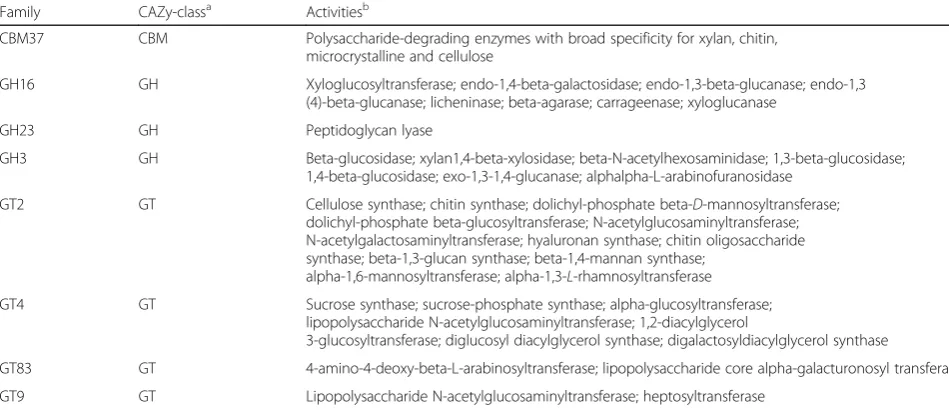
The rumen contains several carbohydrate-active en-zymes that are produced by rumen microorganisms and required for hydrolysis of plant cell-wall polysaccharides. A total of 148,586 predicted genes were annotated to the CAZy database, a database containing 6 classes of CAZy: glycoside hydrolases (GHs), glycosyltransferases (GTs), polysaccharide lyases (PLs), carbohydrate binding mod-ules (CBM), carbohydrate esterases (CEs), and auxiliary activities (AAs). The distribution of the annotated genes is shown in Fig.1. Annotation of the DEGs revealed that 3 genes belonged to GH3, GH16, and GH23 families; 4 genes belonged to GT2, GT4, GT9, and GT83 families;
and 1 gene belonged to the CBM37 family (Table 3).
Families of enzymes belonging to GHs and CBMs are polysaccharides-degrading enzymes produced by rumi-nal cellulolytic bacteria [35]. Increased abundance of GHs and CBMs was due to increased growth of cellulo-lytic bacteria in beef steer fed YEA. Glycosyltransferases represent a class of enzymes involved in synthesizing glycosidic bonds for the biosynthesis of polysaccharides such as lipopolysaccharides [36]. This explains the enriched lipopolysaccharides biosynthesis pathway ob-served in steers fed YEA.
Conclusion
This study provides new insights into the mode of action of live yeast, such as evidence of oxygen consumption and increased abundance of carbohydrate-active enzymes. Taken together, these results confirm the effectiveness of a liveS. cerevisiaeproduct at improving rumen function by increasing the abundance of cellulolytic bacteria, lactic acid-utilizing bacteria, and carbohydrate-active enzymes in the rumen.
Additional files
Additional file 1:Details of sequence data. (XLSX 14 kb)
Additional file 2:Effects of live yeast supplementation on rumen microbial species. (DOCX 14 kb)
Additional file 3:List of differentially abundant genes. (XLSX 38 kb)
Abbreviations
bp:Base pair; CAZy: Carbohydrate-active enzymes; CD-HIT: Cluster database at high identity with tolerance; CON: Control treatment; DEG: Differentially abundant genes; DNA: Deoxyribonucleic acid; FDR: False discovery rate; KEGG: Kyoto Encyclopedia of Genes and Genomes; QUAST: Quality Assessment Tool for Genome Assemblies; rRNA: Ribosomal ribonucleic acid; YEA: Live yeast treatment
Acknowledgements
The authors are grateful to Hank Schweickart for the daily care and treatment of the animals.
Authors’contributions
IO and KA conceived and designed the experiment. IO and JL performed the experiment, IO and FB analyzed the data. IO wrote the paper. CM edited and reviewed the manuscript. All authors read and approved the final manuscript.
Funding
This study (KYSU-000058) was partially supported by funds from Land O′ Lakes Inc. and the US Department of Agriculture’s National Institute of Food and Agriculture Evans-Allen project 1008985.
Availability of data and materials
All data generated or analyzed are available from the corresponding author on request.
Ethics approval
The research protocol (protocol number 18–001) was reviewed and approved by the Institutional Animal Care and Use Committee of Kentucky State University.
Consent for publication
Not applicable.
Competing interests
The authors declare that they have no competing interests.
Received: 7 March 2019 Accepted: 9 July 2019
References
1. Chaucheyras-Durand F, Chevaux E, Martin C, Forano E. Use of yeast probiotics in ruminants: Effects and mechanisms of action on rumen pH, fiber degradation, and microbiota according to the diet. In: Rigobelo E, editor. Probiotic in Animals. Rijeka, Croatia: IntechOpen; 2012. p. 119–52. https://doi.org/10.5772/50192.
2. Nisbet DJ, Martin SA. The effect ofSaccharomyces cerevisiaeculture on lactate utilization by the ruminal bacteriumSelenomonas ruminantium. J Anim Sci. 1991;69:4628–33.
3. Ercolini D. High-throughput sequencing and metagenomics: moving forward in the culture-independent analysis of food microbial ecology. Appl Environ Microbiol. 2013;79:3148–55.
4. Jiang Y, Ogunade IM, Qi S, Hackmann TJ, Staples CR, Adesogan AT. Effects of the dose and viability ofSaccharomyces cerevisiae. 1. Diversity of ruminal microbes as analyzed by Illumina MiSeq sequencing and quantitative PCR. J Dairy Sci. 2017;100:325–42.
5. Mann E, Wetzels SU, Wagner M, Zebeli Q, Schmitz-Esser S.
Metatranscriptome sequencing reveals insights into the gene expression and functional potential of rumen wall bacteria. Front Microbiol. 2018;9:43. 6. Ogunade I, Schweickart H, McCoun M, Cannon K, McManus C. Integrating
16S rRNA sequencing and LC–MS-based metabolomics to evaluate the effects of live yeast on rumen function in beef cattle. Animals. 2019;9(1):28. 7. Ogunade IM, Schweickart H, Andries K, Lay J. Monensin alters the
functional and metabolomics profile of rumen microbiota in beef cattle. Animals. 2018;8:211.
8. Qin J, Li R, Raes J, Arumugam M, Burgdorf KS, Manichanh C, et al. A human gut microbial gene catalogue established by metagenomic sequencing. Nature. 2010;464:59–65.
9. Peng Y, Leung HCM, Yiu SM, Chin FYL. IDBA-UD: ade novoassembler for single-cell and metagenomic sequencing data with highly uneven depth. Bioinformatics. 2012;28:1420–8.
10. Gurevich A, Saveliev V, Vyahhi N, Tesler G. QUAST: quality assessment tool for genome assemblies. Bioinformatics. 2013;29(8):1072–5.
11. Wood DE, Salzberg SL. Kraken: ultrafast metagenomic sequence classification using exact alignments. Genome Biol. 2014;15:46. 12. Zhu W, Lomsadze A, Borodovsky M.Ab initiogene identification in
metagenomic sequences. Nucleic Acids Res. 2010;38:132.
14. Anders S, Huber W. Differential expression of RNA-Seq data at the gene level–the DESeq package. Heidelberg: European Molecular Biology Laboratory (EMBL); 2012.
15. Flint HJ, Bayer EA, Rincon MT, Lamed R, White BA. Polysaccharide utilization by gut bacteria: potential for new insights from genomic analysis. Nat Rev Microbiol. 2008;6:121–31.
16. Reichardt N, Duncan SH, Young P, Belenguer A, Leitch CM, Scott KP, et al. Phylogenetic distribution of three pathways for propionate production within the human gut microbiota. ISME J. 2014;8:1323.
17. Vita N, Valette O, Brasseur G, Lignon S, Denis Y, Ansaldi M, et al. The primary pathway for lactate oxidation inDesulfovibrio vulgaris. Front Microbiol. 2015; 6:606.
18. Iannotti EL, Kafkewitz D, Wolin MJ, Bryant MP. Glucose fermentation products ofRuminococcus albusgrown in continuous culture withVibrio succinogenes: changes caused by interspecies transfer of H2. J Bacteriol. 1973;114:1231–40.
19. Chassard C, Delmas E, Robert C, Bernalier-Donadille A. The cellulose-degrading microbial community of the human gut varies according to the presence or absence of methanogens. FEMS Microbiol Ecol. 2010;74:205–13. 20. Loor JJ, Elolimy AA, McCann JC. Dietary impacts on rumen microbiota in
beef and dairy production. Anim Front. 2016;6:22–9.
21. Hook SE, Wright ADG, McBride BW. Methanogens: methane producers of the rumen and mitigation strategies. Archaea. 2010;2010:945785. 22. Chaucheyras-Durand F, Fonty G, Bertin G, Gouet P.In vitroH2utilization by
a ruminal acetogenic bacterium cultivated alone or in association with an archaea methanogen is stimulated by a probiotic strain ofSaccharomyces cerevisiae. Appl Environ Microbiol. 1995;61:3466–7.
23. Newbold CJ, Rode LM. Dietary additives to control methanogenesis in the rumen. Int Congr Ser. 2006;1293:138–47.
24. Beattie DS, Jenkins HC, Howton MM. Biochemical evidence for the orientation of cytochrome b in the yeast mitochondrial membrane in the eight-helix model. Arch Biochem Biophys. 1994;312:292–300.
25. Chaucheyras-Durand F, Walker ND, Bach A. Effects of active dry yeasts on the rumen microbial ecosystem: past, present and future. Anim Feed Sci Technol. 2008;145:5–26.
26. Kondo KI, Doi H, Adachi H, Nishimura Y. Synergistic effect of CMP/KDO synthase inhibitors with antimicrobial agents on inhibition of production and release of vero toxin by enterohaemorrhagicEscherichia coliO157: H7. Bioorg Med Chem Lett. 2004;14:467–70.
27. Krause DO, Nagaraja TG, Wright AD, Callaway TR. Board invited review: rumen microbiology: leading the way in microbial ecology. J Anim Sci. 2013;91:331–41.
28. Volker D, Hüther L, DaşG, Abel H. Pantothenic acid supplementation to support rumen microbes? Arch Anim Nutr. 2011;65:163–73.
29. NRC. Nutrient Requirements of Dairy Cattle. 7th rev. ed. Washington, DC: National Academies Press; 2001.
30. White WH, Gunyuzlu PL, Toyn JH.Saccharomyces cerevisiaeis capable ofde novopantothenic acid biosynthesis involving a novel pathway of beta-alanine production from spermine. J Biol Chem. 2001;276:10794–800. 31. Wolin MJ, Miller TL. Microbe-microbe interactions. In: Hobson PN, editor.
The rumen microbial ecosystem. London: Elsevier Applied Science; 1988. p. 343–59.
32. Luan Y, Xu W. The structure and main functions of aminopeptidase N. Curr Med Chem. 2007;14:639–47.
33. Alberts B, Johnson A, Lewis J, Raff M, Roberts K, Walter P. The Endoplasmic Reticulum. In Molecular Biology of the Cell. 4th ed. New York: Garland Science; 2002.
34. Bryant MP, Robinson IM. Studies on the nitrogen requirements of some ruminal cellulolytic bacteria. Appl Microbiol. 1961;9:96–103.
35. Flint HJ, Scott KP, Duncan SH, Louis P, Forano E. Microbial degradation of complex carbohydrates in the gut. Gut Microbes. 2012;3(4):1–18. 36. Lairson LL, Henrissat B, Davies GJ, Withers SG. Glycosyltransferases: