R E S E A R C H
Open Access
Effect of
in ovo
folic acid injection on
hepatic
IGF2
expression and embryo
growth of broilers
Yanli Liu
1, Lihui Zhi
2, Jing Shen
1, Shizhao Li
1, Junhu Yao
1and Xiaojun Yang
1*Abstract
Background:Insulin-like factor 2 (IGF2) plays an important role in embryonic growth process by modulating intermediary metabolism and cell proliferation. Folic acid is involved in one carbon metabolism and contributes to DNA methylation which is related to gene expression. The purpose of this study was to explore whether folic acid could regulate IGF2 expression via epigenetic mechanism and further promote embryonic growth of new-hatched broilers.
Methods: In the present study, 360 fertile eggs were selected and randomly assigned to four treatments. On 11 embryonic day of incubation (E11), 0, 50, 100 and 150 μg folic acid were injected into eggs respectively. After hatched, growth performance of broilers were calculated. Hepatic IGF2 expression, methylation level and chromatin structure of promoter region were analyzed.
Results: Results have showed that IGF2 expression was up-regulated in 150 μg folic acid group (P< 0.05) and other two dose of folic acid did not affect gene expression (P> 0.05). Meanwhile, methylation level ofIGF2promoter were lower in 100 and 150 μg groups, which was consistent with lower expression of DNA methyltransferase 1 (DNMT1) (P< 0.05). What’s more, chromatin looseness of IGF2 promoter was higher in 150 μg group than control group (P< 0.05). Further, birth weight (BW), liver and bursa index of new-hatched chickens in 150 μg folic acid group were higher than the other groups (P< 0.05). There were positive correlations between hepaticIGF2 expression and BW and organs index (P< 0.05).
Conclusion:In conclusion, our data have demonstrated that 150μg folic acid injection on E11 could up-regulateIGF2 expression by modulating DNA hypomethylation and improving chromatin accessibility in the gene promoter region, and ulteriorly facilitate embryonic growth and organ development of broilers.
Keywords:Broiler, Chromatin structure, Folic acid, Insulin-like growth factor 2, Methylation
Background
Insulin-like growth factor 2 (IGF2) has been generally studied in eutherian mammals and marsupial for the reason that IGF2/H19are imprinted and IGF2 is associ-ated with performance traits. However, genomic imprint-ing phenomenon has never been detected in chickens and H19 gene is absent from the chicken sequence [1]. IGF2is located on chromosome 5 and displays a biallelic pattern of expression during chicken development [2].
Previous detailed reviews have reported the role of IGFs and provided ample evidence suggesting that IGFs were involved in DNA and protein synthesis, glucose and energy metabolism and lipid metabolism in poultry [3, 4]. Similarly to mammals, as an appropriate selection candidate gene, IGF2 is also associated with economical traits of chicken such as muscle growth, body compos-ition, embryonic growth and differentiation [2, 5].
The chicken is an important model organism in ovipar-ous animals, and this species is well characterized in many biological aspects and bridges the evolutionary gap between mammals and other vertebrates [6]. Whereas, the energy and nutrients needed during embryonic development and * Correspondence:[email protected]
1College of Animal Science and Technology, Northwest A&F University,
Yangling 712100, China
Full list of author information is available at the end of the article
growth of avian are stored in the egg. Nutritionally, the yolk, the egg richest fraction, is the primary source of nutrition. In ovoinjection, a unique way of introducing nutrients into the incubating embryo, is used in poultry to improve nutritional level of eggs. Studies have indi-cated that in ovo injection of amino acids, vitamins as well as trace elements can enhance growth of the em-bryo and improve immune response during post-hatch development in chickens [7].
Folic acid is a key one carbon group involved in DNA, RNA and protein methylation as well as DNA synthesis and maintenance [8]. Epigenetics is to study the herit-able changes in phenotype or gene expression without changes in the primary DNA sequence [9]. Many re-searches have reported the relationship between folic acid and DNA methylation [8, 10, 11]. IGF2 is mainly synthesized in liver and plays an important role in em-bryonic development of avian species via autocrine/ paracrine mechanisms [12]. Moreover, transgenic and gene knockout mouse models have demonstrated that IGF2 is required for tissue growth and fetal normal development [13, 14].
To sum up, on account of the importance of IGF2 function, it will be valuable to study regulatory mech-anism of IGF2 expression, but to date correlational studies whether early nutrient supplementation might affect gene expression via epigenetic ways are scarce in poultry. Considering special characters during chicken growing and development, the present investigation was carried out to explore the effects of inovofolic acid injection on hepatic IGF2 expression and embryo de-velopment of broilers.
Methods
Animals experiment
In the study, 360 Cobb fertile eggs whose weight were among 65.7 ± 0.3 g were randomly assigned to four treatments (6 replicates/treatment, 15 birds/replicate). The experimental eggs were hatched in the micro-computer automatic incubator (Beijing LanTianJiao Electronic Technology Co., LTD, Beijing, China). All replicates of four treatments were arranged locally equalization as much as possible before hatching. Folic acid (Sigma, USA) was dissolved in sterile saline at 500, 1000 and 1500 μg/mL. Folic acid solution (0.1 mL) was injected into the yolk sac on E11 for three treatments respectively and another treatment was injected 0.1 mL saline as the control. The detailed injection methods were on the basis of previous report [15]. Injection time for folic acid was chosen according to the preliminary test where we have set set three times (E3, E7 and E11) for injection. Based on preliminary results (data not shown) and previous research [16], we select E11 as injection age in this study.
Sample collection
During egg incubation, infertile and dead eggs were removed and recorded. After hatched, the fertilized hatchability was calculated by the formula: (the number of hatching birds/the number of fertilized eggs) * 100 %. One healthy bird was selected from each replicate to rapidly dissect whose weight was close to average value of the replicate. The liver, spleen, heart and bursa were removed and weighted immediately to calculate organ index. After weighting, all tissues were collected and frozen in liquid nitrogen. All samples were stored at −80 °C until analysis. All experimental protocol in the study was approved by the Animal Care and Use Com-mittee of the College of Animal Science and Technology of the Northwest A&F University (Shaanxi, China).
Genomic DNA and total RNA preparation
TIANamp Genomic DNA Kit (Tiangen, Beijing, China) was used to obtain hepatic genomic DNA. RNA extrac-tion was performed according to the TRIzol Reagent protocol (Invitrogen, Carlsbad, USA). The concentration of DNA and RNA was determined by measuring the absorbance at 260 nm using a NanoDrop 2000c spectro-photometer (Thermo Fisher Scientific Inc, Delaware, USA). Finally, DNA was stored at−20 °C and prepared for bisul-fite modification. RNA was diluted to a final concentration of 500 ng/μL and used to complete cDNA synthesis by Primer Script RT Reagent Kit (TaKaRa, Dalian, China). All cDNA samples were stored at−20 °C.
Real-time quantitative PCR
The mRNA levels of IGF2 and DNMT1 in liver were quantified. The assay were carried out via the SYBR Premix Ex Taq kit (TaKaRa, Dalian, China) on the IQ5 (Bio-Rad, Hercules, USA). Reaction system of 20 μL contained the following: 1 μL cDNA, 1 μL each primer (10 pmol/μL), 10μL SYBR Premix Ex Taq and 7μL nu-clease free water. Primers sequence were shown in Table 1. Protocols were set as follows: 95 °C for 5 min; followed by 40 cycles of 95 °C for 10 s, 60 °C for 30 s, and 72 °C for 30 s; with a final extension at 72 °C for 5 min. We ensured that data could be used for analysis when melting curve was specific and unimodal. Finally, the average cycle threshold (Ct) values after normalizing to β-action were used for quantification by the 2−ΔΔCt method [17].
Bisulfite conversion and sequencing
bisulfite sequencing PCR (BSP) were as follows: forward TGG TTG TGT TGT AGA TTT TTT TTG T, reverse ACA CT AAA TTT CAC CTC CCA TTT T. They were designed by online Methprimer software (http://www. urogene.org/cgi-bin/methprimer/methprimer.cgi). Modified genomic DNA was served as the template for PCR amplifi-cation immediately and PCR products were gel purified using Gel Purification Kit (TaKaRa, Dalian, China). Then purified DNA were cloned into the pMD19-T vector (TaKaRa, Dalian, China) and used for transformation of competent Escherichia coli. Later, cells were plated on LB ager and identified by blue-white selection. Detailed methods above were under previous research [18]. Positive clones for each subject were randomly selected and grown overnight into LB broth and then LB broth were collected for sequencing (Sangon, Shanghai, China). The final sequence results were analyzed by online QUMA software (http://quma.cdb.riken.jp/).
Chromatin looseness by DNase-qPCR assay
Nuclei from the liver tissue were isolated using Nuclear Extraction Kit (Solarbio, Beijing, China). DNase I digestion and qPCR assays were carried out as described by the methods [19, 20]. Briefly, nuclei were digested with DNase I (Thermo, Beijing, China). Then protein digestion was performed by proteinase K. Finally, DNA in the reaction mixture was purified using QIAquick PCR Purification Kit (Qiagen, Germany). Purified DNA was used for PCR. Reaction system was similar to the qPCR assay. The primer had following sequence: forward CAG GTG GTG CTG CGA TGA C, reverse CGG AGA TGG AGC CGA AGC. The cycle programs were performed as follows: an initial step at 95 °C for 15 min; then 10 cycles of 94 °C for 15 s, 70 °C for 30 s and 72 °C for 45 s; followed by 35 cycles of 94 °C for 15 s, 60 °C for 30 s and 72 °C for 45 s. Data were analyzed as previously reported [20].
Statistical analysis
Experimental data were analyzed by one way ANOVA and regression analysis using SPSS 20.0 (SPSS Inc.,
Chicago, IL, USA). Correlation analysis were con-ducted by Pearson correlation. A probability value of P< 0.05 was considered to be statistically significant and the notable differences between groups were identified by Duncan’s multiple comparisons test. The methylation levels of each CpG site were tested by Fisher’s exact test and the total methylation was tested by Mann-Whitney U-test according to the online QUMA software.
Results
Performance of new-hatched broilers
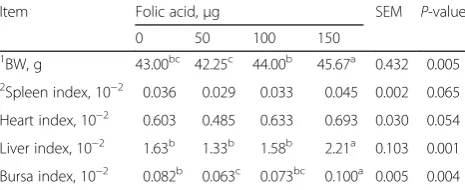
The fertilized hatchability of four groups are orderly 79.2, 79.3, 90.9 and 89.6 % (data not shown). Based on the Chi-square test, 100 and 150 μg folic acid improved the hatchability compared with the control group (P< 0.05). As shown in Table 2, BW, liver and bursa index of chickens in 150 μg folic acid group were markedly higher than the other groups. However, folic acid had no effects on spleen and heart index.
IGF2expression
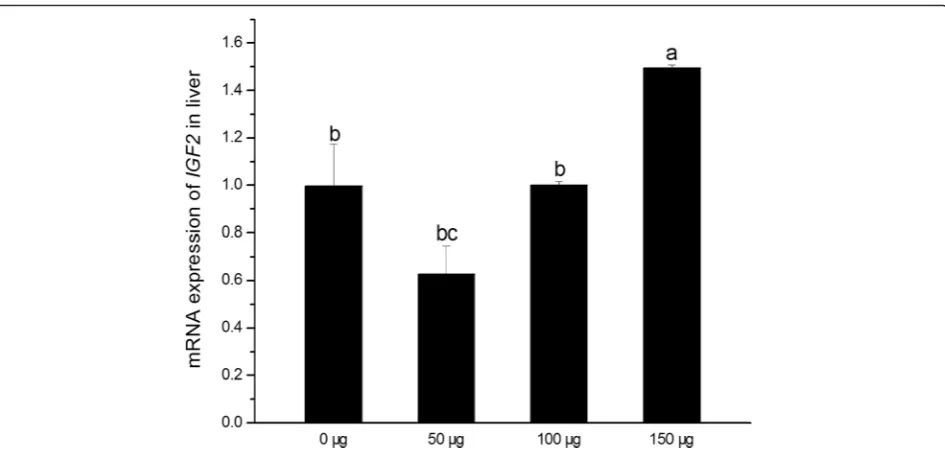
HepaticIGF2expression of birth chicken was shown in Fig. 1. Results indicated that injecting 150 μg folic acid on E11 up-regulated IGF2 expression (P< 0.05), but there were no significant differences between control and lower dose folic acid groups. No curve fitting methods was found by regression analysis using SPSS statistical software (P> 0.05).
Methylation levels ofIGF2promoter region
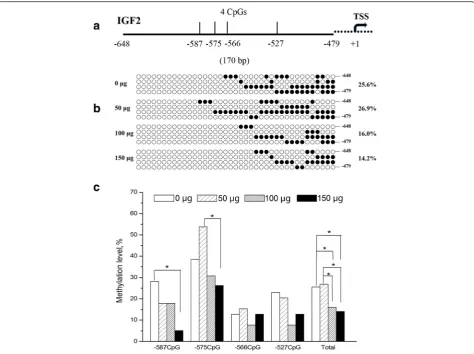
The methylation levels of IGF2 promoter were shown in Fig. 2. The methylation of −566 and −527 CpG sites were not affected by the folic acid. However methylation level of −587 CpG site decreased signifi-cantly in 150 μg folic acid group when compared with the control. As for −575 CpG site, methylation level in 150 μg folic acid group was lower than that in 50 μg folic acid group. Total methylation level of IGF2 promoter were lower in 100 and 150 μg folic Table 1Forwards (F) and reverse (R) primers of genes for
RT-qPCR analysis Genes Accession number
Primer sequences, 5′to3′ Product size, bp
β-actin L08165 F: ATTGTCCACCGCAAATGCTTC 113 R: AAATAAAGCCATGCCAATCTCGTC IGF2 NM001030342 F: AGACCAGTGGGACGAAATAACA 131
R: CACGCTCTGACTTGACGGAC
DNMT1 NM206952 F: ACAGCCTTCGCCGATTACA 248 R: CTCTCCACCTGCTCCACCAC
HAT1 NM204207 F: AGAAGTTTGACTGTGTGGAGGC 152 R: AGAATATGTGTGCAGCAGCATT
Table 2Effects of folic acid injected at E11 on organ index and birth weight of broilers
Item Folic acid,μg SEM P-value
0 50 100 150
1BW, g 43.00bc 42.25c 44.00b 45.67a 0.432 0.005 2Spleen index, 10−2 0.036 0.029 0.033 0.045 0.002 0.065
Heart index, 10−2 0.603 0.485 0.633 0.693 0.030 0.054
Liver index, 10−2 1.63b 1.33b 1.58b 2.21a 0.103 0.001
Bursa index, 10−2 0.082b 0.063c 0.073bc 0.100a 0.005 0.004
1
BW = birth weight of new-hatched broilers; Organ index = organ weight (g)/ birth weight (g)
2
acid groups than the control and 50 μg folic acid groups (P< 0.05). No curve fitting methods was found by regression analysis using SPSS statistical software (shown in Additional file 1) for total and single site methylation level (P> 0.05).
Chromatin looseness ofIGF2promoter region
As depicted in Fig. 3, the promoter region revealed higher chromatin looseness in 150 μg folic acid group after DNase I digestion when compared with the other groups (P< 0.05), while 50 or 100μg folic acid didn’t affect chro-matin looseness ofIGF2promoter region.
DNMT1expression
As shown in Fig. 4, DNMT1 expression was down-regulated in 100 and 150μg folic acid groups (P< 0.05). Compared with control group, 50 μg folic acid injection didn’t affectDNMT1expression of liver. No curve fitting methods was found by regression analysis using SPSS statistical software (P> 0.05).
Transcription factor binding sites prediction
In order to speculate the relationship between IGF2 mRNA expression and the methylation of 4 CpGs examined in the IGF2 promoter regions, the sequence including the 4 CpGs was submitted into the online software (http://www.genomatix.de) to obtain the latent transcription factors bound at the 4 CpG sites. Results predicted are shown in Fig. 5. In line with expectations, there were 7 potential transcription factors found in the predictive sequence, and
introductions of these transcription factors were pre-sented in Fig. 5b, c, d and e.
Correlations between hepaticIGF2and BW and organ index
As shown in Table 3, results indicated that BW of chick-ens and organ index was positively related to IGF2 ex-pression level of the liver (P< 0.01). What’s more, BW showed a significantly positive correlation with the organs index (P< 0.01).
Discussion
Mechanisms of epigenetic regulation contain DNA methylation, histone modification, chromatin remodel-ing in mammals, which modulate chromatin structure and contribute to regulation of molecular processes including transcription and repair [21]. The previous review has proposed that DNA methylation in the pro-moters or other regulatory regions might prevent stable binding of regulatory activator proteins to that sequence, thereby preventing gene expression [21]. Another mech-anism is mediated by DNA-binding proteins which contain methylated DNA-binding domains [22]. The methylated CpG dinucleotide are recognized and bound by these methylated DNA-binding proteins, then the proteins in turn interact with or recruit other transcriptional silencing complexes which work to form a tight chromatin structure at the relevant gene [23]. It is a big challenge for researchers to understand epigenetic mechanisms of gene regulation absolutely in biological progress.
Many studies suggested that IGF2 is indeed more influential than IGF1 for embryo and organ growth in the embryonic development of birds [24–26]. Our data showed that hepatic IGF2 expression was up-regulated by injecting 150 μg folic acid on E11 during incubation period, while 50 and 100μg folic acid might be too less to reach the same effect. Meanwhile, BW, liver and bursa index of new-hatched chickens in 150μg folic acid group increased when compared with the control. Previ-ous study reported that there were correlations between body weight of chick embryo and plasma IGFs level [27]. The liver, as a center of metabolism, was considered to be the major source of blood IGF2 circulation which exerted endocrine functions [12]. It’s well apparent that hepaticIGF2expression is important for the growth and development of broilers embryos. Previous study indi-cated that body and liver weight were related to hepatic IGFsgene expression in ducks [24].
In order to further demonstrate whether the methyla-tion of IGF2 promoter was served as the regulatory factor for gene expression, we detected the methylation status of IGF2 gene promoter region. What is more intriguing was that methylation level of IGF2 promoter region was lower in 150 μg folic acid group, which was consistent with the result ofIGF2 overexpression. DNA methylation affected gene expression by disturbing the binding of specific transcription factors [28]. Whereupon it could be legitimately extrapolated that hypomethyla-tion ofIGF2 promoter might activate gene transcription in virtue of attracting the co-localized transcription factors, subsequently up-regulating IGF2 expression. Just as the prediction, 7 various potential transcrip-tion factors were located abundantly at four CpGs in the promoter region.
Although folic acid’s role in one carbon metabolism is related to increasing DNA methylation, from other
aspects it is not difficult to understand the phenomenon in the study that folic acid decreased total methylation level of gene promoter region. Firstly, some other nutri-ents are involved in one carbon flux to ensure homocyst-eine remethylation, S adenosyl methionine (SAM) formation and DNA methylation such as choline, betaine and other B vitamins [11]. Therefore methylation
status is not only depended on the folic acid. Sec-ondly, methionine is the substrate for SAM, which is the methyl donor in transmethylation reaction of DNA methylation [29]. The conversion of homocyst-eine to methionine benefits from the methyl group donated by 5-Methyl-THF, which finally turns into tetrahydrofolate (THF) in this bidirectional reaction.
Fig. 3Effects of inovofolic acid injection on chromatin looseness ofIGF2promoter region in the liver. Numerical values (0, 50, 100, 150μg) in X-axis mean the amount of folic acid which was injected into eggs. Bars with different letters are significantly different (P< 0.05)
However folic acid is originally first reduced to dihydrofolate (DHF) and then to THF by DHF reductase, thus the level of THF produced from folic acid might suppress homocysteine remethylation reaction. Besides, homocysteine remethylation is the only known reac-tion involving 5-methyl THF whose synthesis is in a unidirectional reaction catalyzed by methylenetetrahy-drofolate reductase (MTHFR). The production of 5-methyl THF by MTHFR is an important and
regulatory step in one carbon metabolism cycle. But SAM is a potent inhibitor of MTHFR, and folic acid may disturb regulation of one carbon metabolism by interfering with the inhibitory effect of SAM on MTHFR activity [30].
The mechanisms associated with effects of folic acid on DNA methylation are complex and not fully under-stood. The previous study found that using of folic acid before and during pregnancy was connected with lower methylation levels at DNA sequences regulating IGF2 expression [31], which suggested that folic acid might lower methylation level in site-specific DNA of the gene. Another research indicated that increased serum folate among smokers was associated with decreased methyla-tion of five detected genes [32]. What’s more, the lowest methylation level at the second site of the PPARγ pro-moter was examined in cells exposed to 4 mg/L of folate [33]. These researches all conformed to the effects of folic acid on DNA hypomethylation of IGF2 promoter region in our study.
One possible mechanism that caused changes in methylation level as well as chromatin structure was
Fig. 5Transcription factor binding site (TFBS) prediction in theIGF2promoter regions.aTotal predicted transcription factors involving the four CpG sites in the promoter ofIGF2gene. The red arrows represent the distribution of the CpG loci.bThe partial predicted transcription factors related to−587 and−575 CpG sites and the same as below.c,dandeare correlated with−575 and−566 CpG sites,−566 CpG site and−527 CpG site respectively. Contents in the boxes describe detailed information of transcription factors which might combine the region containing the CpG sites
Table 3Correlation between hepaticIGF2expression and birth weight and organ index
Item IGF2 BW Spleen Heart Liver Bursa
IGF2 1
BW 0.945a 1
Spleen 0.898a 0.872a 1
Heart 0.932a 0.894a / 1
Liver 0.954a 0.928a / / 1
Bursa 0.942a 0.856a / / / 1
a
enzymes activity.DNMT1 plays a vital part in the main-tenance of methylation especially in tissues of adults after fertilization [34], and unnatural expression ofIGF2 was found in DNMT1 knock-out mice [35]. In present study, we detected lower expression of hepatic DNMT1 in 100 and 150μg folic acid groups which were consist-ent with the results of DNA hypomethylation. Hypome-thylation of a conserved single CpG in DNMT1 had a positive correlation with gene expression of DNMT1 [36]. The previous study showed that choline deficiency induced the hypomethylation of regulatory CpG in the DNMT1gene, leading to overexpression ofDNMT1and the final higher methylation level in global and gene-specific DNA [18]. Thus, taken together, our data obvi-ously pointed to the relationship that inovofolic acid in-jection on E11 caused decline of DNMT1 expression followed by hypomethylation in IGF2promoter regions leading to an acceleration ofIGF2 expression. Likely, the former may be due to the hypermethylation of the CpG inDNMT1regulatory region induced by folic acid.
The phenomenon was doubtful that low methylation level ofIGF2promoter andDNMT1 down-regulation in 100μg folic acid group didn’t result inIGF2 overexpres-sion. We examined the chromatin structure of IGF2 promoter in order to illuminate the doubt. Our data showed that another contributing factor for the detected hepaticIGF2overexpression was chromatin looseness of IGF2 promoter. Because 150 μg folic acid injection im-proved chromatin looseness in the study, but this result was not found in 100 μg folic acid group. Gene expres-sion could be induced by local chromatin structures which regulate transcription factor binding activities [37]. Chromatin is a DNA-protein complex, and protein components are core histones. Hence, it might be prob-able that chromatin ofIGF2 promoter region was chan-ged into loose status to facilitate gene transcription. So the doubt mentioned above could be clarified. The possible explanation is that IGF2 transcription might depend on both methylation and chromatin structure of IGF2promoter regions.
In the study, lower level of folic acid didn’t affect hep-atic IGF2 expression. It was likely that the dose of 50 and 100μg folic acid might be not enough to change the methylation and chromatin structure at the same time. Automatically embryonic growth and organ development of new-hatched chicken couldn’t gain corresponding improvement. Even so, the internal causal relationship be-tween methylation status and chromatin structure ofIGF2 promoter regions is unclear.
Conclusion
In conclusion, the present study has demonstrated that the effects of inovo folic acid injection on hepatic IGF2 expression and embryo growth of chickens. Our results
likely have general implications that embryo growth and organ development of chicken have a positive correlation with hepatic IGF2 expression. 150 μg folic acid injected on E11 might up-regulate IGF2expression by decreasing methylation and improving chromatin accessibility of gene promoter, which offers new insights into the field of nutri-epigenetics. But internal relationship between DNA methylation and chromatin structure affected by folic acid is expected for further research.
Additional file
Additional file 1:The summary of regression analysis for methylation data. (DOC 42 kb)
Acknowledgments
The work was supported by the Natural Science Foundation of China (No. 31272464), the Program for New Century Excellent Talents (NCET-12-0476), and the Program for Shaanxi Science & Technology (2014 K01-18-02, 2015NY149, 2015KTCQ02-19).
Authors’contributions
YLL, LHZ and XJY designed the research; YLL, LHZ, JS and SZL performed the research and analysed the data; YLL wrote the manuscript; SJ, JHY and XJY have taken part in the revision of the manuscript. All authors read and approved the final version of the manuscript.
Competing interests
The authors declare that they have no competing interests.
Author details
1College of Animal Science and Technology, Northwest A&F University,
Yangling 712100, China.2School of Mathematics and Computer Science,
ShanXi Normal University, Linfen 041000, China.
Received: 23 January 2016 Accepted: 28 June 2016
References
1. Yokomine T, Shirohzu H, Purbowasito W, Toyoda A, Iwama H, Ikeo K, et al. Structural and functional analysis of a 0.5-Mb chicken region orthologous to the imprinted mammalian Ascl2/Mash2–Igf2–H19 region. Genome Res. 2005;15(1):154–65.
2. Amills M, Jimenez N, Villalba D, Tor M, Molina E, Cubilo D, et al. Identification of three single nucleotide polymorphisms in the chicken insulin-like growth factor 1 and 2 genes and their associations with growth and feeding traits. Poult Sci. 2003;82(10):1485–93.
3. Wang H-B, Li H, Wang Q-G, Zhang X-Y, Wang S-Z, Wang Y-X, et al. Profiling of chicken adipose tissue gene expression by genome array. BMC Genomics. 2007;8(1):193.
4. McMurtry JP. Nutritional and developmental roles of insulin-like growth factors in poultry. J Nutr. 1998;128(2):302s–5.
5. Beccavin C, Chevalier B, Cogburn LA, Simon J, Duclos MJ. Insulin-like growth factors and body growth in chickens divergently selected for high or low growth rate. J Endocrinol. 2001;168(2):297–306.
6. Hillier LW, Miller W, Birney E, Warren W, Hardison RC, Ponting CP, et al. Sequence and comparative analysis of the chicken genome provide unique perspectives on vertebrate evolution. Nature. 2004;432(7018):695–716. 7. Bakyaraj S, Bhanja SK, Majumdar S, Dash B. Modulation of post-hatch
growth and immunity through in ovo supplemented nutrients in broiler chickens. J Sci Food Agric. 2012;92(2):313–20.
9. Fazzari MJ, Greally JM. Introduction to epigenomics and epigenome-wide analysis. Statistical methods in molecular biology. Bronx: Humana Press; 2010. p. 243–65.
10. Chen P, Li C, Li X, Li J, Chu R, Wang H. Higher dietary folate intake reduces the breast cancer risk: a systematic review and meta-analysis. Brit J Cancer. 2014;110(9):2327–38.
11. Anderson OS, Sant KE, Dolinoy DC. Nutrition and epigenetics: an interplay of dietary methyl donors, one-carbon metabolism and DNA methylation. J Nutr Biochem. 2012;23(8):853–9.
12. McMurtry JP, Francis GL, Upton Z. Insulin-like growth factors in poultry. Domest Anim Endocrinol. 1997;14(4):199–229.
13. DeChiara TM, Robertson EJ, Efstratiadis A. Parental imprinting of the mouse insulin-like growth factor II gene. Cell. 1991;64(4):849–59.
14. DeChiara TM, Efstratiadis A, Robertsen EJ. A growth-deficiency phenotype in heterozygous mice carrying an insulin-like growth factor II gene disrupted by targeting. Nature. 1990;345:78–80.
15. Ohta Y, Tsushima N, Koide K, Kidd M, Ishibashi T. Effect of amino acid injection in broiler breeder eggs on embryonic growth and hatchability of chicks. Poult Sci. 1999;78(11):1493–8.
16. Li S, Zhi L, Liu Y, Shen J, Liu L, Yao J, et al. Effect of in ovo feeding of folic acid on the folate metabolism, immune function and epigenetic modification of immune effector molecules of broiler. Brit J Nutr. 2016;115(03):411–21. 17. Livak KJ, Schmittgen TD. Analysis of relative gene expression data using
real-time quantitative PCR and the 2 < sup >−ΔΔCT</sup > method. Methods. 2001;25(4):402–8.
18. Kovacheva VP, Mellott TJ, Davison JM, Wagner N, Lopez-Coviella I, Schnitzler AC, et al. Gestational choline deficiency causes global and Igf2 gene DNA hypermethylation by up-regulation of dnmt1 expression. J Biol Chem. 2007; 282(43):31777–88.
19. Ling G, Waxman DJ. DNase I digestion of isolated nulcei for genome-wide mapping of DNase hypersensitivity sites in chromatin. Gene regulation. Boston: Humana Press; 2013. p. 21–33.
20. Shu H, Gruissem W, Hennig L. Measuring Arabidopsis chromatin accessibility using DNase I-polymerase chain reaction and DNase I-chip assays. Plant Physiol. 2013;162(4):1794–801.
21. Crider KS, Yang TP, Berry RJ, Bailey LB. Folate and DNA methylation: a review of molecular mechanisms and the evidence for folate’s role. Adv Nutr. 2012; 3(1):21–38.
22. Dhasarathy A, Wade PA. The MBD protein family-reading an epigenetic mark? Mutat Res. 2008;647(1–2):39–43.
23. Miranda TB, Jones PA. DNA methylation: the nuts and bolts of repression. J Cell Physiol. 2007;213(2):384–90.
24. Jianmin Z, Jingting S, Yanju S, Yan H, Chi S, Wenqi Z. Expression of insulin-like Growth factor system genes in liver tissue during embryonic and early post-hatch development in duck (Anas platyrhynchos Domestica). Anim Biotechnol. 2014;25(2):73–84.
25. Richards MP, Poch SM, McMurtry JP. Expression of insulin-like growth factor system genes in liver and brain tissue during embryonic and post-hatch development of the turkey. Comp Biochem Phys A. 2005;141(1):76–86. 26. McMurtry JP, Rosebrough RW, Brocht DM, Francis GL, Upton Z, Phelps P.
Assessment of developmental changes in chicken and turkey insulin-like growth factor-II by homologous radioimmunoassay. J Endocrinol. 1998;157(3):463–73. 27. Lu JW, McMurtry JP, Coon CN. Developmental changes of plasma insulin,
glucagon, insulin-like growth factors, thyroid hormones, and glucose
concentrations in chick embryos and hatched chicks. Poult Sci. 2007;86(4):673–83. 28. Robertson KD. DNA methylation and human disease. Nat Rev Genet. 2005;
6(8):597–610.
29. Stover PJ. One-carbon metabolism-genome interactions in folate-associated pathologies. J Nutr. 2009;139(12):2402–5.
30. Smith DE, Hornstra JM, Kok RM, Blom HJ, Smulders YM. Folic acid
supplementation does not reduce intracellular homocysteine, and may disturb intracellular one-carbon metabolism. Clin Chem Lab Med. 2013;51(8):1643–50. 31. Hoyo C, Murtha AP, Schildkraut JM, Jirtle R, Demark-Wahnefried W, Forman MR,
et al. Methylation variation at IGF2 differentially methylated regions and maternal folic acid use before and during pregnancy. Epigenetics. 2011;6(7):928–36. 32. Stidley CA, Picchi MA, Leng S, Willink R, Crowell RE, Flores KG, et al. Multivitamins,
folate, and green vegetables protect against gene promoter methylation in the aerodigestive tract of smokers. Cancer Res. 2010;70(2):568–74.
33. Yu X, Liu R, Zhao G, Zheng M, Chen J, Wen J. Folate supplementation modifies CCAAT/enhancer-binding protein alpha methylation to mediate differentiation of preadipocytes in chickens. Poult Sci. 2014;93(10):2596–603.
34. Subramaniam D, Thombre R, Dhar A, Anant S. DNA methyltransferases: a novel target for prevention and therapy. Front Oncol. 2014;4:80.
35. Li E, Beard C, Jaenisch R. Role for DNA methylation in genomic imprinting. Nature. 1993;366(6453):362–5.
36. Slack A, Cervoni N, Pinard M, Szyf M. DNA methyltransferase is a downstream effector of cellular transformation triggered by simian virus 40 large T antigen. J Biol Chem. 1999;274(15):10105–12.
37. Chen J, Ivashkiv LB. IFN-gamma abrogates endotoxin tolerance by facilitating Toll-like receptor-induced chromatin remodeling. Proc Natl Acad Sci U S A. 2010;107(45):19438–43.
• We accept pre-submission inquiries
• Our selector tool helps you to find the most relevant journal
• We provide round the clock customer support
• Convenient online submission
• Thorough peer review
• Inclusion in PubMed and all major indexing services
• Maximum visibility for your research
Submit your manuscript at www.biomedcentral.com/submit