ROBERT E. SMIT
Department of Physiology, Univ. of California, Los Angeles, USA
KURZFASSUNG: Braunes Fett in der Ratte: Adaptive Ver~inderungen in der K~lte. Bei m~innlichen Ratten, die einer Umgebungstemperatur yon 6°C ausgesetzt werden, steigt die Masse des braunen Fetts auf das 2- bis 3fache, sein Qo~ (gemessen bei 37 ° C in vitro) etwa auf das Doppelte an. Das Wiirmeiiquivalent dieser Ver~nderungen steigt demnach etwa auf das 6fache des Kontrollwertes. Die entstehende W~rme wird auf dem Blutweg direkt zu den Cervikal- und Thorakalsegmenten des Riickenmarks, zum Herzen und anderen Thorakal- organen gebracht. Die adaptiven Ver~inderungen im braunen Fett gehen auf hyperplastisches Wachstum durch Zellneubildung aus RES-Vorstufen zuri~&. Die H3-markierte DNS-Synthese ist nach 100 Stunden K~lteexposition maximal und wird yon einem entsprechenden Maximum des Gewebewa&stums gefolgt, das nach 192 Stunden abgeschlossen ist. Sein Abklingen in wei- teren 8 bis 16 Tagen entspricht der Beendigung der ,,shivering"-Periode und dem Auftreten konstanter Organmassen. Das K~ilte-Erwachen des winterschlafenden Murmeltieres iiefert ein Beispiel fiir eine ,,on-off"-Kontrolle der Thermogenese durch braunes Fett. Hier tritt das ,,shivering" viel sparer auf.
I N T R O D U C T I O N
In previous work (SMITH 1961, 1962a, b, SMITH & ROBERTS 1964) we have esta- blished the role of multitocular brown adipose tissue (cf RASMUSSEN 1924) as a prime thermogenic effector in the defenses of the laboratory rat against exposure to a cold environment. In this it has been shown that, in response to coId, the brown adipose tissue in all sites of occurrence increases in mass and also in QO2 as measured in vitro. By anatomical studies and direct thermometry of the circulatory supplies of these tissues it has also been shown that during cold exposure the heat generated in the loci of brown fat is conveyed by vascular convection directly into cervical and thoracic spinal segments and additionally into the thoracic cage to warm the heart and related structures (SmTH, R. E. & MALV~A~X, E., unpublished). Thus in vivo the sites of brown fat during cold exposure become centers of thermogenesis wherein the local temperatures rise well above those of the internal viscera and muscle beds. Likewise during the cold-induced arousal of the hibernator (Fig. 1) the temperature of brown adipose tissue rises well in advance of that observed in the body core, as indicated by deep rectal temperature (SMITH & HOCK 1963 cf also SMALLEr & DI~E~CER 1963).
188 R . E . SMITH
varying from 3 hours to 70 or more days (SMITH 1962b, CAMERON & SMITH 1964). These fall into three categories obtained with two series of rats. In the first we employed H~ (tritium) labelled thymidine, injected i.p. one hour prior to time of sacrifice, in order to follow the cetlular differentiation of brown fat and other tissues
(,5 %: M Lu q. Lu t..
M A R M O T NO. 2 - D E E P H I B E R N A T I O N
Moving
Outside
26-
° - - . LEFT AXILLARY (BODY) ( I )
o - - o INTERSCAPULAR SUBCUZ (2)
~ - - ~ DORSOLUMBAR SUBCU'C (5) o - - ~ RIGHT AXILLARY (ARM) (4) , , - - , , , VENTRAL SUBCUT. (5)
. . . ANTERIOR CERVICAL ( 6 ) • - - , , AIR TEMPERATURE ( 7 ) x - - x RECTAL TEMPERATURE (R)
2 4 - 2 2 - 2 0 - 18- 16- 14-
Inside
$ o/oY /"l
' I
7o
?
o / O / °
/
,..5/° _o,
0 0
,2- . ~ L / _ _ _ . . ~ 7 ~ . [ ~ . ~ , - ~-/
. . . . . . .
i
"17"
X
IAciive and- I 0 ~_ shivering
• i - - m - - i - - , ~ 1 - - 1
-~2
\,5,/"
-14 , , '
0
~ - ' ~ - i i I i i i i I ! i t ... I i
I 2
T I M E I N H O U R S
Fig. 1: Temperatures of various sites of brown adipose tissue and other body regions of the marmot
(Marrnota flaviventris)
during cold-induced arousaI from deep hibernation.(After SMITH & Hocx 1963, by permission of Science)
during cold exposure of the host. Secondly, rats from a comparable series of cold- exposures were killed at various times and their respective organ masses determined. Thirdly, on the same series QO2 of the homogenized brown fat was measured by standard Warburg techniques.
RESULTS
!4.:." N @~ , . ¢ ~ " 3'
• % . ~ , , . . . v , . , , ~ 2
e . . ,5"!-" ~ - - . " " f & ¢
*:
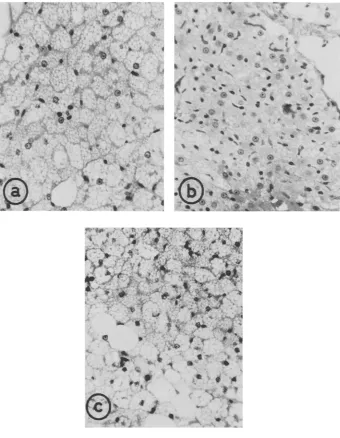
Fig. 2: Photographs of sections of interscapular brown fat taken (a) from an adult rat kept at 260 C and (b) a littermate aPcer exposure to cold (60 C) for 12 hours and (c) a comparable rat
aPcer 24 hours exposure to cold (60 C); Masson's trichrome × 750.
190 R . E . SMITH
the locally occurring white adipose ceiis and a coincident rise both in vascularity of the tissue and relative numbers of the brown adipose cells.
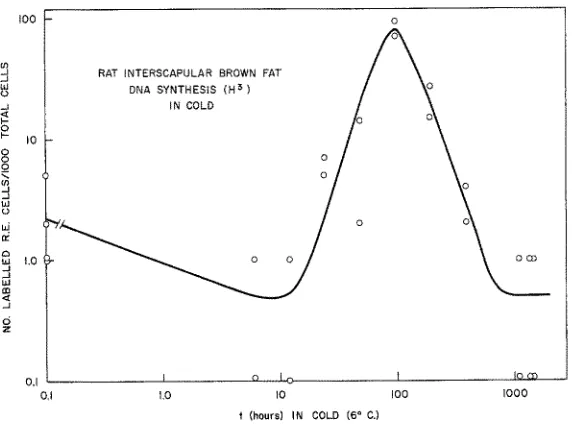
By observation and counts of the radioautographic H 3 thymidine-labelled D N A clusters within the sections of brown adipose tissue, it became evident that (1) no mitotic figures were present in brown adipose cells and (2) that D N A synthesis was occurring only within the reticulo-endothelial elements of the tissue; the latter activity
t00
t.0
o
/ e x
RAT tNTERSCAPULAR BROWN FAT / ~
0.1 t 0 , L,o 1 Io cr~
0,1 1,0 I0 I00 I000
(hours) IN COLD (6 ° C.)
Fig. 3: Plot of frequency of reticulo-endothelial cells exhibiting synthesis of DNA following various times of exposure of the host to cold
rea&ed a peak at the 96 hours cold-exposure period and thereaPcer declined (Fig. 3) to near normal by the end of the 192 hour period.
To obtain further insight on the cytogenesis of the brown fat cells some rats were exposed to cold for 72 hours and then iniected with H a thymidine, but were not killed at the usual 1 hour post injection but instead held in the cold until 24 and 48 hours thereaflcer. Since in these animals the labelled D N A clusters were found within brown adipose cells it was concluded that these ceils were arising through cytogenesis de novo from reticnlo-endothelial precursors, rather than by mitoses of the existing multi- locular cells.
Concurrent with the foregoing, histological studies were conducted also upon other tissues of these rats, including white adipose tissue from the epididymal fat pads. Counts of the number of cells per unit area in sections of this tissue showed a pro- gressive rise with exposure time; hence the conclusion was reached that depot fat stores generally were supporting the metabolic requirements and with prolonged exposure to cold continuing slowly toward a state of relative depletion (cf Fig. 4).
merit, though not injected with radiothymidine. These were singly maintained on our standard ration and 12 hours light cycIe and routinely killed at 0900 each morning exactly as were those of the previous series (cf SmTH & RO~I;RTS 1964). All tissues were similarly removed and in this series, instead of being placed in fixative, were
t000 I
rOD
u. F:
I0 I I I I I t I I
OJ t 0
y : iI~.6 100486
I I_ I I I I I I I I I
10 tOO t000
t {hours) IN COLD (6~C.)
I _L_I I
Fig. 4: Numbers of white adipose celis per unit area in sections of epididymal fat from adult male rats exposed to cold for various periods of time
0.4 -
Int. Scop. B.E
0.3 -~"--"--~/"---~
0.2~ .~ o ~ °
o - //---o
m Braeh. B.F.
0% =. k o _ / i : ~ J . ,;' •
I
~':1:322:~'--
~
rhorocicBmF.
o.I
~.,"-'~
.
~
L A Cervical B.F.
o I J 1 J i I i I i // I
0 1 2 $ 4 5 6 7 8 16
TIME IN DAYS
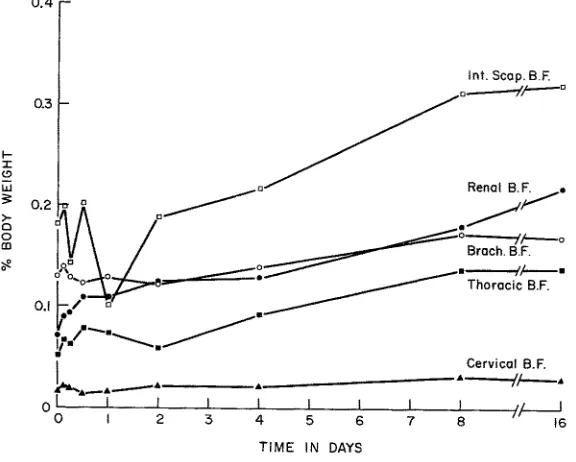
Fig. 5: Wet mass of epididymal fat and of brown adipose tissue from the major sites of deposition in rats, plotted as a function of time in cold
weighed with minimal water loss, and homogenates of brown fat tissues were made in 0.25 M sucrose for use in respiratory assays. Exposure sequences were likewise rando- mized as in the preceding series.
192 R . E . SMrrH
peak of D N A synthesis observed earlier in the first series at 96 hours was indeed prognostic of a peak in hyperplastic development of brown adipose tissue, whi& in theory (cf CAMERON & GREULICH) should have occurred some 72 hours later. Exa- mination of the curves of tissue mass versus time in cold (Fig. 5) obtained in the second series shows clearly that in all sites of brown fat the maximum growth rate occurred in the interval between the 96 and 192 hour points. Following this period the growth rate declines appreciably; notably, the tissue mass appears to reach an essentially steady state by the end of the first 16 days exposure, although it increases slowly thereaPcer, but mainly in relation only to total body weight.
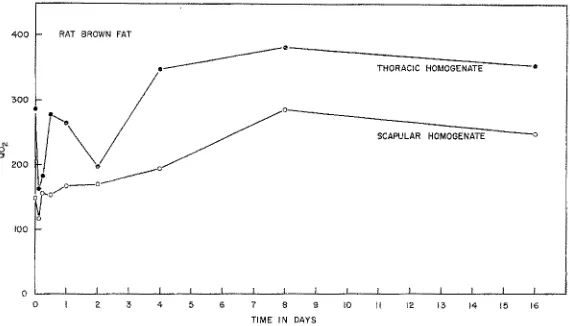
QO,a values (Fig. 6) concurrently obtained with the homogenates of brown fat, also show a rising trend with longer exposure times. Aside from the transient fall at the
300
2 0 0
THORACIC H O M O G E N A T E ~ e
SCAPULAR HOMOGENATE ~ o
O I I I I I I I I t ~ t t 1 I I I I _ _ O t 2 ~ 4 5 6 ? 8 9 10 I{ 12 1 3 14 15 16
TIME IN DAYS
Fig. 6: QO~ in #I O~/mg N/hr of homogenates of" brown adipose tissues taken respectively from thoracic and interscapular sites in rats exposed to cold for various times up to 60 days. Points are mean values from 4 to 6 animals at each time. S y s t e m and p r o c e d u r e as follows: Into 5 mt Warburg flasks, with 0.05 ml 10°/0 KOH in center wells, were placed 0.5 mI 1:10 brown fat homogenate in 0.25 M sucrose, and 0.5 ml of reaction mixture con- taining in ~moles, ATP, 2; a-ketoglutarate, 10; KF, 10; MgC12, 5; PO~ as KH2PO~I (pH 7.4), 15; tris buffer (pH 7.4), 25; glucose, 25 and hexokinase, 25 kM units. The latter two were tipped into the system from the side arm at the time of the first readings. Final reaction volume was i ml equilibrated with 0.9 and incubated at 37°C. Mean Kjeldahi nitrogen content of homogenate per flask was 0.41 mg for thoracic brown fat and 0.50 mg for the interscapular 3 and 6 hour points, QO~ generally rises over the initial i6 days of the exposure to cold and thereaPcer remains more or less steady or m a y rise somewhat further, as occurred in the interscapular tissue.
infer that for the rat cold acclimation is achieved when the thermal contribution from this tissue becomes sufficient to raise the cephalic blood temperature above that of the shivering threshold. In generat, by the end of two weeks in the cold there has also been an appreciable rise both in QO~ and relative mass of some of the major viscera in- cluding heart.
One may also speculate on the mechanism by which the brown adipose tissue may reach its apparently new steady state of mass in response to a given level of environ- mentaI cold. Three features of the development are (1) the initial depression of QO.2 as measured in vitro and (2) the initial lag phase in cytogenesis, both corresponding with (3) the period of depletion in the intracellular multilocular fat vacuoles. From an examination of figure 2 one is also struck with the rapidity of disappearance of local white adipose cells, which becomes virtually complete by the 192 hour period, and the rise in apparent vascularity of the tissue by 48 hours. Clearly seen also is the con- current depletion of white fat depots elsewhere in the body. Evidently the initial phase entaiIs an immediate atta& upon the intracellular storage, -which becomes replaced at the expense of local white fat and is subsequently maintained by vascular transport of fat from other storage sites.
As these adaptive responses become morphologically apparent under stress, they reflect target effects of neural and neurohumorat outputs arising as an integrated response of the intact organism. Thus, in respect to thermogenesis, the hypertrophy of brown adipose tissue is a resultant of synergistic action on part of both thyroid and adrenocortical activity together with somatotrophic principles. Deriving from hypo- thalamico-hypophyseal channels, these join with autonomic-sympathetic outflows to enhance the overall exchange of materials and essential energy-yielding reactions to meet the hypothermic threat of a cold environment.
SUMMARY
1. Brown adipose tissue has been earlier shown in this laboratory to represent a highly vascularized thermogenic effector system which in response to cold supplies heat to cervical and thoracic neural and visceral elements.
2. In respect to rats, evidence is adduced to show that during cold exposure the hyper- plastic development and rising QO~ of the brown adipose tissue coincides in point of time with the gradual disappearance of the shivering thermogenesis normally occurring during the first two or three weeks of exposure.
3. Factors which may limit the amount and hyperplastic rate of growth of the tissue are suggested.
LITERATURE CITED
Ca~a~l/o>~, L L. & GREULICH, R. C., 1963. Evidence for an essentially constant duration of DNA synthesis in renewing epithelia of the adult mouse. J. Celt. Biol. 18, 31-40. -- & SMiTU, R. E., 1964. Cytological responses of brown fat tissue in cold exposed rats.
194 R . E . SMITH
RaSMb'SSEN, A. T., 1924. The so-calIed hibernating gIand. J. Morph. 38, 147-205.
SM*LLEY, R. & D~EYE~, R., 1963. Brown Fat: Thermogenic effect during arousal from hiber- nation in the bat. Science 140, 1333-1334.
SmTH, R. E., 1961. Thermogenic activity of hibernating gland in the cold-acclimated rat.
Physiologist 4, 113.
- - 1962a. Thermoregutation by brown adipose tissue in cold. Federation Proc. 21, 221.
- - 1962b. The physiological role of brown adipose tissue. Proceedings of the 2nd Symposium
on Natural Mammalian Hibernation, 1962, Helsinki. ED. PAAvo SUOMALAINEN. Ann.
Acad. Sci. Fenn. A:IV:71, 1964.
- - & HocK, R. J., 1963. Brown Fat: Thermogenic effector of arousal in hibernators. Science
1 4 0 , 199-200.
- - & HoIj~R, D. J., 1962. Metabolism and cellular function in cold acclimation. Physiol. Rev.
42, 60-142.
- - & ROBERTS, J. C., 1964. Thermogenesis of brown adipose tissue in cold-acclimated rats.
Am. J. Physiol. 206, 143-148.
Discussion following the paper by SMITH
K~NNE: Congratulations on this fine piece of work. I have severaI questions. To begin with, what is the minimum period of time required to initiate measurable changes in the mass of brown fat tissue?
SMITH: From preliminary data on intact rats obtained with thermisters and thermocouples suitably arranged in tissues and various intravascular locations, we find that the thermogenic response of brown fat to a cold &allenge may occur within a period of less than one minute. This response appears to be subject to very rapid "on-off" controI, mediated probably by the sympathetic-autonomic nervous system.
KINNE: IS the amount of response different in young and adult individuals?
SMITH: We have no direct evidence; however WEISS (1957, Am. ]. Physiol. 188, 430) has shown that capacity of rats for satisfactory cold acclimation goes through a maximum at about the 3 months age level. Although the original study emphasized thyrotrophic aspects of this response, it can be noted here that hyperplastic activity of brown fat is remarkably sensitive to thyroid hormone and to a synergistic effect of cortico-steroid action, as LAC~tANCE & PAG~ have shown (1953, Endocrinology 82, 57). Very probably also the cold resistance of neonatal rodents may be dependent upon the relatively high proportion of brown fat present in the body at that stage.
KINNE: IS there a correlation between the amount of response and total metabolic rate?
SMITm May I take this question to mean the correlation between thermogenic activity of brown fat and total body metabolism?
KINNE: Yes, that is correct.
the sympathetic adrenergic supply and to other neurohmnorai factors. Oxidative activity is accentuated also by the high frequency of mitochondria in close association with the multi- locular fat vacuoles within the cytoplasm. Finally, the abundant vascularity of the tissue and its high sensitivity to norepinephrine (HA~NON & LAI~SON 1962, Am. J. Physiol. 203, 1055) suggests an unusual capacity of the tissue to exchange materials in proportion to the increasing cardiac output accompanying the acute response to cold. Likewise our own findings on the increasing oxidase activity of this tissue during development of acclimation to cold suggests a fairly close correlation between aerobic metabolism and cellularity of the tissue with the metabolism of the whole animal.
KINNE: Did you obtain indications as to differences in the response patterns due to the season?
SMrrm This question relates well to the previous ones in that all of the changes noted above do show considerable sensitivity to neurohumoral factors which are themselves seasonally influenced; many such effects have been recorded in amount, composition and cellular proper- ties of brown fat (see Jo~ANssoN 1959, Metabolism 8, 221 ; Rr~iILLA~ 1958, Ann. N. Y. Acad. ScL 72 Art. 1, 1-68).
KINNr: If rapid changes in outside temperature have almost immediate functional as well as structural consequences, the resulting fast "on-off" responses would "gear" the organism in a rapid sequence into different directions, probably at the cost of extra energy. On the grounds of efficiency considerations, one might have expected a somewhat less sensitive compensatory mechanism. Maybe the individual is not only capable of acclimating to high or Iow environ- mental temperature but also to rather constant versus &anging temperature patterns.
SMm~: Our experience with both rats and hibernators has impressed us with the extreme lability of the temperature changes of the interscapular and superior cervical sites of brown fat. We find also that these areas may coincidentally change temperatures in opposite directions at times, from which it appears that their respective controls are possibly under relatively independent effector mechanisms.
LANGEt~: Ich m~Schte darauf hinweisen, da~ das braune Fettgewebe bei Embryonen eine gro~e Menge Glykogen im Cytoplasma der plurivakuol~iren Fettzellen enth~ilt. Nach Untersuchungen yon SC~tIER~R (1956, ZooL Beitr. N. F. 2, 63-125) an Wanderratten verschwindet dieses Gty- kogen wiihrend der Geburt innerhalb ganz kurzer Zeit, so dag s&on bei einem nur wenige Stunden alten Neugeborenen ni&ts mehr davon na&weisbar ist. Es s&eint mir naheliegend, diesen Glykogenverlust mit dem Aufbau der - bei der Ratte zun~i&st freilich nut bes&rS.nk- ten - Temperaturregulation des Neugeborenen in Zusammenhang zu bringen.
SMITtI: This appears entirely possible. As we have indicated elsewhere, the relative abundance of brown adipose tissue in neonates, both human and rodent, would also suggest an early thermoregnlatory role for this tissue (cf. MOUNT 1963 [SMIT~, R. E. in discussion] ; Responses to thermal environment in newborn pigs, Fed. Proc. 22 (3), and cf. 1964, Ann. Acad. Sci. Fenn. A: IV, 71).
LANCER: Wurde die Relation der Meggr6ge fiir den O2-Verbrauch (Energieproduktion) zur Menge der lipoidfreien Tro&ensubstanz bere&net? Vers&iedene physiologische Gr/Sgen blei- ben, auch unter Schwankungen yon Neutralfett und Wassergehalt, bei Bezug auf das Tro&en- gewicht des lipoidfreien Materials konstant. Auch ist der Ruhe-O~-Verbrau& yon braunem und weigem Fettgewebe glei&, wenn man ihn auf dieses Bezugssystem berechnet. Es w~ire inter- essant zu wissen, ob nach dem ersten pl6tzli&en Anstieg der Aktivit~it, der wohl si&er in der vorhandenen Masse an Cytoplasma erfolgen mug, die st~indig erh6hte Aktivit~it wS.hrend Dauer-Unterklihlung yon der gleichen Cytoplasma-Menge geleistet wird oder ob eine Ver- mehrung der Cytoplasma-Masse erfolgt. Es ist also die Frage, ob der geleistete Energieumsatz im Gewebe, bezogen auf die lipoidfreie Tro&ensubstanz, au& bei langdauernder W~irme- produktion grbf~er ist als in Ruhe.
196 R . E . SMITH
fat cells in the brown adipose tissue of normal compared to cold-acclimated rats would tend to depress qO2 of the former on either a wet or dry weight basis. The residual difference obtained on basis of N content evidently reflects a qualitative difference in celiular compo- sition of the active protoplasmic mass in the respective samples. Certainly there is evidence that in response to cold, the brown fat tissues undergo hyperplasia, with resuIting increase in cellular number and total mass. As the vascular celIularity increases as well, both of these developments proceed concurrently with the depletion of unilocular (white) adipose cells within the tissue. Additionally, there is the early transient cycle of diminution in the multi- locular fat vacuoles of the brown adipose cells, Thus the latter response may support the early thermogenesis of the tissue, i. e. during the initial hours of cold-exposure, while the chronic phases are supported by the hyperplasias leading to greater tissue mass. The latter, however, should also present a pattern of enhanced enzyme activities in order to support the raised qO.2(N).
LOCK~R: Is it not a contradiction that in the cold-acclimated rat, brown fat contributes so much to non-shivering thermogenesis, whereas in the hibernator it brings about arousal, a process connected with dramatic shivering?