R E S E A R C H A R T I C L E
Open Access
Evaluating differently tutored groups in
problem-based learning in a German
dental curriculum: a mixed methods study
Susanne Gerhardt-Szep
1*, Florian Kunkel
2, Andreas Moeltner
3, Miriam Hansen
4, Anja Böckers
5,
Stefan Rüttermann
1and Falk Ochsendorf
6Abstract
Background:It is still unclear to what extent the PBL tutor affects learning in PBL-sessions. This mixed-methods study (Part 1 and 2) evaluated the effects of facilitative (f) versus non-facilitative (nf) tutoring roles on knowledge-gain and group functioning in the field of endodontics.
Methods:Part 1 was a quantitative assessment of tutor effectiveness within a prospective, experimental, single-blind, stratified, randomized, two-group intervention study. Participants attended PBL in the context of a hybrid curriculum. A validated questionnaire was used and knowledge assessments were conducted before and after the intervention. External observers rated tutor performance. Part 2 was a qualitative assessment of tutor effectiveness and consisted of semi-structured expert interviews with tutors and focus group discussions with students.
Results:Part 1: f tutors obtained significantly higher scores than nf tutors with respect to learning motivation and tutor effectiveness (p≤0.05). nf tuition resulted in a slightly larger knowledge gain (p= 0.08). External observers documented a significantly higher activity among facilitative tutors compared to non-facilitative tutors.
Part 2: Tutors found the f role easier although this led to a less autonomous working climate. The students rated f tutoring as positive in all cases.
Conclusions:With respect to PBL-group performance, students felt that groups guided in a non-facilitative fashion exhibited a higher level of independence and autonomy, especially with increasing PBL experience. In addition, students reported that more preparation was necessary for sessions guided by a non-facilitative tutor. Tutors were able to modify their role and influence group processes in a controlled manner. Results are useful for future “Train-the-Teacher” sessions.
Keywords: Assessment, Clinical tutor, Curriculum, Effectiveness, Evaluation, Faculty development, Focus groups, Knowledge, Mixed methods research, Problem-based learning
Background
In their 2012 guidelines entitled “Recommendations on higher education qualifications for the healthcare sys-tem”for the advancement of dental medicine at German universities, the German Council of Science and Hu-manities endorses the problem-oriented and patient-centred learning as a great step forward [1].
Since the introduction of problem-based Learning (PBL) in the 1960s, many empirical studies employing various evaluation methods have evaluated the effectiveness of PBL [2–17]. Most authors chose a qualitative approach using interviews of various types [18–20]. Only approxi-mately 10 % of these studies employed the mixed-methods approach, although such studies are particularly informative because they address the research question on various methodological levels [21–24]. Literature suggests that it can be used as an effective approach, but this is not always the case [25]. Actually it is known, that PBL aims to improve the hypothetico-deductive reasoning (HDR) of
* Correspondence:[email protected]
1Department of Operative Dentistry, Center for Dentistry and Oral Medicine (Carolinum), Medical Faculty, Goethe University of Frankfurt am Main, Theodor-Stern-Kai 7, Building 29, 60596 Frankfurt am Main, Germany Full list of author information is available at the end of the article
students. However, HDR brings with it a high cognitive load, so the full use of PBL is not advocated for medical curricula [25]. In the literature, there is general agreement on the definition of PBL: small groups of students work interactively on the solution of problems while being sup-ported by a tutor. Thereby, distinction is made between sessions necessitating the student’s presence in the group and periods of individual learning. The tutor is required to accompany, rather than control, the learning process. The role of the tutor may be described as conducive or facilita-tive [26]. Facilitation requires understanding of the learn-ing process, primarily involves monitorlearn-ing of student learning and promotion of effective group function [27]. In order to effect student learning in the small group PBL session, the facilitator must be informed about and be acutely aware of his/her role [28]. Such performance was aptly described by Hamdy as follows: “The key is when, how and how much guidance should be provided” [29]. Nonetheless, clear description of the extent of guidance and precise delineation of tutor performance are rare in the literature as are reports of controlled, clinical studies of PBL. Dolmans et al. [30] alerted to this gap and inter-preted it as a guiding principle for future research. How-ever few studies aiming to elucidate open questions on the tutor’s role have been published since this paper.
The present prospective controlled study attempted to evaluate precisely defined tutoring styles. To account for the complexity of the topic, we chose a mixed-methods study design. Part 1 (quantitative part) addressed the fol-lowing questions:
RQ1: How do the different tutoring styles (facilitative and non-facilitative) affect learning motivation, tutor ef-fectiveness, group dynamics, and learning success in PBL sessions for dental students attending a hybrid curriculum? RQ2: Can external observers distinguish between the different tutoring styles, based on the tutors‘activities performed?
Part 2 of the study (qualitative part) attempted to an-swer the following question:
RQ3: How do students and tutors rate the different tutoring styles in the PBL sessions?
Methods
Sample-size calculation
Sample-size calculation was based on an intermediate ef-fect size (d = 0.5). For a one-sided test (i.e., assuming
that the effects of facilitative tutoring are not equal to those of non-facilitative tutoring) at a power of 0.8, the sample size per study group amounted ton= 50.
Study population and exclusion criteria
Overall, 4 PBL tutors and 106 students (41 men, 65 women; mean age = 25.2 years) participated in the study. The students were attending the first clinical semester (sixth subject-specific semester) of the dental school during summer term 2008, winter term 2008, or sum-mer term 2009. Table 1 shows the distribution of the study population, stratified by age and gender. Inclusion criteria for the tutors were several years of experience with PBL tutorials and a complete dental training in-cluding the license to practice. All participating students had to be attending the sixth subject-specific semester and were not allowed to have any experience with PBL tutorials or to have attended any lectures on the subject of endodontology at study start. Due to previously de-fined exclusion criteria, a total of n= 5 were excluded from the final study design, so that the study population consisted of n= 101. Prior to study start, the study protocol was approved by the local Ethics Committee (164/08).
Dentistry curriculum
The Dental School at the University of Frankfurt am Main, Germany employs a hybrid curricular structure that combines conventional (i.e., lectures, courses, seminars) and modern (i.e., eLearning, PBL, blended learning) teaching methods. None of the participating students had previously worked with PBL, while all tutors had several years of PBL experience and were established experts (i.e., content expert tutors) in both theoretical and practical endodontics. This module fo-cused on endodontics is curriculary integrated and part of the first clinical semester.
Concept of PBL
The PBL module consisted of 7 steps, in accordance with the procedure used at the University of Maas-tricht [31]. Steps 1 to 5 (1. Clarification of terms and concepts; 2. Formulation of problem statement; 3. Brainstorm; 4. Categorizing and structuring of brain-storm; 5. Formulation of learning objectives) were dealt with during Session 1, while Step 6 (Self-study)
Table 1Distribution of study population stratified for age and gender
Semester Facilitative Non-facilitative
Men Women Mean age (years) Men Women Mean age (years)
SS 2008 4 8 26.50 4 8 25.41
WS 2008 6 9 25.00 5 11 25.73
consisted of the individual processing of learning ob-jectives. Step 7 (Post-discussion and reflection on learning process) took place in Session 2 scheduled 1 week after Session 1. Each PBL session lasted 90 min, group work in connection with each PBL case lasted 180 min. A total number of eight cases were included into this study.
Instruction of students
Prior to the planned PBL module entitled“Endodontics”, the students received verbal instruction lasting approxi-mately 60 min, focusing on the following issues: What does PBL stand for? Definition of steps, timeframe, tips for literature search, allocation of roles in the group (time keeper; summarist; moderator; writer), and the role of the tutor. In addition, a video film about PBL was shown, and a handout was provided (32).
Training of tutors
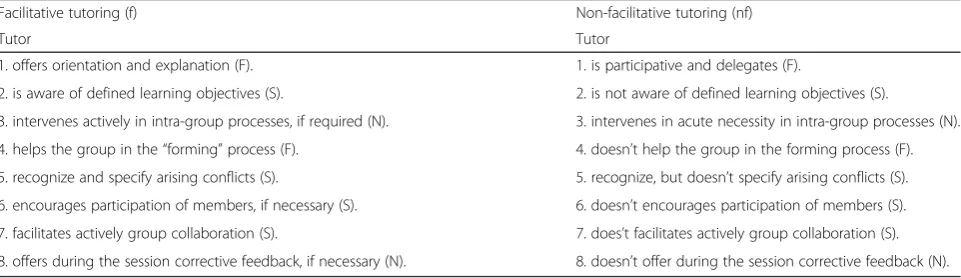
All tutors (n= 4; 3 women, 1 man) underwent a “Train-the-Teacher” seminar (60 min) to refresh their PBL experience and to familiarize themselves with the facilitative (f ) and non-facilitative (nf ) tutoring styles (Table 2). The tutoring styles were defined in accord-ance with publications by Walsh [32] and Tuckman [33] as well as observations made on occasion of a PBL-guest visit at Charité, University of Berlin. At the end of the “Train-the-Teacher” seminar it was checked, if the tutors can correctly act in the different styles using video-analysis. The PBL module and the “Train-the-Teacher” seminar were supervised by an established expert (Master of Medical Education) in this field.
Study procedures
Quantitative part (Part 1)
Part 1 was a prospective, experimental, single-blind, stratified, randomized, two-group intervention study comparing a number of variables before and after the PBL module using knowledge assessments. The students
were stratified for age and gender using the software RandList 1.2 (DatInf GmbH, Tübingen, Germany). They were randomly allocated to one of the two groups. Randomization codes were generated locally and were treated confidentially before study start. The study par-ticipants were not informed of the planned interventions (single-blind study design).
PBL cases
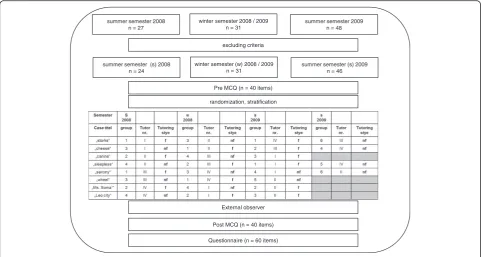
In each semester students were allocated. Each group worked on two different PBL cases. Not all students worked on each case (Fig. 1). However, the contents de-veloped by the group were presented to all students of the semester in a plenary lecture session at the end of each PBL case study, ensuring that all participants were informed. Thus, all participants were able to complete the post-PBL test.
PBL was scheduled on 2 days (Tuesday and Thursday) each week with different groups. One week intervened between the two sessions of each group (for example from Tuesday to Tuesday or from Thursday to Thurs-day). The weekly timetable of the hybrid dental curricu-lum included few PBL and more plenary lecture sessions. On the respective PBL days (Tuesday and Thursday), two groups were taught in the same location/ class room (sufficiently far away from each other). To prevent any detection of the differences in the tutoring style we ensured that both groups were either accom-panied in the same style in this joint session. Groups were tutored by just one style (facilitative or non-facilitative) that was determined before the start of the study. However, the tutors acted in both a facilitative or non-facilitative fashion, depending on the group. The group members were unaware to which one of the two tutoring styles they had been allocated. Each PBL case consisted of eight learning objectives that were known to the tutors only. Thus, a total of 64 learning objectives were elaborated for the eight PBL cases.
Table 2Characteristics of facilitative and non-facilitative tutoring (as defined in the study protocol. Group interaction phases are F = forming, S = storming, and N = norming)
Facilitative tutoring (f) Non-facilitative tutoring (nf)
Tutor Tutor
1. offers orientation and explanation (F). 1. is participative and delegates (F).
2. is aware of defined learning objectives (S). 2. is not aware of defined learning objectives (S).
3. intervenes actively in intra-group processes, if required (N). 3. intervenes in acute necessity in intra-group processes (N).
4. helps the group in the“forming”process (F). 4. doesn’t help the group in the forming process (F).
5. recognize and specify arising conflicts (S). 5. recognize, but doesn’t specify arising conflicts (S).
6. encourages participation of members, if necessary (S). 6. doesn’t encourages participation of members (S).
7. facilitates actively group collaboration (S). 7. does’t facilitates actively group collaboration (S).
External observers
Each PBL group received an external observer who con-firmed the allocated tutoring role and its proper applica-tion by the tutor. Before study start, the external observer was trained to assess the frequency of activities initiated by the tutor or the group.
Pre- and post-PBL tests
Both groups underwent a written test (multiple-choice questionnaire) before and after the PBL module to assess the participants’level of knowledge. Neither test was an-nounced. Both tests consisted of 40 multiple-choice questions that were different in the pre- and post-PBL tests. The tests were to be completed within 20 min in an anonymized fashion, ensuring however that the pre-and post-PBL tests could be matched for each participant. The contents of the tests remained unchanged during the study period (three semesters). Values of Cronbach‘s alpha amounted to 0.63 and 0.67 for the pre- and post-PBL tests, while the values for the difficulty of the pre- and post-PBL tests were 0.40 and 0.53, respectively.
Study questionnaire
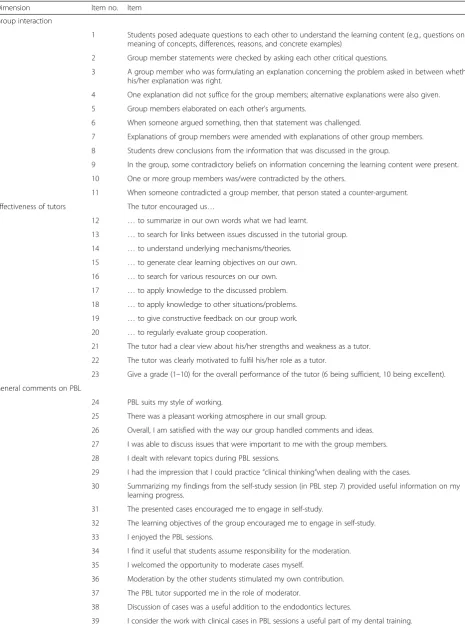
Effectiveness of the tutoring styles was assessed on the basis of a questionnaire completed by the students. The contents of the questionnaire (n= 60 questions) were based on studies by Visschers-Pleijers et al. [34] and Dolmans & Ginns [35] and matched the PBL question-naire used at Charité, Berlin [36]. The questionquestion-naire consisted of three sections (i.e., group interaction, tutor
effectiveness, general comments on PBL), with a section for additional remarks provided (Table 3). Questions were answered using a Likert scale ranging from one to five (1 = completely disagree, 2 = disagree, 3 = neutral, 4 = agree, 5 = completely agree). In addition, an observa-tion chart (“manipulation check“) was constructed on which the external observer recorded tutor performance and his/her activities as well as those of the group.
Qualitative part (Part 2)
The participating tutors were questioned about their ex-perience with PBL by means of expert interviews that were half-standardized (semi-structured), i.e., the inter-views were conducted using a guideline that only pro-vided subject-related questions (Table 4).
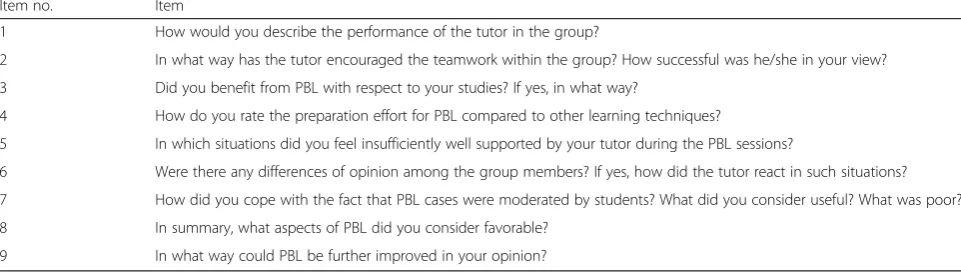
One PBL group consisting of randomly allocated par-ticipants (n= 8 students) was exposed to both tutoring styles (facilitative or non-facilitative) in several sessions. These students participated in a focused group discus-sion to share their view about the two tutoring styles (Table 5). The setting of an open discussion allowed each participant to freely express his/her personal view and impression.
The guidelines for expert interviews and the focused group discussion were prepared in collaboration with the Institute of Psychology, Department for Educational Psych-ology of the Goethe University of Frankfurt am Main. All interviews and the focused group discussion were recorded in both audio and video forms, using a HDC-SD40EG-K Full HD Camcorder (Panasonic K. K., Kadoma, Japan).
summer semester 2008 n = 27
winter semester 2008 / 2009 n = 31
summer semester 2009 n = 48
excluding criteria
summer semester (s) 2008 n = 24
winter semester (w) 2008 / 2009 n = 31
summer semester (s) 2009 n = 46
Pre MCQ (n = 40 items)
randomization, stratification
External observer
Post MCQ (n = 40 items)
Questionnaire (n = 60 items)
Table 3Questionnaire
Dimension Item no. Item
Group interaction
1 Students posed adequate questions to each other to understand the learning content (e.g., questions on meaning of concepts, differences, reasons, and concrete examples)
2 Group member statements were checked by asking each other critical questions.
3 A group member who was formulating an explanation concerning the problem asked in between whether his/her explanation was right.
4 One explanation did not suffice for the group members; alternative explanations were also given.
5 Group members elaborated on each other’s arguments.
6 When someone argued something, then that statement was challenged.
7 Explanations of group members were amended with explanations of other group members.
8 Students drew conclusions from the information that was discussed in the group.
9 In the group, some contradictory beliefs on information concerning the learning content were present.
10 One or more group members was/were contradicted by the others.
11 When someone contradicted a group member, that person stated a counter-argument.
Effectiveness of tutors The tutor encouraged us…
12 …to summarize in our own words what we had learnt.
13 …to search for links between issues discussed in the tutorial group.
14 …to understand underlying mechanisms/theories.
15 …to generate clear learning objectives on our own.
16 …to search for various resources on our own.
17 …to apply knowledge to the discussed problem.
18 …to apply knowledge to other situations/problems.
19 …to give constructive feedback on our group work.
20 …to regularly evaluate group cooperation.
21 The tutor had a clear view about his/her strengths and weakness as a tutor.
22 The tutor was clearly motivated to fulfil his/her role as a tutor.
23 Give a grade (1–10) for the overall performance of the tutor (6 being sufficient, 10 being excellent).
General comments on PBL
24 PBL suits my style of working.
25 There was a pleasant working atmosphere in our small group.
26 Overall, I am satisfied with the way our group handled comments and ideas.
27 I was able to discuss issues that were important to me with the group members.
28 I dealt with relevant topics during PBL sessions.
29 I had the impression that I could practice“clinical thinking“when dealing with the cases.
30 Summarizing my findings from the self-study session (in PBL step 7) provided useful information on my learning progress.
31 The presented cases encouraged me to engage in self-study.
32 The learning objectives of the group encouraged me to engage in self-study.
33 I enjoyed the PBL sessions.
34 I find it useful that students assume responsibility for the moderation.
35 I welcomed the opportunity to moderate cases myself.
36 Moderation by the other students stimulated my own contribution.
37 The PBL tutor supported me in the role of moderator.
38 Discussion of cases was a useful addition to the endodontics lectures.
Study evaluation
The quantitative data (Part 1) were evaluated in line with the intention-to-treat (ITT) principle. The following analyses were conducted:
1. quality criteria of the multiple-choice tests
2. analysis of study questionnaire, determination of reliability values and factors
3. explorative data analysis
4. mixed-model analysis (analysis of variance), taking group and tutor effects into account (significance levelp≤0.05).
Table 3Questionnaire(Continued)
40 The range of discussed cases broadened my knowledge of endodontics.
41 Case presentations by others were helpful to me.It was easy for me to participate in the discussion because…
42 …I could readily picture the patients being discussed.
43 …I had seen similar patients in the 9th semester when assisting in courses.I felt supported by my tutor with respect to my needs, expectations, views, etc.…
44 …as a group member.
45 …as moderator.
46 …when I presented a case.The PBL tutor…
47 …makes sure that the group defines problem issues.
48 …activates my previous knowledge.
49 …encourages me to contribute.
50 …responds to contributions by team members.
51 …assists me in putting things into context.
52 …makes sure that the group formulates clear learning objectives.
53 …makes sure that the learning objectives are discussed.
54 …prevents digression from the topic.
55 …assists me in visualizing results.The PBL tutor…
56 …encourages group work.
57 …describes well the way we work together.
58 …helps the group to solve conflicts.
59 I feel that the tutor was too strict (scores 1–2), just right (scores 3–5), or too lenient (scores 6–7).
60 I feel that the PBL tutor has talked too much (scores 1–2), has talked exactly as much as needed (scores 3–5), or has not talked enough (scores 6–7).
Table 4Guideline for expert interviews (n= 11 items)
Item no. Item
1 How did your facilitative (f) or non-facilitative (nf) tutoring style affect the group discussion? Please describe a typical situation.
2 Did you observe a difference in the working atmosphere, depending on the tutoring style (f/nf) you applied?
3 Please describe in your own words how you perceived the differences between the tutoring styles (f/nf).
4 Which measures did you take to encourage the teamwork when applying the tutoring styles (f/nf)? How successful were you in your view?
5 Why do you think students can benefit particularly from PBL? Do you see any differences between the two tutoring styles (f/nf) in this respect?
6 How would you estimate your preparation effort for PBL? Do you feel that there are any differences in the expenditure of work between the two tutoring styles?
7 Which tutoring role made it easier for you to support the group with respect to the PBL procedure? Please explain.
8 How did you react to differences of opinion in the group, depending on the tutoring style you used (f/nf)?
9 What was your experience with the moderation of PBL cases by the students? Did you detect any differences, depending on the type of tutoring you assumed?
10 How did you feel in the role as a facilitative or non-facilitative tutor? Which role made it easier for you to perform the task of tutoring?
All data were statistically analyzed using the software SAS 9.1 (SAS Institute Cary, NC, USA).
In Part 2 of the study (qualitative data), the recorded expert interviews and focused group discussion were transcribed, and relevant information was grouped by topic. The codes generated in this way were processed with the program MAXQDA (Verbi GmbH, Marburg, Germany) and analyzed in terms of a“thematic analysis” [37]. Two independent individuals who had been trained beforehand established the topic categories. These were based on interpretation of terms in the context in which they had been mentioned.
Results
Quantitative part (Part 1)
Dropout rate
The mean response rate for the total study population was 95.04 %, with a mean dropout rate amounting to 4.96 %.
Activities of tutors and groups as noted by the external observers
Table 6 lists the findings with respect to tutor and group activities as perceived by the external observers.
Factor analysis
Determination of the proper values for questions 1 to 60 in the explorative analysis of the questionnaire proved a 3 or 8-factor solution to be appropriate. The 8-factor ap-proach allows a more detailed analysis; thus it was used for subsequent analyses. Table 7 shows the reliability es-timates (Cronbach’s alpha), mean data, andp-values for the analyzed factors with the corresponding items of the questionnaire. Support by the tutor, tutor effectiveness, and motivation were significantly better in groups re-ceiving facilitative tutoring than those rere-ceiving non-facilitative tutoring.
The dimension “tutor effectiveness” consisting of 5 subdimensions achieved mean (± SD) values ranging from 3.77 ± 0.82 (context-relevant learning) to 4.05 ±
0.63 (intrapersonal behaviour). For facilitative tutoring, the subdimensions reached the following mean scores: constructive, active learning: 4.08 ± 0.76 (versus 3.77 ± 0.85 for non-facilitative tutoring); self-driven learning: 4.22 ± 0.78 (versus 3.83 ± 0.92); context-relevant learning: 3.92 ± 0.79 (versus 3.62 ± 0.82); collaborative learning: 4.15 ± 0.78 (versus 3.87 ± 0.80); and intrapersonal behav-ior: 4.15 ± 0.80 (versus 3.96 ± 0.84).
Statistical analysis of pre- and post-PBL tests
The overall results of the post-PBL test were signifi-cantly better than those of the pre-PBL test. The stu-dents reached a mean score of 16.05 ± 4.49 points in the pre-PBL test, and a mean of 21.38 ± 4.69 points com-puted for the post-PBL test (p≤0.0001). After the pre-PBL test the students were stratified into the facilitative (with a mean of 16.30 points) and non-facilitative group (with a mean of 15.82 points) with no statistically signifi-cant difference (p= 0.590) between them.
In the post-PBL test both groups received significantly more correct answers than the respective pre-PBL group (p≤0.05). Comparing the post-PBL results in the two tutoring styles (nf = 22.2 correct answers, f = 20.5 cor-rect answers) no significant difference could be ob-served (p= 0.08).
Qualitative part (Part 2)
Expert interviews
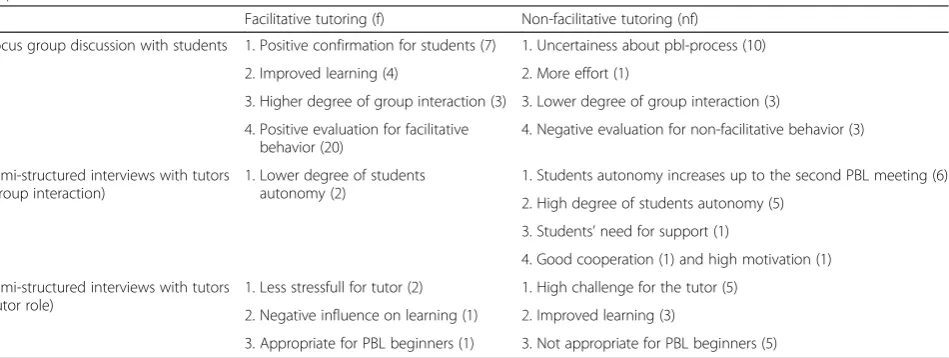
Table 8 shows the outcome (frequency of responses) of the focused group discussion with students and expert interviews with tutors. Additionally most tutors indi-cated that non-facilitative tutoring was difficult to apply Table 5Guideline for focus group discussion (n= 9 items)
Item no. Item
1 How would you describe the performance of the tutor in the group?
2 In what way has the tutor encouraged the teamwork within the group? How successful was he/she in your view?
3 Did you benefit from PBL with respect to your studies? If yes, in what way?
4 How do you rate the preparation effort for PBL compared to other learning techniques?
5 In which situations did you feel insufficiently well supported by your tutor during the PBL sessions?
6 Were there any differences of opinion among the group members? If yes, how did the tutor react in such situations?
7 How did you cope with the fact that PBL cases were moderated by students? What did you consider useful? What was poor?
8 In summary, what aspects of PBL did you consider favorable?
9 In what way could PBL be further improved in your opinion?
Table 6Tutor and group activities in groups tutored facilitatively (f) and non-facilitatively (nf). Data are means ± SD (SD = standard deviation)
Parameter Facilitative (f) Non-facilitative (nf) Signifikance f/nf
Tutor activity 40.00 ± 24.17 26.96 ± 22.08 yes (p= 0.0047)
(n= 7) and that previous training was necessary (n= 7). Irrespective of the tutoring style in their group, the students expressed uncertainty about the PBL proced-ure (n= 14). Moreover, the group composition was named to significantly influence the procedure (n= 8), and marked focusing on the tutor was observed (n= 2).
Similarly, the tutors considered PBL a challenging learn-ing tool (n= 8) in which the group composition plays an important role (n= 3). They also concluded that PBL is easier to apply (n= 1) and requires less preparation time than classical teaching (n= 4). Suggestions for improving PBL included more practicing of the two different tutoring styles (n= 18), prolonged PBL meeting times (n= 3), and use of additional PBL cases (n= 4).
In the groups tutored non-facilitatively, tutors ob-served a high degree of student autonomy during the PBL sessions, particularly after the second session. They confirmed that “students found out very many things on their own in the second session“, and “needed less eye contact“. Furthermore, tutors concluded that the facilita-tive role is more suitable in a hybrid curriculum.
Focus group discussion
Table 8 shows the students‘assessment of tutoring styles and their effects on the PBL process. Additionally the stu-dents rated PBL as practice-oriented learning (n= 6) and favored the facilitative tutoring style (n= 20), with only one student rating the two tutoring styles as equally effective. Comments on the facilitative tutor were as follows: The fa-cilitative tutor “tries to guide things into the right direc-tion“; “is considered“,“does not use a poker face“,“was a supervisor and guide at the same time”; “provided feed-back”; and “gave us an opportunity to ask questions”. In contrast, the non-facilitative tutor“was straight-faced“; tried to lead us astray“; and“solely acted as physician or patient”.
Suggestions for improving the module mostly con-cerned organizational issues (n= 10), followed in fre-quency by proposals of modifying the module contents (n= 6).
The students described the facilitative tutor role as a “guideline that leads you along“, and realized that“it is not that bad if you say the wrong thing“. In addition, they appreciated the fact that this tutoring style“lets you
Table 8Outcome of focused group discussion and expert interviews (with corresponding numbers indicating the frequency of responses)
Facilitative tutoring (f) Non-facilitative tutoring (nf)
Focus group discussion with students 1. Positive confirmation for students (7) 1. Uncertainess about pbl-process (10)
2. Improved learning (4) 2. More effort (1)
3. Higher degree of group interaction (3) 3. Lower degree of group interaction (3)
4. Positive evaluation for facilitative behavior (20)
4. Negative evaluation for non-facilitative behavior (3)
Semi-structured interviews with tutors (group interaction)
1. Lower degree of students autonomy (2)
1. Students autonomy increases up to the second PBL meeting (6)
2. High degree of students autonomy (5)
3. Students’need for support (1)
4. Good cooperation (1) and high motivation (1)
Semi-structured interviews with tutors (tutor role)
1. Less stressfull for tutor (2) 1. High challenge for the tutor (5)
2. Negative influence on learning (1) 2. Improved learning (3)
3. Appropriate for PBL beginners (1) 3. Not appropriate for PBL beginners (5)
Table 7Factors and corresponding items of the questionnaire (Values are Cronbach’s alpha (CA) and means ± SD (SD = standard deviation; plusp-values) for the 8-factor solution for groups supervised facilitatively (f) and non-facilitatively (nf)
Factor Items CA Facilitative (f) Non-facilitative (nf) Signifikance f/nf
Support 19,20,44,47,51–58 0.87 4.14 ± 0.45 3.89 ± 0.43 Yes (p= 0.003)
Tutor effectiveness 12–18,21,22,45,46 0.85 4.05 ± 0.50 3.75 ± 0.49 Yes (p< 0.001)
Group interaction 1–8,25–27,42 0.81 3.96 ± 0.41 3.86 ± 0.39 No (p= 0.229)
Acceptabiliy 29–32,38–41 0.81 4.12 ± 0.56 4.04 ± 0.51 No (p= 0.54)
Motivation 24,28,33–35 0.75 4.01 ± 0.66 3.85 ± 0.46 Yes (p= 0.04)
Tutors’overall performance 23,48–50,59,60 0.30 4.10 ± 0.38 4.02 ± 0.33 No (p= 0.09)
Moderation 36,37,43 0.53 3.32 ± 0.69 3.16 ± 0.68 No (p= 0.09)
Conflict potential 9–11 0.56 3.32 ± 0.66 3.26 ± 0.66 No (p= 0.6)
know whether you go off in the wrong direction”. The pri-mary effect of non-facilitative tutoring on the group was uncertainty with respect to the PBL procedure. The stu-dents named the more practical mode of learning in PBL modules as the main advantage of PBL over con-ventional learning. Practice-oriented application of the-oretical topics were considered “good training for work with the patient“;“attempts to solve problems in a prac-tical way”, and a “stimulating exercise”. In the clinical sense, PBL was regarded as “more effective“, and “the awareness for practical problems is being triggered”. Stu-dents stated that for the first PBL cases, they would wish to have a facilitative tutor who subsequently “becomes increasingly non-facilitative”.
Discussion
The tutor influences the success of PBL-groups. How-ever the best way to perform the tutor’s role is a matter of debate. We compared two different tutor-styles. The facilitating tutor was more active, intervened and guided the group. The non-facilitating tutor only in-tervened in certain situations and kept still most of the time (see Tables 2 and 3).
There is general agreement in the available literature that PBL strengthens the learning motivation [2, 3, 6, 9]. In his flow theory, Csikszentmihalyi stated that “the structure of activity in the context of challenge, goal, feedback, concentration, and control has major influ-ences on intrinsic motivation [38, 39]. “Flow” is defined as“the holistic experience that people feel when they act with total involvement”. In line with these statements, our study revealed a significant difference in the variable “motivation“between the two tutoring styles in favor of facilitative tutoring (4.01 ± 0.66 versus 3.85 ± 0.46).
The style of PBL tutoring affects the group work in a direct manner. For the present study, we used some of the dimensions published by Dolmans & Ginns [35]. In line with the PBL form used at Charité, Berlin, our ques-tionnaire consisted of 60 items. Some items (items 47– 55) were phrased in a way that may have favored the facilitative style, which should be critically stated. The highest values in the rating of tutors occurred in the subdimension “intrapersonal behavior”. Facilitative tu-tors were more effective in “generating clear learning objectives“encouraging“the search for additional sources of information“, which was reflected in the group mem-bers’ assessment of tutors. To optimize group work, Wood [40] suggested allocating specific roles to the group members before sessions (e.g., reader, writer, time keeper, moderator, and summarist). We used these roles also in the present study.
PBL evaluation consists of assessing the students as well as the program [14, 41]. Such evaluations are diffi-cult to conduct, and several differing approaches have
been described in the literature. By employing multiple-choice tests, Budé et al. [42] demonstrated a significant difference (p= 0.072) between so-called directive and traditional PBL modules, with the directive programs achieving a better result. In our study, knowledge gain in the post-PBL test was significant in both groups, reflect-ing the newly acquired knowledge after completreflect-ing the PBL module. There was a trend towards better results in the group tutored non-facilitatively, but the difference did not reach statistical significance.
In the expert interviews, tutors expressed clear diffi-culties with their non-facilitative role. Moreover, tutors documented more problems in implementing a non-facilitative tutoring style with PBL beginners, as apparent by the following comments: “My personal experience is that the non-facilitative role is not easy for a student who has never participated in a PBL module“; “If group members have already undergone a PBL session, I feel comfortable in either role”; or “The first session was really difficult when assuming the non-facilitative role”. The comment “The differences between the tutor roles and their practical implementation were not entirely clear in the role description“suggests that there was a need for more extensive tutor training. In line with this observation, the need for more extensive tutor training is emphasized in the literature [43–46].
With respect to internal study validity, the aspects to be considered include maturity, selection of study partic-ipants, study location, instrumentation, and the special study design used. During the 8-week PBL module„ End-odontics“, students attended multiple other lectures and courses that were not directly connected with the topic of the PBL module but may have indirectly affected the monitoring of learning objectives. To minimize this ef-fect, all programs on similar topics organized by the out-patient clinic for restorative dentistry were scheduled to take place after completion of the PBL module. Matur-ation’may possibly also have affected the tutors involved in the study. It cannot be ruled out that the tutors be-came increasingly accustomed to their specific role dur-ing the study. This factor was controlled by the external observers who confirmed the assigned roles. To reduce potential problems associated with the study location, all PBL sessions were conducted in the same room (simula-tion laboratory) and took place on the same week day (Tuesday) at the same time (2 p.m. to 5 p.m.).
were conducted without announcing them; neither the students nor the tutors knew the exact date of the tests.
The four tutors taking part in the study were respon-sible for the implementation of the different roles during the PBL sessions. All of them had many years of experi-ence with PBL. However, it was feared that some of them might leave the university before the end of the study because of an expiring contract, which constituted a substantial complication in the planning of the study. The chosen study design (“nested“design) appeared to provide the best condition for this potential complica-tion in that it allowed for a maximum size of factor vari-ance. For this reason, the tutors had to switch roles each time, and the various PBL cases were exchanged during the module. In this way, replacing a tutor would have been less critical.
The chosen study design also addressed the potential problem of implementation, i.e., the specific selection of a role for each tutor and free allocation of students to a tutorial. Any interaction between groups (tutored by a facilitative or non-facilitative style) was minimized by the simultaneous scheduling of PBL-sessions with only the same tutoring style. Thus, potential variation in tutor performance was not evident in the parallel sessions. Any confounding by student interaction outside the PBL module was kept to a minimum by blinding the partici-pants with respect to the study variables.
Our study design consisting of pre- and post-PBL as-sessments may be associated with certain limitations in connection with the testing condition [47]. There is a danger that students anticipate the tests and will there-fore not be unprepared when attending PBL sessions. Moreover, based on their experience with the nature of information and type of questions in the pre-PBL test, participants can prepare more effectively for the post-PBL test than for the pre-post-PBL test. Nonetheless, Fraenkel & Wallen [47] also point to the advantages of this study design; it provides information on the group composition with respect to the knowledge level and consequently on the comparability of the two groups. The authors point out that this study design is particu-larly useful if groups contain no more than 30 partici-pants. With as many as 101 participants in our study, this limit was clearly exceeded. The large group size in our study resulted from the combination of three semes-ters. Consequently, pre-PBL testing was of critical im-portance to ensure comparable knowledge levels among the groups. In our study, the groups were, in fact, com-parable with respect to their current knowledge on the subject.
An additional aspect of debate is the number of study participants. Within the study time frame, it was not possible to recruit more students (total number of stu-dents per semester = 48) and tutors (total number of
experienced PBL tutors available at the entire dental school = 5) at our institute. Sample-size calculation prior to study start yielded a number of at least 50 partici-pants per group (facilitative versus non-facilitative), but this number could not even have been met by adding students from an additional semester. Nonetheless, it would be desirable to confirm our findings in subse-quent studies involving larger study populations.
With respect to external validity of the study, generalizability of our findings and the special setting of a replication study are of interest. To ensure that our re-sults can be transferred to other persons, situations, con-ditions, and time frames, we allocated students to one of two groups by stratified randomization. Moreover, the low dropout rate increased the external validity of this study. Further strengthening of the external validity re-sulted from the nature of our evaluation that can be viewed as a replication study. Because the study ran over a period of three semesters, findings were transferable to other study subjects as different students were involved.
The “readiness” of tutors and students underwent a certain process. Initially, the facilitative style was fa-vored by both the tutors and students. In the Results section we state that the facilitative tutoring style had resulted in less self-directed learning by the end of the PBL experiments. The tutors mentioned that the non-facilitative tutoring style greatly increased the students’ability to learn on their own.
Conclusions
Within the limitations of the study that was based on a hybrid curriculum, we conclude that the tutor style should be modified during PBL training. Initially, the fa-cilitative style may be more suitable, but the non-facilitative tutoring style should be introduced when students have gained sufficient knowledge in PBL. We believe that this approach would be of optimal long-term benefit to both students and tutors participating in PBL programs.
Competing interests
The authors declare that they have no competing interests.
Authors’contributions
All authors read and approved the manuscript and have made substantive intellectual contributions to the published study. SG and FO proposed the PBL method, designed the experiment and evaluation method and played a leading role in writing the article. FK designed and carried out the questionnaire for the qualitative part of the study. AM collected and analyzed the data. AB helped draft and critically appraise the manuscript. MH helped design and carry out the theoretical frame for the qualitative part of the study. SG and SR revised the manuscript based on reviewers’reports. All authors read and approved the final manuscript.
Acknowledgements
Author details
1Department of Operative Dentistry, Center for Dentistry and Oral Medicine (Carolinum), Medical Faculty, Goethe University of Frankfurt am Main, Theodor-Stern-Kai 7, Building 29, 60596 Frankfurt am Main, Germany.2Private Practice, Bergerstraße 159, 60385 Frankfurt am Main, Germany.3Competence Center for Assessment in Medicine, Medical Faculty, University of Heidelberg, Im Neuenheimer Feld 346, 69120 Heidelberg, Germany.4Institute of Psychology, Interdisziplinäres Kolleg Hochschuldidaktik (IKH), Goethe University of Frankfurt am Main, Senckenberganlage 15, 60325 Frankfurt am Main, Germany.5Medical Faculty, Institute of Anatomy and Cell Biology, University in Ulm, Albert-Einstein Allee 11, 89081 Ulm, Germany.6Medical Faculty, Institute of Dermatology, Goethe University of Frankfurt am Main, Theodor-Stern-Kai 7, Building 28, 60596 Frankfurt am Main, Germany.
Received: 29 September 2014 Accepted: 7 December 2015
References
1. German Council of Science and Humanities. Recommendations on higher education qualifications for the healthcare system. Berlin 2012. Available from : http://www.wissenschaftsrat.de/download/archiv/2411-12_Executive-Summary.pdf
2. Albanese MA, Mitchell S. Problem-based learning: a review of literature on its outcomes and implementation issues. Acad Med. 1993;68:52–81. 3. Vernon DT, Blake RL. Does problem-based learning work? A meta-analysis of
evaluative research. Acad Med. 1993;68:550–63.
4. Berkson L. Problem-based learning: have the expectations been met? Acad Med. 1993;68:S79–88.
5. Kasim R. What can studies of problem-based learning tell us? Synthesizing and modeling PBL effects on national board of medical examination performance: hierarchical linear modeling meta-analytic approach. Adv Health Sci Educ. 1999;4:209–21.
6. Colliver JA. Effectiveness of problem-based learning curricula: research and theory. Acad Med. 2000;75:259–66.
7. Smits PB, Verbeek JH, de Buisonje CD. Problem based learning in continuing medical education: a review of controlled evaluation studies. BMJ. 2002;324:153–6.
8. Dochy F, Segers M, Van den Bossche P, Gijbels D. Effects of problem-based learning: a meta-analysis. Learn Instr. 2003;13:533–68.
9. Newman M. A pilot systematic review and meta-analysis on the effectiveness of problem based learning: on behalf of the Campbell Collaboration Systematic Review Group on the effectiveness of Problem Based Learning: Catherine Cookson Centre for Medical Education and Health Informatics. Available from:http://citeseerx.ist.psu.edu/viewdoc/ download?doi=10.1.1.133.6561&rep=rep1&type=pdf
10. Gijbels D, Dochy F, Van den Bossche P, Segers M. Effects of problem-based learning: a meta-analysis from the angle of assessment. Rev Educ Res. 2005; 75:27–61.
11. Polyzois I, Claffey N, Mattheos N. Problem-based learning in academic health education. A systematic literature review. Eur J Dent Educ. 2010;14:55–64. 12. Townsend G, Winning T. Research in PBL–where to from here for
dentistry? Eur J Dent Educ. 2011;15:193–8.
13. Schmidt HG, Rotgans JI, Yew EH. The process of problem-based learning: what works and why. Med Educ. 2011;45:792–806.
14. Townsend GC, Kim M, Sankey D. Dynamic systems (Complexity) theory as a new conceptual model for researching PBL in dental education. Eur J Dent Educ. 2012;16:43–51.
15. Huang B, Zheng L, Li C, Li L, Yu H. Effectiveness of problem-based learning in Chinese dental education: a meta-analysis. J Dent Educ. 2013;77:377–83.
16. Bate E, Hommes J, Duvivier R, Taylor DC. Problem-based learning (PBL): getting the most out of your students - their roles and responsibilities: AMEE Guide No. 84. Med Teach. 2014;36:1–12.
17. Hayashi S, Tsunekawa K, Inoue C, Fukuzawa Y. Comparison of tutored group with tutorless group in problem-based mixed learning sessions: a randomized cross-matched study. BMC Med Educ. 2013;13:158.
18. Bearn DR, Chadwick SM. Problem-based learning in postgraduate dental education: aqualitative evaluation of students’experience of an orthodontic problem-based postgraduate programme. Eur J Dent Educ. 2010;14:26–34.
19. Watmough SD, O’Sullivan H, Taylor DC. Graduates from a reformed undergraduate medical curriculum based on Tomorrow’s Doctors evaluate the effectiveness of their curriculum 6 years after graduation through interviews. BMC Med Educ. 2010;10:65.
20. Lee GH, Lin CS, Lin YH. How experienced tutors facilitate tutorial dynamics in PBL groups. Med Teach. 2013;35:935–42.
21. Grant A, Kinnersley P, Field M. Learning contexts at Two UK medical schools: a comparative study using mixed methods. BMC Res Notes. 2012;19:153.
22. Kamp RJ, Dolmans DH, Van Berkel HJ, Schmidt HG. The effect of midterm peer feedback on student functioning in problem-based tutorials. Adv Health Sci Educ Theory Pract. 2013;18:199–213.
23. Maudsley G, Williams EM, Taylor DC. Problem-based learning at the receiving end: a‘mixed methods’study of junior medical students’ perspectives. Adv Health Sci Educ Theory Pract. 2008;13:435–51. 24. Woltering V, Herrler A, Spitzer K, Spreckelsen C. Blended learning
positively affects students’satisfaction and the role of the tutor in the problem-based learning process: results of a mixed-method evaluation. Adv Health Sci Educ Theory Pract. 2009;14:725–38. 25. Qiao YQ, Shen J, Liang X, Ding S, Chen FY, Shao L, et al. Using cognitive
theory to facilitate medical education. BMC Med Educ. 2014;14:79. 26. Azer SA. Problem-based learning: where are we now? Guide supplement
36.1 - viewpoint. Med Teach. 2011;33:121–2.
27. Groves M, Régo P, O’Rourke P. Tutoring in problem-based learning medical curricula: the influence of tutor background and style on effectiveness. BMC Med Educ. 2005;5:20.
28. McLean M. Clinical role models are important in the early years of a problem-based learning curriculum. Med Teach. 2006;28:64–9.
29. Hamdy H. The fuzzy world of problem based learning. Med Teach. 2008;30: 739–41.
30. Dolmans DH, Gijselaers WH, Moust JH, de Grave WS, Wolfhagen IH, van der Vleuten CP. Trends in research on the tutor in problem-based learning: conclusions and implications for educational practice and research. Med Teach. 2002;24:173–80.
31. Maurer H, Neuhold C. Problems Everywhere? Strengths and Challenges of a Problem-Based Learning Approach in European Studies. Paper prepared for the Higher Education Academy Social Science Conference“Ways of Knowing, Ways of Learning”28 and 29 May 2012. Liverpool. Available from:http://www.mcegmaastricht.eu/ pdf/MCEG_part%20PBL_link2_%20PBL%20implementation%20 challenges.pdf
32. Walsh A. The tutor in problem-based learning: a novice’s guide. Hamilton: McMaster University; 2005. Available from: http://fhs.mcmaster.ca/facdev/ documents/tutorPBL.pdf.
33. Tuckman BW. Developmental sequence in small groups. Psychol Bull. 1965; 63(6):384–99.
34. Visschers-Pleijers AJ, Dolmans DH, Wolfhagen IH, Van der Vleuten CP. Development and validation of a questionnaire to identify learning-oriented group interactions in PBL. Med Teach. 2005;27:375–81.
35. Dolmans DH, Ginns P. A short questionnaire to evaluate the effectiveness of tutors in PBL: validity and reliability. Med Teach. 2005;27:534–8.
36. Spiess C. Development of a PBL-mentoring program in preparation for the model course including a status analysis of the faculty role and implementation of the method PBL. 2008. Available from: http://www.reformstudiengang-medizin.de/attachment/1d598b30fe438f8e6a4d33a28e495d40/d173c66177a 98611d1cd17dae7808a1e/Entwicklung%20eines%20POLMentorenprogramms% 20in%20Vorbereitung%20auf%20den%20Modellstudiengang%20inkl.%20einer% 20Statusanalyse%20der%20Dozentenroll.-e%20und%20Umsetzung%20der%20 Methode%20POL in german language
37. Mayring P. Combination and Integration of Qualitative and Quantitative Analysis. Forum Qual Res 2(1):6. Available from: http://www.qualitative-research.net/index.php/fqs/article/view/967
38. Csikszentmihalyi M. Beyond boredom and anxiety. Experiencing flow in work and play. San Francisco: Jossey Bass Wiley; 2000.
39. Van Berkel H, Schmidt H. Motivation to commit oneself as a determinant of achievement in problem-based learning. High Educ. 2000;40:231–42.
41. Watmough S, Charry MG, O’Sullivan H. A comparison of self-perceived competencies of traditional and reformed curriculum graduates 6 years after graduation. Med Teach. 2012;34:562–8.
42. Budé L, Imbos T, Wiel M, Broers N, Berger M. The effect of directive tutor guidance in problem-based learning of statistics on students’perceptions and achievement. High Educ. 2009;57:23–36.
43. Grand Maison P, des Marchais JE. Preparing faculty to teach in a problem-based learning curriculum: the Sherbrooke experience. Can Med Assoc J. 1991;144:557–62.
44. Maudsley G. Roles and responsibilities of the problem based learning tutor in the undergraduate medical curriculum. Br Med J. 1999;318:657–61. 45. Wetzel MS. Developing the role of the tutor/facilitator. Postgrad Med J.
1996;72:474–7.
46. McLean M. What can we learn from facilitator and student perceptions of facilitation skills and roles in the first year of a problem-based learning curriculum? BMC Med Educ. 2003;3:9.
47. Frankel JR, Wallen NE. How to design and evaluate research in education. New York: Mc Graw-Hill Humanities; 2008.
• We accept pre-submission inquiries
• Our selector tool helps you to find the most relevant journal
• We provide round the clock customer support
• Convenient online submission
• Thorough peer review
• Inclusion in PubMed and all major indexing services
• Maximum visibility for your research
Submit your manuscript at www.biomedcentral.com/submit