Page 1 of 12
Open Access
Research article
Underutilization of information and knowledge in everyday medical
practice: Evaluation of a computer-based solution
David Zakim
1, Niko Braun
2, Peter Fritz
1and Mark Dominik Alscher*
2Address: 1IDM Foundation Institute of Digital Medicine, Am Kriegsbergturm 44, D-70192 Stuttgart, Germany and 2Department of General Internal Medicine and Nephrology, Stuttgart, Germany
Email: David Zakim - [email protected]; Niko Braun - [email protected]; Peter Fritz - [email protected]; Mark Dominik Alscher* - [email protected]
* Corresponding author
Abstract
Background: The medical history is acknowledged as the sine qua non for quality medical care because recognizing problems is pre-requisite for managing them. Medical histories typically are incomplete and inaccurate, however. We show here that computers are a solution to this issue of information gathering about patients. Computers can be programmed to acquire more complete medical histories with greater detail across a range of acute and chronic issues than physician histories.
Methods: Histories were acquired by physicians in the usual way and by a computer program interacting directly with patients. Decision-making of what medical issues were queried by computer were made internally by the software, including determination of the chief complaint. The selection of patients was from admissions to the Robert-Bosch-Hospital, Stuttgart, Germany by convenience sampling. Physician-acquired and computer-acquired histories were compared on a patient-by-patient basis for 45 patients.
Results: The computer histories reported 160 problems not recorded in physician histories or slightly more than 3.5 problems per patient. However, physicians but not the computer reported 13 problems. The data show that computer histories reported problems across a range of organ systems, that the problems detected by computer but not physician histories were both acute and chronic and that the computer histories detected a significant number of issues important for preventing further morbidity.
Conclusion: A combination of physician and computer-acquired histories, in non-emergent situations, with the latter available to the physician at the time he or she sees the patient, is a far superior method for collecting historical data than the physician interview alone.
Background
Everyday medical practice does not proceed on the basis of date information about patients nor on up-to-date knowledge for managing problems that are identified [1-4]. History-taking, the acknowledged starting point for
quality medical care, is inadequate so that information about patients goes undiscovered [5-9]; and outcomes from treating recognized problems are unequal to what can be achieved through effective use of existing knowl-edge [1-3,10,11]. This underutilization of information
Published: 5 November 2008
BMC Medical Informatics and Decision Making 2008, 8:50 doi:10.1186/1472-6947-8-50
Received: 18 July 2008 Accepted: 5 November 2008
This article is available from: http://www.biomedcentral.com/1472-6947/8/50 © 2008 Zakim et al; licensee BioMed Central Ltd.
about patients and knowledge about management appears to be a major contributor not only to poor out-comes but to the high cost of health care [10]. Short-com-ings in delivering quality care are unlikely to resolve until the ineffective use of information about patients and knowledge about disease are addressed directly. Since information about patients is pre-requisite for effective use of knowledge to manage their medical problems, it makes sense to address first the issue of poor history-tak-ing.
History-taking, in theory, can be off-loaded from physi-cians to computers, i.e., the data fields of an "electronic medical record" can be populated by direct, computer-based interview of patients. Computerized history-taking was an active area of academic inquiry at the beginning of the computer age; and early literature demonstrates that history-taking by computer was a promising and effective technology (see reference [12] for review). Paradoxically, interest in the technology ebbed as computers became
cheaper and easier to use and software easier to write. We believe computing can resolve the negative impact on quality of care from deficiencies in history-taking and that this technology thus should be pursued vigorously. We report experience here with a computerized history-taking program that interacts directly with patients in the absence of inputs from physicians or other providers. The data document the extent to which medical problems are not recorded in routine medical histories and show that computerized history-taking can resolve deficiencies in acquiring information from patients about significant medical problems affecting them.
Methods
Software program
Acquisition of clinical data in the history-taking program is based on the principles of pathophysiology formalized as software algorithms representing medical knowledge as branched chain decision trees. Figure 1 is an example of a typical decision tree, which is the initial tree in the
evalu-Example of a decision tree that organizes the flow of questions during an interview Figure 1
Page 3 of 12 ation of a patient presenting with chest pain. The tree in
Figure 1 is one of a family of 29 trees used to evaluate patients with chest pain and then to acquire a complete cardiovascular history. The arrangement of nodes in Fig-ure 1 is based on a logical flow of questions in response to answers concerning the pathophysiology of coronary artery disease as it applies to acquiring a history of a patient with suspected coronary disease, as for example the severity, nature, location and radiation of pain, associ-ated cardiac and/or vagal symptoms, precipitators of pain and so on. Nodes coded with 4 letters followed by a Roman numeral and ending in an Arabic number repre-sent questions. Small case letters are answer values for the parent question. A specific answer or set of answers points to a specific follow up node, indicated by the direction arrows. Question nodes are of several types: yes/no; yes/ no/uncertain; single selection multiple choice question; multiple choice questions; graphic representations of anatomy, e.g. to select affected joints in a patient with joint pain; and user entries, which can be entry of free text or entry from pull down menus. Nodes consisting of 3 let-ters represent sets of trees. Node PPU, for example, is a set of trees representing the pathophysiology of pulmonary disease as it applies to history-taking. The tree in Figure 1 will switch from acquiring a history concerning cardiac disease to focus on possible pulmonary disease when, for example, a patient's chest pain has the properties of pleu-ritic pain. The node PGL is a set of trees representing the pathophysiology of gastrointestinal disease, exclusive of liver disease, as it applies to history-taking. Nodes with 4 initial letters, a Roman numeral and ending in a capital letter represent single trees, which in turn represent single pathophysiologic issues. Node PGLHID represents a tree that questions the patient about swallowing disorders. Thus, when the history of chest pain (acquired by transit of the tree in Figure 1) indicates intermittent chest pain always precipitated by swallowing, the program will direct history-taking to the pathophysiology of swallowing dis-orders (node PGLHID) and then to a review of the gas-trointestinal history (PGL). Nodes labeled complete end a string of questions; and depending on the arrangement of nodes at least one "Complete" node ends a tree.
As eluded to already, knowledge as trees for history-taking is broken-down by organ system and further as medical issues within an organ system. The elements acquiring the cardiac history, for example, are organized as separate trees for issues like hypertension, peripheral vascular dis-ease, heart failure, coronary artery disdis-ease, and so on. Trees within an organ system and across organ systems are integrated as a single interview by a master tree so that patients are asked relevant questions about all systems no matter what their chief complaint, i.e., where in the set of trees an interview began. Moreover, no matter where the interview begins, e.g., independent of the organ system of
the chief complaint or a switch in the pathophysiology pursued by history of the present illness, the program will be directed to acquire a history of all organ systems, a social history, a history of significant past medical events, a history of medications being taken, a history of known allergies and a family history. The master tree will direct the interview to a complete cardiac history as part of the review of systems for a patient with pleuritic pain or a patient with a swallowing disorder manifesting as chest pain. The program thus emulates history-taking by a phy-sician, who may decide as the patient's story develops to switch a line of inquiry to pursue alternate pathophysiol-ogies. This level of flexibility at run time is achieved through the mechanism of gating entry into every tree in the program.
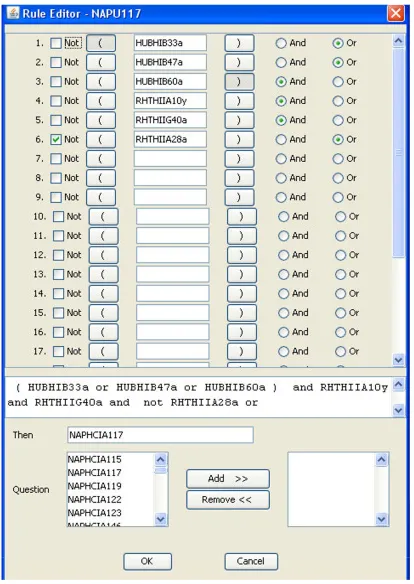
The program "tests" whether a patient should be inter-viewed about every issue in the program as that issue is reached in the course of an interview. The "test" is based on answers to prior questions in the interview, which "gate" entry to every tree. Questions HUBHIB60 and HUBHIB33 gate the entry into the tree in Figure 1. One of these questions must be answered "Yes" (answer value a) for the tree to be entered. If the tree in Figure 1 is not entered, the interview proceeds to the next tree in the order of trees within the module NAP. The mechanism of gating enables the program to explore all aspects of the history that are significant for a given patient while avoid-ing redundancy and issues of no medical significance, as determined by answers to questions at each node in an interview.
Authors of content use the tree structures shown to develop their history-taking programs. The information in trees is compiled as machine-readable code, which directs the program at run time by calling questions from a data-base as the program instantiates one or another node. The program tested in this work comprised 8018 nodes repre-senting approximately 12,000 data fields.
patho-Author interface for creating a rule (or inference) to interpret the significance of clinical data entered by patients Figure 2
Page 5 of 12
Example of report compiled from interview data, as discussed in text Figure 3
Example of report compiled from interview data, as discussed in text. C/V means cardiovascular; NTG means nitro-glycerin.
!"#$%&' (
)*
+ , +
+ - +
+ - ./+
& * .. 0 .+. 1-!. - Ɗ
Ɗ$# 2 #+ 3./4
/5$ #Ɗ $
.#. + . . 6 - + ) (. 7+ 0)4 70
% .89.:; 6.< - 1 0 -.-. 0 .=> 33 == =)$ 0 >. .+# . .
+ + 4 -# . +(; #
.- + -. =7+?= = = + +, -#. - > =-.== / 62 . %. +. . - -
A CTI V E PROB LEM S
*. 7
/. @ - A
.
*
PROCED URES
2 - .
..
physiology. Note in Figure 2 that interpretation of clinical data to generate a possible diagnosis, e.g. "Symptoms compatible with angina" is concept-driven. "If state-ments" comprising a rule cite data fields not specific text.
Deployment of software
Prior to deployment, the program was bench-tested exten-sively for errors in the logic of the trees, for errors in the flow of questions and gating of entry to trees and for errors in reporting of findings. In addition, the program was used by several hundred out-patients in the United States.
The software for acquiring the history operated from a central server behind a firewall within the IT department of the Robert-Bosch-Hospital (RBK, Stuttgart, Germany). Patients connected to the history-taking software via the hospital's Intranet. Patients selected their preferred lan-guage of German or English for the interview. After enter-ing demographic data, they were asked to select a chief complaint from a set of menus. All subsequent questions were determined by the software as illustrated in Figure 1. Patients were able to review and change prior answers by moving the program backward one question at a time along the same branching pathways as the forward loop of questions. Moving backward erased answers to questions traversed in the backward direction. Just as the program determines when a specific tree ends (see figure 1), the master tree ends on a "Complete" node at the end of the family history. When the interview ends, all data are stored as codes in a structured, searchable database within the central computer. Data from computer interviews were extracted from compiled reports as in the example in Figure 3 not by review of individual data fields. Compu-ter-acquired histories were available only to reviewers not to patients' physicians. Computer histories were extracted by D.Z.; physician histories were extracted from the hospi-tal chart by N.B.
Patient selection
Patients who were interviewed had been admitted emer-gently. Patient charts were not consulted prior to any interview; and the study nurse, who picked patients ran-domly for interview, had no knowledge of these patients before an interview and carried on no discussions with floor staff about a patient's clinical state. No demographic criteria were used to select patients except that interviews were limited to patients on general internal medicine, car-diology and nephrology services, which agreed to partici-pate in the program. Patients were asked simply to participate in a test of a new program by which computers interview patients about their past and present health problems. No attempt was made to explain to patients the clinical value of the medical history. No patient who was asked to participate declined to be interviewed.
Ninety eight patients were interviewed by the computer program after a physician's history was recorded. Patients could choose between a computer workstation in the study unit of the clinic or use a laptop in bed, which had a wireless connection to the intranet of the hospital.
About half the patients had not used a computer previous to being interviewed. These patients were instructed in use of a computer mouse by the study nurse. All patients who agreed to computer interview were able to use the pro-gram. Only one patient, of those who started an interview, did not finish the interview, in this case because of severe pain secondary to gangrene of a limb. Hospital charts and records of computer interviews were reviewed in detail and reported here for 45 of these patients, who were inter-viewed by computer within 48 hours of a physician his-tory. This cut-off was used because present illnesses precipitating hospital admission were not captured ade-quately by computer interviews for intervals between phy-sician and computer interviews longer than 48 hours. The data relating to patient reaction to the computer interview and ease of use by patients includes all 98 patients, who filled out a questionnaire about their experiences with the computer-assisted interview. Responsible physicians did not know which patients were interviewed by computer and were not shown reports from these interviews.
Data extraction and analysis
Data were extracted from hospital charts by N.B. and M.D.A.; data from the computer histories were extracted by D.Z., who tabulated comparisons between the 2 sets of records. Nurses at Robert Bosch Krankenhaus do not take medical histories in regard to allergies or adverse drug reactions. Pharmacists make no entries into charts and have no separate records of drug allergies or history of adverse drug reactions. Data on these issues either are obtained only by physician interview of the patient.
Ethical approval
The local ethics committee and regulating government authorities approved the study (University of Tuebingen, Germany). Written informed consent was obtained from all patients. The study was registered (ClinicalTrials.gov: NCT00430755).
Results
Comparison of problems reported in computer but not physician histories
Page 7 of 12
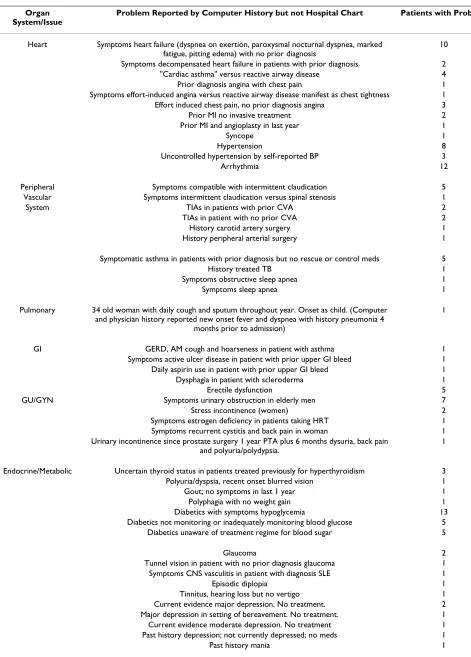
Table 1: Significant problems reported by computer histories but not physician histories for 45 hospitalized patients
Organ System/Issue
Problem Reported by Computer History but not Hospital Chart Patients with Problem
Heart Symptoms heart failure (dyspnea on exertion, paroxysmal nocturnal dyspnea, marked
fatigue, pitting edema) with no prior diagnosis
10
Symptoms decompensated heart failure in patients with prior diagnosis 2
"Cardiac asthma" versus reactive airway disease 4
Prior diagnosis angina with chest pain 1
Symptoms effort-induced angina versus reactive airway disease manifest as chest tightness 1
Effort induced chest pain, no prior diagnosis angina 3
Prior MI no invasive treatment 2
Prior MI and angioplasty in last year 1
Syncope 1
Hypertension 8
Uncontrolled hypertension by self-reported BP 3
Arrhythmia 12
Peripheral Symptoms compatible with intermittent claudication 5
Vascular Symptoms intermittent claudication versus spinal stenosis 1
System TIAs in patients with prior CVA 2
TIAs in patient with no prior CVA 2
History carotid artery surgery 1
History peripheral arterial surgery 1
Symptomatic asthma in patients with prior diagnosis but no rescue or control meds 5
History treated TB 1
Symptoms obstructive sleep apnea 1
Symptoms sleep apnea 1
Pulmonary 34 old woman with daily cough and sputum throughout year. Onset as child. (Computer
and physician history reported new onset fever and dyspnea with history pneumonia 4 months prior to admission)
1
GI GERD, AM cough and hoarseness in patient with asthma 1
Symptoms active ulcer disease in patient with prior upper GI bleed 1
Daily aspirin use in patient with prior upper GI bleed 1
Dysphagia in patient with scleroderma 1
Erectile dysfunction 5
GU/GYN Symptoms urinary obstruction in elderly men 7
Stress incontinence (women) 2
Symptoms estrogen deficiency in patients taking HRT 1
Symptoms recurrent cystitis and back pain in woman 1
Urinary incontinence since prostate surgery 1 year PTA plus 6 months dysuria, back pain and polyuria/polydypsia.
1
Endocrine/Metabolic Uncertain thyroid status in patients treated previously for hyperthyroidism 3
Polyuria/dyspsia, recent onset blurred vision 1
Gout; no symptoms in last 1 year 1
Polyphagia with no weight gain 1
Diabetics with symptoms hypoglycemia 13
Diabetics not monitoring or inadequately monitoring blood glucose 5
Diabetics unaware of treatment regime for blood sugar 5
Glaucoma 2
Tunnel vision in patient with no prior diagnosis glaucoma 1
Symptoms CNS vasculitis in patient with diagnosis SLE 1
Episodic diplopia 1
Tinnitus, hearing loss but no vertigo 1
Current evidence major depression. No treatment. 2
Major depression in setting of bereavement. No treatment. 1
Current evidence moderate depression. No treatment 1
Past history depression; not currently depressed; no meds 1
3.5 problems per patient across a range of organ systems involving acute and chronic issues and risks for further morbidity, as for example uncontrolled hypertension, unrecognized transient ischemic attacks (TIAs) and high risk of falling. We did not find a clustering of differences between computer and physician histories in a few patients but a wide distribution across all charts exam-ined. Not unexpectedly, there was a larger numbers of dis-crepancies between computer-generated and physician histories in patients with a larger burden of disease.
Comparison of problems reported in physician but not computer histories
The computer program asked patients to select a chief complaint from a series of menus, because the program does not have natural language processing or speech rec-ognition. The sequence of items and menus of chief com-plaints appeared to impact what the patient selected. For example, several patients with a chief complaint of chest pain in physician histories selected more generic com-plaints from the computer menus, e.g., heart problems or
Prior diagnosis bipolar disorder not currently depressed 1
Symptoms migraine; no prior diagnosis; positive FH migraine 1
Neurology Multiple hospitalizations for falls; negative AUDIT score 3
High risk for falling because of motor weakness, unsteady gait, past history falls not requiring hospitalization
10
Episodic dizziness and abnormal gait in patient with positive AUDIT score 1
Hodgkin's treated with XRT 3 years prior to admission. Now on chemo for 2nd recurrence. 1
Renal cell cancer treated with surgery and radiation 20 years prior to admission. No recurrence.
1
Oncology Rheumatology Active rheumatoid arthritis on steroids 1
Life Style Active smokers seeking help to stop smoking 2
Positive AUDIT score 5
Multiple 1st and 2nd degree relative with breast cancer 1
Family History Multiple 1st degree relatives with diabetes in patient with history gestational diabetes and
recent onset chest pain provoked by emotional upset.
1
Vegetative Night sweats 1
Symptoms Weight loss > 10 pounds in non-dieting patient 1
The physician history was acquired prior to the computer history, which was obtained within the first 2 days of hospitalization.
Table 1: Significant problems reported by computer histories but not physician histories for 45 hospitalized patients (Continued)
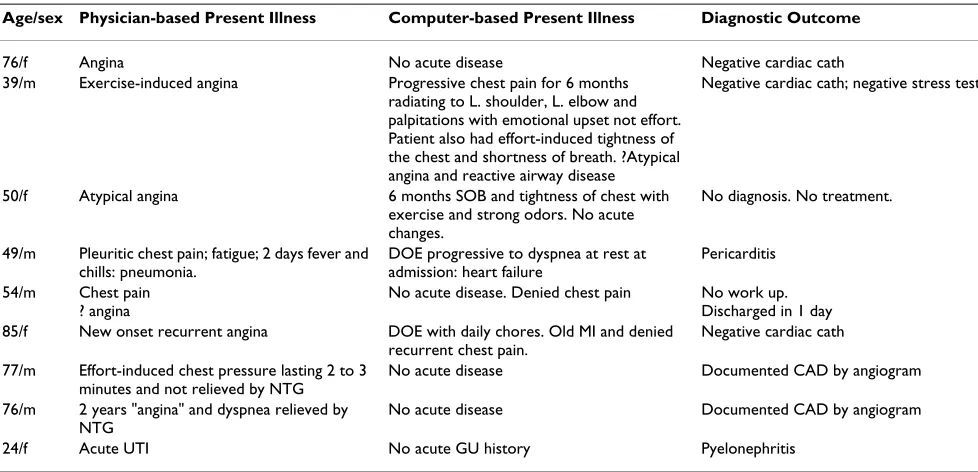
Table 2: Comparison of findings reported by physician histories and computer histories for 8 patients presenting to their physicians with a chief complaint of chest pain and for whom there were significant discrepancies between physician and computer histories of the present illness
Age/sex Physician-based Present Illness Computer-based Present Illness Diagnostic Outcome
76/f Angina No acute disease Negative cardiac cath
39/m Exercise-induced angina Progressive chest pain for 6 months
radiating to L. shoulder, L. elbow and palpitations with emotional upset not effort. Patient also had effort-induced tightness of the chest and shortness of breath. ?Atypical angina and reactive airway disease
Negative cardiac cath; negative stress test.
50/f Atypical angina 6 months SOB and tightness of chest with
exercise and strong odors. No acute changes.
No diagnosis. No treatment.
49/m Pleuritic chest pain; fatigue; 2 days fever and
chills: pneumonia.
DOE progressive to dyspnea at rest at admission: heart failure
Pericarditis
54/m Chest pain
? angina
No acute disease. Denied chest pain No work up.
Discharged in 1 day
85/f New onset recurrent angina DOE with daily chores. Old MI and denied
recurrent chest pain.
Negative cardiac cath
77/m Effort-induced chest pressure lasting 2 to 3
minutes and not relieved by NTG
No acute disease Documented CAD by angiogram
76/m 2 years "angina" and dyspnea relieved by NTG
No acute disease Documented CAD by angiogram
Page 9 of 12 breathing problems before seeing menus of complaints
with chest pain, anginal equivalents, and so on. There thus was poor correspondence between the exact words of chief complaints recorded by physician and computer his-tories. On the other hand, there was good correspondence between the details of present illnesses collected by physi-cian and computer histories across several chief com-plaints including patients reporting chest pain to their physician but heart or breathing problems in the compu-ter incompu-terview. Exceptions to this are shown in Table 2, for which the chief complaint was chest pain in all but one patient. The key facts from physician and computer histo-ries are illustrated here together with results of laboratory evaluations for each patient in whom the computer tory failed in a significant way to mirror the physician his-tory. The computer histories failed to report angina in 2 patients (lines 7 and 8) and failed to report acute urinary tract infection in another (line 9). One cannot say with certainty whether the physician history or computer his-tory was a more accurate reflection of the patient's true state for patients in lines 1, 2, 3, 5 and 6; but the computer history is more compatible with the evaluations for these patients than the physician histories. Both sources of his-tory failed to identify correctly the nature of the acute problem for the patient in line 4.
It is not possible to examine the basis for discrepancies between computer histories and physician histories for the data in Table 1 because the physician leaves only a sin-gle record, which is the recorded history [see also Discus-sion]. The computer history leaves a searchable trail of what was asked, what was answered and the sequence of questions. The details of the computer histories for patients in line 7, 8 and 9 in Table 2 were analyzed to determine the basis for discrepancies between the reported computer histories and the recorded physician histories. The patient in line 7 entered in the computer history that he was admitted because of heart disease but answered "No" to a series of questions about chest pain and anginal equivalents provoked by effort or emotion or occurring at rest. The physician-acquired history for the patient mentioned in line 7 of Table 2 indicated a 2 year history of "angina" and dyspnea relieved by nitroglycerin. When interviewed by the computer-driven history pro-gram, the patient in line 8 selected they were admitted for heart disease and to have a heart catheterization, but denied a history of angina or heart attack. The patient answered "No" to the same series of questions cited for the patient in line 7 and "No" to questions about short-ness of breath. The failure in interviewing the patient in line 9 was caused by a logic error. The software contained a set of questions appropriate to the patient's complaints suggesting pyelonephritis, as recorded by the physician history, but access to these questions in response to the
patient's chief complaint of kidney problems was logically incorrect.
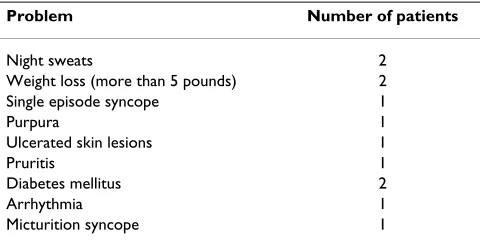
The problems in Table 3 were reported in physician histo-ries but not computer histohisto-ries. The failure of the compu-ter histories to report the problems listed here reflect patient error in answering questions. The episodes of syn-cope reported in the medical charts were denied during the computerized history-taking as was the presence of diabetes. There is no coverage of skin lesions in the ver-sion of the program tested; so failure to report skin lever-sions is an inherent deficit. Failure to detect weight loss and night sweats in the instances cited reflects logic errors in the software, which asks about the systemic symptoms only in the context of specific disease entities not generi-cally as part of a history of vegetative function. Both instances of weight loss and 1 instance of night sweats occurred in patients with end stage renal disease on dialy-sis, which was reported by the computer histories for both patients. The other instance of night sweats occurred in a patient with diabetes and decompensated alcoholic liver disease, which conditions were reported by the computer history for the patient.
Drug allergies, adverse drug reactions and potential for adverse drug-drug interactions
The computer as compared with physician histories reported a greater incidence of allergies and possible adverse reactions to drugs [Table 4]. No documentation was available to assess the reason for discontinuing statins in 2 patients; CPKs were not available for the 2 patients with muscle soreness while taking statins. The data in Table 4 do not mean, of course, that the computerized his-tory-taking detected all adverse events or drug reactions in the patients interviewed. The data show only the greater rate of detection of drug allergies and adverse reactions as compared with physician histories.
Table 3: Problems reported in physician histories but not computer histories in 37 patients for whom data were extracted in Table 1 and for the 8 additional patients in Table 2
Problem Number of patients
Night sweats 2
Weight loss (more than 5 pounds) 2
Single episode syncope 1
Purpura 1
Ulcerated skin lesions 1
Pruritis 1
Diabetes mellitus 2
Arrhythmia 1
Patient satisfaction with the interview program
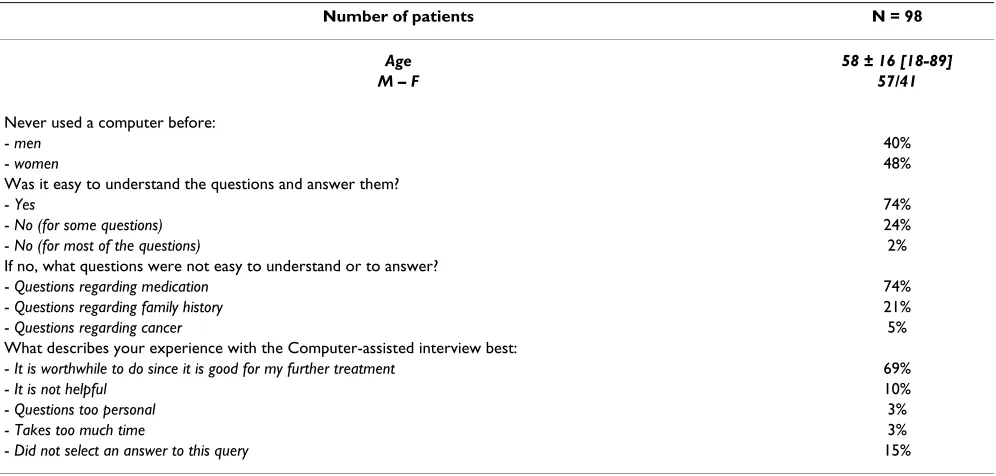
Patients reported a high level of satisfaction with the com-puter history; 69% believed their medical care would be enhanced after taking the computer-assisted interview [Table 5]. Almost half of these patients had not used a computer before. It was especially significant that only 3% of patients thought the interview was too long.
Discussion
Bachman in 2003 reviewed the accumulated experience with computerized history-taking and found 61 instances of clinical tests of such programs [12]. Only 6 of these pro-grams were in general medicine, and only 1 of these had a large database of medically relevant questions. Histories acquired by computer were compared with physician his-tories in 28 instances; and computer hishis-tories were
deter-mined to have provided more sensitive information than the physician histories in 25 of these 28 studies. These studies did not report details about the problems found by computer versus physician; and in some cases the find-ings were compilations of numbers of symptoms or num-bers of questions asked by computerized history versus physician history. It is not possible to determine from these data the extent to which significant clinical informa-tion was not recorded by physician histories. Addiinforma-tion- Addition-ally, it is not extractable from the data to which extend a so called "checklist effect" solely is responsible for some of the found differences. This effect describes the phenome-non that a simple reminder of issues, which should be part of history taking, by a checklist can improve the qual-ity of results.
Table 4: Detection of allergies and possible adverse drug reactions in 45 in-patients for whom data are shown in Table 1
Agent Reaction Physician History Computer History
Penicillin Allergic with hives, giant hives and pruritis 2 4
Penicillin Fever without skin reaction 0 1
Codeine Allergic – not specified 1 0
Aspirin Aspirin sensitive asthma 0 1
Latex Allergic with giant hives, urticaria 0 1
Contrast Dye Allergic with hives and itching 0 2
Peanuts/other nuts Allergic with rash, hives, itching 0 1
Atorvastatin Patients could not tolerate drug but denied muscle
soreness or weakness or abnormal LFTs
0 2
Simvastatin Muscle soreness 0 2
Simvastatin plus calcium channel blocker Potential adverse interaction 0 1
Aspirin plus coumadin Potential adverse interaction 0 2
Table 5: Results of the questionnaire to get information about the experiences of patients after performing a computer-assisted interview
Number of patients N = 98
Age 58 ± 16 [18-89]
M – F 57/41
Never used a computer before:
- men 40%
- women 48%
Was it easy to understand the questions and answer them?
- Yes 74%
- No (for some questions) 24%
- No (for most of the questions) 2%
If no, what questions were not easy to understand or to answer?
- Questions regarding medication 74%
- Questions regarding family history 21%
- Questions regarding cancer 5%
What describes your experience with the Computer-assisted interview best:
- It is worthwhile to do since it is good for my further treatment 69%
- It is not helpful 10%
- Questions too personal 3%
- Takes too much time 3%
Page 11 of 12 A single study of computerized history-taking coupled to
decision support found no advantages from the combina-tion versus physicians providing usual care, measured by the number of problems detected in relatively young out-patients [13]. The report in reference [13] also lacked details for evaluating the disease burden in the study patients, the problems identified, whether the absence of differences in detecting problems by computer versus physician history applied to all patients and all problems and the relative contributions of the computerized history and decision support components to the measured end point of the study. Indeed, we believe the current report is the first to provide readers with clinical details of a his-tory-taking program in general medicine with a database of questions in the tens of thousands and a patient-by-patient analysis of findings from computerized and physi-cian history-taking and to document the nature of clinical information missing from physician histories. The soft-ware tested in the current study had not been refined pre-viously by clinical testing with real patients, and in this sense was in an early stage of development. The data show, nevertheless, the significant extent to which physi-cian histories as compared with computerized history-tak-ing fail to acquire and/or record significant medical information on patients' medical status, that the defi-ciency in information gathering extends to acute and chronic issues and that the deficiency in collecting robust clinical information can be solved through computerized history-taking.
It is important to consider two issues related to the large false negative rate for physician history-taking. The first is whether this reflects false positive findings or unreasona-ble sensitivity to trivial symptoms by computerized his-tory-taking. The data in the present report seem sufficient to exclude both possibilities. The computer-based find-ings are not the simple listing of symptoms or tabulation of questions asked. Problems were identified in the com-puter histories by automated analysis of answers to series of questions interpreted in the context of known patho-physiology. An obvious extension of the current work, however, is objective confirmation of findings by compu-terized history through direct, structured re-questioning of patients by an independent observer. The second issue is whether the computer histories benefitted from prior physician histories that triggered recall by patients of details about their health. There is no mechanism for excluding this possibility in acutely ill patients because medical ethics and liability law prevent prior interview of these patients by computer. The more important question is putting in place a method to maximize acquisition of clinically significant historical data. The present data show that a combination of a physician interview and a compu-ter-based interview is a superior method for collecting information from patients as compared with physician
interview alone whether or not the physician interview facilitates discovery of clinically significant problems by the computerized interview. We note that this combina-tion can be achieved with little or no demand on doctors' time.
The accuracy of patient answers is a significant issue for computerized and physician history-taking. We mean by this mistaken entries not deliberate falsification of inputs. By testing computer programs against physician histories and objective measures of disease, points of common mis-takes in computer entries can be identified. Three patients with diabetes answered "No" when asked directly, during the computer interview, whether they had diabetes. Two patients with objective evidence of coronary disease and physician histories compatible with effort-induced angina answered "No" when asked by computer about effort-induced chest pain and anginal equivalents. These false negatives could reflect failure by patients to read ques-tions and answers carefully, poorly phrased quesques-tions and answers, mistaken selection of "No" when "Yes" was the intended answer, failure to comprehend prior diagnoses or intentional entry of false information. Editing of text and page design to facilitate usability and construction of feedback loops in the computer program will minimize chances for false negatives caused by misinterpretation of text, failure to read text carefully and data entry errors. Since the computer system can be configured to operate iteratively, the computer can re-interview patients on selected problems not detected during an initial interview but detected by objective measures of physiologic param-eters. However, it also must taken into account that patients are not trained in pathophysiology as physicians are and therefore by building the program the program-ming doctors could not forecast the answers in precise manner. However, that impairment can be extinguished by repetitive testing of the program under real world con-ditions.
The demonstrable value of history-taking software as compared with physician-acquired histories depends on the training, knowledge and time available for history-tak-ing by physicians as well as the burden of disease in a pop-ulation. The differences between computerized and physician histories reported here might not be as large in tests in other facilities. On the other hand, the data indi-cate that most of the problems detected by computerized history-taking were chronic and had not been attended to prior to hospitalization. It seems clear that computerized history-taking will have value across an array of physi-cians.
Conclusion
Publish with BioMed Central and every scientist can read your work free of charge "BioMed Central will be the most significant development for disseminating the results of biomedical researc h in our lifetime."
Sir Paul Nurse, Cancer Research UK
Your research papers will be:
available free of charge to the entire biomedical community
peer reviewed and published immediately upon acceptance
cited in PubMed and archived on PubMed Central
yours — you keep the copyright
Submit your manuscript here:
http://www.biomedcentral.com/info/publishing_adv.asp
BioMedcentral
adjunct to practice because the combination uncovers more significant clinical problems than the physician tory alone. In the acute situation, the computerized his-tory can be obtain after the physician hishis-tory and resuscitation of the patient, as the computer history will indicate a range of co-morbid states otherwise undetected. In the non-emergent setting, the computer history can be available to the physician at the time they see patients in order to focus on specific clinical issues.
Competing interests
NB, MDA, and PF declare no competing interests. DZ is the holder of a U.S. patent for technology used in the soft-ware that was tested in this report and has a pending U. S. patent application for related technology. The issued pat-ent is assigned and DZ is obligated to assign future patpat-ents to the IDM-foundation Institute for Digital Medicine, Stuttgart, Germany. These patents are assigned without rights to royalties.
Authors' contributions
DZ was the designer of the software program, a significant contributor to the medical content of the software for his-tory taking, extracted the data from computer records and compared these data with extracted clinical charts. MDA developed the study protocol, organized funding for the study and organized the legal frame. NB was responsible for review and data extraction from the hospital charts. MDA and PF were involved in design and conduct of the study. All authors contributed to writing of the manu-script.
Source of funding
Funding for this work was provided by the Robert Bosch Krankenhaus and the Robert Bosch Stiftung. The funders had no role in planning or directing the clinical study and no influence on the data reported.
Acknowledgements
The authors acknowledge the invaluable contributions of Ms. Katrin Nei-derstrasser, who was responsible for recruiting and supervising the patients in this study.
References
1. Institute of Medicine: Crossing the Quality Chasm: A New Health System for the 21st Century Washington, D.C.: National Academies Press; 2001.
2. Institute of Medicine: Performance Measurement: Accelerating Improve-ment Washington, DC: National Academies Press; 2006.
3. McGlynn EA, Asch SM, Adams J, Keesey J, Hicks J, DeCristofaro A, et al.: The quality of healthcare delivered to adults in the United States. New Engl J Med 2003, 348:2635-45.
4. Shortell SM, Rundall TG, Hsu J: Improving patient care by linking evidence-based medicine to evidence-based management.
JAMA 2007, 298:673-76.
5. Bentsen BG: The accuracy of recording patient problems in family practice. J Med Educ 1976, 51:311-16.
6. Romm FJ, Putnam SM: The validity of the medical record. Med Care 1981, 19:310-15.
7. Ramsey PG, Curtis JR, Paauw DS, Carline JD, Weinrich MD: History-taking and preventive medicine skills among primary care physicians: an assessment using standardized patients. Am J Med 1998, 104:152-58.
8. Enright PL, McClelland RL, Newman AB, Gottlieb DJ, Lebowitz MD: Underdiagnosis and undertreatment of asthma in the eld-erly. Cardiovascular Health Study Research Group. Chest
1999:603-13.
9. Cox JL, Zitner D, Courtney KD, MacDonald DL, Petersen G, Cochrane B, Mathers J, Merry H, Flowerden G, Johnstone DE: Undocumented patient information: an impediment to qual-ity of care. Am J Med 2003, 114:211-16.
10. Wolff JL, Starfield B, Anderson G: Prevalence, expenditures, and complications of multiple chronic conditions in the elderly.
Arch Int Med 2002, 162:2269-76.
11. Gandhi TK, Kachalia A, Thomas EJ, Puopolo AN, Yoon C, Brennan TA, Studdert DM: Missed and delayed diagnoses in the ambu-latory setting: A study of closed malpractice claims. Ann Int Med 2006, 145:488-96.
12. Bachman JW: The patient-computer interview: a neglected tool that can aid the clinician. Mayo Clin Proc 2003, 78:67-78. 13. Apkon M, Mattera JA, Lin Z, Herrin J, Bradley EH, Carbone M, et al.:
A randomized outpatient trial of a decision support informa-tion technology tool. Arch Int Med 2005, 165:2388-94.
Pre-publication history
The pre-publication history for this paper can be accessed here: