Strong Cognitive Symbiosis: Cognitive Computing
for Humans
Csaba Veres
University of Bergen, Fosswinckelsgate 6, Bergen, Norway
Abstract: Cognitive Computing has become somewhat of a rallying call in the technology world, 1
with the promise of new smart services offered by industry giants like IBM and Microsoft. The 2
recent technological advances in Artificial Intelligence (AI) have thrown into the public sphere 3
some old questions about the relationship between machine computation and human intelligence. 4
Much of the industry and media hype suggests that many traditional challenges have been 5
overcome. On the contrary, our simple examples from language processing demonstrate that 6
present day Cognitive Computing still struggles with fundamental, long-standing problems in AI. 7
An alternative interpretation of cognitive computing is presented, following Licklider’s lead in 8
adoptingman-computer symbiosisas a metaphor for designing software systems that enhance human 9
cognitive performance. A survey of existing proposals on this view suggests a distinction between 10
weak andstrongversions of symbiosis. We propose aStrong Cognitive Symbiosis which dictates an 11
interdependence rather than simply cooperation between human and machine functioning, and 12
introduce new software systems which were designed for cognitive symbiosis. We conclude that 13
strong symbiosis presents a viable new perspective for the design of cognitive computing systems. 14
Keywords:cognitive computing; cognition; AI; cognitive symbiosis; language; HCI 15
1. Introduction
16
The Gartner Hype Cycle for Smart Machines, 2017, namesCognititve Computingas a technology 17
on the "Peak of Inflated Expectations" [1]. The IEEE Technical Activity for Cognitive Computing 18
defines it as "an interdisciplinary research and application field" ... which ... "uses methods from 19
psychology, biology, signal processing, physics, information theory, mathematics, and statistics" ... in 20
an attempt to construct ... "machines that will have reasoning abilities analogous to a human brain". 21
The IBM Corporation has been active in bringing Cognitive Computing to the commercial world 22
for some years. Perhaps their earliest success was the computer ’Deep Blue’ which beat the world 23
chess champion after a six-game match on May 11, 1997 [2]. They then developed the computer 24
’Watson’ which, it was claimed, could process and reason about natural language, and learn from 25
documents without supervision. In February 2011 Watson beat two previous champions in the 26
"Jeopardy!" quiz show, demonstrating its ability to understand natural language questions, search its 27
database of knowledge for relevant facts, and compose a natural language response with the correct 28
answer. John Kelly, director of IBM Research, claims that "The very first cognitive system, I would say, 29
is the Watson computer that competed on Jeopardy! [3]. Kelly continues that cognitive systems can 30
"understand our human language, they recognize our behaviours and they fit more seamlessly into 31
our work–life balance. We can talk to them, they will understand our mannerisms, our behaviours -32
and that will shift dramatically how humans and computers interact." 33
IBM’s public promotional materials claim that "cognitive computers can process natural 34
language and unstructured data and learn by experience, much in the same way humans do"[4]. 35
This kind of extravagant language brings to mind the term ’strong AI’ which describes systems 36
that process information "in the same way humans do". Strong AI holds that "the appropriately 37
programmed computer literally has cognitive states and that the programs thereby explain human 38
cognition". On the other hand ’weak AI’ proposes that the computer merely "enables us to formulate 39
and test hypotheses in a more rigorous and precise fashion"[5]. Searle argues against the possibility 40
of strong AI with his famous Chinese room scenario, where he argues that an ungrounded symbol 41
manipulation system lacks, in principle, the capacity for human understanding. It is not clear if the 42
current crop ofCognitive Computingsystems claim to be strong AI, but the more extravagant claims 43
appear not too far off. 44
Microsoft is another industry giant who has added Cognitive Computing to their repertoire, 45
addingCognitive Servicesto their Azure computing platform [6]. These are basically AI services which 46
can be composed into an interactive application. The services include Vision, Knowledge, Language, 47
Speech and Search. 48
In a similar vein, Google inc. is heavily involved in commercializing AI, particularly deep 49
learning [7], an evolution of neural networks with many hidden layers [8] which are particularly 50
good at image recognition tasks. Google demonstrated GoogLeNet, the winning application at the 51
2014 ImageNet Large-Scale Visual Recognition Challenge [9]. It should, however, be pointed out that 52
Google does not specifically refer to cognitive computing by name. 53
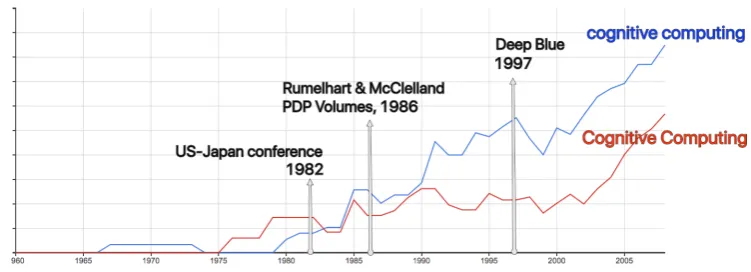
The termCognitive Computinghas been in use since the 1980s, as can be seen in the Google Ngram 54
Viewer (Figure 1). The early use of the term was associated with a strong growth in neural network 55
research following a joint US-Japan conference on Cooperative/Competitive Neural Networks in 56
1982 [10]. In 1986 the backpropagation algorithm was detailed in the two volume publication: 57
"Parallel distributed processing: Explorations in the microstructure of cognition"[11], which enabled 58
networks to learn much richer associations than was previously possible. Neural network modeling 59
became much more versatile and accessible to researchers, and resulted in a plethora of new research 60
programs exploiting the connectionist paradigm. 61
Figure 1.The use of the terms cognitive computing and Cognitive Computing according to Google’s Ngram Viewer. Several key points in the evoultion of AI are also shown.
The advances in neural network computing also helped revive research in related fields such 62
as Fuzzy Logic with the emergence of neuro-fuzzy systems which could learn parameters in a 63
fuzzy system, leading to a set of methodologies that could perform imprecise reasoning, or soft 64
computing[12]. Finally, the mid-1980s also saw the advent of genetic algorithms which could be used 65
to avoid local minima in learning systems[13]. In 1993 the state of the art could be summarized 66
as: "Cognitive computing denotes an emerging family of problem-solving methods that mimic the 67
intelligence found in nature" ... "all three core cognitive computing technologies — neural-, fuzzy-68
and genetic-based — derive their generality by interpolating the solutions to problems with which 69
they have not previously been faced from the solutions to ones with which they are familiar."[14] 70
While none of these technologies could decisively meet Searle’s challenge for strong AI, it 71
appeared that some of the research was heading in that direction. For example the claimed biological 72
plausibility of neural networks was used to argue that connectionist models of cognition were 73
more viable than theories based on symbol manipulation [11]. Similarly, neuro-fuzzy systems 74
final analysis, the role model for soft computing is the human mind."[12]. These technologies 76
offered themselves as the foundation of programs that could indeed mimic human cognition. These 77
sentiments are echoed in current claims thatCognitive Computing systems process information "as 78
humans do". 79
Thirty years earlier Licklider was also contemplating a future with computers capable of human 80
thought-like behaviour [15], in response to the bold expectations for AI by the U.S. Department 81
of Defense (DOD). In the early 1960’s, the DOD predicted that machines could take over from 82
human operators by the 80’s. But Licklider felt that the emergence of something like strong AI 83
was not imminent, and there would be an interim period of "between 10 and 500 years" in which 84
humans and computers would exist in a symbiotic relationship which would "bring computing 85
machines effectively into the processes of thinking". He argued that for many years computer 86
programs would not be able to mimic human thought processes, but instead work with humans as 87
"dissimilar organisms living together in intimate association", enhancing the weaker parts of human 88
cognition. Rather than build machines that mimic human reasoning, we should strive to understand 89
how humans solve problems so that we can design programs that can take over those aspects of 90
problem solving that are most mundane or difficult. The principles of human cognition must be 91
well understood even if they can’t be directly replicated, so computer programs can be written with 92
precisely the functionality that is needed to enhance human cognition. 93
In this article we argue that the situation has not changed significantly since Licklider’s seminal 94
paper. Modern Cognitive Computing still falls short of realizing human-like thought. Section 2. 95
considers the fundamentals of cognitive computing from the perspective of language processing and 96
argues that the currently fashionable models do not accurately reflect human cognitive processes. 97
Section 3. presents related work on human-computer symbiosis. Section 4. develops our notion of 98
aStrong Cognitive Symbiosisand discusses some applications which use these principles. Sections 5. 99
and 6. conclude the paper. 100
2. Cognitive Computing and Cognition
101
While the popular discourse about Cognitive Computing emphasizes the human-like properties, 102
the scientific publications on the inner workings of Watson (perhaps the canonical example) clearly 103
show the many non human-like aspects of the implementation. For example, during the initial search 104
phase Watson retrieves a large amount of potentially relevant data through a number of different 105
techniques including the use of an inverted index in the Lucene search engine, and SPARQL queries 106
to retrieve RDF triples from a triplestore[16]. This retrieves a huge volume of potentially relevant 107
facts which are then further processed, often with statistical techniques. It is very unlikely that human 108
reasoning would follow a similar process. Mental processes almost certainly do not use SPARQL. 109
Noam Chomsky at the MIT symposium on "Brains, Minds and Machines" held in May 2011 [17] 110
took modern AI to task, voicing the opinion that the currently popular statistical learning techniques 111
cannot reveal causal principles about the nature of cognition in general, and language in particular. 112
They are simply engineering tools which can perform very useful tasks, but they will not give insight 113
into cognitive processes, and do not operate by the same principles. 114
Peter Norvig, a fellow speaker at the symposium and director of research at Google took up the 115
challenge to argue that this is a false dichotomy and that Chomsky’s proposed explanatory variables 116
in linguistic knowledge are a fiction [18]. In his opinion predictive statistical models based on vast 117
quantities of data are simply all there is to natural language cognition. Progress in Linguistics is to 118
be made not by postulating hypothetical causal mental states and testing their consequences through 119
intuition in the form of grammaticality judgment, but by collecting vast quantities of language data 120
and finding statistical models that best fit the data. If Norvig is correct then the current optimism 121
about the possibilities of statistical models for cognitive computing are perhaps justified (and some 122
of Watson’s heuristics could be considered genuinely ’cognitive’), but if Chomsky is correct, then we 123
expect the current approaches to run into difficulties under some circumstances. Our position is that 125
if such differences are inevitable then it would be an advantage to know about them in advance, to 126
design reliable and useful solutions which compensate for the deficits. 127
The fundamental theoretical divide is apparent in Chomsky’s belief in linguisticcompetence, the 128
tacit, internalized knowledge of language, and performance which is the observable manifestation 129
of the former (speech acts, written texts, etc.). However, performance data is not a pure reflection 130
of competence since linguistic productions are riddled with errors due to attention shifts, memory 131
limitations and environmental factors. Chomsky therefore eschews corpus data as evidence for 132
theory building, preferring instead grammaticality judgments which are elicited in response to 133
sentences constructed to test a certain theory about competence. 134
Norvig defends the use of corpora, while rejecting the use of grammaticality judgment as a form 135
of linguistic evidence. He claims that elicited judgments do not accurately reflect real language use. 136
He cites the famous example from Chomsky [19] who claims that neither sentence 1 or 2 (or any part 137
of the sentences) has ever appeared in the English language, and therefore any statistical model of 138
grammaticalness will rule them as being equally remote from English. Yet it is clear to humans that 139
1. but not 2. is a grammatical sentence of English, proving that grammar is not based on statistics: 140
1. Colourless green ideas sleep furiously. 141
2. Furiously sleep ideas green colourless. 142
Pereira [20] argues to the contrary and shows that modern statistical models of language prove 143
Chomsky wrong. In fact, 1. is 200,000 times more probable than 2. in a large corpus of newspaper 144
text. In his essay Norvig discusses a replication of the experiment on a different corpus "to prove that 145
this was not the result of Chomsky’s sentence itself sneaking into newspaper text". The replication 146
corroborates Pereira’s findings. In addition, he finds that both sentences are much less probable 147
than a normal grammatical sentence. Thus not only is Chomsky wrong about the statistical facts 148
about 1. and 2., but he is also wrong about the categorical distinction between grammatical and 149
ungrammatical sentences: 1. is more grammatical than 2, but less grammatical than ordinary 150
sentences, according to Norvig. 151
We disagree with these conclusions, and argue that the experiment in fact supports Chomsky’s 152
view. Suppose Norvig’s concerns about the possible proliferation of Chomsky’s sentence in the 153
news corpus was in fact true, but it was true about 2. rather than 1. That is, sentence 2. becomes 154
common in text. Perhaps a fundamentalist Chomskian government assumes power in the future 155
and enforces a rule that every written newspaper text must be headed by Chomsky’s "Furiously 156
sleep ideas green colourless", to remind writers to use only grammatical sentences. Before long, the 157
probability of 2. will exceed that of 1. But will 2. become more grammatical than 1, or will it just 158
become annoyingly omnipresent? We think the latter, in which case the statistical theory would make 159
the wrong prediction. To deny grammaticality judgment as a source of linguistic evidence in favor 160
of corpora seems mistaken. There must be a principled criterion for what sort of observed strings 161
should be counted as linguistic evidence. 162
One task where statistical methods have excelled is for lexical disambiguation, as summarized 163
in [20] "the co-occurrence of the words ’stocks’, ’bonds’ and ’bank’ in the same passage is potentially 164
indicative of a financial subject matter, and thus tends to disambiguate those word occurrences, 165
reducing the likelihood that the ’bank’ is a river bank, that the ’bonds’ are chemical bonds, or that 166
the ’stocks’ are an ancient punishment device". Norvig points out that 100% of the top contenders at 167
the 2010 SemEval-2 completion used statistical techniques. However, the limitations of the approach 168
can be easily demonstrated. Consider the following examples involving the ambiguous word ’bank’. 169
3. I will go to the river bank this afternoon, and have a picnic by the water. 170
4. I will go to the riverside bank this afternoon, and if the line isn’t too long, have a picnic by the 171
The word ’bank’ in sentence 3. is clearly about "the land alongside or sloping down to a river 173
or lake" (Oxford English Dictionary), while 4. is more difficult to interpret, but appears to be about 174
the ’financial’ interpretation of ’bank’. Both 3. and 4. contain words that are likely to co-occur with 175
the ’sloping land’ interpretation of ’bank’ (i.e. picnic, water), which makes 4. misleading. But 4. 176
also contains ’riverside’ which is a location, and gives us the clue that ’bank’ must be some sort of 177
bounded object that has a location property. We suggest that the resolution of ambiguity requires a 178
suitable theory of compositional, structural lexical semantics (e.g.[21]) rather than statistical models. 179
That is, some semantic elements like [location] and [physical object] would combine in some suitable 180
account of compositional lexical semantics. In fact, even Watson uses a structured lexicon in question 181
analysis and candidate generation[22]. 182
We can push the example in sentence 4 a little further, by swapping the word ’riverside’ with 183
’river’: 184
5. I will go to the river bank this afternoon, and if the line isn’t too long, have a picnic by the water. 185
On first reading this seems odd, but suppose one was given as context that the person who uttered the 186
sentence lived in a city which recently developed the previously neglected riverside into a business 187
hub, and several banks were opened. With such knowledge the ’financial’ reading of ’bank’ becomes 188
instantly clear, without a change in the a priori statistical distributions. As more people started talking 189
and writing about the river branch of their bank then no doubt over time the statistical facts would 190
come to reflect this usage. Statistical models completely miss the causal explanation for the change in 191
the observed facts. Statistics does not drive interpretation: interpretation drives statistics. The current 192
series of AI success stories primarily involve statistical learning approaches which accomplish their 193
specific tasks well, but lack the properties fundamental to aspects of semantic interpretation. 194
The semantic shallowness of cognitive computing by statistical learning has recently been 195
illustrated through the construction ofadversarialexamples. In a paper titled "Intriguing properties 196
of neural networks" [23], the authors show that slight (and hardly perceptible) perturbations in an 197
image can cause it to be misclassified by a deep neural network. The manipulation involves changes 198
in areas of the image that show points of maximum gradient in the trained network. A similar effect 199
was shown in the paper "Deep Text Classification Can be Fooled" [24], where the authors showed 200
that theinsertion,modificationandremovalof hardly perceptible text snippets can cause text to be mis 201
classified. In some cases, the insertion of a single key word can cause the text to be mis classified by 202
a computer but remain correctly classified by the human. These examples show again that statistical 203
techniques can perform semantic classification very accurately (99.9% accuracy before the insertion) 204
without necessarily having representation of a semantics comparable to a human. But the lack of 205
semantics can also cause them to wildly mis behave. In the following section we review previous 206
ideas about ways in which computers can augment human reasoning without necessarily trying to 207
replicate it. 208
3. Related Work
209
The idea that technology can augment human cognition is an old one, and shared by many 210
technical approaches. The engineering view of human thinking is central to the field ofcybernetics, 211
"the science of control and communication, in the animal and the machine" ([25]). The termIntelligence 212
Amplificationhas been used in various guises since William Ross Ashby introduced the notion that 213
human intelligence can be "amplified ... synthetically" [26] in hisIntroduction to Cybernetics. 214
The use of computing devices to enhance human cognitive behaviors is of course a central theme 215
of modern computing. Early attempts to harness the power of computers in this way can be seen in 216
the work of Douglas Engelbart who founded the Augmented Human Intellect Research Center at 217
SRI (Stanford Research Institute) International. He wrote: "The conceptual framework we seek must 218
direct aid to an individual in comprehending complex situations, isolating the significant factors, and 220
solving problems." [27]. 221
While these early pioneers were concerned with how technology could help people solve 222
complex tasks, it was the research field of Human Computer Interaction (HCI) which began directly 223
investigating the interaction between humans and machines. Initially conceived during WWII as 224
Human Factors Engineering, the goal was to discover principles which facilitated the interaction of 225
humans and machines, in this case military hardware such as airplanes. As the investigations turned 226
more specifically to human interaction with computing devices, other descriptors emerged to capture 227
the subject matter more accurately: cognitive systems engineering, andHuman-Information Interaction 228
(HII) (see [28] for a historical review). 229
Neo-Symbiosis is a new attempt to invigorate Licklider’s notion of symbiosis in today’s 230
environment with our better understanding of cognition and more sophisticated computing 231
resources. The insight ofNeo-Symbiosisis that the human-computer interaction shouldn’t be confined 232
to simply augmenting cognitive skills a person already has (e.g. with increased speed, memory, 233
etc.), but to interact at a fundamental level to affect the reasoning process itself. An example is the 234
visualization of the periodic table of elements conceived by Mendeleev in 1869, which can trigger 235
novel human insight. The Periodic table not only provided a simple display of known data but also 236
pointed out gaps in knowledge that led to discoveries of new elements. It may have taken much 237
longer to discover the gaps if the existing knowledge was coded in a different format [28]. Another 238
example is the humble spelling checker which takes advantage of the computer’s superior ability 239
to reliably store and retrieve arbitrary data, in order to monitor any mistakes that a human might 240
make in their spelling. Note that the interaction is symbiotic because the human can interact with 241
the spell checker, instructing it to accept the correction, to ignore it, or even to learn a new alternative 242
spelling if the person really did want to spell the word in a peculiar new way. These examples show 243
that the basic principles behind Neo-Symbiosis are not necessarily new. The novelty of the approach 244
is to clarify known psychological principles in sufficient detail to specify functional allocations that 245
are best performed by humans or computers. For example, human actions are frequently driven by 246
context, such that a web search with the word "apple" would have a different intention if the person 247
had previously searched for "orange" than if he had searched for "microsoft". Computer systems 248
could therefore monitor cognitive state to determine intended context, and then use their powerful 249
search capabilities to find relevant resources. As a related example, people often act differently in 250
different contexts, but they might miss cues (or make mistakes) about the specific context in which 251
they find themselves. A cognitive assistant could, for example, monitor a chat session in which a 252
person is writing separately to their spouse and their boss, and issue a warning if they wrote an 253
inappropriate message because they were inadvertently writing to the wrong person. [28] provide 254
numerous examples of human cognitive properties and their implications for design of computer 255
functionality. They base these cognitive properties on various proposals from the psychologist Daniel 256
Kahneman, and therefore their proposals are predicated on a particular theoretical position [29]. 257
The IBM corporation’s interpretation ofSymbiotic Cognitive Computing is to immerse cognitive 258
computing resources in a physical, interactive environment. They built a Cognitive Environments 259
Laboratory (CEL)to explore how people and cognitive computing implementations work together [30, 260
31]. The CEL approach sees the role of the computer as a "super expert" which interacts with people, 261
offering advice and information based on superior computational power. In the CEL environment 262
the computer system follows individual users as they move about the environment, seamlessly 263
connecting them to information sources. The system can perform functions like transcribing spoken 264
conversations in order to preserve a recored of the discussion, and augment that with a record of all 265
information that was on displays at the time. This can help decision makers re-trace their steps in 266
case of disputes, for example. The environment can present information on one more of the large 267
number of displays, based on spoken requests by the users. Many sophisticated, interactive 2D 268
environment in which researchers can study the interaction of humans and computers with state of 270
the art speech and face recognition technologies. 271
The approach differs from Neo-Symbiosis, where the operations of computer systems are 272
designed to have a deeper integration with cognitive processes, rather than assume the role of 273
intelligent assistants. The key observation is that Neo-Symbiosis uses specific theories about cognition 274
to construct tools which support cognition at specific points of possible failure, whereas the CEL 275
approach is to provide assistance during tasks which have been observed as difficult in work settings 276
experienced over time. Thus, [31] propose five key principles of symbiotic cognitive computing: 277
"context, connection, representation, modularity, and adaption." The principles are derived by 278
"reflecting upon the state of human-computer interaction with intelligent agents and on our own 279
experiences attempting to create effective symbiotic interactions in the CEL" ([31], p.84). Clearly this 280
is not a strongly theory driven approach. 281
Similarly, [32] argues that representations are the medium of cognition and are therefore key to 282
supporting symbiosis. While the authors do not provide an implementation, they discuss theMatLab 283
programming competition which used a number of novel artifacts to communicate information about 284
code snippets submitted by users, and to encourage the reuse of such code by other contestants using 285
a rewards system. The authors argue that successful outcome was achieved through an symbiosis 286
between the artifacts and the players. However, the role played by the artifacts was simply to enable 287
discovery and integration of the code snippets, and to provide an incentive mechanism to the players. 288
As a symbiotic system, the MatLab game has a similar grounding, in intuition, as the CEL. 289
One view which presents IBM’s Watson in a light closer to the Neo-Symbiosis view is shared 290
by [33]. They argue that good results from cognitive systems can only come trough a symbiotic 291
relationship where humans take charge of tasks in which the computers are deficient. In the case of 292
Watson, this equates to the selection of the training corpus, which needs to be fine-tuned by humans 293
because Watson cannot automatically infer which body of documents is likely to be relevant to a 294
particular domain of interest. Another consideration is the kinds of data provided. Should the corpus 295
include data catalogs, taxonomies and ontologies, or should the system be expected to discover these 296
on its own? The decisions made by humans at this early stage of machine learning can significantly 297
impact the overall performance of the system. A similar view is held by the CrowdTruth initiative 298
which argues that semantic annotation should be spread among a large number of naive annotators, 299
and that human disagreement should form an important input to cognitive learning systems [34]. In 300
some places John Kelly also hints at this sort of interaction, claiming that computers must at some 301
stage "... interact naturally with people to extend what either humans or machine could do on their 302
own" [3]. 303
A somewhat contrary but bold view of the consequences of Cognitive Computing can be seen 304
in Dan Briody’s post on IBM’s "thinkLeaders" platform. He foresees a vastly changed business 305
environment that has adapted to Cognitive Computing, and predicts that "New ways of thinking, 306
working and collaborating will invariably lead to cultural and organizational change ..." [35]. 307
Presumably these new ways of thinking are an adaptation to the human-like but not-quite-human 308
cognitive assistants. 309
We will now describe our approach to cognitive symbiosis which does not rely on developing 310
new ways of thinkingbut instead, intelligently supportsold ways of thinkingto achieve new results. 311
4. Towards a Strong Cognitive Symbiosis
312
The existing approaches to symbiosis stride the divide between two different interpretations 313
of the term. Mirriam Webster defines symbiosis as "the living together in more or less intimate 314
association or close union of two dissimilar organisms" or "a cooperative relationship (as between 315
two persons or groups)". WordNet 3.1 gives a stronger interpretation as "the relation between two 316
Inderal 1 tablet 3 times a day Lanoxin 1 tablet every AM
Carafate 1 tablet before meals and at bedtime Zantac 1 tablet every 12 hours (twice a day) Quinaglute 1 tablet 4 times a day
Coumadin 1 tablet a day
(a)Prescription suited for a doctor/pharmacist
Br
eakfast
Lunch Dinner Bedtime Lanoxin 3
Inderal 3 3 3
Quinaglute 3 3 3 3
Carafate 3 3 3 3
Zantac 3 3
Coumadin 3
(b)Prescription suited for a patient
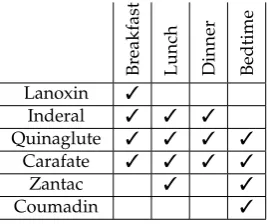
Figure 2.Two isomorphic views organized for different tasks
difference is that the two organisms are dependent on one another in the stronger WordNet definition, 318
implying that there are functions that neither could perform without the other. 319
This distinction can be seen as a "symbiosis version" ofstrongversusweakAI.Associationimplies 320
only that the machine can communicate and co-operate at a level which is typically restricted to 321
human-human interaction, whereas interdependence implies that the machine could not operate at 322
some level without the human interaction. That is, they share some key aspect of computation and 323
representation which allows information exchange at an algorithmic level. 324
We can get a sense of this difference through the following two examples involving information 325
representation in reasoning and decision making. In the bookThings that Make Us Smart[36], Don 326
Norman argues that the unaided human mind is "overrated" and much of what it has achieved is 327
due to the invention of external aids that help overcome intrinsic limitations in memory capacity, 328
working memory processing, and so on. The information format of these external aids is critical for 329
assisting particular kinds of reasoning. One example from the work of Ruth Day involves written 330
notation about prescription drugs and the recommended doses. Figure 2 (a) shows the longhand 331
notation which is natural for prescribing doctors and contains valuable information for pharmacists 332
filling the prescription. However, the format would not be easy for patients who are concerned with 333
questions like "what pills should I take at breakfast?" These questions are much better answered by 334
the representation in figure 2 (b). Notice in 2(b) that the medicine names have been re ordered so 335
that they are now grouped according to the time of day to be administered. It seems intuitively 336
obvious that the two representations make certain tasks simpler, but there is no attempt to provide an 337
explanation of this in terms of precise cognitive processes. Norman does make a distinction between 338
reflexiveandexperientialthought, but these are not fleshed out in detail in terms of specific cognitive 339
algorithms. 340
The second example concernscognitive illusions, systematic problems of reasoning which result in 341
errors of judgment (see [29] for a comprehensive review). A typical example isbase rate neglect, which 342
is supposed to show that the human mind lacks specific algorithms for naive Bayesian inference. For 343
example, consider the following "mammography" problem (adapted from [37]): 344
The probability of breast cancer is 1% for a woman at age forty who participates in 345
positive mammography. If a woman does not have breast cancer, the probability is 9.69% 347
that she will also get a positive mammography. A woman in this age group had a positive 348
mammography in a routine screening. What is the probability that she actually has breast 349
cancer? %
350
The correct answer can be calculated using then common formulation of Bayes’ theorem 351
(equation 1) 352
p(A| B) = p(B| A)p(A)
p(B) (1)
which in this example evaluates to: 353
p(A| B) = (0.8)(0.01)
(0.01)(0.80) + (0.99)(0.096) =0.078=7.8% (2)
[37] showed that 95 out of 100 physicians estimated the answer to be between 70% and 80%, 354
which is in fact ten times higher than the correct answer. This is an example of base rate neglect, since 355
the error in reasoning is consistent with the claim that people ignore the relatively low background 356
probability of having breast cancer (P(A) = 0.01). Thus, the nearly 10% probability of showing a false 357
positive reading is quite high given the low background probability of actually having breast cancer, 358
and drastically reduces the true probability that a person with a positive test reading has the illness. 359
However, [38] challenged the prevailing view that such experiments show that humans lack 360
the appropriate cognitive algorithms to solve problems with Bayesian reasoning. Instead, they 361
argue, humans do have the necessary procedures, but they operate with representations that are 362
incompatible with the formulation of the problems. More specifically in the current example the 363
problem formulation is in terms ofprobability formats, whereas the mental algorithms which would 364
solve such problems operate onfrequency formats. By way of analogy, "assume that in an effort to find 365
out whether a system has an algorithm for multiplication, we feed that system Roman numerals. The 366
observation that the system produces mostly garbage does not entail the conclusion that it lacks an 367
algorithm for multiplication. We now apply this argument to Bayesian inference." 368
Their general argument is that mathematically equivalent representations of information entail 369
algorithms that are not necessarily computationally equivalent. Using this reasoning they performed 370
experiments in which the representational format was manipulated, and showed significant increases 371
in answers corresponding to the Bayesian outcome. Consider the following, frequentist version of the 372
previous problem. 373
10 out of every 1,000 women at age forty who participate in routine screening 374
have breast cancer. 8 of every 10 women with breast cancer will get a positive 375
mammography. 95 out of every 990 women without breast cancer will also get a positive 376
mammography. Here is a new representative sample of women at age forty who got a 377
positive mammography in routine screening. How many of these women do you expect 378
to actually have breast cancer? out of 379
The researchers conducted several experiments and showed dramatic improvements in 380
performance when the problem was presented in frequentist format. When presented in this format it 381
is hard to ignore the large number of women (95) that will test positive even though they do not have 382
breast cancer. The reasonable conclusion is that "Cognitive algorithms, Bayesian or otherwise, cannot 383
be divorced from the information on which they operate and how that information is represented", 384
and this has a profound lesson for educators "... to teach representations instead of rules, that is, 385
to teach people how to translate probabilities into frequency representations rather than how to 386
insert probabilities into equations ..." and tutoring systems "... that enhance the idea of frequency 387
representations with instruction, explanation, and visual aids hold out the promise of still greater 388
These concluding comments support the strong notion of cognitive symbiosis. Our suggestion 390
is that key interactions in the symbiotic system can be regarded as a hypothesis about cognitive 391
functioning used to solve tasks. This hypothesis then determines the most useful information for 392
assisting the problem solution. In other words, the information exchanged between the human 393
and computer in an effort to solve a problem are predicated on a hypothesis about what kind of 394
cognitive algorithm will be used to solve the problem, and precisely what form of information and 395
representation the algorithm requires. 396
Our vision of cognitive symbiosis is derivative of this approach. We assert that current 397
approaches to AI are not sufficient to emulate the full range of human cognitive abilities, even though 398
they do manage to performsomecognitive tasks at a level comparable to humans (e.g. [39]). However 399
these successes are limited to very narrow domains and there are barriers which prevent similar 400
success in others. This, in turn, implies that AI will be limited within the foreseeable future, just as 401
it was in Licklider’s time. Our suggestion is to adopt a strong view of cognitive symbiotic systems 402
engineering in which the goal is to produce software systems whose interactions with people are 403
optimized to tightly engage with empirically identified weaknesses in human as well as machine 404
cognition. 405
Our concrete work on cognitive symbiotic systems has focused on applications which use 406
predominantly natural language. In the area of natural language processing (NLP) and machine 407
learning, semantic interpretation, or symbol grounding [40] pose one of the most difficult problems 408
[34]. Two common NLP tasks which depend on semantic interpretation and therefore prove 409
particularly difficult are keyphrase/term/word extraction and lexical disambiguation [41,42]. Yet 410
these are tasks on which humans excel. Regarding lexical ambiguity, people are so efficient 411
that they are typically unaware of alternative interpretations of ambiguous words and sentences 412
[43]. The psycholinguist David Swinney has studied the time course of ambiguity resolution in 413
sentence comprehension using thecross modal primingparadigm, His experiments have shown that 414
humans can automatically resolve lexical ambiguity within three syllables of the presentation of the 415
disambiguating information [44]. 416
On the other hand humans are poor, but computers much more capable of storing and retrieving 417
information. Jonides argues that memory is an essential component of thinking, and shows evidence 418
that individual variations in working memory capacity correlate with performance on various 419
reasoning tasks [45]. Limitations in working memory capacity result in deficiencies in reasoning. 420
Minimizing the need to burden working memory ought to improve thinking. 421
The symbiotic applications we now describe were developed to exploit the human capacity for 422
keyword selection and disambiguation, and combine it with the computer’s capabilities to store, 423
retrieve and discover vast amounts of text related to specific keyword indexes. We present this as an 424
example of strong symbiosis, since each actor contributes to the result according to their respective 425
cognitive strengths, and neither would be able to perform as accurately on their own. 426
LexiTags[46,47] is a social semantic bookmarking service in which users can save URLs of interest 427
and annotate them with disambiguated tags that are either WordNet senses or DBPedia identifiers. 428
The service is very similar tohttp://delicious.comwhere users assign personal keywords calledtags 429
to web sites of interest, and the service stores the URL together with the set of tags. The tags can then 430
be used torefindthe web sites. The additional step in LexiTags is that users have to disambiguate 431
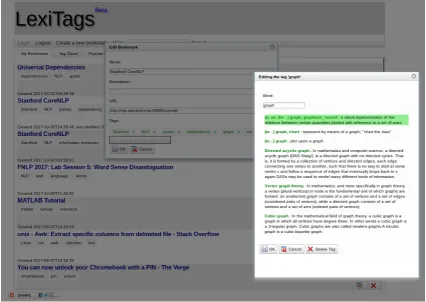
their tags by selecting one of the unambiguous choices offered through the user interface (Figure 432
3). We call thissemantic tagging. Semantic tagging therefore assigns unambiguous, user specific key 433
topics to documents and other web resources. While sophisticated statistical algorithms exist for topic 434
analysis (e.g.[48]), the problem of allocating personalized, contextually significant topic(s) or tags to 435
Figure 3. The LexiTags bookmarking interface. The bookmarks and editing interface are greyed out while the disambiguation screen is visible. Words are disambiguated with WordNet synsets or DBPedia identifiers.
In return for the additional step to disambiguate semantic tags, the user receives a range 437
of benefits not available in traditional bookmarking services. Semantic tags facilitate accurate 438
classification of the resource. This in turn makes it possible to identify other resources which are 439
semantically related by precise relations such as taxonomy, meronymy, derivational relatedness, 440
entailment or antonymy [49]. In addition,word embeddingscan be used to identify statistically related 441
semantic concepts [50]. Word embeddings can be made more precise and useful if disambiguation 442
information is available. For example [51] forms ultradense representations with AutoExtend by 443
using WordNetsynsetsandlexemesto create orthogonal transforms of standard word embeddings. 444
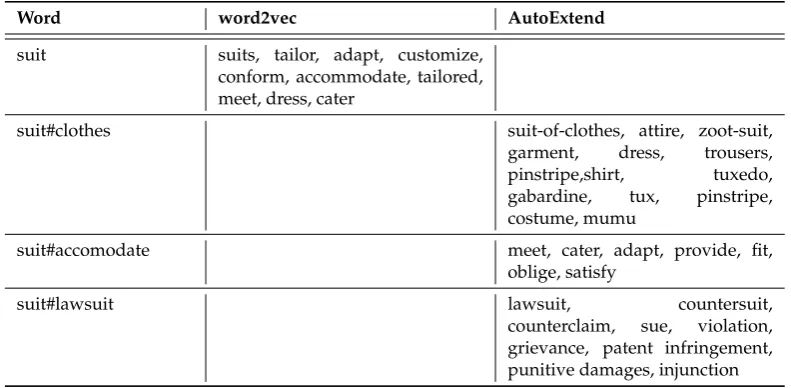
To illustrate, Table 1 shows related words for the non disambiguated tagsuitusing word2vec, the 445
state of the art tool for word embedding [52]. The related words indicate that at least two distinct 446
senses have been confounded, the nounsuit(of clothes) and the verb tosuit(his needs). The table also 447
shows related words for these two disambiguated senses as encoded in AutoExtend, as well as the 448
additional noun sense lawsuit. Clearly, recommendations of related items can be more accurate and 449
varied when semantic tags are used. For example, the semantically disambiguated tagsuit#clothes 450
could recommend resources tagged with a rich set of the relevant tagsattire, garment, trousers, shirt, 451
Table 1. Ambiguous and disambiguated words and semantically similar words based on word2vec and AutoExtend.
Word word2vec AutoExtend
suit suits, tailor, adapt, customize, conform, accommodate, tailored, meet, dress, cater
suit#clothes suit-of-clothes, attire, zoot-suit,
garment, dress, trousers, pinstripe,shirt, tuxedo, gabardine, tux, pinstripe, costume, mumu
suit#accomodate meet, cater, adapt, provide, fit,
oblige, satisfy
suit#lawsuit lawsuit, countersuit,
counterclaim, sue, violation, grievance, patent infringement, punitive damages, injunction
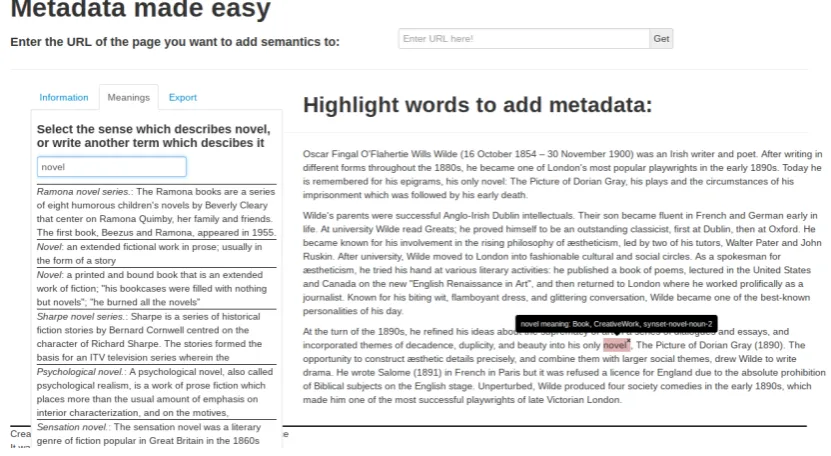
A second, related tool shows how disambiguated lexical tags can be used to perform a metadata 453
reasoning task which might otherwise be very difficult. MaDaME[53] is a web application for 454
developers who wish to mark up their sites with the http://schema.org classes and properties. 455
Schema.org is an effort originally proposed by a consortium of search engine providers to promote 456
schemas for structured data on the Internet, on web pages, and in email messages. The tool allows 457
users to highlight key words in their web site, and disambiguate them by selecting a sense from 458
WordNet or DBPedia with a similar interface as LexiTags. The tool then automatically infers the most 459
appropriate schema.org concepts and generates markup that adds schema.org as well as WordNet 460
and SUMO identifiers to the HTML web page. Figure 4 shows the higlighted word novel and 461
its metadata mappings. The inference is currently performed via a mapping between WordNet 462
synsets and schema.org classes; a tree search algorithm identifies the closest match between user 463
selected synsets and the existing mappings. We are currently looking into replacing the classic search 464
Figure 4. The highlighted word is disambiguated by the panel on the left. The WordNet synset is mapped to the closest schema.org type and SUMO concept, and the metadata is added to the HTML source code.
While Strong Cognitive Symbiosis is a new design principle pioneered in this publication, 466
elements of the approach can be gleaned in other applications. For example [54] discuss visual 467
analytic decision-making environments for large-scale time-evolving graphs. These pose difficulties 468
for decision making because they describe phenomena where large volumes of inter related data are 469
evolving in complex patterns. Current visualization techniques do not offer a solution for decision 470
making with such complex data. The authors argue that designing decision-making environments 471
for such complex tasks require systems which "work in symbiosis with humans" (p.85). These 472
would require an understanding of human thought processes and incorporate those processes into 473
the computational model to reduce human burden. To this end they propose three HCI principles 474
for human-machine interaction in visual analytics regarding: (i)Data and view specifications, (ii) View 475
manipulations, and (iii) Process and provenance. These principles essentially prescribe that graph 476
browsing interfaces should allow users to select and navigate graph structures according to their 477
specific needs and goals, and to retain traceability of states. In order to react to user requests with 478
time-evolving graphs, the application has to solve some difficult computational problems in terms of 479
data management, analytics and graph visualization. However, the computational problems almost 480
exclusively involve formal properties of the graphs themselves rather than the way a human might 481
process those graphs. For example, summarizing graphs involves the calculation of node-edge 482
properties such asjourney, density, eccentricity, diameter, radius, modularity, conductance, reachability, 483
andcentrality measures. Special techniques are needed for analysis, summary, and visualization of 484
evolving graphs in which these formal properties are subject to change. The symbiotic aspect of 485
the application is that the visualizations and summaries must be comprehensible for humans, and 486
humans must be able to manipulate those representations to answer their questions. 487
5. Discussion
488
The rise in the awareness of Artificial Intelligence in public consciousness has been phenomenal 489
in the past few years. Many leading technology companies have declared that "it’s superior AI" are 490
key to its continued success: Amazon, Google, Apple [55–57]. Russia’s president Vladimir Putin has 491
Together with this awareness have come warnings from prominent scientific and business 493
figures about the dangers of an AI which becomes more powerful than the human mind. The so-called 494
singularityhas profound warnings about what can happen if humans lose control of the machines 495
[59–61]. 496
We think that fears of singularity are overstated. While we are suitably impressed with recent 497
progress in image recognition, text processing, and so on, we are also acutely aware of remaining 498
limitations. A technology which has difficulties with resolving lexical ambiguity, it seems to us, does 499
not appear to be on the verge of attaining human-level cognition in the immediate future. 500
The biggest question of practical and commercial interest, then, is how to best use our human 501
knowledge of statistical learning systems and AI in general, to construct computing platforms and 502
information systems that can help humans perform complex cognitive tasks. What is the best way 503
to benefit from Cognitive Computing?. A preconception that machines can perform tasks "just like 504
humans" is counter productive if it is not true, because it sets up an industry expectation that cannot 505
be fulfilled and might stifle alternative approaches. For example if company A markets a fully 506
automatic cognitive solution for managing unstructured data, then a competing company B will 507
have a hard time developing a semi automated, symbiotic solution to the same problem, even if the 508
symbiotic solution would prove more effective. In this paper we have argued that the preconception 509
is in fact, not true. Computers are still very far from thinking like humans. It is therefore time to 510
take a step back, and focus on systems which use modern AI techniques to realize a strong symbiotic 511
relation between human and machine. 512
We acknowledge that Strong Cognitive Symbiosis is difficult to achieve because it requires a 513
design in which the operation of the machine and human can interact at a deep algorithmic level. 514
This is not typical of modern AI systems, especially those constructed around neural network or 515
deep-learning frameworks. Such programs typically learn end-to-end generalizations from large 516
data sets, and the focus is the input-output mappings they can learn. In the rare cases where an 517
intervention is made at an algorithmic level, it is to the detriment of the result [23,24]. However, there 518
is an emerging approach which is highly compatible with our suggestions,Neural-Symbolic Learning 519
and Reasoning[62]. The goal of neural-symbolic computation is to integrate neural network learning 520
and symbolic reasoning, for example by extracting logical expressions from trained neural networks, 521
or using an independent feature space to enableheterogeneous transfer learning. The latter example 522
is particularly interesting. [63] show how it is possible to train a network on an image clustering 523
task where the training data is from a feature set that is different from the test set. In essence, they 524
use an independent set of invariant image features derived from local image descriptors [64], to 525
mediate between the training and test set. The technique works by computing co occurrence matrices 526
between the invariant featuresFand an image spaceA, and between the featuresFand a second, 527
text labeled image space W. Finally, [63] show a transfer of learning from text space W to image 528
spaceA. The intriguing possibility for a strong symbiosis perspective is to use a similar technique in 529
a domain where the invariant features are tuned through close interaction between human users and 530
the computer, to obtain the best results for each individual user. 531
6. Conclusions
532
In conclusion we propose that, recent advances in deep neural network technology 533
notwithstanding, we are no closer to predicting the arrival of "real" Artificial Intelligence than 534
Licklider was 50 years ago. We are still in that interim period of "between 10 and 500 years". In this 535
paper we argued that the false belief that we are in fact close to constructing computers with genuine 536
cognitive abilities is disingenuous, for it diverts efforts away from investigating strong symbiotic 537
systems which are constructed around their inherent but well understood cognitive limitations. We 538
need to develop a principled framework which incorporates the shared and equal contribution of 539
term, domain restricted engineering successes. Strong Cognitive Symbiosisis an attempt at such a 541
framework. 542
Conflicts of Interest:“The authors declare no conflict of interest.” 543
Abbreviations
544
The following abbreviations are used in this manuscript: 545
546
IEEE: Institute of Electrical and Electronics Engineers 547
AI: Artificial Intelligence 548
IBM: International Business Machines 549
SPARQL: SPARQL Protocol and RDF Query Language 550
RDF: Resource Description Framework 551
MIT: Massachusetts Institute of Technology 552
HCI: Human Computer Interaction 553
CEL: Cognitive Environments Laboratory 554
SUMO: Suggested Upper Merged Ontology 555
HTML: Hypertext Markup Language 556
557
References
558
1. http://www.cityam.com/270451/gartner-hype-cycle-2017-artificial-intelligence-peak-hype accessed 559
10/10/2017 560
2. http://www-03.ibm.com/ibm/history/ibm100/us/en/icons/deepblue/accessed 10/10/2017 561
3. http://www.scientificamerican.com/article/will-ibms-watson-usher-in-cognitive-computing/ accessed 562
10/10/2017 563
4. http://www.research.ibm.com/cognitive-computing/#fbid=GZ_iDrBgajZaccessed 10/10/2017 564
5. Searle, J. R. (1980). Minds, brains, and programs. Behavioral and Brain Sciences, 3(03), 417–424. 565
doi:10.1017/S0140525X00005756 566
6. https://azure.microsoft.com/en-us/services/cognitive-services/accessed 10/10/2017 567
7. http://deeplearning.netaccessed 10/10/2017 568
8. Hinton, G. E., Osindero, S., & Teh, Y.-W. (2006). A fast learning algorithm for deep belief nets. Neural 569
Computation,18(7), 1527–1554. doi:10.1162/neco.2006.18.7.1527 570
9. Szegedy, C., Liu, W., Jia, Y., Sermanet, P., Reed, S., Anguelov, D., et al. (2014). Going Deeper with 571
Convolutions. Google Tech Report, arXiv.org. 572
10. http://cs.stanford.edu/people/eroberts/courses/soco/projects/neural-networks/History/history2.html 573
accessed 10/10/2017 574
11. David E. Rumelhart, James L. McClelland, and the PDP Research Group (Eds.). (1986). Parallel Distributed 575
Processing: Explorations in the Microstructure of Cognition, Vol. 1: Foundations. MIT Press, Cambridge, 576
MA, USA. 577
12. Zadeh, L. A. (1994). Soft computing and fuzzy logic. Software, IEEE,11(6), 48–56. doi:10.1109/52.329401 578
13. Yen, J. (1999). Fuzzy logic-a modern perspective. Knowledge and Data Engineering, IEEE Transactions on, 579
11(1), 153–165. doi:10.1109/69.755624 580
14. Johnson, R. C. (1993). What is cognitive computing? Dr. Dobb’s Journal,18(2), 18–24. 581
15. Licklider, J. C. R. (1960). Man-Computer Symbiosis. Human Factors in Electronics, IRE Transactions on,(1),
582
4–11. doi:10.1109/THFE2.1960.4503259 583
16. Ferrucci, D., Brown, E., Chu-Carroll, J., Fan, J., Gondek, D., Kalyanpur, A. A., et al. (2010). Building Watson: 584
An Overview of the DeepQA Project. AI Magazine,31(3), 59–79. doi:10.1609/aimag.v31i3.2303 585
17. http://mit150.mit.edu/symposia/brains-minds-machinesaccessed 10/10/2017 586
18. http://norvig.com/chomsky.htmlaccessed 10/10/2017 587
19. Chomsky, N. (1957). Syntactic Structures. The Hague: Mouton. 588
20. Pereira, F. (2000). Formal grammar and information theory: together again? Philosophical Transactions 589
of the Royal Society of London a: Mathematical, Physical and Engineering Sciences,358(1769), 1239–1253. 590
doi:10.1098/rsta.2000.0583 591
22. Deep parsing in Watson. (2012). IBM Journal of Research and Development, 56(3.4), 3:1–3:15. 593
doi:10.1147/JRD.2012.2185409 594
23. Szegedy, Zaremba, Sutskever, Bruna: Intriguing properties of neural networks. (2013). arXiv:1312.6199 595
[cs.CV] 596
24. Bin Liang, Hongcheng Li, Miaoqiang Su, Pan Bian, Xirong Li & Wenchang Shi. Deep Text Classification 597
Can be Fooled (2017). http://arxiv.org/abs/1704.08006 598
25. Wiener, N. Cybernetics. John Wiley & Sons, New York; 1948. 599
26. Ashby, W.R., An Introduction to Cybernetics, Chapman and Hall, London, UK, (1956). Reprinted, Methuen 600
and Company, London, UK, 1964. 601
27. Engelbart, D.C., Augmenting Human Intellect: A Conceptual Framework, Summary Report AFOSR-3233, 602
Stanford Research Institute, Menlo Park, CA, October (1962) 603
28. Griffith, D., and Greitzer, F. (2007) Neo-Symbiosis: The Next Stage in the Evolution of Human 604
Information Interaction. International Journal of Cognitive Informatics and Natural Intelligence, 1(1), 39-52, 605
January-March 2007. 606
29. Kahneman, D. (2011). Thinking Fast and Slow. Farrar, Straus and Giroux (Publisher). 607
30. J. O. Kephart and J. Lenchner, "A Symbiotic Cognitive Computing Perspective on Autonomic Computing," 608
2015 IEEE International Conference on Autonomic Computing, Grenoble, (2015), pp. 109-114. doi: 609
10.1109/ICAC.2015.16 610
31. Robert G. Farrell, Jonathan Lenchner, Jeffrey O. Kephart, Alan M. Webb, Michael J. Muller, Thomas D. 611
Erikson, David O. Melville, Rachel K. E. Bellamy, Daniel M. Gruen, Jonathan H. Connell, Danny Soroker, 612
Andy Aaron, Shari Trewin, Maryam Ashoori, Jason B. Ellis, Brian P. Gaucher, Dario Gil: Symbiotic 613
Cognitive Computing. AI Magazine 37(3): 81-93 (2016) 614
32. Erickson, T.. A Distributed Cognition Perspective on Symbiotic Cognitive Systems: External 615
Representations as a Medium for Symbiosis. AAAI Workshops, North America, mar. 2016. Available 616
at: <https://www.aaai.org/ocs/index.php/WS/AAAIW16/paper/view/12616>. Date accessed: 28 Aug. 617
(2017) 618
33. Judith Hurwitz, Marcia Kaufman, Adrian Bowles. (2015). Cognitive Computing and Big Data Analytics. 619
Wiley. ISBN: 978-1-118-89662-4 620
34. Lora Aroyo, Chris Welty. (2014) The Three Sides of CrowdTruth. J. Human Computation. 1(1). 621
35. https://www.ibm.com/blogs/think-leaders/technology/cognitive-computing-new-vocabulary/ last 622
accessed 10/10/2017 623
36. Donald A. Norman. (1993). Things that Make Us Smart: Defending Human Attributes in the Age of the 624
Machine. Addison-Wesley Longman Publishing Co., Inc., Boston, MA, USA. 625
37. Eddy, D. M. (1982). Probabilistic reasoning in clinical medicine: Problems and opportunities. In Daniel 626
Kahneman, Paul Slovic & Amos Tversky (eds.), Judgment Under Uncertainty: Heuristics and Biases. 627
Cambridge University Press. pp. 249–267 628
38. Gigerenzer, G. & Hoffrage, U. How to improve Bayesian reasoning without instruction: Frequency formats. 629
Psychological review 102, 684 (1995). 630
39. Kosinski, M., & Wang, Y. (2017, September 12). Deep neural networks are more accurate than humans at 631
detecting sexual orientation from facial images.. Retrieved from psyarxiv.com/hv28a 632
40. Stevan Harnad, The symbol grounding problem, Physica D: Nonlinear Phenomena, Volume 42, Issue 1, 633
(1990), Pages 335-346, ISSN 0167-2789, http://dx.doi.org/10.1016/0167-2789(90)90087-6. 634
41. Hasan, KS & Ng, V. Automatic Keyphrase Extraction: A Survey of the State of the Art. 635
Proceedings of the 52nd Annual Meeting of the Association for Computational Linguistics (Volume 636
1: Long Papers), pp. 1262-1273 ACL (1) (2014). at https://pdfs.semanticscholar.org/f892/ 637
5b12b51cdbda6bc55da18b7e975c38446326.pdf 638
42. Agirre, Eneko; Edmonds, Philip; Word sense disambiguation: Algorithms and applications (2007) Springer 639
Science & Business Media 640
43. Steven Lawrence Small, Garrison Weeks Cottrell, and Michael Tanennaus (Eds.) (1988) Lexical Ambiguity 641
Resolution: Perspectives from Psycholinguistics, Neuropsychology, and Artificial Intelligence. Morgan 642
Kaufmann Publishers Inc., San Francisco, CA, USA. 643
44. Swinney, David. (1979) A Lexical access during sentence comprehension: (Re)consideration of context 644
45. Jonides, J. Working Memory and Thinking. In. Smith, E. E., and Osherson, D. N. (1995) An Invitation to 646
Cognitive Science, Second Edition, Volume 3, MIT Press 647
46. Veres, C. (2011) LexiTags: An Interlingua for the Social Semantic Web. Social Data on the Web (SDoW) 648
workshop at the 10th International Semantic Web Conference, Oct. 23 - 27, 2011. 649
47. Veres, C. (2013). Crowdsourced Semantics with Semantic Tagging: "Don’t just tag it, LexiTag it!" in Maribel 650
Acosta, Lora Aroyo, Abraham Bernstein, Jens Lehmann, Natasha F. Noy, Elena Simperl (Eds.): Proceedings 651
of the 1st International Workshop on Crowd- sourcing the Semantic Web, Sydney, Australia, October 19, 652
2013. CEUR Workshop Proceedings 653
48. Blei, D. M. (2012). Probabilistic topic models. Communications of the ACM, 55(4), 77–84. 654
doi:10.1145/2133806.2133826 655
49. Christiane Fellbaum (1998, ed.) WordNet: An Electronic Lexical Database. Cambridge, MA: MIT Press. 656
50. Tomas Mikolov, Scott Wen-tau Yih, Geoffrey Zweig (2013). Linguistic Regularities in Continuous Space 657
Word Representations. Published In Proceedings of the 2013 Conference of the North American Chapter of 658
the Association for Computational Linguistics: Human Language Technologies (NAACL-HLT-2013) 659
51. Rothe, Sascha and Schütze, Hinrich. AutoExtend: Extending Word Embeddings to Embeddings for Synsets 660
and Lexemes. (2015) Proceedings of the ACL. 661
52. T Mikolov, I Sutskever, K Chen, GS Corrado, J Dean (2013) Distributed representations of words and 662
phrases and their compositionality. Advances in neural information processing systems, 2013 663
53. Veres, C. (2013) Schema.org for the Semantic Web with MaDaME. in Steffen Lohmann (Ed.): Proceedings 664
of the I-SEMANTICS 2013 Posters & Demonstrations Track, Graz, Austria, September 4-6, 2013. 665
CEUR-WS.org 2013 CEUR Workshop Proceedings, Volume 1026. 666
54. Venna, Siva RamaKrishna Reddy & Gottumukkala, Raju & Raghavan, Vijay. (2016). Visual Analytic 667
Decision-Making Environments for Large-Scale Time-Evolving Graphs. Handbook of Statistics . . 668
10.1016/bs.host.2016.07.002. 669
55. https://www.androidheadlines.com/2017/04/ai-key-amazons-future-success-says-jeff-bezos.html last 670
accessed 10/10/2017 671
56. https://www.theverge.com/2016/4/21/11482576/google-ceo-sundar-pichai-cloud-ai-future last 672
accessed 10/10/2017 673
57. http://bgr.com/2017/06/11/apple-ai-machine-learning-ar-wwdc-2017/last accessed 10/10/2017 674
58. http://fortune.com/2017/09/04/ai-artificial-intelligence-putin-rule-world/last accessed 10/10/2017 675
59. https://en.wikipedia.org/wiki/Technological_singularitylast accessed 10/10/2017 676
60. https://goo.gl/JkudMVlast accessed 10/10/2017 677
61. http://www.bbc.com/news/technology-30290540last accessed 10/10/2017 678
62. Garcez, Artur d’Avila and Besold, Tarek R. and Raedt, Luc de and Foldiak, Peter and Hitzler, Pascal 679
and Icard, Thomas and Kühnberger, Kai-Uwe and Lamb, Luis C and Miikkulainen, Risto and Silver, 680
Daniel L, (2015), Neural-Symbolic Learning and Reasoning: Contributions and Challenges. Knowledge 681
Representation and Reasoning: Integrating Symbolic and Neural Approaches: Papers from the 2015 AAAI 682
Spring Symposium 683
63. Yang, Qiang and Chen, Yuqiang and Xue, Gui-Rong and Dai, Wenyuan and Yu, Yong. (2009). 684
Heterogeneous transfer learning for image clustering via the social. http://dx.doi.org/10.1145/1687878. 685
1687880 686
64. Lowe, David G. (2004) Distinctive Image Features from Scale-Invariant Keypoints. International Journal 687
of Computer Vision, issn 0920-5691, volume 60, number 2, p. 91 - 110. http://dx.doi.org/10.1023/b:visi. 688