Patron: Her Majesty The Queen Rothamsted Research Harpenden, Herts, AL5 2JQ
Telephone: +44 (0)1582 763133 Web: http://www.rothamsted.ac.uk/
Rothamsted Research is a Company Limited by Guarantee Registered Office: as above. Registered in England No. 2393175. Registered Charity No. 802038. VAT No. 197 4201 51. Founded in 1843 by John Bennet Lawes.
Rothamsted Repository Download
A - Papers appearing in refereed journals
Balk, J., Connorton J. M., Wan, Y., Lovegrove, A., Moore, K. L., Uauy, C.,
Sharp, P. A. and Shewry, P. R. 2019. Improving wheat as a source of
iron and zinc for global nutrition. Nutrition Bulletin. pp. 1-7.
The publisher's version can be accessed at:
•
https://dx.doi.org/10.1111/nbu.12361
•
https://onlinelibrary.wiley.com/doi/full/10.1111/nbu.12361
The output can be accessed at: https://repository.rothamsted.ac.uk/item/84v90.
© 14 January 2019. Licensed under the Creative Commons CC BY.
Improving wheat as a source of iron and zinc
for global nutrition
J. Balk*
,†, J. M. Connorton*
,†, Y. Wan
‡, A. Lovegrove
‡, K. L. Moore
§,¶, C. Uauy*, P. A. Sharp**
and P. R. Shewry
‡*John Innes Centre, Norwich Research Park, Norwich, UK;
†School of Biological Sciences, University of East Anglia, Norwich, UK; ‡Department of Plant Science, Rothamsted Research, Harpenden, UK;
§
School of Materials, University of Manchester, Manchester, UK;
¶
Photon Science Institute, University of Manchester, Manchester, UK; **Department of Nutritional Sciences, Kings College, London, UK
Abstract
Wheat is the staple food crop in temperate countries and increasingly consumed in developing countries, displacing traditional foods. However, wheat products are typically low in bioavailable iron and zinc, contributing to deficiencies in these micronutrients in countries where wheat is consumed as a staple food. Two factors contribute to the low contents of bioavailable iron and zinc in wheat: the low concentrations of these minerals in white flour, which is most widely consumed, and the presence of phytates in mineral-rich bran fractions. Although high zinc types of wheat have been developed by conventional plant breeding (biofortification), this approach has failed for iron. However, studies in wheat and other cereals have shown that transgenic (also known as genetically modified; GM) strategies can be used to increase the contents of iron and zinc in white flour, by converting the starchy endosperm tissue into a ‘sink’ for minerals. Although such strategies currently have low acceptability, greater understanding of the mechanisms which control the transport and deposition of iron and zinc in the developing grain should allow similar effects to be achieved by exploiting naturally induced genetic variation. When combined with conventional biofortification and innovative processing, this approach should provide increased mineral bioavailability in a range of wheat products, from white flour to wholemeal.Keywords: bioavailability, biofortification, iron, phytic acid, wheat, zinc
Introduction
It is difficult to overemphasise the global importance of deficiencies of mineral micronutrients, principally of iron and zinc, in human diets. It has been estimated
that globally 43% of children and 29% of women of reproductive age have anaemia, and about half of these cases result from iron deficiency (WHO 2015). Zinc deficiency is associated with stunted growth in children under the age of 5 years and reported to affect approx-imately 155 million children globally (WHO 2013). In the UK, the zinc intake of around a quarter of adoles-cents is below the lower reference nutrient intake (LRNI; intakes below which are inadequate for most
Correspondence:Professor Peter Shewry, Department of Plant Science, Rothamsted Research, Harpenden, Hertfordshire AL5 2JQ, UK.
individuals), and the iron intake of over half of adoles-cent girls and over a quarter of adult females is below the LRNI (Robertset al.2018). Cereals such as wheat, rice and maize provide 30–35% of energy intake in the UK (Bates et al. 2014) and up to 60% of the daily calories in developing countries (Ritchie & Roser 2018), but conventional processing of the grains removes most of the micronutrients.
Many countries have mandatory fortification for iron and selected vitamins in flours from wheat, maize and rice (www.ffinetwork.org). Fortification of cereal flour with zinc is also practised in several countries, but lar-gely on a voluntary basis (Brownet al.2010). All white wheat flour milled in the UK is fortified in accordance with the Flour and Bread Regulations 1998 (http:// www.legislation.gov.uk/uksi/1998/141/contents/made) with inorganic forms of iron at levels of 16.5 mg/kg (equivalent to levels in high extraction rate wheat flour), which then enters the food chain through bread, pasta, noodles, cakes, biscuits and a range of other products. In other parts of the world where wheat is a staple crop, such as north India and Pakistan, fortifica-tion is difficult to implement because milling is carried out domestically at a small scale as well as in large-scale industrial mills. Hence, more innovative strategies are required to ensure sustainable micronutrient levels in those regions that need it most.
The provision of adequate minerals from bread and other cereal products is determined by their total amount in the grain and by their bioavailability. Although the latter can be increased, to a limited extent, by post-harvest processing such as micro-milling and fermentation, modern breeding approaches may be the only way to achieve the profound increases in the amounts of bioavailable iron and zinc that are required to meet the metabolic demands of the global population, by altering the localisation and form of the minerals in the grain.
Location of iron and zinc in wheat grains
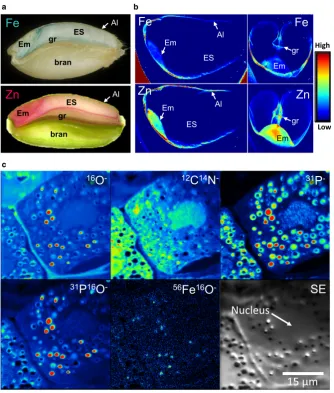
The wheat grain is a single-seeded fruit, called a cary-opsis. It contains a small embryo, which forms the new plant on germination, and a large storage tissue (the endosperm), which comprises mainly starch (a source of energy) and protein. These tissues are surrounded by protective layers derived from the seed coat (testa) and fruit coat (pericarp). Iron and zinc, together with other minerals, are concentrated in the embryo and in the outer layer of endosperm cells, called the aleurone. These distributions can be clearly seen in sections of a wheat grain using simple staining methods (Fig. 1a),
but higher resolution is obtained by modern imaging systems such as Synchrotron X-ray fluorescence (Fig. 1b) and NanoSIMS (secondary ion mass spec-troscopy) (Fig. 1c) (Moore et al. 2012; Neal et al.
2013). The uneven distribution of the two minerals makes sense from a plant biology perspective: upon ger-mination of the seed, the embryo will grow rapidly into a young seedling for which it requires enzymes that are dependent on iron, zinc and other cofactors (Bastow
et al. 2018). The growth is sustained by energy and amino acids derived from the storage reserves (starch and protein) in the central starchy endosperm. How-ever, because the starchy endosperm cells die during the later stages of grain maturation (Young & Gallie 2000), the starch and protein are mobilised as sugars and amino acids after lytic digestion by enzymes secreted from the aleurone layer and embryo. Interest-ingly, the two minerals differ slightly in distribution between the two tissues, with iron being more concen-trated in the aleurone and zinc in the embryo (as shown in Fig. 1b). The biological significance of these differ-ences in the locations of the two minerals is not known. Traditional milling of wheat by grinding between stones produces wholemeal flour in which all parts of the grain are mixed and can be only partially sepa-rated by sieving. However, the introduction of roller milling at the end of the 19th century enabled the pre-cise separation of the starchy endosperm from the embryo (germ) and the outer layers (including the aleurone), which are usually recovered together as the ‘bran’. This resulted in the availability of affordable white bread, previously an expensive luxury, for the whole population. However, the removal of both the germ and the aleurone layer means that white flour has substantially lower contents of iron and zinc than wholemeal – for example, means of 6.7 mg/kg iron and 8.4 mg/kg zinc in white flour, compared to 28.2 mg/kg iron and 28.6 mg/kg zinc in the whole-grain (Tanget al.2008). The contents of iron and zinc can partially be restored in white flour by enriching it with wheat germ as in ‘patent breads’ (Burnett 2005). In addition, numerous public health campaigns have been aimed at increasing the consumption of whole-meal products. Nevertheless, of the total bread-making flour produced in the UK, less than 10% is wholemeal (NABIM 2017).
Roller milling also results in the removal of most of the anti-nutrient phytic acid, which limits mineral bioavailability (as discussed below). Phytic acid (inosi-tol hexakisphosphate) is the storage form of phospho-rus of plants, which is another important element for seedling germination and growth.
© 2019 The Authors.Nutrition Bulletinpublished by John Wiley & Sons Ltd on behalf of British Nutrition Foundation
Naturally occurring iron and zinc
compounds and their bioavailability
Iron and zinc are essential cofactors in a wide range of metabolic enzymes. Thus, these elements occur in protein-bound forms in plants and animals. Iron can bind directly to the protein, or as an iron–sulphur cofactor or as haem (Balk & Schaedler 2014). The bioavailability of haem iron is high because it is very stable and is thought to be taken up by a specific transporter in the smaller intestine (Knutson 2017). However, plants contain very little haem iron (<0.1% w/v; Espinas et al. 2012) in contrast to animal tissues
(notably meat and liver). Zinc binds to proteins directly, for example, in zinc-finger structures.
Iron and zinc are transported in plants as soluble forms chelated by small organic molecules and reach the developing grain through specialised vascular tis-sues (xylem and phloem), which extend along the groove of the grain (Fig. 1a). The organic acids citrate and malate facilitate the transport of iron in the xylem while nicotianamine facilitates iron and zinc transport in the phloem and intracellularly (Connorton et al.
2017a). Iron–nicotianamine complexes are present in extracts of white wheat flour (Eagling et al. 2014a) and nicotianamine enhances the bioavailability of iron
16
O
- 12C
14N
- 31P
-31
P
16O
- 56Fe
16O
-SE
15 μm
Nucleus
Em
ES
Al
bran
Em
ES
Al
bran
Fe
Zn
gr
Low High
Zn
Fe
Em Al
ES
Zn
Fe
Em
Al
ES gr
gr
gr
Em
Em
a b
c
and zinc as demonstrated in mouse studies (Lee et al.
2009) and in Caco-2 cells (Eaglinget al.2014b). Plants have the capability to store iron either inside a shell formed by the protein ferritin or in bodies derived from vacuoles (Connorton et al. 2017a). Wheat grains are low in ferritin, but high-resolution imaging techniques such as NanoSIMS show that iron is localised in small intracellular bodies (Fig. 1c). These bodies also contain phosphate in the form of phytic acid and are called phytin globoids. Phytic acid has a cyclic structure with six phosphate groups, each of which can bind a metal ion such as iron and zinc (Maga 1982). Neal et al. (2013) used extended X-ray fluorescence fine structure spectroscopy (EXAFS) to show the presence of iron and zinc complexes in wheat aleurone cells. A further application of X-ray fluorescence, X-ray absorption near-edge structure (XANES) imaging, gives information on the atomic ligands of the metals, confirming that most of the iron is bound to phytic acid in the aleurone (De Brieret al.
2016). This colocation poses a challenge for human nutrition because mineral–phytate complexes tend to be insoluble with low bioavailability in humans.
Agronomic and selective breeding
strategies to increase bioavailable forms of
iron and zinc
In addition to improvements in yield, disease resis-tance and processing quality, there has been grow-ing research interest over the past 20 years in improving the health benefits of cereal crops, including increasing their mineral and vitamin con-tents (Vasconcelos et al. 2017), an approach known as biofortification. However, this has focused on increasing the mineral content in the wholegrain, rather than on the starchy endosperm tissue (which may limit the bioavailability).
There are two main biofortification approaches: agronomy and genetics (including conventional breed-ing and genetic modification; GM). Usbreed-ing agronomic methods, the zinc content of grain can be increased by simply fertilising the plants with zinc salts; for exam-ple, foliar application of ZnSO4 increased total grain
zinc by about 60% (Zhang et al. 2012). However, such agronomic practices are less effective for iron, except if combined with increased nitrogen fertilisa-tion (Aciksozet al. 2011) which may not be economi-cally or environmentally acceptable. Conventional breeding has been used by workers at the International Crops Research Institute for the Semi-Arid Tropics (ICRISAT, India) to develop varieties of sorghum and
pearl millet with increased contents of iron and zinc, and at the International Maize and Wheat Improve-ment Center (CIMMYT, Mexico) to increase the zinc content of wheat grain (Veluet al. 2018).
The zinc biofortified lines from CIMMYT are cur-rently being grown in Pakistan and India and have 20–40% higher zinc concentration and at least compa-rable grain yield to the best local cultivars (Veluet al.
2018). Furthermore, human intervention trials to determine the bioavailability of the zinc in the biofor-tified lines are currently being carried out in Pakistan (Lowe et al. 2018). However, despite a number of research programmes globally, including at CIMMYT, no high iron wheat lines have yet been developed by conventional breeding.
Transgenic strategies to increase
bioavailable forms of iron and zinc
A step change in our ability to biofortify crops has come from a much better understanding of how plants take up and distribute micronutrients, mainly through the identification of genes for mineral transport and the biosynthesis of organic metal chelators. This knowledge has been exploited in modern biotechnol-ogy approaches, demonstrating that it is possible to increase iron and zinc levels, not only in the whole-grain but also specifically in the starchy endosperm. In fact, this shows that there is no biological reason why iron and zinc cannot be concentrated in the starchy endosperm and hence white flour.
The proof-of-concept of transgenic approaches was initially demonstrated in rice. Increased expression of
NAS3, one of three genes encoding nicotianamine syn-thase (NAS), led to a 2.2-fold increase in the concen-tration of zinc and a 2.9-fold increase in the concentration of iron in the grain (Lee et al. 2009). Furthermore, feeding anaemic mice this enriched rice resulted in greater increases in haemoglobin and haematocrit (the volume of red blood cells in blood) compared to when conventional rice was fed. This high bioavailability results from the fact that the star-chy endosperm cells do not store phytate. The initial transgenic work on NAS in rice led to similar studies in other cereals including wheat (e.g. Masuda et al.
2009; Zheng et al. 2010; Johnson et al. 2011; Singh
et al. 2017). The advantage of increasing nico-tianamine levels is that it leads to increases in both iron and zinc because it serves as a chelator for both metals in their ionic forms.
By contrast, redirecting minerals into the starchy endosperm cells by overexpressing metal transporter
© 2019 The Authors.Nutrition Bulletinpublished by John Wiley & Sons Ltd on behalf of British Nutrition Foundation
genes leads to increases in single minerals, due to the high specificity of metal transporters, unless several genes are overexpressed together. For example, expres-sion of the barley Metal Tolerance Protein 1 (HvMTP1), under the control of a starchy endosperm-specific promoter, significantly increased the zinc con-tent in the endosperm of barley grains (Mengueret al.
2018), while expression of a wheat Vacuolar Iron Transporter (TaVIT2) using a similar promoter more than doubled the iron content of the white flour frac-tion (Connorton et al. 2017b). This is illustrated in Fig. 2, which compares the contents of iron, zinc and phosphorus in bran and flour fractions of a TaVIT2
transgenic line with control wheat grain milled on a laboratory roller mill. It is notable that the increased content of iron in the white flour (break and reduc-tion) fractions in the transgenic line is not accompa-nied by an increase in phosphorus, showing that iron can accumulate in the endosperm without being asso-ciated with phytic acid.
More recently, Wu et al. (2018) have shown that preventing iron storage in the vacuoles, while at the same time overexpressing the iron storage protein fer-ritin specifically in the starchy endosperm cells, greatly increased iron in polished rice.
Hence, it is now accepted that transgenesis can be used to increase the contents of bioavailable iron and zinc in the starchy endosperm of cereals (white flour of wheat and polished white rice) by several-fold, by redirecting mineral transport and/or providing a sink to sequester the iron.
Post-harvest improvements of iron and zinc
bioavailability
It is probable that modern breeding approaches dis-cussed above will be combined with novel processing approaches to increase the content of bioavailable minerals in wheat-based foods, ranging from whole-meal to white flour products. The two most promising
0 10 20 30 40
Iron (µg/g)
TaVIT2 Control
0 10 20 30
Zinc (µg/g)
TaVIT2 Control
0 1 2 3 4 5 6
P
hosphor
u
s (mg/g)
TaVIT2 Control
Reduction rollers
1stReduction flour
Break rollers
Sieves Reduction
rollers
2ndReduction flour
Fine bran
Coarse bran
1stSemolina
Coarse bran
2ndBreak flour
Break rollers
1stBreak flour
Conditioned grain
2ndSemolina
Sieves Sieves
Sieves
Fine bran
b a
of these are mechanical treatments and fermentation. Mechanical treatments, particularly micro-grinding, have been discussed in a recent article in this journal (Aslam et al. 2018). Plant cell walls are resistant to digestion in the gastro-intestinal tract and therefore mineral bioaccessibility from wheat aleurone cells may be limited (Latunde-Dada et al. 2014; Edwards et al.
2015). Enzymatic treatment and micro-milling tech-niques designed to disrupt the aleurone cell walls enhance the release of iron from wheat flour during
in vitro digestion and increase iron uptake by intesti-nal epithelial cells (Latunde-Dada et al. 2014). This suggests that disruption of the aleurone cell walls may be an effective approach to increase iron bioavailabil-ity from wheat products.
Many microorganisms secrete phytase enzymes, which can release minerals from phytate complexes, particularly microorganisms present in sourdough sys-tems (Katina et al. 2005; Rodriguez-Ramiro et al.
2017). Hence sourdough wholegrain products may have increased mineral bioavailability. However, whereas this approach may increase mineral bioavail-ability in foods made from wholegrain and high extraction flours, it is not relevant to white flour prod-ucts which are dominant in most countries.
Future perspectives
Although transgenic strategies provide exciting oppor-tunities to make dramatic increases in the contents and bioavailabilities of minerals in white flour prod-ucts, it must be borne in mind that transgenic crops have limited acceptability by consumers and regula-tory bodies, particularly in the European Union but also in many less developed countries. Furthermore, the recent (July 2018) ruling from the European Court of Justice that gene-edited crops, which do not contain foreign DNA, should be considered genetically modi-fied organisms (GMOs) (https://bit.ly/2RZFzmB) sug-gests that restrictions on growth and marketing are unlikely to be relaxed in the near future.
Although conventional mutagenesis remains outside GM legislation, most mutations result in loss, or reduced, gene expression and the application of muta-genesis to biofortification is therefore a challenge. Nevertheless, this is likely to be the most promising route for developing biofortified wheat in the future. Elucidation of the pathways and mechanisms of iron and zinc transport and deposition in the developing grain should identify genes encoding key transporters, or other factors, that can be downregulated or switched off, to redirect minerals into the starchy
endosperm. This will be facilitated by the availability of comprehensive libraries of wheat mutants (Krasi-levaet al. 2017). Combined with conventional biofor-tification and innovative processing this should provide increased mineral bioavailability in a range of wheat products, from white flour to wholemeal.
Acknowledgements
Rothamsted Research receives grant-aided support from the Biotechnology and Biological Sciences Research Council (BBSRC) of the UK and the work reported here forms part of the Designing Future Wheat Institute Strategic Programme [BB/P016855/1]. PRS and YW are also funded by BBSRC grant BB/P019358/ 1. JB, CU and JMC are funded by BBSRC grant BB/ P019072/1 and the Institute Strategic Programme BB/ P012523/1. JB and JMC thank Graham Chilvers (UEA) for ICP-OES analysis. We thank Dr. Andrew Neal (Rothamsted Research) for allowing us to use Fig. 1b.
Conflicts of interest
The authors have no conflicts of interest to disclose.
References
Aciksoz SB, Yaziki A, Ozturk Let al.(2011) Biofortification of wheat with iron through soil and foliar application of nitrogen and iron fertilisers.Plant and Soil349: 215–25.
Aslam MF, Ellis PR, Berry SEet al.(2018) Enhancing mineral bioavailability from cereals: current strategies and future perspec-tives.Nutrition Bulletin43: 184–8.
Balk J & Schaedler TA (2014) Iron cofactor assembly in plants.
Annual Review of Plant Biology65: 125–53.
Bastow EL, Garcia de la Torre VS, Maclean AEet al.(2018) Vacuo-lar iron stores gated by NRAMP3 and NRAMP4 are the primary source of iron in germinating seeds.Plant Physiology177: 1267– 76.
Bates B, Lennox A, Prentice Aet al.(eds) (2014)National Diet and Nutrition Survey: Results from Years 1–4 (combined) of the Roll-ing Programme (2008/2009–2011/2012). Public Health England: London, UK.
Brown KH, Hambidge KM, Ranum Pet al.(2010) Zinc fortification of cereal flours: current recommendations and research needs.
Food and Nutrition Bulletin31(1 Suppl): S62–74. Burnett J (2005) Brown is best.History Today55: 52–4.
Connorton JM, Balk J & Rodrıguez-Celma J (2017a) Iron transport in plants–a brief overview.Metallomics9: 813–23.
Connorton JM, Jones ER, Rodriguez-Ramiro Iet al. (2017b) Wheat vacuolar iron transporter TaVIT2 transports Fe and Mn and is effective for biofortification.Plant Physiology174: 2434–
44.
De Brier N, Gomand SV, Donner Eet al.(2016) Element distribu-tion and iron speciadistribu-tion in mature wheat grains (Triticum
© 2019 The Authors.Nutrition Bulletinpublished by John Wiley & Sons Ltd on behalf of British Nutrition Foundation
aestivumL.) using synchrotron X-ray fluorescence near-edge struc-ture (XANES) imaging.Plant Cell and Environment39: 1835–47. Eagling T, Neal AL, McGrath SPet al.(2014a) Distribution and
speciation of iron and zinc in grain of two wheat genotypes. Jour-nal of Agricultural and Food Chemistry62: 708–16.
Eagling T, Wawer AA, Shewry PRet al.(2014b) Iron bioavailability in two commercial cultivars of wheat: comparison between whole-grain and white flour and the effects of nicotianamine and 20 -deoxymugineic acid on iron uptake into Caco-2 cells.Journal of Agricultural and Food and Chemistry62: 10320–5.
Edwards CH, Grundy MM, Grassby Tet al.(2015) Manipulation of starch bioaccessibility in wheat endosperm to regulate starch digestion, postprandial glycemia, insulinemia, and gut hormone responses: a randomized controlled trial in healthy ileostomy par-ticipants.American Journal of Clinical Nutrition102: 791–800. Espinas NA, Kobayashi K, Takahashi Set al.(2012) Evaluation of unbound free heme in plant cells by differential acetone extrac-tion.Plant and Cell Physiology53: 1344–54.
Johnson AAT, Kyriacou B, Callahan DLet al.(2011) Constitutive overexpression of theOsNASgene family reveals single-gene strategies for effective iron- and zinc-biofortification of rice endo-sperm.PLoS ONE6: e24476.
Katina K, Arendt E, Liukkonen K-Het al.(2005) Potential of sour-dough for healthier cereal products.Trends in Food Science and Technology16: 104–12.
Knutson MD (2017) Iron transport proteins: gateways of cellular and systemic iron homeostasis.Journal of Biological Chemistry
292: 12735–43.
Krasileva V, Vasquez-Gross HA, Howell Tet al.(2017) Uncovering hidden variation in polyploid wheat.Proceedings of the National Academy of Sciences of the United States of America114: E913–
21.
Latunde-Dada GO, Li X, Parodi Aet al.(2014) Micromilling enhances iron bioaccessibility from wholegrain wheat.Journal of Agricultural and Food Chemistry62: 11222–7.
Lee S, Jeon US, Kim Y-Ket al.(2009) Iron fortification of rice seeds through activation of thenicotianamine synthasegene. Proceed-ings of the National Academy of Sciences of the United States of America106: 22014–9.
Lowe NM, Khan MJ, Broadley MRet al.(2018) Examining the effectiveness of consuming flour made from agronomically biofor-tified wheat (Zincol-2016/NR-421) for improving Zn status in women in a low-resource setting in Pakistan: study protocol for a randomised, double-blind, controlled cross-over trial (BiZiFED).
British Medical Journal Open8: e021364.
Maga JA (1982) Phytate: its occurrence, food interactions, nutri-tional significance and methods of analysis.Journal of Agricul-tural and Food Chemistry30: 1–9.
Masuda H, Usuda K, Kobayashi Tet al.(2009) Overexpression of the barley nicotianamine synthase geneHvNAS1Iincreased iron and zinc concentrations in rice grains.Rice2: 155–66. Menguer PK, Vincent T, Miller AJet al.(2018) Improving zinc
accumulation in cereal endosperm using HvMTP1, a transition metal transporter.Plant Biotechnology Journal16: 63–71.
Moore KL, Zhao F-J, Gritsch Cet al.(2012) Localisation of iron in wheat grain using high resolution secondary ion mass spectrome-try.Journal of Cereal Science55: 183–7.
NABIM (2017)UK Flour Milling Industry 2017.The National Association of British and Irish Millers. NABIM: London, UK. Neal AL, Geraki K, Borg Set al.(2013) Iron and zinc complexation
in wild-type and ferritin-expressing wheat grain: implications for mineral transport into developing grain.Journal of Bioinorganic Chemistry18: 557–70.
Ritchie H, Roser M (2018)Diet compositions. Available at: https:// ourworldindata.org/diet-compositions’ (accessed 1 November 2018).
Roberts C, Steer T, Maplethorpe Net al.(2018) National Diet and Nutrition Survey Results from Years 7 and 8 (Combined) of the Rolling Programme (2014/2015–2015/2016). London: Public Health England and Food Standards Agency.
Rodriguez-Ramiro I, Brearley CA, Bruggaber SFAet al.(2017) Assessment of iron bioavailability from different bread making processes using anin vitrointestinal cell model.Food Chemistry
228: 91–8.
Singh SP, Keller B, Gruissem Wet al.(2017) Rice NICOTIANA-MINE SYNTHASE 2expression improves dietary iron and zinc levels in wheat.Theoretical and Applied Genetics130: 283–92. Tang J, Zou C, He Zet al.(2008) Mineral element distributions in
milling fractions of Chinese wheats.Journal of Cereal Science48: 821–8.
Vasconcelos MW, Gruissem W & Bhullar NK (2017) Iron biofortifi-cation in the 21stcentury: setting realistic targets, overcoming obstacles, and new strategies for healthy nutrition.Current Opin-ion in Biotechnology44: 8–15.
Velu G, Singh R, Balasubramanian Aet al.(2018) Reaching out to farmers with high zinc wheat varieties through public-private partnerships– an experience from Eastern-Gangetic plains of India.Advances in Food Technology and Nutritional Sciences1: 73–5.
WHO (World Health Organization) (2013)World Health Report: Research for Universal Health Coverage. World Health Organiza-tion: Geneva, Switzerland.
WHO (World Health Organization) (2015)The Global Prevalence of Anaemia in 2011. World Health Organization: Geneva, Switzerland.
Wu T-Y, Gruissem W & Bhullar NK (2018) Targeting intracellu-lar transport combined with efficient uptake and storage signifi-cantly increases grain iron and zinc levels in rice.Plant Biotechnology Journal. https://doi.org/10.1111/ppi.12943. Young TE & Gallie DR (2000) Programmed cell death during
endosperm development.Plant Molecular Biology 44: 283–
301.
Zhang Y-Q, Sun Y-X, Ye Y-Let al.(2012) Zinc biofortification of wheat through fertilizer applications in different locations of China.Field Crops Research125: 1–7.