Network Journal (TEAN), 9 (2). pp. 51-63.
Downloaded from: http://insight.cumbria.ac.uk/id/eprint/3881/
Usage of any items from the University of Cumbria’s institutional repository ‘Insight’ must conform to the following fair usage guidelines.
Any item and its associated metadata held in the University of Cumbria’s institutional repository Insight (unless stated otherwise on the metadata record) may be copied, displayed or performed, and stored in line with the JISC fair dealing guidelines (available here) for educational and not-for-profit activities
provided that
• the authors, title and full bibliographic details of the item are cited clearly when any part of the work is referred to verbally or in the written form
• a hyperlink/URL to the original Insight record of that item is included in any citations of the work
• the content is not changed in any way
• all files required for usage of the item are kept together with the main item file.
You may not
• sell any part of an item
• refer to any part of an item without citation
• amend any item or contextualise it in a way that will impugn the creator’s reputation
• remove or alter the copyright statement on an item.
The full policy can be found here.
Citation
Coker, L. Developing understanding of student-teacher agency: implications for programme
Developing understanding of
Student-Teacher Agency: Implications for Programme Development
Teacher Education Advancement Network Journal Copyright © 2017 University of Cumbria Vol 9(2) pages 51-63 Helen Coker
University of the Highlands and islands
Abstract
Developing student teachers to become confident and effective professionals is a central aim of teacher education programmes. Developing understanding of student-teacher agency - the ways in which student teachers actively participate in their learning - has the potential to inform programme development. Working in the context of a blended learning Professional Graduate Diploma in Education (PGDE) programme, the research presented here aimed to develop understanding of student-teacher agency, with the purpose of informing programme development. Deepening our understanding of the student teacher experience enabled critical reflection on the design and delivery of the programme, informing our developments.
Taking a narrative stance, data were generated from fifty-three student teachers, during a discussion activity in which they reflected on their experiences during the PGDE year. Analysis utilised Priestley, Biesta a d ‘o i so f a e o k fo Tea he Age . Fi di gs suggested that stude t tea he s peripheral positioning, to the community of professional teachers, influences their approach to their own learning during the PGDE year. Findings directly informed the development of programme structures. Deeper understanding of student-teacher agency has informed our practice in a blended learning environment: Understanding these aspects of the student-teacher experience has the potential to inform the development of programmes utilising different methods of delivery.
Teacher-education
Student-teacher Agency
Programme development
Blended Learning
Critical Reflection
Introduction
Developing student teachers to become confident and effective professionals is a central aim of teacher-education programmes. As teacher educators we are keen to enable our students to become agentive professionals, who can contribute meaningfully to the profession. The research presented here informed the development of effective and enabling programme structures on a teacher-education programme, based in a distributed university in Scotland. Using the theoretical framework of ecological agency (Emirbayer & Mische, 1998; Priestley, Biesta & Robinson,2015) the study explored the ways in which student teachers engaged with the programme during their college-based learning on a one-year professional graduate diploma (PGDE) programme.
The programme from which this research drew evidence utilised blended delivery across a geographically disparate group of student teachers. The online space of the programme acted as a central point for programme activity, structuring the college-based aspects of the programme. Staff and students were unevenly distributed across six physical locations. The distributed nature of the programme presented potential issues for student-teacher interactions with both peers and university staff. However, it also provided an opportunity to utilise technology to enable connections across the cohort, the variety of local contexts potentially enriching learning opportunities through such connections.
While the research aimed to inform programme development across the whole programme, the use of the agency framework enabled observation of individual student engagement. The research presented here suggested that student teachers are positioned differently to teachers and this is reflected in the enactment of agency. For the student teacher, being agentive requires engagement with the entry requirements of the profession as student teachers are located in a peripheral position when compared with experienced teachers who have been the focus of research on teacher agency (Philpott and Oates, 2016; Priestley, Biesta & Robinson, 2015; Riveros, Newton & Burgess, 2012). These findings have implications for programme design and development.
Context
Student teachers involved with this research were studying a Professional Graduate Diploma in Education (PGDE) at a geographically disparate university in Scotland. The PGDE was delivered, through a blended learning model, to students in six different physical locations. The numbers of students in each location varied from three to twenty-six. The programme utilised a blended delivery model, using video conferencing (VC), online learning and face-to-face activities. The learning materials and activities were designed to open up spaces for dialogue between students across the cohort and enable critical and collaborative engagement with the course materials.
The programme had been developed through a process of critical reflection (Coker, 2015). The online space (a combination of a Blackboard learning management system (LMS) and Mahara e-portfolio platform), at the time of the research, was structured to reflect the multi-faceted role of teachers:
Collaborative Practice - Mondays
Enquiry and Practice - Midweek
Reflective Practice -Thursdays
Professional Practice – Fridays
Activities relating to each of these facets were delivered through video-conferencing (VC) lectures and workshops (on Monday, Thursday and Friday), individual work and group seminars in the LMS (Midweek), and structured triad activities and group tasks in local face-to-face groups (Monday and Thursday afternoons). The midweek online seminar groups were spread across different physical locations, and facilitated through the online space. This structure was designed to introduce, and guide students on an inward trajectory, to the community of practice (Wenger, 1998) of teaching. It modelled a socio-cultural philosophy which aligned with current curriculum philosophy (The Scottish Government, 2004). Knowledge was approached as active, as participation rather than acquisition (Sfard, 1998). Student teachers were perceived as e oming tea he s, situati g thei lea i g fi l within a cultural context (Bruner, 1996; Seely-Brown, Collins & Duguid, 1989).
current educational narrative (Philpott, 2014); it presented the values and beliefs of the professional community into which the students were entering. The structure of the SPR - starting with Social Justice - situated the script within the historical context of Scottish Education. The on-going updating of the standards reflected the evolution of the professional community. The standard reified the values and beliefs of the professional community but was itself situated historically, and thus not objective.
Aims of the Research
The research aimed to develop understanding of student-teacher agency in order to inform the development of programme structures. Student teachers are positioned at the beginning of their professional journeys; the PGDE year marking the entry into their teaching careers. By developing our understanding of the ways in which student teachers actively engaged during the college-based aspects of the programme we theorised we would be able to develop our understanding of their emerging agency (Priestley, Biesta & Robinson, 2015) and associated enabling and constraining factors. This would enable us to develop effective programme structures which supported student teachers to become agentive and effective professionals.
Agency
Agency, in the o te t of this esea h, as defi ed as a ti e pa ti ipatio o the pa t of the stude t teacher. Teacher agency has been explored i elatio to tea he s professional learning (Philpott and Oates, 2016), and professional practice (Priestley, Biesta & Robinson, 2015, Priestley, Biesta, Philippou and Robinson., 2015; Riveros, Newton & Burgess, . The ost f e ue tl used conceptualisation of agency Philpott a d Oates, : has ee that of E i a e & Mische (1998) in which agency was defined as emerging from the chordal triad or past, present and future experiences. Developing this sociological framework Priestley, Biesta & Robinson (2015) presented an ecological model for teacher agency (Figure 1.). Agency was seen to emerge from the interaction of teachers past histories, future orientations and current context.
The current research used this model as a framework to explore student-teacher agency. However, there are some differences between student teachers and teachers. In terms of past experiences teachers have a professional history as a teacher. Student teachers have a vast array of histories of participation (Wenger, 1998), some within professions other than teaching, some who have yet to enter a profession. In regards to future orientation - the projective aspect - students aim to pass the PGDE and probation year and then enter a teaching career: the short term future is a shared experience. Therefore, student teachers differ from teachers in the diversity of their past experiences – being from a range of different professions - and the shared aims – in relation to passing their probation year - in the projective element. Teachers in Priestley, Biesta & Robinson (2015) study had a range of past experiences and future aspirations, but these were located in the same professional community, as they were all practising teachers.
As teacher educators we approached the research with a vested interest in the practical-evaluative aspect, the current context. We were interested to explore how elements of the current context, which we had designed, enabled student-teacher agency. In designing the initial programme structures our focus was on the material aspects of the practical-evaluative element. The programme structures reflected our own understanding and were both implicitly and explicitly informed by our cultural values and beliefs. In structuring the week around the multi-faceted notion of teacher identity the programme structures reflected the discourses of the educational community in which we, as teacher educators, participated.
We were reflexive in approaching the research, as we were aware of our vested interest in certain aspects of potential findings. Acknowledging this we designed the research methodology to listen to students and observe, but with an understanding that we had our own opinions in regards to which parts of the PGDE programme we felt would be most cognisant to the development of agency. The results of the research highlighted aspects we had not considered. For ethical reasons we did not share the research with the wider teaching team until the particular group of students had graduated. All students took part in the research as part of a residential week in the thirty-third week of a forty-two week year. Following the residential, student teachers would complete a final teaching placement and return to college for two weeks at the end of the programme. Permission was gained and any students who did not consent were identified and their contributions were removed from the data.
Methods and Methodology
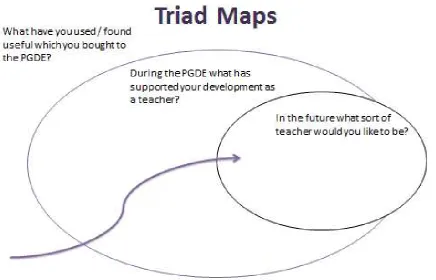
Evidence was collected using a discussion-based mapping activity. This was part of a group task which students took part in during a residential week. Fifty-three students, from a cohort of sixty, took part and gave us permission to collect data. This enabled us to collect data from all students, using a format they were familiar with. This was at once a pragmatic and methodological decision. Pragmatically the activity fitted easily into the programme residential. Methodologically we were able to collect data co-constructed by students as they discussed the questions they had been asked. The data itself contained a layer of member checking in its creation through small group dialogue.
Figure 2. Triad Map: students completed in groups of three.
Discussing their experiences, each member of the group was given a different coloured pen and asked to write on the map. The dialogic nature of this process was reflected in the nature of the evidence; stude ts added thei ag ee e t to ea h othe s o e ts. The p o ess as si ila to a fo us g oup i that it p o ided a espo se to spe ifi situatio s i o te t F ee a , : . Stude ts e e asked to share their experiences of the year within the context of the programme, working with the peers who had experienced it with them. The map (fig ii) was used to structure the dialogue. The dialogic aspect of this, the supporting discussion, was seen to work to co-construct a shared understanding of the experience and in doing so highlight issues salient to the group. The subsequent analysis enabled identification of themes, metaphors and plotlines (Clandinin, 2007).
Taking a reflexive approach the researchers acknowledged they were actively teaching on the programme. Neither of the researchers participated in placement or pastoral aspects of the programme. As the programme was ongoing at the point of evidence collection it was acknowledged that student teachers may have shaped their discussions on what they perceived we were looking for. The activity was introduced as part of our ongoing research and clearly presented as having no relation to assessment. There was, however, a power differential in our relationship with students as we would be marking student teachers final assessments enabling them to pass the programme. The use of small familiar groups for discussion and an activity which was congruous with ongoing programme tasks was designed to enable the collection of evidence which was as little affected by these issues as possible.
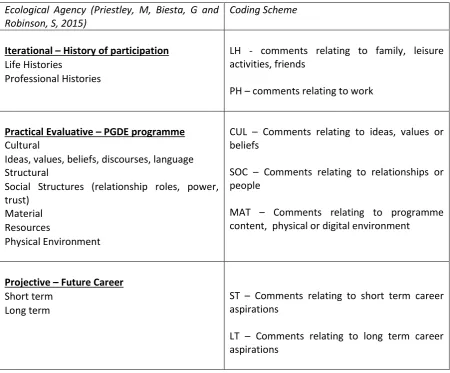
further immerse herself in the data. Wordclouds for each element were created and notes were made in response to these. Comments were then coded. Priestley, Biesta & Robinson (2015) framework for teacher agency was developed, through discussions with a second researcher, into a coding scheme (Table 1). Using the coding scheme all comments, from all students, were coded by a single researcher.
Table. 1. Coding framework developed from Priestley, Biesta & ‘o i so s f a e o k fo teacher agency.
Ecological Agency (Priestley, M, Biesta, G and Robinson, S, 2015)
Coding Scheme
Iterational – History of participation Life Histories
Professional Histories
LH - comments relating to family, leisure activities, friends
PH – comments relating to work
Practical Evaluative – PGDE programme
Cultural
Ideas, values, beliefs, discourses, language Structural
Social Structures (relationship roles, power, trust)
Material
Resources
Physical Environment
CUL – Comments relating to ideas, values or beliefs
SOC – Comments relating to relationships or people
MAT – Comments relating to programme content, physical or digital environment
Projective – Future Career Short term
Long term
ST – Comments relating to short term career aspirations
LT – Comments relating to long term career aspirations
The data were approached qualitatively, as an observation of the student experience. The coding of the triad maps enabled data to be visualised which enabled the examination of the created narrative; enabling the researcher to look for what is happening, what are the main features that are being
epo ted Cohe , Manion & Morrison, 2013: 583).
Results
Figure 3. Wordcloud presenting data from the iterative element of the triad map.
The experiences presented were relevant to the predominant narratives of the professional community. Students referred to languages at a time when this was central to policy developments. They referred to relevant skills such as management and to experiences related to working with children. Students brought a variety of life history and professional history with them. They referred to both life and professional experience when reflecting on the iterative aspect of agency.
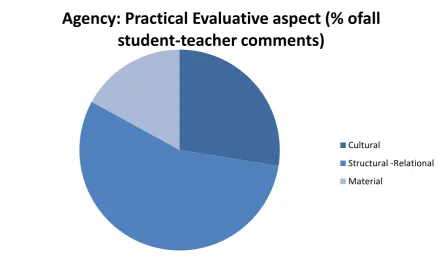
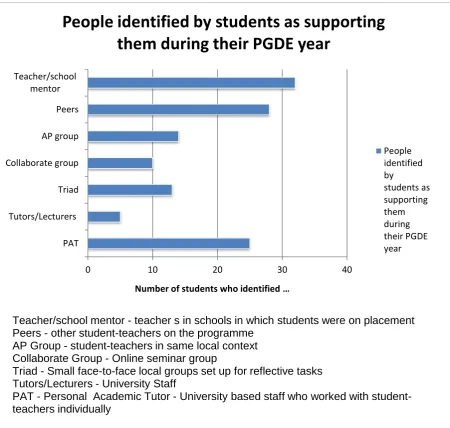
Comments relating to the Practical-Evaluative aspect of agency suggested that the structural-relational - social structures and relationship roles - aspect was central (Figure 3.). Fifty-two out of fifty-three students identified people as having supported them through their PGDE year.
Figure 4. Coding of Practical-Evaluative aspect of student-teacher agency.
Agency: Practical Evaluative aspect (% ofall
student-teacher comments)
Cultural
Structural -Relational
Cultural factors such as placements and experientials were identified by thirty-nine students. Three students identified the standard for provisional registration (SPR). Twenty-seven identified material aspects such as content or resources. One student mentioned a physical setting. This suggested that from the student perspective, relationships with others, particularly school based professionals and peers, were of most value during their PGDE year.
Figure 5. Coding of people who were identified as supporting students during PGDE year.
Staff on placement and peers were identified as being the most supportive. Students had individual interviews throughout the year with their PAT – Personal Academic Tutor – who was the third most supportive person identified. PATs worked with students on a one-to-one basis with interviews following each placement. The focus on placement staff and peers could suggest a future orientation as these are the relationships which will continue into students teaching careers. They are also potentially the most authentic discourses in relation to the professional practice student teachers are entering. Students were aiming to become teachers and so valued interactions with teachers (Figure 5.). The cultural values and beliefs of the professional community, the ways of being , were perhaps most clearly visible through the school based professionals.
0 10 20 30 40
PAT Tutors/Lecturers
Triad Collaborate group AP group Peers Teacher/school
mentor
Nu ber of stude ts who ide tified …
People identified by students as supporting
them during their PGDE year
People identified by
students as supporting them during their PGDE year
Teacher/school mentor - teacher s in schools in which students were on placement Peers - other student-teachers on the programme
AP Group - student-teachers in same local context Collaborate Group - Online seminar group
Triad - Small face-to-face local groups set up for reflective tasks Tutors/Lecturers - University Staff
Twenty-three out of fifty-three students identified the structural groups in which they had worked in college – triads, collaborate group (online seminar group) and local groups – as supporting them. Ten students mentioned their Collaborate (online seminar) groups. This suggests that the dialogic activities - which were put in place to enable dialogue - were partly successful. However, it also suggests that students valued one-to-one interactions more than group dialogue. Their role in the teacher-mentor and PAT dialogue was different to that in the structured dialogue – teacher-mentor and PAT interactions were one-to-one and potentially held a more validating role. This potentially reflected the peripheral position of the students in relation to the professional community of teachers.
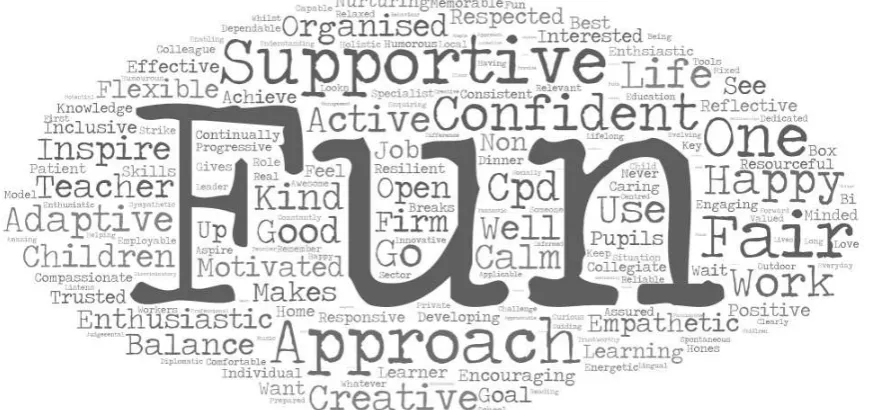
In the projective element (fig. vii), there was less variety than in the iterative and practical-evaluative elements. The focus of student s projections – what type of teacher they wanted to become – was largely humanistic. Reflection and enquiry, which were key aspects of the programme, did not feature here. The qualities of a teacher were focused on - rather than skills or people.
Figure 6. Wordcloud presenting data from the projective element.
Discussion
Developing our PGDE programme the focus of our initial design had been on the material aspects of the practical-evaluative element; identifying resources and structuring the environment in which students were working (fig. i). Being a blended programme the online architecture had been the focal point through which we had presented the programme. The physical spaces in which student teachers participated varied due to the multi-campus nature of the programme. As teacher educators we had created an online setting which utilised the resources we deemed important to the development of student teachers. Developing our understanding of student-teacher agency led us to consider the iterational and projective elements of agency, and highlighted the value of relationships, and the social structures of the practical-evaluative element. These considerations informed developments to the existing programme structures.
involved actively aligning one s previous experiences with the professional values and beliefs of the professional community how could we further support this? Student teachers engaged in this process implicitly on placements and through engagement with assignments. Focusing on this, on what stude ts did P iestle , Biesta, Philippou & Robinson., 2015), we re-visited the spaces we had created for reflection - a reflective journal and the reflective triad discussions - and built in structured reflective activities which engaged with previous experiences.
The shared nature of student teachers aspirations, the projective element, suggested that student teachers aspirations were shielded, to an extent, by thei e t i to the p ofessio al o u it . Rather than aspiring to different roles within the professional community student teachers were perhaps focused solely on entering the community. The fo us o fu (Figure 6.) suggested aspirations of teachers, reflective of a position outwith the professional community. In interviews at the beginning of the year aspiring student teachers had expressed similar aspirations. From a programme perspective the student teachers had not engaged with the critically reflective and enquiry-based aspects of teacher identity, which were integral to the learning outcomes of the programme. This highlighted the complexity of the relationship between socio-cultural context and the individual engagement (Philpott and Oates, 2016).While it was clear that past experiences had been aligned to the values and beliefs of the professional community, future aspirations were not aligned with the learning outcomes of the programme. As teacher educators these outcomes were aspects of practice we aspired to for our graduates to take into their professional lives. We therefore reflected on the connections between student-teacher aspirations and the development of critical enquiry skills. As part of the PGDE, student teachers engaged with a school-based enquiry; informed by these research findings this was developed to engage more explicitly with professional development. The choice of topic for the enquiry was decided through a reflective activity in which student teachers engaged with the feedback they had, from their placement reports, about their own professional development. Using the SPR as a framework, student teachers identified areas of practice most relevant to their own professional development, thus making salient the link between programme learning outcomes and future professional development. The use of the SPR, the narrative template of the professional community (Philpott, 2014), embedded the values and beliefs of the professional community within the context of the PGDE programme, aligning future aspirations more explicitly with current activities.
Relationships were identified as important to student teachers during their PGDE year. Students had identified a number of people who supported their development over the PGDE year (Figure 5). As well as class teachers and mentors, peers were identified as important. Within a geographically disparate cohort, students access to each other was varied. The online seminar (Collaborate) groups had been developed following a critical review of the programme (Coker, 2015). The review had identified dialogic participation patterns in the online space aligning to student success. Engaging in dialogue with the wider cohort, as well as local peers, had been observed to correlate with success in assignments. The online groups were introduced to support the development of a dialogic approach within the online setting, encouraging student teachers to engage in dialogue across the cohort, as well as in their local groups. This reflected current approaches to teacher learning, in which collaborative activities were utilised to enable learning communities to develop (Philpott & Oates, 2016; Riveros, Newton & Burgess, 2012). The visibility of the Collaborate groups, in the current research, suggested that the online groups had enabled student teachers to engage in cross-campus dialogue, and were themselves aware of the value of this. The relational aspects of online dialogue are a focus of continuing research.
access the professional community of practice, the relationships which were aligned with their future aspirations. Relationships of this kind could be observed as conduits to professional capital (Hargreaves & Fullan, 2012). These relationships also had uneven power relationships. Student teachers were positioned through them as students rather than teachers, the uneven power role both enabling validation of the student teacher and highlighting their peripheral position on the edge of the professional community. Validation by those within the community potentially supported an inward trajectory.
Understanding student-teacher agency in relation to their positioning on the periphery of the professional community enabled us to reflect on how we can best support our student teachers. Aligning tasks explicitly with ongoing professional development, and reflecting on what student teachers brought with them, has enabled us to support their emerging agency. Rather than supporting student teachers to take ownership of the standard for provisional registration (SPR) we now approach the SPR as the entry way into the professional community and work with student teachers to reflect on and develop the skills they need to gain entry. The relationships involved in entering the professional community are now the focus, as much as the development of the skills and identity required. Being a blended programme, consideration of the ways in which the online space mediated relationships during the PGDE year is of interest. Working online has the potential to support rurally-based and geographically disparate groups of student teachers. Engaging with the ways in which online spaces mediate the relationships involved will further enable us to develop our own practice and best support the student teachers we are working with. This is the focus of the next stage of our ongoing critical enquiry. As well as using the programme to develop student teachers skills and individually enable them to enter the professional community, we also need to focus on the relational aspects of practice and consider how we can support these. As teacher educators supporting the development of student-teacher agency is as much about supporting relationships as it is about supporting individuals.
Conclusions
Developing our understanding of student-teacher agency has informed the development of our programme structures. Enabling student teachers to become confident and effective professionals is a central aim of our programme. Working in a blended learning environment, consideration of student-teacher agency has enabled us to consider all aspects of the practical-evaluative element (Figure 1.), Priestley, Biesta & ‘o i so , . The elatio al aspe ts of stude t tea he s e ologi al conditions, the relationships they engaged in, were highlighted by our critical reflections. The design of the PGDE programme had focused on the material - resources and environment - and cultural - discourses, values and beliefs – aspects of the practical-evaluative element. Further developments will consider the relationships within which student-teachers participate, and the complex relationship between the ecology, which we can to an extent shape, and the participation of individuals, whose agency emerges from the chordal triad of past experience, current ecology and future aspirations (Emibayer & Mische, 1998). The structural, relational aspects of student teachers ecological conditions are as important as the material; resources and environment, and cultural; discourses, values and beliefs, in relation to programme design and development.Understanding these aspects of the student-teacher experience has the potential to inform the development of programmes utilising different methods of delivery.
References
Bruner, J. (1996) The Culture of Education. London, England: Harvard University Press. Clandinin, D, J (2007) Handbook of Narrative Enquiry, Mapping a Methodology. London: Sage.
Cohen, L, Manion, L., Morrison, K (2013) Research Methods in Education, London: Taylor and Francis. Coke , H Using Data to See what Students are Doing: A Critically Enquiring Approach to LMS De elop e t, Journal of Perspectives in Applied Academic Practice JPAAP, 3(1), doi: 10.14297/jpaap.v3i1.146.
Emirbayer, M., Mis he, A What is Age ? American Journal of Sociology, 103(4), pp. 962-1023.
F ee a , T., Best p a ti e i fo us g oup esea h: aki g se se of diffe e t ie s, Journal of advanced nursing, 56(5), pp.491-497.
Hargreaves, A., Fullan, M. (2012) Professional capital: Transforming teaching in every school. New York: Teachers College Press.
Philpott, C. (2014) Socioculturally situated narratives as co-authors of student teachers' learning from e pe ie e , Teaching Education, 25 (4). pp. 391-409. ISSN 1047-6210
http://dx.doi.org/10.1080/10476210.2014.908839
Philpott, C., Oates, C., (2016) Teacher agency and professional learning communities; what can Learning Rounds in Scotland teach us? Professional Development in Education, pp.1-16.
http://www.tandfonline.com/doi/abs/10.1080/19415257.2016.1180316 (Accessed: 09 May
2017).
Priestley, M, Biesta, G., Robinson, S, (2015) Teacher Agency, An Ecological Approach. London: Bloomsbury.
Priestley, M., Biesta, G.J.J., Philippou, S., Robinson, S. (2015) The teacher and the curriculum: exploring tea he age , in D. Wyse, L. Hayward & J. Pandya (eds.) The SAGE Handbook of Curriculum, Pedagogy and Assessment, London: SAGE Publications Ltd.
Riveros, A, Newton, P., Bu gess, D A situated a ou t of tea he age a d lea i g: C iti al efle tio s o p ofessio al lea i g o u ities, Canadian Journal of Education, 35 (1) pp. 202-216
The Scottish Government. (2004). A Curriculum for Excellence - The Curriculum Review Group. [online] Available at: http://www.gov.scot/Publications/2004/11/20178/45862 (Accessed: 04 April 2017].
Seely-Brown, J., Collins, A., Duguid, P. Situated Cog itio a d the Cultu e of Lea i g,
Educational Researcher, 18(1), pp. 32-42.
Sfard, A. (1998) O T o Metapho s fo Lea i g a d the Da ge s of Choosi g Just O e i K o ledge and Practice: Representations and Identities , Educational Researcher, 27(2), pp. 4-13.