Running head: self-bias
Self-bias modulates saccadic control
A. Yankouskaya, D. Palmer, Stolte, M., J. Sui, G.W. Humphreys
Department of Experimental Psychology University of Oxford
Alla Yankouskaya, PhD
Cognitive Neuropsychology Centre Department of Experimental Psychology University of Oxford
9, South Parks Road, OX1 3UD
UK
Diahann Palmer, MD,
Cognitive Neuropsychology Centre Department of Experimental Psychology University of Oxford
9, South Parks Road, OX1 3UD
UK
Moritz Stolte, PhD
Cognitive Neuropsychology Centre Department of Experimental Psychology University of Oxford
9, South Parks Road, OX1 3UD
UK
Jie Sui, PhD
Cognitive Neuropsychology Centre Department of Experimental Psychology University of Oxford
9, South Parks Road, OX1 3UD
UK
G.W. Humphreys, Professor
Cognitive Neuropsychology Centre Department of Experimental Psychology University of Oxford
9, South Parks Road, OX1 3UD
UK
Acknowledgements
This work was supported by an Advanced Investigator grant from the European Research Council (Pepe: 323883) to the last author
Key words: self-bias, saccadic control, attention
Word count:
Abstract: 159
Abstract
We present novel data on the role of attention in eliciting enhanced processing of
stimuli associated with self. Participants were required to make pro- or anti-saccades
according to whether learned shape-label pairings matched or mismatched. When stimuli
matched participants were required to make an anti-saccade and when the stimuli
mismatched a pro-saccade was required. We found that anti-saccades were difficult to
make to stimuli associated with self when compared to stimuli associated with a friend and
a stranger. In contrast, saccades to friend-stimuli were easier to make than
anti-saccades to stranger-stimuli. In addition, a correct anti-saccade to a self-associated stimulus
disrupted subsequent pro-saccade trials, relative to when the preceding anti-saccade was
made to other stimuli. The data indicate that self-associated stimuli provide a strong cue for
explicit shifts of attention to them, and that correct anti-saccades to such stimuli demand
high levels of inhibition (which carries over to subsequent pro-saccade trials). The self
Introduction
It is known that human cognition is strongly modulated by self-bias. Information
encoded in relation to the self tends to be better remembered and recollected than other
information (Turk, Cunningham, & Macrae, 2008); people respond faster to their own faces
rather than to those of others (Ma & Han, 2010; Theeuwes, Van der Stigchel, & Olivers,
2006); responses to their own objects are faster and more accurate compared to responses
to objects owned by others (Turk, van Bussel, Waiter, & Macrae, 2011). Recently, the
effects of self-biases have been found even in simple perceptual tasks (Sui, He, &
Humphreys, 2012; Sui, Sun, Peng, & Humphreys, 2014). Specifically, in a task where
participants associate simple geometric shapes with personal labels (you, friend, or stranger)
and then immediately judge whether subsequent label–shape pairings matched, there are
faster responses and higher perceptual sensitivity to self-associations compared with
other-associations (Sui et al., 2012). Previous research provides strong evidence that the effects
of self: (i) are stable over time (Stolte, Yankouskaya, Humphreys, & Sui, 2015); (ii) mimic
behavioural and neural responses generated by stimuli with high perceptual saliency (Sui,
Liu, Mevorach, & Humphreys, 2013); (iii) are automatic and not easily overruled even if
participants set an expectation for another stimulus (friend or stranger) on the trial (Sui, et
al., 2014); (iv) alter perceptual processing even when the shape is subsequently presented
without the label (Sui, Yankouskaya, & Humphreys, 2015)
Although the effect of self-prioritization in perceptual matching is robust, it remains
unknown where the effect comes from. Recent studies have shown that the
self-prioritization effect may reflect attentional biases to self-related stimuli (Alexopoulos,
Muller, Ric, & Marendaz, 2012; Bredart, Delchambre, & Laureys, 2006). The results in
behavioual studies are also supported by neuroimaging work demonstrating that
network (Sui, Liu, et al., 2015). There is also evidence of self-related attentional biases
from ERP studies. For example, researchers have reported that when an item is cued as
being relevant to the self, the amplitude of P300 component was increased compared to an
other-relevant cue, indicating an enhanced attentional processing to the item. This has been
attributed to self-related stimuli narrowing the range of spatial attention, indexed by
reduction of the amplitude of the occipital P1 component elicited by task-irrelevant probes
when participants responded to self-relevant objects (Turk, van Bussel, Brebner, et al.,
2011).
However, a number of other studies provide contradictory evidence (Devue,
Laloyaux, Feyers, Theeuwes, & Bredart, 2009; Devue, Van der Stigchel, Bredart, &
Theeuwes, 2009; Gronau, Cohen, & Ben-Shakhar, 2003; Kawahara & Yamada, 2004). For
example, Devue et al. (2006) measured eye-tracking movements in visual search for
self-faces among other self-faces and suggested that the self-prioritization effect reflects a difficulty
in disengaging attention from highly familiar faces, rather than differential attentional
engagement. Bundesen et al. (1997) reported that presenting the participant’s own name as
a distractor did not cause more interference than other names, but participants were more
accurate in reporting their own name presented as targets. These authors suggested that the
advantage for the participant’s own name as a target was not attentional, but rather reflected
a better identification of the participant’s own name compared with other names. Other
researchers have argued that self-related stimuli capture attention only when they are
presented within the participant’s attentional focus (i.e., at fixation) and when the stimuli
are task-relevant (Gronau et al., 2003; Kawahara & Yamada, 2004). Notably visual search
tasks typically use complex stimuli (e.g., faces) which may involve several stages of
information processing, and hence these studies do not rule out the possibility that
In the present study we assessed whether stimuli associated with the self can capture
attention with simple displays using a measure of explicit attention based on eye tracking.
To do this we had participants carry out a perceptual matching task similar to that
previously used to elicit self-bias (Sui, Liu, et al., 2009; Sui et al., 2012), but required eye
movements to be made to signal the response. Participants first associated three different
shapes (e.g., circle, triangle, square) with three labels (letters represented You, Friend,
Stranger). By having people associate the shapes with social labels, the neutral geometric shapes are ‘tagged’ with social relevance (Sui et al., 2012). This procedure allows us study
how basic perceptual processing for that shape changes when compared with other matched
shapes (e.g., Sui, et al., 2014). They then saw displays in which the label appeared at
fixation and the shape was presented at a peripheral location in either left or right visual
field. If the label and the shape matched, the participants had to make an anti-saccade. If the
label and shape mismatched, a pro-saccade had to be made. This task, which required
voluntary control of attention, allows a precise assessment of the effects of self information
on top-down cognitive control. Specifically, comparing the accuracy of eye-movements for
conditions that involved competition between a reflexive saccadic response and the
voluntary inhibition of the reflexive tendency (on anti-saccade trials) enabled us to test: (i)
whether it is more difficult to make an anti-saccade to self-related compared to
other-related stimuli; (ii) what is the cost of voluntary attentional control for self compared to
friend and stranger associations.
METHOD Participants
Thirty four healthy participants (18 to 35 years, M = 25.18, SD = 5.32) were recruited
for the study. Data from one participant were excluded from later analyses due to data lost
females) were right handed, had normal or corrected-to-normal vision and had no
neurological history. This experiment was approved by Central University of Oxford
Research Ethics Committee (CUREC). All participants provided informed consent.
Materials
The experiment comprised a 3 shapes x 3 labels x 2 conditions (matching,
mismatching) design. The assignment of label and shape was balanced across participants
following a Latin square. The letters Y, F and S were used to represent ‘you’, ‘friend’ and ‘stranger’ respectively and were paired with three out of four simple geometric shapes (a
square, triangle, circle or diamond). Each display consisted of a dark grey background with
a centrally presented white letter and a shape placed on the left or on the right from the
letter at visual degrees of 6.8°. Both the letters and the shape were of 2.8° in size. Stimulus
sets, randomized across participants, were consisted of pairings of three of the four
geometric shapes with the letters Y, F and S.
The experiment was implemented and run in Matlab (32-bit version R2012a; The
MathWorks, Natick, MA) Psychotoolbox and conducted with the Tobii TX300 eye tracker,
running at 300 Hz on a 22-inch screen (51×32 degree of visual angle, 1920×1080 pixels,
100ppi). To minimize head movement and maintain the distance between eyes and the
centre of monitor constant (60 cm), participants’ heads were secured in a chin-rest. The
eye-tracking system was calibrated for each participant using a 9-point calibration scheme.
Verification of each point calibration involved ensuring that fixation of the eye was within
2° of each calibration point. The calibration was repeated if a participant failed to fixate on
less than seven out of nine points within the defined accuracy limit. Following the
acceptance of the calibration, the task instructions appeared on screen.
Procedure
(represented by the letter Y1), a shape and a close friend (represented by the letter F), and a
shape and a complete stranger (represented by the letter S)2. Based on previous studies
showing that participants can rapidly gain associations between the shapes and labels just
after an association instruction (Sui et al., 2012, 2014), we had participants perform 24
practice trials to reinforce associations between the letters and shapes trials where they
indicated their responses (‘match’ or ‘mismatch’) by pressing buttons on a keyboard. After
each trial they were provided with feedback on accuracy.
After the initial associations, participants were asked to make a saccadic response (‘look at the shape presented’) for mismatching pairings between a letter and a shape, and
an anti-saccadic response (‘look in the direction opposite the shape presented’) for
matching trials. The participants then performed eight practice trials followed by five
blocks of 48 trials each (24 required anti-saccadic responses) yielding a total of 240
experimental trials. The experiment lasted around 1.2 hour.
Each trial started with a black fixation cross (1° of visual angle) which appeared for
500 ms in the centre of the screen which participants were instructed to focus on. If a
participant was unable to focus on the fixation cross during this time, a display stimulus
was not presented, the trial was recorded as a miss, and added to the end of the block. This
criterion was set up to ensure that participants focused at the centre of the screen before the
stimuli appeared in order to accurately and consistently record eye-movements. On valid
trials, when the fixation cross disappeared, the stimulus pairs were presented for 800 ms
followed by a 700ms blank screen before the start of the next trial (Figure 1). After each
block participants were given a 5 min break.
1 Our previous work showed that there were no significant differences in the magnitude of self-biases elicited by an association to a shape with a label ‘you’ or a label ‘me’ or ‘myself’.
(Figure 1 about here)
We first flagged data (0.15% across all trials) where the eye tracker lost the eye data
momentarily. The flagged data were replaced with last known good value. Blink (3.1%)
and missed (0.42%) trials were identified and excluded from the analysis. Saccade onset
was defined as the time point at which the eye moved 30º of visual angle or faster per
second (with minimum amplitude of 1.5º). When eye velocity went down again below 30º
/s, the time point immediately after this sample was regarded as the termination of the
saccade
.
Saccadic landing positions was specified for pro-saccade as 2º window around ashape, for anti-saccade as 2º window around mirrored shape location. We excluded 2.2% of
anti-saccade trials and 1.34 % of pro-saccade trials that were outside the landing positions.
The first saccade after target onset was considered the saccadic response. To
exclude anticipatory responses, trials with latencies of saccadic responses less than 80 ms
(2.13 % of valid saccadic trials) and greater than 500 ms (0%) were excluded from
consequent analysis. Each trial was classified by the condition: stimulus type and saccade
type (saccade, pro-saccade). There were two measures for the pro-saccade and
anti-saccade trials respectively: saccadic directional accuracy3 (whether the initial saccade
moved in the correct direction) and saccade latency (the difference in time between the
presentation of the stimulus to make an eye movement and the beginning of the initial
saccade). An incorrect saccade direction was defined as the first saccade after a stimulus
onset towards a shape (on anti-saccade trials), or away from the shape (on pro-saccade
trials).
3 We emphasize here the term ‘saccadic directional accuracy’ to avoid confusion with
saccadic accuracy that typically refers to the spatial error between intended and actual
RESULTS
Saccadic directional accuracy for anti- and pro-saccade trials
To examine the effect of the stimulus on saccadic directional accuracy in anti-saccade
and pro-saccade trials, a two way repeated measures ANOVA was calculated with the
factors being the saccade type (anti-saccade, pro-saccade) and stimulus (self, friend,
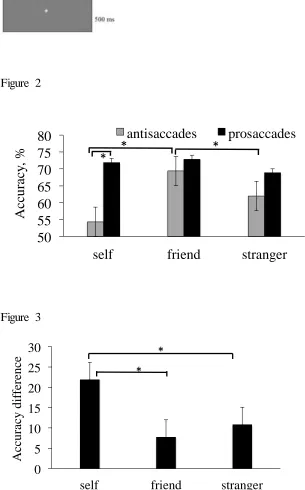
stranger associations). There was a main effect of saccade type (F(1,32)=18.56, p<0.001, ηp2.65; 90% CI [ 0.47, 0.75]) indicating that saccadic directional accuracy on anti-saccade
trials (M=61.6, SD=4.3) was lower than on pro-saccade trials (M=75.9, SD=3.21) (Figure
2). There was a main effect of stimulus (F(2,64)=6.78, p=0.007, ηp²=.34; 90% CI [ 0.019,
0.43]) and an interaction of saccade type *stimulus (F(2,64)=8.52, p=0.002, ηp²=.42, 90%
CI [0 .023, 0.59]). Two separate ANOVAs were performed to test the interaction effect
(Figure 2). The results show that there was a main effect of stimulus on anti-saccade
(F(2,64)=8.59, p=0.001, ηp²=.39; 90% CI [ 0.026, 0.48]); there was lower saccadic
directional accuracy for self compared to friend (t(32)=3.27, p=0.005; dz = 0.56; 95% CI
for dz [ 0.35, 0.67]), and for stranger compared to friend stimuli (t(32)=3.5, p=0.004; dz =
0.60; 95% CI for dz [0.49, 0.74]). No significant differences were found between
anti-saccades for self and stranger although the trend was for responses to be more errors in
saccadic direction for stranger stimuli (t(32)=1.4, p=0.09, dz = 0.24; 95% CI for dz [ 0.09,
0.23]). There was no effect of stimulus on saccadic directional accuracy of pro-saccades
(F(2,64)=2.1, p=0.16).
(Figure 2 about here)
We further examined anti-saccade and pro-saccade saccadic directional accuracy by
testing whether correct eye-responses for self, friend and stranger stimuli differed from
for all stimuli except anti-saccades for self (t(32)=0.92) were significantly higher than
chance level (t(32)=2.58, p=0.017, dz = 0.44, 95% CI for dz [ 0.29, 0.52]; t(32)=10.26,
p<0.001, dz = 1.78, 95% CI for dz [1.24, 1.93] for friend and stranger anti-saccades
respectively; t(32)=4.76, p<0.001, dz = 0.82, 95% CI for dz [0.67, 1.05]; t(32)=9.36,
p<0.001, dz = 1.62, 95% CI for dz [1.47, 1.63]; t(32)=6.56, p<0.001, dz = 1.14, 95% CI for
dz [1.03, 1.37] for self, friend, stranger pro-saccades respectively).
The cost of voluntary control
To verify above self-biases in saccadic directional accuracy and reduce the variations
of conditions, the difference between pro-and anti-saccades in saccadic directional accuracy
were contrasted for each condition as a measure of the voluntary control of saccades. There
was a main effect of stimulus type (F(2,64)=7.87, p=0.002, ηp² = .32, 90% CI [0.26, 0.43])
showing that the contrast between the two types of saccade was larger for self relative to
friend (t(32)=3.23, p=0.016, dz = 0.56, 95% CI for dz [0.39, 0.68]) and stranger stimuli
(t(32)=2.95, p=0.031, dz = 0.51, 95% CI for dz [0.26, 0.66]) (Figure 3). There was no
difference between voluntary control for friend and stranger stimuli (t(32)=1.05, p=0.84, dz
= 0.18, 95% CI for dz [0.01, 0.16]). The data indicate that the increased difficulty of
making an anti-saccade relative to pro-saccade was exacerbated for self-related stimuli.
(Figure 3 about here)
Inter-trial effect comparisons
Further analyses were performed to test the cost of voluntary control by examining
inter-trial effects of pro-saccades and anti-saccades. We calculated saccadic directional
accuracy for correct anti-saccade trials (for the self, friend and stranger) preceding correct
pro-saccade trials (averaged across self, friend and stranger shapes), along also with
measures ANOVA with preceding saccade (anti-saccade, pro-saccade) and preceding shape
type (self, friend, stranger) as within subject factors was carried out to examine the
inter-trial effects. There was a main effect of preceding saccade (F(1,32)=76.79, p<0.001, ηp²=.78, 90% CI [0.59, 0.89]); a main effect of shape type (F(2,64)=10.23, p<0.001,
ηp²=.37, 90% CI [0.21, 0.54]) and an interaction of preceding saccade* preceding shape
type (F(2,64)=11.68, p<0.001, ηp²=.39; 90% CI [0.22, 0.57]).
To explore the interaction effect, two separate ANOVAs were performed for each
type of preceding saccade. In the first ANOVA we examined whether anti-saccades for
self, friend and stranger on trial N-1 had a differential effect on saccadic directional
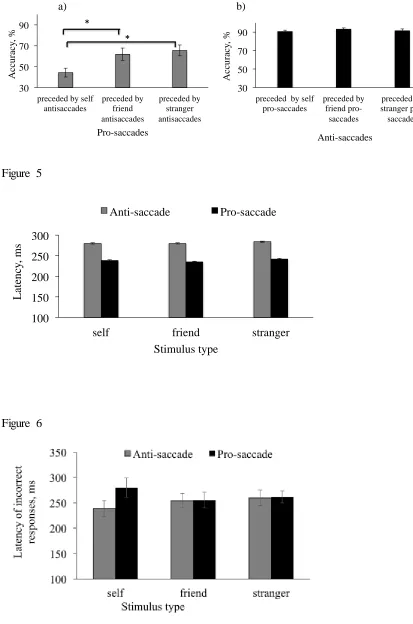
accuracy of the next pro-saccade trial (trial N). The results showed significantly lower
accuracy in saccade trials preceded by correct self-anti-saccades compared to
pro-saccades preceded by correct anti-pro-saccades to friend stimuli (t(32)=5.9, p<0.001, dz = 1.03,
95% CI for dz [0.66, 1.29]) and to stranger stimuli (t(32)=7.1, p<0.001, dz = 1.23, 95% CI
for dz [1.02, 1.44]) (overall, F(2,64)=11.47, p<0.001, ηp²=.39; 90% CI [0.11, 0.52]). There
was no difference in saccadic directional accuracy of pro-saccades preceded by correct
friend and stranger-anti-saccades (t(32)=0.85) (Figure 4, a). The second ANOVA tested
whether making a preceding correct pro-saccade to self, friend and stranger shapes affected
saccadic directional accuracy for the next anti-saccade trial. The result indicated that there
was no differential effect of the preceding pro-saccade on anti-saccade saccadic accuracy
(F(2,64)=0.41 (Figure 4, b).
(Figure 4 about here)
In addition to measuring saccadic directional accuracy, we calculated the latency of
the first correct and incorrect eye-movement4. First, a two way repeated measures ANOVA
was carried out to examine the effect of saccade type (anti-saccade, pro-saccade) and
stimulus (self, friend, stranger) on latency of correct responses (Figure 5). There was a
main effect of saccade type (F(1,32)=12.95, p=0.001, ηp²=.39, 90% CI [0.19, 0.56])
indicating that latencies for pro-saccade trials were shorter compared to anti-saccade trials.
No other terms were found significant (no main effect of stimulus (F(2,64)=0.79; no
interaction of saccade type*stimulus (F(2,64)=0.88)).
(Figure 5 about here)
Then, a similar two-way repeated measures ANOVA was performed on the latency
of incorrect responses. There were no main effects of saccade type (F(1,32)=0.25) and
stimulus (F(1,32)=0.404). However, the interaction between saccade type and stimulus
(F(2, 64)=3.26, p=0.044 ηp²=.09, 90% CI [0.07, 0.18]) was significant (Figure 6). Paired
sample t-test showed that latency of incorrect responses for self anti-saccade condition was
significantly shorter compared to incorrect responses for self saccade condition (t(32)=2.63,
p=0.031, dz = 0.43, 95% CI for dz [0.23, 0.57]) . No reliable differences were found
between friend anti-saccade and friend saccade trials (t(32)=0.036, and between stranger
anti-saccade and stranger saccade conditions (t(32)=0.12.
(Figure 6 about here)
Our inter-trial comparisons showed significantly lower accuracy in pro-saccade trials
preceded by correct self-anti-saccades compared to pro-saccades preceded by
other-anti-saccades (Figure 4). If the preceding correct self-anti-saccade are required more control
(inhibition) to be generated, we may expect that the subsequent pro-saccades are also
4 We also examined the effect of stimuli on the amplitude of saccadic responses, but no
delayed5. To test this assumption, we calculated saccadic latency for correct anti-saccade
trials (for the self, friend and stranger) preceding correct pro-saccade trials (averaged across
self, friend and stranger shapes), along with saccadic latency for correct pro-saccade trials
for each shape preceding correct anti-saccade trials (averaged across self, friend and
stranger stimuli).
A two-way repeated measures ANOVA with preceding saccade (anti-saccade,
pro-saccade) and preceding shape type (self, friend, stranger) as within subject factors was
carried out to examine the inter-trial effects on saccadic latency (Figure 7). There was a
main effect of preceding shape type (F(2,64)=4.4, p=0.016, ηp²=.12, 90% CI [0.06, 0.23])
indicating that preceding self-shape slowed down saccadic latency on the subsequent
pro-saccades. There was no effect of preceding saccade (F(1,32)=0.22 or interaction effect
(F(2,64)=1.78, p=0.17). To explore the effect of preceding shape type, two separate
ANOVAs were performed on the saccadic latency for anti-saccades and pro-saccades.
There was a main effect of preceding shape type in anti-saccade trials (F(2,64)=5.11,
p=0.009, ηp²=.14, 90% CI [0.08, 0.41] showing significant delays in pro-saccades preceded
by self-shape compared to friend-shape (p=0.003) and stranger-shape (p=0.037) (adjusted
for multiple comparisons using Bonferroni correction). No effect of preceding shape type in
pro-saccade trials was found (F(2,64)=0.41).
(Figure 7 about here)
DISCUSSION
In line with previous findings, our results show that anti-saccadic responses elicit
more saccadic errors compared to pro-saccades (Barton, Raoof, Jameel, & Manoach, 2006;
Nieuwenhuis, Broerse, Nielen, & de Jong, 2004; Hallett, 1978). More pertinently,
however, this effect was stronger for self than friend stimuli. In addition, relative to
stranger stimuli, self stimuli showed a significantly greater contrast between pro- and
anti-saccade trials and anti-anti-saccades only for self-stimuli. Furthermore, our data showed greater
disruption on pro-saccades when the preceding trial required an anti-saccade to self-stimuli
compared with other stimuli. Taken together, both findings indicate (i) an increase in the
relative difficulty of anti-saccades for self-related items, (ii) larger disruption in
pro-saccade responses (in both saccadic directional accuracy and latency) preceded by
self-anti-saccades. This latter finding may stem from the requirement to inhibit a pro-saccade to the
self stimulus when an anti-saccade was required on trial N-1, which may then make it more
difficult to generate a pro-saccade on trial N. Furthermore, our data of the latency of
incorrect responses showed that only for ‘self’ condition incorrect responses for the
anti-saccade trials were significantly shorter compared to pro-anti-saccade trials. The results suggest
that there are qualitative differences in the ability to generate an anti-saccade away from a
stimulus associated with the self compared with other people. Note that this result is highly
unlikely to reflect the difficulty of matching self-related stimuli since a strong advantage
for matching self-related items has been consistently demonstrated in the literature (e.g.,
Sui et al., 2012).
Current views on anti-saccadic responses (e.g., Barton, Raoof, Jamel, & Manoach,
2006; Munoz & Everling 2004) propose an involvement of two processing stages that are
linked to two independent mechanisms: (1) suppressing an automatic pro-saccade
eye-movement and (2) generating instead a voluntary saccade in the opposite direction.
Presumably, the higher cost of voluntary control for self-associated responses may reflect
either or both stages together. If the cost of voluntary control is linked to the suppression of
reflexive saccades (e.g., if the inhibition of pre-target activity for the self takes longer
voluntary saccade remains the same for all stimuli, then we should expect longer latencies
for self-anti-saccades compared to others. However, we found no significant differences in
correct anti-saccade latency between the conditions. On the other hand, there may need to
be more inhibition of the pro-saccade to self stimuli, even if the time to generate effective
inhibition (e.g., to enable an anti-saccade to be made) does not differ for the contrasting
stimuli. It would then follow that it may be more difficult to generate a subsequent
pro-saccade, since the pro-saccade will be strongly inhibited. This is what we observed. Our
results on inter-trial effects support the idea that there is greater suppression of
pro-saccades to make an anti-saccade to a self-related stimulus. We also observed longer
latency on pro-saccades preceded by self-anti-saccades. This finding further support the
idea that the correct anti-saccades for self-associated stimuli require more control
(inhibition) to be generated.
In contrast to the effects of self-related stimuli, anti-saccades to friend-related stimuli
were easier to make than those to stimuli related to a stranger. This result is interesting
since it indicates a dissociation between effects of self-association (disrupting
anti-saccades) and effects of familiarity (the association to a friend). We propose that familiar
stimuli (friend associations) are processed more efficiently than unfamiliar stimuli (stranger
associations) and exert a reduced cost on difficult responses (anti-saccades). Self-related
stimuli, on the other hand, cue attention to themselves, disrupting anti-saccades. Our
results provide strong support for the attentional draw of self-associated stimuli and suggest
that voluntary saccadic responses away from a self-related item demand greater inhibition
than is the case for stimuli related to other people.
In addition, a recent eye-tracking study (Siebold, Weaver, Donk, & van Zoest, 2016)
using an oculomotor visual search paradigm did not find the effects of self on an early
orientation lines (right- and left-tilted) and two labels (‘you' and ‘stranger'), and then make
a speeded eye-movements to one of the two lines without any task instruction (Experiment
1), to dot probe target located on one of the two lines (Experiment 2), or to the line that was
cued by its associated label (Experiment 3). Similar to our finding, there was no effect of
self-prioritization on involuntary eye-movements. Furthermore, the study suggests that
top-down information affects detection responses, but not localization of socially salient stimuli, providing indirect support for our conclusion that once a ‘self-cued' stimulus is
detected, it is more difficult to control involuntary eye-movement.
The results of the present study raise an important question for further studies: what is
the relationship between individual differences in the magnitude of self-biases (i.e., the
response time advantage for stimuli associated with self compared to other) and the cost of
voluntary control of saccades for self. If the magnitude of the facilitation effect for
self-associated stimuli can predict the cost of self-related attentional control, this may have
important implications in neuropsychological studies (e.g., in patients with lesions affecting
brain regions shown to be related to self-biases (van den Bos & Güroğlu, 2009) and the
frontal eye fields (Machado & Rafal, 2003), patients suffering from depression (Koenigs &
Grafman, 2009).
References
Alexopoulos, T., Muller, D., Ric, F., & Marendaz, C. . (2012). I, me, mine: Automatic attentional capture by self‐related stimuli. European Journal of Social Psychology, 42(6), 770-779.
Barton, J. J., Raoof, M., Jameel, O., & Manoach, D. S. (2006). Task-switching with antisaccades versus no-go trials: a comparison of inter-trial effects. Exp Brain Res, 172(1), 114-119. doi: 10.1007/s00221-005-0313-6
Bredart, S., Delchambre, M., & Laureys, S. (2006). Short article one's own face is hard to ignore. Quaterly Journal of Experimental Psychology (Hove), 59(1), 46-52. doi: 10.1080/17470210500343678
Bundesen, C., Kyllingsbaek, S., Houmann, K. J., & Jensen, R. M. (1997). Is visual
Devue, C., Laloyaux, C., Feyers, D., Theeuwes, J., & Bredart, S. (2009). Do pictures of faces, and which ones, capture attention in the inattentional-blindness paradigm? Perception, 38(4), 552-568.
Devue, C., Van der Stigchel, S., Bredart, S., & Theeuwes, J. (2009). You do not find your own face faster; you just look at it longer. Cognition, 111(1), 114-122. doi:
10.1016/j.cognition.2009.01.003
Gronau, N., Cohen, A., & Ben-Shakhar, G. (2003). Dissociations of personally significant and task-relevant distractors inside and outside the focus of attention: a combined behavioral and psychophysiological study. J Exp Psychol Gen, 132(4), 512-529. doi: 10.1037/0096-3445.132.4.512
Hallett, P. E. (1978). Primary and secondary saccades to goals defined by instructions. Vision Research, 18(10), 1279-1296.)
Kawahara, J., & Yamada, Y. (2004). Does one’s name attract visual attention? Visual Cognition, 11, 997-1017.
Koenigs, M.& Grafman, J. (2009). The functional neuroanatomy of depression: Distinct roles for ventromedial and dorsolateral prefrontal cortex. Behavioral Brain Research, 201(2), 239–243. doi:10.1016/j.bbr.2009.03.004
Ma, Y., & Han, S. (2010). Why we respond faster to the self than to others? An implicit positive association theory of self-advantage during implicit face recognition. J Exp Psychol Hum Percept Perform, 36(3), 619-633. doi: 10.1037/a0015797
Machado, L.; & Rafal, R.D. (2004) Control of fixation and saccades during an anti-saccade task: an investigation in humans with chronic lesions of oculomotor cortex.
Experimental Brain Research. 156(1), 55-63
Munoz, D., & Everling, S. (2004) Look away: the anti-saccade task and the voluntary control of eye movement. Nat Rev Neurosci, 5, 218–228. doi:10.1038/nrn1345 Nieuwenhuis, S., Broerse, A., Nielen, M. M., & de Jong, R. (2004). A goal activation
approach to the study of executive function: an application to antisaccade tasks. Brain Cogn, 56(2), 198-214. doi: 10.1016/j.bandc.2003.12.002
Siebold A., Weaver M.D., Donk M., & van Zoest W. (2016), Social salience does not transfer to oculomotor visual search. Visual Cognition, 23 (8), 989-1019. doi:10.1080/13506285.2015.1121946
Stolte M, Humphreys G, Yankouskaya A, Sui J. (2015). Dissociating Biases Towards the Self and Positive Emotion. Quaterly Journal of Experimental Psychology (Hove), 7, 1-34.
Sui, J., He, X., & Humphreys, G. W. (2012). Perceptual effects of social salience: evidence from self-prioritization effects on perceptual matching. Journal of Experimental Psychology. Human Perception and Performance, 38(5), 1105-1117. doi:
10.1037/a0029792
Sui, J., Liu, M., Mevorach, C., & Humphreys, G. W. (2015). The salient self: the left intraparietal sulcus responds to social as well as perceptual-salience after self-association. Cerebral Cortex, 25(4), 1060-1068. doi: 10.1093/cercor/bht302 Sui, J., Sun, Y., Peng, K., & Humphreys, G. W. (2014). The automatic and the expected
self: separating self- and familiarity biases effects by manipulating stimulus probability. Attention, Perception andPsychophysics, 76(4), 1176-1184. doi: 10.3758/s13414-014-0631-5
Theeuwes, J., Van der Stigchel, S., & Olivers, C. N. (2006). Spatial working memory and inhibition of return. Psychonomic Bulletin and Review, 13(4), 608-613.
Turk, D. J., Cunningham, S. J., & Macrae, C. N. (2008). Self-memory biases in explicit and incidental encoding of trait adjectives. Conscious Cognition, 17(3), 1040-1045. doi: 10.1016/j.concog.2008.02.004
Turk, D. J., van Bussel, K., Brebner, J. L., Toma, A. S., Krigolson, O., & Handy, T. C. (2011). When "it" becomes "mine": attentional biases triggered by object ownership. Journal Cognitive Neuroscience, 23(12), 3725-3733. doi: 10.1162/jocn_a_00101
Turk, D. J., van Bussel, K., Waiter, G. D., & Macrae, C. N. (2011). Mine and me: exploring the neural basis of object ownership. Journal Cognitive Neuroscience, 23(11), 3657-3668. doi: 10.1162/jocn_a_00042
van den Bos, W., & Güroğlu, B. (2009). The Role of the Ventral Medial Prefrontal Cortex in Social Decision Making. Journal of Neuroscience, 29(24), 7631-7632. doi: 10.1523/JNEUROSCI.1821-09.2009
Figure 1. Trial sequence
Figure.2 Saccadic directional accuracy for anti-saccades and pro-saccades for self, friend and stranger stimuli. Error bars represent +/- 1SEM. The stars indicate significant
differences between a pair of conditions (adjusted for multiple comparisons using Bonferroni correction).
Figure 3. Saccadic directional accuracy difference between pro- and anti-saccades. Error bars represent +/- 1SEM. The stars indicate significant differences between a pair of conditions (adjusted for multiple comparisons using Bonferroni correction).
Figure 4. Inter-trial effects of preceding self-, friend-, stranger-anti-saccades on the accuracy of the next pro-saccade trials (a); and effects of preceding self-, friend- stranger-pro-saccades on the directional accuracy of the next anti-saccade trial (b). Error bars represent +/- 1 SEM. The stars indicate significant differences between a pair of conditions (adjusted for multiple comparisons using Bonferroni correction).
Figure 5. Latency for correct anti-saccade and pro-saccade trials. Error bars represent +/- 1SEM.
Figure 6. Latency for incorrect anti-saccade and pro-saccade trials. Error bars represent +/- 1SEM.
Figure 7. Inter-trial effects of preceding self-, friend-, stranger-anti-saccades on the latency of the next pro-saccade trials (a); and effects of preceding self-, friend-
Figure 2
Figure 3
Figure 4
50
55
60
65
70
75
80
self
friend
stranger
A
cc
u
ra
cy
,
%
antisaccades
prosaccades
*
*
*
0 5 10 15 20 25 30self friend stranger
Figure 5
Figure 6
Figure 7
30 50 70 90
preceded by self pro-saccades preceded by friend pro-saccades preceded by stranger pro-saccades A cc u ra cy , % Anti-saccades 30 50 70 90
preceded by self antisaccades preceded by friend antisaccades preceded by stranger antisaccades A cc u ra cy , % Pro-saccades
a) b)
* * 100 150 200 250 300
self friend stranger
L at en cy , m s Stimulus type