Intellect journal article No: 2674
Submitted to Intellect journal Drawing: Research, Theory, Practice 5 Nov 2016 Accepted subject to revision 17 Feb 2017
This version re-numbered No. 2929 revised 22 March 2017
Due for publication in Vol.2 No.2 late 2017
Talking the line: inclusive strategies for the teaching of drawing
.Authors
Qona Rankin (Royal College of Art) Howard Riley (Swansea College of Art) Nicola Brunswick (Middlesex University) Chris McManus (University College London)
Rebecca Chamberlain (Goldsmiths, University of London)
Abstract
The article reports on a series of drawing workshops held at the Royal College of Art (RCA), London, which tested an original pedagogical strategy designed to help dyslexic and/or dyspraxic art and design students who had reported difficulties with their abilities to make accurate representational drawings. A group of non-dyslexic/dyspraxic RCA students volunteered as control group, and both cohorts completed three days of workshops in the
Drawing Studio of the RCA. Results of recorded interviews eliciting student observations as they drew, and a questionnaire in the form of a Likert scale, administered before and after the
workshop indicate positive shifts in both cohorts’ attitudes towards specific aspects of the stages involved in the production of accurate representational drawings of still-life set-ups, the human skeleton, and the clothed life-model. Assessment of the drawings produced indicates positive shifts in the two cohorts in geometric accuracy and other qualitative criteria embedded in the teaching strategy such as control of scale, proportion and illusions of depth. Both cohorts displayed similar positive attitude shifts and both sets of drawings indicated similar positive shifts in visual qualities. An interim conclusion posits that the pedagogical strategy appears to enhance the abilities of both dyslexic/dyspraxic students and non-dyslexic/dyspraxic students to make accurate representational drawings. This result correlates closely with the findings of an earlier, prototype workshop held at the RCA in July 2012. It is suggested that similar
Keywords: art students pedagogy drawing dyslexia inclusivity
Introduction
This article is based upon a presentation made by two of the authors (Rankin and Riley) to the
10th International Conference of the British Dyslexia Association, held in Oxford, March 2016. We started from the premise that dyslexic readers’ cognitive differences as described by Uta
Frith (1997), Margaret Snowling (1997), Amanda Kirby (1999), Tilly Mortimore (2003) and Liz
Du Pre, Dorothy Gilroy and Tim Miles (2008), impact on how, and the speed with which they
receive, hold, retrieve and structure information. We also understand from interview responses
that some dyslexic/dyspraxic art students feel that they cannot draw well, so we set out with the
hope of being able to help those students who recognise certain shortcomings in their drawing to
improve their observational drawing skills.
Recently, on the BBC Radio 4 programme The Art of Walking into Doors (Ledgard 2015), one of
us (McManus) described drawing from observation as: ‘…taking in visual input, processing it
through our eye, through our brain, sending it to another bit of the brain that produces motor
outputs and moving our hand in just the right way to make the two look the same, it’s a very
complicated process’.
We are interested in how the cognitive differences of dyslexia affect the complications of
perceiving (receiving) and structuring the transformation of a three-dimensional object in space
into a two-dimensional drawing, and whether teaching strategies developed to help dyslexic
A short explanation of dyslexia/dyspraxia and its relevance to drawing
It has long been accepted that dyslexia affects the way information is processed, stored and
retrieved, with problems of memory, speed of processing, time perception, organisation and
sequencing. More recently dyspraxia has been recognized as a condition affecting fine and/or
gross motor coordination, which can also have serious negative impacts on daily life, including
social, emotional difficulties as well as problems with time management, planning and
organization. Moreover, there has been a lot of debate amongst researchers in this field
addressing the notion of a lack of automaticity contributing to the reading deficit in dyslexic
children and fine and/or gross motor coordination difficulties often seen in dyspraxic individuals
(Nicolson and Fawcett 1990)
Most observational drawing involves looking at an object and then looking away to the drawing.
This inevitably requires a short-term storage of the visual information so that corresponding
marks can be made on the paper. In the same way that short term memory problems can
negatively affect the reader we suggest that the drawer may be similarly affected. In addition,
since drawing is in part a symbolic act of representing the visual world by arbitrary marks, then
dyslexic readers may also have specific problems with making marks in drawings. A paucity of
planning and organisational skills and visual perceptual confusion between field and ground
could adversely affect the composition of a drawing. The inability to accurately control a pen or
pencil due to motor co-ordination difficulties may present additional difficulties to the dyspraxic
drawer.
Although we have not been able to provide empirical evidence to suggest that dyslexic and
dyspraxic processing difficulties should be a consideration when teaching drawing, we have
poor at drawing (McManus et al., 2010) and some of our previous research findings (eg
Chamberlain et al., 2015) raised several possibilities: firstly, it would appear that motivational
and personality factors are important in being able to draw well, and it may be that increasing
both motivation and the opportunity to practise drawing will improve performance (as with any
complex skill); secondly, it has been well documented that specific teaching strategies1 can have
enormous benefit on the learning of both dyslexic and dyspraxic students (Mortimore 2003;
Fleming and Kleinhenz 2007)
Therefore we wish to test the possibility that art students with dyslexia may benefit from the
explicit teaching of techniques for carrying out basic skills such as accurately representing angles
and proportions, judging figure/field relationships, and re-conceptualising their processes of
perception by ‘looking without language’: this phrase relates to the idea that when we are able to
label what we see with a particular word, we tend to use that filter of language to the detriment of
the actual information received in the structure of the arrays of light arriving at the eyes. One
simple way of by-passing the filter of language is to concentrate attention on those areas of the
visual field which have no language-label; these areas are referred to as ‘negative spaces’ - the
spaces between objects - or ‘shapes of tones’, defined by the contrast boundaries between areas
of tone or texture which together make up the overall layouts of the objects within the visual
field.
In addition, we are interested to explore whether the students’ verbal articulation of their drawing
processes whilst drawing could also be of benefit. Changing the internal dialogue from what is
known to what is perceived may impact upon how, and how fast, the visual information from the primary geometry of the scene (i.e. the arrangement in space of lines of projection from the
the drawings (the relationships between points, lines and shapes of tone). Students’ verbal
reflections recorded whilst drawing are transcribed at appropriate places in the article.
The drawing workshops: description of teaching strategies
The workshops are structured upon a teaching strategy designed to consolidate the student’s
learning through repetitive procedures adapted from Nist and Kirby (1986) and reported in Nist
and Mealey (1991) and Mortimore (2003). This type of learning follows an eight-step process:
1. Focus attention
2. Give a general overview 3. Introduce new terms
4. Go through the procedure step by step
5. Model the process - think aloud - introduce new frameworks of thought; the students also discuss the process and teach each other
6. Guide the practice- students repeat the instructor’s strategy with support 7. Independent practice
8. Re-demonstrate the practice, if necessary, to reinforce
The eight-step process outlined above has been adapted to a strategy of teaching drawing in a
traditional drawing studio where the student is encouraged:
1. To focus attention upon the subject-matter and its relationship with the surroundings
(figure/field relations): relationships of format, scale and positioning of the drawing
within the picture-plane (the drawing sheet itself) relevant to the main axes of the
drawing sheet.
2. To construct a general structure, or scaffolding: in terms of life-drawing, this would relate
to the main axes of the model’s pose, using, for example, the ‘invisible grid’ of lines
running across the figure that connect salient points such as nose, nipples, navel, knees,
and knuckles. These axes might be the vehicle by which students hone their skills of
accuracy in drawing angles and lengths in proportion so that the repetitive, low-level
3. To explore visual concepts such as contrast boundary in place of the common term
‘outline’. This immediately engages the student with the variety of tonal values across the
whole subject-matter and, in particular, allows the student to notice how the contrast
boundary fluctuates at the edges between figure and field. The concept of negative space
(spaces between those items in the visual field normally labelled with language), can also
aid students to look without language, to apply specifically non-verbal methods in the
process of drawing. Thirdly, to draw attention to the visual vertices, simply described as
T and Y junctions apparent as edges where two surfaces are occluded by a third (Biederman 1987; Ostrofsky and Kozbelt 2012)
4. Tutor demonstrates Steps 1-3. Students repeat these first three steps at the beginning of
every new drawing.
5. To discuss with the tutor the process under way on the drawing board.
6. To repeat the recommended strategies with support from the tutor.
7. To draw independently at unsupervised open-access drawing sessions.
8. Tutor re-demonstrates the practices and strategies in order to reinforce them.
The drawing workshops: details of participants
Thirteen students, all with extensive experience in drawing, volunteered to spend three days
drawing as part of the AcrossRCA programme in October 2015. This programme is a series of
cross-curricular projects that takes place each October at the Royal College of Art. A follow-up
workshop was held in January 2016. (There had also been a prior, prototype workshop held at
Of the five male and eight female participants with an age range between 23 and 67 years, two
were statemented as dyspraxic, three dyslexic, three were dyslexic and dyspraxic, and five had
no assessment. Only one student was left-handed. Students came from a wide range of College
departments: Jewellery & Metalwork, Industrial Design Engineering, Ceramics & Glass, Global
Innovation Design, Design Products, Textiles, Visual Communication, Curating Contemporary
Art, Printmaking, and Painting. The common basis of all these practices has been described as an
‘intelligence of seeing’ (Riley 2008). Drawing nurtures the development of such intelligence.
Throughout the workshops, participants were also encouraged to verbalise any thoughts that
came to mind whilst they were being filmed. They were given guidelines on how to make a
concurrent verbal report, taken from Perkins (in Fayena-Tawil, Kozbelt and Sitaris 2011: 138). A
Sony Handycam digital video recorder was initially attached to a tripod and positioned over the participants’ right shoulder to record action and verbalised thoughts. However, due to lack of
space in the drawing studio the camera was ultimately hand-held. Every two minutes throughout
the sessions the camera was moved to a different participant. The camera operator prompted the
participant if he or she fell silent for more than a few seconds. Prompts were questions like
‘What are you thinking about now?’ ‘What’s on your mind now?’ Selected comments by the
students are included in the discussion below. (All students gave written consent to their
comments being transcribed for the purpose of publication).
The drawing workshops: detailed description of content and procedure over the 3 days A pre-workshop questionnaire was completed prior to first drawing. The questionnaire, in the
form of a 7-point Likert scale ranging from ‘Strongly Disagree’ (1) through to ‘Strongly Agree’
fundamental concepts and strategies for constructing a 2-D representation of the 3-D visual field,
and also a self-assessment of their competencies in applying those strategies.
Participants were given A2 and A3 sheets of cartridge paper and could choose to use pencil,
charcoal or chalk pastel. (This variety of media enabled students to explore the maxim that the
medium dictates the scale of the drawing.) The objects to be drawn were selected for their range
of organic/geometric qualities, lending the compositions a range of possibilities for combining
lengths, angles, edges, a variety of scales, and arranged so as to emphasise negative spaces and
contrast boundaries within the structure of the primary geometry of the observed scene.
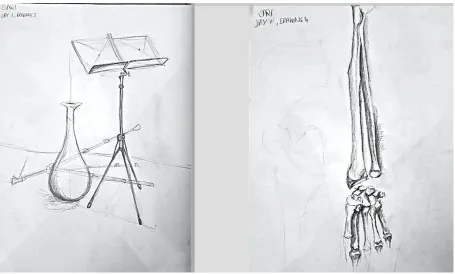
Day 1 only: For the first drawing of the day, a still-life set-up, no tuition advice was offered, so
that the drawings serve as the baseline for judging any improvements across the three days. A
copy of an article ((Rankin et al., 2012) outlining the structure of the specific strategies to be
employed in the teaching of dyslexic students, an 8-step model adapted from Sherrie Nist and
Kate Kirby (1986 in Nist and Mealey 1991: 60-61) was handed out after this first drawing.
All Days:
10am-11.30am Three drawings of half an hour each
A still-life comprising a mix of organic and inorganic objects was set up.
Drawing 1: Students were advised to make decisions on format (portrait/landscape/square) relative to the overall proportions of the subject-matter, and also to consider figure/field
relationships in terms of scale, balance, symmetry with regard to the major axes of the drawing
paper: the centre vertical, the centre horizontal, the two diagonals. Students were encouraged to
concentrate upon the linear and angular relationships between the edges of the objects within the
Drawing 2: Students’ attention was drawn to the negative spaces between the objects on display, those spaces unlabelled with words. The phrase looking without language was introduced as the
topic.
Drawing 3: Students were encouraged to focus on contrast boundaries within the set-up: information about surfaces and edges contained in the structured light arriving at our eyes, with
an emphasis on using tone and texture. No ‘outlines’ were allowed!
12noon -1pm One drawing
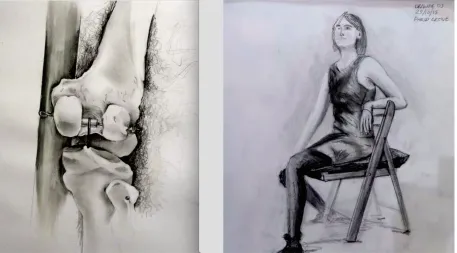
A full-sized human skeleton was set up. The tutor’s initial advice focussed upon proportion
between parts of the skeleton, and the judgement of length and angle. In this way, a ‘scaffolding’
of lines connecting salient points in the skeleton itself was produced. Switching attention from
solid forms to the negative spaces between was encouraged as a means of controlling accuracy of
shapes, and the concept of contrast boundaries between tonal and textural properties of the set-up
was reiterated in one-to-one discussions with students.
2pm- 3pm One drawing
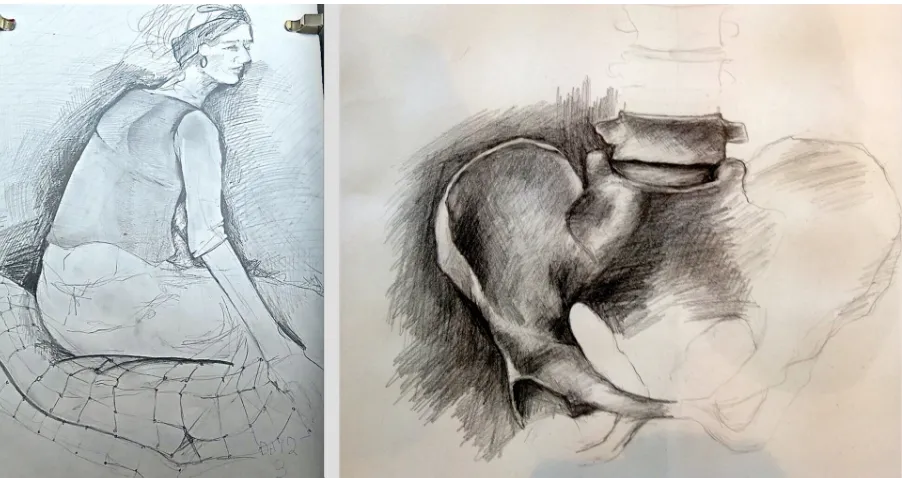
Drawing from clothed life model. Tutorial advice emphasised the topics already covered in the
earlier drawing exercises, but with additional tuition about primary geometry and secondary
geometry (i.e. how the arrangement in space of lines of projection from the three-dimensional
objects to the plane of projection is translated into the secondary geometry of the drawings: the
relationships between points, lines and shapes of tone and texture).
3.30pm-4pm Continue life drawing prior to display and group discussion.
Discussion and analysis of drawings produced in the workshops
There have been growing suggestions that the style of drawings of dyslexic and non-dyslexic art
students may be different, with Grant (2008) suggesting that in dyslexic students ‘…the brain is
thinking faster than the hand can execute an idea’, their drawings having smaller strokes, lines
that overlap, fainter marks, and a 'wooden feel'. Such observations correlate with the taxonomy
of indicators of dyslexia developed by Rankin, Riley and Davies (2007).
Professor John Stein of Oxford University (in Ledgard 2015) recently observed ‘The dyslexic
brain works slower but will see all sorts of alternative routes and often sees the correct result
without going through the linear steps often resulting in very creative solutions to a problem. 2-D
drawing requires the ability to go from A to B to C linear thinking, whereas in fact the dyslexic
(sic) may have seen the 3-D structure in its entirety and it’s very difficult for them then to go into
this linear way of putting it down on paper.’
There was a noticeable improvement in the confidence displayed in the drawings made across
the October 2015 workshops and the January 2016 follow-up workshop, where the tentative
wispy marks in the first drawings, exemplified in Figure 1(L), develop into drawn marks
indicating confidence through their robustness and boldness, for example Figure 1 (R). This
visual assessment of confidence is corroborated by the questionnaire results, and exemplified in
these student comments:
‘I was just thinking this particular, what you call hairy lines it’s almost like how my short-term memory is working, it’s like a bit strobe lighting going down like that rather than a nice you know, sort of fractured impression in my mind. I can feel confident about one line and then when it comes to matching it up with another line then suddenly it’s all wrong’.
Figure 1 (L): Student A (dyspraxic) Day 1 Drawing 1. (R): Student A (dyspraxic) Day 1 Drawing 4.
‘I’m trying to not do lots of strokes just do definite single strokes so I’m thinking about trying to get the geometry right by having crisp, definite, confident lines’.
It was salutary to hear this dyspraxic student articulate what the teaching strategy had
specifically identified as a prime reason for students’ disappointment with their drawings: her
inability to plan and organise the detailed parts of her drawing so that it ‘…fitted onto the paper’:
‘I’m trying to place everything on the page in a geometric form. I’m trying to find the geometry, the shapes, just to get the proportion of how everything is related.’
This particular problem is one that is recognised and addressed in the earliest stage of the
workshops. The observations made by students about losing their place in the drawing, for
example forgetting which of the skeleton’s ribs they were working on and sometimes correcting
the wrong rib, can be compared to the typical eye-tracking difficulties many dyslexic children
the visual magnocellular system is often impaired. Clearly this could interfere both with the
reliable direction of visual attention and of eye movements’.
Once the student is able to control the scale and positioning of the drawing using the scaffolding
of the major axes relative to the scale and format of the drawing paper, (Figure 2 L), confidence
is established to elaborate on the next stages of drawing construction. The metaphor of
‘scaffolding’ resonates with Mortimore’s (2003) observations about dyslexic students’
tendencies to be wholist thinkers who often have trouble organising details in order to support an
overall argument in written form: ‘…strategies to help wholists will include…scaffolding frames
to support the oral or written expression of information. (p. 118)’
Figure 2 (L): Student B (dyslexic) Day 1 Drawing 3. Use of axes to control details of scale and figure/field relationships. (R): Student C (dyspraxic) Day 2 Drawing 2. Focus upon negative spaces controls proportion and figure/field relationship.
The concept of negative space is familiar to most teachers and experienced practitioners of
drawing. However, the concentrated and repeated observation of such spaces, unlabelled by
language, appears to improve control of a drawing’s proportional relationships between negative
and positive shapes making up the figure/field composition. (Figure 2 R). As this student notes:
helpful with the fingers cause I think there’s a tendency to feel like they're sort of sausages. For me anyway I need to count them one, two, three, four’.
Similarly, the concept of contrast boundaries, relating to the edges between areas of tone and/or
texture in the visual field, is recognised by many teachers of drawing as being a more direct way
of producing illusions of depth within a drawing (Figure 3 L) much more direct than the practice
common to many students of drawing of trying to ‘walk the tightrope of the outline’.
‘I’m thinking about, I’ve made it so flat that I cannot distinguish what is what any more so I’m trying to make it stand out a bit more by blurring the edges and introducing the back ground instead of doing it the other way around’. (Student comment)
Figure 3 (L): Student D (non-dyslexic) Day 3 Drawing 2. Use of contrast boundaries produces illusions of depth. (R): Student E (dyslexic) Day 3 Drawing 3. Observation of ‘T and Y junctions’ the pattern of edges made where one surface occludes another, and both occlude a third. For example, at the junction where the model’s left wrist occludes the rib-cage and background.
The repeated strategy of observing edges rather than outlines also aids the awareness of the ‘T
and Y junctions’, produced whenever one tonal or textured surface occludes another, against the
Finally, Figure 4 shows a couple of examples illustrating the full range of the teaching strategies
in drawings made in the latter stages of the workshops.
Figure 4 (L): Student F (dyslexic) Day 2 Drawing 3. (R): Student G (non-dyslexic) January 2016 follow-up workshop.
Conclusions
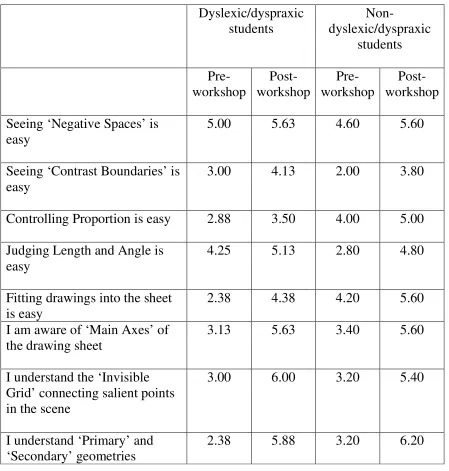
Analysis of the Likert Scale questionnaire administered before and after the workshops indicates
a positive shift in students’ attitudes over the period of the workshops towards the awareness and
understanding of the fundamental concepts and strategies covered (Table 1) This correlates with
an increase in confidence towards the construction of drawings. There appear to be similar
positive shifts in both dyslexic/dyspraxic students and non-statemented students: this could be
construed as evidence of the teaching strategies’ potential to address the issue of inclusivity
Dyslexic/dyspraxic
students
Non-dyslexic/dyspraxic
students
Pre-
workshop
Post-
workshop
Pre-
workshop
Post-workshop
Seeing ‘Negative Spaces’ is
easy
5.00
5.63
4.60
5.60
Seeing ‘Contrast Boundaries’ is
easy
3.00
4.13
2.00
3.80
Controlling Proportion is easy
2.88
3.50
4.00
5.00
Judging Length and Angle is
easy
4.25
5.13
2.80
4.80
Fitting drawings into the sheet
is easy
2.38
4.38
4.20
5.60
I am aware of ‘Main Axes’ of
the drawing sheet
3.13
5.63
3.40
5.60
I understand the ‘Invisible
Grid’ connecting salient points
in the scene
3.00
6.00
3.20
5.40
I understand ‘Primary’ and
‘Secondary’ geometries
2.38
5.88
3.20
6.20
These results correlate closely with the results of an earlier experimental workshop held at the
RCA in July 2012.
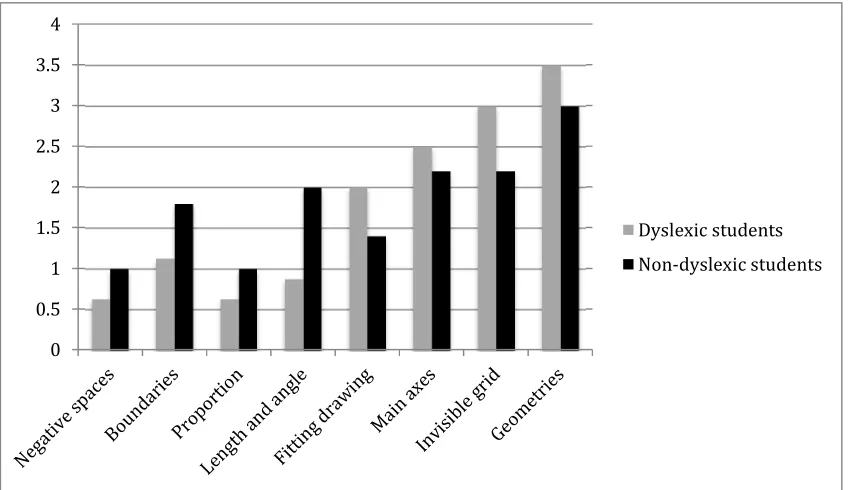
Table 2: Mean change in response for each group pre- and post-workshop across the eight questionnaire items.
Having established that both dyslexic/dyspraxic students and non-dyslexic students indicate
positive attitude shifts towards the key concepts and strategies related to the accurate
construction of drawing and the related indications of an increase in confidence towards the
application of those concepts and strategies, (Table 1), we would like to extend the research (by
increasing the size of the student cohorts) to explore any indications of qualitative differences
between the two cohorts’ drawings. For example, Table 2 indicates that the dyslexic/dyspraxic
students are more confident than the control cohort on those items dealing with relationships
involving the overall pattern of the drawing within its sheet, whilst the control cohort appears to
do better on the items dealing with individual details within the drawing: individual shape, length,
0 0.5 1 1.5 2 2.5 3 3.5 4
angle and contrast boundary. Research is underway to find out more about the possible
correlation between global processing skills and dyslexia.
It would appear from a close observation of the limited number of drawings produced in the four
days of workshops (three in October 2015, one in January 2016) that the drawings of both
cohorts display improvements in terms of the application of the concepts and strategies
employed in the workshops. As an example, Figure 5 represents late-workshop drawings by a
dyslexic/dyspraxic student (L), and a non-dyslexic student (R). It is accepted that a more
in-depth comparison is required before a more authoritative conclusion can be posited.
Figure 5 (L): Student H (dyslexic/dyspraxic). (R): Student J (non-dyslexic).
Further analysis also needs to be carried out in order to assess if the recorded student comments
changed throughout the workshops, but first impressions suggest that the language became more
about what the participants were seeing, and less about their preconceptions.Thepreconceptions.
observing the behaviour as it unfolded in time, informed the insight that led to the questions: are
there behaviours that encourage accurate drawing? How can we use this information to augment
the efficacy of the teaching strategies described in this article in order to help students improve
their drawing ability so that they no longer feel professionally disadvantaged?
At the 10th International Conference of the British Dyslexia Association held in Oxford, March 2016, it was clear that the profile of dyslexia is dynamic and the more we discover the less
helpful very specific definitions seem. We would agree that there needs to be a menu of
interventions that can be matched to individual children’s needs and we would like our drawing
strategy to be included in this. Tom Nicholson (2016) showed a Venn diagram of co-occurrences
of areas of deficit; namely vocabulary, reading and maths. It is tempting to include drawing in
his Venn diagram:
A Vocabulary
B Reading
C maths
D drawing
Figure 6 Venn Diagram incorporating Drawing.
We have shown that our interventions have achieved successful outcomes in the series of RCA
school children with a profile of learning difficulties, to improve their learning experiences and
outcomes at school. This is research yet to be undertaken.
Endnote
1 In the early 1970s with the emergence of cognitive psychology, a strong emphasis was placed
on the reading process of dyslexic students, and there was recognition for the important role that
direct instruction played. Following on from this, there was considerable research into
teacher-directed comprehension strategies. In 1986 Sherrie Nist and Kate Kirby developed a generic
teaching strategy where the instructor guides the learner through an eight-step process. Nist and
Mealey (1991) provided a review of the efficacy of direct instruction strategies, but also
acknowledged the role metacognition had to play. ThusThus, without the abilities to detect errors,
to separate important from unimportant information, and the individual’s ability to self-regulate
their actions during reading, these strategies would fail. The metacognitive component also
enabled the student to build up confidence and so continue with the task once direct instruction
had been withdrawn. Today the eight-step process is often quoted within good practice
guidelines and remedial programmes for supporting dyslexic children (Mortimore 2003) where
an exceptionally structured, explicit, systematic and comprehensive approach is needed. It
seemed entirely appropriate to the present authors to adapt this eight-step process for the
purposes of teaching drawing from observation to students with dyslexia.
References
Biederman, I. (1987), ‘Recognition-by-Components: A Theory of Human Image Understanding’. Psychological Review 94 (2): pp115-147.
Du Pre, Liz, Gilroy, Dorothy and Miles, Tim (2008), Dyslexia at College. 3rd ed. London: Routledge.
Fawcett, Angela J. (ed.) (2001), Dyslexia: Theory & Good Practice. Vol.6. London: Wiley.
Fayena-Tawil, Frieda., Kozbelt, Aaron. and Sitaris, Lemonia. (2011), 'Think Global, Act Local: A
Protocol Analysis Comparison of Artists' and Nonartists' Cognitions, Metacognitions, and
Evaluations While Drawing'. Psychology of Aesthetics, Creativity, and the Arts. 5 (2): pp135-145.
Fleming, J. and Kleinhenz, E. (2007), Towards a Moving School: Developing a Professional Learning and Performance Culture. Melbourne: ACER Press. Frith, Uta (2002), Understanding Dyslexia. Milton Keynes: Open University.
Grant, D. (2010), That's the Way I Think: Dyslexia, Dyspraxia and ADHD Explained. Abingdon: Routledge.
Kirby, Amanda (1999), Dyspraxia. The Hidden Handicap. London: Souvenir Press.
Ledgard, Chris (Producer) (2015), The Art of Walking into Doors. BBC Radio 4 broadcast 28 September 2015. Accessible at: bbc.in/KujXPD
Nicholson, Tom (2016), 'Phonological Awareness and Reading Difficulties'. Keynote address at the 10th International Conference of the British Dyslexia Association. Oxford, March 2016. Proceedings forthcoming.
Nicolson, R.I. and Fawcett, Angela .J. (1990), 'Automaticity: A New Framework for Dyslexia Research?', Cognition. 35(2): pp159-182.
Nist, Sherrie.L., and Kirby, Kate (1986), 'Teaching Comprehension and Study Strategies through Modeling and Thinking Aloud'. Reading Research and Instruction. 25 (4): pp254-264.
Nist, Sherrie. L. and Mealey, Donna. L. (1991), ‘Teacher Directed Comprehension Strategies’. In Teaching Reading and Study Strategies at the College Level edited by Flippo, R. F. & Caverly, D. C. Newark DE: International Reading Association. pp42-85.
McManus, Ian Christopher, Chamberlain, Rebecca, Loo, Phic-Wern, Rankin, Qona, Riley, Howard and Brunswick, Nicola (2010), ‘Art Students Who Cannot Draw: Exploring the Relations Between Drawing Ability, Visual Memory, Accuracy of Copying and Dyslexia’. Psychology of Aesthetics, Creativity and the Arts, 4(1): pp18-30.
Whurr.
Ostrofsky, Justin,. and Kozbelt, Aaron. (2012), ‘A Multi-Stage Attention Hypothesis of Drawing Ability’. In Thinking Through Drawing: Practice into Knowledge edited by Kantrowitz, A., Brew, A. and Fava, M. New York: Columbia University. pp61-66.
Rankin, Qona, Riley, Howard and Davies, Mary (2007), ‘Including Dyslexics: Indicators of Dyslexia in Art Students' Drawings’. Proceedings of the Include 07 Conference. London: Royal College of Art.
Rankin, Qona, Riley, Howard, Chamberlain, Rebecca, McManus, Ian Christopher. and Brunswick, Nicola (2012), ‘Learning to Perceive: Informing Pedagogical Practice through the Empirical Study of Drawing’. Tracey. The Online Journal of Drawing Research. Available at: http://www.lboro.ac.uk/microsites/sota/tracey/journal/thin/2014/rankin.html
Riley, Howard (2008), ‘Drawing: towards an Intelligence of Seeing’, in Garner, S. (ed.) Writing on Drawing. Bristol/Chicago: Intellect/Univ. of Chicago. pp153-167.
Snowling, Margaret J. (2000), Dyslexia. 2nd ed. Oxford: Blackwell.