Designing gold extraction processes: Performance study of a case-based
reasoning system
Lotta Rintala
a,⇑, Maria Leikola
a, Christian Sauer
b, Jari Aromaa
a, Thomas Roth-Berghofer
b, Olof Forsén
a,
Mari Lundström
aa
Department of Materials Science and Engineering, Aalto University, PO Box 16200, FI-0076 Aalto, Finland
bSchool of Computing and Engineering, University of West London, St Mary’s Road, Ealing, London W5 5RF, United Kingdom
a r t i c l e i n f o
Article history:
Received 11 January 2017 Revised 22 February 2017 Accepted 28 February 2017 Available online 8 March 2017
Keywords:
Knowledge modelling Process design Decision support system Flowsheet recommendation
a b s t r a c t
This paper presents a method for externalising and formalising knowledge involving the selection of hydrometallurgical process flowsheets for gold extraction from ores. A case-based reasoning (CBR) sys-tem was built using an open source software myCBR 3.0. The aim of the syssys-tems is to recommend flow-sheet alternatives for processing a potential gold ore deposit. Nine attributes:Ore type,Gold ore grade, Gold distribution,Gold grain size,Sulfide present,Arsenic sulfide,Copper sulfide,Iron sulfideandClay present were modelled and several literature sources of actual gold mines and processes were used for acquiring cases for the system. After preliminary testing, functional evaluation of the built CBR system was carried out by using five real mining projects as test cases. Additionally, human experts in the field of gold hydrometallurgy were interviewed to demonstrate the benefits of the CBR system as it holds no human biases towards any processing techniques. It was found that the suggestions of the CBR system provided useful information and direction for further process design and performed well compared to the inter-viewed human experts, thus confirming that the system is of practical relevance to the process engineer designing an industrial gold processing plant. The current model was found to be a functioning basis for further development through additional attributes, adjusted attribute weighting and increased number of cases.
Ó2017 The Authors. Published by Elsevier Ltd. This is an open access article under the CC BY-NC-ND license (http://creativecommons.org/licenses/by-nc-nd/4.0/).
1. Introduction
The governing method for gold ore processing has been cyanide leaching since the late 19th century (Marsden and House, 2006). After decades of active development of the process for various types of ores and concentrates, there are several different hydrometallurgical flowsheets for cyanide leaching. As ores differ greatly, the flowsheet needs to be tailored for the deposit in ques-tion. The process design is initially based on existing knowledge and then on experimental results. The amount of information available in journal articles and industry reports concerning the processing of gold ores is large and increases continuously. There-fore, the challenge is not the task of acquiring knowledge, but
rather the task of managing, classifying and performing compara-tive analysis of the available information. Efficient exploitation of the existing information aids the professional in defining the needed experiments for developing a process flowsheet for an ore of interest, and in consequence of that, achieve bench and pilot scale experiments sooner. Additionally, rapid financial analysis and cost evaluation of possible flowsheets can be made more attainable through effective comparison techniques. It is well known that ore mineralogies and composition often change within the same deposit. If these variations are known before planning the initial processing plant, comparing possible processes for the different mineralogies in the deposit can lead to a compromise that remains more feasible over time.
Modelling all facets of a processing plant with a vast number of straightforward rules and deterministic equations is highly chal-lenging, as the available data is often incomplete and fuzzy (Rintala et al., 2012, 2015). Instead, the target of this study is to develop a software system that is able to give starting points for gold ore process design by helping the user to remember and com-pare previously successfully applied processing options on similar
http://dx.doi.org/10.1016/j.mineng.2017.02.013
0892-6875/Ó2017 The Authors. Published by Elsevier Ltd.
This is an open access article under the CC BY-NC-ND license (http://creativecommons.org/licenses/by-nc-nd/4.0/). Abbreviation:CBR, case-based reasoning.
⇑Corresponding author.
E-mail addresses: [email protected] (L. Rintala), [email protected]
(M. Leikola),[email protected](C. Sauer),[email protected](J. Aromaa),
[email protected] (T. Roth-Berghofer), [email protected]
(O. Forsén),[email protected](M. Lundström).
Contents lists available atScienceDirect
Minerals Engineering
mining sites (Sauer et al., 2013, 2014). To develop such a decision support method, systematic knowledge formalisation is required (Kolodner, 1992).
The three most prominent reasoning methodologies available to create a decision support system are rule-based, case-based and model-based reasoning. Of these three, only case-based reasoning (CBR) is able to handle incomplete and fuzzy knowledge in a way suitable for recommending hydrometallurgical process alterna-tives (Rintala et al., 2011), and was therefore chosen as the reason-ing methodology for this study. CBR has already been applied in various fields of engineering and process design. To name a few examples,Vong et al. (2002)have utilised CBR to support hydraulic production machine design, andSeuranen et al. (2005)have stud-ied how to develop a method for recommending feasible separa-tion process sequences and a separasepara-tion process structure in chemical technology.
CBR uses the knowledge of past problems, cases, and predicts the likely outcome or applicable solution to a current problem. It performs this prediction based on the knowledge stored in previ-ous cases which are gathered in a case base (Aamodt and Plaza, 1994; Richter, 1998). The knowledge is stored in the case’s various attributes, such as pH, chemical formula, price, location, symptom, colour, etc. The current problem is formulated into a case by defin-ing its attribute values and is referred to as the query case.
When using the CBR system, a user makes a query by entering values for each attribute and then the system retrieves cases from the case base organised by their similarity with the query. These similarity measures get values between 0 and 1, the former denot-ing that the query case and retrieved case are completely dissimi-lar and the latter indicating that they are identical. The total similarity (global similarity) between case and query is a result of the combination of attribute specific similarities (local similari-ties) by applying a suitable amalgamation function. When a case consists of n attributes, the global similarity, Sim (q,c),between queryqand casecin the case base is calculated as the weighted sum of the attribute specific local similarities according to Eq.(1) (Stahl and Roth-Berghofer, 2008):
Simðq;cÞ ¼X n
i¼1
x
isimiðqi;ciÞ ð1ÞHeresimiand
x
idenote the local similarity measure and the weight of attributei.The aim of this research is to construct and study the function-ality of a CBR system, designed to recommend possible processing flowsheets for a gold ore of interest. The CBR methodology is applied to compare and rank process alternatives based on similar-ities between ore properties as defined by the selected nine attri-butes. Additionally, the constructed CBR system is tested through preliminary retrieval tests and its functionality is evaluated against the expertise of senior level hydrometallurgical experts.
2. Methods
This section describes the construction of the CBR system, methodology of the retrieval tests and interviewing techniques applied during knowledge acquisition.
2.1. Knowledge formalisation
The knowledge formalisation described in this paper was per-formed using the open source similarity-based retrieval tool myCBR in its latest version 3.0 (myCBR, 2012). The myCBR tool offers a set of graphical user interphases (GUIs) called myCBR workbench, which can be employed for rapid knowledge mod-elling and prototyping of CBR systems (Stahl and Roth-Berghofer,
2008). This specific CBR tool was selected due to its various useful functionalities such as the possibility to model several local simi-larity measures for one attribute and then select which one is used in the retrieval step.
2.1.1. Defining case attributes
At the beginning of knowledge formalisation, the relevant enti-ties in the domain need to be identified, as well as their relation-ships with each other. In this study, the relevant entities were the mineralogical properties of gold ores. Marsden and House (2006) have suggested that after determining the gold mineral type, the ore composition, especially the concentration of gold, other valuable minerals, and minerals detrimental to processing, must be determined prior to gold process design. They also discuss the importance of gold grain size distribution and liberation char-acteristics of valuable minerals. In this study, nine attributes:Ore type,Gold ore grade,Gold distribution,Gold grain size,Sulfide present, Arsenic sulfide, Copper sulfide, Iron sulfide and Clay present were modelled.
Gold mineral type, referring to the most general description of the ore, such as ‘‘Free milling” or ‘‘Silver rich”, and gold concentra-tion, or Gold ore grade, were relatively straightforward to model into attributes. Other valuable minerals, such as silver, were not seen being as characterising as gold with regards to process design and profitability. Overall mineralogical composition is also impor-tant, but significantly more complicated to model into attributes. However, some minerals are more influential than others. The flowsheet design is significantly different for sulfidic gold ores compared to other types, such as free milling ores, because sulfides consume cyanide during leaching. Therefore, three mineral attri-butes were selected to describe the sulfidic mineralogy of the ore:Arsenic sulfide,Copper sulfide, andIron sulfide. Additionally, a simple attribute stating the presence of sulfides, without determin-ing the kind of sulfidic mineral was included in the model. Another aspect of ore composition that affects the process design is the presence of clay; hence, an attributeClay presentwas included in the system. Clay minerals reduce the gold dissolution rates, whether directly associated with the gold, or just present in the ore. Clays tend to hinder the cyanidation process for example by forming impermeable coatings over the surface of the gold which develop after grinding (Gasparrini, 1993). Gold grain size distribu-tion is often described rather vaguely in literature with terms such as ‘‘Fine grains”. It was however included in the model, despite the possible loss of information related to its modelling. The liberation characteristics of all valuable minerals affect the processing meth-ods, but gold was seen as the most defining. Therefore, the attri-buteGold distributionwas formulated to model the mode of gold occurrence as either ‘‘Free” or ‘‘Enclosed in mineral”.
In conclusion, the following attributes were selected to be mod-elled in the first version of the CBR system:Ore type,Gold ore grade, Gold distribution,Gold grain size,Sulfide present,Arsenic sulfide, Cop-per sulfide,Iron sulfide, andClay present.
2.1.2. Case representation
Attribute-value pairs were selected for case representation, describing the mineralogy of an industrially utilised gold ore/con-centrate. In myCBR the user can select from several attribute data types, which indicate the nature of the attribute. Examples of data types are numerical values and symbolic values, such as names of substances. The attribute types employed in the built system were symbols, Boolean, and floating point numbers. The attributes and their respective data types are presented inTable 1.
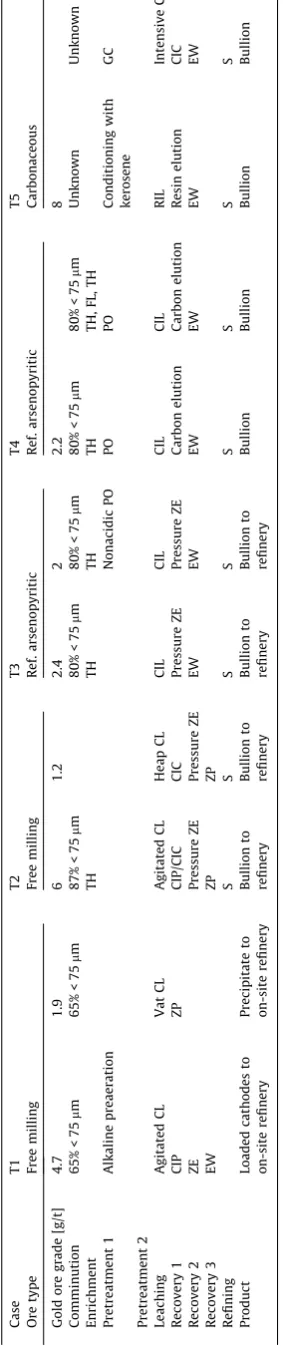
Sim-ilarity modelling of the flowsheets was not in the scope of this research.Table 2presents the structure of the flowsheet formalisa-tion by two example cases: East Driefontein and Sao Bento. The lat-ter utilises gravity concentration and then the concentrate and tailings are processed in separate streams.
2.1.3. Similarity measures
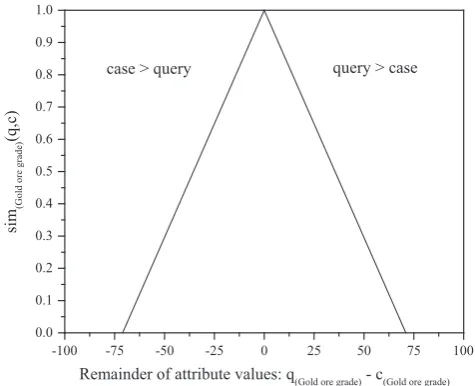
The local similarity of the attributeGold ore gradewas modelled by a symmetric distance function illustrated inFig. 1and defined by Eq.(2).
y¼ 1
71x
þ1 ð2Þ
Here y expresses the local similarity value and x indicates the remainder of the twoGold ore gradevalues in the queried ore and the case. The denominator in Eq.(2)is defined by the maximum dif-ference betweenGold ore gradevalues in the case base. For example, if two values for this attribute are compared using this function: Value A:50 and Value B:40 (both expressed in g/t), then x = 10, which calculates to a similarity of B being 0.86 ‘‘similar” to A.
The attributesClay presentandSulfide presentare Boolean attri-butes, and can therefore have only the values Yes or No, and the local similarity between them is exactly 0 or 1. Other selected attri-butes,Ore type,Gold distribution,Gold grain sizeandArsenic,Copper andIron sulfide,were modelled by comparative similarity tables. The 10th edition of the Nickel–Strunz classification of minerals (Mindat, 2014) was used as a reference for local similarity models of minerals. Each mineral in the Nickel-Strunz classification has an assigned class code depending on the elements and ions within it. The general format of the code is two numbers, two letters, and two numbers with a possible additional letter, if there are more than one mineral having the same classification code: XX.YY.XX (y). There are some exceptions to the general format, but none of
these were included in the case base. Only the attribute values that were used in the case base were modelled.
The following rules for local similarities of minerals were for-mulated based on the Nickel-Strunz classification:
If the first numbers of the mineral class code are equal, local similarity is 0.5.
If the number and the first letter of the mineral class code are equal, local similarity is 0.7.
If the number and both letters of the mineral class code are equal, local similarity is 0.8.
Table 1
Case representation including the data types of attributes.
Attribute Possible values Data type
Ore type Carbonaceous, Copper rich, Free milling, Refractory Arsenopyritic, Refractory
antimony sulfide, Refractory iron sulfide, Silver rich, Telluride
Symbol
Gold ore grade [g/t] Floating point number
Gold distribution Free, Grain enclosed in mineral Symbol
Gold grain size Coarse, Fine, Micronsized, Sub-micronsized Symbol
Sulfide present Yes, No Boolean
Arsenic sulfide Arsenic sulfide, Arsenopyrite, Orpiment, Realgar, Any, None Symbol
Copper sulfide Bornite, Chalcopyrite, Copper sulfide, Covellite, Digenite, Any, None Symbol
Iron sulfide Iron sulfide, Marcasite, Pyrite, Pyrrhotite, None Symbol
Clay present Yes, No Boolean
Table 2
Structure of flowsheet formalisation demonstrated by two examples; East Driefontein and Sao Bento.
Process step East Driefontein Sao Bento
Ore type Free milling Ref. arsenopyritic
Gold ore grade [g/t] 8 7.2
Comminution 78% < 75mm 75% < 75mm
Enrichment TH FL, G, TH Gravity concentration
Pretreatment 1 Alkaline preaeration Acidic pretreatment
Pretreatment 2 Acidic PO
Leaching Agitated CL Agitated CL
Recovery 1 CIP CIP/CIL
Recovery 2 Carbon elution AARL elution
Recovery 3 EW EW
Refining Smelting Smelting Smelting
Product Bullion Ag-Au bullion Bullion
AARL = Anglo American Research Laboratory method, CL = Cyanide leaching, CIP = Carbon-in-pulp, EW = Electrowinning, FL = Flotation, G = Grinding, PO = Pressure oxidation, TH = Thickening.
-100 -75 -50 -25 0 25 50 75 100 0.0
0.1 0.2 0.3 0.4 0.5 0.6 0.7 0.8 0.9 1.0
case > query query > case
sim
(Gold ore grade)
(q,c)
Remainder of attribute values: q(Gold ore grade) - c(Gold ore grade)
If the main class code is equal, but the additional letter is differ-ent, local similarity is 0.9.
If the class code is identical, local similarity is 1.00.
In the instance of the attributeArsenic Sulfide, five different val-ues were modelled; three different minerals and the valval-ues of ‘‘None” and ‘‘Any”. The Nickel-Strunz classification codes for arsenopyrite (FeAsS), orpiment (As2S3) and realgar (
a
-As4S4) are02.EB.20, 02.FA.30 and 02.FA.15a respectively and the local similar-ity model inTable 3was created according to the formulated rules. The rules for the‘‘None” and‘‘Any” values were the following: the value ‘‘Any” is 0.5 similar to any mineral in the similarity table of a specific mineral group, hereArsenic sulfide, and the value‘‘None” is similar only with itself.
2.2. Case construction
After the case structure was formalised, a case base could be compiled. The cases were constructed by extracting the mentioned nine ore attributes from the case sources and transferring them into the attribute-value tuples presented in Table 1. At the moment, it is not possible to use several ore descriptions for one case. However, such a deposit that is a combination of more than one ore type can be added in the case base as two cases.
2.3. Retrieval tests
All the retrieval tests were performed using the built-in retrie-val tool of the myCBR software. The preliminary retrieretrie-val tests were performed using one attribute-value pair at a time and then increasing the number of attribute-value pairs used, while verify-ing the validity of the calculations. These hypothetical queries enabled the investigation of the quality of local similarity models, the calculation of global similarities according to Eq.(1), and the consideration of possible weighting factors.
The flowsheet recommendation ability of the built CBR system was tested using mineralogy and process information of actual gold mines (Marsden and House, 2006) that were not included in the case base. These five test queries T1-T5 are presented inTable 4. The objective of this test phase was to investigate how similar
process flowsheets are between the query case and the best match-ing cases. Additionally, these results could later be compared with process flowsheet proposals by human experts.
Process flowsheets of the actual gold processing plants applied for the test queries T1-T5 (Table 4.) are presented inTable 5. All of the queried ores are processed in two separate streams in their original flowsheets.
2.4. Interviewing technique
Interviewing techniques can be divided into three categories based on the predefined questions and their control over the course of the interview; structured i.e. a form, semi-structured or theme interview and unstructured or open interview (Preece et al., 2002). In this study experts were interviewed with a semi-structured interviewing technique where the questions were pre-defined, asked in the same order and no additional questions were asked. Because the aim of the interviews was not quantitative anal-ysis of the results, but to simply compare the qualitative differ-ences of human experts and the CBR system, the number of interviews was set at three.
The interviews were conducted with experienced hydrometal-lurgical experts, Interviewees I, II and III, who have worked with gold processing for several years. Their experience level can be described as follows:
I: 30 years of metallurgical experience in industry of which 11 years in gold processing,
II: 26 years of experience in extractive metallurgy of which 18 years in academia focusing on non-ferrous metals, especially gold,
III: 33 years of non-ferrous process engineering, R&D and metal-lurgical plant design with the latest 5 years exclusively dedi-cated to gold hydrometallurgy.
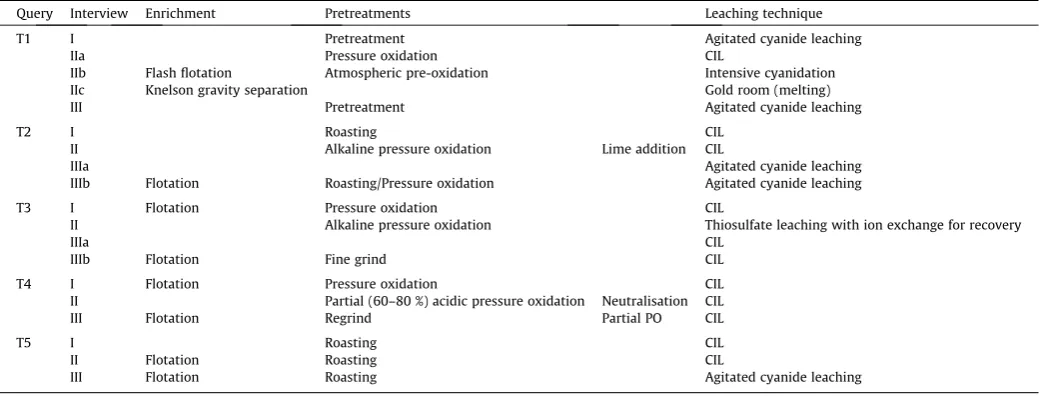
They were presented with the original descriptions of the ores that were used to construct the test queries T1-T5 inTable 7. An example of such a description is the way Marsden and House (2006) described the ore mined in Homestake Lead, operated by Barrick Gold Corporation until shutdown in 2000. This description was used for test case T1 and was presented to the interviewees in its original form, seen here:
‘‘Fine free gold and minor silver are associated with a predom-inantly chloritic-quartzite gangue. Small quantities of pyrrho-tite and other minor sulfides occur in the ore”
[Marsden and House, 2006]
Also the gold concentration [g/t] and the location of the deposit were given to the interviewees. They were then asked to draw a block flowsheet they would propose for the described ore. During the interviewing situation, the interviewer was to not interfere with the interviewees’ answering technique after the instructions
Table 3
The local similarity table for the symbol type attributeArsenic sulfide.
Case value
Query value Arsenopyrite Any None Realgar Orpiment
Arsenopyrite 1 0.5 0 0.5 0.5
Any 0.5 1 0 0.5 0.5
None 0 0 1 0 0
Realgar 0.5 0.5 0 1 0.8
Orpiment 0.5 0.5 0 0.8 1
Table 4
The queries T1-T5 formed based on the five actual gold mines (Marsden and House, 2006). The attributes that were not used in the query are marked by z.
Query
Attribute T1 T2 T3 T4 T5
Ore type Free milling Free milling Refractory arsenopyritic Refractory iron sulfide Carbonaceous
Gold ore grade [g/t] 4.7 6.0 2.4 2.2 8.0
Primary gold distribution Free Free Grain enclosed in mineral Grain enclosed in mineral Free
Primary gold grain size Fine Fine Fine Micronsized Fine
Sulfide present Yes Yes Yes Yes Yes
Arsenic sulfide z z Arsenopyrite Arsenopyrite z
Iron sulfide Pyrrhotite z Pyrite Pyrite z
had been given. The purpose of this experiment was to compare the CBR system with the human expert in time sensitive situations where no additional information is available and the process sug-gestion needs to be formulated effectively in an instant.
3. Results and discussion
The assembled case base and the challenges that arose from its construction are considered first in this section. Then the results of the retrieval tests are presented and finally the outcome of the expert interview evaluation is discussed.
3.1. Compiled case base
The constructed case base is presented inAppendix A. First, 43 cases were extracted fromMarsden and House’s (2006)book ‘‘The Chemistry of Gold Extraction” and 5 cases from other public sources or directly from mining/gold extraction companies (Mining-technology, 2005; Newcrest Mining, 2014; True Gold Mining, 2014; Tyhee Development Group, 2010; The AusIMM Bulletin, 2015), resulting in altogether 48 cases. Some of the mining projects that were used as case sources divided the ore into several different streams that were treated differently, resulting in several separate cases in the case base with the same source.
Regarding the actual extraction process of cases, the attributes Ore type,Gold ore grade,Sulfide presentandClay presentwere the most straightforward to assign values to from the literature descriptions. The attributesGold distribution, Gold grain sizeand the attributes concerning sulfides were found more challenging. These attributes may have several valid values at the same time, as seen in the description of the deposit for the Consolidated Murchison site in Papua New Guinea:
‘‘Refractory minerals are predominantly antimony and arsenic sulfides, such as berthierite (FeSb2S4), gudmundite (FeSbS),
arsenopyrite (FeAsS), and gersdorffite ((Fe,Ni,Co)AsS), with minor quantities of other base metal sulfides. Gold occurs as coarse visible gold, aurostibnite (AuSB2), and as fine gold
dis-seminated in sulfides. On average, the ore contains 3% to 4% Sb and 0.1% to 0.3% As.”
[Marsden and House, 2006]
Here gold occurs both as coarse visible gold and as fine gold dis-seminated in sulfides. The corresponding values for the attribute Gold distributionare‘‘Free” and‘‘Grain enclosed in mineral”. A possi-ble solution for this propossi-blem is to save such descriptions as two separate cases, especially when the ore is treated with the same processes only in the beginning, for example crushing and grind-ing, and after that two different process flowsheets are applied (Marsden and House, 2006).
The problem with duplicate values for an attribute happens also with the description of the Paradise Peak site in Nevada, USA:
‘‘Hydrothermal deposit occurred with native silver and gold, but silver also occurred as silver sulfide. Major gangue mineral was quartz, with halides, cinnabar, orpiment, realgar, and bismuth-bearing stibnite.”
[Marsden and House, 2006]
As can be seen inAppendix A, in the case base the value for the attributeArsenic sulfideis‘‘Orpiment”. However, also realgar is pre-sent in the ore. This problem could be avoided by adding more attributes for the same entities, for example, having two or more attributes forArsenic sulfide, for instance,Primaryand Secondary arsenic sulfide. Then the user could add two values for the same
attribute and the knowledge loss is smaller. Though, this approach shifts the challenge to the retrieval phase. An additional layer must be added into the similarity calculation, so that the retrieval finds also the cases where the values are similar to the query, but the order of them is vice versa.
3.2. Retrieval tests
Preliminary testing of the functionality of the calculation algo-rithms were performed on a simplified case base of 25 cases and the final retrieval tests, based on actual gold processes, were car-ried out using the full case base of 48 cases.
3.2.1. Results of the preliminary retrieval tests
The similarity values of the retrieved cases were compared to the manually calculated similarities of the queried attribute values as they should be equal according to Eq.(1). The results of the pre-liminary retrieval tests showed that all the global similarity values matched the manually calculated ones, and were therefore correct. However, the retrieval results indicated a need for further develop-ment of modelling the following attributes:
1. Gold ore grade: Increased impact of larger differences in the attri-bute value. An advanced function, being modelled in the myCBR tool, using its function editors, could be utilised as the local sim-ilarity measure, instead of the simplified polynomial function. 2. Gold grain size: Lower weighting of the attribute should be used
to reduce the role of this attribute.
3. Clay present: As the presence of clay has a great impact on pro-cessing requirements, the weighting of the attribute could be used to emphasise its role in the global similarity. Besides weighting of the attribute in the global similarity calculation, it is possible to use certain attribute values to exclude cases from the retrieval results. In the matter ofClay present, the cases that are not equiv-alent to the queried value forClay presentcould be excluded.
As an example of the global similarity distribution for one hypo-thetical set of queried attribute values,Fig 2shows all the cases
within the simplified case base, from most similar to least similar compared to the query.
It was shown that the built CBR system is able to retrieve cases from the case base using a set of selected attributes and rank them. The cases with the highest global similarities would then be used as starting points for further gold ore process flowsheet develop-ment for the ore of interest. It is up to the user to decide what glo-bal similarity level is used as acceptance level. In the query results shown inFig. 2the user might select e.g. three, five or seven most similar cases.
3.2.2. Retrieval tests using actual mineralogies of gold mining projects The five best matching and two worst matching cases retrieved and their similarities with the queries T1-T5 are presented in Table 6.
The best matching case for Query T1 is the East Driefontein deposit, with a global similarity value of 0.86. The ores in both cases are relatively similar, both ores are free milling, in which the gold is distributed as fine free grains and the ores contain sul-fides, of which pyrrhotite is mentioned. The differences of the cases are that in the query case there is no clay present, but in the description of the East Driefontein the presence of clay is unde-fined. The process flowsheets of T1 and East Driefontein are fairly similar as well. Both ores are crushed and ground to somewhat similar size. In both cases alkaline preaeration is utilised before agitated cyanide leaching. The main difference in the flowsheets is that in the case T1 the sand fraction of the ore is treated by vat cyanide leaching, whereas in East Driefontein the whole ore fraction if treated in a cyanide leaching reactor.
The best matching cases for Query T2 are the Kidston and Pine Creek cases, with global similarity values of 1.0. All the ores are free milling ores with fine gold particles and clay present. In the case source (Marsden and House, 2006) the ore of the case T2 is described as follows: ‘‘Epithermal deposit of free-milling, oxidised ore overlie refractory sulfides. Major gangue minerals are limestone, dolomite, and sandstones. Orebody contains heavily silicified regions and between 10% and 20% clay. Fine free gold and electrum, and minor mercury (1– 20 g/t) occur.” The ore of the Kidston case is described as follows in the case source:
AshantiJoutel McLaughlin
Fairview
Giant YellowknofeCambell Red Lake Fimiston-GidjiJerritt Canyon
Consol. Murchin. Kidston
GoldstrikeSao Bento Lihir
Porgera
Emperor MinesEast DriefonteinHarmony N4 Pl. Grasberg-Ertsberg
Parad
ise PeakEl Indio Ok Tedi Alumbrera
Presedent Br and New P.
Round Mou ntai
n
Easy Creek
0.0 0.2 0.4 0.6 0.8 1.0
Sim(q,c)
Case
‘‘A predominantly free-milling ore with oxidised, transition, and sulfide zones were present in volcanic breccia. Gangue was mainly quartz, muscovite, chlorite, and carbonates with moderate clay (kaolinite) content. Some pyrite (<2%) was present. Fine free gold was present, some intimately associated with pyrite. Copper min-eralisation was variable. Free gold was liberated at approximately 53mm.” These descriptions show the extent of the knowledge loss, when only a few attributes are used to describe the ore in the knowledge formalisation. However, the attributes employed are appropriate as the three cases are notably similar and the process flowsheets of the cases are rather similar as well. No pretreatment is employed and all ores are treated with agitated cyanide leaching followed by either carbon-in-pulp, carbon-in-column or both. The main difference in the flowsheets is that in the case T2 low-grade material is treated by heap cyanide leaching, whereas Pine Creek and Kidston apply only reactor leaching.
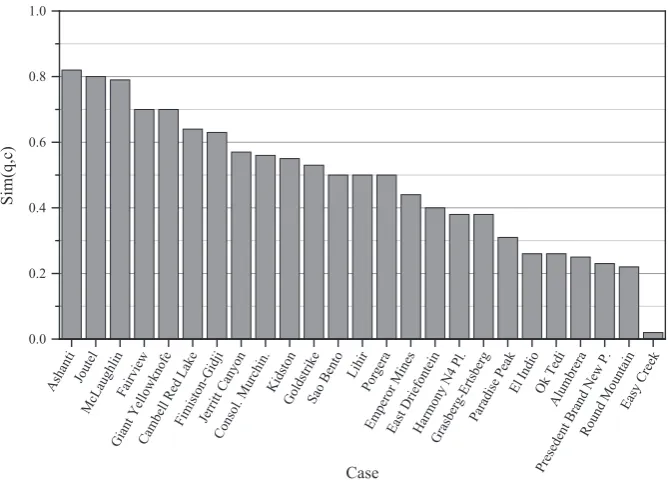
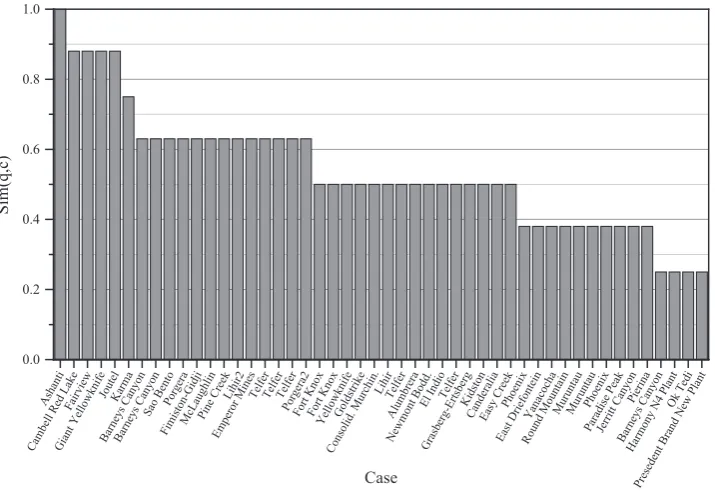
The best matching case for Query T3 is the Ashanti plant, with a global similarity value of 1.0. All the queried values are similar in these two cases. However, the process flowsheets are slightly different. The refractory sulfide ore (Au 2.0 g/t) of the case T3 is pretreated by nonacidic pressure oxidation before leaching by carbon-in-leach. The oxidised ore of the case T3 is treated by carbon-in-leach followed by pressure zinc precipitation. In the Ashanti case no pretreatments, such as pressure oxidation, are used and agitated cyanide leaching is employed as the leaching technique. This shows that the most similar case does not neces-sarily present an identical flowsheet with the query. Nevertheless, the idea of the CBR tool is that the system user can utilise the cases with highest global similarities as starting points for further
process development. By observing the four next similar cases to case T3 (Cambell Red Lake, Fairview, Giant Yellowknife and Joutel with global similarity values of 0.88), it is observed that in all these next similar cases a pretreatment is used prior to cyanide leaching. This indicates to the system user that the option of using a pre-treatment is likely to be beneficial, although not applied in the most similar case (Ashanti). In one of the next best matching cases (Giant Yellowknife) carbon-in-leach is utilised as in the case T3. To illustrate the global similarity distribution of the entire case base, all the cases and their similarities with T3 are illustrated inFig 3.
The best matching cases for Query T4 are the two Barneys Can-yon cases and the Joutel project, with global similarity values of 0.88. The ores in all cases are refractory iron sulfides, in which the gold grains are enclosed in mineral. The ores contain sulfides, of which pyrite and arsenopyrite are mentioned. Joutel differs from T4 in gold grain size and the Barneys Canyon ores contain clay, unlike T4. However, the process flowsheet of Joutel is much more similar to T4 than the Barneys Canyon cases. In T4 and Joutel the ores are pretreated, by pressure oxidation and preaeration respec-tively, before cyanide leaching. In the dissimilar Barneys Canyon cases the ore is heap leached without any pretreatment. This underlines the benefit of CBR, as it provides several options for the user to compare.
The best matching case for Query T5 is the Grasberg-Ertsberg mining project, with a global similarity value 0.83. The process flowsheet industrially applied in the case T5 is very different from the process flowsheet of Grasberg-Ertsberg. In the case T5 majority of the fine carbonaceous material is processed by conditioning with kerosene prior to resin-in-pulp treatment. The sulfide
Table 6
The most similar (1st–5th) and dissimilar (47th–48th) cases for the test queries T1-T5, global similarity was calculated by Eq.(1)and has a value between 0 and 1.
Paired Query T1 Query T2 Query T3 Query T4 Query T5
Cases Case Sim Case Sim Case Sim Case Sim Case Sim
1st East Driefontein 0.86 Kidston 1.00 Ashanti 1.00 Barneys Canyon 0.88 Grasberg-Ertsberg 0.83
2nd Fort Knox 0.71 Pine Creek 1.00 Cambell Red Lake 0.88 Barneys Canyon 0.88 Fort Knox 0.67
3rd Fort Knox 0.71 Fort Knox 0.83 Fairview 0.88 Joutel 0.88 Fort Knox 0.67
4th Yanacocha 0.71 Fort Knox 0.83 Giant Yellowknife 0.88 Ashanti 0.75 East Driefontein 0.67
5th Yellowknife 0.71 East Driefontein 0.83 Joutel 0.88 Cambell Red Lake 0.75 Yanacocha 0.67
47th Lihir2 0.29 Easy Creek 0.33 Ok Tedi 0.25 Harmony N4 Plant 0.13 Porgera2 0.33
48th Porgera2 0.29 Porgera2 0.33 President Brand New Plant 0.13 President Brand New Plant 0.13 Barneys Canyon 0.17
Table 7
Interviewing results from the three senior experts.
Query Interview Enrichment Pretreatments Leaching technique
T1 I Pretreatment Agitated cyanide leaching
IIa Pressure oxidation CIL
IIb Flash flotation Atmospheric pre-oxidation Intensive cyanidation
IIc Knelson gravity separation Gold room (melting)
III Pretreatment Agitated cyanide leaching
T2 I Roasting CIL
II Alkaline pressure oxidation Lime addition CIL
IIIa Agitated cyanide leaching
IIIb Flotation Roasting/Pressure oxidation Agitated cyanide leaching
T3 I Flotation Pressure oxidation CIL
II Alkaline pressure oxidation Thiosulfate leaching with ion exchange for recovery
IIIa CIL
IIIb Flotation Fine grind CIL
T4 I Flotation Pressure oxidation CIL
II Partial (60–80 %) acidic pressure oxidation Neutralisation CIL
III Flotation Regrind Partial PO CIL
T5 I Roasting CIL
II Flotation Roasting CIL
concentrate of the case T5 is treated by using intensive cyanide leaching. In the Grasberg-Ertsberg case the process employed produces merely Cu-Au concentrate by flotation, which is further processed in copper smelters. Actually none of the process flowsheets of the best matching cases are similar to the process flowsheet industrially applied in the test case T5. Even though more attributes were used in the query, the system could not find similar raw material that have similar process flowsheet, as at the moment there are no similar process flowsheets applied for any of the cases in the case base.
The retrieval results for all of the queries demonstrate the inherent capability of CBR to handle fuzzy knowledge. Overall, the results were at least satisfactory for T1-T4 providing similar process flowsheets as either the most similar case (T1, T2 and T4) or in the five most similar cases (T4). The CBR system pro-vides results not only in the form of the best matching case but also a number of next best matching cases, sorted by their global similarity to the query. Thus CBR is able to provide results even when no exact match is found. This capability combined with the approach of similarity based retrieval allows the CBR system to provide possible solutions even on only sparse, incom-plete or fuzzy queries.
3.3. Human expert interviews
Three hydrometallurgical experts, here Interviewee I, II and III, answered the interviewing questions. As can be seen fromTable 7, their answers show some similarities, but also differ in many ways. For clarity, the table only holds the answers concerning enrich-ment, pretreatment and leaching techniques. All interviewees implied comminution before these steps and basic recovery tech-niques thereafter. In some cases the interviewee suggested several parallel process paths for the ore and in these cases the different paths are indicated as Ia, Ib, etc.
In T1, the answers are quite similar, since all would choose a pretreatment for oxidising sulfides, followed by cyanide leaching (Interviewee I did not specify the pretreatment further). For T2, Interviewee I would suggest roasting, Interviewee II’s suggestion
is alkaline pressure oxidation and Interviewee III suggests one or the other for the refractory part of the ore. The answers differ most regarding T3 where Interviewee I would float and pressure oxidise the concentrate, then apply CIL (carbon-in-leach), but Interviewee II suggests applying alkaline pressure oxidation followed by thiosulfate leaching due to the ore’s preg-robbing characteristics. Interviewee III however would divide the ore into oxidic and sulfidic streams, only leach the oxidic part, while applying floatation, fine grinding and CIL for the sulfidic stream. All interviewees would suggest pressure oxidation for T4 and Roasting for T5. Two out of three interviewees would apply flotation for T4 and T5.
Generally, it can be said that interviewees I and II prefer CIL and possibly would recommend it, unless there was an obvious reason for concluding otherwise. Whereas interviewee III clearly prefers agitated cyanide leaching, unless the ore is preg-robbing. The interviewees agree on the pretreatment methods on none of the test cases, even though the given information is identical and relatively straightforward. This indicates that their assumptions of the ores, past experiences etc. play a role in their decision making. Certain patterns can be seen in their answers. For example, it is possible that Interviewee I has had experience with using flotation before pressure oxidation (T3 and T4), but not before roasting (T2 and T5). Interviewee II might have had lots of experiences with pressure oxidation (T1-T4) and less with roasting T5. Interviewee III seems to be more familiar with regrinding the ore during the process than the other two experts (T3 and T4).
Compared to the actual processes utilised for the ores in queries T1-T5 the only question where the interviewees proposed similar flowsheet was T4. On other questions, the process flowsheets they suggested were distinctly dissimilar from the original processes. This merely comes to show that making process suggestions based on lacking knowledge of the ore is very challenging. Humans naturally use their past experiences in situations where rapid decisions need to be made based on lacking information, as was the case in the interviewing situation. However, these presumptions can then
Asha nti
Cambell Red Lake Fairview
Gia nt Yel
lowknifeJoutelKarma
Barneys CanyonBarneys Canyon Sao BentoPorgera
Fimiston-GidjiMc Laughli
n
Pine Creek Lihir2
Empero
r MinesTelferTelferTelferPorgera2 Fort KnoxFort Knox
Yel lowknife
Goldstrike
Conso lid. Murchin.
LihirTelfer Alumbrera Newmont Bo
dd. El IndioTelfer
Grasb erg-Ertsb
erg Kidston
Canderali a
Easy Creek
Pho enix
East Drie
fontein Yanacocha
Round Mo untain
Mu runtau
Muru ntau
Phoenix
Paradise PeakJerritt CanyonPierina
Barneys Cany on
Harmony N4 PlantOk
Tedi
Presedent Brand New Plant 0.0
0.2 0.4 0.6 0.8 1.0
Sim(q,c)
Case
follow the decision maker further into the decision making process, even after sufficient information and resources are available. Automated decision support systems, such as CBR, can lessen these human biases by providing objective analysis based on greater amounts of information.
4. Conclusions
The evaluation showed that the CBR methodology and the modelled attributes resulted in a system that was able to retrieve similar raw materials that have relatively similar process flowsheets compared to the test cases (T1-T5). The results of the CBR retrieval tests were compared with the interview results of human experts (I-III). It was shown that the constructed CBR system could retrieve more similar process flowsheets compared to the human experts. When the objective is to quickly assess different processing methods for a gold ore deposit of interest, the CBR system is able to present a variety of options within a few seconds without human biases. These options can then be thoroughly evaluated with geological and metallurgical experi-ments prior to process design.
To enable a more accurate retrieval of cases, in the next phase of this research the number and accuracy of attributes will be improved to cover other relevant mineralogical properties of the ore. For example,Gold occurrencewas modelled in a limited man-ner; the attribute was described by two stages only: ‘‘Free” or ‘‘Enclosed in mineral”. As also other factors, such as surface expo-sure and the type of mineral that has enclosed the gold, are rele-vant in the behaviour of the leaching process, the modelling of theGold occurrenceattribute will be studied in more detail. Addi-tional attributes could include, for example, the size of the ore body, which has a great impact on the feasibility of capital investments.
The size of the case base will be extended further. This will increase the probability of a similar ore being present in the case base when a query is made. During the construction of the case base, it was noted that the CBR software needs to be modified in a way that one attribute can have more than one value. For exam-ple, if two different iron sulfides are present in the ore, the user should be able to enter this into the query. In addition, observa-tions were made about the system’s functionality related to simi-larity calculations. It was suggested that the impact of large differences in the value ofGold ore gradeshould be emphasised through an advanced local similarity function. The impact of the attributeGold grain sizeneeds to be decreased and that of the attri-buteClay presentneeds to be increased by applying appropriate weighting factors.
Eventually, the constructed CBR tool should serve gold processing experts in the initial stages of flowsheet design by providing new ideas and possibly a second opinion. The real benefit of the automated decision support system is that it does not exclude any processing methods merely due to human biases, such as familiarity with another processing method. With continued development of the system, its functionality in providing starting points for gold process design will increase further.
Acknowledgements
This work was supported in part by The Emil Aaltonen Founda-tion as well as in part by the LOWGRADE project of the ELEMET research program funded by FIMECC Oy. The financial support of Tekes and Outotec Oyj is gratefully acknowledged as well as the financial support of Technology Industries of Finland Centennial Foundation Fund for the Association of Finnish Steel and Metal
Case Ore type Gold ore grade [g/t]
Gold distribution
Gold grain size
Sulfide present
Arsenic sulfide
Copper sulfide
Iron sulfide Clay present
Case source
Fort Knox Free milling 0.9 Free Fine Yes None None Pyrite _undefined_ Marsden and House (2006), Chapter 12.2.2.10
Fort Knox Free milling 0.9 Free Fine Yes None None Pyrite _undefined_ Marsden and House (2006), Chapter 12.2.2.10
Yanacocha Free milling 1.5 Free Fine Yes None None None _undefined_ Marsden and House (2006), Chapter 12.2.2.11
Giant Yellowknofe Ref.
arsenopyritic
8.0 Grain encl. in min.
Sub-micronsized
Yes Arsenopyrite Any Pyrite No Marsden and House (2006), Chapter 12.2.5.3
Sao Bento Ref.
arsenopyritic
7.2 _undefined_ _undefined_ Yes Arsenopyrite None Pyrrhotite No Marsden and House (2006), Chapter 12.2.5.5
Fairview Ref.
arsenopyritic
7.0 Grain encl. in min.
Sub-micronsized
Yes Arsenopyrite Any Pyrite No Marsden and House (2006), Chapter 12.2.5.6
Ashanti refractory sulfide plant
Ref.
arsenopyritic
12.0 Grain encl. in min.
Fine Yes Arsenopyrite None Pyrite No Marsden and House (2006), Chapter 12.2.5.1
Cambell Red Lake Ref.
arsenopyritic
20.0 Grain encl. in min.
_undefined_ Yes Arsenopyrite Chalcopyrite Pyrite No Marsden and House (2006), Chapter 12.2.5.2
Joutel Ref. iron sulfide
5.8 Grain encl. in min.
Fine Yes Arsenopyrite None Pyrite No Marsden and House (2006), Chapter 12.2.4.1
Fimiston-Gidji Ref. iron sulfide
3.8 Grain encl. in min.
Fine Yes None None _undefined_ No Marsden and House (2006), Chapter 12.2.4.2
McLaughlin Ref. iron sulfide
4.7 Grain encl. in min.
Fine Yes None Chalcopyrite Pyrite Yes Marsden and House (2006), Chapter 12.2.4.3
Lihir Ref. iron sulfide
5.0 Grain encl. in min.
Sub-micronsized
Yes _undefined_ _undefined_ Pyrite _undefined_ Marsden and House (2006), Chapter 12.2.4.4
Porgera Ref. iron sulfide
5.0 Grain encl. in min.
Sub-micronsized
Yes None Chalcopyrite Pyrite No Marsden and House (2006), Chapter 12.2.4.5
Goldstrike Ref. iron sulfide
8.5 Grain encl. in min.
Sub-micronsized
Yes None None Pyrite Yes Marsden and House (2006), Chapter 12.2.4.6
Barneys Canyon Ref. iron sulfide
3.0 Grain encl. in min.
Micronsized Yes Arsenopyrite _undefined_ Pyrite Yes Marsden and House (2006), Chapter 12.2.4.8
Barneys Canyon Ref. iron sulfide
3.0 Grain encl. in min.
Micronsized Yes Arsenopyrite _undefined_ Pyrite Yes Marsden and House (2006), Chapter 12.2.4.8
Barneys Canyon Free milling 1.5 Grain encl. in min.
Micronsized No None None None Yes Marsden and House (2006), Chapter 12.2.4.8
Consolidated Murchison
Ref. antimony sulfide
3.0 Free Coarse Yes Arsenopyrite _undefined_ _undefined_ No Marsden and House (2006), Chapter 12.2.7.1
Paradise Peak Silver rich 3.1 Free _undefined_ Yes Orpiment None None No Marsden and House (2006), Chapter 12.2.3.1
Easy Creek Silver rich 70.0 _undefined_ _undefined_ Yes None Chalcopyrite Pyrite No Marsden and House (2006), Chapter 12.2.3.2
Grasberg-Ertsberg Copper rich 2.0 Free Fine Yes None Chalcopyrite None No Marsden and House (2006), Chapter 12.2.6.1
(continued on next page)
L.
Rintala
et
al.
/Minerals
Engineering
109
(2017)
42–53
Case Ore type Gold ore grade [g/t]
Gold distribution
Gold grain size
Sulfide present
Arsenic sulfide
Copper sulfide
Iron sulfide Clay present
Case source
OkTedi Copper rich 2.8 Free Coarse No None None None No Marsden and House (2006), Chapter 12.2.6.2
ElIndio Copper rich 8.4 Free Coarse Yes None None Pyrite No Marsden and House (2006), Chapter 12.2.6.3
Alumbrera Copper rich 0.8 Free Coarse Yes None Chalcopyrite Pyrite No Marsden and House (2006), Chapter 12.2.6.4
Phoenix Copper rich 1.1 _undefined_ _undefined_ Yes _undefined_ Chalcopyrite Pyrite _undefined_ Marsden and House (2006), Chapter 12.2.6.5
Phoenix Copper rich 1.1 _undefined_ _undefined_ Yes _undefined_ Chalcopyrite Pyrite _undefined_ Marsden and House (2006), Chapter 12.2.6.5
Canderalia Copper rich 0.3 Free Fine Yes _undefined_ Chalcopyrite Pyrite _undefined_ Marsden and House (2006), Chapter 12.2.6.6
Telfer Copper rich 1.5 Grain encl. in min.
Fine Yes Any Chalcopyrite Pyrite _undefined_ Marsden and House (2006), Chapter 12.2.6.7
Telfer Copper rich 1.5 Free Fine Yes Any Chalcopyrite Pyrite _undefined_ Marsden and House (2006), Chapter 12.2.6.7
Telfer Copper rich 1.5 Grain encl. in min.
Fine Yes Any Chalcopyrite Pyrite _undefined_ Marsden and House (2006), Chapter 12.2.6.7
Telfer Copper rich 1.5 Grain encl. in min.
Fine Yes Any Chalcopyrite Pyrite _undefined_ Marsden and House (2006), Chapter 12.2.6.7
Telfer Copper rich 1.5 Free Fine Yes Any Chalcopyrite Pyrite _undefined_ Marsden and House (2006), Chapter 12.2.6.7
EmperorMines Telluride 25.0 Free _undefined_ Yes Arsenopyrite Any Pyrite No Marsden and House (2006), Chapter 12.2.8.1
JerrittCanyon Carbonaceous 6.7 Free _undefined_ Yes Realgar None Pyrite Yes Marsden and House (2006), Chapter 12.2.9.1
Yellowknife Silver rich 5.1 Free Fine Yes Arsenopyrite None Pyrrhotite _undefined_ Tyhee Development Group (2010)
Newmont Boddington
Copper rich 0.8 Free Micronsized Yes Arsenopyrite Chalcopyrite Pyrite _undefined_ The AusIMM Bulletin (2015)
Lihir2 Ref. iron sulfide
2.2 Grain encl. in min.
_undefined_ Yes Arsenopyrite Chalcopyrite Pyrite Yes Newcrest Mining (2014)
Karma Ref.
arsenopyritic
1.1 _undefined_ Fine Yes Arsenopyrite Chalcopyrite Pyrite _undefined_ True Gold Mining (2014)
Porgera2 Ref. iron sulfide
3.9 Grain encl. in min.
Sub-micronsized
Yes Arsenopyrite None Pyrite _undefined_ Mining-technology (2005)
52
L.
Rintala
et
al.
/Minerals
Engineering
109
(2017)
References
Aamodt, A., Plaza, E., 1994. Case-based reasoning: foundational issues, methodological variations and system approaches. AI Commun. 7 (1), 39–59.
http://dx.doi.org/10.3233/AIC-1994-7104.
Gasparrini, C., 1993. Gold and Other Precious Metals from Ore to Market. Springer, Berlin Heidelberg.http://dx.doi.org/10.1007/978-3-642-77184-2. ISBN 978-3-642-77186-6.
Kolodner, J.L., 1992. An introduction to case-based reasoning. Artif. Intell. Rev. 6, 3– 34.http://dx.doi.org/10.1007/BF00155578.
Marsden, J.O., House, I.C., 2006. The Chemistry of Gold Extraction. Society for Mining, Metallurgy, and Exploration, Inc., Littleton. ISBN-13:978-0-87335-240-6.
Mindat, 2014. Nickel-Strunz Classification – Primary Groups, tenth ed. <http:// www.mindat.org/strunz.php> (accessed 20.01.14).
Mining-technology, 2005. Porgera Gold Mine, Papua New Guinea. <http://www. mining-technology.com/projects/porgera/> (accessed 16.09.16).
myCBR, 2012. myCBR 3.0 software. <http://www.mycbr-project.net/> (accessed 01.03.13).
Newcrest Mining, 2014. Technical Report on the Lihir Property in Papua New Guinea <http://www.newcrest.com.au/media/resource_reserves/Technical% 20Reports/FINAL_Technical_Report_on_Lihir_Property_December_31_2013_ 010414.pdf>(accessed 06.09.16).
Preece, J., Rogers, Y., Sharp, H., 2002. Interaction Design: Beyond Human-Computer Interaction. John Wiley & Sons. ISBN 0-471-49278-7.
Richter, M.M., 1998. Introduction. In: Lenz, M., Bartsch-Spörl, B., Burkhard, H.-D., Wess, S. (Eds.), Case-Based Reasoning Technology: From Foundations to Applications. Lecture Notes in Artificial Intelligence. Springer, pp. 1–15.
http://dx.doi.org/10.1007/3-540-69351-3. ISBN 3-540-64572-1.
Rintala, L., Aromaa, J., Forsén, O., 2012. Use of published data in the development of hydrometallurgical flow sheet for gold using decision support tools. In: The Proceedings of XXVI International Mineral Processing Congress. September 24– 28, 2012. The Indian Institute of Mineral, New Delhi, India. ISBN: 978-80-969886-4-8.
Rintala, L., Aromaa, J., Forsén, O., 2015. Applicability of published experimental work as a knowledge source in the recommendation of gold ore processing
workflows. Physicochem. Problems Mineral Process. 51 (2), 707–717. ISSN 1643-1049.
Rintala, L., Lillkung, K., Aromaa, J., 2011. The use of decision and optimization methods in selection of hydrometallurgical unit process alternatives. Physicochem. Problems Mineral Process. 46 (1), 229–242. ISSN 1643-1049. Sauer, C.S., Rintala, L., Roth-Berghofer, T., 2013. Knowledge formalisation for
hydrometallurgical gold ore processing. In: Bramer, M., Petridis, M. (Eds.), Research and Development in Intelligent Systems XXX. Springer International Publishing, pp. 291–304. http://dx.doi.org/10.1007/978-3-319-02621-3_22. ISBN 978-3-319-02620-6.
Sauer, C.S., Rintala, L., Roth-Berghofer, T., 2014. Two-phased knowledge formalisation for hydrometallurgical gold ore process recommendation and validation. Künstliche Intelligenz 28 (4), 283–295.http://dx.doi.org/10.1007/ s13218-014-0315-2.
Seuranen, T., Hurme, M., Pajula, E., 2005. Synthesis of separation processes by case-based reasoning. Comput. Chem. Eng. 29 (6), 1473–1482. http://dx.doi.org/ 10.1016/j.compchemeng.2005.02.016.
Stahl, A., Roth-Berghofer, T., 2008. Rapid prototyping of CBR applications with the open source tool myCBR. In: Althoff, K.-D., Bergmann, R., Minor, M., Hanft, A. (Eds.), Advances in Case-Based Reasoning. ECCBR 2008. Lecture Notes in Computer Science 5239. Springer, Berlin, Heidelberg, pp. 615–629.http://dx. doi.org/10.1007/978-3-540-85502-6_42.
The AusIMM Bulletin, 2015. Ore Processing Operations at Newmont Boddington Gold <ttps://www.ausimmbulletin.com/feature/ore-processing-operations-at-newmont-boddington-gold/>(accessed 16.09.16).
True Gold Mining, 2014. Karma Feasibility Study Executive Summary <http:// truegoldmining.com/karma-feasibility-study-executive-summary> (accessed 16.09.16).
Tyhee Development Corp, 2010. Technical Report on the Pre-Feasibility Study on the Yellowknife Gold Project, Northwest territories, Canada. <http:// www.tyhee.com/docs/ygp-preliminary_feasibility_study.pdf> (accessed 16.09.16).
Vong, C.M., Leung, T.P., Wong, P.K., 2002. Case-based reasoning and adaptation in hydraulic production machine design. Eng. Appl. Artif. Intell. 15 (6), 567–585.