The scholarship of critical review: improving
quality and relevance
Dana Lawrence,
DC, MMedEd*Phillip Ebrall,
BAppSc(Chiropractic), Grad Cert Tert Learning Teaching, PhD†Objective: To describe the process of scientific peer
review as it is used in the manuscript submission process, assess threats and challenges to the peer review process, and to offer suggestions for enhancing its effectiveness.
Discussion: Peer review is often seen as one of the
hallmarks of scientific publication. The primary goal of peer review is to improve the science within papers that are ultimately published, by helping an editor better understand the strengths and weaknesses of a given paper. This process, while fairly well studied within the medical field, has received almost no attention at all within chiropractic. This paper provides guidance to reviewers and potential reviewers which can help them to understand both the scientific and the human aspects of peer review. This is designed to elevate this function to one trusted by the profession rather than seen as simply another hurdle to overcome. Several future directions are offered, including unblinding the review process for transparency, conducting rigorous studies looking at peer review, and developing formal training programs for potential reviewers.
Conclusion: Peer review is likely to remain in force as
a means to provide guidance to authors and editors about the rigor of submitted papers. However, the nature of peer review may be changing and editors and authors need to stay aware of the implications of these changes.
* Senior Director, Center for Teaching and Learning, Palmer College of Chiropractic, 1000 Brady Street, Davenport, IA 52803.
† Associate Professor of Chiropractic Education and Head, Division of Chiropractic, RMIT University, P.O. Box 71, Bundoora, Victoria 3083, Australia
Conflict of interest: Dr. Lawrence currently chairs the Editorial Board of Journal of the American Chiropractic Association and serves on the editorial board of numerous journals within the chiropractic and CAM professions. He is Editor Emeritus of Journal of Manipulative
and Physiological Therapeutics and past editor of several other journals. Dr. Ebrall has served continuously since 1994 as a manuscript
reviewer and editorial board member. He is currently a member of the editorial boards of Chiropractic Journal of Australia, Journal of
Manipulative and Physiological Therapeutics, Journal of Chiropractic Education and Clinical Chiropractic (as a Member of the International
Advisory Panel, a subset of the Editorial Board); a member of the editorial board of Topics in Clinical Chiropractic until it ceased publication, and in mid-2007 resigned from the editorial boards of two journals within the chiropractic profession.
© JCCA 2008.
Objectif : Décrire le processus d’analyse scientifique
par les pairs, expliquer la façon dont il est utilisé dans le processus de présentation des manuscrits, évaluer les embûches et les défis associés au processus d’examen et présenter des suggestions pour en améliorer l’efficacité.
Discussion : L’examen par les pairs est souvent perçu
comme un sceau pour une publication scientifique. L’objectif principal de l’examen vise à améliorer la teneur scientifique du contenu des manuscrits, qui seront publiés en dernier ressort, en aidant un directeur de publication à mieux comprendre les forces et les
faiblesses d’une étude précise. Relativement bien observé dans le domaine médical, ce processus n’a pratiquement reçu aucune attention dans le domaine de la
Recommendations to open the process, study it and develop training programs are designed to ensure that the process remains as impartial as possible.
(JCCA 2008; 52(4):211–223)
k e y w o r d s : Peer Review; Periodicals; Chiropractic
Introduction
“Mandatory revision in accordance with reviewers’
comments has apparently become the norm for articles published in certain quarters ... These high rates of co-erced revision place enormous power in the hands of reviewers to enforce conformity to their views while largely escaping responsibility, or accountability, for their actions.”1
The peer review process, while generally being seen as a cornerstone of the scientific publication process, has re-ceived little study within the chiropractic profession. Journal editors, who have the responsibility for selecting those articles considered worthy of publication, cannot be experts on all the potential topics that a manuscript dis-cusses. Further, by the nature of their comments, review-ers wield significant power with regard to establishing what amounts to “informal standards” for editors with re-gard to scientific rigor. This process is subject to all the same human vagaries that any human endeavour is; it can be used to determine quality, to establish the limits of ac-ceptable science, or even to prevent publication of a giv-en manuscript. These are important issues to examine, yet there is little information located specifically within the chiropractic profession about the success and useful-ness of peer review.
Peer review occurs in the process of considering a manuscript for publication. An editor will typically select
2 or more people with expertise in the topics discussed by the paper and will ask them to read the paper and offer their thoughts about its rigor. Reviewers, who offer their time as a service to their profession and its science, spend several hours reading and critiquing the paper. For this they are paid nothing. What reviewers do when they offer their comments is to determine what they consider cur-rent and correct, whether they agree with the data analy-sis, how much speculation an author can present, and whether or not the discussion or argument the author presents is valid or not. In addition, from a more humane perspective, they establish standards for decency, collegi-ality and ethics in the process.2
The chiropractic profession, through its journal edi-tors, offers no formal or even informal training for its peer reviewers to our knowledge. Typically, new review-ers are sent a paper, and perhaps a written guide, and then prepare their initial reviews. They may review the paper in similar fashion to reviews they received in the past, or they may attempt to review the paper in direct opposition to how they were reviewed in the past. And how do jour-nal editors identify reviewers? One of us was an editor for a number of chiropractic journals, and located review-ers by reading the literature, seeing who wrote papreview-ers of influence in our discipline area, and by asking for and ac-cepting recommendations from current editorial board members. What was wanted was expertise, someone with demonstrated skills and a willingness to work on behalf
Conclusion : L’examen par les pairs demeurera
vraisemblablement en vigueur comme moyen de fournir de guide aux auteurs et aux directeurs de publication pour jauger la rigueur des études scientifiques proposées pour publication. Cependant, la nature de l’examen des pairs peut changer et les directeurs de publication et les auteurs doivent se tenir au courant des conséquences de cette évolution.Recommandations ouvrir le processus, l’étudier et mettre au point des programmes de formation conçus pour assurer que le processus demeure le plus impartial possible.
(JACC 2008; 52(4):211–223)
of our science and who would also support the mission of the journal.
Traditionally, peer review is done blind; that is, the identity of the author is kept from the reviewers (the manuscript is blinded of any identifying information be-fore it is sent for review) and the authors are blinded from the names of the reviewer. This is done in the belief that keeping this information confidential will reduce person-al bias and person-allow for a more honest review. It is interest-ing to note that this practice is beinterest-ing challenged and we return to discuss it further later in this paper. Studies3,4
have shown that the quality of reviews differs little if blinded or unblinded. In professions such as chiropractic, where there is a small base of active researchers, virtually everyone knows what research others are involved with and can identify the authors even when blinded. The im-plications of this are unknown.
The American Medical Association has sponsored a number of International Congresses on Peer Review in Biomedical Publication, the first of which occurred in Chicago, IL in 1989, with publication of papers in 1990.5
One of us (DJL) was in attendance at that Congress, whose results were printed in a book published by the Council of Biology Editors.6 This text presents 34
sepa-rate papers covering the gamut of peer review: history, journal practices, publication bias, testing peer review, quality assurance, and the practical consequences of peer review. Four Congresses have followed, and a small number of editors within chiropractic have been able to attend. The science moves apace. It is time that the chiro-practic profession catches up; experiences that both of us have had in the past few years suggests that the process may have become problematic and requires professional consideration.
Our profession does not give the peer review process much thought; our researchers generally consider peer re-view another hurdle to be overcome, yet peer rere-view con-tinues though authors are often unhappy with how they are treated and with the recommendations and decisions that they receive. Neither of us are arrogant enough to think that the papers we write should be accepted simply because we wrote them, but we are sufficiently astute to think there is something wrong within the chiropractic profession when the reviewer feedback appears more de-structive than conde-structive and fails to suggest meaning-ful improvement. We are not alone in raising this issue;
Margaret Winkler of the Journal of the American
Medi-cal Association recently asked if “editorial review and
decision-making is broken”.7 We note further that in
ad-dition to our own experience we have each studied ethics and writing and have published in this field.8–12
We certainly acknowledge the importance and useful-ness of peer review. Given that the role of peer review has been clearly established, the purpose of this commen-tary is to provide an overview of the process and, in addi-tion, provide guidance for those members of editorial boards who participate as peer reviewers. Rather than simply placing the blame for poor peer review at the feet of the authors who submit their manuscripts,13 our
ex-press purpose for writing is to help improve the standard of scholarship inherent in writing a meaningful review of a peer’s manuscript.
Discussion
A number of journals have published papers providing readers with information about how to conduct peer re-view of manuscripts submitted for publication. Proven-zale and Stanley14 note that reviewers serve 2 functions:
to judge whether a paper merits publication, and to pro-vide constructive criticisms for the authors, regardless of whether the manuscript is judged worthy of publication. We note that the second function can be overlooked, es-pecially when a novice scientist has submitted a paper that is deficient in some way and is immediately judged not worth publishing. Yet this is precisely the person who would benefit most from the suggestions of a thoughtful reviewer.
Sara Rockwell provides an excellent guide for review-ers on her website2. Though the real goal of her
Few attempts have been made to identify who makes a good reviewer. Black and colleagues15 surveyed
review-ers for 420 manuscripts submitted to the British Medical
Journal in the first half of 1997. They also used a new
in-strument to rate the quality of reviews they received. They found that the characteristics of the reviewers had little association with the quality of the reviews they pro-duced. Using logistic regression analysis, the only factor found to be associated with higher quality reviews was being trained in epidemiology or statistics. Notably, they found that younger age was an independent predictor for a quality review, while reviews from members of the edi-torial board ranked poorly. This suggests that younger re-viewers, being less established, are willing to work harder to help establish their career; older editorial board members, most likely being senior scientists, no longer have the time to conduct the rigorous reviews they un-doubtedly did earlier in their career.
Callahan and Tercier16 studied whether previous
train-ing was associated with quality review. They examined the past training of 306 experienced reviewers, finding that academic rank, formal training in critical appraisal or sta-tistics or experience as a principal investigator did not pre-dict performance of higher quality reviews. Prepre-dictors of quality reviews included work in a university-based hos-pital (as opposed to a teaching environment) and again, relative youth. They concluded that there are no easily identifiable types of training or experience that predict quality review in their journal. This harmonizes with an earlier study by Evans et al17 that found the only predictors
for a quality review were being under the age of 40 and whether they came from one of the top 15 US academic in-stitutions. This was seen by Kliewer et al18 as well, where
review scores were highly correlated with age; scores de-creased the older a reviewer was, with the largest drop-off at 60 years of age. In a companion article, Kliewer and his team19 found that reviewers who were older and of higher
rank tended to find most manuscripts less important than their younger and lower-ranked colleagues. Additionally, they found that manuscript acceptance in general was as-sociated with country of origin and with reviewer scoring of the science and import of these major papers.
What Peer Review is Not
Reviewers are selected by the editor because of their knowledge and expertise about the topic of a particular
paper. Taking this into account, the primary purpose for selecting that reviewer is to utilize her or his expertise in the review of a manuscript; it is not for the reviewer to justify his or her existence by using the review to ex-pound her or his own opinion.
Peer review is not about the reviewer. It is not an op-portunity for reviewers to advance their own cause. We have each both experienced reviews of our writing that could be seen as derogatory to the views of the manu-script author, and which appear to advance an agenda fa-voured by the reviewer.
This is clearly an unacceptable practice and it is the re-sponsibility of the editor to act as the gatekeeper to pre-vent such reviews from being forwarded to the authors. This is not always the case and some editors may fail to filter or interpret the reviews they receive and forward them verbatim. One reason for this is the fact that modern technology has allowed the creation of so-called “author and editorial gateways.” This is an electronic submission and review process whereby authors submit their paper via the internet, and editors use a series of point and click screens at their end to accept a manuscript for considera-tion and select the reviewers for each paper.
We have each experienced this, and we each have had reviews sent to us that are lengthy, list many comments and suggestions for revision, but are not accompanied by comments from the editor as to which of those many comments merit our attention. We have had situations where we have comments from reviewers which directly contradict one another, yet no guidance from the editor as to what to do. We are left trying to infer for ourselves the best manner to proceed, which later leads to further prob-lems on resubmission because we guessed wrong. This is incredibly frustrating. Authors spend time, money and energy in developing their paper, and deserve guidance when questions arise as to how best to proceed. They also deserve timeliness, not a 4-month waiting period to get results for their reviews.
requested his or her replacement. The good editor should accede to this request, as has been the case at times with the JCCA and other journals.
Nor should peer review be a combative exercise, yet examples of this abound. Perhaps it is the convenience of electronic writing and distribution that has led to some reviewers eschewing their responsibility to read, think and then critique and instead inserting reactive commen-tary directly into the manuscript. Rather than being a re-view this approach represents an abuse of privilege.
The comments sought by the editor are meant to be those formed through a process of critically thinking about the piece the reviewer has read and the subsequent act of interpreting that thinking into words relevant to the manuscript and the reviewer’s opinion of it. Peer review is not a line-by-line attack within a manuscript; this ap-proach is clearly devoid of the intellectual processes as-sociated with review being a process of read, think, critique.
Given both the relatively small number of chiroprac-tors who write for publication and the even smaller number who volunteer their services as a peer reviewer, there are many times when a reviewer will have a fairly strong suspicion as to the authorship of the manuscript. It must be appreciated that peer review is not an opportuni-ty for a reviewer to slip a few punches below the belt in the guise of anonymity to wound a colleague they may not like or respect.
Reviewers have an ethical responsibility to immediate-ly declare to the editor any likelihood that there may be a suspected conflict of interest. Editors need not pursue the matter to determine whether there may be substance to any such suggestion; rather, they should take the review-er’s expression at face value and withdraw the manu-script from consideration by that reviewer.
All reviewers will naturally see good ideas expressed in writing for the first time, and this confers the highest code of ethical behaviour onto the reviewer. Peer review is not an opportunity for reviewers to advance their own cause through being privy to new ideas which have yet to be published. Reviewers are ethically bound to wait until the manuscript is eventually published before they allow themselves any uptake of the author’s content into their own work. It must also be remembered that other review-ers may be at variance with the ideas and concepts within the manuscript and they may never see the light of day.
What Peer Review Should Achieve
The primary purpose of peer review is to provide the edi-tor with an independent expert opinion on the publisha-bility of an as yet unpublished manuscript. Given the maxim if it is not published and indexed it does not exist, the process is critical for the authors of the manuscript.
Editors will rarely rely on a single review to inform their decision making. Indeed, the JCCA routinely utilis-es up to 5 reviewers for each submitted manuscript. For this reason, an editorial board consists of a number of members each with expertise in the main fields of a par-ticular journal’s interest. For example, the Journal of
Chiropractic Education, whose purpose is to promote
ex-cellence in chiropractic education, has a 27-member board, all of whom are associated with a chiropractic ed-ucational institution20. At least 4 members have expertise
in developing new chiropractic programs while all have a sufficiently broad range of expertise to allow the editor to gain expert review of most topics likely to be the subject of submitted manuscripts. And journals such as the
Jour-nal of Manipulative and Physiological Therapeutics
of-ten use extramural reviewers not on the editorial board due to the volume of submissions the journal receives. At the time Dr. Lawrence left the JMPT, in the year prior there were close to 500 submissions, meaning a need for more than 1000 reviews. This would have seriously over-worked the members of the editorial board, and so the journal has an extensive list of potential reviewers to use beyond those listed on the Editorial Board masthead page.
As it stands, it is likely that the manuscript will be re-viewed by several people unknown to each other who will eventually submit their review to the editor. Each in-dividual report should address a range of matters meant to inform the editor in a consistent manner as to various aspects of the manuscript. There are certain things editors need to learn to assist their decision making regarding a manuscript. At times, however, editors may share the re-views they receive with all the reviewers for a given pa-per, which is often done to balance the decisions making process. This is the case, for example, with the Journal of
the Canadian Chiropractic Association.
major-ity of cases provides the editor with a clear sense of the merit of a particular manuscript.
In essence, the reviewer is expected to advise the editor as to what is good and not good scientifically within the manuscript. Reviewers need not, and should not, spend time offering editorial comments about grammar and spelling; this is a waste of their time and unnecessary since most editors actually edit manuscripts or have re-dactors who do so at the galley/pseudo-page stage. Noth-ing is more frustratNoth-ing to an author than to receive a review which consists of several pages of grammatical corrections or preferences, none of which address the substance of the manuscript. Both of us have had reviews which have done just that; that one of us spent 2 decades as an editor himself suggests both the irony and absurdity of this approach to manuscript review.
Reviewers need to attend to questions of the degree to which the manuscript matches the mission of the journal and this infers a degree of suitability or unsuitability for the particular journal and its readership. In some respects this element provides an easy basis for the editor or re-viewers to reject a paper for personal or political reasons. A classic example of this occurred to one of us. He customised a recent manuscript so it clearly addressed the scholarship of learning and teaching and then submit-ted it to a journal whose mission includes “advancing the scholarship of learning and teaching.” The paper was re-jected outright as not being suited to the journal’s mis-sion, leaving one to wonder whether there was a prejudice against the scholarship of chiropractic learning and teaching. If such a seeming disconnect exists, some-thing has gone wrong somewhere. We realize that there may be differences between authors and editors, but this seems fundamental and should have been questioned, or even triaged, by the editor; after all, why would an editor send a paper out for review that is apparently patently in-correct for the mission of the journal?
The Basis for Making Judgement
Peer review is not an essentially quantitative process; it is qualitative and relies on the expertise of the reviewer to make judgement calls. There are some basic ground rules to guide this process, each typically opening with a large-ly dichotomous question and closing with a ranking or value set against the response.
Provenzale and Stanley14 suggest that reviewers use a
systematic approach. First, categorize the paper. Deter-mine whether or not you, the reviewer have a bias toward the paper, either positive or negative. Further, determine if you have the expertise to review the work. Then, read it. You can do an initial scan, and then a more compre-hensive read through. They suggest looking at the paper component by component, examining abstract, introduc-tion, methods, results, discussion, figures and graphs and tables, references and the conclusion. For each, they pro-vide detailed information concerning what to look for. They describe the differences between an informative re-view and a non-informative rere-view; the latter involved what might be termed snapshot verdicts, missed signal reviews, and/or hidden-agenda reviews.
Once you are familiar with the manuscript, the next decision to make is whether the paper represents new thought, as in new data or a new interpretation of known data. This is the largely dichotomous question which can be answered as “yes, this is new and I have not seen it be-fore” or “hang-on, I’ve seen this before in the literature-base.” The option that shifts this decision-making from being purely dichotomous is the unease that comes when you think you’ve probably seen it, or something like it, elsewhere. It is at this point that the judgement requires a ranking or value. It may be that the work has a degree of familiarity but the author has presented a new interpreta-tion; the judgement becomes one of the extent to which the interpretation endows the work with sufficient power to be regarded as a new contribution of value.
Originality must be considered in terms of the disci-pline’s literature base, which is, of course, larger than any single journal. In other words, it is not acceptable to in-form an editor that the work has been accepted by the dis-cipline but has not yet been published in this particular journal; this is not a reason to consider the work further.
Once a judgement has been made about the degree of originality, the reviewer is able to make a judgement on the quality of the work. As previously stated, the review-er is not meant to do the work of the editor and again, mi-nor lapses in grammar and punctuation should be overlooked. An important part of the editorial process is to give the paper a final shape that is in keeping with the style of the journal and there are appropriate systems in place to achieve that.
con-clusions, and so on. Both of us fully appreciate the subtle differences in writing style and argument-making that re-flect the nationality of the author but the point that should be kept at the forefront is the style of the journal. The role of the reviewer is to identify the theme of an argument and then test the author’s use of supportive evidence. At this stage another layer is introduced that goes more to the ethical dimension of the paper, and that is whether the author is selectively citing the literature.
Here, reviewers must make the effort to update them-selves on the relevant literature to allow an informed judgement of the works the author is citing as well as the works the author may not be citing. An important stage in this process is for reviewers to be aware of the strengths and weaknesses of each paper in the relevant literature base that in turn will allow an informed judgment on the value of each citation and its place or otherwise in the current work.
The next judgement has to do with the validity of the conclusions. Has the author presented appropriate data that justifies each conclusion? A classic example is a con-clusion that stated “the admissions interview is not a pre-dictor of success” in the absence of the paper including any data to inform the reader or allow such a conclusion.21
A well-written paper will lead the reviewer through logical steps that take the shortest path to simple conclu-sions. The use of the term simple does not infer light-weight; rather, it allows for extremely powerful conclusions that sit at the end of a well-conducted intel-lectual journey. Our reference to the shortest path means the author should be using a clean writing style that is un-encumbered by sentences that add nothing of value to af-fect the conclusion but slow the reader. An example relates to ethics clearance where a sufficient statement is “this work was approved by the Institutional Review Board of such-and-such institution.” The remaining judgements have to do with the overall construction of the manuscript and this is where decisions are made about the adequacy of figures and tables and the appro-priateness of the title and abstract. While some of these may be more gut-feeling and qualitative than evidence-based and quantitative, it is possible to re-read the ab-stract after reading the body of the paper and its conclu-sions and realise the author is saying something in the abstract that is not within the paper. While this is not a common finding, it can arise due to the reliance on
elec-tronic writing we explored earlier in this paper. In the pressured environment of finalising a manuscript for sub-mission it is possible to edit one part and leave a connect-ed remnant elsewhere. In this sense the judgement calls become technical with close attention to detail.
All of the above lead to perhaps the most important judgement call, the suitability of the manuscript for pub-lication. A reviewer may recommend to the editor that a manuscript be published as is. Whilst a rare occurrence, it is not to be unexpected where an experienced editor has received a manuscript from an experienced author. Simi-larly, it is not usual for a reviewer to respond with the judgement that a particular manuscript is so poor it is be-yond redemption; experienced editors should not leak such a manuscript to reviewers. This is not to say there aren’t times when a writer known to the editor submits an unacceptable manuscript and the editor specifically seeks a third-party opinion to retain their own neutrality.
The typical recommendation will be to publish with ei-ther minor modifications or more substantive amend-ments. In either case the reviewer must provide a point-by-point list of suggestions to guide the author toward the desired outcome of publication. Such a list will also guide the editor who will, as discussed earlier, itemize those she or he feels worthy of being addressed by the au-thor and those that, in the editor’s view, can be over-looked.
Many journals provide checklists or question series for reviewers. As early as 1989, the Canadian Medical
Asso-ciation Journal provided reviewer forms with specific
questions on them as guides. For example, in one editori-al,22 then-editor Bruce Squires provided a table that listed
the questions for a review of a descriptive study. An ex-ample of a question to be asked about the introduction is “is the stated problem important?” while a question about the discussion asks “are the limitations clearly de-scribed?” These questions become a useful guide for re-viewers in assessing the worthiness of a paper for publication.
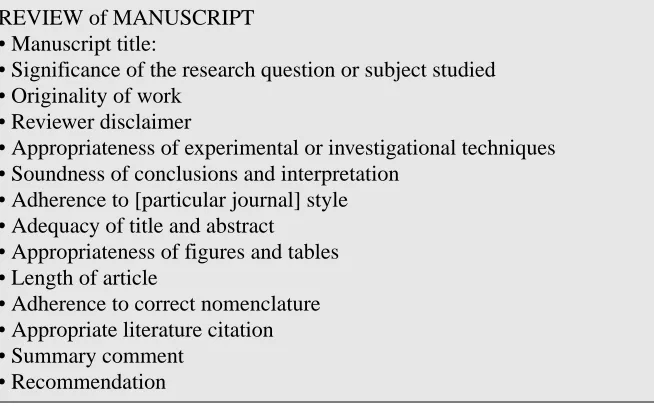
Table 1 provides a list of questions a reviewer may wish to examine when reviewing an article for possible publication.
How to Deliver Negative News
journal to advance an author’s own cause and publish material from like-minded friends and colleagues that is unlikely to be accepted in the mainstream journals, there is every likelihood that a review will conclude with a rec-ommendation to publish with change or to not publish. We are cognizant of the words of the eminent editor Peter Morgan, who stated that “the author may, with some jus-tification, see revision as enforced collaboration with a phantom team of critics and an unruly editor”.23 As noted
above, the recommendation to publish with change must be accompanied by the reviewer’s guide to what the re-viewer considers appropriate changes.
However before getting to the final recommendation it may become evident to the reviewer that a particular manuscript is not working and is not acceptable for publi-cation. A common cause is for the author to tackle too much content in a single paper. A possible response is for the reviewer to guide the author to construct 2 papers. The following text is a real-life example from one of us who recently addressed this problem. Note the elements of commencing this comment with a positive, making a sensible suggestion in an un-emotive manner, and con-cluding with a positive suggestion that may enhance the work of this author: “This is a nice piece of writing and it
would be a shame to shorten it as, when published, it will
serve as a valuable reference point for other educators. The options are to separate into two papers, one to spe-cifically address the development of the curriculum and the other to specifically discuss models of teaching [topic removed]. The latter could be the first paper in the series and could serve to introduce the topic of curriculum de-velopment which would be a subsequent paper. This ap-proach may have merit because it would buy the author time to survey the class or students who undertook this course and report their experience. This would strength-en the paper as it would complete the Boyer loop of de-sign, implement, review, refresh.”
Using another author, here is an example of how to convey the news that the manuscript is not publishable at this time. Note there is no ad hominem attack on the au-thor and there is a reassurance that the auau-thor’s ideas have some value.
The papers are not publishable in their current form but they contain important material which seems to be well-researched and should be published. The themes are suited to the Journal’s objectives. The authors should be encouraged to restructure, rewrite, and resubmit.
One of the perceived problems with that original man-uscript was an incomplete literature review. The body of the reviewer’s comments included this guidance:
Table 1 A guide to the comments expected within a review of a manuscript
submitted for peer review
REVIEW of MANUSCRIPT • Manuscript title:
• Significance of the research question or subject studied • Originality of work
• Reviewer disclaimer
• Appropriateness of experimental or investigational techniques • Soundness of conclusions and interpretation
• Adherence to [particular journal] style • Adequacy of title and abstract
• Appropriateness of figures and tables • Length of article
• Adherence to correct nomenclature • Appropriate literature citation • Summary comment
It is important for this topic to be intelligently reviewed and I feel the authors have done a fairly good job in sort-ing through the literature and maksort-ing sense of it. The au-thors state they used PubMed as their data source and while this is quite acceptable I think the Index to Chiro-practic Literature should have been used as well to pick up anything chiropractors may have squirreled away. There may also be papers of interest in the social science or al-lied health data bases, particularly as the use of [topic re-moved] may also be a social science question.
Using another example, here is the advice from the ed-itor in the case where a paper was considered inappropri-ate for a particular journal:
I have received the 5 reviews on your paper. Based on those reviews, I respectfully suggest that your paper might find a better home than the [journal omitted]. Re-gretfully, I cannot advance this paper in the [journal omitted] process.
While there is nothing ad hominen there is also a re-grettable absence of advice from the editor to further guide the author.
We consider that a review has achieved its objective when it helps grow and develop the authors to the point where their work is publishable and goes on to make a worthwhile contribution to the literature of the discipline.
Weaknesses of Peer Review
We appreciate that it is possible that some editorial boards may not have the capacity to provide a sufficient breadth of expertise to competently advise the editor in all cases. This weakness of the peer review process in general is compounded when there is insufficient exper-tise within an editorial board to offer the editor and asso-ciate editor the level of advice and guidance thought essential in the absence of either holding qualifications beyond chiropractic and education. The danger in this scenario is not so much a restriction on the journal achieving its aim but the bias against new thought that may arise from condensing control into a small group with limited expertise.
A worse outcome would be the reliance of an editor on friends or acquaintances to perform peer review. In this situation, the integrity of a journal’s mission could be compromised through the use of people not closely asso-ciated with the journal and perhaps not fully understand-ing either its mission or the discipline of the work they
may be reviewing. Further, such people may not have sufficient expertise to offer a meaningful review, and the review of manuscripts submitted by established educa-tors and researchers is no place to begin the learning process.
If a journal is to truly step up and meet its objectives and responsibilities then it must embrace a reasonably sized pool of reviewers with appropriate expertise and capability in the topics most likely to be submitted for consideration to publish.
We see another weakness of the peer review process within chiropractic journals as being the absence of any formal procedure where an author may challenge a re-viewer’s comments. The more effort an editor makes to filter the review comments so that only the most pertinent are returned to the author, the less we see the likelihood of appeal. However when an author becomes aggrieved by being bombarded with unfiltered comment that may be ill-conceived, irrelevant and at worst, vindictive, the greater the likelihood.
Unfortunately the increased likelihood of the need to appeal for a fair go has an inverse relationship with the ability of an editor to offer it. To this end we make the point that a journal is neither a fiefdom nor a democracy. In a sense good editorship is about being a benevolent dictator; tough decisions have to be made about deeply loved work from fragile egos for the greater good of the readership of the journal which is quantified as circula-tion. Those who volunteer to perform peer review have a special privilege to make a meaningful contribution to this process. At the same time, the ultimate decision is in the hands of an editor; when questions are sent to the edi-tor, the editor is obligated to respond, because it is peo-ple’s careers, time and money at stake. But as we have noted, both of us have sent messages to editors of promi-nent chiropractic scientific journals to which no response was ever received. If we, established authors both, are not having our questions answered, where does that leave the novice?
How to Deliver for the Editor
consider a 2-week window appropriate, yet it is rarely achieved in practice. Each of us have waited far longer to receive the results of reviews, and in several cases have waited more than 4 months to receive reviewer com-ments, leading us to withdraw papers from consideration as a result.
Withdrawal is not an act of petulance; rather, it is a re-flection of the contemporary society in which we find our-selves as writers. All academics are under pressure to publish and in our institutions this is quantified by the level of academic appointment. For example, the School of Health Sciences (RMIT University, Australia) expects an Associate Professor to publish 4 peer-reviewed papers annually and in journals recognized by the federal govern-ment as having appropriate editorial processes in place.
Effective academics have rhythms and untimely review processes are simply unacceptable as they break the rhythm cycle. Further, this creates unnecessary stresses on authors, who reasonably expect to hear something re-garding their paper; not hearing can affect their academic evaluation and even their career. Effective authors also write in teams, as we are doing for this paper, and it is not an embarrassment for us to state that the elapsed time for going from blank page to finished initial manuscript for this paper was less than 3 weeks. The more difficult peri-od is that of concept and this can be measured in months if not longer, but reviewers are only dealing with a semi-finished product and it is reasonable to expect a timely re-sponse. When it is lacking, authors will withdraw and move on.
Reviewers offer their best service for an editor when they provide a well-structured review that contains duly considered judgements couched in supportive language and returned in a timely manner.
Blinding
We have discussed principles around blinding at the be-ginning of this paper and we come back to it to provide a common standard for current practice. As long as peer view remains a blinded process the reviewer has the re-sponsibility to ensure they are indeed blinded.
As most reviewers will write their review in Microsoft Word® the following process must be followed: Open the
File menu and select the Properties tab. Ensure the
en-tries are blank except for the Title. The reviewer will not include their name in any part of the review text. As there
is no need for a title page for the review there is similarly no provision for the author’s name to appear elsewhere. It is worth remembering that saving a file in Word can of-ten identify the reviewer when the cursor is moved over the file icon.
We say above as long as peer review remains a
blind-ed process to raise an important question: Does blinding
matter? That is, does it affect the quality of what is pub-lished? The answer is decidedly murky. In the notably important development of open access publication, such as the Biomed Central family of journals, authors are of-ten allowed to recommend reviewers for their submis-sions. One might think that this would lead to less critical commentary about papers, and a higher likelihood of publication. While there is evidence to suggest some truth to this, the actual reality is more complex. Wager and colleagues25 studied whether reviewers selected by
authors were as good as those chosen by the editor. They found that reviewer source had no effect on review quali-ty or tone, but that author selected reviewers were more likely to recommend publication and less likely to recom-mend rejection than reviewers selected by the editors, at initial review. After the revision process, there was no difference between groups with regard to their final rec-ommendations for acceptance or rejection.
Rivara et al4 found much the same. In their paper, they
report that there was little difference in quality between author-selected reviewers and editor-selected reviewers, and there was little difference in the time it took to have manuscripts reviewed; however, again, the editor-select-ed reviewer was less likely to recommend publication. And yet again, Schroter et al26 had similar findings in
their paper, finding that quality between groups did not differ but that author-suggested reviewers tended to more favourably review papers. Thus, it seems that blinding may not be critically important to the quality of the re-view, given that here the authors were actually selecting their own reviewers.
the papers we are reviewing. Only our integrity prevents us from potentially acting in some untoward fashion in our review and we have both removed ourselves when we thought we had conflict, more because we knew the author too well than because we had any differences. We argue that it is time to lift the veil on blind peer review; we are a mature profession and we should demonstrate that maturity. Certainly, unblinding the review process would end some of the practices we describe above.
Editorial Independence: Beneficence, Arrogance or Ignorance
The objective of this paper is to reinforce the peer-review process as one that is advisory to the editor but which serves the critically important function of advancing our knowledge. Peer review does not have any capacity to re-place the judgement of the editor. In turn this confers a responsibility upon editors to make their own informed judgement on the merits of review comments.
This is not a compromise of editorial independence; rather, it is an act of beneficence, the moral principle of doing good. It is not unknown for a reviewer to have evil intent that may overtly or covertly be expressed as ad
hominem attacks or comments in their review.
Benefi-cence requires the editor to filter out such comments, thus protecting the best interests of all parties including the journal.
Nor is the exercise of editorial independence an act of arrogance. After all, the editor is responsible for making judgement calls that align with the journal’s mission and purpose. At times, controversy can be expected and there can be benefit associated with publishing such material. The editor will wisely ensure that the substance of any controversial content is presented fairly.
However we are less able to be gentle about ignorance. This paper was conceptualised through our frustration with what was perceived as substandard editing and re-viewing. In our belief that the journals of our discipline deserve nothing but the best we have collaborated to doc-ument our not inconsiderable experience on both sides of the fence for the purpose of improving the process.
Such a goal is presumptive that the process needs im-provement. It is our view that there is always room for improvement, not only in our own behaviours but in this case within the entire editorial process, including editors as well as peer reviewers.
We are familiar with an editorial published during 200727 that drew a series of conclusions about the
profes-sional behaviours of chiropractors. The thrust of that piece was to demonstrate that chiropractic was indeed a profession with a defined set of high-order behaviours, yet the data sources were simply the promises made at graduation as written into various Chiropractic Oaths. A profession is defined by the lived behaviours of its partic-ipants and not the promised behaviours of its newest members.
Then there was an editorial that cited each paper in its current issue for the purpose of allowing editorial com-ment on each28. This practice also affected the citation
in-dex for those papers, potentially enhancing the impact factor for the journal. This was brought to the attention of the editor, who then ensured that the practice has not re-curred.
We trust this commentary goes some small way to im-proving the lived behaviours evident within the peer-re-view process. And given that the one real privilege of an editor is to publish and be damned without the complexi-ty of peer review, we trust ignorance will be less of an excuse in the future.
Recommendations
Based on the above thoughts, we suggest the following: • Unblind the review process: Chiropractic has reached
a point in its scientific maturity where we collectively need to recognize the fact that we have relatively few full-time researchers, and among those who do con-duct research, nearly all are aware of what the others are doing. It is becoming harder and harder to fully blind scientific reviews, and we argue that transparen-cy alone is sufficient reason to abandon this practice in the absence of hard evidence that blinding reviews leads to stronger papers than unblinded reviews. As a mature profession, we should openly criticize our peers; unblinding reviews removes the potential for abuse hidden within the blinded process, leads to high-er levels of accountability, and will chigh-ertainly heighten the level of civility in reviewers. The lead scientific journal Nature Cell Biology has recommended change in peer review, making transparency paramount.29
“journalology.” Editors should have ease of access to descriptive information, for example, the time from sending a review out to the receipt of its review for each individual who provides reviews for the journal, the time from submission to publication for accepted papers, the overall acceptance rate, etc. With some work, it would be possible to provide quality evalua-tions for reviewers. We can study how many papers that have been rejected at one journal are later pub-lished elsewhere. All of this can help journal editors decide whether or not to keep reviewers who take too long to return their reviews, and whose reviews suffer from lower quality ratings. It can help determine how well the review system is working within chiropractic; if anecdote were evidence, the comments we have re-ceived have given us reason to worry.
• Develop training programs for peer reviewers: Of course, we can also decrease abuse and poor perform-ance by developing training programs. In the past, a few presentations have been made at annual scientific programs such as the Association of Chiropractic Col-leges/Research Agenda Conference, but these are typi-cally sparsely attended and are open to all. With the advancements in online technology, it would be a rela-tively simple matter to develop online programs for training peer reviewers. This can be done in modular format, making the time commitment one that the po-tential reviewer can easily handle. In addition, editors and reviewers should become conversant with the text by Hames30 addressing peer review, which provides
detailed information for potential reviewers.
Conclusion
An editorial in the journal Medical Education31 asked the
question “Are scientific papers out of date?” It points to problems within the historical development of scientific journals, noting that in the past 50 years there has been a shift to passive voice, to longer sentences, an assumption that scientific papers are the repository of scientific knowledge, and the growing importance of a formal re-viewing system. This last development is cited as actually being a system of validation. The editorial also notes that the use of the personal computer and the use of the inter-net and web have highly significant implications for re-view and for publication. We acknowledge that peer review faces new challenges, and that to date within the
chiropractic academic and research communities these challenges remain unmet and unrecognized. Our goal in this paper is to openly discuss these challenges while at the same time providing guidance to current and future reviewers about the activity in which they have volun-teered their service.
Although small, the chiropractic writing base is rela-tively productive and growing. There is a good base of well-written texts to support our educational programs and a reasonable distribution of journals world-wide to maintain currency. In the latter in particular we have done so well, yet we can do so much better.
References
1 Bradley JV. Editorial overkill. Bull Psychonomic Soc 1982; 19:271–274
2 Rockwell S. Ethics of peer review: a guide for manuscript reviewers. URL http://radonc.yale.edu/pdf/Ethical_Issues_ in_Peer_Review.pdf accessed 13th February 2008
3 Van Rooyen S, Godlee F, Evans S, Black N, Smith R. Effect of open peer review on quality of reviews and on reviewers’ recommendations: a randomised trial. BMJ. 1999; 318:23–27.
4 Rivara FP, Cummings P, Ringold S, Bergman AB, Joffe A, Christakis DA. A comparison of reviewers selected by editors and reviewers suggested by authors. J Pediatr. 2007; 151:202–205.
5 Rennie D. Editorial peer review in biomedical publication: the First International Congress. JAMA 1990; 263:1317. 6 Council of Biology Editors. Peer review in scientific
publishing. CBE; Chicago, IL, 1991.
7 Annual meeting report. Evidence-based editing: promotion of editorial research. Science Editor 2008; 31:12
8 Ebrall P. Editorial ethics [Young M, Bolton T, The write stuff; letter] Clin Chiropr. 2004 Sep; 7(3):154.
http://dx.doi.org/doi:10.1016/j.clch.2004.02.006
9 Callender A, Chance MA, Gotlib A, Lawrence DJ, Ward RW. More editorial ethics [Young M, Bolton J. The write stuff. Clin Chiropr 2003; 6:89–91; letter]. Clin Chiropr. 2004 Sep; 7(3):155.
http://dx.doi.org/doi:10.1016/j.clch.2004.05.004 10 Lawrence DJ. Peer Review: Different perspective. J Am
Chiropr Assoc. 2002 March; 39(3):40–42.
11 Ebrall PS. Commentary: The ethics of publication. J Chiropr Educ 1993 Sept:43–51.
12 Lawrence DJ. Conflict in Peer Review [Editorial]. J Manipulative Physiol Ther. 1990; 13:177–178. 13 Gleberzon BJ. Commentary: A peer-reviewer’s plea.
14 Provenzale JM, Stanley RJ. A systematic guide to review-ing a manuscript. J Nucl Med Technol. 2006; 34:92–99. 15 Black N, van Rooyen S, Godlee F, Smith R, Evans S. What
makes a good reviewer and a good review for a general medical journal? JAMA 1998; 280:231–233
16 Callahan ML, Tercier J. The relationship of previous training and experience of journal peer reviewers to subsequent quality review. PLoS Med. 4(1):e40. doi:10.1371/journal.pmed.0040040
17 Evans AT, McNutt RA, Fletcher SW, Fletcher RH. The characteristics of peer reviewers who produce good quality reviews. J Gen Intern Med. 1993; 8:422–428.
18 Kliewer MA, Freed KS, DeLong DM, Pickhardt PJ, Provenzale JM. Reviewing the reviewers: comparison of review quality and reviewer characteristics at the American Journal of Roentgenology. AJR. 2005; 184:1731–1735. 19 Kliewer MA, DeLong DM, Freed K, Jenkins CB, Paulson
EK, Provenzale JM. Peer review at the American Journal of Roentgenology: how reviewer and manuscript characteristics affected editorial decisions on 196 major papers. AJR. 2004; 183:1545–1550.
20 http://www.journalchiroed.com/, accessed 25th January 2008.
21 Lawson DM, Till H. Predictors of performance of students from the Canadian Memorial Chiropractic College on the licensure examinations of the Canadian Chiropractic Examining Board. J Manipulative Physiol Ther 2006; 29:566–569.
22 Squires B. Descriptive studies: what editors want from authors and reviewers. CMAJ. 1989; 141:879–880. 23 Morgan P. The joys of revising a manuscript. CMAJ. 1986;
134:1328.
24 J Chiropr Hum URL http://
www.journalchirohumanities.com/editorialstaff.html, accessed 25th January 2008.
25 Wager E, Parkin EC, Tamber PS. Are reviewers suggested by authors as good as those chosen by editors? Results of a rater-blinded retrospective study. BMC Medicine. 2006; 4:13 doi:10.1186/1741-7015-4-13.
26 Schroter S, Tite L, Hutchings A, Black N. Differences in review quality and recommendations for publication between peer reviewers suggested by authors or editors. JAMA 2006; 295:314–317.
27 Johnson C. Integrity and chiropractic. J Chiropr Humanities 2007; 6:43–44.
28 Young M, Bolton J. The write stuff. Clin Chiropr. 2003; 6:89–91.
29 Editorial. Opening up review. Nature Cell Biol 2007; 9:1. 30 Hames I. Peer review and manuscript management in
scientific journals: guidelines for good practice. Oxford, UK; Blackwell Publishing, 2007.