Type of the Paper (Article)
1
A Static-loop-current attack against the KLJN secure
2
key exchange system
3
Mutaz Y. Melhem and Laszlo B. Kish *
4
Department of Electrical and Computer Engineering, Texas A & M University, 3128 TAMU,
5
College Station, TX, 77843, USA; E-Mails: [email protected](MYM); [email protected] (L.B.K.)
6
* Correspondence: [email protected]; Tel.: +1-708-776-367x6
7
8
9
Abstract: A new attack against the Kirchhoff-Law-Johnson-Noise (KLJN) key distribution system is
10
introduced. The attack is based on 1) Utilizing the dc-voltage-source - which we put at Alice’s end
11
in our mathematical modeling of the attack-that could exist due to errors, imbalances,
12
Electromagnetic interference and etc.2) On studying the number of samples per bit in the security
13
key that the measured Alice/Bob voltages exceeds or falls below a threshold voltage, respectively.
14
The threshold voltage is the average between dc voltages across low and high resistors- generated
15
by a dc-voltage source. We count the number of samples the voltage at Bob’s end (containing both
16
the noise and dc components) exceeds the threshold voltage and how many times it falls below the
17
threshold to judge whether the resistor can be guessed as low or high for every cycle. Also for a
18
pre-specified key-length we count the number of high resistance estimations per bit –at Bob’s
19
end-according to the previous criterion and the non-successful estimations per bit to judge the final
20
guessed resistor value at Alice’s end and Bob’s end, where if we have more bits with most of its
21
measured samples are above the threshold voltage then we will predict Bob’s resistance as high
22
resistance, otherwise we predict Bob’s resistance to be low resistance. The Simulation was
23
conducted and the attack proved that it is successful unless the temperature increased dramatically
24
to ranges more than a threshold temperature ~ 1010Kelvin that increases when the number of
25
samples per bit increases.
26
Keywords: Thermal-Noise; attack; sampling rate; Success Rate; simulation; Kirchoff—law-
27
johnson-noise KLJN key distribution system; unconditional security;Measurement; evaluation ;
28
correct guessing probability.
29
30
1. Introduction
31
1.1 Secure Communications
32
Communications systems, standards and technologies havebeen developed since ancient history.
33
Today we have the internet, Internet-of-Things (IoT), the operating 4th generation wireless networks
34
(LTE), and the expected 5th generation wireless networks. An important requirement of any
35
communication paradigm between these devices is to accomplish the communication securely. That
36
is, to protect the privacy of the users’ data that is transferred over the network. To achieve the
37
confidentiality of the transferred data that can contain sensitive information (e.g., bank account
38
credentials, social security number, etc.) it is of utmost importance to defend against attacks. These
39
attacks (i.e., eavesdropping, sniffing, man-in-the-middle (MitM), etc.) might be launched by
40
malicious attackers that are located (topologically or physically) between the sender and receiver
41
devices. Software based cryptography (SBC) emerged to assure inexpensive secure
42
communications. SBC can be classified into two types, symmetric and asymmetric cryptography.
43
Symmetric key exchange (that uses the same key for encrypting and decrypting data) was the most
44
popular until W. Diffie and M.E. Hellman published their famous paper [1] with the concept of
45
public-key cryptography (also known as asymmetric key cryptography[2]). Diffie and Hellman's
46
publication pushed widespread scientific researches to generate a practical public-key encryption
47
system, the goal was reached in 1978 when Ronald Rivest, Adi Shamir, and Len Adleman,
48
introduced the RSA algorithm [3]. Such algorithms utilize computational complexity and achieve
49
only conditional security. The system is temporarily secure if an adversary has limited
50
computational resources. In order to achieve the unconditional security that is
51
information-theoretic security, proper laws of physics and special hardware are utilized. Two major
52
theorems were developed for unconditional security: 1) The Quantum key distribution (QKD) [4, 5],
53
which is based on the Quantum no-cloning theorem. 2) The Kirchhoff's-law-Johnson-noise (KLJN)
54
secure key distribution method, which is based on the fluctuation-distribution-theorem that
55
satisfies the 2nd law of thermodynamics.
56
57
1.2 The KLJN Scheme:
58
The KLJN scheme is a statistical physical key distribution scheme [6-17]. The scheme has several
59
advantages, for example, it can be integrated on a chip. The core model is composed of two identical
60
pairs of resistors and at Alice’s and Bob’s ends, respectively, see Fig. 1. The noise generators
61
associated with each resistor can be the thermal noise of the given resistor or an external noise
62
generator. The power spectral density of voltage and current in the channel can be described by the
63
following equations[11] :
64
4 ( )
u
kTR R S f
R R
(1)
65
A B 4 ( )
i
kT S f
R R
(2)
66
Where kis Boltzmann’s constant, T is temperature at thermal equilibrium, RA and RBare the
67
operating resistance at Alice’s and bob’s ends, respectively. Equations (1) and (2) have two
68
unknowns, so Eve can find the values ofRA&RBbut without knowing their locations. The values of
69
A
R &RBare either R0orR1, R0is used to key bit 0 and R1is used to key bit 1 at either end. When
70
A
R ≠RB, Eve can identify the values of the resistors but without knowing which resistor is at Alice
71
or Bob ends, which indicates the security of the system since she cannot identify the location of the
72
resistor when 01 or 10 combinations are set in. But Eve can crack the 11 or 00 combinations. The
73
KLJN system can be configured with an external noise generator with power spectral density
74
( )=Ѵ , where the Ѵ “temperature scaling” coefficient can be set to a large value to diminish
75
the impact of background noise effects[11] . In the KLJN system all resistors - at both ends- have the
76
same temperature or have the same coefficient to provide thermal equilibrium and as per the 2nd
77
law of thermodynamics to guarantee zero net power-flow. Hence, Eve cannot use the power flow
78
(2) they find the resistance at the other end, since each knows the value of the resistance at its end,
80
so equations (1) and (2) are considered 1-variable equation for Alice and Bob.
81
83
82
Figure 1. The KLJN System as first introduced in [18], where RL is the low resistance that is used to
84
key 0 and RH is the high resistance that is used to key 1. While UHAn( )t & ULAn( )t and UHBn( )t &
85
LBn( )
U t are the noise sources generated by the high & the low resistances at either Alice’s or
86
Bob’sends, respectively. U t( ) and I t( ) are the Voltage and the current in the wire, respectively.
87
88
Since emergence of the KLJN scheme several attacking methods against the system were proposed,
89
e.g. [8, 19], [20] which was refuted by [21], [10] which was refuted by [7, 14, 22] , and [23]. Bennet
90
and Riedel challenged the security of KLJN and they published a paper [6] that claims that the KLJN
91
protocols can be defeated by an adversary who is able to perfectly monitor the time-dependent fields
92
in the region between Alice and Bob as electromagnetic theory would allow[13]. This attack
93
neglected Nyquist’s sampling theorem and it was refuted by [24]. F. Hao claimed in [25]that the
94
temperature difference in the channel that would have exist in real communication systems will
95
make the KLJN insecure, his argument was refuted in [26] due to the irrelevancy of the claims.
96
Several papers in the literature was published to prove the effectiveness and the accuracy of the
97
KLJN system like [27]which proves the natural immunity of KLJN to man in the middle attacks, in
98
[28] the KLJN was proved to have unconditional security against any type of non-ideality based
99
attack..[29] Proves that the KLJN is also secure under the non-ideal situation when the wire between
100
Alice and Bob has a resistance. The KLJN was proved to provide conditional security in ranges ten
101
times more than the ranges of quantum communication channels [30].
102
Several papers was written to discuss further development of the system to enhance its security like
103
[31],or it can be developed to count for certain types of attacks like [32], and [19] where a variable
104
noise generator is used to eliminate second law attack. The KLJN was extended to build networks
105
with high speed secure communications [9, 11].
106
2. The attack
107
2.1 The situation that Eve’s utilizes to make the attack
108
The KLJN system [6, 7] assumes that each resistor is connected directly to the ground. In the real
109
world there is often an imbalance, a DC or AC voltage difference between the end points of the
110
interference (EMI) [7]. This potential information leak was mentioned [7] and showed to cause
112
information leak in the case of significant cable resistance. However, the trickier situation when
113
cable resistance is negligible has never analyzed in previous works and that situation requires a new
114
statistical attack that is introduced in this paper.
115
116
In this paper, for the sake of simplicity,we assume that the imperfection is represented by a positive
117
DC voltage generator located at Alice’s end, see Fig.2. Due to Kerckhoff's principle of security, we
118
must assume that Eve knows the polarity and value of this DC voltage. (If she does not know it at the
119
beginning, she will be able to extract it by a long-time averaging). The direction of the current I(t) is
120
assumed to point from Alice to Bob. The voltage U(t) on the wire contains the sum of a DC and an
121
AC (stochastic) components.
122
123
Figure 2. The KLJN system under study, where UAnÎ{ULAn;UHAn} and UBn Î{ULBn;UHBn}, are the
124
noises belonging to the randomly chosen resistors, R
A and RB Î{RL;RH}, of Alice and Bob,
125
respectively, Udcis the DC voltage source and U(t) and I(t)are the voltage and current on the wire,
126
respectively.
127
Let us analyze the resulting voltages and currents. The current in the wire is:
128
I
(
t
)
I
DC
I
n(
t
)
(3)129
where IDC is its DC component
130
DC DC
A B U I
R R
(4)
131
and In(t) is its AC (noise) component
132
An Bn
n
A B
( ) ( )
( ) U t U t
I t
R R
, (5)
133
where UAn and UBnÎ{ULn;UHn}, are the voltages of the noise generators are the Johnson noise
134
sources of the randomly chosen resistors, RA and RBÎ{R RL; H}, of Alice and Bob, respectively.
135
The voltage on the wire is:
136
U
(
t
)
I
(
t
)
R
B
U
Bn(
t
)
(6)137
From Equations 5 and 8 we obtain
138
where UDCwand UACw(t) represent the DC and AC voltage components in the wire, respectively.
140
In general, the DC component can be written as:
141
U
DCw
I
DCR
B
U
DCR
A
R
BR
B (8)142
The voltage and current in the wire have normal distribution since the addition of normally
143
distributed signals result in a signal that has normal distribution with a corresponding mean (given
144
by Equation 10) and variance.
145
The DC component is different during Alice's and Bob's LH and HL bit situations of secure bit
146
exchange, which yields information leak. In the LH situation, that is, when RA RLand RB RH,
147
the DC component of the voltage on the wire is
148
U
DCwº
U
LH
U
DCR
HR
H
R
L , (9)149
and, in the HL bit situation:
150
U
DCwº
U
HL
U
DCR
LR
H
R
L.
(10)151
Note, as we have been assuming that in the given KLJN setupRH >RL, in this particular situation
152
UHL<ULH (11)
153
For later usage, we evaluate the average of ULH and UHL, and call this quantity threshold voltage,
154
Uth,
155
UthULHUHL
2
UDC
2 (12)
156
On the other hand, the corresponding AC (noise) component is the same in both the LH and HL
157
cases:
158
UACw 4kT RLRH
RLRH (13)
159
where UACw means the effective noise voltage on the wire.
160
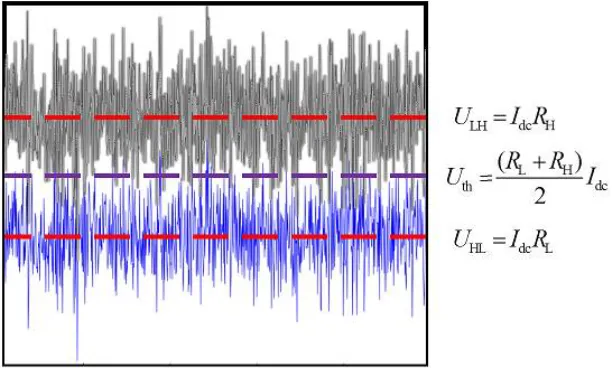
For an illustration, see Figure 3. The DC component, that is, the mean value of Gaussian depends on
161
the bit situation during secure key exchange. This dependence pose as a source of information leak
162
for Eve, and it will be exploited below for the new attack scheme.
163
164
2.2 The attack scheme
165
i) Measurement: During a single secure bit exchange, Eve measures N independent samples of the
167
wire voltage.
168
ii) Evaluation: She evaluates the fraction
g
of these N samples that are above Uth:169
g
N N , (14)
170
where
N
is the number of samples that are above Uth.171
iii) Guessing (based on Equations 9-12): For
0.5
<
g
andg
<
0.5
, Eve's guesses are theLH
and172
HL
bit situations, respectively. Forg
0.5
her decision is undetermined and carries no useful173
information.
174
iv) Eve's correct guessing probability p is given as:
175
p lim
ntot®¥ ncor
ntot , (15)
176
where ntot is the total number of guess bits and ncor is the number of correctly guessed bits. The
177
situation
p
0.5
indicates perfect security against Eve's attack.178
In the next section, we demonstrate the attack method by computer simulations.
179
180
181
Figure 3. Eves' threshold scheme to guess the bit situation LH vs HL.
182
183
3. Simulation Results
184
We tested Eve's success probability p for the LH situation, see equation 9. We assumed that Alice
185
and Bob selected RL 1 kΩ and RH10 kΩ. During these experiments, the DC voltage was kept
186
at a constant level of 0.1 V (see Figures 2 and 3). To generate the noise, we used the white Gaussian
187
noise function (wgn) from the communication system toolbox of Matlab [33] to test the success
188
the range of temperatures were 1 MHz and 107<Teff <1015 K, respectively. For lower
190
temperatures p was 1 within the statistical inaccuracy of simulation. The duration of the secure bit
191
exchange period was measured by the number N of independent noise samples used during the
192
exchange of the particular bit[34] .
193
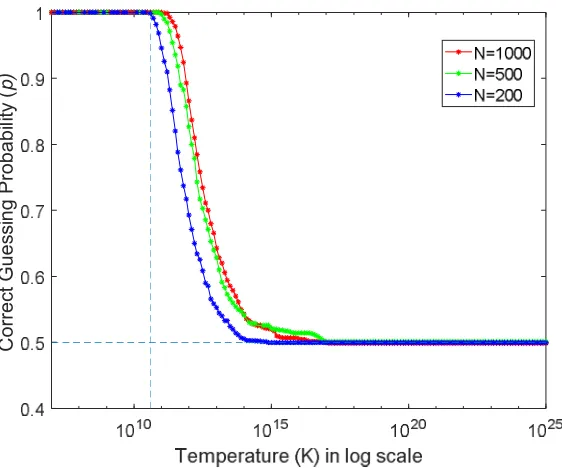
We carried out computer simulations with secure key length M =700 bits at different sampling rates
194
N = 50, 100 and 200, respectively. Figure 4 shows Eve's probability p of successful guessing of a key
195
bit vs temperature. With temperature approaching infinity, the effective noise voltage on the wire is
196
also approaching infinity. That means, in the infinite temperature limit Gaussian density function
197
will be symmetrically distributed around the threshold voltage Uth thus the probability of finding
198
the noise amplitude above or below Uth is 0.5, which means Eve's probability of successful
199
guessing of key bit represents the perfect security limit, p = 0.5 .
200
201
Figure 4. Eve's probability p of successful guessing of a key bit vs temperature at bandwidth
D
f
=202
106 Hz, for key length 700 bits, and number of samples/bit 200, 500 and 100, respectively. p=0.5
203
stands for perfect security.
204
205
Of course, this dependence can simply interpreted by the behavior of the error function (see also
206
Equations 8 and 12):
207
p U t
{
( )
³Uth}
0.5 1erf UthUDCw Ueff æè ç
ö
ø ÷ é
ë ê ê
ù
û ú ú
, (17)
208
where U t
( )
is the instantaneous voltage amplitude in the wire and the error function is:209
C
o
rr
e
c
t
G
u
e
s
s
in
g
P
ro
b
a
b
ili
ty
(
p
erf
(
x
)
1
p
exp
y2
x x
ò
dy
(19)210
The noise in the KLJN scheme is a bandlimited white noise thus, in accordance with the Johnson
211
formula, the effective noise voltage Ueff is proportional to
T
effD
f
,212
U
effµ
T
effD
f
. (20)213
Therefore, when the temperature T is converging to infinity, p is converging to the perfect security
214
limit of 0.5, see Figure 4.
215
216
4. Some of the possible defense techniques against the attack
217
Based on the considerations above, the attack can be defended by various means. The most natural
218
ways are:
219
i) Cancelling the effect of the DC-Voltage sources. For example, Bob can put a variable DC source
220
that compensates its effect. Also all measures for finding and eliminating ground loops should be
221
applied to the circuit.
222
ii) Alice and Bob can increase the effective temperatureTeff , see Equation 18 and Figure 4.
223
iii) Alice and Bob can increase the bandwidth to increase the effective value of the noise, see
224
Equations 18 and 20. However, the bandwidth must stay below the wave limit [24]; this tool is
225
strongly limited.
226
5. Conclusion
227
In this paper a novel attack against a KLJN scheme is shown that uses a practical non-ideal feature,
228
namely the imbalance of voltages between ground points that typically occurs in connected
229
electrical system. We showed that such parasite voltages and currents could cause information leak.
230
Computer simulations demonstrated the attack and simple defense methods.
231
232
233
234
235
236
237
238
References
240
1. Diffie, Whitfield, and Martin Hellman. "New Directions in Cryptography." IEEE transactions on
241
Information Theory 22, no. 6 (1976): 644-54.
242
2. Delfs, Hans, Helmut Knebl, and Helmut Knebl. Introduction to Cryptography. Vol. 2: Springer, 2002.
243
3. Agrawal, Vikas, Shruti Agrawal, and Rajesh Deshmukh. "Analysis and Review of Encryption and
244
Decryption for Secure Communication." International Journal of Scientific Engineering and Research
245
(IJSER) 2, no. 2 (2014).
246
4. Makarov, Vadim, Jean-Philippe Bourgoin, Poompong Chaiwongkhot, Mathieu Gagné, Thomas
247
Jennewein, Sarah Kaiser, Raman Kashyap, Matthieu Legré, Carter Minshull, and Shihan Sajeed. "Laser
248
Damage Creates Backdoors in Quantum Communications." technology 16 (2015): 22.
249
5. Renner, Renato. "Security of Quantum Key Distribution." International Journal of Quantum Information 6,
250
no. 01 (2008): 1-127.
251
6. Bennett, Charles H, and C Jess Riedel. "On the Security of Key Distribution Based on Johnson-Nyquist
252
Noise." arXiv preprint arXiv:1303.7435 (2013).
253
7. Chen, Hsien-Pu, Laszlo B. Kish, Claes-Göran Granqvist, and Gabor Schmera. "Do Electromagnetic
254
Waves Exist in a Short Cable at Low Frequencies? What Does Physics Say?" Fluctuation and Noise Letters
255
13, no. 02 (2014): 1450016.
256
8. Chen, Hsien-Pu, Muneer Mohammad, and Laszlo B. Kish. "Current Injection Attack against the KLJN
257
Secure Key Exchange." Metrology and Measurement Systems 23, no. 2 (2016): 173-81.
258
9. Gonzalez, Elias. Information Theoretically Secure Enhanced Johnson Noise Based Key Distribution
259
over the Smart Grid. Ph.D., 10291126, Texas A&M University, Ann Arbor, 2016.
260
10. Gunn, Lachlan J., Andrew Allison, and Derek Abbott. "A Directional Wave Measurement Attack
261
against the Kish Key Distribution System." Scientific reports 4 (2014): 6461.
262
11. Kish, Laszlo B. "Totally Secure Classical Communication Utilizing Johnson (-Like) Noise and
263
Kirchoff's Law." Physics Letters A 352, no. 3 (2006): 178-82.
264
12. Kish, Laszlo Bela. "Enhanced Secure Key Exchange Systems Based on the Johnson-Noise Scheme."
265
Metrology and Measurement Systems 20, no. 2 (2013): 191-204.
266
13. Kish, Laszlo B. The Kish Cypher: The Story of KLJN for Unconditional Security: World Scientific, 2017.
267
14. Kish, Laszlo B., Zoltan Gingl, Robert Mingesz, Gergely Vadai, Janusz Smulko, and Claes-Göran
268
Granqvist. "Analysis of an Attenuator Artifact in an Experimental Attack by Gunn–Allison–Abbott
269
against the Kirchhoff-Law–Johnson-Noise (KLJN) Secure Key Exchange System." Fluctuation and Noise
270
Letters 14, no. 01 (2015): 1550011.
271
15. Kish, Laszlo B., and Claes G. Granqvist. "Random-Resistor-Random-Temperature
272
Kirchhoff-Law-Johnson-Noise (Rrrt-KLJN) Key Exchange." Metrology and Measurement Systems 23, no.
273
1 (2016): 3-11.
274
16. Kish, Laszlo B., and Robert Mingesz. "Totally Secure Classical Networks with Multipoint Telecloning
275
(Teleportation) of Classical Bits through Loops with Johnson-Like Noise." Fluctuation and Noise Letters
276
06, no. 02 (2006): C9-C21.
277
17. Mingesz, Robert. "Experimental Study of the Kirchhoff-Law-Johnson-Noise Secure Key
278
Exchange."International Journal of modern physics 33, (2014):1-12.
279
19. Kish, Laszlo B., and Claes-Göran Granqvist. "Elimination of a Second-Law-Attack, and All
281
Cable-Resistance-Based Attacks, in the Kirchhoff-Law-Johnson-Noise (KLJN) Secure Key Exchange
282
System." Entropy 16, no. 10 (2014): 5223-31.
283
20. Liu, Pao-Lo. "A New Look at the Classical Key Exchange System Based on Amplified Johnson Noise."
284
Physics Letters A 373, no. 10 (2009): 901-04.
285
21. Kish, Laszlo B., and Tamas Horvath. "Notes on Recent Approaches Concerning the Kirchhoff-Law–
286
Johnson-Noise-Based Secure Key Exchange." Physics Letters A 373, no. 32 (2009): 2858-68.
287
22. Chen, H.-P., Kish, L. B., Granqvist, C. G. & Schmera, G. "On the" Cracking" Experiments in Gunn,
288
Allison, Abbott," a Directional Coupler Attack against the Kish Key Distribution System." Metrol.
289
Meas. Syst. 21, 389–400 (2014)
290
23. Gunn, Lachlan J., Andrew Allison, and Derek Abbott. "A New Transient Attack on the Kish Key
291
Distribution System." IEEE Access 3 (2015): 1640-48.
292
24. Kish, Laszlo B, Derek Abbott, and Claes G Granqvist. "Critical Analysis of the Bennett–Riedel Attack
293
on Secure Cryptographic Key Distributions Via the Kirchhoff-Law–Johnson-Noise Scheme." PLoS ONE
294
8, no. 12 (2013): e81810.
295
25. Hao, Feng. "Kish's Key Exchange Scheme Is Insecure." IEE Proceedings-Information Security 153, no. 4
296
(2006): 141-42.
297
26. Kish, Laszlo B. "Response to Feng Hao's Paper" Kish's Key Exchange Scheme Is Insecure"." Fluctuation
298
and Noise Letters 6, no. 04 (2006): C37-C41.
299
27. ———. "Protection against the Man-in-the-Middle-Attack for the Kirchhoff-Loop-Johnson
300
(-Like)-Noise Cipher and Expansion by Voltage-Based Security." Fluctuation and Noise Letters 6, no. 01
301
(2006): L57-L63.
302
28. Kish, Laszlo B., and Claes G. Granqvist. "On the Security of the Kirchhoff-Law–Johnson-Noise (KLJN)
303
Communicator." Quantum Information Processing 13, no. 10 (2014): 2213-19.
304
29. Kish, Laszlo B, and Jacob Scheuer. "Noise in the Wire: The Real Impact of Wire Resistance for the
305
Johnson (-Like) Noise Based Secure Communicator." Physics Letters A 374, no. 21 (2010): 2140-42.
306
30. Mingesz, Robert, Zoltan Gingl, and Laszlo B Kish. "Johnson (-Like)–Noise–Kirchhoff-Loop Based
307
Secure Classical Communicator Characteristics, for Ranges of Two to Two Thousand Kilometers, Via
308
Model-Line." Physics Letters A 372, no. 7 (2008): 978-84.
309
31. Smulko, Janusz. "Performance Analysis of the" Intelligent" Kirchhoff-Law–Johnson-Noise Secure Key
310
Exchange." Fluctuation and Noise Letters 13, no. 03 (2014): 1450024.
311
32. Liu, Pao-Lo. "A Key Agreement Protocol Using Band-Limited Random Signals and Feedback." Journal
312
of Lightwave Technology 27, no. 23 (2009): 5230-34.
313
33. https://www.mathworks.com/help/comm/ref/wgn.html
314
34. Saez, Yessica, and Laszlo B. Kish. "Errors and Their Mitigation at the Kirchhoff-Law-Johnson-Noise
315
Secure Key Exchange." PLoS ONE 8, no. 11 (2013): e81103.
316
317
![Figure 1. The KLJN System as first introduced in [18], where](https://thumb-us.123doks.com/thumbv2/123dok_us/1029854.1603152/3.595.178.416.138.308/figure-kljn-introduced.webp)