Article
1
Discrete Sine Transform-Based Interpolation Filter
2
for Video Compression
3
MyungJun Kim and Yung-Lyul Lee *
4
Department of Computer Engineering, Sejong University, Seoul 05006, Korea; [email protected]
5
* Correspondence: [email protected]
6
Abstract: High Efficiency Video Coding (HEVC) uses an 8-point filter and a 7-point filter, which
7
are based on the discrete cosine transform (DCT), for the 1/2-pixel and 1/4-pixel interpolations,
8
respectively. In this paper, discrete sine transform (DST)-based interpolation filters (IF) are
9
proposed. The first proposed DST-based IFs (DST-IFs) use 8-point and 7-point filters for the
10
1/2-pixel and 1/4-pixel interpolations, respectively. The final proposed DST-IFs use 12-point and
11
11-point filters for the 1/2-pixel and 1/4-pixel interpolations, respectively. These DST-IF methods
12
are proposed to improve the motion-compensated prediction in HEVC. The 8-point and 7-point
13
DST-IF methods showed average BD-rate reductions of 0.7% and 0.3% in the random access (RA)
14
and low delay B (LDB) configurations, respectively. The 12-point and 11-point DST-IF methods
15
showed average BD-rate reductions of 1.4% and 1.2% in the RA and LDB configurations for the
16
Luma component, respectively.
17
Keywords: HEVC; Interpolation filter; Sinc; DCT (discrete cosine transform); DST (discrete sine
18
transform)
19
1. Introduction
20
The ITU Telecommunication Standardization Sector-Video Coding Expert Group (ITU-T
21
VCEG) and the Moving Picture Expert Group (ISO/IEC MPEG) organized the Joint Collaborative
22
Team on Video Coding (JCT-VC) [1], and they jointly developed the next-generation video-coding
23
standard HEVC/H.265. In HEVC [2], motion-compensated prediction (MCP) is a significant
24
video-coding function that reduces the temporal redundancy in video signals. In the MCP, each
25
prediction unit (PU, block) in the encoder finds the block that has the least SAD (sum of absolute
26
difference) from the reference pictures in terms of the Lagrangian cost [3]. Since the moving objects
27
between two pictures are continuous, it is difficult to identify the actual motion vector in
28
block-based motion estimation. Therefore, the use of fractional pixels that have been derived from
29
an interpolation filter for motion-vector searches can improve the precision of the MCP.
30
The sinc function is an ideal interpolation filter in terms of signal processing [4], [5]. However,
31
the sinc-interpolation filter is difficult to implement in HEVC because the sinc-interpolation filter
32
needs to reference the neighbor pixels from -∞ to ∞. Therefore, the HEVC interpolation filters are
33
designed from the DCT type-II (DCT-II) transform [6], [7], [8] that improves the bit reduction by
34
approximately 4.0 % compared with the H.264/AVC interpolation filters [9]. The filter lengths of the
35
DCT-II-based interpolation filter (DCT-IF) are 8-point and 7-point for the 1/2-pixel and 1/4-pixel
36
interpolations, respectively. In the present paper, a DST [10]-based interpolation filters (DST-IFs)
37
that use different interpolation-filter lengths are proposed.
38
This paper is organized as follows. Section 2 presents the ideal interpolation filter, the sinc
39
function, the DCT-IF, the proposed DST-IF, and an analysis of the interpolation filters. Section 3
40
presents the experiment results, and Section 4 concludes the paper.
41
42
43
44
2. Interpolation Filters for Generating Fractional Pixels
45
2.1 The sinc-based interpolation filter
46
The sinc-based interpolation filter is an ideal interpolation filter in terms of signal processing
47
and its equation is as follows:
48
sin ( )
( ) ( ) ( ) s s s k s s t kT T x t x kT
t kT T π π ∞ =−∞ − = −
(1)where the sinc-based interpolation filter is defined as x(t), t represents the locations of the
49
subsamples and k is the integer sample value, and Ts is the sampling period that is equal to 1. When
50
the sinc-based interpolation filter is lengthened from -∞ to ∞, it is the ideal interpolation filter to
51
reconstruct all the samples. Although the sinc-based interpolation filter is ideal, it is not possible to
52
implement it in HEVC. Since it is impossible to reference all of the neighbor pixels in a picture, the
53
DCT-IF is adopted in HEVC, the filter lengths of which are restricted within 8-point and 7-point for
54
the 1/2-pixel and 1/4-pixel interpolations, respectively.
55
2.2 The DCT-II interpolation filter (DCT-IF) in HEVC
56
The DCT-IF [4] in HEVC is designed in a different way but it can be designed easily in this
57
paper from the following forward/inverse DCT-II:
58
1 0
2 ( 1/ 2)
( ) Nn k ( ) cos
n k
X k c x n
N N
π
− =
+
=
(1)1 0
2 ( 1/ 2)
( ) kN k ( ) cos
n k
x n c X k
N N
π
− =
+
=
(2)In Equation (1), X(k) is the DCT-II coefficients and the input pixel x(n) is the IDCT-II (Inverse
59
DCT-II) coefficients in Equation (2).
60
61
1 , k=0 2 1 , otherwise k c = (3)
62
where ck is 1/√2 at k=0, and ck is 1 at k≠0. The substitution of Equation (1) into Equation (2) results in
63
the following DCT-IF equation:
64
65
1 1 2
0 0
2 ( 1/ 2) ( 1/ 2)
( ) mN ( ) kN kcos cos
m k n k
x n x m c
N N N
π π
− −
= =
+ +
=
(4)Table 1. 8-point and 7 point DCT-II based Interpolation Filter Coefficients in HEVC.
Index i 0 1 2 3 4 5 6 7
1/2-pixel filter[i] -1 4 -11 40 40 -11 4 -1
1/4-pixel filter[i] -1 4 -10 58 17 -5 1
66
For example, the 1/2-pixel interpolation filter, when n = 3.5, in the 8-point DCT (N = 8) is derived
67
as a linear combination of the cosine coefficients and x(m), m = 0,1,…,7. Similarly, the 1/4-pixel
68
cosine coefficients and x(m), m = 0,1,…,6. Lastly, the DCT-IFs that interpolate the 1/2-pixel and
70
1/4-pixel interpolations are shown as the integer numbers in Table 1. The filter-coefficient order of
71
the 3/4-pixel interpolation filter is the reverse of the filter-coefficient order of the 1/4-pixel
72
interpolation filter.
73
74
75
Figure 1. Fractional pixel position in Luma motion compensation.
76
Figure. 1 is an example of the integer- and fractional-pixel positions in the Luma motion
77
compensation. In Figure 1, the capital letters (A0 to A7) indicate the integer-pixel position, the small
78
letter b0 is the 1/2-pixel position, and a0 and c0 are the 1/4-pixel and 3/4-pixel positions, respectively.
79
For example, using the DCT-IF, the b0 and a0 are calculated from Table 1 as follows:
80
0
( 1
04
111
240
340
411
54
61
732)
6
b
= − ⋅ + ⋅ − ⋅ + ⋅ + ⋅ − ⋅ + ⋅ − ⋅ +
A
A
A
A
A
A
A
A
0
( 1
04
110
258
317
45
51
632)
6
a
= − ⋅ + ⋅ − ⋅ + ⋅ + ⋅ − ⋅ + ⋅ +
A
A
A
A
A
A
A
(5)
where the computation of a0 is the same as that of b0 from Table 1, the computation of c0 is in the
81
order that is the reverse of that of a0, and “>>” operation means the bit-wise shift right.
82
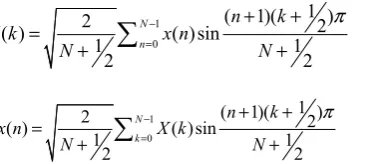
2.3 The Proposed DST-VII Interpolation Filter (DST-IF)
83
The DST-IF for HEVC can easily be designed in this paper from the forward/inverse DST-VII.
84
The DST-VII and inverse DST-VII are defined as follows:
85
1 0
1
( 1)( )
2 2
( ) ( )sin
1 1
2 2
N n
n k
X k x n
N N π − = + + = +
+ (6) 1 0 1( 1)( )
2 2
( ) ( )sin
1 1
2 2
N k
n k
x n X k
N N π − = + + =
+
+ (7)where X(k) is the DST-VII coefficient and x(n) represents the input pixels. The substitution of
86
Equation (6) into Equation (7) results in the following DST-IF equation:
87
1 1
0 0
1 1
( 1)( ) ( 1)( )
2 2 2
( ) ( ) sin sin
1 1 1
2 2 2
N N
m k
m k n k
x n x m
N N N
π π
− −
= =
+ + + +
=
+
+ + (8)In the similar way to obtain the DCT-IF coefficients, the DST-IF is derived from Equation (8).
88
For example, the 1/2-pixel interpolation filter, when n = 3.5, in the 8-point DST (N = 8) is derived as a
89
linear combination of the sine coefficients and x(m), m = 0,1,…,7. Similarly, the 1/4-pixel
90
interpolation filter, when n = 3.25, in the 7-point DST (N = 7) is derived as a linear combination of the
91
sine coefficients and x(m), m = 0,1,…,6. Lastly, the DST-IFs that interpolate the 1/2-pixel and
92
1/4-pixel interpolations are shown in Table 2. The filter-coefficient order of the 3/4-pixel
93
interpolation filter is the reverse of the filter-coefficient order of the 1/4-pixel interpolation filter [11].
94
Table 2. 8-point and 7 point DST-VII-based Interpolation-Filter (DST-IF) Coefficients.
95
Index i 0 1 2 3 4 5 6 7
1/2-pixel filter[i] -2 6 -13 41 41 -13 6 -2
1/4-pixel filter[i] -2 5 -11 58 18 -6 2
96
In the given example, the 8-point and 7-point DST-IFs were derived, but the M-point and
97
(M-1)-point DST-IFs, where M > 8, can be easily derived in a similar way for high-resolution
98
Table 3. 12-point and 11-point DST-VII-based Interpolation-Filter (DST-IF) Coefficients.
100
Index i 0 1 2 3 4 5 6 7 8 9 10 11
1/2-pixel filter[i] -1 2 -4 7 -13 41 41 -13 7 -4 2 -1
1/4-pixel filter[i] -1 2 -3 6 -11 58 19 -8 4 -3 1
Table 4. 12-point and 11-point DCT-II-based Interpolation-Filter (DCT-IF) Coefficients.
101
Index i 0 1 2 3 4 5 6 7 8 9 10 11
1/2-pixel filter[i] -1 2 -4 7 -12 40 40 -12 7 -4 2 -1
1/4-pixel filter[i] -1 2 -3 5 -11 58 18 -7 4 -2 1
102
The 12-point and 11-point DST-IFs that interpolate the 1/2-pixel and 1/4-pixel interpolations are
103
shown in Table 3. The 12-point and 11-point DST-IFs in Table 3 are derived in this paper from
104
Equation (8), where N = 12 and n = 5.5 and N = 11 and n = 5.25, respectively. In the similar way, the
105
12-point and 11-point DCT-IFs in Table 4 are derived in this paper.
106
2.4 Analysis of the interpolation filters
107
108
Figure 2.Magnitude Responses of Interpolation Filters for the 1/2-pixel Position in the Luma Component.
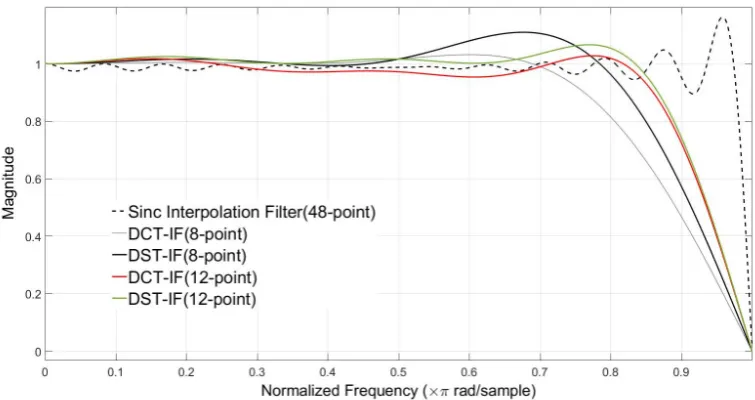
109
110
Figure 2 shows all of the different graphs of the magnitude responses of the 1/2-pixel
111
interpolation filters. In the x-axis, the discrete time frequency
ω
ˆ
is normalized in the range of 0 to112
1, where 1 corresponds to the π radian. The y-axis is the magnitude response. Figure 2 illustrates the
113
magnitude-response graphs of five (5) interpolation filters reconstructing the 1/2-pixel position. The
114
sinc function, which is assumed the ideal interpolation filter, is designed with a 48-point
115
interpolation filter and represented by a dot-line. The 48-point sinc interpolation filter has relatively
116
high frequency response even around
ω
ˆ
=0.9π compared with other interpolation filters such as117
8-point DCT-IF, 8-point DST-IF, 12-point DCT-IF, and 12-point DST-IF and it comprises many more
118
ripples at high frequencies compared with the other interpolation filters. In particular, in the low
119
frequency responses when
ω
ˆ
<0.5π, all interpolation filters have similar responses. It can be120
interpreted that all five (5) interpolation filters have similar low frequency responses but the high
121
frequency responses are different. Comparing the 8-point DCT-IF drawn in a gray line and the
122
8-point DST-IF drawn in a black line, the 8-point DST-IF has relatively high frequency responses
123
similar. In case of the 12-point DST-IF and 12-point DCT-IF, which are represented by a green and
125
red line, two interpolation filters have relatively higher frequency responses than the 8-point
126
DST-IF and 8-point DCT-IF even if the low frequency responses are quite similar. The 12-point
127
DST-IF and the 12-point DCT-IF have similar high frequency responses because they have almost
128
similar interpolation filter coefficients as shown in Table 3 and Table 4 where only the filter
129
coefficients of integer pixel position 4,5,6,7 are different in 1/2-pixel filter coefficients. It means that
130
12-point DST-IF and 12-point DCT-IF are similar when they are derived mathematically. Therefore,
131
comparing the 12-point DST-IF with 8-point DCT-IF and DST-IF and 12-point DCT-IF in Figure 2,
132
the 12-point DST-IF shows relatively high frequency responses, even though the 48-point sinc
133
interpolation filter shows better high frequency responses than other four (4) interpolation filters.
134
135
3. Experimental Results
136
3.1. Experimental Conditions
137
The proposed DST-IF was implemented in the HEVC reference software, HM-16.6 [12],
138
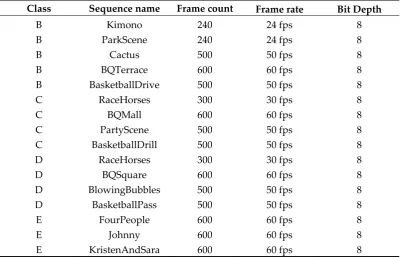
according to the HEVC common-test conditions. Table 5 shows the test sequences where the
139
sequences of the classes B, C, D, and E comprise the resolutions of 1080p, 832 × 480, 416 × 240, and
140
720p, respectively, and the proposed method was applied when the quantization-parameter (QP)
141
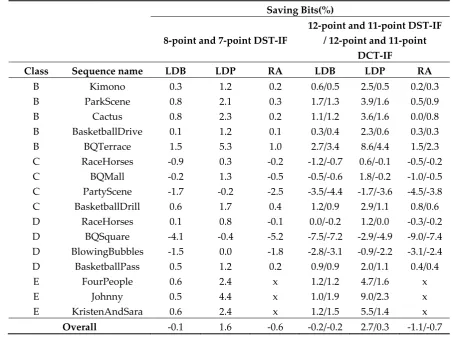
values were 22, 27, 32, and 37, respectively. Table 6 and Table 7 show the test sequences and the
142
BD-rate gain compared with those of HM-16.6 for the Luma component in the LDB, low delay P
143
(LDP), and RA configurations, respectively. The random access configuration has hierarchical B
144
pictures (IBBBBBBBP) which have a GOP (Group of pictures) size of eight (8). The low delay
145
structure is composed of the first I (intra) picture and following P (Predictive) pictures (IPPPPP…).
146
The P pictures in the low delay structure are GPB’s (Generalized P and B pictures), in which the P
147
pictures are replaced by B pictures having the same two reference pictures.
148
The negative sign of the BD-rate represents the bit-saving of the proposed method compared
149
with that of HM-16.6 in the same PSNR (peak signal-to-noise ratio) reference [13].
150
Table 5. Test Sequences used in HEVC Common-Test Conditions.
151
Class Sequence name Frame count Frame rate Bit Depth
B Kimono 240 24 fps 8
B ParkScene 240 24 fps 8
B Cactus 500 50 fps 8
B BQTerrace 600 60 fps 8
B BasketballDrive 500 50 fps 8
C RaceHorses 300 30 fps 8
C BQMall 600 60 fps 8
C PartyScene 500 50 fps 8
C BasketballDrill 500 50 fps 8
D RaceHorses 300 30 fps 8
D BQSquare 600 60 fps 8
D BlowingBubbles 500 50 fps 8
D BasketballPass 500 50 fps 8
E FourPeople 600 60 fps 8
E Johnny 600 60 fps 8
E KristenAndSara 600 60 fps 8
3.2. Experimental Results
153
Table 6. DST-IF Bit-saving Results applied to Uni- and Bi-directional Prediction.
154
Saving Bits(%)
8-point and 7-point DST-IF
12-point and 11-point DST-IF / 12-point and 11-point
DCT-IF
Class Sequence name LDB LDP RA LDB LDP RA
B Kimono 0.3 1.2 0.2 0.6/0.5 2.5/0.5 0.2/0.3
B ParkScene 0.8 2.1 0.3 1.7/1.3 3.9/1.6 0.5/0.9
B Cactus 0.8 2.3 0.2 1.1/1.2 3.6/1.6 0.0/0.8
B BasketballDrive 0.1 1.2 0.1 0.3/0.4 2.3/0.6 0.3/0.3
B BQTerrace 1.5 5.3 1.0 2.7/3.4 8.6/4.4 1.5/2.3
C RaceHorses -0.9 0.3 -0.2 -1.2/-0.7 0.6/-0.1 -0.5/-0.2
C BQMall -0.2 1.3 -0.5 -0.5/-0.6 1.8/-0.2 -1.0/-0.5
C PartyScene -1.7 -0.2 -2.5 -3.5/-4.4 -1.7/-3.6 -4.5/-3.8
C BasketballDrill 0.6 1.7 0.4 1.2/0.9 2.9/1.1 0.8/0.6
D RaceHorses 0.1 0.8 -0.1 0.0/-0.2 1.2/0.0 -0.3/-0.2
D BQSquare -4.1 -0.4 -5.2 -7.5/-7.2 -2.9/-4.9 -9.0/-7.4
D BlowingBubbles -1.5 0.0 -1.8 -2.8/-3.1 -0.9/-2.2 -3.1/-2.4
D BasketballPass 0.5 1.2 0.2 0.9/0.9 2.0/1.1 0.4/0.4
E FourPeople 0.6 2.4 x 1.2/1.2 4.7/1.6 x
E Johnny 0.5 4.4 x 1.0/1.9 9.0/2.3 x
E KristenAndSara 0.6 2.4 x 1.2/1.5 5.5/1.4 x
Overall -0.1 1.6 -0.6 -0.2/-0.2 2.7/0.3 -1.1/-0.7
155
HM-16.6 uses an 8-point filter and a 7-point filter for the 1/2-pixel and 1/4-pixel interpolations,
156
respectively. From Table 6, the average bit-saving (BD-rate gain) in the RA configuration was
157
improved by 0.6 % with the use of the 8-point DST-IF for 1/2-pixel and 7-point DST-IF for 1/4-pixel.
158
Especially, the result of BQSquare in Class D achieved a bit-saving up to 5.2 % in the RA
159
configuration. The average bit-savings of 0.6 % and 0.1 % were achieved in the RA and LDB
160
configurations, respectively. However, the average bit-saving was decreased by 1.6 % in the LDP
161
configuration. In Table 6, the 12-point and 11-point DST-IFs that were applied to HM-16.6 also
162
showed bit-saving in the RA and LDB configurations and bit-increasing (BD-rate loss) in the LDP
163
configuration. In Table 6, Class E sequences in the RA configuration are not experimented because
164
they are not experimental condition in the HEVC test. Those sequences are marked as x.
165
Interestingly, the DST-IFs in the LDP configuration show bit increments (BD-rate loss), while
166
the DST-IFs in the RA and LDB configurations show bit-savings. It’s because the backward
167
(uni-directional) prediction using the decoded past pictures provides the incomplete
168
motion-compensated block compared with the bi-directional prediction that utilizes the average
169
pixel values of two different blocks that were derived by the forward and backward
170
motion-compensations for subsample interpolation. Therefore, the proposed 12-point and 11-point
171
DST-IFs are applied only on the bi-directional motion-compensated blocks. The 12-point and
172
11-point DST-IFs, which are almost the same filter coefficients as the 12-point and 11-point DCT-IFs,
173
are effective on the bi-directional prediction. Table 7 shows the results of the DST-IF bit-saving
174
results applied only on the bi-directional prediction. In the RA and LDB configurations, the 8-point
175
and 7-point DST-IFs achieved bit-savings of 0.7 % and 0.3 % compared with HM-16.6, respectively,
176
HM-16.6, respectively. Table 7 shows the results of the 12-point and 11-point DCT-IFs as well. It
178
shows bit-savings of 0.6% and 0.7% in the LDB and RA configurations compared with HM-16.6,
179
respectively.
180
Table 7. DST-IF Bit-saving Results applied to Bi-directional Prediction.
181
Saving Bits(%)
8-point and 7-point DST-IF
12-point and 11-point DST-IF / 12-point and 11-point
DCT-IF
Class Sequence name LDB RA LDB RA
B Kimono 0.1 0.1 0.1/0.1 0.0/0.2
B ParkScene 0.2 0.1 0.0/0.3 0.0/0.6
B Cactus 0.2 0.0 -0.4/0.2 -0.3/0.6
B BasketballDrive 0.0 0.0 -0.1/0.1 -0.1/0.2
B BQTerrace 1.1 0.8 0.4/2.3 0.8/2.0
C RaceHorses -0.7 -0.2 -1.3/-0.5 -0.6/-0.2
C BQMall -0.3 -0.6 -1.2/-0.9 -1.3/-0.5
C PartyScene -1.5 -2.4 -3.8/-3.7 -4.4-3.5
C BasketballDrill 0.2 0.2 0.3/0.2 0.2/0.3
D RaceHorses -0.1 -0.2 -0.3/-0.2 -0.5/-0.2
D BQSquare -3.7 -5.0 -8.3/-6.3 -9.1/-6.9
D BlowingBubbles -1.2 -1.7 -2.9/-2.4 -3.0/-2.1
D BasketballPass 0.0 -0.1 -0.1/0.1 -0.1/0.2
E FourPeople 0.4 x -0.1/0.6 x/
E Johnny -0.4 x -1.5/0.2 x
E KristenAndSara 0.2 x -0.2/0.5 x
Overall -0.3 -0.7 -1.2/-0.6 -1.4/-0.7
182
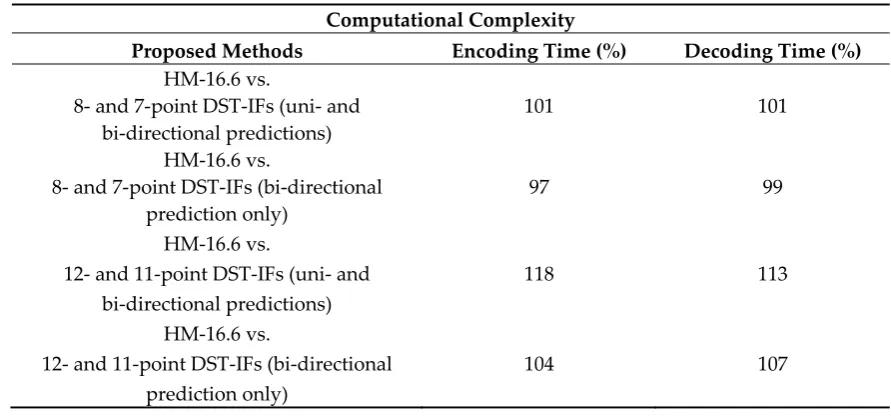
Table 8. Results of the Computational Complexity of the Proposed Method in the Low Delay B (LDB)
183
Configuration.
184
Computational Complexity
Proposed Methods Encoding Time (%) Decoding Time (%) HM-16.6 vs.
8- and 7-point DST-IFs (uni- and bi-directional predictions)
101 101
HM-16.6 vs.
8- and 7-point DST-IFs (bi-directional prediction only)
97 99
HM-16.6 vs.
12- and 11-point DST-IFs (uni- and bi-directional predictions)
118 113
HM-16.6 vs.
12- and 11-point DST-IFs (bi-directional prediction only)
104 107
Table 8 shows the computational-complexity results. As the 12-point and 11-point DST-IFs
186
reference four additional neighbor pixels compared with the 8-point and 7-point DST-IFs in HEVC,
187
when both the uni-directional and bi-directional predictions were applied, the computational
188
complexities in the encoding process and the decoding process were increased by 118 % and 113 %,
189
respectively. However, the 12-point and 11-point DST-IFs, which were applied on only the
190
bi-directional prediction, increased the computational complexity in the encoding process by 104 %
191
and in the decoding process by 107%. The computational-complexity of the 12-point and 11-point
192
DCT-IFs is almost same as that of the 12-point and 11-point DST-IFs. Even if the complexity of the
193
proposed 12-point and 11-point DST-IFs is increased compared with that of the existing 8-point and
194
7-point DCT-IFs in HEVC, the proposed method gives better bit-saving results than the existing
195
method.
196
For an alternative method, one interpolation filter was chosen between the DCT-IF and the
197
DST-IF, and this experiment has been tested using the coding unit-level rate-distortion optimization
198
[14], but the results are worse than those of Table 6 and Table 7 because one signaling bit is needed
199
to indicate which interpolation filter is used in the decoder side.
200
5. Conclusions
201
In this paper, DST-IF pairs of 12-point and 11-point filter lengths are proposed to achieve a
202
bit-rate reduction compared with the 8-point and 7-point DCT-IFs. Interestingly, the 12-point
203
DST-IF and the 12-point DCT-IF have similar high frequency responses because the 12-point DST-IF
204
and 12-point DCT-IF derived have almost similar interpolation filter coefficients as shown in Table
205
3 and Table 4. The experiment results show that the proposed DST-IF pairs achieved coding gains in
206
the RA and LDB configurations. However, as the bit-rate was increased in the LDP configuration
207
using the uni-directional prediction, the proposed DST-IF method was applied only on the
208
bi-directional prediction. Overall, the proposed 12-point and 11-point DST-IFs achieved average
209
BD-rate reductions of 1.4 % and 1.2 % compared with the 8-point and 7-point DCT-IFs in the RA and
210
LDB configurations of the Luma component, respectively. We believe this method can be
211
considered in the next video coding standard.
212
213
Acknowledgments: This research was in part supported by the National Research Foundation of Korea (NRF)
214
grant funded by the Korea government (Ministry of Science, ICT and Future Planning)
215
(NRF-2015R1A2A2A01006085)
216
Author Contributions: MyungJun Kim and Yung-Lyul Lee conceived and designed the experiments;
217
MyungJun Kim performed the experiments; Yung-Lyul Lee wrote the paper.
218
Conflicts of Interest: The authors declare no conflicts of interest.
219
References
220
1. B. Bros, W.-J. Han, J.-R. Ohm, G. J. Sulivan, Y.-K. Wang, and T. Wiegand, “High Efficiency Video Coding
221
(HEVC) text specification draft 10 (for FDIS & Consent),” document JCT-VC-L103, Jan. 2013.
222
2. Gary J. Sullivan, Jens-Rainer Ohm, Woo-Jin Han, and T. Wiegand, “Overview of the High Efficiency Video
223
Coding (HEVC) Standard,” IEEE Transactions on Circuits and Systems, no. 12, Dec. 2012.
224
3. C. Rosewarne, B. Bross, M. Naccari, K. Sharman, and Gary. J. Sullivan, High Efficiency Video Coding
225
(HEVC) Test Model 16 (HM 16) Improved Encoder Description Update 2, ITU-T/ISO/IEC Joint
226
Collaborative Team on Video Coding (JCT-VC) document JCTVC-T1002, Feb. 2015.
227
4. McClellan, James H., Ronald W. Schafer, and M. A. Yoder, “Signal Processing First,” Upper Saddle River,
228
NJ: Pearson/Prentice Hall, 2003.
229
5. Simon Haykin and Barry Van Veen, “Signals and Systems,” 2nd edition, Wiley 2003.
230
6. Kemal Ugur, Alexander Alshin, Elena Alshina, Frank Bossen, Woo-Jin Han, Jeong-Hoon Park, and Jani
231
Lainema, "Motion Compensated Prediction and Interpolation Filter Design in H.265/HEVC", IEEE in
232
7. Mathias Wien (2015). “High Efficiency Video Coding - Coding Tools and Specification,” Springer, Berlin
234
Heidelberg.
235
8. Vivienne Sze, Madhukar Budagavi, and Gary J. Sullivan (2014). “High Efficiency Video Coding (HEVC) –
236
Algorithms and Architectures,” Springer, Switzerland.
237
9. T. Wiegand, Gary J. Sullivan, G. Bjøntegaard, A. Luthra, “Overview of the H.264/AVC video coding
238
standard,” IEEE Transactions on Circuits and Systems, vol. 13, no. 7, pp. 560-576, Jul. 2003.
239
10. Stitch (2013), “Dicrete Sine Transform,” http://planetmath.org/sites/default/files/texpdf/39764.pdf
240
(accessed Sept, 2016).
241
11. MyungJun Kim, Nam-Uk Kim, Yung-Lyul Lee, “Investigation on interpolation filters in HEVC,” IWAIT
242
2017, January, 2017.
243
12. F. Bossen, “Common HM test conditions and software reference configurations,” Document of Joint
244
Collaborative Team on Video Coding, JCTVC-H1100, Feb. 2012.
245
13. G. Bjøntegaard, “Calculation of Average PSNR Differences between RD-curves”, ITU-T VCEG Meeting,
246
Austin, TX, USA, Tech. Rep. SG16 Q.6 Doc., VCEG-M33, Apr. 2001.
247
14. Gary. J. Sullivan, and T. Wiegand, “Rate-Distortion Optimization for Video Compression”, IEEE Signal
248