Project code: B.NBP.0638 Prepared by: Dr K. Dhileepan
Queensland Department of Agriculture and Fisheries
Date published: 4 August 2016
PUBLISHED BY
Meat and Livestock Australia Limited Locked Bag 991
NORTH SYDNEY NSW 2059
Prickly acacia biocontrol phase II:
host-specificity testing of agents from India
Meat & Livestock Australia acknowledges the matching funds provided by the Australian Government to support the research and development detailed in this publication.
This publication is published by Meat & Livestock Australia Limited ABN 39 081 678 364 (MLA). Care is taken to ensure the accuracy of the information contained in this publication. However MLA cannot accept responsibility for the accuracy or completeness of the information or opinions contained in the publication. You should make your own enquiries before making decisions concerning your interests. Reproduction in whole or in part of this publication is prohibited without prior written consent of MLA.
Abstract
Prickly acacia (Vachellia nilotica ssp. indica), a multipurpose tree native to the Indian subcontinent, is a Weed of National Significance and is widespread throughout the grazing areas of northern Australia. Biological control of prickly acacia has been in progress since the early 1980s, but with limited success to date. Based on genetic and climate matching studies, native surveys for potential biological control agents were conducted in India, resulting in the prioritisation of several species. The brown leaf-webber, Phycita sp. A, was imported into quarantine in January 2011 and host specificity testing commenced in June 2011. In no-choice larval development trials the leaf-webber completed development on 16 out of 27 non-target plant species tested. Despite occurring only on prickly acacia in the field, testing of the brown leaf-webber was terminated in December 2012 due to unacceptable non-target feeding. The second leaf-webber, Phycita sp. B, was imported into quarantine in October and December 2013 and host-specificity testing commenced in May 2014 after colony establishment, though maintaining the colony has proved difficult due to issues with stimulating reproduction. Host-specificity testing of a scale insect, Anomalococcus indicus, commenced in July 2011. The scale insect completed development on 17 of the 83 non-target plant species tested during no-choice trials. However, when provided with a choice, prickly acacia was the preferred host. In view of the field host specificity of the scale insect in India, choice trials under field conditions in India involving non-target test plants on which the scale insect completed development in no-choice tests in quarantine are in progress. Results to date suggest that Neptunia major and Vachellia sutherlandii are likely to be susceptible to the scale insect attack under field conditions. Tests for the susceptibility of other non-target plants for the scale insect under field conditions in India are in progress. The green leaf-webber larvae completed development on 10 out of 19 test plant species under no-choice conditions but in no-choice oviposition trials egg have been laid only on prickly acacia and N. major. However, in paired choice oviposition trials, eggs were laid only on prickly acacia and not on N. major. No further progress on screening the remaining test plants for the green leaf-webber was made due to difficulties in maintaining a culture of the insect in quarantine. A colony of the leaf-weevil Dereodus denticollis could not be established in the quarantine due to difficulties with its oviposition and larval feeding. Three promising gall-inducing biocontrol insects (a thrips gall, a mite gall and a midge gall) have been identified in Ethiopia. Based on damage potential, field host range and geographic range, the gall thrips, Acaciothrips ebneri (Karny) (Thysanoptera: Phlaeothripidae), inducing rosette galls in shoot tips and sprouting axillary buds resulting in shoot tip dieback, was imported into high-security quarantine in Brisbane, Australia and host specificity tests are in progress. No-choice tests on 14 non-target test plant species so far suggest that the gall thrips is highly host specific with no galls on any of the non-target plant species.
Executive Summary
Prickly acacia (Vachellia nilotica ssp. indica), a multipurpose tree native to the Indian subcontinent, is a Weed of National Significance, and is widespread throughout the grazing areas of northern Australia. Biological control of prickly acacia has been in progress since the early 1980s, but with limited success to date. Based on genetic and climate matching studies, native surveys for potential biological control agents were conducted in India and resulted in the prioritisation of the following agents for detailed host specificity tests: a scale insect (Anomalococcus indicus), two leaf-webbers (Phycita sp. A and Phycita sp. B) and a leaf weevil (Dereodus denticollis).
The brown leaf-webber (Phycita sp. A) was imported from India into a quarantine facility at the Ecosciences Precinct in Brisbane in January 2011. Under quarantine conditions adult moths lived for 8 ± 0.5 days and laid 78 ± 8 eggs. Eggs hatched in 6 ± 0.8 days and the larval stage lasted 41 ± 1.2 days, during which they consumed prickly acacia leaves. Fully-grown larvae pupated for 13 ± 0.4 days within the larval silk tunnel or in the soil. On prickly acacia, 80% of neonate larvae became adults.
Host-specificity testing of the brown leaf-webber commenced in June 2011. In no-choice larval development trials, the leaf-webber completed development on 16 of 27 non-target plant species tested, yet in the field the insect was observed only on prickly acacia. These results suggest that oviposition behaviour could be the key mechanism in host selection by the leaf-webber, resulting in its incidence only on prickly acacia in India. However, oviposition preference could not be reliably determined under quarantine conditions. Hence testing of the brown leaf-webber was terminated in December 2012.
The scale insect (A.indicus) was initially imported into Australia in June 2011. Females have three instars, developing into sexually mature nymphs after 52 days under quarantine conditions. The generation time from egg to egg was 89 days. Females can produce more than 1200 eggs which they oviposit into a cavity underneath their body. Emerging crawlers are the only life stage at which the scale can disperse, though most settle close to the parental female. Males took 62 days to develop through five instars into winged adults. Host-specificity testing of the scale insect commenced in July 2011. The scale insect
completed development on 17 of the 83 non-target plant species tested during no-choice trials. Development on Acacia falcata, Vachellia sutherlandii, V. bidwillii, Neptunia major and N. monosperma was comparable to the scale’s development on prickly acacia. In contrast to the brown leaf webber, testing of host preference in the field is feasible because host selection is not dependent on oviposition behaviour.
In view of the field host specificity of the scale insect in India, choice trials under field conditions in India, involving non-target test plants on which the scale insect completed development in no-choice tests in quarantine are in progress. Results to date suggest that N. major and V. sutherlandii are likely to be susceptible to the scale insect attack under field conditions. Tests for the susceptibility of other non-target plants for the scale insect under field conditions in India are in progress.
A colony of the leaf-weevil (D. denticollis) could not be established in the quarantine due to difficulties with its oviposition and larval feeding. Further work will be conducted using freshly field collected adults from India.
Three promising gall-inducing biocontrol insects (a thrips gall, a mite gall and a midge gall) have been identified in Ethiopia. Based on damage potential, field host range and geographic range, the gall thrips, Acaciothrips ebneri (Karny) (Thysanoptera: Phlaeothripidae), inducing rosette galls in shoot tips and sprouting axillary buds resulting in shoot tip dieback, was imported into high-security quarantine in Brisbane, Australia in December 2015. A colony of the gall thrips has been established and host specificity tests are in progress. Preliminary no-choice host specificity testing has been conducted on 14 non-target test plant species and to date no galls have been recorded on any of these species.
To MLA 10 Jan 2017:
The MLA agreement is closed, QDAF have progressed investigations in India current being hopeful that the scale insect will prove sufficiently host specific to be approved for release in Australia.
Update on field susceptibility studies in India (10 Jan 2107): Seeds of all the 16 test plant species have been exported to India, on multiple occasions, for inclusion in the field choice trails in India. Many of the Australian native plant species are not growing/surviving well under field conditions in India. As a result, field susceptibility data are available only for some of the non-target test plant species from India. Among the test plant species that grew well under Indian conditions, the scale insect attack was evident (though only very few adults) on only one species (Neptunia major, a plant that sustained high scale insect population under no-choice conditions in quarantine tests in Australia), only when they are physically in contact with or in close proximity (less than 60 cm) the prickly acacia plants with scale insects. In the trial in progress since January 2016, there was no evidence of the scale insect on any of the surviving Australian native test plant species, including N. major, Acacia cardiophylla, A. irrorata, A. decurrens, A. deanei, A. filicifolia and A. oshanseii (the test plants are about 90 cm from each other). It is likely that only one of the non-target test plant species, N. major, identified as ‘susceptible to scale insect’ in the no-choice tests in
Table of Contents
1 Background ... 7
2 Projective Objectives ... 8
3 Methodology ... 9
3.1 Test plants ... 9
3.2 Phycita sp. A (Lepidoptera: Pyralidae) ... 11
3.2.1 Life cycle ... 12
3.2.2 Host-specificity tests ... 12
3.2.2.1 No-choice larval feeding and development tests ... 12
3.2.2.2 No-choice continuation trials ... 13
3.2.2.3 Choice oviposition tests ... 13
3.3 Anomalococcusindicus (Hemiptera: Lecanodiaspididae) ... 13
3.3.1 Lifecycle ... 14
3.3.1.1 Egg and crawler biology ... 14
3.3.1.2 Female biology ... 14
3.3.1.3 Male biology ... 14
3.3.2 Host specificity ... 14
3.3.2.1 No-choice nymphal development ... 14
3.3.2.2 Comparative nymphal development ... 15
3.3.2.3 Nymphal host preferance ... 15
3.3.2.4 Field choice trials... 15
3.3.2.5 Field host range ... 19
3.4 Dereodusdenticollis (Coleoptera: Curculionidae) ... 19
3.5 Phycita sp. B (Lepidoptera: Pyralidae) ... 20
3.5.1 Life cycle ... 20
3.5.2 Host-specificity tests ... 20
4 Results ... 21
4.1 Host test list ... 21
4.2 Phycita sp. A ... 22
4.2.1 Life cycle ... 22
4.2.2 Host-specificity tests ... 22
4.2.2.1 No-choice tests ... 22
4.2.2.2 No-choice continuation trials ... 25
4.2.2.3 Choice oviposition tests ... 26
4.3.1 Lifecycle ... 26
4.3.1.1 Egg and crawler biology ... 26
4.3.1.2 Female biology ... 27
4.3.1.3 Male biology ... 32
4.3.2 Host-specificity tests ... 32
4.3.2.1 No-choice nymphal development ... 32
4.3.2.2 Comparative nymphal development trial ... 32
4.3.2.3 Nymphal host preference ... 38
4.3.2.4 Field choice trials ... 40
4.3.2.5 Field host range ... 42
4.4 Dereodusdenticollis ... 42
4.5 Phycita sp. B ... 43
4.5.1 Life history ... 44
4.5.2 Host specificity ... 45
4.5.2.1 No-choice larval feeding and development ... 45
4.5.2.2 Oviposition tests ... 46
5 Discussion ... 47
5.1 Phycita spp. ... 47
5.2 Anomalococcusindicus... 48
5.2.1 Life history ... 48
5.2.2 Host specificity ... 49
6 Acknowledgements ... 51
7 Conclusions/Recommendations ... 51
7.1 Brown leaf-webber (Phycita sp. A) ... 51
7.2 Scale insect (A. indicus) ... 51
7.3 Green leaf-webber (Phycita sp. B) ... 51
7.4 Leaf weevil (D. denticollis) ... 52
7.5 New agents from Ethiopia ... 52
7.5.1 Gall thrips ... 52
8 Key Messages ... 52
9 Bibliography ... 53
1 Background
Vachellia nilotica ssp. indica (Benth.) Kyal. & Boatwr (formerly known as Acacia nilotica subsp. indica (Benth.) Brenan and hereon referred to as prickly acacia) is a Weed of National Significance in Australia (http://www.weeds.org.au/WoNS/pricklyacacia). Introduced from India in the late 1890s as an ornamental tree, and promoted as a shade tree for sheep in western Queensland, prickly acacia now infests over seven million hectares of the Mitchell Grass Downs in western Queensland, as well as scattered coastal infestations in Queensland, the Northern Territory and Western Australia (Mackey 1997). Prickly acacia infestations cost primary producers AU$9 m/year in lost pasture production (Dhileepan 2009). It forms dense thickets, reducing pasture, interfering with mustering and stock access to water, threatens grassland biodiversity and facilitates soil erosion. It has the potential to infest most of northern Australia (Kriticos et al. 2003; Spies and March 2004). Biological control of prickly acacia was initiated in Australia in the early 1980s and of the six agents released, two have established, but with limited success (Dhileepan 2009).
Vachellia nilotica (L.f.) P.J.H. Hurter & Mabb.consists of nine morphologically and ecologically distinct subspecies (Brenan 1983). Biochemical and molecular studies suggest that the prickly acacia populations in Australia are the subspecies indica (Benth.) Brenan, which is native to India and Pakistan (Wardill et al. 2005). Native surveys for potential biological control agents were initiated in India in July 2008 and continued until June 2011. Using field host range, geographic range, seasonal incidence, damage potential, and preliminary host-specificity test results in India, as filters, the following agents were prioritised for detailed host specificity tests: a scale insect (Anomalococcus indicus), two leaf-webbers (Phycita sp. A and Phycita sp. B) and a leaf weevil (Dereodus denticollis). Permits to import the prioritised insects into a quarantine facility in Brisbane, Australia were obtained from relevant regulatory authorities in 2010 (Phycita sp. A, A. indicus and D. denticollis) and 2013 (Phycita sp. B).
To be approved for release in Australia, candidate biocontrol agents need to be assessed in quarantine for their ability to damage and complete their life cycle on non-target native, ornamental and agricultural plants. Host-specificity tests usually involve no-choice (agent in a container with only the non-target host species) and choice (non-targets plus target) trials. Continuation trials assess the population viability of an agent on a non-target host by allowing it to try and pass through multiple generations. An agent may feed and even develop on a non-target host in no-choice trials, but this may be an artefact of laboratory conditions, such as indiscriminate oviposition seen in lepidopterans, and would not be seen in the wild. Choice trials can be used to further assess these potential non-target host plants. The results of these may still be inconclusive, with only an incomplete preference for the target host over the target host. ‘False negatives’ (i.e. incorrectly concluding no non-target attack) are also possible, because the choice may not be available in the wild. Trials under field conditions, if feasible, can resolve some uncertainty. Consideration must be given to the biology of the agent and whether non-target hosts will be encountered and selected in the wild (van Klinken 2000).
2 Projective Objectives
1. Imported two insects, the brown leaf-webber (Phycita sp. A) and the scale insect (A. indicus) from India into a quarantine facility at the Ecosciences Precinct in Brisbane (MET).
The brown leaf-webber and the scale insect were imported into quarantine on multiple occasions.
2. Conduct host specificity tests for the brown leaf-webbier (Phycita sp. A) and the scale insect (A. indicus) with over 80 species of test plants including Australian native Acacia species (MET).
For the brown leaf-webber no-choice host specificity tests have been completed for 27 test plant species. Due to no-target feeding on multiple test plant species, screening of other test plants in no-choice test was suspended. Further studied have focussed on no-choice continuation trials and choice oviposition preference tests. Due to potential non-target, further screening of test plants was suspended and the colony in quarantine was destroyed.
For the scale insect, no-choice tests were conducted with 81 plant species, 78 species with four or more replicates and three species with fewer than four replicates. Based on the results from the no-choice trials, choice trials were conducted under quarantine conditions and in the field in India.
3. Complete detailed studies on the lifecycle of the two insects, including mating patterns, sexual dimorphism, oviposition, feeding patterns, diapause tendencies, adult longevity and temperature tolerance (MET).
Studies on the lifecycle including mating patterns, oviposition behaviour, feeding patterns and longevity of brown leaf-webber and the scale insect have been completed.
4. Assess the risk to non-target plants in Australia based on the field host range in India and no-choice, multiple choice and demographic tests in quarantine in Brisbane (MET).
Non-target risk assessment for brown leaf-webber based on no-choice larval feeding, no-choice continuation trials and choice oviposition tests completed. Based on the risk assessment, further screening of test plants was suspended and the colony in quarantine was destroyed.
For the scale insect, no-choice and choice trials have been completed in quarantine. Field choice test in India are in progress. Non-target risk assessment will be conducted when the field choice tests in India are completed.
5. Submit regulatory approval to release the insects in Australia if the test results indicate that the agents are host specific and do not pose any non-target risk
A decision on submitting release application will be made based on results from the choice trials in India.
3 Methodology
3.1 Test plants
The test plant list was based on the list approved by the regulatory authorities for testing Chiasmia spp. (Palmer and Senaratne 2007), but has been revised following recent taxonomic changes to Acacia sensu lato. Where substitutions to the host test list were made, species from the same phylogenetic group were used (Table 1). Test plants species were sourced either as potted plants from nurseries or grown from seed and were maintained in a shade house or heated glasshouse at the Ecosciences Precinct (ESP), Brisbane, Australia. Attempts to source some test species (notably Vachellia species) were largely unsuccessful, and as such, a reduced number of these species have been tested. Table 1. Test plant species used in host specificity tests for Phycita sp. A and A. indicus in Australia. N = Native; I = Invasive; C = Crop; NC LD = no-choice larval development test; PC O = paired-choice test – oviposition; CT = continuation test; MC = multiple-choice test.
Order/Family/Subfamily/Tribe/Genus/Section/Species Status
Phycita
sp. A
Phycita
sp. B A. indicus
Order Fabales
Family Fabaceae
Subfamily Mimosoideae
Tribe Acacieae
Genus Vachellia
V. bidwillii Benth. N NC LD NC LD
V. farnesiana (L.) Willd.*
I
NC LD
NC LD; MC LF
V. sutherlandii (F. Muell.) F. Muell
N
NC LD
NC LD;
NC O NC LD
V.valida (Tindale & Kodela) Kodela N NC LD
Genus Acacia
Section Alatae
A. alata R. Br. N NC LD NC LD
Section Botrycephalae
A. baileyana F. Muell. N
NC LD; PC O, CT
NC LD;
NC O NC LD
A. cardiophylla A. Cunn. ex Benth. N NC LD NC LD NC LD
A. dealbata Link N NC LD
A. deanei (R. T. Baker) Welch, Coombs &
McGlynn N NC LD NC LD NC LD
A. decurrens Willd. N NC LD
A. elata A.Cunn. ex Benth. N NC LD
A. filicifolia Cheel & Welch
N
NC LD
NC LD;
NC O
A. glaucocarpa Maiden & Blakely N NC LD
A. irrorata Seib. ex Streng. N NC LD, CT NC LD NC LD
A. mearnsii De Wild.
N NC LD; PC O, CT
NC LD;
NC O NC LD A. oshanesii F. Muell. & Maiden N NC LD NC LD NC LD
A. parramattensis Tind. N NC LD NC LD
A. spectabilis A. Cunn. ex Benth.
N
NC LD
NC LD;
NC O NC LD
A. terminalis (Salisb.) J.F.Macbr. N NC LD NC LD
Section Juliflorae
A. cincinnata F.Muell. N NC LD
A. hemsleyi Maiden N NC LD
A. holosericea A. Cunn. ex G. Don N NC LD NC LD
A. leiocalyx (Domin) Pedley N NC LD
A. mangium Willd. N NC LD NC LD
A. plectocarpa A. Cunn. ex Benth. N NC LD NC LD
A. shirleyi Maiden N NC LD
Section Phyllodineae
A. conferta A. Cunn. ex Benth. N NC LD NC LD
A. falcata Willd.
N
NC LD; MC LF
A. macradenia Benth. N NC LD NC LD
A. peuce F. Muell. N NC LD
A. podalyriifolia A. Cunn. ex G. Don N NC LD NC LD
A. salicina Lind. N NC LD NC LD
A. tetragonophylla F. Muell. N NC LD NC LD
A. victoriae Benth N NC LD NC LD
Section Plurinerves
A. complanata A. Cunn. Ex Benth. N NC LD
A. coriacea DC. N NC LD NC LD
A. excelsa Benth. N NC LD
A. harpophylla F. Muell. Ex Benth. N NC LD NC LD
A. flavescens A. Cunn. ex Benth N NC LD
A. melanoxylon R. Br N NC LD
A. simsii A. Cunn. ex Benth. N NC LD NC LD
A. stenophylla A. Cunn. ex Benth. N NC LD
Section Pulchellae
A. drummondii Lindley N NC LD NC LD
A. lasiocarpa Benth.
N
NC LD
NC LD;
NC O
Acacia pulchella R.Br. N
NC LD;
NC O NC LD
Tribe Mimoseae
Adenanthera pavonina L. N NC LD
Dichrostachys cinerea(L.) Wight & Arn. N NC LD
Leucaena leucocephala (Lam.) de Wit * C/I NC LD NC LD
Neptunia dimorphantha Domin N NC LD
N. major (Benth.) Windler
N
NC LD; NC O; PC
O NC LD
N. monosperma F. Muell. Ex. Benth. N NC LD
Tribe Ingeae
Albizia procera (Roxb.) Benth. N NC LD
Archidendron lucyi F.Muell. N NC LD
Cathormion umbellatum (Vahl) Kosterm. N NC LD
Inga edulis Mart.* E NC LD
Pararchidendron pruinosum (Benth.)
I.C.Nielsen N NC LD NC LD; MC LF
Paraserianthes lophantha (Willd.)
I.C.Nielsen N NC LD
Subfamily Caesalpinaceae
Tribe Caesalpinieae
Caesalpinia ferrea Tulasne* O NC LD
Delonix regia (Bojer ex Hook.) Raf. * O NC LD
Tribe Cassieae
Cassia brewsteri (F.Muell.) Benth. N NC LD
Ceratonia siliqua L.* E NC LD
Senna acclinis (F.Muell.) Randell N NC LD
Tribe Cercideae
Bauhinia hookeri F.Muell. N NC LD
Tribe Detarieae
Tamarindus indica L.* O NC LD
Subfamily Papilionoideae
Tribe Abreae
Abrus precatorius ssp. precatorius L. N NC LD
Tribe Bossiaeeae
Hovea acutifolia A.Cunn. ex G.Don N NC LD
Platylobium formosum Sm. N NC LD
Tribe Cercideae
Barklya syringifolia (F.Muell.) Wund. N NC LD
Bauhinia hookeri F.Muell. N NC LD
Tribe Dalbergieae
Arachis hypogaea L. C NC LD
Tribe Desmodieae
Desmodium macrocarpum Domin. N NC LD
Tribe Galegeae
Swainsona galegifolia (Andrews) R.Br N NC LD
Tribe Indigofereae
Indigiofera australis Willd. N NC LD
Tribe Millettieae
Callerya megasperma (F.Muell.) Schot N NC LD
Millettia sp. N NC LD
Tribe Mirbelieae
Pultenaea villosa Andrews NC LD
Tribe Phaseoleae
Cajanus cajan (L.) Millsp. C NC LD Clitoria ternatea L. I NC LD Erythrina vespertilio Benth. N NC LD Hardenbergia violacea (Schneev.) Stearn N NC LD Phaseolus lunatus L. C NC LD
Vigna unguiculata var. sesquipedalis (L.)
Verdc. C NC LD
Tribe Sophoreae
Castanospermum australe A.Cunn. &
C.Fraser ex Hook. N NC LD NC LD
Tribe Tephrosieae
Tephrosia grandiflora (L'Hér. ex Aiton)
Pers.* E NC LD
Order Malpighiales
F amily Euphorbiaceae
Mallotus claoxyloides N NC LD
Order Malvaceae
Family Malvaceae
Brachychiton acerifolius (A.Cunn. ex
G.Don) Macarthur & C.Moore N NC LD
3.2 Phycita sp. A (Lepidoptera: Pyralidae)
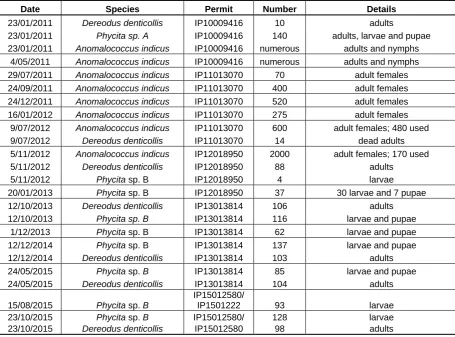
Field collected brown leaf-webber larvae and pupae were imported from India into a quarantine facility at ESP in January 2011 (Table 2). A colony was established and maintained in insect-proof cages (90 x 80 x 75 cm) on both whole plants and cut foliage of prickly acacia in a quarantine glasshouse (22-27oC; 65% RH and natural photoperiod).
Newly emerged moths were either released directly into insect-proof cages containing potted prickly acacia plants or were placed in pairs in glass / plastic oviposition containers with prickly acacia cut foliage for egg laying. An isotonic liquid (Gatorade® or Powerade®)
larvae in oviposition containers were transferred onto potted prickly acacia plants in insect-proof cages for larval development and pupation. Pupae were collected from potted plants and maintained in plastic containers for adult emergence. Newly emerged larvae and adults were used in all experiments.
Table 2. Importations of prickly acacia biological control agents from India.
Date Species Permit Number Details
23/01/2011 Dereodus denticollis IP10009416 10 adults
23/01/2011 Phycita sp. A IP10009416 140 adults, larvae and pupae 23/01/2011 Anomalococcus indicus IP10009416 numerous adults and nymphs
4/05/2011 Anomalococcus indicus IP10009416 numerous adults and nymphs 29/07/2011 Anomalococcus indicus IP11013070 70 adult females 24/09/2011 Anomalococcus indicus IP11013070 400 adult females 24/12/2011 Anomalococcus indicus IP11013070 520 adult females 16/01/2012 Anomalococcus indicus IP11013070 275 adult females
9/07/2012 Anomalococcus indicus IP11013070 600 adult females; 480 used
9/07/2012 Dereodus denticollis IP11013070 14 dead adults
5/11/2012 Anomalococcus indicus IP12018950 2000 adult females; 170 used
5/11/2012 Dereodus denticollis IP12018950 88 adults
5/11/2012 Phycita sp. B IP12018950 4 larvae
20/01/2013 Phycita sp. B IP12018950 37 30 larvae and 7 pupae
12/10/2013 Dereodus denticollis IP13013814 106 adults
12/10/2013 Phycita sp. B IP13013814 116 larvae and pupae
1/12/2013 Phycita sp. B IP13013814 62 larvae and pupae
12/12/2014 Phycita sp. B IP13013814 137 larvae and pupae
12/12/2014 Dereodus denticollis IP13013814 103 adults
24/05/2015 Phycita sp. B IP13013814 85 larvae and pupae
24/05/2015 Dereodus denticollis IP13013814 104 adults
15/08/2015 Phycita sp. B
IP15012580/
IP1501222 93 larvae
23/10/2015 Phycita sp. B IP15012580/ 128 larvae
23/10/2015 Dereodus denticollis IP15012580 98 adults
3.2.1 Life cycle
To study the lifecycle, a pair of newly emerged and mating adults (n = 10) were transferred onto a potted plant enclosed in a cylindrical transparent Perspex tube (34 cm high and 12 cm diameter) with a gauze cap. The adults were transferred on to a fresh plant each week, and the longevity, pre-oviposition period, and the number of eggs laid per female per week were recorded.
3.2.2 Host-specificity tests
Host-specificity testing commenced in June 2011 and was completed in December 2012. All tests were conducted in a temperature (22-27°C), light (14 h light: 10 h dark) and humidity (60-70% RH) controlled quarantine insectary at ESP in Brisbane, Queensland.
3.2.2.1 No-choice larval feeding and development tests
checked two to three times per week for evidence of larval feeding and webbing, larval development, pupation and adult emergence. A minimum of five replicates of each test plant was used.
3.2.2.2 No-choice continuation trials
No-choice larval development continuation trials to ascertain the suitability of non-target plant species to sustain continuous multiple generations of the leaf-webber, commenced in April 2012. Three non-target test plant species, Acacia baileyana, A. mearnsii, and A. irrorata were chosen, as these had supported the development of the leaf-webber to adults, in the no-choice larval feeding trials. Each test was replicated a minimum of three times and commenced with the placement of 60 newly emerged first instar larvae onto both test and control plants. Additional plants were added to cages as required, to feed developing larvae until pupation. The total number of adults emerging per test cage was recorded, together with the development period (in days) from first instar larva to adult. When sufficient numbers of males and females were collected together, pairs were placed in oviposition containers to allow mating and oviposition. The number of eggs laid by pairs were recorded. Newly hatched larvae were then used to set up subsequent generations on the same test plant species. Individual test replicates were continued for a maximum of three subsequent generations, if sufficient eggs and larvae were produced.
3.2.2.3 Choice oviposition tests
Test plant species on which there was any evidence of feeding and development in no-choice tests were subjected to no-choice oviposition tests. A no-choice oviposition trial involving prickly acacia and four non-target test plant species (A. baileyana, A. mearnsii, A. oshanesii and A. macradenia) within a single, large, walk-in cage was conducted (three replications). Despite using large and similar-sized test plants and multiple pairs of the leaf-webber moth, adults failed to lay eggs on any plant – all eggs were laid on the gauze walls of the cage. One hypothesis for the lack of oviposition on any tests plants in the test arena was that one or some of the test plants may repulse the ovipositing moths. Hence paired choice oviposition tests involving only two test plants (prickly acacia + one test plant species) were conducted with prickly acacia and A. mearnsii (seven replications) and prickly acacia and A. baileyana (three replications). Adults were left in the choice oviposition arena for five days and then the numbers of eggs laid on individual test plants and on the cage walls were counted.
3.3 Anomalococcus indicus (Hemiptera: Lecanodiaspididae)
Identification of the insect was made by a scale taxonomy expert Dr Gillian Watson, then working for Commonwealth Agricultural Bureaux International (CABI, UK). Infested prickly acacia stems collected in the field in Tamil Nadu, India were initially shipped to Brisbane on January 2011 (Table 2). A colony was established within the quarantine facility at ESP on potted prickly acacia plants contained in large gauze cages (61 x 61 x 183 cm) and housed in a temperature-controlled quarantine glasshouse maintained at 22-27oC, 60-70% RH and
3.3.1 Lifecycle
The size of individuals was determined by measuring their length and width (widest part) using a stereo microscope with a calibrated micrometre.
3.3.1.1 Egg and crawler biology
To determine the time to death of crawlers without feeding, 100 newly emerged crawlers were confined in a glass petri-dish on a moistened filter paper. As the crawlers were adversely affected by handling, monitoring was restricted to once a day. Nymphal development was studied by transferring 100 newly emerged crawlers to a new potted prickly acacia plant using a fine paint brush and following their development. The number, sex and developmental stage of the nymphs were recorded on a weekly basis for a minimum of 100 days, at which time crawlers were emerging from beneath mature females. The distribution of nymphs in relation to the parent female was examined by gluing gravid
females, still attached to a piece of bark from the plant on which they developed, to trunks of uninfested prickly acacia plants.
3.3.1.2 Female biology
Gravid females were carefully removed from prickly acacia stems so that no bark was attached. Each female was placed in a glass petri-dish on a piece of filter paper and checked daily for eggs and crawlers until they died. Gravid females were also attached to uninfested prickly acacia plants. Two methods of attachment were used. Some were attached as mentioned earlier, while others were placed into vegetable gel-cap halves which were pinned to the trunk.
To investigate whether A. indicus reproduces parthenogenetically, newly emerged crawlers were placed on potted prickly acacia plants (see above). To reduce extraneous variation, plants were infested in pairs, each with crawlers from the same female. Plant pairs were kept in separate cages. All males were removed from the plants in one of the cages as soon as they pupated. Once individuals became adults, female size (length, width and height) was measured on a weekly basis and the presence of newly emerged crawlers noted. 3.3.1.3 Male biology
Due to the difficulty of locating adult males, second-instar males were labelled and the date of pupation noted. Pupae were removed from plants and confined in a petri dish until adult males emerged, the date of which was noted. To determine the survival rates of adult males, groups of at least four newly emerged adults were confined in a petri-dish on a piece of filter paper and checked periodically.
3.3.2 Host specificity
3.3.2.1 No-choice nymphal development
colony. Due to the known absence of parasitoids and predators, only three capsule halves (each containing five gravid females), were attached to each plant. Test and control plants were arranged in 175 cm3 collapsible gauze cages so that there was no contact between
plants. Test and control plants were checked on a monthly basis. The capsules containing the adult females were removed after one month. The number and developmental stage of any scale found was recorded. Each trial ran for a minimum of three months. After this time, test plants with no scale were removed. Those with scale were monitored for crawler emergence together with the control plants, until either crawlers were observed or scale development had ceased. Due to non-target feeding and development, screening of test plants was suspended in 2013 but recommenced in late 2014.
The V. valida plants available for testing were very small (< 10 cm tall) so similar sized prickly acacia plants were used for comparisons. Using a fine paint brush, 50 newly emerged crawlers were carefully placed on each plant. The number, sex and developmental stage of the nymphs were recorded periodically for a minimum of three months until the writing of this report.
3.3.2.2 Comparative nymphal development
Two of the native species on which A. indicus completed development (Neptunia major and A. falcata) were included in a trial to compare the survival and development of the scale on prickly acacia and the non-target species. Using a fine paint brush, 100 newly emerged crawlers were carefully placed on each plant. The number, sex and developmental stage of the nymphs were recorded periodically for a minimum of three months, until crawlers were seen emerging from beneath gravid females. Gravid females were then removed from their host plant. Each was placed into a glass petri-dish on a piece of moistened filter paper and checked daily for eggs and crawlers (until they died).
3.3.2.3 Nymphal host preference
To examine the host preference of newly emerged crawlers, one plant each of prickly acacia, V. farnesiana, A. falcata, and Parachidendron pruinosum were arranged around an infested prickly acacia plant with gravid females, so that each was in contact with the infested plant and each other. Given that crawlers tend not to travel far from the parental female, an attempt was made to ensure the point of contact between the test plants and the infested plant occurred close to a gravid female. The infested prickly acacia plant was removed after two weeks. Several weeks after this the number of scale on each plant was counted and the proportion on each species determined. A second set of nymphal host preference trials was conducted with Vachellia sutherlandii, A. falcata, N. major and prickly acacia.
3.3.2.4 Field choice trials
Trial 1: The first field choice trial involving N. major (n = 8) as test plants and prickly acacia (n = 8) and control plants commenced in January 2014 and continued till July 2014 (when all prickly acacia control plants died due to scale insect attack). Scale insect infested prickly acacia plants (as source plants for the scale insect) was placed in the middle (about 6 scale insect infested plants). Prickly acacia and N. major plants were placed in concentric circles at a distance of 60 cm (4 plants for each of prickly acacia and N. major) and 90 cm (4 plants for each of prickly acacia and N. major) from the source plants. Any source plants which died due to scale insect damage were replaced with a fresh scale insect source plant. Plants were sampled at monthly intervals and the number of plants with scale insect and the number of scales per plant were recorded.
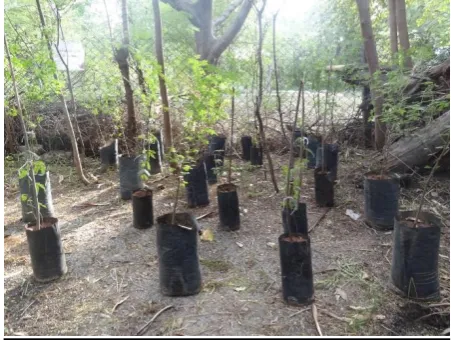
Trial 2: A similar field choice trial involving N. major (n = 11) as test plants and prickly acacia (n = 11) as control plants (Fig. 1) commenced in August 2014 and continued till Jan 2015 (when all prickly acacia control plants died due to scale insect attack). Scale insect infested prickly acacia plants (as source plants for the scale insect) were placed in the middle (about 4 scale insect infested plants). Prickly acacia and N. major plants were placed in concentric circles at a distance of 60 cm (4 prickly acacia plants and 7 N. major plants) and 120 cm (4 prickly acacia plants and 7 N. major plants) from the source plants. Any source plants which died due to scale insect damage were replaced with a fresh scale insect source plant. Plants were sampled at monthly intervals and the number of plants with scale insect and the number of scales per plant were recorded.
Fig. 1. Field susceptibility trial for the scale insect in India involving prickly acacia (control) and N. major (test plant) with scale-insect infested prickly acacia plants as source plants for the scale insect in the middle.
Trial 3: A field choice trial involving prickly acacia (n=15) as control plants and N. major (n=15) as test plants was conducted from December 2014 to May 2015, under a prickly acacia tree naturally infested with the scale insect at the IFGTB campus (Fig. 2). The plants were arranged alternately around the naturally infested tree and observations were made at weekly intervals.
Prickly acacia with scale insects as source plants
Fig. 2. Field susceptibility trial for the scale insect in India involving prickly acacia (control) and N. major (test plant) below a prickly acacia tree naturally infested with the scale insect.
Trial 4: A more robust field susceptibility trial for the scale insect, involving six species of test plant species from Australia (on which the scale insect completed development in no-choice tests in quarantine) commenced in a farmer’s field in Devarayapuram (N 10°59'51.54"; E 76°48'57.12"), a village near Coimbatore in December 2014 (Fig.3) and continued till May 2015. Ten potted plants each of N. major, Vachellia farnesiana, Acacia falcata, A. terminalis, Parachidendron pruinosum, V. nilotica ssp. indica (control-scale free) and V. nilotica ssp. indica (source plant – scale infested) were arranged in a split-plot design (10 replications, each with a single scale infested prickly acacia plant in the centre, with the six test plant species [including a control prickly acacia plant] placed 90 cm from the scale infested source plant in a circle) were arranged below scale-infested prickly acacia trees in the farmer’s field. Arrangements were made with the owner of the property to water the experimental plants on alternate days.
Trial 5: A field choice trial involving 10 test plant species (N. major, Paraserianthes lopentha, V. farnesiana, V. tortilis, V. sutherlandii, Acacia auriculiformis, A. falcata, A. terminalis, A. planifrons and Senegalia ferruginea) commenced in March 2015 (Table 3; Fig. 4). The trial included 10 rows of potted prickly acacia plants alternating with 10 rows of test plant species (10 replications for each test plant species + 50 replications for prickly acacia + 50 scale-insect infested prickly acacia plants as source plants for scale insect). In each row of 10 prickly acacia plants, 5 were scale-infested (source plants for the scale insect) alternating with 5 scale-insect free plants. In each row of test plant species, there was one potted plant each of 10 test plant species (N. major, Paraserianthes lophantha, V. farnesiana, V. tortilis, V. sutherlandii, A. auriculiformis, A. falcata, A. terminalis, A. planifrons and S. ferruginea). The test and control plants are being monitored at monthly intervals for scale incidence.
Table 3. Schematic experimental plan for the field susceptibility trial for the scale insect at the IFGTB campus, Coimbatore, India involving prickly acacia (control) and 10 test plant species. PAI = prickly acacia – scale infested (source plants); PAC = prickly acacia – control; NM = Neptunia major; VF = Vachellia farnesiana; AA = Acacia auriculiformis; AT = Vachellia tortilis; Ater: Acacia terminalis; AP = Acacia planifrons; SF = Senegalia ferruginea; AF = Acacia falcata; VS = Vachellia sutherlandii; PL = Paraserianthes lophantha.
Due to high mortality among the native Australian test plant species in India, additional fresh seeds of Australian native test plant species (Acacia irrorata, A. terminalis, A. plectocarpa, A. falcata, V. sutherlandii, A. coriacea, A. complanata, N. major, Platylobium formosum and P. lophantha - species on which the prickly acacia scale insect completed development under no-choice conditions in quarantine in Australia) were hand delivered for inclusion in field choice tests in October 2015.
Line 1 Line 2 Line 3 Line 4 Line 5 Line 6 Line 7 Line 8 Line 9 Line 10
Row 1 PAC PAI PAC PAI PAC PAI PAC PAI PAC PAI
Row 2 NM VF AA AT Ater AP SF AF VS PL
Row 3 PAI PAC PAI PAC PAI PAC PAI PAC PAI PAC
Row 4 PL NM VF AA AT Ater AP SF AF VS
Row 5 PAC PAI PAC PAI PAC PAI PAC PAI PAC PAI
Row 6 VS PL NM VF AA AT Ater AP SF AF
Row 7 PAI PAC PAI PAC PAI PAC PAI PAC PAI PAC
Row 8 AF VS PL NM VF AA AT Ater AP SF
Row 9 PAC PAI PAC PAI PAC PAI PAC PAI PAC PAI
Row 10 SF AF VS PL NM VF AA AT Ater AP
Row 11 PAI PAC PAI PAC PAI PAC PAI PAC PAI PAC
Row 12 AP SF AF VS PL NM VF AA AT Ater
Row 13 PAC PAI PAC PAI PAC PAI PAC PAI PAC PAI
Row 14 Ater AP SF AF VS PL NM VF AA AT
Row 15 PAI PAC PAI PAC PAI PAC PAI PAC PAI PAC
Row 16 AT Ater AP SF AF VS PL NM VF AA
Row 17 PAC PAI PAC PAI PAC PAI PAC PAI PAC PAI
Row 18 AA AT Ater AP SF AF VS PL NM VF
Row 19 PAI PAC PAI PAC PAI PAC PAI PAC PAI PAC
Fig. 4. Field susceptibility trial for the scale insect at IFGTB campus involving prickly acacia and 10 test plant species (see table 3 for details).
Trial 6: An additional field choice trial involving 13 test plant species (N. major,A. falcata, A. terminalis, V. sutherlandii, C. siliqua, Platylobium formosum, A. filicifolia, A. cardiophylla, A. irrorata, A. deanei, A. parramattensis, A. mearnsii, and A. decurrens) commenced in January 2016 in the IFGTB campus and is in progress. Each species was replicated 10 times and were arranged in the trial in Latin square design. Ten scale infested prickly acacia plants were also included in the experiment as source of infestation. A 45 cm gap between the plants in column and a 60 cm gap between the rows were maintained. Observations on the incidence and spread of the scale insect on each test plant in terms of number of nymphs and adults and growth parameters such as height and basal diameter of the plants have been recorded at monthly intervals.
3.3.2.5 Field host range
Field host specificity of the scale insect at subspecies level was documented in 72 survey sites in southern India. Various non-target species, Vachellia leucophloea, S. ferruginea, Senegalia senegal (natives of India) and Vachellia horrida (native of Africa) occurring at the survey sites were surveyed to ascertain if the ecological host range of insects found on prickly acacia extended to these species.
3.4 Dereodus denticollis (Coleoptera: Curculionidae)
The weevil was identified by Dr. V.V. Ramamurthy, a specialist coleopteran taxonomist based at the Indian Agricultural Research Institute, New Delhi, India.
Ten field collected D. denticollis adults (of unknown age) starved for 48 hours were released on each plant, enclosed in an insect-proof cage, and monitored daily for feeding and survival, till all adults died.
In Australia, imported adults were kept within the quarantine facility at ESP on potted prickly acacia plants contained in insect-proof cages (90 x 80 x 75 cm). It has yet to be successfully cultured in quarantine.
New culturing practises were implemented in May 2015 following importation of new insect material and advice from Indian counterparts. Medium sized glass jars (15 cm diameter and 25 cm high) were used to house two mating pairs of D. denticollis weevils (n=16). Jars were supplied with two 20 cm sprigs of prickly acacia submerged into saturated floral foam. Jars were checked periodically and foliage changed every two to three days.
Eggs were removed from glass jars once they began to darken in colour and placed on moistened filter paper within plastic petri dishes. Newly hatched larvae were placed on various feeding substrate and periodically assessed for survival. Larval feeding substrates tested to date include; freshly cut stem semi-submerged in moistened sand, fresh root material buried in moistened sand, fresh root material within a petri dish lined with moistened paper towel, potted seedlings, potted plants and a semi-artificial diet consisting of ground up root material from a mature prickly acacia tree excavated from Gayndah.
3.5 Phycita sp. B (Lepidoptera: Pyralidae)
Field-collected green leaf-webber larvae and pupae were imported from India into a quarantine facility at ESP in 2012 and 2013 (Table 2). A colony was established and maintained in insect-proof cages (90 x 80 x 75 cm) in a quarantine glasshouse (22-27oC;
65% RH and natural photoperiod). Newly emerged moths were released directly into insect-proof cages containing potted prickly acacia plants. An isotonic liquid (Gatorade® or
Powerade®) was supplied to adults to enhance egg production and adult longevity.
The colony failed to reproduce in early 2015 and consequently died out. Additional importations were thus made in May and August 2015.
3.5.1 Life cycle
Lifecycle of Phycita sp. B was studied under laboratory conditions in India and under quarantine conditions in Australia. To study the lifecycle, eggs were collected and placed into glass petri-dishes until larvae hatched. Newly emerged larvae were transferred either onto potted prickly acacia plants or placed in a glass petri dish containing cut prickly acacia foliage (foliage added as required) in insect-proof cages for larval development and pupation. Pupae were collected from potted plants and maintained in plastic containers for adult emergence. Adult moths were transferred to new cages either every day or every few days.
3.5.2 Host-specificity tests
In India, no choice host specificity tests were conducted on 10 non-target test plant species (Acacia planifrons, A. auriculiformis, A. deanii, Vachellia leucophloea, V. farnesiana, V. tortilis, Senegalia mellifera, S. catechu, S. ferruginae and Neptunia major) (on live potted plants) with a minimum of five replications for each species. Ten newly emerged larvae were released on each plant kept inside the rearing jars, covered by transparent muslin cloth, and monitored daily for larval feeding, survival and development.
In Australia, host-specificity testing commenced in May 2014 and continued till December 2015. All tests were conducted in a temperature (22-27°C), light (14 h light: 10 h dark) and humidity (60-70% RH) controlled quarantine insectary at ESP. Newly emerged larvae and adults were used in all experiments. Batches of test plants were screened as they became available and in each batch potted prickly acacia plants were included as positive controls. Ten newly emerged larvae were added to each potted test plant, as well as prickly acacia. Plants with larvae were placed in insect-proof cages and were checked two to three times per week for evidence of larval feeding and webbing, larval development, pupation and adult emergence. A minimum of five replicates of each test plant have been conducted for 12 species (Table 1).
No-choice oviposition trials are being conducted with non-target species in which larval development occurred. In these tests, five male and five female moths are confined to insect-proof cages containing non-target test plants and a control cage containing a prickly acacia plant. Cages are checked for eggs periodically.
Oviposition choice tests have commenced for the non-target test species that received egg lay during no-choice oviposition tests. Five pairs of moths are released into an insect proof cage containing one non-target test plant and one prickly acacia plant.
4 Results
4.1 Host test list
The majority of the species in the test list belong to Acacia sensu lato (s.l.). Morphological and molecular studies have demonstrated that Acacia s.l. is polyphyletic and the genus has been split into five genera (Acacia, Vachellia, Senegalia, Acaciella and Mariosousa).Acacia sensu stricto (s.s.) has been retypifiedso that the majority of species within Acacias.l. (i.e. Acacia subg. Phyllodineae) retain this name (see Maslin et al. 2003; Miller and Seigler 2012). Acacias.s. contains nearly 1000 species and most of these are Australian. Sections within Acacia s.s. are not considered natural groupings (see Maslin et al. 2003), but are retained here. Species within Acacia subgenus Acacia (includingprickly acacia) have been transferred to the genus Vachellia Wight & Arn. Fourteen Vachellia species are found in Australia, of which nine are endemic and five (V. nilotica, V. farnesiana, V. karroo (Hayne) Banfi & Galasso, V. gerrardii (Benth.) P.J.H.Hurter and V. xanthophloea (Benth.) Banfi & Galasso) are exotic (Kodela and Wilson 2006; University of Queensland 2011; AVH 2015). Senegalia is represented in Australia by two rare endemic species and two naturalised species (Maslin 2012), and Acaciella is represented in Australia only by the naturalised species Acaciella angustissima (Mill.) Britton & Rose and Acaciella glauca (L.) L. Rico (University of Queensland 2011). Sourcing specimens of these genera was either difficult (Vachellia) or not possible (Senegalia and Acaciella). Ideally more Vachellia species would have been tested.
Adenanthera) and four naturalized genera (Prosopis, Mimosa, Leucaena and Desmanthus). The tribe Ingeae is represented in Australia by eight genera including 20 native species and three naturalised species. Recent molecular work suggests that Vachellia is nested with tribe Mimoseae (Bouchenak-Khelladi et al. 2010). As such, Vachellia nilotica is now believed to be more closely related to species within Mimoseae than it is to the majority of Australian acacia species (Acacia s.s). Vachellia is also more closely related to Senegalia, Acaciella and Mariosousa (all formerly within Acacia s.l.) than Acacias.s. which forms a clade with the Ingeae tribe.
4.2 Phycita sp. A
4.2.1 Life cycle
Images of several of the life stages are provided (Fig. 5). Under quarantine conditions, adult moths lived for 8.8 ± 0.5 days (range: 6 to 21 days) and laid eggs within 2-10 days of adult emergence. Females laid 78 ± 8 eggs (range: 55 to 350 eggs), on the leaves and stems of host plants, cage walls or the gauze covers on oviposition containers. Eggs hatched in 6 ± 0.8 days (range: 6 to 10 days). Newly emerged larvae feed almost immediately, tying leaves together with silk webs, forming tunnels as they mature. The larval stage lasted for 41 ± 1.2 days (range: 27 to 48 days). Fully grown larvae pupated for 13 ± 0.4 days (range: 6 to 19 days) within the larval silk tunnel or in the soil. On prickly acacia, 80% of the neonate larvae became adults.
Fig. 5. Phycita sp. A a. eggs laid on gauze; b. larva; c. adult.
4.2.2 Host-specificity tests
4.2.2.1 No-choice tests
No-choice larval feeding and development tests were completed for 27 test plant species (Table 2). Non-target feeding and development through to adults occurred on 16 of the 27 non-target plant species (Figures 6 and 7). The durations of larval, pupal and total (larva to adult) development, pupal weight, and proportion of larvae that developed into adults differed significantly between the test plant species (Figures 6 and 7). On four out of the 17 non-target test plant species (V. sutherlandii, A. deanei, A. mearnsii and A. lasiocarpa), the durations of development and rates of survival were not significantly different to the target weed. On the remaining test plant species, the durations of development and survival rates varied greatly, but were significantly lower than on prickly acacia (Figures 6 and 7). There was a significant negative correlation between the duration of larval survival and the proportion of larvae that developed into adults (R = 0.663, F = 11.8, P = 0.004; Fig. 8),
indicating that many of the non-target plant species that sustained complete development of Phycita sp. A are less favourable than prickly acacia.
Fig. 6. Duration (mean ± se) of Phycita sp. A larval (solid bars) and pupal survival (empty bars) on various test plants in no-choice tests under quarantine in Australia.
0 50 100 150
V. nilotica subsp. indica V. bidwillii V. farnesiana V. sutherlandii A. alata A. baileyana A. cardiophylla A. deanei A. filicifolia
A. irrorata A. mearnsii A. oshanesii A. parramattensis
A. spectabilis A. terminalis A. holosericea A. plectocarpa A. drummondii A. lasiocarpa
A. conferta A. macradenia A. podalyriifolia A. victoriae A. harpophylla A. flavescens Ad. pavonina L. leucocephala
C. australe
Duration of larval survival and pupation (days)
T
e
s
t
pla
nt
s
pe
c
ie
s
Larval duration
Fig. 7. Proportion (mean ± se) of Phycita sp. A larvae that developed into pupae (empty bars) and adults (solid bars) on various test plant species in no-choice tests under quarantine in Australia.
Nil Nil
Nil Nil
Nil Nil Nil Nil Nil Nil
0 20 40 60 80
V. nilotica subsp. indica V. bidwillii V. farnesiana V. sutherlandii A. alata A. baileyana A. cardiophylla A. deanei A. filicifolia
A. irrorata A. mearnsii A. oshanesii A. parramattensis
A. spectabilis A. terminalis A. holosericea A. plectocarpa A. drummondii A. lasiocarpa
A. conferta A. macradenia A. podalyriifolia A. victoriae A. harpophylla A. flavescens Ad. pavonina L. leucocephala
C. australe
Larva developing into pupa and adult (%)
T
est pl
an
t
sp
ec
ies
Larva to pupa (%)
Fig. 8. Relationship between the duration of Phycita sp. A larval development (x- axis) and proporiton of larvae that developed into adults (y-axis) in no-choice tests under quarantine conditions in Australia. Target (solid circle), non-targets (empty circles); 1 = prickly acacia; 2 = A. lasiocarpa; 3 = A. deanei; 4 = V. sutherlandii; 5 =A. mearnsii; 6 = A. cardiophylla; 7 = A. filicifolia; 8 = A. conferta; 9 = A. baileyana; 10 = A. irrorata; 11 = A. podalyriifolia; 12 = A. alata; 13 = A. oshanesii; 14 = A. parramattensis; 15 = A. terminalis; 16 = V. bidwillii; 17 = A. macradenia.
4.2.2.2 No-choice continuation trials
The leaf-webber completed up to three generations on the non-target species A. baileyana and at least two generations on the non-target species A. mearnsii (Fig. 9). The proportion of larvae that developed into adults did not differ significantly between prickly acacia and A. baileyana in the first two generations (generation 1: F1,4 = 6.94, P = 0.058; generation 2: F1,4
= 6.99, P = 0.057; Fig. 9), and between prickly acacia and A. mearnsii in the first generation (F1,8 = 0.354, P = 0.568; Fig. 9). However, on A. baileyana, adults developed in only one of
the replications in the third generation and no adults developed in the fourth generation (Fig. 9). On A. mearnsii, adults developed in only one replication in the second generation, and hence the trial could not be continued. The development time from neonate larva to adult on A. baileyana (H = 23.457, P < 0.001) and A. mearnsii (H = 4.392, P = 0.036), was significantly longer than on prickly acacia (Fig. 9). In fecundity trials, significantly fewer eggs were laid by females that developed on A. baileyana (64 ± 29 eggs per female) and A. mearnsii (117 ± 25 eggs per female) than on prickly acacia (156 ± 63) (F2, 21 = 7.65, P =
0.004).
1
16 4
12 9
15 6
3
7
10 5
14 13
2
8
17 11
y = 0.013x2- 2.5964x + 125.93
R² = 0.5864
0 10 20 30 40 50
20 40 60 80 100 120
A
d
u
lt
e
m
e
rg
e
n
ce
(%)
Fig. 9. Duration of Phycita sp. A larval development (mean ± se) and proportion of larvae that developed into adults (mean ± se) on two non-target test plant species, A. meansii and A. baileyana (solid bars) and prickly acacia (empty bars) over multiple generations under no-choice conditions in quarantine. Within each generation, treatment means with the same letter are not significantly different (Dunn’s Method, P > 0.05).
4.2.2.3 Choice oviposition tests
In paired-choice tests all eggs were laid only on prickly acacia (5.9 ± 3.8 eggs in paired choice trials with A. mearnsii and 2.0 ± 0.58 eggs in paired choice trials with A. baileyana) with no eggs laid on the non-target plants.
4.3 Anomalococcus indicus
4.3.1 Lifecycle
The life cycle of A. indicus, from egg through to adult, is shown in Fig. 10. The two sexes undergo different developmental cycles (Taylor and Dhileepan 2013). There are three instars in the female (1st, 2nd and adult) and five in the male (1st, 2nd, pre-pupa, pupa and adult).
4.3.1.1 Egg and crawler biology
Fertile eggs are deep-green speckled (Table 3; Fig. 11). Eggs are oviposited into a cavity under the parent female’s body (Taylor and Dhileepan 2013). Crawlers emerged from eggs
a a 0 20 40 60 80 100
Gen 1 Gen 2
% adu lt em ergenc e Generation
% Adult Emergence A. mearnsii V. nilotica ssp. indica
a a Nil a a 0 20 40 60 80 100
Gen 1 Gen 2 Gen 3 Gen 4
% adu lt em ergenc e Generation
% Adult Emergence
A. baileyana V. nilotica ssp. indica
a b 0 20 40 60 80 100
Gen 1 Gen 2
Dev el opm ental ti m e (day s ) Generation
Neonate larva to adult (days)
A. mearnsii V. nilotica ssp. indica
a a Nil b b 0 20 40 60 80 100
Gen 1 Gen 2 Gen 3 Gen 4
D ev elopm ent al tim e (day s ) Generation
Neonate larva to adult (days)
within one or two hours of being oviposited. Newly hatched crawlers remain in the cavity beneath the female for an indeterminate length of time.
In the absence of food, newly emerged crawlers survived for up to 208 hours but 75% died within 54 hours. Regular handling adversely affected crawlers’ survival (F2,17 = 32.11, P <
0.001) and 95% died within 96 hours (Fig. 12).
Most crawlers settled close to the parent female, with more than 70% of those successfully settled doing so within 10 cm of her (Fig. 13). The average mortality of newly emerged crawlers transferred to new host plants was 31.7% (± 2.9). A further 5.6% (± 1.2) died during the stationary phase of the first instar and another 5% died before reaching adulthood. Sexual dimorphism becomes obvious during the second instar, 36 days (range 22-47 days)
after crawlers have hatched (Fig. 11). The ratio of male to female progeny produced by adult females varied greatly, averaging 2.6 (± 0.5) and ranging from 0.6 to 3.9.
4.3.1.2 Female biology
The duration of the female’s juvenile stage is 52 days (Fig. 10), after which they moult into adults (Taylor and Dhileepan 2013). Adult females morphologically resemble nymphs. Fertilised adult females become distended, with eggs visible through the membranous derm (Fig. 11). Under quarantine conditions, oviposition began when females were an average of 89 days old (Fig. 10), and continued for up to 16 days. The female body shrivels as eggs are discharged from the body and the female dies when oviposition has finished. An average of 802 ± 114 crawlers emerged per reproductive female (range: 167-1647). The size of the parent female (volume) had a significant impact on the number of crawlers produced (F1,8 =
40.06, P < 0.001; y = 34.54x-329; Fig. 14). A significantly lower number of nymphs established where females were attached to prickly acacia plants using gel capsules compared to those that were glued with a section of stem from the plant on which they developed (108 ± 94 and 471 ± 94 respectively; t7 =-3.64, P = 0.008).
Under quarantine conditions, 5.7% (± 1.2%) of crawlers developed into reproductive females. Based on the mean number of crawlers produced per female, an average gravid female is therefore likely to produce 45 reproductive females. The proportion of adult females on a plant that did not become gravid varied from none to all of them.
Fig. 10. Development of A. indicus, from egg through to adult. atime from newly emerged
crawler to obvious sexual differentiation; btime from obvious sexual differentiation; cfirst sign
of crawlers; dfrom newly emerged crawler to emergence of adult male; efrom newly emerged
crawler to newly moulted adult; ffrom newly emerged crawler to ovipositing adult female.
Gravid adult femalec (fig. 12e, f) Adult male
(fig. 12i)
19.5 days ± 0.2
32.3 days ± 0.8a
40.4 days ± 1.2 18.2 days ± 1.5 6.8 days ± 0.1b
1.1 days ± 0.1 42.5 days
± 0.8
<1 day
Fertilisation
Male development timed: 62 days ± 1.0 Female development timee: 52 days ± 2.5 Lifecyclef: 89 days ± 2.9
~ 1 day
O
vo
vi
vi
p
a
ri
ty
~ 1-2 hours
Embryogenesis
Newly moulted adult female 2nd instar
2nd instar male (fig. 12g)
Pre-pupa
Pupa (fig. 12h)
2nd instar female (fig. 12c,d) Sexual differentiation
Egg (fig 12a)
Table 4. Mean (±SE) length, width and height (females only) of A. indicus life stages.
ameasured shortly before pupation of males; bincluding the penile sheath; c single individuals
were selected rather than those in groups with other females.
Life stage n Length (mm) Width (mm) Height (mm)
Egg 50 0.51 (0.01) 0.26 (0.01) -
Crawler 50 0.46 (0.01) 0.24 (0.01) - 2nd instar ♂a 35 1.47 (0.02) 0.72 (0.01) -
♂pupa 110 1.54 (0.01) 0.71 (0.01) -
Adult ♂b 23 1.03 (0.02) -
2nd instar ♀a 40 1.12 (0.01) 0.77 (0.01) 0.36 (0.01) Newly moulted adult ♀c 20 2.09 (0.03) 1.59 (0.03) 0.91 (0.03) Unmated ♀c 20 3.67 (0.10) 3.09 (0.07) 1.71 (0.05) Gravid ♀c 20 4.61 (0.08) 3.71 (0.05) 2.85 (0.07)