SRRTC: Social Recommendation based on
Relationship Transmission with Convergence
Algorithm
Huakang Li1,3,4, Yixiong Bian1,2, Xiuying Xu1and Guozi Sun1,3,4*
1 Jiangsu Key Lab of Big Data and Security and Intelligent Processing Nanjing University of Posts and
Telecommunications, Nanjing, 210023, China; [email protected] 2 University of Houston 4800 Calhoun Rd. Houston, TX 77004
3 Collaborative Innovation Center for Economics crime investigation and prevention technology, Jiangxi
Province, China
4 State Key Laboratory of Mathematical Engineering and Advanced Computing, Wuxi, 214125, China
* Correspondence: [email protected]; Tel.: +86-189-5189-6572
Abstract: Social recommendation is almost as the integration of the business platform and social 1
platform, and gradually become a top in recommendation system. Social recommendation algorithm 2
solves the problem of cold start and data sparseness for traditional commodity, while the internal 3
structure of the relationship graph in social relations has not been fully excavated. This paper proposes 4
two models of Micro Relation Transfer Model and Macro Relation Transfer Model of social relations, 5
and applies the social relations transfer models into the social recommendation system. A relationship 6
graph is built from the relationship between customers on the Internet. Micro Relation Transfer 7
Model establishes the transfer activation function by calculating the relationship between the two 8
customers using the similarity of interests set. Micro Relation Transfer Model spreads the relationship 9
of friends by calculating the proportion of common neighbors held by the customer’s social relations. 10
In order to effectively control the transmission range and effect of social relations graph, we introduce 11
pruning algorithm based on Monte Carlo Decision Tree convergence algorithm. The experimental 12
results show that SRRTC algorithm enhances the success rate and stability significantly. 13
Keywords:social recommendation; relationship graph; micro relation transfer model; macro relation 14
transfer model; monte carlo decision tree 15
1. Introduction 16
With the development of cloud computing and big-data analysis, the performance of 17
recommendation systems has been greatly developed in theory and practice. Currently, the 18
recommendation system has become a very important technology in e-commerce and social 19
networking, and has produced significant economic benefits. The most famous application in large 20
and medium-sized sites, such as Facebook, Amazon, Taobao and Douban, uses various forms of 21
recommendation algorithms to provide content, friend, and shop items recommending. 22
Collaborative Filtering (CF) algorithm, which is the primary applied algorithm, takes advantage 23
of fast and accurate features. Content-based recommendation algorithm was trying to explain the 24
interpretable relation between items in a certain extent. On the other hand, some researchers introduced 25
the user’s personal information, browsing history, and physical location information to improve the 26
accuracy of the recommendation system. However, these methods could not solve the data sparseness 27
and cold start problems. 28
Currently, some researchers use the social relations to deal with the sparseness and cold start 29
of recommended algorithm when some online shopping or media platforms developed the social 30
modules. According to social relations and user’s feedback for relation estimation and reasoning, 31
SocialTrust, such as EigenTrust [1], TidalTrust [2], MoleTrust [3], and James Caverlee [4], propose a 32
recommending theory based on the credibility of the dynamic trust reasoning model. 33
The existing credible recommendation methods are more concerned with dominant trust 34
relationships, ignoring the transitivity of social relations, like: friends of friends are more likely 35
to be friends, and birds of a feather flock together. In this paper, two trustworthiness models, Micro 36
Relation Transfer Model and Macro Relation Transfer Model of social relations, in sociology are 37
introduced into the social recommendation system to solve the sparseness and cold start problems. We 38
build a relation graph of the relationship between customers on the Internet. Micro Relation Transfer 39
Model establishes the transfer activation function by calculating the relationship between the two 40
customers using the similarity of interest set. Micro Relation Transfer Model spreads the relationship 41
of friends by calculating the proportion of common neighbors held by the customer’s social relations. 42
In order to effectively control the transmission range and effect of social relations graph, we introduce 43
pruning algorithm based on Monte Carlo Decision Tree convergence algorithm. The experimental 44
results show that SRRTC algorithm enhances the success rate and stability significantly. 45
This paper is organized shown as follows: Section2introduces the trusted recommended system 46
and the social relation transmission research hotspot. Section3 introduces the recommendation 47
algorithm of friend social transfer and explains Micro and Macro’s Relation Transfer Model. The 48
optimization pruning algorithm is proposed in Section4. Section 5illustrates the experimental 49
processes and measurements. The performance is discussed in Section6. Finally Section7presents a 50
summary of the work of this paper. 51
2. Related Works 52
The traditional recommendation systems which are mainly based on review comments 53
collaborative filtering (CF) [5], content similarity estimation and mixed recommendation. Many 54
algorithms in [6] have achieved good performance in e-commerce and media platforms, such as the 55
Amazon, Taobao, and Reuters News, to solve the sparsity problems of CF. 56
In general, the CF method is subject to cold start and data sparsity problems. There are many 57
literatures that propose ways to attempt to solve those problems. One possible solution is to reduce the 58
sparsity degree by removing the non-representative user or project to narrow the user rating matrix 59
[7]. Another approach is to identify the most appropriate user in the forecasting process by using 60
specific methods such as specific similarity measures [8,9], pattern mining [10], social networks [11], or 61
resource allocation [12]. 62
Social relation (Trust relation [13]) mining or a new research hotspot that many scholars 63
have discussed extensively in recent years. In [14], the author proposes a social network service 64
recommendation method with trust enhancement function, called "trustman". In order to improve 65
the accuracy of the prediction of the top k ranking, [15] proposed a method based on the objective 66
function recommendation, in which the users are divided into two types of trustees. Based on the 67
Tensor factorization technique, Kim and Yoon proposed a trust model in [16], which shows a trust 68
model with additional information as a factor. In [17], the author defines the trust and reputation, and 69
introduces the corresponding calculation method in which the trust factors have certain advantages in 70
a film recommendation. In [2], two novel methods of using the trust network to improve the top-N 71
recommendation are proposed. In order to alleviate the cold user problem, the author uses a special 72
API in [3] to select the most valuable node in an aspect to calculate the probability of a similar favorite 73
category. In [4], the author attempted to provide a personalized news recommendation in the news 74
reading community through implicit social information to deal with cold start problems. In [18], 75
Krauss and Arbanowski introduced the social preference ontology to solve the cold start and sparse 76
problems. 77
Yilmazel and Kaleli analyzed the robustness of some typical recommended methods based 78
on distributed data in [19]. In order to limit the behavior of malicious recommendation and 79
e-commerce environment bidding in [20]. In [21], Shambour and Lu developed an implicit trust 81
filter recommendation method and an improved user-based collaborative filtering recommendation 82
method to select a reliable business partner to do reliable business deals. Since the trust value is 83
calculated based on the user’s average rating, the reliability and sensitivity are not high. Alejandro 84
and Parapar used spectral clustering to deduce a clustering-based collaborative filtering algorithm in 85
[22]. The method of sorting could accurately select the appropriate neighbors, so the performance is 86
superior to other technologies. [23] proposed a reputation measurement method that measures service 87
reputation to prevent malicious users from web service recommendations. By detecting malicious 88
feedback ratings and integrating feedback anomalies, the method can identify the trustworthiness 89
of Web services and generate prevention programs to improve the Web service recommendation 90
performance. In [24], a multi-category recommendation system for a specific domain trust network is 91
proposed, which used a more scientific root mean square error MAE coefficient as a measure of the 92
recommendation system performance. 93
To sum up, these methods improve the recommendation system performance successfully in 94
some degree through using trust value between users. However, social relations, as a complex social 95
network model, have the dynamic transfer feature. Therefore, based on previous researches [25], we 96
propose a macro friendship relation similarity expansion algorithm, and the micro-friend relation 97
expansion algorithm of depth transfer, combined with MCTS algorithm and pruning algorithm, to 98
optimize the collaborative recommendation system and as far as possible to solve the cold start and 99
sparse problems. 100
3. Social Relation Transmission Recommendation 101
Currently, more and more social communication platforms begin to provide the online 102
shopping model in oder to increase the incoming and user adhesion. Therefore, the social relation 103
recommendation algorithm is also being proposed to improve the performance of traditional 104
collaborative filtering model. In this section, the social relation transmission model will be introduced 105
deeply after the social relation recommendation model. 106
3.1. Social Relation Recommendation
107
3.1.1. Collaborative Filtering Algorithm 108
Assuming there are M users andN items on the platform, the user set and item set can be 109
described asUser = {u1,u2, ...,um}andItem = {item1,item2, ...,itemn}. We can generate a review 110
score matrixRmn ={r11, ...,rij, ...rmn}, if theithuser buys thejthproduct, and the evaluation score for 111
the item isrij. Then, we can estimate the similarity of evaluation scores between useraand userb 112
using Peason model: 113
simR(a,b) =
∑
i⊂Uab
Rai×Rbi− ∑
i⊂Uab Rai× ∑
i⊂Uab Rbi
n √
A×√B (1)
where 114
A=
∑
i⊂Uab
R2ai− ( ∑
i⊂Uab Rai)2
n (2)
B=
∑
i⊂UabR2bi− ( ∑
i⊂Uab Rbi)2
Figure 1.Social relationship network diagram
3.1.2. Social Recommendation Algorithm 115
In the social platform, we can get a friendship matrixF={f11, ...,fab, ...,fmm}where we can use 116
fabto describ friendly relationship between useraand userb. fab=1 represents useraand userbis 117
a friend, the relationship is credible, and fab=0 represents there is no direct relationship. Then we 118
obtain the social relation similarity between useraand userbusing cosine function. 119
SimF(a,b) =
∑
a,b∈F ab
r ∑
a∈F a2r∑
b∈F
b2 (4)
Assume that the social relationshipSimFis orthogonal to the user’s interestSimR, we can use a 120
linear function to construct the social recommendation modelSimSas: 121
SimS=αSimR+βSimF (5)
hereαandβis undetermined coefficient. And the strategy of value can be described as follows:
122
α+β=1 (6)
3.2. Relationship Transmission Model
123
In the real world, most people become friends in the following two ways (as shown in Fig.1). On 124
one hand, “Friends of friends are more likely to be friends”, which we call it as Micro Relation Transfer 125
Model. On the other hand, it calls "things of one kind come together, birds of a feather flock together" 126
phenomenon. Two people have a lot of common friends, when they become friends, the surrounding 127
friends will be more and more dense, which we defined as Macro Relation Transfer Model. 128
3.2.1. Macro Relation 129
IfAandBhave many common friends likeC,DandE, they are much easy to be friends. Thus, 130
the friendly relationship transfer model is similar to width traversal, which we called Macro Relation 131
t fmacro(a,b) = 1 I−1
I
∑
i=1(ai−a sa
)(bi−b sb
) (7)
At the same time, we assume thataandbcan become a direct friend when the transfer relationship 133
is larger than a thresholdδmacro: 134
f0(a,b) =
(
1 t fmacro(a,b)≥δmacro
0 other (8)
3.2.2. Micro Relation 135
Assuming thatAandCare good friends ofB,BintroducesAtoC, andCintroduces Ato his 136
own good friendD. Thus, the friendly relationship transfer model is similar to deep traversal, which 137
we called Micro Relation Transfer Model. But in real life, the trustiness between friends to pass once 138
will be descended certainly. Therefore, we define the micro transfer model between new friendly 139
relationship as follows: 140
t fmicro(a,b) = 1
|L|l
∑
∈L1
dl
(9)
where Useracan contactbthrough relational pathlandLrepresents all possible paths. Like the 141
macro relation, we assume thataandbcan become a direct friend when the transfer relationship is 142
larger than a thresholdδmicro: 143
f0(a,b) =
(
1 t fmicro(a,b)≥δmicro
0 other (10)
3.2.3. Transfor Model 144
Assume that the obtained relationship matrixTFcan be accumulated on the original friend 145
relationship matrixFafterµintration:
146
Fµ=Fµ−1+TFµ−1(a,b) (11)
4. Transmit Optimization Method 147
We believe that the transfer of friendship can improve the performance of the recommended 148
system, but there are also some problems, such as over fitting. Therefore, we propose the following 149
optimization methods. 150
4.1. Category Recommendation
151
We think that users could buy the same category product with the same functional requirements, 152
but in the specific purchase of the product model will have their own tendencies, such as different 153
brands and different price range. Therefore, we use the category to calculate the recommending list. 154
Assume that categorycicontainsiproduct items,{item1, ...,itemI} ∈ci, the review score of usera 155
for category is: 156
Riac = 1 I
I
∑
i=1ria (12)
simcR(a,b) =
∑
i⊂Uab
Rcai×Rcbi− ∑
i⊂UabR c ai× ∑
i⊂UabR c bi
n √
A×√B (13)
4.2. Optimization Methods
158
We propose the MCST Direction Optimization and Threshold Pruning Optimization methods to 159
deal with the credibility problem in the relationship transfer. 160
4.2.1. MCST Direction Optimization 161
In the real society, the friendship between people will decrease with the increase of the 162
transmission number of layers. Therefore, we introduce the MCTS algorithm to guide the Macro and 163
Micro relations. MCTS algorithm is divided into three parts: selection, transmission, backtracking. The 164
details are as follows: 165
Select: From the root node (Alayer node), recursively select theBlayer nodeLthat meets the 166
following convergence constraints. 167
∆(n) =Fn−Fn−1 (14)
lim
n→∞∆(n)<γ (15)
Fn is thenth transfer. The transmission will be terminated when the difference between two 168
transfer results is less than the thresholdγ.
169
Transmission: If it does not terminate at L-level, it will continue to look for its child nodes (C-level 170
nodes), traverse its child nodes (Liin theClayer) and add the above convergence constraints again at 171
L0. 172
Backtracking: Update the value on the current eligible usersi action sequence (create the 173
relationship between layerAand layerC). 174
4.2.2. Threshold Pruning Optimization 175
In this section, we use the threshold pruning algorithm to preprocess the similarity matrix of 176
the original user, similarity matrix of the original friedn relationship, similarity matrix of the Macro 177
transfer relation in expansion and similarity of the Macro transfer relation in expansion, processing 178
method is as follows: 179
Scut= n
∑
i=0Cut(Si ≤δ) (16)
Siis a certain similarity in the matrix of similarity needed to be processed, andδis a threshold. If
180
similarity between two users is less than the threshold in the similarity matrix, this similarity between 181
the users will be deleted. 182
After the data is preprocessed by the pruning algorithm, the friend relations with weak reliability 183
in the original data are removed, and a new similarityScutmatrix could be obtained. We could finish 184
the recommendation based on the cut similarityScut. 185
5. Experimental Environments 186
5.1. Experimental Data and Environment
187
The data set used in this paper is from the prestigious e-commerce commodity evaluation website 188
Table 1.Experimental dataset size
Table Name Data Size
User 131228
Product 317755 Category 587
Review 1127673 Similarity 3689606 Trust 538391
Review table, and the trust defaults are 1.0. Through calculation and analysis, we find that there are 190
17599 users who do not exist the score information, more than half of the user scores are less than 5 or 191
the number of direct trusts is less than 5 which means the data set is very sparse. 192
5.2. Measure of Recommended Algorithm
193
1) Recommended Success Rate (SR) 194
SR=
∑
R∈Rtest
(PR∩∑R0∈R
topN−SPR0)
Rtest (17)
Ris the user needed to be recommended. R’ is the users whose similarity with the userRranks 195
amongTop−Nin the corresponding data table. Rtest is the test user set. PR is the item number 196
(category) set purchased byR.PR’ is the number (category) set of items purchased by theTop-Nusers. 197
RtopN−Srepresents theTop−Nusers set with the highest similarity to the userRin the data tableS. 198
In the experiment, the recommended success rate is used to measure the macro-quality of each 199
recommendation algorithm. The higherSR, the better recommendation performance. 200
MAE= ∑Ru,i∈Rtest|Ru,i−R 0 u,i|
Rtest (18)
|Rtest|is the number of reviews in Review table.Ru,iandR0u,irespectively represent the amount of 201
user’s actual comment (purchase) and user’s predicted comment (purchase). Particularly,|Ru,i−R0u,i| 202
is Boolean minus. 203
Since MAE is absolutized, there is no case of positive and negative to be offset, which could 204
better reflect the actual situation of the prediction error. Therefore, we use MAE to determine the 205
recommended system micro-quality level. The smaller MAE value, the lower error of the recommended 206
algorithm, the more stable recommendation, and the higher performance. 207
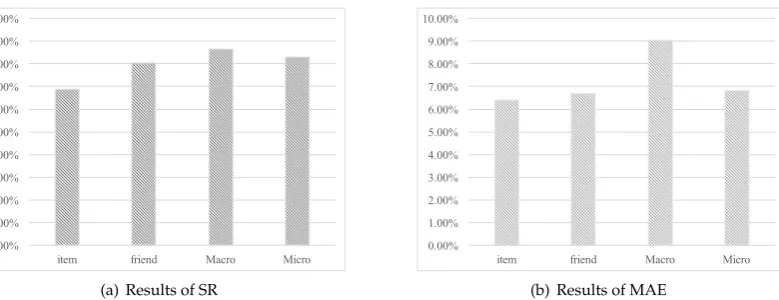
6. Results 208
In the experiment, we use four methods, traditional Collaborative Filtering (cf), 209
social-based recommendation (friend), Macro transfor recommendation (Macro) and Micro transfor 210
10.00% 11.00% 12.00% 13.00% 14.00% 15.00% 16.00% 17.00% 18.00% 19.00% 20.00%
item friend Macro Micro
(a) Results of SR
0.00% 1.00% 2.00% 3.00% 4.00% 5.00% 6.00% 7.00% 8.00% 9.00% 10.00%
item friend Macro Micro
(b) Results of MAE
Figure 2.Collation Map Under Different Recommendation
Figure2shows the the SR and MAE results on the category recommendation. We can see that the 212
Macro and Micro algorithms are improved by 3.4% and 1.5%, respectively compared with existing 213
friend social-based collaborative recommendation algorithm in Figure2(a). However, the MAE for 214
the Macro and Micro algorithms alos increased for Macro and Micro algorithms, which means that 215
this two kinds of extended algorithms have decreased in the recommended stability in in Figure2(b). 216
The Macro and Micro delivery have some improvement on the accuracy of the recommendation. 217
0.00% 2.00% 4.00% 6.00% 8.00% 10.00% 12.00% 14.00% 16.00% 18.00% 20.00%
item friend Macro Micro item item-opt category category-opt
(a) Results of SRs
0.00% 5.00% 10.00% 15.00% 20.00% 25.00% 30.00% 35.00%
item friend Macro Micro
item item-opt category category-opt
(b) Results of MAEs
Figure 3.Collation Map Under Different Optimization
In order to analyze the experimental results more clearly, we show the effect of item-based and 218
category-based recommendations with different methods in Figure3. Figure3(a) illustrates the SR 219
results for item-based and category-based with four recommendation methods. We can clearly see that 220
the SRs results based on category recommendations are almost more than 4∼5% in average comparing 221
with the item-based SRs. Moreover, the proposed optimization pruning algorithm basically does 222
not reduce the SR results of each method. Figure3(b) illustrates the MAE results for item-based 223
and category-based with four recommendation methods. It is very clear that the MAE value based 224
on category recommendations is much smaller than the item-based recommendation results. The 225
proposed pruning algorithms can effectively suppress the recommended error conditions for Macro 226
and Micro transfor. 227
7. Conclusions 228
This paper proposed relations transmission in the social recommendation system based on the 229
social relation theory of internal structure of relation graph. We named the deep spread of relation 230
Model. Micro Relation Transfer Model is considering that birds of a feather flock together, transformed 232
the relation with maximum interest similarity. Macro Relation Transfer Model is conceding that 233
people who have mutual friends are most likely to friends, spread the relationship by the proportion 234
of common neighbors. The Monte Carlo Decision Tree convergence algorithm was introduced to 235
diminish the effect of social transmission. We used epinion dataset to enhance the performance of the 236
entire recommended system successfully. 237
Acknowledgments:This work was supported by the NSFC (No.61502247, 11501302, 61502243, 91646116), China 238
Postdoctoral Science Foundation (No.2016M600434), Natural Science Foundation of Jiangsu Province (BK20140895, 239
BK20150862), Scientific and Technological Support Project (Society) of Jiangsu Province (No.BE2016776), and 240
Postdoctoral Science Foundation of Jiangsu Province(1601128B), Opening Project of Collaborative Innovation 241
Center for Economics crime investigation and prevention technology(JXJZXTCX-015), and Open Project Program 242
of the State Key Laboratory of Mathematical Engineering and Advanced Computing(2017A10). 243
References 244
1. M. Morita , Y. Shinoda, in: B. Croft, C.J. van Rijsbergen (Eds.), Information Filtering Based on User Behavior 245
Analysis and Best Match Text Retrieval, 1994, pp. 272-281. 246
2. G. Guo , J. Zhang , N. Yorke-Smith , Leveraging multiviews of trust and similarity to enhance clustering-based 247
recommender systems, Know. Based Syst. 74 (2015) 14-27. 248
3. M. Ramezani , P. Moradi , F. Akhlaghian , A pattern mining approach to enhance the accuracy of collaborative 249
?ltering in sparse data domains, Physica A 408 (2014) 72-84. 250
4. A. Javari , M. Izadi , M. Jalili , Recommender systems for social networks analysis and mining: precision 251
versus diversity, Complex Syst. Netw. (2015) 423-438. 252
5. Schafer J B, Dan F, Herlocker J, et al. Collaborative Filtering Recommender Systems[J]. Acm Transactions on 253
Information Systems, 2004, 22(1):5-53. 254
6. Hosale N S, Pande S S. A Survey on Recommendation System for Big Data Applications[J]. Journal of 255
Biological Engineering, 2015, 7(1):67-73. 256
7. H. Chen, S. LV. Study on trust-based collaborative filtering recommendation strategy. Journal of 257
Computational Information Systems, Binary Information Press, 2012, 8(10): 4095-4100. 258
8. D. Sepandar, T. Mario, The Eigentrust algorithm for reputation management in p2p networks. Proceedings of 259
the 12th international conference on World Wide Web, Budapest, HUNGARY, 2003: 640-651. 260
9. J. Ann, Golbeck. Computing and applying trust in web-based social networks. PhD thesis, University of 261
Maryland, 2005. 262
10. P. Massa, P. Avesani. Trust Metrics on Controversial Users: Balancing Between Tyranny of the Majority and 263
Echo Chambers. International Journal on Semantic Web and Information Systems, 2007, 3(1): 39-64. 264
11. J. Caverlee, L. Liu, S. Webb. Towards Robust Trust Establishment in Web-Based Social Networks with 265
SocialTrust. Proceedings of the 17th international conference on World Wide Web, Beijing, China,2008: 266
1163-1164. 267
12. M. Papagelis, D. Plexousakis, T. Kutsuras. Alleviating the Sparsity Problem of Collaborative Filtering Using 268
Trust Inferences. Proceedings of the 3rd International Conference on Trust Management (iTrust-05). Springer 269
Berlin Heidelberg, 2005: 224-239. 270
13. A. Josang, S. Marsh, S. Pope. Exploring Different Types of Trust Propagation. Proceedings of the 4th 271
International Conference (iTrust-06), Pisa, Italy. Springer Berlin Heidelberg, 2006: 179-192. 272
14. Z. Sai, Commodity recommendation system based on social network trust model. Guangzhou: South China 273
University Of Technology, 2012. 274
15. B. Zhang, Z. Huang, J. Yu, Y. Xiang. Trust Computation for Multiple Routes Recommendation in Social 275
Network Sites. Security and Communication Networks, 2014. DOI: DOI:10.1002/sec.935. 276
16. J. Lu , D. Wu , M. Mao , W. Wang , G. Zhang , Recommender system application developments: a survey, 277
Decis. Support Syst. 74(2015) 12-32. 278
17. B. Sarwar , G. Karypis , J. Konstan , J. Riedl , Item-based collaborative ?ltering recommendation algorithms, 279
in: Proceedings of the 10th International Conference on World Wide Web, Publishing, Hong Kong, 2001, pp. 280
285-295. 281
18. A. Javari , J. Gharibshah , M. Jalili , Recommender systems based on collaborative ?ltering and resource 282
19. P. Moradi, S. Ahmadian, F. Akhlaghian, An effective trust-based recommendation method using a novel 284
graph clustering algorithm, Physical436 (2015) 462-481. 285
20. S. Deng, L. Huang, G. Xu, Social network-based service recommendation with trust enhancement. Expert 286
Syst. Appl. 2014, 41,8075-8084. 287
21. Can, Bharat, B. Sort: A self-organizing trust model for peer-to-peer systems. IEEE Trans. Dependable Secur. 288
Comput. 2013, 10, 14-27. 289
22. C. Park, D. Kim, J. Oh, H. Yu, Improving top-K recommendation with truster and trustee relationship in user 290
trust network. Inf. Sci. 2016, 374, 100-114. 291
23. S. Kim, Y. Yoon, Recommendation system for sharing economy based on multidimensional trust model. 292
Multimed. Tools Appl. 2016, 75, 15297-15310. 293
24. M. Ozsoy, F. Polat, Trust based recommendation systems. In Proceedings of the 2013 IEEE/ACM International 294
Conference on Advances in Social Networks Analysis and Mining, Niagara Falls, ON, Canada, 25-28 August 295
2013; pp. 1267-1274. 296
25. A Josang, S Marsh, S Pope. Exploring Different Types of Trust Propagation. Proceedings of the 4th 297