48
PROFICIENCY INCREASE BY
COLLABORATION WITHIN THE FOREIGN
LANGUAGE STUDY PROCESS
Diana Liepa, Inta Ratniece Riga Teacher Training and Educational Management Academy, Riga, Latvia
E-mail: [email protected], [email protected]
Abstract
In the fields of science and education transnational cooperation has become particularly relevant for developing of contemporary conceptions in education and science. As the first step in such coopera
-tion has been the Bologna process, started on June 19, 1999, when 29 Ministers of European countries signed the Bologna Declaration. The Bologna Declaration promotes education and cooperation being the fundamentals of a peaceful and a democratic society. The European dimension is characterized by student mobility and cooperation between educational institutions in European study programmes. The significance of communication and foreign language acquisition skills is gradually increasing (Bologna Declaration, 1999). A strategic goal for the European Union is todevelop the most competitive and dynamic knowledge-based economy in the world capable of sustainable economic growth with a wider variety and better jobs and greater social cohesion. All citizens of European Union countries require foreign language skills, because these skills provide citizens with the opportunity to make use of the free movement to work or to study at one of the EU member states and as such they stimulate the development of a European labour market. As an EU member state, Latvia participates in this process. Improvements should be achieved in teacher education by implementing innovations in the study process.
Key words: didactic modules, experience, planning, aim, assessment.
Introduction
49
Problem of Research
Despite the increasingly broadening integration approach in foreign language studies, graduates of higher education institutions are not always competent to use the language profes -sionally. The existing studies are devoted to specific fields, yet no general solution to the prob -lem has been detected. There is a contradiction between the student learning experience and the professional needs of foreign language use. Different and contradicting views of lecturers of foreign languages, other lecturers and students on the aims of foreign language studies and the organization processes do not allow to get good results in language acquisition.
Research Focus
The aim of the study is: development of a foreign language study model theoretically based on the integrated language acquisition, oriented to the improvement of students foreign language learning experience (practically acquired competences through personal activity: a total of skills, knowledge, values, attitudes) according to the trainee teachers needs.
Methodology of Research
General Background of Research
Didactics, according to the framework of teaching – learning theory, has diverse con -ceptual approaches’ sets that are called didactic models. Didactic models provide theoretical background (with hints how to apply it in practice) regarding the basic favourable factors of a teaching–learning process, possibilities, stumbling blocks and organisation/classroom man -agement (Gudjons, 2007:258). While analysing, H. Gudion selects 5 main models out of all didactic models: model based on theoretical background, goal- oriented study model, cyber -netic model, critically constructive and critically communicative model. Didactic models can be divided into 3 groups: learning-oriented, education and learning-oriented and interactive– oriented didactic models. Regarding the choice of a didactic module (an independent unit that can be combined with others and easily rearranged, replaced, or interchanged to form differ -ent structures or systems) for a didactic model, I. Maslo suggests: firstly, to be goal-ori-ented: oriented on pragmatic or future moral values. Secondly, to analyse the content of the studies, splitting it into 3 components: 1) study content for learners without any previous knowledge, which is an absolute necessity to master and the tutor can assist in the acquisition of it; 2) the study content for learners who have an appropriate background knowledge of it and a long list of literature is available; 3) the study content that is not proved yet, and is being developed cur -rently. In the first case I. Maslo recommends to make use of critically constructive model, in the second case I. Maslo suggests to use critically communicative model, but in the third case I. Maslo favours the systematically constructive model. If learners do not have independent study skills, it is recommended to use theoretical didactic study models (Maslo, 2007) consisting of flexible modules. Along with the classical model, various other models have been developed, for example, action-oriented didactics and observation of the study process etc. In training adults to improve foreign languages’ competence diverse pedagogical models are made use of, but none of them meets the learners’ total needs. Study process is a long-term process and it cannot be done with the help of only one particular didactic model (Gudjons, 2007:256).
in the 21 century Volume 52, 2013
50 that characterises the model. The traditional model is associated with the teacher’s prominent role to choose the study content in accordance with the study programmes and plans. The goal of the traditional model is to provide the learners with knowledge, whereas, practical use of it as well as development of the learners’ moral values are not paid attention to. The next model is just the opposite of the traditional module. The basic idea of it is associated with a language learner’s performance throughout the activities. The learner should master a language by him -self/herself, whereas the teacher acts as a consultant. Using this model, language learners have the opportunity to select techniques how to master the study content. The most crucial factor is learning rather than teaching. The model is appropriate for the acquisition of language skills and competencies. The third model is associated with the teacher’s and learner’s partnership, and the decision process is learning rather than teaching. The teacher selects the study material and the techniques based on the needs’ analysis of the learners. Both the teacher and the learners should be active participants in the study process… but it is not so in many cases and situations. An innovative teacher creates an environment to encourage the learners to take on more com -plicated problems in order to solve them (Ose, 2001). The fourth model is similar to the third one. The only difference lies in its attitude to the community/society. Arousing of interest and understanding of the ongoing processes in the global and local community are targeted to meet the challenges and to impact and subsequently to change them. Topicality of the current global political as well as economic changes must be part and parcel of the study content (Lindeman, 1999). M. Knowles and P. Jarvis, characterising the models used in adult training, emphasise that adult learners should have the most decisive role in planning and organising of the study process. The educator’s task is to guide and to encourage the adult learners for independent ac -tivities as well as to consult them if necessary. The pedagogical models, offered by M. Knowles and P. Jarvis, are grounded on adult learners’ high motivation, necessity and interest which cre -ate their dynamic involvement in the language acquisition process for achieving good results. Both authors do not consider real situations with hard–to-motivate adult learners. The essence of learning is a more widely understood concept, which is linked to the necessity of a practi -cal application of the acquired knowledge, skills, attitudes and values (Jarvis, 2004:93). The relationships between the lecturers and the students are relationships between subjects. Differ -ences can be observed in various kinds of relationships and interactions between a student and a lecturer. Mutual coercion or mutual synergy of persons creates a certain relationship model and brings changes to the aims, motives, attitudes and actions of the persons involved. Thus, the student is the subject of actions, who, by developing through action or through interaction with others, him/herself determines the character of this action or interaction. The process of foreign language studies should be organized by engaging students in a conscious planning, organiza -tion, self-assessment and assessment of this process. Within foreign language studies use is made of various pedagogical models, yet none of these models is complete. The study process is too extensive to be explained thoroughly by a single didactical model. Pedagogues should integrate various models, depending on the study course, theme, audience etc. Comprehension of these models stimulates the improvement of studies.
Sample of Research
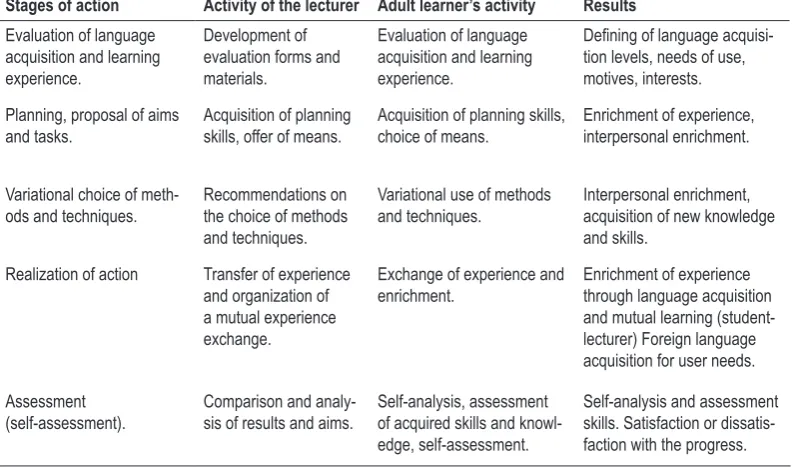
51 Table 1. Collaboration Scheme in Foreign Language Studies in accordance with
the model by Ausma Špona (Špona, 2006:105).
Stages of action Activity of the lecturer Adult learner’s activity Results Evaluation of language
acquisition and learning experience.
Development of evaluation forms and materials.
Evaluation of language acquisition and learning experience.
Defining of language acquisi -tion levels, needs of use, motives, interests. Planning, proposal of aims
and tasks. Acquisition of planning skills, offer of means. Acquisition of planning skills, choice of means. Enrichment of experience, interpersonal enrichment.
Variational choice of
meth-ods and techniques. Recommendations on the choice of methods and techniques.
Variational use of methods
and techniques. Interpersonal enrichment, acquisition of new knowledge and skills.
Realization of action Transfer of experience and organization of a mutual experience exchange.
Exchange of experience and
enrichment. Enrichment of experience through language acquisition and mutual learning (student-lecturer) Foreign language acquisition for user needs.
Assessment
(self-assessment). Comparison and analy-sis of results and aims. Self-analysis, assessment of acquired skills and knowl-edge, self-assessment.
Self-analysis and assessment skills. Satisfaction or dissatis-faction with the progress.
in the 21 century Volume 52, 2013
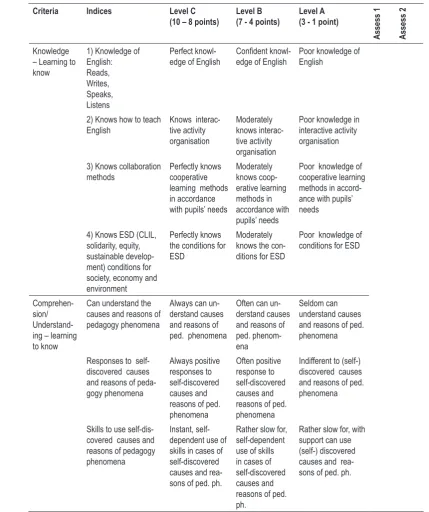
52 Table 2. Model of Criteria, indices and levels for self-assessment of the emerg-ing English Foreign Language teacher’s competence development.
Criteria Indices Level C
(10 – 8 points) Level B(7 - 4 points) Level A(3 - 1 point)
Assess 1 Assess 2
Knowledge – Learning to know
1) Knowledge of English: Reads, Writes, Speaks, Listens Perfect
knowl-edge of English Confident knowledge of English- Poor knowledge of English
2) Knows how to teach
English Knows interac-tive activity organisation
Moderately knows interac-tive activity organisation
Poor knowledge in interactive activity organisation
3) Knows collaboration
methods Perfectly knows cooperative learning methods in accordance with pupils’ needs
Moderately knows coop-erative learning methods in accordance with pupils’ needs
Poor knowledge of cooperative learning methods in accord-ance with pupils’ needs
4) Knows ESD (CLIL, solidarity, equity, sustainable develop-ment) conditions for society, economy and environment
Perfectly knows the conditions for ESD
Moderately knows the con-ditions for ESD
Poor knowledge of conditions for ESD
Comprehen-sion/ Understand-ing – learnUnderstand-ing to know
Can understand the causes and reasons of pedagogy phenomena
Always can un-derstand causes and reasons of ped. phenomena
Often can un-derstand causes and reasons of ped. phenom-ena
Seldom can understand causes and reasons of ped. phenomena
Responses to self-discovered causes and reasons of peda-gogy phenomena
Always positive responses to self-discovered causes and reasons of ped. phenomena
Often positive response to self-discovered causes and reasons of ped. phenomena
Indifferent to (self-) discovered causes and reasons of ped. phenomena
Skills to use self-dis-covered causes and reasons of pedagogy phenomena
Instant, self-dependent use of skills in cases of self-discovered causes and rea-sons of ped. ph.
Rather slow for, self-dependent use of skills in cases of self-discovered causes and reasons of ped. ph.
53 Skills as
ability to use knowledge – learning to do
Reading Can and knows how to teach reading perfectly by any texts
Can and knows how to teach reading perfectly by text-book texts
Can and knows how to teach reading poorly by text-book texts
Speaking Can and knows how to teach speaking perfect-ly by monologues and dialogues
Can and knows how to teach speaking moderately by monologues and dialogues
Can and knows how to teach speaking poorly by monologues and dialogues
Writing Can and is good at creating texts by writing
Can and is moderate at creating texts by writing
Can yet is poor at creating texts by writing
Organising of
interac-tive learning methods Can and often is good at organ-izing interactive learning methods
Can and some-times is good at organizing interactive learn-ing methods Seldom can organize interactive learning methods Collaboration methods appropriate for pupils’ needs
Good at choosing collaboration methods appro-priate for pupils’ needs Moderate at choosing collab-orationmethods appropriate for pupils’ needs
Seldom chooses collaboration meth-ods appropriate for pupils’ needs
Shared relationships – learning to live together
Organisation Knows how and systematically organizes coop-erativelearning in pairs and groups
Partly organ-izes cooperative learning in pairs and groups
Seldom organizes cooperative learning in pairs and groups
Respect During teaching/ learning process the teacher always respects pupils (their ignorance) and their parents
During teaching/ learning proc-ess the teacher often respects pupils (their ignorance) and their parents
During teaching/ learning process the teacher seldom respects pupils (their ignorance) and their parents
Taking responsibility in
collaboration During teaching/learning process the teacher and the pupil share responsibility for it equally (50 %<=> 50%)
During teaching/ learning process the teacher and the pupil share responsibility for it unequally (the teacher > than 50%)
in the 21 century Volume 52, 2013
54 Attitude –
learning to be Attitude to the profes-sion I have well prepared for teacher’s continu-ous professional performance
I have prepared for teacher’s professional performance
I have not prepared for teacher’s profes-sional performance
Attitude to the child The child is a very great, genuine teacher’s treasure
The child is a great, genu-ine teacher’s treasure
The child is a teacher’s treasure
Devotedness to
teacher’s work I am very greatly devoted to the teacher profes-sional perform-ance
I am devoted to the teacher professional performance
I am not much devoted to the teacher professional performance
Attitude to
collabora-tion and cooperacollabora-tion I very highly appreciate col-laboration and cooperation with pupils, colleagues and parents
I highly appreci-ate collaboration and cooperation with pupils, colleagues and parents
I appreciate not very much col-laboration and cooperation with pupils, colleagues and parents
Instrument and Procedures
The research involved the emerging Educational Management students and Primary School trainee teachers with additional specialisation in English as a Foreign Language teachers at Riga Teacher Training and Educational Management Academy. All the students were invited to participate in the introductory lecture-discussion acquainting with the up-coming opportu -nity to participate in an Erasmus project Intensive Programme “Active citizenship in teaching foreign languages” (CiTiFoLa No IP-2010-04) organized by mutual efforts of twelve teacher training institutions from twelve different countries from the European Union and beyond. The students investigated a presentation about the previous Erasmus project Intensive Programmes (IP) and their connection with sustainable development and education for sustainable develop -ment ideas. The students were suggested to explore additional sources connected to Erasmus projects before applying for active participation in the above mentioned IP. They were suggest -ed to participate in the competition consisting of writing an essay and filling-in the application form. Both the essay and the application form involved students into self-assessment of their needs, knowledge, skills, values, experiences, attitudes to functional English, teaching/learning of English and sustainable development. Four of the emerging English as a Foreign Language teachers succeeded in joining the IP - Active citizenship in teaching foreign languages. Thus, they constitute Group 1 of the research survey. Other 14 interested emerging English as a For -eign Language teachers participated in the survey constituting Group 2 – the control group of the empirical experiment. The participation was voluntary as it was an informal studies module, yet within the formal study process framework.
Using statistical methods the dynamics of the competence development and transforma -tions were analysed, the results were evaluated and generalized on the basis of the examination of the interplay of data by means of the statistical program SPSS 17.0 (Statistical Package for Social Sciences).
55
Data Analysis
The survey data were obtained by inducing the students to participate in self-assessment involving an addition focusing on education for sustainable development knowledge, values, attitudes and experience by the participants.
The Model of Criteria, indices and levels for measurement of the emerging EFL teach -ers’ competence development opportunities highlighting collaboration in education was de -veloped by I.Ratniece thanks to discussions with students, colleagues (Dr.paed. D. Liepa, etc.) and guidance of professor A. Špona. It was displayed to scholars and students for discussing and suggesting variants for further developments and improvements. Discussions revealed that the emerging teachers support the idea of teacher education activating the tool for sustainable development dissemination. Moreover, the teachers in the 21st century should convince their students that education is not about consumption but about service to make a better world for their generation as well as the oncoming generations. Other ideas approved in discussions by the emerging students maintained: the educated person – teacher always has time for syn -ergy. Therefore, innovative education is not only the pursuit of perfection, but understanding of human frailty as well. Educators should promote themselves creatively alongside their main collaboration partners – students to attain their common goal - progress due to ESD, intergen -erational solidarity and global citizenship issues involved. Latvian educators should pursue the goals by joint efforts with colleagues from beyond Latvia. Shared experiences bring genuine reward.
The students were invited to volunteer for participation in the cooperation project as an empirical experiment involving the above-mentioned significant principles for improving the student active participation for gaining self-experience. The volunteers applied for participation in the project Intensive Programme CiTiFoLa (Active citizenship in teaching foreign languages). Before entering the Intensive Programme (IP) and after the completion of IP the participants of it as well as the participants of the control group, who did not participate in the project Intensive Programme CiTiFoLa, also self-assessed their achievements in accordance with the improved Self-assessment Model (Table 2). The model has been empowered also in the academic year 2011/2012 to be used by applicants volunteering to participate in the consecutive Erasmus project Intensive Programme SoliTiFoLa (Intergenerational solidarity in teaching foreign languages).
Results of Research
in the 21 century Volume 52, 2013
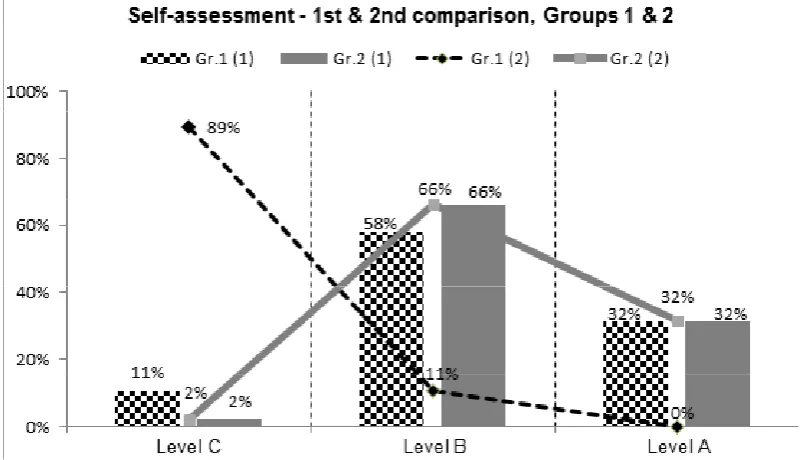
56 This was established not only due to the second self-assessment (Group 1- successful applicants to IP; Group 2 - Control group), but also by correlation with the experts’ evaluation of the both groups’ success in their school practice and qualification examination that took place after the IP participants had had their global informal studies. The experiment and the fol -lowing self-assessment 2 as well as discussions and dissemination of their experiences among the fellow-students pointed out the need for synergy between teachers and learners, in direct contradiction to traditional competitive approaches. Teaching and learning within a group or team context can be particularly effective in higher education.The synergised atmosphere mim -ics potential workplace scenarios that await students after graduation. The skills learned in this group atmosphere are essential in many vocations. The students and their teacher trainers have found that this cooperative learning and teaching atmosphere resulted in students being actively involved at a higher level. Furthermore, during the reflection it was argued that the re -sponsibility of learning should reside increasingly with the learner. The emerging teachers thus emphasized the importance of the adult learner being actively involved in the learning process, unlike previous educational models where the responsibility for the results rested totally with the lecturer, where the learner played a passive, receptive role. In their reflection Group 1 in -sisted on the value of the acquired experience, opportunities to equal global collaboration both with peers and representatives from other generations for cognition of innovative ideas usher -ing in positive changes, alternative interpretations of sustainable development. The attained in -novative self-experience in global environment leads to increase of competence for their future socio-pedagogical synergy (Ratniece, 2012).
Figure 1: Average self-assessment of IP participants’ target group in compari-son with the average self-assessment of the control group.
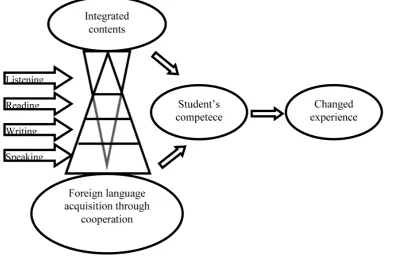
57 improves, if the choice of study contents is linked to the student needs, if it develops an inter -est and an understanding of the personal significance of learning; the study process observes an integrity of foreign language acquisition components, which ensures an improvement of the learning experience and its use in particular – development of writing and speaking skills; the totality of pedagogical conditions serves as a purposeful development of language learning experience; the student and the lecturer show an active cooperation within the learning process, which ensures an enrichment of language use experience.
Figure 2: Model of Foreign Language Studies.
Discussion
The methodology and novelties of English as a foreign language (EFL) teaching should be particularly focused on for the proficiency advancement of the emerging English as a For -eign language teacher professional competence both by formal and informal studies.
Educational innovation development due to global collaboration is challenged by Eras -mus Intensive Programmes such as “CiTiFoLa.” The programme CiTiFoLa IP 2010/2011 aims and the CLIL working methods of CiTiFoLa involved: knowing 1 (the principles of content-based language learning /CLIL/TiFoLa); knowing 2 (the role of task-content-based activities and proj -ect work in content-based language learning); being able 1 to: respond to feedback on their language output in English to make progress; being able 2 to: give others feedback on their lan -guage output in English; being able 3 to: respond to feedback on their grasp of content to make progress in English; being able 4 to: give others feedback on their grasp of content in English; being more competent 1 in: learning a foreign language (i.e. English) from extended input and meaningful output; being more competent 2 in: supporting other students in learning a foreign language from extended input and meaningful output; being more competent 3 how to work in ICT environment, Moodle; being more competent 4 how to transfer sustainable development ideas to learners.
in the 21 century Volume 52, 2013
58 universities. In the interim they developed their own lesson plan for a lesson conducting on the topic related to sustainable development and active citizenship in international teams of four emerging teachers from four different countries guided by teacher trainers from twelve differ -ent teacher training higher education institutions, after observing lessons in the host country’s schools at the end of the first week and the beginning of the second week. Each international lesson was conducted in the second week of the IT CiTiFoLa in a respective host school in Austria. The international team of the emerging teachers transformed and implemented their knowledge, skills and experiences gained and combined. Synergy of more than three genera -tions (including teacher trainers, emerging teachers, young learners and other stakeholders) was actively stimulated and essentially encouraged by dissemination of sustainable development ideas. The research results suggest that a unified foreign language study conception should be developed and implemented in practice. A unified approach should be introduced in the development of study courses, an interdisciplinary approach to studies, an interaction between contents and forms aimed at unity. The planning and organisation of the study process should take into account unified language skill acquisition criteria and levels.
Discussion questions guiding our research:
How the acquisition of foreign languages can be stimulated in the study process? 1)
How to realise a unified foreign language study conception in the real life? 2)
Conclusions
The process of foreign language acquisition in informal studies based on collaboration stimulates the student skills to make use of the foreign language in various situations of life, which includes actions, through completion of which the students develop various language competences and professional competences and which stimulate the improvement of the expe -rience. In the active process of foreign language acquisition the students develop a positive atti -tude to language acquisition, to the acquired profession, new values emerge and the personality of the student improves. In order to develop the experience of students, the study process should make use of the language skill self-evaluation criteria of foreign language learners involving the aspect of education for sustainable development.
Studying is a total of teaching and learning processes both throughout formal and in -formal studies, a purposeful interaction between lecturers and students directed at an indepen -dent, purposeful and conscious activity of the student. The active process of foreign language acquisition stimulates the student skills, challenges them to make use of the foreign language in various situations of life, which includes actions, through completion of which the students develop various language competences and professional competences and which stimulate the improvement of the experience.
In the process of foreign language acquisition based on collaboration, the students de -velop a positive attitude to language acquisition, for the acquired profession. The responsibility of learning should reside increasingly with the learner. The emerging teachers thus emphasize the importance of themselves and, subsequently, the next generation learner is being actively involved in the learning process. A contrasting benevolent model appears to involve learners in active learning, moreover, active citizenship. Challenging the previous educational models, where the responsibility rested with the instructor to teach and where the learner played a pas-sive, receptive role. Synergy rewards both - students and teachers functioning together gaining increased competence and producing a result not independently obtainable.
New values emerge for professional competence and the personality of the student im -proves. In order to develop the experience of students, the study process should make use of language skill self-assessment and subsequent implementation of the knowledge, skills, experi -ences, attitudes gained into immediate practice.
59 a total of teaching and learning processes, a purposeful interaction between lecturers and stu -dents directed at an independent, purposeful and conscious activity of the emerging teacher entering synergy of generations based on positive attitude to sustainable development.
References
Gudjons, H. (2007). Pedagoģijas pamatatziņas. Rīga: Zvaigzne ABC.
Jarvis, P. (2004). Adult Education and Lifelong Learning. London: Routledge Falmer.
Knowles, M. (1980). The modern practice of adult education: from pedagogy to andragogy. Cambridge:
Adult Education.
Liepa, D. (2011). Integration of foreign language acquisition components in the study process. Rīga:
LU.
Lindeman, E. (1999). Dynamic social research. London: Routhledge.
Maslo, I. (2007). Didaktiskie modeļi kā didaktiskās rīcības plānošanas un analīzes teorijas. Rīga: LU.
Ose, G. (2001). Kā mācās pieaugušie. Rīga: A/S Poligrāfists.
Špona, A. (2006).Audzināšanas process teorijā un praksē. Rīga: RaKa.
Ratniece, I. (2012). Collaboration with Students – Trainee Teachers of English. Annales Universita
-tis Paedagogicae Cracoviensis, Studia Anglica I. 106. Ed. M. Misztal, M. Trawinski. Krakow: Wydawnictwo Naukowe UP. 36 -46.
The Bologna Declaration of 19 June 1999. Retrieved from 15.09.2012, http://www.aic.lv/rec/lv/new_d_ lv/bol_dec.htm
Advised by Margarita Kaltigina, Riga Teacher Training and Educational Management Academy, Riga, Latvia
Received: January 14, 2013 Accepted: February 12, 2013
Diāna Liepa Dr.paed, Associate Professor, Riga Teacher Training and Educational Management Academy, Imantas 7. līnija, Rīga, LV- 1083, Lavia.
E-mail: [email protected]
Inta Ratniece Mg. paed. Lecturer, Riga Teacher Training and Educational Management Academy, Imantas 7. līnija, Rīga, LV- 1083, Lavia.