Volume 37, 2011
säljö, r. (1996). mental and physical artefacts in cognitive practices. i. p. reiman & h. spada (eds.),
Learning in humans and machines (284-324). oxford: pergamon/elsevier.
sandoval, W. a. (2005). understanding students´ practical epistemologies and their influence on learning through inquiry. Science Education, 89, 634-656.
siegman, a. W., feldstein, s. (1987) Nonverbal behavior and communication. hillside, nJ: lawrence erlbaum associates.
schoultz, J., hultman, G. (2004). science teaching and the school – when concepts meet context. Journal of Baltic Science Education, 2 (6) 22-33.
received: November 11, 2011 accepted: December 15, 2011
Agnaldo Arroio Doctor, Professor, Faculty of Education, University of São Paulo, São Paulo, Brazil.
E-mail: [email protected] Website: http://www.fe.usp.br
DOES INTELLIGENT E-LEARNING TOOLS
NEED MORE PEDAGOGICAL
METHODOLOGY OR ICT
Boris Aberšek, Metka Kordigel Aberšek
University of Maribor, Slovenia E-mail: [email protected], [email protected]
Abstract
Evolution in computer and other information communication technologies have made also possibilities to develop intelligente computer-aided learning tools for enhanced learning. Today, most researchers in the field of educational technology seem to be preoccupied with either heuristic, the development of Artificial Intelligence application, or the epistemology, philosophy concerned with the nature and scope (limitations) of knowledge and representation or varius learning theories such as constructivism and conectionism by computer program. The enthusiasm to develop technologicall advanced learning tools resulted in technologies with limited application. The need to develop simple computer-based tools to assist instruction and demonstrate its impressiveness to enhance learning is most important, but those tools desperetly need to be designed with epistemological (didactical) knowledge and integrated into a pedagogical framework.
The paper presents researc connected with the design and use of an interactive computer-aided learning tool for enhanced learning and the impact of an interactive computer-aided e-learning tool on students learning achievement. The study was motivated by the need to evaluate the use and effectiveness of computer-aided learning applications as they are used in the instructional environment. The mayor research questions that guided this study are: Does the e-learning tool have a measurable effect on students learning? And what is the impact of the e-learning tool usage on students’ performance? The results of the study proof the impact of usage e-learning tools on students’ performance at knowledge assessment. While using the prepared e-learning tool, the score and the time of complete interactive session were measured.
Key words:education, ICT, intelligente learning tools.
Introduction
information and communication technology (ict), through e-learning, e-lab, networking, knowledge-based systems, and other technologies, will play an increasingly important role in the way that education is taught and delivered to the student, specially science and technology students. but all this modern technology must have base on special didactics and media didactic. through these technologies and didactic, the student will be placed in an “active” role, as opposite to a “passive” environment of one-way lecturing. the teacher can then act as a facilitator and author of the learning environment instead of merely a one-way communicator.
there is no denying about the appeal of computer and other ict technologies. their magnetic effect on students’ attention is all too familiar to teachers but parents too, particularly when the alternatives are homework and household chores (massey and brown, 2005). if we would like to use this entire new gadget, we must know:
10 a good learning tool is not simply a sequence of things that happen but a carefully constructed tapestry in which events is juxtaposed and emotions peak (langley, 2006). a good learning tool is also highly interactive, deliberately generating tension between the degree of control the content (subject) story imposes and the student’s freedom of interaction. two extremes are:
1. With no story and complete freedom of interaction. students do what they want, but their experience can be boring.
2. on the other hand, if the story provides too much control, the experiences become more like watching a movie than learning. the secret of the solution is in balancing these two extremes.
a lot of research in education is concerned with the development of artificial intelligence applications such as computer-aided instruction (cai), intelligent cai, intelligent tutoring system (ets) and intelligent learning environment (ila) (felder, 1993; allen, 2008) and also with applications that can be justified as being consistent with educational theories. there is also a new trend which deals with comparing the performance and attitudes of students taking online courses versus those taking lecture-based courses (davis, 2003, sunal, 2003). computer-supported collaborative learning (cscl) is one of the most promising innovations to improve teaching and learning with the help of modern information and communication technology. most recent developments in cscl have been called e-learning 2.0, but the concept of collaborative or group learning whereby instructional methods are designed to encourage or require students to work together on learning tasks has existed much longer. it is widely agreed to distinguish collaborative learning from the traditional “direct transfer” model in which the instructor is assumed to be the distributor of knowledge and skills, which is often given the neologism e-learning 1.0, even though this direct transfer method most accurately reflects computer-based learning systems (cbl) (stahl, 2006).
locus of control remains an important consideration in successful engagement of e-learners. according to the work of cassandra b. Whyte, the continuing attention to aspects of motivation and success in regard to e-learning should be kept in context and concert with other educational efforts. information about motivational tendencies can help educators, psychologists, and technologists develop insights to help students perform better academically (Whyte, 1980).
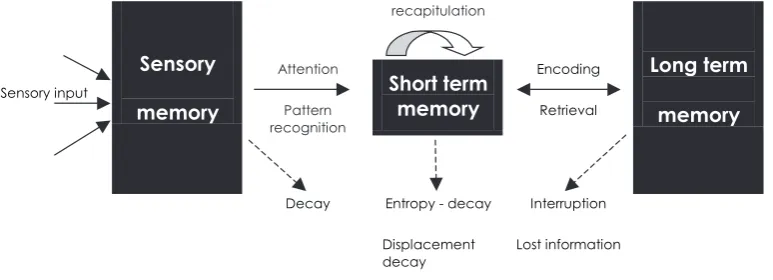
Figure 1: Model of information process.
in the 21st century Volume 37, 2011 11
perceive online computer-aided learning tools a major breakthrough in teaching and learning, many educators and trainers do not support it (conlon, 1997). although the growth of online computer-aided learning tools has been significant recently, there still exists a mayor gap in design and evaluation of their educational (teaching and learning perspectives) capabilities and effectiveness in enhancing the learners’ experience (saade, 2007).
according to information theory process (broadbert, 1958) as briefly shown in figure 1, computer-aided learning tool is a tool that helps students to reduce the demand on their working memory and facilitate information transfer into long-term memory.
Methodology of Development
today, the term “computer- assisted learning” is used loosely and represents the utilization of any application for delivering content to the student. this may be: electronic material that students would read or interactive learning tools to help learning. concerns currently being explored by researchers include student’s attitudes, course design and delivery, course evaluation, and instructor behaviour and attitudes (sunal, 2003, achtemaier, 2003,aberšek, Kordigel aberšek, 2010). the effectiveness of computer assisted learning applications and utilization of well-developed research plans are relatively scarce at this time (sunal, 2003). this study was motivated by the need to evaluate the use and effectiveness of computer-aided learning applications as they are used in the instructional environment.
presented research try to point out the effectiveness of an interactive computer-aided application whose primary objective is to assist students in learning. as it is mentioned, any computer-aided application/learning tool, especialy intelligent computer based tutoring system must have in general level two parts:
1. the first part is heuristic part. Generally heuristic refers to experience-based techniques for problem solving, learning, and discovery. heuristic methods are used to speed up the process of finding a satisfactory solution, where an exhaustive search is impractical. examples of this method include using a “rule of thumb”, an educated guess, an intuitive judgment, or common sense. in more precise terms, heuristics are strategies using readily accessible, though loosely applicable, information to control problem solving in human beings and machines (pearl, 1983). in computer science,
metaheuristic designates a computational method that optimizes a problem by iteratively trying to improve a candidate solution with regard to a given measure of quality. metaheuristics make few or no assumptions about the problem being optimized and can search very large spaces of candidate solutions. however, metaheuristics do not guarantee an optimal solution is ever found. many metaheuristics implement some form of stochastic optimization.
12 oneself), place (e.g., one’s hometown), thing (e.g., cars), or activity (e.g., addition). somephilosophers think there is an important distinction between “knowing that”, “knowing how”, and “acquaintance-knowledge”, with epistemology primarily interested in the first.
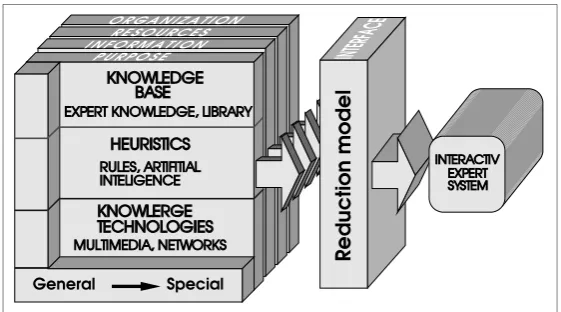
at the executive level the intelligent computer-aided learning tools are interactive computer programs which incorporate expertise and provide advice on a wide range of tasks (aberšek, 2004, 2005). these systems typically consist of the following three basic components:
• the behaviour of the problem domain.
• context is a workspace for the problem constructed by the inference mechanism from the information provided by the user and the knowledge - base.
• inference mechanism, which monitors the execution of the program by using the knowledge - base to modify the context.
in addition to the three main modules described above, the system should also be provided with a graceful:
• user interface, • explanation facility,
• Knowledge - acquisition module, as shown in figure 2.
Figure 2: Configuration of the Expert System (Aberšek, 2004).
the mayor research questions that guided this study are:
1. does the e-learning tool have a measurable effect on students learning? 2. What is the impact of the e-learning tool usage on students’ performance?
in the 21st century Volume 37, 2011 13
Case Study: the E-learning Tool, Design (Heuristic) and Pedagogy (Epistemology)
described case study investigates the effectiveness of e-learning tool – Gears and gears transmission, designed for university level students of technical pedagogical program at the faculty of natural science and mathematics. its primarily objective is to allow students to explore different perspectives to concepts by manipulating related information. the goal of the exercise is to provide the student with an opportunity to construct his/her own mental model of a specific concept. this objective has some elements of the constructivist approach (dalgano, 2009) and entails the implementation of learning strategies designed to involve the student in the learning process as well as a relatively high level of interactivity with instantaneous feedback. the e-learning tool was developed so that students could practice and assess their knowledge and assess their knowledge of content material and concepts to a specific matter (Jones, 2007).
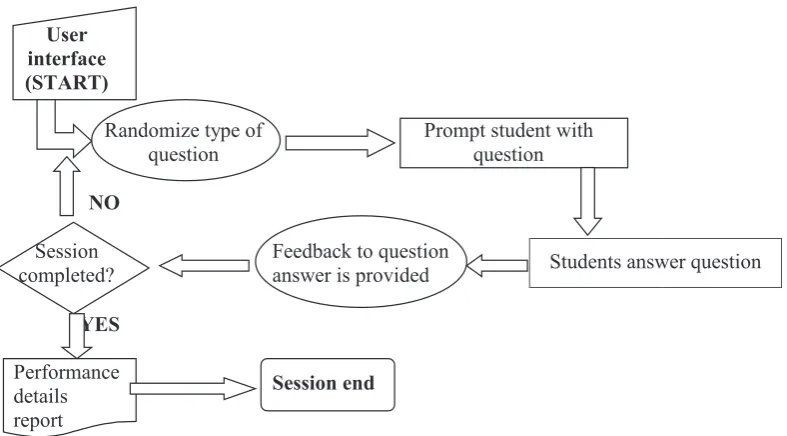
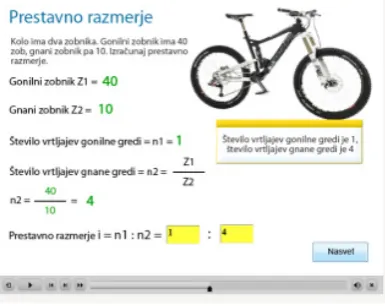
in using the e-learning tool, students rehearse concepts specific to a subject matter by having the application prompting them with multiple choice, true or false and fill-in-the-blanks questions (figure 3). a net version of student interface is shown at figure 4.
Figure 3: Flow Chart of the QUESTION-ANSWER process between students and
14
Figure 4: User interface for gear ratio.
a rehearsing process entails a double randomization procedure, one type of question level and the other at the actual question level. after logging into the main page of the e-learning tool (see figure 4), the student selects which specific concept he/she wishes to rehearse. the e-learning tool now selects from a pool of related questions also using the same randomization function. the student answers the question; the time to answer the question is logged and feedback to the answer (correct or incorrect) is given to the student. another question is than selected by the e-learning tool using the same procedure as described above. the session continues till the time is completed. after that a student gets a detailed performance report and an overall performance score.
Methodology of Experimental Research
the study examined the impact that the e-learning tool may have on learning. two groups were used from two different semesters. students were involved as a part of the design and technology curriculum at the faculty of natural science and mathematics, university of maribor. a total of 34 students participated in the study.
the participants of the study were divided in two randomly selected groups, which attended and worked in the course in two study years, one next to the other. the courses in both sessions were taught by the same professor, delivered in the same department (department of technology), and included the same assignments, notes, book, activities and projects. the two groups were used to compare their performance. it is important to point out the equivalence of the groups. demographics data included gender and age, they were reviewed and differences were not significant.
the case study was conducted during two consecutive study years. in the first study year a group of 18 students (Group a) participated. one week prior to the final exams the students were encouraged to use the e-learning tool for self learning as a help for accessing their knowledge. the final exam was than administrated. during the following study year the other 16 students (Group b) taking the same course, were given the final exam without having them use of the e-learning tool. for both groups the test topics, week, at which the test was administrated from the beginning from the study year and time allocated to the final exam, were the same and both groups had access to the same questions too.
once again: the mayor research questions that guided this study were: does the e-learning tool have a measurable effect on students learning? and what is the impact of the e-learning tool
in the 21st century Volume 37, 2011 15
Results of Research
this research is consistent with the prior results where interactive computer based tutoring system - cbts was been shown to positively impact students learning (aberšek, 2010). the results of the study are also consistent with previous research suggesting that students who use some kind of tutoring system for self learning/evaluation higher in exams that those who use traditional study methods (aberšek, 2009, 2010). table 1 presents the performance statistic of the study.
Table 1. Performance statistics.
Sample Min score in % Mean (SD) Max score in %
Group A: With CBTS
Group B: Without CBTS 4635 75 (11.00)66 (12.00) 9482
Discussion
this study explored the impact of an interactive e-learning toolon learning. the use of the term ‘learning’ was used loosely and most times is measured by performance. its use in the context of this study has implications to the design of the e-learning toll which promotes student development of mental models. the study included two groups where only one was given the e-learning tool to use prior to the final exam. results were consistent with the prior research (Wegner, 1999), showing the positive impact of the e-learning tools on student learning and those suggesting that students who use computer-aided tools score higher in exams than those who use traditional study methods.
there is a clear indication that Group a shows better results than Group b. this indicates that the application influenced students learning, this enhanced learning is reflected in the minimal, maximal and consecutiveness in the mean score and indicate difference of 14%.
Conclusion
computer based learning tools create a compelling experience. for application seeking to teach users through realistic experience, computer based techniques can make the experience much more memorable. in a test bed environment, the context and control afforded by intelligence design techniques, intelligent heuristic allow integration of technologies and evaluation of the overall experience, even with partial implementation. and we must point out, that for good and effective e-learning tools the epistemological, philosophical and didactical part is equally (maybe even more) important than heuristics (technological, ict part), since the history proves, that schools had been and can work also without ict, but ict without pedagogy and didactics is empty and useless.
References
aberšek, b. (2005). modern learning environments in combination with intelligent expert system. Journal of Science Education, Vol. 6, special issue, pp. 13-14
aberšek, b., & poppov, V.(2004). intelligent tutoring system for training in design and manufacturing.
Advanced Engineering Software, 35, pp. 461-471.
Aberšek, B., Ploj Virtič, M. (2009). Enhancement of Educational Process Using Experience Based
16 aberšek, b., Kordigel aberšek, m. (2010). information communication technology and e-learning
contra teacher. Problems of Education in the 21st Century, Vol. 24, pp. 8-18.
achtemeier, d. s., morris, V. l., finnegan, l. c. (2003). consideration for developing evaluations of online courses. Journal of Asynchronous Learning Networks, Vol. 7, issue 1, pp. 1-13.
allen, i. e., seaman, J. (2008). Staying the Course: Online Education in the United States. needham ma: sloan consortium.
broadbent, d. e. (1958). Perception and Communication. oxford: pergamon.
conlon, t. (1997). the internet is not a panacea. Scottish Educational Review, 29, 1, pp. 30- 38.
dalgarno, b., bishop, a. G., adlong, W., & bedgood Jr, d.r. (2009). effectiveness of a virtual laboratory as a preparatory resource for distance education chemistry students. Computers and Education, 53(3), pp. 853-865.
davis, r. s. (2003). learner intent and online courses. The Journal of Interactive Online Learning, Vol. 2, no. 1, pp. 23-34.
encyclopaedia of philosophy (1967). Volume 3. macmillan, inc.
encyclopaedia britannica (2007). online, http://www.britannica.com/ (08.10.2011).
felder, m. r. (1993). reaching the second tier – learning and teaching style in college science teaching.
Journal of College Science Teaching, 23, pp.286-290.
Jones, p., beyron, m. J. (2007). temporal support in the identification of e-learning efficacy: an example of object classification in the presence of ignorance. Expert System, Vol. 24, issue1, pp. 1-16.
langely, p. (2006). cognitive architectures and General intelligent systems. Artificial Intelligence Magazine, 27, 2, pp. 33-44.
massey, a. p, brown, s. a., Johnson, J. d. (2005). it all is fun and Games...until students learn. Journal of Information Systems Education, Vol. 16(1), pp. 9-14.
pearl, J. (1983). Heuristics: Intelligent Search Strategies for Computer Problem Solving. new york, addison-Wesley.
stahl, G., Koschmann, t., suthers, d. (2006). computer-supported collaborative learning: an historical perspective, in r. K. sawyer (ed.), Cambridge handbook of the learning sciences (pp. 409-426). cambridge, uK: cambridge university press.
saade, G. r. (2007). dimensions of perceived usefulness: toward enhanced assessment, Decision Sciences Journal of Innovative Education, Vol. 5, issue 2, pp. 289-310.
sunal, W. d., sunal, s. c., odell, r. m., sundberg, a. c. (2003). research-supported best practices for developing online learning. The Journal of Interactive Online Learning, 2, 1, pp. 1- 40.
in the 21st century Volume 37, 2011 17
Wegner, b. s., holloway, K. c., Garton, e. m. (1999) the effects of internet-based instruction on student learning. Journal of Asynchronous Learning Networks, 3, 2, pp. 98-106.
Advised by Vincentas Lamanauskas, University of Siauliai, Lithuania
received: September 18, 2011 accepted: October 24, 2011
Boris Aberšek Professor, Dr., University of Maribor, Faculty of Natural Science and Mathematics, Koroška 160, 2000 Maribor, Slovenia.
Phone: +386 2 2293 752, Fax: +386 2 2518 180. E-mail: [email protected]
Metka Kordigel Aberšek Professor, Dr. University of Maribor, Faculty of Education, KoroškaUniversity of Maribor, Faculty of Education, Koroška 160, 2000 Maribor, Slovenia.