Pharmacophore 2011, Vol. 2 (3), 158-163
ISSN 2229 – 5402
Pharmacophore
(An International Research Journal)
Available online at http://www.pharmacophorejournal.com/
Original Research Paper
DEVELOPMENT AND VALIDATION OF LC METHOD
FOR THE ESTIMATION OF ZOLMITRIPTAN
IN PHARMACEUTICAL DOSAGE FORM
N.Usha Rani
1*
, R. Sreenivasa Rao
1,
K .Saraswathi
2, T.E.G.K. Murthy
31
Dept of Chemistry, B.C.A.S, Bapatla,
Guntur (D.T), AP, India
2
S.V. University, Titrupathi, AP, India
3Bapatla College of Pharmacy, Bapatla,
Guntur (D.T), AP, India
ABSTRACT
A simple, specific, accurate and precise reverse phase high performance liquid chromatographic method was developed and validated for the estimation of Zolmitriptan in tablet dosage form. A chromosil C-18, 5µm column having 250 x 4.6 mm internal diameter in isocratic mode with mobile phase containing acetonitrile: methanol: orthophosphoric acid in the ratio of 69:29:02 (v/v/v) was used. The flow rate was 1.0 ml/min and effluents were monitored at 210 nm. The retention time for Zolmitriptan was 1.9 min. The method was validated for linearity, accuracy, precision, specificity, limit of detection, limit of quantification and robustness. Limit of detection and limit of quantification were found to be 0.005 ppm and 0.0165 ppm respectively and recovery of Zolmitriptan from tablet formulation was found to be 99.85%. The proposed method was successfully applied for the quantitative determination of Zolmitriptan in tablet formulation.
Keywords: Zolmitriptan, HPLC, Linearity, Validation, Robustness.
INTRODUCTION
therapy of migraine or for use in themanagement of hemiplegic or basilar migraine. Zolmitriptan is a selective serotonin receptor
agonist of the 1B and 1D subtypes. It is a triptan, used in the acute treatment of migraine attacks
Molecular formula of Zolmitriptan C and Molecular weight 287.357.
16H21N3O2
with or without aura and cluster headaches. IUPAC name is (S) -4-({3-[2-(dimethylamino) ethyl]-1H-indol-5-yl}methyl)-1,3-oxazolidin-2- one. Zolmitriptan is used for the acute treatment of migraines with or without aura in adults. Zolmitriptan is not intended for the prophylactic
Literature survey revealed that numerous methods have been developed and reported for estimation of Zolmitriptan in pharmaceutical formulations.
N.Usha Rani et al. / Pharmacophore 2011, Vol. 2 (3), 195-200
sensitive and rapid for quantification of Zolmitriptan in tablet dosage forms as well as subsequent validation of developed method according to ICH guide lines.
EXPERIMENTAL
Instrument
The liquid chromatographic system consisted of Shimadzu HPLC model (VP series) containing LC-10AT (VP series) pump, variable wave length programmable UV/visible detector SPD- 10AVP and rheodyne injector (7725i) with 20 µl fixed loop. Chromatographic analysis was performed using Intersil ODS C-18 column with 250 x 4.6mm internal diameter and 5µm particle size. Shimadzu electronic balance (AX-200) was used for weighing purpose.
Reagents and Materials
Methanol, acetonitrile and tetrahydrofuran of HPLC grade was purchased from E. Merck, Mumbai, India.
Preparation of Standard Stock Solution
A stock solution of Zolmitriptan was prepared by accurately weighing 10mg of drug into 100 ml of volumetric flask and dissolved in the chosen solvent. Appropriate aliquot of this solution was further diluted with solvent to obtain final standard solution of 25 ppm of Zolmitriptan. Resultant solution was filtered through Ultipor N66 Nylon 6, 6 membrane sample filter paper.
Preparation of Sample Solution
The formulation tablets of Zolmitriptan were crushed to give finely powdered material. Powder equivalent to 10 mg of drug was taken in 10 ml of volumetric flask containing 5 ml of mobile phase and was shaken to dissolve the drug and then filtered through Ultipor N66 Nylon
6,6 membrane sample filter paper. Volume of the filtrate was adjusted to the mark with the same solvent to obtain concentration of 20 ppm.
Chromatographic Conditions
The mobile phase consisting of acetonitrile : methanol : Ortho phosphoric acid were filtered through 0.45µm Ultipor N66 Nylon 6,6
membrane solvent filter, degassed and were pumped from the solvent reservoir in the ratio of 69:29:2(v/v/v),and was pumped into the column. The flow rate of mobile phase was maintained at 1.0ml/min and detection wavelength was set at 210nm with a run time of 10min. The volume of injection loop was 20µl. Prior to injection of the drug solution, the column was equilibrated for at least 30min with the mobile phase flowing through the system. The column and the HPLC system were kept at ambient temperature.
Calibration Curve
Appropriate aliquots of standard Zolmitriptan stock solution were taken in different volumetric flasks and resultant solution was diluted up to the mark with mobile phase to obtain final concentration of 0.1959, 0.3918, 0.7839, 1.5675, 3.125, 6.25, 12.5, 25, 5, 0 ppm of Zolmitriptan. These solutions were injected into chromatographic system. Chromatograms were obtained and peak area ratio was determined for each concentration of drug solution. Calibration curve of Zolmitriptan was constructed by plotting peak area ratio versus applied concentration of Zolmitriptan and regression equation was computed. Similarly the sample solution was chromatographed and concentration of Zolmitriptan in tablet sample was found out using regression equation.
Method Validation
The method was validated for accuracy, precision, linearity, specificity, limit of detection, limit of quantification and robustness by following procedures.
Accuracy
N.Usha Rani et al. / Pharmacophore 2011, Vol. 2 (3), 195-200
amount of Zolmitriptan was estimated by measuring the peak area ratios and by fitting these values to the straight line equation of calibration curve. The recovery studies were carried out three times over the specified concentration range and amount of Zolmitriptan was estimated by measuring the peak area ratios by fitting these values to the straight line equation of calibration curve. From the above determination, percentage recovery and standard deviation of percentage recovery were calculated.
Precision
The intra-day precision study of Zolmitriptan was carried out by estimating the correspondence responses six times on the same day with 6.25 ppm concentration and inter-day precision study of Zolmitriptan was carried out by estimating the correspondence responses six times next day with 6.25 ppm concentration.
Linearity and range
The linearity of the method was determined at seven concentration levels ranging from 0.19-50 ppm for Zolmitriptan.
Specificity
Commonly used excipients (colloidal silicon dioxide, lactose, magnesium stearate, povidone, starch and talc) were spiked into a pre-weighed quantity of drug. The chromatogram was taken by appropriate dilutions and the quantity of drug was determined.
Limit of detection and limit of quantification
Limit of detection = 0.005 ppm
Limit of quantification = 0.0165 ppm
Stability
In order to demonstrate the stability of both standard and sample solutions during analysis, both the solutions were analyzed over a period of 8 hours at room temperature.
Robustness
Robustness of the method was studied by changing the composition of organic phase by ±5% and the pH by ± 0.2, and also by observing the stability of the drugs for 24 hours at ambient temperature in the mobile phase.
RESULTS AND DISCUSSION
The UV spectra of Zolmitriptan showed that the drug absorbs appreciably at 210 nm was selected as the detection wave length in liquid chromatography. Optimization of mobile phase was performed based on asymmetric factor and peak area obtained. Different mobile phases were tried but satisfactory separation, well resolved and good symmetrical peaks were obtained with the mobile phase acetonitrile: methanol: Ortho phosphoric acid in the ratio of 69:29:02 (v/v/v) was used. The retention time of Zolmitriptan was found to be 1.9 min, which indicates a good base line.
N.Usha Rani et al. / Pharmacophore 2011, Vol. 2 (3), 195-200
proposed method is highly accurate. Proposed liquid chromatographic method was applied for the determination of Zolmitriptan in tablet formulation. The result for Zolmitriptan was comparable with a corresponding labelled amount. The absence of additional peaks indicates no interference of the excipients used in the tablets.
CONCLUSION
Proposed study describes new LC method for the estimation of Zolmitriptan in tablet formulation and serum. The method was validated and found to be simple, sensitive, accurate and precise. Percentage of recovery shows that the method is free from interference of the excipients used in the formulation. Therefore the proposed method can be used for routine analysis of estimation of Zolmitriptan in its tablet formulation and serum.
Table 1: Regression analysis of the calibration curve
Parameters Values
Calibration range (ppm) 0.1959-50
Slope 11807.72
Intercept 185.83
Correlation coefficient 0.9953
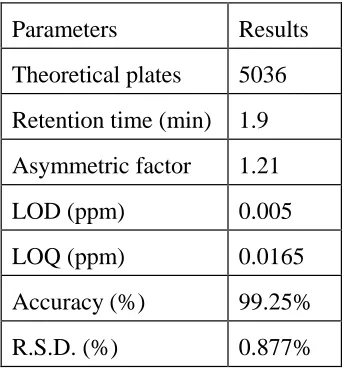
Table 2: System suitability and validation parameters
Parameters Results
Theoretical plates 5036
Retention time (min) 1.9
Asymmetric factor 1.21
LOD (ppm) 0.005
LOQ (ppm) 0.0165
Accuracy (%) 99.25%
R.S.D. (%) 0.877%
Table 3: Assay results of formulation
Formulatio Labelled claim % of Zolmitriptan in
N.Usha Rani et al. / Pharmacophore 2011, Vol. 2 (3), 195-200
Figure1: Molecular structure of Zolmitriptan
Figure2: HPLC chromatogram of Zolmitriptan formulation
N.Usha Rani et al. / Pharmacophore 2011, Vol. 2 (3), 195-200
Figure3: Calibration curve
REFERENCES
1. (2009), “Top 200 generic drugs by retail dollars (2008)”, Drug Topics.
2. Newman, LC and Lipton, RB (2001), “Migraine MLT-Down: An Unusual Presentation of Migraine in Patients With Aspartame-Triggered
Headaches”, Headache: the Journal of Head and Face Pain, 41 (9), 899-901.
3. MacGregor, EA (1998), “Zolmitriptan clinical studies”, Drugs Today, 34 (12), 1027-1033., M.K. Srinivasu B. Mallikarjuna Rao, G. Sridhar, P. Rajender Kumar, K.B. Chandrasekhar and Aminul,Islam (2005), “A
potential impurities”, Journal of Pharmaceutical and Biomedical Analysis,Vol. 37( 3), 453-460
4. B, Mallikarjuna Rao ; MK, Srinivasu; G, Sridhar and Aminul, Islam(2005), A stability indicating LC method for Zolmitriptan”,
Journal of Pharmaceutical and BiomedicalAnalysis,Vol. 39,(3-4), 15 503- 509.
5. Journal of Pharmaceutical and Biomedical Analysis
Volume 39, Issues 3-4, 15 September 2005, Pages 796-800 A validated chiral LC method for the enantiomeric separation of Zolmitriptan key intermediate, ZTR-5M.K. Srinivasu, B. Mallikarjuna Rao, G. Sridhar, K.B. Chandrasekhar, and P. Rajender Kumar 6. R,Navaneeswari and P Raveendra, Reddy
(2011), “A New Stability Indicating RP- HPLC Method for Related Substances in Zolmitriptan”, African Journal Of Scincetific Research, Vol. 4,(1).