www.theoryofcomputing.org
Quantum Interactive Proofs and
the Complexity of Separability Testing
Gus Gutoski
∗Patrick Hayden
†Kevin Milner
‡Mark M. Wilde
§Received September 8, 2013; Revised January 27, 2015; Published March 26, 2015
Abstract: We identify a formal connection between physical problems related to the
detection of separable (unentangled) quantum states and complexity classes in theoretical computer science. In particular, we show that to nearly every quantum interactive proof complexity class (includingBQP,QMA,QMA(2), andQSZK), there corresponds a natural separability testing problem that is complete for that class. Of particular interest is the fact that the problem of determining whether an isometry can be made to produce a separable state is eitherQMA-complete orQMA(2)-complete, depending upon whether the distance between quantum states is measured by the one-way LOCC norm or the trace norm. We obtain strong hardness results by employing prior work on entanglement purification protocols to prove that for eachn-qubit maximally entangled state there exists a fixed one-way LOCC measurement that distinguishes it from any separable state with error probability that decays exponentially inn.
ACM Classification:F.1.3
AMS Classification:68Q10, 68Q15, 68Q17, 81P68
Key words and phrases: quantum entanglement, quantum complexity theory, quantum interactive
proofs, quantum statistical zero knowledge, BQP, QMA, QSZK, QIP, separability testing
∗Supported by Government of Canada through Industry Canada, the Province of Ontario through the Ministry of Research and Innovation, NSERC, DTO-ARO, CIFAR, and QuantumWorks.
†Supported by Canada Research Chairs program, the Perimeter Institute, CIFAR, NSERC and ONR through grant N000140811249. The Perimeter Institute is supported by the Government of Canada through Industry Canada and by the Province of Ontario through the Ministry of Research and Innovation.
‡Supported by NSERC.
1
Introduction
Certain families of decision problems have proven to be particularly versatile and expressive in complexity theory, in the sense that slightly varying their formulation can tune the difficulty of the problems through a wide range of complexity classes. Adding quantifiers to the problem of evaluating a Boolean formula, for example, brings the venerable satisfiability problem up through the levels of the polynomial hierarchy [68] all the way up toPSPACE[67], at each level providing a decision problem complete for the associated complexity class. Moreover, adding limitations to the format of the Boolean satisfiability problem gives decision problems complete for a variety of more limited classes.1 Likewise, in the domain of interactive proofs [4,38,5,71,54,73], problems based on distinguishing probability distributions or quantum states, depending on the setting, arise very naturally.
In the domain of quantum information theory, quantum mechanical entanglement is responsible for many of the most surprising and, not coincidentally, useful potential applications of quantum infor-mation [49], including quantum teleportation [9], super-dense coding [13], enhanced communication capacities [11,12,28], device-independent quantum key distribution [35,69], and communication com-plexity [25]. Thus, deciding whether a given quantum state is separable (unentangled) or entangled is a prominent and long-standing question that frequently resurfaces in different forms. The complexity of determining whether a given mixed quantum state is separable or entangled therefore arose early and was resolved: the problem isNP-complete with respect to Cook reductions when the state is specified as a density matrix and one demands an error tolerance no smaller than an inverse polynomial in the dimension of the matrix [39,37].
From a physics or engineering perspective, however, it is often more natural to specify a quantum state as arising from a sequence of specified operations (as in a quantum circuit) or the application of a local Hamiltonian [59,14]. This formulation of the quantum separability problem was studied by three of us [46], wherein it was shown that the problem is hard for bothQSZKandNP, even when one demands that no-instances be far from separable in the so-called “one-way LOCC distance” (and not merely in trace distance). It was also shown that this one-way LOCC variant of the problem admits a two-message quantum interactive proof, putting it inQIP(2). The exact complexity of this problem is still open.
Informally, theone-way LOCC distanceis an operationally motivated distance measure for bipartite quantum states [62]. Given two statesρ,ξ of registersAB, the one-way LOCC normkρ−ξk1- LOCC
dictates the maximum probability with whichρcould be distinguished fromξby two parties acting locally
on registersA,Band endowed with classical communication fromAtoB. It is clear that the one-way LOCC distance is no larger than the trace distance, and it can sometimes be much smaller [34,29,30,62]. In one of the earliest examples [34], it was found that maximally mixed states on the symmetric and antisymmetric subspace of two systems of dimensiondhave a 1-LOCC distance no larger thanO(1/d)
while their trace distance is maximal, given that these states are orthogonal. SeeSection 2.4for details. In this paper, we explore several variations on the complexity of determining whether a state specified by a quantum circuit is separable, or whether a channel specified by a quantum circuit can be made to produce a separable output state. The properties we vary include the following:
1. Allowing arbitrary mixed states versus restricting attention to pure states.
2. Allowing arbitrary channels versus restricting attention to isometric channels.
3. We compare the difficulty of deciding whether entanglement is present (separable versus entangled states) with the difficulty of identifying any correlation whatsoever (product versus non-product states).
4. Measuring distance between quantum states using the trace norm or the so-called “one-way LOCC norm” of [62].
We study seven different combinations of these properties, obtaining problems that are complete for four different complexity classes based on quantum interactive proofs:BQP,QMA,QMA(2), andQSZK. Our study applies to multipartite states and channels, though only bipartite states and channels are required for the hardness results. We obtain strong hardness results as a corollary of a theorem establishing the existence of a fixed one-way LOCC measurement that successfully distinguishes a givenn-qubit maximally entangled state from any separable state with error probability that decays exponentially in n. (Theorem 3.1ofSection 3.) It appears that this observation has not yet been made explicitly in the literature, though it is implied by prior results on entanglement purification protocols [10,7,3,43]. We provide a new proof.
Outline of paper.A detailed list of our complexity theoretic results is given inFigure 1ofSection 1.1. A summary of relevant concepts such as the one-way LOCC distance, various complexity classes, the permutation and swap tests is given inSection 2. Our strong lower bound on the one-way LOCC distance between maximally entangled and separable states is proven inSection 3. The completeness results are presented inSections 4–7. InSection 9we discuss how these completeness results provide operational interpretations for several geometric measures of entanglement discussed in [75,23] and references therein. Finally, we conclude inSection 11with a summary of our results and a discussion of directions for future research.
1.1 Overview of results
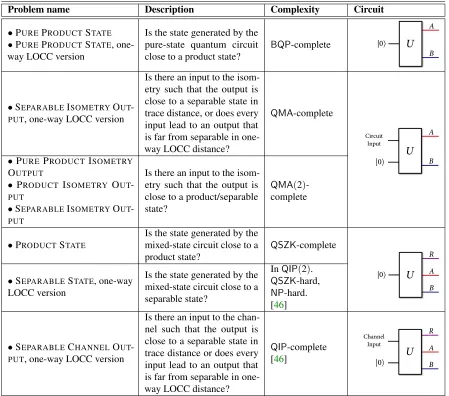
Figure 1gives a brief description of each problem and provides a concise summary of our results. Below we give more details of our results along with their relation to prior results in the literature:
1. PURE PRODUCT STATE is BQP-complete, as is the one-way LOCC version of the problem. (Theorem 4.2 ofSection 4.) Membership inBQPfollows from the soundness of the “product test” [44]. Hardness of the one-way LOCC version follows from an application ofTheorem 3.1.
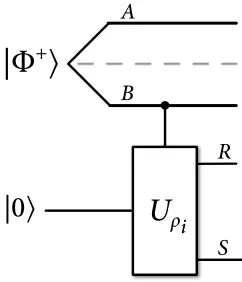
3. PUREPRODUCTISOMETRYOUTPUT, PRODUCTISOMETRYOUTPUT, and SEPARABLE ISOME-TRYOUTPUTareQMA(2)-complete. (Theorem 6.2andCorollary 6.9ofSection 6.) Membership of PUREPRODUCTISOMETRYOUTPUTinQMA(2)follows from a simple application of the swap test combined with the collapseQMA(k) =QMA(2)[44]. Hardness is the result of a novel circuit gadget (Figure 4). Completeness for the other two problems follows by an equivalence to PURE PRODUCTISOMETRY(Section 6.3).
4. PRODUCT STATE is QSZK-complete. (Theorem 7.2 ofSection 7.) The result follows by an equivalence with theQSZK-complete problem QUANTUMSTATESIMILARITY[70,74].
5. The one-way LOCC version of SEPARABLESTATEis inSQG, a competing-provers class known to coincide withPSPACE[41]. (Proposition 8.2ofSection 8.) As mentioned previously, this problem is already known to be contained inQIP(2)[46], which is a subset ofPSPACE[51,50]. Thus, this new bound is not a complexity-theoretic improvement over prior work.
However, it is interesting that this problem admits a succinct quantum witness in support of separability, provided that the verifier is granted the additional ability to query a second, competing prover in his effort to check the veracity of the first prover’s purported witness. By contrast, the two-message single-prover quantum interactive proof of [46] depends critically upon the ability of the prover to apply achannelin support of separability.
2
Preliminaries
This section summarizes some facts about quantum information and complexity theory relevant for the rest of the paper. Familiarity with both fields of study is assumed; our primary goal here is to establish notation and terminology. Some references giving background on these topics are [63,78,79] and [73,1].
2.1 Registers, states, separable states
A register is a finite-level quantum system, which is implicitly identified with a finite-dimensional complex Euclidean space. Registers are denoted with Roman capital lettersA,B, . . .. Thestateof a register is described by adensity matrix, which is a positive semidefinite matrixρwith Tr(ρ) =1. Apure
stateis a rank-one density matrix. Pure states can be written in standard bra-ket notationρ=|ψihψ|for
some unit vector|ψi. It is common practice to refer to unit vectors|ψias pure states. The Greek letters φ,ψ are reserved for pure states and we often abbreviate|ψihψ|toψ.
A multipartite state ρA1···Al is aproduct state if ρA1···Al =ρA1⊗ · · · ⊗ρAl for statesρA1, . . . ,ρAl of
registersA1, . . . ,Al, respectively. A state isseparableif it can be written as a probabilistic mixture of
product states [77]. That is, a multipartite stateρA1···Al is said to beseparableif it admits a decomposition
of the following form:
ρA1···Al =
∑
y∈Y
pY(y)σA1,y
1 ⊗ · · · ⊗σ l,y
Al , (2.1)
for collections {σA1,y
1 }, . . . ,{σ l,y
Al } of quantum states and some probability distribution pY(y) over an
Problem name Description Complexity Circuit
•PUREPRODUCTSTATE
•PUREPRODUCTSTATE, one-way LOCC version
Is the state generated by the pure-state quantum circuit close to a product state?
BQP-complete
A
B
U |0⟩
•SEPARABLEISOMETRYOUT
-PUT, one-way LOCC version
Is there an input to the isom-etry such that the output is close to a separable state in trace distance, or does every input lead to an output that is far from separable in one-way LOCC distance?
QMA-complete A B U |0⟩ Circuit Input
• PUREPRODUCT ISOMETRY
OUTPUT
• PRODUCT ISOMETRY OUT
-PUT
•SEPARABLEISOMETRYOUT
-PUT
Is there an input to the isom-etry such that the output is close to a product/separable state?
QMA(2) -complete
•PRODUCTSTATE
Is the state generated by the mixed-state circuit close to a product state? QSZK-complete R A B U |0⟩
•SEPARABLESTATE, one-way
LOCC version
Is the state generated by the mixed-state circuit close to a separable state?
InQIP(2).
QSZK-hard,
NP-hard. [46]
•SEPARABLECHANNELOUT
-PUT, one-way LOCC version
Is there an input to the chan-nel such that the output is close to a separable state in trace distance or does every input lead to an output that is far from separable in one-way LOCC distance?
QIP-complete [46] R A B U |0⟩ Channel Input
decomposition of any separable state in terms of pure product states:
ρA1···A`=
∑
z∈ZpZ(z)|ψ1,zihψ1,z|A1⊗ · · · ⊗ |ψ `,zih
ψ`,z|A`. (2.2)
A state isentangledif it is not separable.
In the multipartite case it is often necessary to specify thecutorpartitionof the registers relative to whichρis product or separable. For example, a stateρ of registersABCDcould be a bipartite product
state with respect to the cutAB:CD, yet it may not be a product state with respect to the tripartite cut A:B:CDor the bipartite cutAC:BD. We letSdenote the set of all separable states with respect to a given cut. Whenever the cut is not immediately clear from the context, we make it explicit with an argument—for example,S(A:B:CD).
2.2 Trace distance, fidelity
TheSchatten 1-normkXk1of a matrixX is defined as the sum of the singular values ofX. (Hereafter we refer to this norm as simply the1-norm. This norm is sometimes called thetrace normand is alternately denotedkXkTr.) The 1-norm characterizes the physically observable difference between two quantum
statesρ,ξ in the following sense: given a quantum register prepared in one of{ρ,ξ}chosen uniformly at
random, the maximum probability with which one can correctly identify the given state by a two-outcome measurement of that register is equal to 1/2+kρ−ξk1/4. The measurement that achieves this maximal
probability is known as theHelstrom measurement[48].
The quantity kρ−ξk1 is sometimes called thetrace distance betweenρ,ξ. The trace distance
between two quantum statesρ,ξ is given by the following variational characterization:
kρ−ξk1=2 max
0ΠITr(Π(ρ−ξ)), (2.3)
where the maximizingΠ? leads to the Helstrom measurement{Π?,I−Π?}. A straightforward conse-quence of (2.3) is that if two states are close in trace distance then they must have similar measurement statistics. In particular, for all measurement operators 0ΠIit holds that
Tr(Πρ)≥Tr(Πξ)−1
2kρ−ξk1. (2.4)
The trace distancekψ−φk1between two pure states|ψi,|φiis related to the inner producthψ|φi
by the formula
|hφ|ψi|2=1− kψ−φk21/4. (2.5) The following implication holds for any pure statesφ,ψ and anyε∈[0,1]:
|hφ|ψi|2≥1−ε =⇒ kφ−ψk1≤2
√
ε. (2.6)
Thefidelityis a pseudodistance measure for quantum states given by
F(ρ,ξ) =
√
ρ
p
ξ
2
for all density matricesρ,ξ.Uhlmann’s Theoremasserts that the fidelity between two statesρ,ξ is the
optimal squared overlap between purifications ofρ,ξ:
F(ρ,ξ) = max
|φρi,|φσi
|hφρ|φσi|
2. (2.8)
Uhlmann’s Theorem gives the fidelity an operational interpretation as the maximum probability with which a purification ofρwould pass a test for being a purification ofσ. The fidelity and trace distance
are related by the Fuchs-van-de-Graaf inequalities [36]:
1−pF(ρ,ξ)≤1
2kρ−ξk1≤
p
1−F(ρ,ξ). (2.9)
2.3 Permutation test, swap test
Thepermutation testis a quantum circuit applied to a multi-register systemA1, . . . ,Anwith the property
that the probability of passing is equal to the shadow of the state on the symmetric subspace of the complex Euclidean space associated withA1, . . . ,An(i. e., Tr(ΠAsym1,...,Anρ)) [53] (see also [6,52]). Furthermore, if
the test passes, then the resulting state of those registers is supported on the symmetric subspace. The test consists of the following steps:
1. Prepare ann!-dimensional ancillary registerW in a uniform superposition of alln! computational basis states. (This is accomplished by applying the quantum Fourier transform to the all-zeros state |0iofW.)
2. Apply a controlled-permutation unitary that permutes registersA1, . . . ,Anaccording to the
permu-tation indexed in registerW.
3. Invert the quantum Fourier transform onW and measure that register in the computational basis. Accept if and only if the measurement outcome is all zeros.
A special case of the permutation test forn=2 is known as the swap test [20]. (In this case the ancillary registerWis just a single qubit and the quantum Fourier transform is just the standard Hadamard gate.) The swap test has the powerful property that if registersA1A2are prepared in a pure product state |ψi|φithen the swap test passes with probability
1 2+
1
2|hψ|φi|
2=1−1
8kψ−φk
2
1. (2.10)
Thus, with repetition, the swap test can be used to estimate the distance between any two unknown pure states.
2.4 One-way LOCC distance
one-way LOCC norm[62]. For each matrixX acting on the complex Euclidean space associated with registersAB, the one-way LOCC normkXk1- LOCCofX is defined by
kXk1- LOCC=max
ΛB→M
k(IA⊗ΛB→M)(X)k1, (2.11)
where the maximization is over allquantum-to-classicalchannelsΛB→M. These are the channels that
measure the contents of registerBand store the classical outcome in a new registerM. Every such channel has the form
ΛB→M(ρ) =
∑
m
Tr(Λmρ)|mihm|, (2.12)
where{|mi}is an orthonormal basis and{Λm}forms a quantum measurement, meaning that eachΛmis
positive semidefinite and∑mΛm=I.
This definition of the one-way LOCC norm is asymmetric: one could define another norm as a maximization over measurements of registerA, and these norms are distinct. It is clear from the definition that
kXk1- LOCC≤ kXk1, (2.13)
because the one-way LOCC measurements are a subset of all measurements.
The one-way LOCC norm extends naturally to multi-register systems [56,16,19]. In particular, for each matrixX acting on the complex Euclidean space associated with registersA1· · ·A`, the`-partite one-way LOCC norm ofX is given by
kXk1- LOCC= max
ΛA2,...,ΛA`
k(IA1⊗ΛA2⊗ · · · ⊗ΛA`)(X)k1, (2.14)
where the maximization is now over quantum-to-classical channelsΛA2, . . . ,ΛAl. The interpretation
here whenX is a difference of two density matrices is that the last`−1 parties each perform a local measurement on their systems and communicate the results to the first party, who then attempts to distinguish the two states.
2.5 Quantum interactive proofs
Aquantum interactive proof consists of a conversation between a polynomial-time quantumverifierand a computationally unbounded quantumproverregarding some binary input stringx. The prover attempts to convince the verifier to acceptxand the verifier attempts to judge the veracity of the prover’s argument. A promise problemLis said to admit a quantum interactive proof withcompleteness candsoundness sif there existsc,s∈[0,1]such thatc>sand a verifier who meets the following conditions:
Completeness condition. Ifxis a yes-instance ofL, then the prover can convince the verifier to accept with probability at leastc.
The completeness and soundness parametersc,sneed not be fixed constants but may instead vary as a function of the input length|x|. If these parameters are not specified then it is assumed thatLadmits a quantum interactive proof for some choice ofc(|x|),s(|x|)for which there exists a polynomial-bounded functionp(|x|)such thatc−s≥1/p. The complexity classQIPconsists of all promise problems that admit quantum interactive proofs and is known to coincide withPSPACE[50].
Often in the study of interactive proofs the precise values ofc,sare immaterial because error-reduction procedures can be used to transform any verifier for whichc−s≥1/pinto another verifier for which ctends toward one andstends toward zero exponentially quickly in the bit length ofx. (For example, sequential repetition followed by a majority vote can be used to reduce error forQIP.) For this reason, it is typical to assume without loss of generality thatc,sare constants such as 2/3,1/3 or thatcis exponentially close to one andsis exponentially close to zero whenever it is convenient to do so. However, it is not always clear that a given complexity class is robust with respect to the choice ofc,sso it is good practice to be as inclusive as possible when defining these classes.
Interesting subclasses ofQIPare obtained by restricting the number of messages in the interaction between the verifier and prover. For each positive integerm, the classQIP(m)consists of those problems that admit a quantum interactive proof in which the verifier exchanges no more thanmmessages with the prover. It is known that three messages suffice for any quantum interactive proof, so thatQIP=QIP(3)
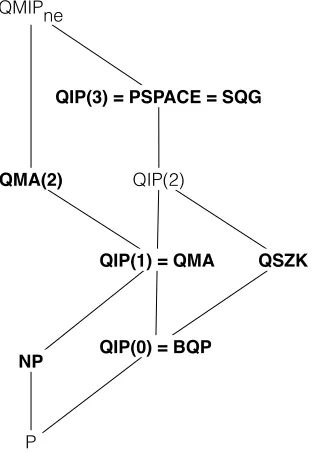
[54], leaving a hierarchy of four classes defined by quantum interactive proofs. Fundamental complexity classes such asBQPandQMAcan be written in this notation asQIP(0)andQIP(1), respectively. This hierarchy, along with other complexity classes considered in this paper (other thanQMIPne), is depicted inFigure 2. QMIPne is a class defined in [55]—it allows for multiple prover interactive proofs with
provers who do not share entanglement (clearly, this contains bothQMA(2)andQIP).
A quantum interactive proof for a promise problemLis said to bestatistical zero knowledgeif for each yes-instancexofLthe verifier learns nothing from the prover beyond the veracity of the claim “x is a yes-instance ofL.” This property is formalized via a simulation-based definition of “knowledge.” The complexity class of promise problems that admit statistical zero knowledge quantum interactive proofs is calledQSZK. We need not concern ourselves with a precise definition of this class, since our completeness results are established by equivalence to anotherQSZK-complete problem. The reader is referred to the seminal works in [70,74] for more information on statistical zero knowledge quantum interactive proofs.
Other interesting variations of the quantum interactive proof model are obtained by considering multiple cooperating or competing provers. For example, one can consider a variant ofQMAin which kdistinct and unentangled provers cooperate in order to convince the verifier to accept. The resulting complexity class is calledQMA(k)and is known to satisfyQMA(k) =QMA(2)for all integersk≥2 [44]. The only known bounds forQMA(2)are the trivial boundsQMA⊆QMA(2)⊆NEXP. Lower bounds forQMA(2)are presented in references [2,15,8,22,57,24]; upper bounds in references [18,66].
Despite the lack of any decent upper bound onQMA(2), we are aware of only two problems in
QMA(2)that are not also known to be inQMA: the pure-stateN-representability problem [58] and the separable sparse Hamiltonian problem [21]. Of these, only the latter is known to beQMA(2)-complete. The present paper gives anotherQMA(2)-complete problem inSection 6.
QMIPne
QMA(2)
QIP(3) = PSPACE = SQG
QIP(2)
QSZK QIP(1) = QMA
QIP(0) = BQP NP
P
Figure 2: The quantum interactive proof hierarchy and related classes discussed in this paper. A line denotes inclusion of the lower class in the higher class. (For example,Pis a subset ofNP.) Classes for which a separability testing problem is known to be complete are in bold type.
to convince the verifier to rejectx. As before, interesting complexity classes are obtained by restricting the number and timing of messages in the interaction between the verifier and provers. InSection 8we exhibit a protocol in which the verifier receives a single message from the yes-prover and then exchanges two messages with the no-prover. The complexity class of promise problems that admit such proofs is calledSQG(for “short quantum games”) and is known to coincide withPSPACE[41].
Each of the aforementioned complexity classes is known to be robust with respect to the choice of completeness and soundness parametersc,s, meaning that any protocol for whichcis larger thansplus an inverse polynomial in the input length can be amplified into a new protocol withcexponentially close to one andsexponentially close to zero. Error reduction forBQPfollows immediately from Chernoff-type bounds via sequential repetition followed by a majority vote. Error-reduction results forQIP,QIP(2),
QMA,QSZK,QMA(2), andSQGwere established in [54,51,61,70,44,41], respectively.2
2ThatSQGis robust with respect to error follows from the containmentsSQG(c,s)⊆PSPACEfor anyc−s>1/poly [41] andPSPACE⊆SQG(1−ε,ε)for any desired exponentially smallε[40]. However, the “error reduction procedure” induced
3
One-way LOCC distance to a separable state
In this section we prove a theorem that enables us to establish strong hardness results for various separability testing problems appearing later in the paper.
If|φiis any maximally entangled pure state of twon-qubit registersABthen
max σ∈S(A:B)
F(φ,σ) =2−n. (3.1)
A concise proof of the above equality can be found in [72, Lecture 17]. Applying the above relation and (2.9), we find the following result for the trace distance:
min σ∈S(A:B)
kφ−σk1≥2 1−2−2n. (3.2)
In fact, a much stronger statement holds: every maximally entangled state is exponentially far from separable not only in trace distance, but also in one-way LOCC distance. It appears that this observation has not yet been made explicitly in the literature, though it is implied by prior results on entanglement purification protocols [10,7,3,43]. We provide a new proof.
Theorem 3.1(Minimum one-way LOCC distance to separable). For all maximally entangled pure states
|φiof two n-qubit registers AB it holds that
min σ∈S(A:B)
kφ−σk1- LOCC≥2(1−(2/3)n). (3.3)
Moreover, this bound is witnessed by afixedone-way LOCC measurement that depends only on|φi.
Proof. LetAn:=A1· · ·Andenote Alice’snqubits, and letBn:=B1· · ·Bndenote Bob’s. By the local
uni-tary equivalence of maximally entangled states, it suffices to exhibit a fixed one-way LOCC measurement that successfully distinguishes any separable stateσAn:Bn fromnsinglets
n O
i=1 ψ−
AiBi, (3.4)
each in the state|ψ−i:= (|01i − |10i)/√2. One such scheme is as follows:
1. (Twirling) Bob selectsn2×2 unitaries{U1, . . . ,Un}at random according to the Haar measure and
applies unitaryUito hisith qubit. He reports to Alice which unitaries he selected and she applies
Ui to herith qubit. This “twirling” step has the effect of symmetrizing their state so that it is a
mixture of Bell states.
2. Fori∈ {1, . . . ,n}, Bob picks one of the following three Pauli operators
X :=
0 1 1 0
, Z:=
1 0
0 −1
, Y =iX Z (3.5)
at random. LetPidenote theith choice. He measuresPion hisith qubit. After performing the last
3. Fori∈ {1, . . . ,n}, Alice measuresPion herith qubit.
4. She accepts that the state isnsinglets if and only if all measurement outcomes are different. The main reason that this 1-LOCC distinguishing protocol works is as follows: the singlet is the only state having the property that measurement outcomes are different when performing the same von Neumann measurement on each qubit (for any von Neumann measurement). Furthermore, the maximum probability with which a separable state can pass this test is equal to 2/3, so that performingnof these tests on a separable stateσAn:Bn reduces the probability of passing the “singlet test” to(2/3)n.
We now analyze this protocol in more detail. Due to the fact that(U⊗U)|ψ−i=|ψ−ifor any 2×2
unitaryU, the first step has no effect on the singlets. Furthermore, the rest of the protocol succeeds with probability one if the state is equal tonsinglets, due to the property mentioned in the previous paragraph. So we turn to analyzing the probability of accepting if the state is in fact separable. We begin by analyzing the first “Pauli test” in steps 2-4 and find a bound on its acceptance probability. When doing so, it suffices to consider the reduced state ofσAn:Bn on systemsA1andB1, which is separable across this
cut because the original state is separable across theAn:Bncut. The initial twirling procedure transforms this separable state to the following “Werner” state:
pψ−
ψ− A1B1+
1−p 3
ψ+
ψ+ A1B1+
φ+
φ+ A1B1+
φ−
φ− A1B1
, (3.6)
such that the maximal value of p is 1/2 [49, Section VI-B-9]. (The states|ψ+iA
1B1, |φ
+i
A1B1, and |φ−iA
1B1 are the other Bell states orthogonal to|ψ
−i
A1B1.) One can check that the probability with which
each of the three other Bell states besides|ψ−iA1B1 passes the “Pauli test” on theith qubit (in steps 2-4
above) is equal to 1/3. So this implies that the maximum probability with which this Pauli test can pass is 1/2·1+1/6·(1/3+1/3+1/3) =2/3. The analysis is the same for the othern−1 Pauli tests: the only property that we use is that the reduced states on systemsAi:Bi is separable across this cut, so that
entanglement (or any correlation whatsoever) in the systemsA1· · ·AnorB1· · ·Bn(but not across the cut
An:Bn) cannot help in passing this test. This property follows from the facts that (i) the initial state is separable across theAn:Bncut, (ii) the scheme is LOCC with respect to this cut, and (iii) separability is preserved under LOCC. The result is that(2/3)nis a universal bound on the maximum probability with which any separable stateσAn:Bn can pass the overall test. By the discussion inSections 2.2and2.4, the
statement in the theorem follows.
4
P
UREP
RODUCTS
TATEis
BQP
-complete
We begin with the simplest of our separability testing promise problems—that of determining whether the state prepared by a given quantum circuit is close to a pure product state. We propose two variants of this problem, one easier than the other. We prove that the harder variant is inBQPand we prove that the easier variant isBQP-hard, establishingBQP-completeness for both problems.
Problem 4.1((α,β, `)-PUREPRODUCTSTATE3).
3If`=2 then the problem is called(
Input: A description of a quantum circuit that prepares an`-partite pure state|ψi.
Yes: |ψiisα-close to a pure product state:
min |φ1i,...,|φ`i
kψ−φ1⊗ · · · ⊗φ`k1≤α. (4.1)
No: |ψiisβ-far from any pure product state:
min |φ1i,...,|φ`i
kψ−φ1⊗ · · · ⊗φ`k1≥β. (4.2)
We define theone-way LOCC versionof(α,β, `)-PUREPRODUCTSTATEsimilarly except that the
trace norm in the specification of a no-instance is replaced with the one-way LOCC norm. The one-way LOCC version of PUREPRODUCTSTATEtrivially reduces to the trace distance version by virtue of the inequalitykXk1≥ kXk1- LOCC. The main result of this section is the following theorem:
Theorem 4.2(PUREPRODUCT STATEisBQP-complete). The following hold:
1. The trace distance version of(α,β, `)-PUREPRODUCTSTATE4is inBQPfor all`andα <β
√
11 32 .
2. The one-way LOCC version of(ε,2−ε)-BIPARTITEPUREPRODUCTSTATEisBQP-hard, even
whenε decays exponentially in the input length.
Thus, both problems areBQP-complete for all`≥2and all(α,β)with0<α<β
√
11
32 andβ <2.
4.1 Membership inBQP
Our efficient quantum algorithm for the PUREPRODUCTSTATEproblem employs theproduct test. The product test is a boolean test that takes as input two copies of an arbitrary multipartite pure state|ψi.
The closer|ψiis to a product state, the higher the probability with which the product test passes. A specification of the product test is as follows:
1. Given are two copies of an arbitrary`-partite pure state|ψi. One of these copies is contained in
registersA1, . . . ,A`and the other inB1, . . . ,B`.
2. Perform`swap tests—one for each pair of registers(Ai,Bi)fori=1, . . . , `. Accept if and only if
all the swap tests pass.
The relationship between the distance from|ψito the nearest product state and the success probability of
the product test was established in [44].
Theorem 4.3([44]). For each`-partite pure state|ψilet Ptest(ψ)denote the probability with which the
product test passes when applied to|ψiand let
1−ε= max
|φ1i,...,|φ`i
|hψ|φ1⊗ · · · ⊗φ`i|2. (4.3)
4It is implicit here and throughout the rest of the paper that the gap between
αandβ
√ 11
It holds that
1−2ε≤Ptest(ψ)≤1− 11
512ε. (4.4)
The bounds ofTheorem 4.3are easily written in terms of the trace distancetbetween|ψiand the
nearest product state via (2.5):
1−t2/2≤Ptest(ψ)≤1− 11
2048t
2. (4.5)
Armed with the product test, we now present our quantum algorithm for the PURE PRODUCT STATE problem.
Proposition 4.4. (α,β, `)-PUREPRODUCTSTATEis inBQPfor all`and allα<β
√
11 32 .
Proof. The efficient quantum algorithm for(α,β, `)-PUREPRODUCTSTATEis as follows: use the input
circuit to prepare two copies of|ψi, perform the product test, and accept if and only if the product test
passes.
If|ψiis a yes-instance then (4.5) tells us that the product test passes with probability at least 1−α2/2.
On the other hand, if|ψiis a no-instance then (4.5) tells us that the product test passes with probability
at most 1−(11/2048)β2. The algorithm witnesses membership inBQPwhenever the former quantity is
larger than the latter, which occurs wheneverα<β·
√ 11/32.
4.2 Hardness forBQP
Proposition 4.5. The one-way LOCC version of(ε,2−ε)-BIPARTITEPUREPRODUCTSTATEisBQP
-hard, even whenε decays exponentially in the input length.
Proof. LetLbe any promise problem inBQPand let{|νix}xbe a family of efficiently preparable pure
states witnessing membership ofLinBQP. By this we mean the following: for each instancexofLthe state|νxiis held in two registersDG. RegisterDis a decision qubit indicating acceptance or rejection
ofxand registerGis a garbage register that is a purifying system forD.
Suppose that the family{|νix}xhas completeness 1−δ and soundnessδ. In this proof we reduce the
arbitrary problemLto the one-way LOCC version of(α,β)-BIPARTITEPUREPRODUCTSTATEwhere
α=2
√
δ, (4.6)
β =2−22−n/2−2
√
δ, (4.7)
for any desiredn. The desired hardness result then follows by an appropriate choice ofδ,n, given that
BQP(c,s)⊆BQP(δ,1−δ)for anyδ exponentially small in the input length.
The reduction is as follows. Given an instancexofLwe produce a description of the following circuit for preparing a pure state|ψiof registersAA0BDG:
2. Perform a controlled swap gate that swaps registersA0andBwhenDis in the reject state|noiand acts as the identity otherwise.
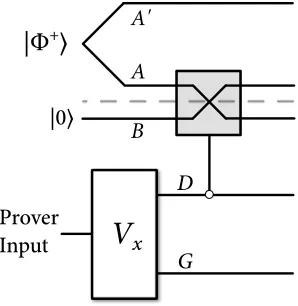
A graphical depiction of this state preparation circuit appears later in the paper as a special case of Figure 3.
Ifx is a yes-instance ofLthen|νxihas squared overlap at least 1−δ with|yesiD|ζiGfor some
state|ζi of register G. It follows that the constructed state |ψi is 2 √
δ-close in trace distance to |φ+iAA0|0iB|yesiD|ζiG, which is a product with respect to the cutAA0:BDG. So|ψiis a yes-instance of
the one-way LOCC version of(α,β)-BIPARTITEPUREPRODUCTSTATE.
Next, suppose thatxis a no-instance ofL. In this case|νxihas squared overlap at least 1−δ with
|noiD|ηiGfor some state|ηiof registerG. It follows that|ψiis 2
√
δ-close in trace distance to a state
which is in tensor product with the 2n-qubit maximally entangled state|φ+ion registersAB. By contrast,
for any product state|φiof registersAA0:BDGthe reduced state TrA0DG(φ)of registersABmust also
be a product state. Thus, it suffices to exhibit a fixed one-way LOCC measurement that successfully distinguishes any product state of registersABfromnEPR pairs with high probability. The existence of such a measurement was proved inTheorem 3.1.
We therefore have the following for any product state|φiof registersAA0:BDG:
kψ−φk1- LOCC≥TrA0DG(φ)−φ+ AB
1- LOCC−
φAB+ −TrA0DG(ψ)
1- LOCC (4.8)
≥2−22−n/2−2 √
δ, (4.9)
from which it follows that|ψiis a no-instance of the one-way LOCC version of(α,β)-BIPARTITEPURE
PRODUCTSTATE.
5
S
EPARABLEI
SOMETRYO
UTPUT(one-way LOCC version) is
QMA
-complete
In this section we proveQMA-completeness of the problem of deciding whether the isometry implemented by a given quantum circuit can be made to produce a state that is close to separable in trace distance or far from separable in one-way LOCC distance.
Problem 5.1((α,β, `)-SEPARABLEISOMETRYOUTPUT, one-way LOCC version).
Input: A description of a quantum circuit that implements an isometryU with an`-partite output systemA1· · ·A`.
Yes: There is an input stateρsuch thatUρU∗isα-close in trace distance to separable:
min
ρ σ∈S(minA1:···:A`)
kUρU∗−σk1≤α. (5.1)
No: For all input statesρ it holds thatUρU∗isβ-far in one-way LOCC distance from separable:
min
ρ σ∈Smin(A1:···:A`)
The main result of this section is the following theorem:
Theorem 5.2 (SEPARABLE ISOMETRY OUTPUT, one-way LOCC version is QMA-complete). The
following hold:
1. The one-way LOCC version of(α,β, `)-SEPARABLEISOMETRY OUTPUTis inQMAfor all`and
allα<β4/16.
2. The one-way LOCC version of(ε,2−ε)-BIPARTITE SEPARABLEISOMETRYOUTPUTisQMA -hard, even whenε decays exponentially in the input length.
Thus, the problem isQMA-complete for all`≥2, all0<α <β4/16, and allβ<2.
5.1 Containment inQMA
Our quantum witness for separability invokes the notion ofk-extendibility of separable states [76]. We therefore begin with a brief summary ofk-extendibility.
LetABbe any two registers and letB1, . . . ,Bk be registers each of the same size asB. A bipartite
stateρof registersABisk-extendibleif there exists a stateω of registersAB1· · ·Bk that is invariant under
permutations of registersB1, . . . ,Bkand consistent withρ, meaning that TrB2···Bk(ω) =ρ.
The set of allk-extendible states (with respect to a given cut of the registers) is denotedEk. It is a
basic fact that every separable state isk-extendible for allk, so thatS⊆Ek.To see this, let
ρ=
∑
i
pi|ψiihψi|A⊗ |φiihφi|B (5.3)
be any separable state of registersABand observe that
∑
i
pi|ψiihψi|A⊗ |φiihφi|⊗Bk (5.4)
is ak-extension ofρ. It is known that ifρ is not separable then there exists somek0for whichρ is not k0-extendible. Moreover, it is known thatEk+1⊆Ekfor allk, from which it follows that the setsEkform
a containment hierarchy that converges to the setSof separable states in the limitk→∞[31,32]. The notion ofk-extendibility extends naturally to multi-register systemsA1· · ·A`by imposing the extendibility condition on each individual register [33,19], though the notation is cumbersome. Formally, letAi,1, . . . ,Ai,kbe registers of the same size asAi. A stateρ of registersA1· · ·A`isk-extendible with respect toA1:· · ·:A`if there exists a global stateω of all`kregistersAi,j that is consistent withρ on
A1· · ·A`and invariant under permutations of registersAi,1, . . . ,Ai,kfor alli=1, . . . , `. (Observe that there
are`·k! such permutations.)
Brandão and Harrow have shown that ifρ is close tok-extendible in trace distance for not-too-large
kthenρis also close to separable in one-way LOCC distance [19]. The following is a straightforward
consequence of their result.
Theorem 5.3. Let A1, . . . ,A` be registers whose total combined dimension is D. Letρ beε-far from
separable in one-way LOCC distance, so that
min σ∈S(A1:···:A`)
Then for anyδ <ε it holds thatρ isδ-far from k-extendible in trace distance, so that
min σ0∈Ek(A1:···:A`)
kρ−σ0k1≥δ, (5.6)
provided
k≥
`+4` 2logD (ε−δ)2
. (5.7)
Proof. Letσ0be anyk-extendible state withk> `. We know from [19, Theorem 2 and Corollary 8] that there is a separable stateσ00∈Ssuch that
σ0−σ00
1- LOCC≤
s
4`2logD
k−` . (5.8)
So we use this in the following chain of inequalities:
ε ≤ min
σ∈S(A1:···:A`)
kρ−σk1- LOCC (5.9)
≤ kρ−σ00k1- LOCC (5.10)
≤ kρ−σ0k1- LOCC+kσ0−σ00k1- LOCC (5.11)
≤ kρ−σ0k1+ s
4`2logD
k−` . (5.12)
Since this bound holds for anyk-extendible state, we can conclude that
ε−
s
4`2logD
k−` ≤σ0∈Ekmin(A1:···:A`)
kρ−σ0k1. (5.13)
The statement of the theorem then follows by pickingklarge enough so that
ε−
s
4`2logD
k−` ≥δ.
We now present our succinct quantum witness for the one-way LOCC version of the SEPARABLE ISOMETRYOUTPUTproblem.
Proposition 5.4. The one-way LOCC version of(α,β, `)-SEPARABLEISOMETRYOUTPUTis inQMA
for all`and allα<β4/16.
Proof. For convenience we writeA:=A1· · ·A`where the combined registerAhas dimensionD. It is helpful to label the input and output registers ofUasU:S→A. Letε>0 be such that
√
α<(β−ε)2/4.
1. Receivek`+1 registers from the prover labeledSandAij whereAij has the same size asAifor
i=1, . . . , `and j=1, . . . ,kand
k=
`+4`
2logD
ε2
. (5.14)
ApplyUto registerSto obtain registerA:=A1, . . . ,A`.
2. Perform`permutation tests: one for each group(Ai,Ai1, . . . ,Aki)ofk+1 registers. Accept if and
only if all permutation tests pass.
In what follows we use the shorthandAj :=A1j· · ·A`jfor each j∈ {1, . . . ,k}.
Suppose first thatU is a yes-instance of the problem. We show that there exists a stateρSA1···Akof the
k`+1 registersSA1· · ·Akthat causes the verifier to accept with probability at least 1−√α. To this end
we define the following symbols:
1. LetσAbe a separable state andρSbe a state of registerSsuch that
kUρSU∗−σAk1≤α, (5.15)
as promised in (5.1).
2. LetσAA1···Ak be a(k+1)-extension ofσAin registersAA1· · ·Ak. It is important that this(k+1)
-extension be taken as a convex combination of pure states as in (5.4), so that it would be accepted by the permutation test with probability one.
3. Let ˆU:SW →Adenote the unitary circuit that implementsU when the workspace registerWis initialized to|0i.
By the preservation of subsystem fidelity [51, Lemma 7.2] there exists a state ρSA1···Ak of registers
SA1· · ·Ak consistent withρSsuch that
F (Uˆ∗⊗IA1···Ak)σAA1···Ak(Uˆ⊗IA1···Ak),ρSA1···Ak⊗ |0ih0|W
=F Uˆ∗σAUˆ,ρS⊗ |0ih0|W
. (5.16) Let us argue that this stateρSA1···Akis our desired state. It follows from (2.9), (5.15), and unitary invariance
of fidelity that
1−α≤F σA,Uˆ(ρS⊗ |0ih0|W)Uˆ∗
(5.17)
=F Uˆ∗σAU,ˆ ρS⊗ |0ih0|W
. (5.18)
Applying the above and (2.9) to the right side of (5.16), we find that the quantity in (5.16) is at least 1−Uˆ∗σAUˆ −ρS⊗ |0ih0|W
1≥1−α. (5.19)
Applying (2.9) to the left side of (5.16), we find that the quantity in (5.16) is at most
1−1 4
(Uˆ∗⊗IA1···Ak)σAA1···Ak(Uˆ ⊗IA1···Ak)−ρSA1···Ak⊗ |0ih0|W 2
Combining (5.19) and (5.20) leads to the following bound:
kσAA1···Ak−(U⊗IA1···Ak)ρSA1···Ak(U∗⊗IA1···Ak)k1≤2
√
α. (5.21)
Thus,ρSA1···Ak is 2
√
α-close in trace distance to a state that is accepted by the verifier with certainty. It
then follows from (2.4) that the verifier acceptsρSA1···Ak with probability at least 1−
√
αas desired.
Now suppose thatUis a no-instance of the problem. ByTheorem 5.3and our choice ofkwe have that
min ρS
min σA∈Ek(A1:···:A`)
kUρSU∗−σAk1≥β−ε. (5.22)
We claim that an upper bound on the probability with which all the permutation tests pass is given by the maximum fidelity ofUρSU∗with ak-extendible state:
Pr[all pass]≤max ρS
max σA∈Ek
F(UρSU∗,σA). (5.23)
It follows from (2.9) that this probability is at most 1−(β−ε)2/4. We choseε so that the completeness
1−√α is larger than the soundness 1−(β−ε)2/4, from which it follows that the problem is inQMA.
We now justify the claim in (5.23) using a method similar to that in [46, Section 4]. In order to implement the permutation tests instep 2the verifier prepares a control registerCin state
|permiC:=√1 k!π
∑
∈Sk|πiC, (5.24)
which is a uniform superposition over all possible permutations ofkelements resulting from an application of the quantum Fourier transform [63] to the state|0iC, so that theCregister requiresdlog2(k!)equbits. The verifier then applies the following controlled-permutation operation:
(UΠ)AA1···AkC:=
∑
π∈Sk
Wπ
AA1···Ak⊗ |πihπ|C, (5.25)
whereWπ
AA1···Ak is a unitary operation corresponding to permutationπ. The verifier finally applies an
inverse quantum Fourier transform toC, measures it in the computational basis, and accepts if the measurement outcomes are all zeros. Letting|ψiRSA1···Akbe a purification of the prover’s input, we can
write the maximum acceptance probability of this proof system as follows:
max |ψiRSA1···Ak
h0|CQFTC−1(UΠ)AA1···AkCUS→A|ψiRSA1···Ak|permiC
2 2
= max
|ψiRSA1···Ak,|φiRAA1···Ak
h0|Chφ|RAA1···AkQFT−C1(UΠ)AA1···AkCUS→A|ψiRSA1···Ak|permiC
2
2. (5.26)
We can define a channel generated by the inverse of the verifier’s circuit conditioned on accepting as follows:
After doing so, we can apply Uhlmann’s theorem to (5.26) to rewrite the maximum acceptance probability as follows:
max ρS,σAA1···Ak
F(US→AρSUS∗→A⊗ |permihperm|C,MAA1···Ak→AC(σAA1···Ak)). (5.28)
Since the fidelity can only increase under the discarding of the control registerC,5 the maximum acceptance probability is upper bounded by the following quantity:
max ρS,σAA1···Ak
F(US→AρSUS∗→A,MAA1···Ak→A(σAA1···Ak)), (5.29)
where
MAA1···Ak→A(σAA1···Ak) =TrC{MAA1···Ak→AC(σAA1···Ak)} (5.30)
= 1
k!π
∑
∈Sk
TrA1···Ak
Wπ
AA1···AkσAA1···Ak WAAπ1···Ak
∗
,
The equation above reveals thatMAA1···Ak→A is just the channel that applies a random permutation of
theAA1· · ·Aksystems and discards the lastksystemsA1· · ·Ak. Clearly, since the channelMAA1···Ak→A
symmetrizes the state of the systemsAA1· · ·Ak, the maximum in (5.29) is achieved by a stateσAA1···Ak for
which systemsAA1· · ·Akare permutation symmetric. Thus, by recalling the definition ofk-extendibility, we can rewrite (5.29) as the maximumk-extendible fidelity ofUS→AρSUS∗→A:
max ρS,σAA1···Ak
F(US→AρSUS∗→A,MAA1···Ak→A(σAA1···Ak)) = max
ρS,σA∈Ek(A1:···:A`)
F(US→AρSUS∗→A,σA). (5.31)
This demonstrates that the maximumk-extendible fidelity is an upper bound on the maximum acceptance probability and completes our proof of the claim in (5.23).
5.2 Hardness forQMA
Proposition 5.5. The one-way LOCC version of(ε,2−ε)-BIPARTITESEPARABLEISOMETRYOUTPUT
isQMA-hard, even whenεdecays exponentially in the input length.
Proof. This proof is almost exactly the same as the proof ofProposition 4.5. The only difference is that here we must quantify over all states of a new input registerPfor each circuit. Nonetheless, we include a full proof for completeness.
Let L be any promise problem in QMA and let {Vx}x be a family of isometric verifier circuits
witnessing this fact with completeness 1−δ and soundnessδ for sufficiently smallδ to be chosen later.
Circuits in this family take the formVx:P→DG. The input registerPis supplied by the prover. The
output registerDis a decision qubit indicating acceptance or rejection ofxand the output registerGis a garbage register that holds the purification ofD.
In this proof we reduce the arbitrary problemLto the one-way LOCC version of(α,β)-BIPARTITE
SEPARABLEISOMETRYOUTPUTwhere
α=2
√
δ, (5.32)
β =2−22−n/2−2
√
δ, (5.33)
for any desiredn. The desired hardness result then follows by an appropriate choice ofδ,n.
The reduction is as follows. Given an instancexofLwe produce a description of the following isometric circuitU:P→AA0BDG:
1. Given the input registerPapply the verifier circuitVxto obtain registersDG.
2. Prepare registersAA0in a 2n-qubit maximally entangled state such asnEPR pairs, which we denote by|φ+i. Prepare registerBin then-qubit|0istate.
3. Perform a unitary conditional swap gate that swaps registersA0andBwhenDis in the reject state |noiand acts as the identity otherwise.
SeeFigure 3for a graphical depiction of this circuit.
D
G
V
x ProverInput
|Φ
+⟩
|0⟩
B A A'
Figure 3: The circuitUproduced by our reduction from an arbitrary problemL∈QMAto the one-way LOCC version of(ε,2−ε)-BIPARTITESEPARABLEISOMETRYOUTPUT. The dashed line indicates that the output registers are to be divided along the bipartite cutAA0:BDG. This construction also appears in the proof ofProposition 4.5in the special case where the prover’s input is empty.
Supposexis a yes-instance ofL and let|ϖibe a pure state of register Pthat causes the verifier
to accept with high probability, meaning that the stateVx|ϖi has squared overlap at least 1−δ with
|yesiD|ζiG for some state|ζi of register G. It follows thatU|ϖi is 2
√
δ-close in trace distance to
|φ+iAA0|0iB|yesiD|ζiG, which is a product with respect to the cutAA0:BDG, and soU is a yes-instance
of the one-way LOCC version of(α,β)-BIPARTITESEPARABLEISOMETRYOUTPUT.
Next, suppose thatxis a no-instance ofL. In this case for all input statesρ of registerPthe output
stateUρU∗ of registersAA0BDGis 2
√
maximally entangled state|φ+i on registers AB. By contrast, for any separable stateσ of registers
AA0:BDGthe reduced state TrA0DG(σ)of registersABmust also be separable. Thus, it suffices to exhibit
a fixed one-way LOCC measurement that successfully distinguishes any separable state of registersAB fromnEPR pairs with high probability. The existence of such a measurement was proved inTheorem 3.1.
We therefore have the following for any input stateρ of registerPand any separable state σ of registersAA0:BDG:
kUρU∗−σk1- LOCC≥TrA0DG(σ)−φ+ AB
1- LOCC−
φAB+ −TrA0DG(UρU∗)
1- LOCC (5.34)
≥2−22−n/2−2 √
δ, (5.35)
from which it follows thatU is a no-instance of the one-way LOCC version of (α,β)-BIPARTITE
SEPARABLEISOMETRYOUTPUT.
6
S
EPARABLEI
SOMETRYO
UTPUTis
QMA
(
2
)-complete
InSection 5we showed that the one-way LOCC version of the SEPARABLEISOMETRYOUTPUTproblem isQMA-complete. By contrast, in this section we show that the trace distance version of this problem (and some closely related variants of it) areQMA(2)-complete.
We begin by restricting attention to the problem of determining whether an isometryUdescribed by a quantum circuit can be made to produce a pure product output state from a pure input state.
Problem 6.1((α,β, `)-PUREPRODUCTISOMETRYOUTPUT).
Input: A description of a quantum circuit that implements an isometryU with an`-partite output systemA1· · ·A`.
Yes: There is an input state|ψisuch thatU|ψiisα-close to a pure product state:
min |ψi
min |φ1i,...,|φ`i
kUψU∗−φ1⊗ · · · ⊗φ`k1≤α. (6.1)
No: For all input states|ψiit holds thatU|ψiisβ-far from a pure product state:
min |ψi
min |φ1i,...,|φ`i
kUψU∗−φ1⊗ · · · ⊗φ`k1≥β. (6.2)
The main result of this section is the following theorem:
Theorem 6.2(PUREPRODUCT ISOMETRYOUTPUTisQMA(2)-complete). The following hold:
1. (α,β, `)-PUREPRODUCTISOMETRYOUTPUTis inQMA(2)for all`and allα <β.
2. (ε,2−ε)-BIPARTITEPUREPRODUCTISOMETRYOUTPUTisQMA(2)-hard, even whenε decays
exponentially in the input length.
6.1 Containment inQMA(2)
Proposition 6.3. (α,β, `)-PUREPRODUCTISOMETRYOUTPUTis inQMA(2)for all`and allα<β. Proof. We prove that the problem is inQMA(`+1), from which it follows that the problem is also in
QMA(2)via the main result of [44]. The verifier witnessing membership of the problem inQMA(`+1)
is as follows:
1. Receive an input state|ψifrom one of the provers and a candidate product state|φ1i ⊗ · · · ⊗ |φ`i from the remaining`provers.
2. ApplyU to the input. Perform a swap test betweenU|ψiand|φ1i ⊗ · · · ⊗ |φ`i. Accept if and only if the swap test passes.
IfUis a yes-instance then the provers can cause the verifier to accept with probability at least 1−α2/8
by an appropriate choice of states|ψi,|φ1i, . . . ,|φ`i. It follows from a standard convexity argument that the provers achieve their maximum probability of success for the swap test when they each send the verifier a pure state, so we assume that they do so without loss of generality. So ifU is a no-instance then the verifier will accept with probability at most 1−β2/8 regardless of which states the provers send to
the verifier. Asα<β, there is a gap between completeness and soundness for this verifier.
6.2 Hardness forQMA(2)
Proposition 6.4. (ε,2−ε)-BIPARTITEPUREPRODUCT ISOMETRYOUTPUTisQMA(2)-hard, even
whenε decays exponentially in the input length.
Proof. LetLbe any promise problem inQMA(2)and let{Vx}xbe a family of unitary verifier circuits
(indexed by instancesxofL) witnessing this fact with completeness 1−δ and soundnessδ for sufficiently smallδ to be chosen later. Circuits in this family take the formVx:ABW→DG. Such a verifier circuitVx
is depicted inFigure 4(a). The input registersA,Bare supplied by the two provers and the input register Wis a workspace register initialized to the|0istate. The output registerDis a decision qubit indicating acceptance or rejection ofxand the output registerGis a garbage register that consists of the remaining qubits upon whichVxacts.
In this proof we reduce the arbitrary problemLto(α,β)-BIPARTITEPURE PRODUCTISOMETRY OUTPUTwhere
α =2
√
δ, (6.3)
β =2
r
1−√δ+2−n/2
2
, (6.4)
for any desiredn. The desired hardness result then follows by an appropriate choice ofδ,n.
The reduction is as follows. Given an instancexofLwe produce a description of the following isometric circuitU:G→ABCC0W:
D
G
V
x|0⟩ Prover 1 Input
Prover 2 Input
A
B
W
(a) AQMA(2)verifier.
D
G
|1⟩
|Φ
+⟩
A
B
W C' C
V
x†(b) The circuit produced by our reduction.
Figure 4: (a) A unitary verifier circuitVxfor an arbitrary verifier witnessing membership ofLinQMA(2)
on inputx. (b) The circuitUproduced by our reduction. Dashed lines indicate that the output registers are to be divided along the bipartite cutA:BCC0W.
2. Prepare registersCC0 in a 2n-qubit maximally entangled state such asn EPR pairs, which we denote by|φ+i.
3. Perform a unitary conditional swap gate that swaps registersAandCwhenWis orthogonal to the |0istate and acts as the identity otherwise. (Here we implicitly pad the registerAwith|0iqubits so as to have the same size asC.)
SeeFigure 4(b) for a graphical depiction of this circuit.
Let us argue that this construction has the claimed properties. Suppose first thatxis a yes-instance ofLand let|φiA|ϕiBbe a pure product state of registersABthat causes the verifier to accept with high
probability. That is, the stateVx|φiA|ϕiB|0iW has squared overlap at least 1−δ with|yesi|ψifor some
state|ψi of registerG. ThusU|ψiis 2
√
δ-close in trace distance to|φiA|ϕiB|φ+iCC0|0iW, which is
a product with respect to the cutA:BCC0W, and soU is a yes-instance of (α,β)-BIPARTITE PURE
PRODUCTISOMETRYOUTPUT.
Next, suppose thatxis a no-instance ofL. Fix any pure input state|ψifor registerGand observe that
U|ψi=Π0U|ψi+ (I−Π0)U|ψi (6.5)
whereΠ0=|0ih0|W denotes the projection onto the|0istate for registerW. From the definition of the
circuitUit is clear that we may write
Π0U|ψi=Π0(Vx∗|yesi|ψi)⊗ |φ+iCC0 (6.6)
=|ζABi|0iW|φ+iCC0 (6.7)
(I−Π0)U|ψi=SwapAC0 (I−Π0)(Vx∗|yesi|ψi)⊗ |φ+iCC0 (6.8)
for some choice of subnormalized pure states|ζABiand|ξBC0Wiof registersABandBC0W, respectively.
Then for any pure product state|φiof registersA:BCC0W it holds that |hφ|U|ψi| ≤max
|φ0i
hφ0|Π0U|ψi
+max
|φ00i
hφ00|(I−Π0)U|ψi
(6.10)
where the maxima on the right side are also over product states|φ0i,|φ00iof registersA:BCC0W.
First, let us bound the maximum over|φ0i. It is clear from (6.7) that this maximum is achieved by
some|φ0iof the form
|φ0i=|φiA|ϕiB|0iW|φ+iCC0, (6.11)
in which case we have
hφ0|Π0U|ψi
=|hφ|Ahϕ|Bh0|WVx∗|yesi|ψi| ≤
√
δ (6.12)
where the inequality follows from the assumption thatxis a no-instance ofL.
Next, let us bound the maximum over|φ00i. Since(I−Π0)U|ψiis maximally entangled on registers
AC, its squared inner product with any product state|φ00iis at most 2−nas observed in (3.1) ofSection 3. We have thus shown that
max |ψi
max
product|φi
|hφ|U|ψi|2≤
√
δ+2−n/2
2
(6.13) and consequently
min |ψi
min
product|φi
kUψU∗−φk1≥2
r
1−√δ+2−n/2
2
. (6.14)
We have thus shown thatU is a no-instance of(α,β)-BIPARTITEPUREPRODUCTISOMETRYOUTPUT.
6.3 Equivalence of separability testing problems
We also consider two variants of PUREPRODUCTISOMETRYOUTPUT(Problem 6.1) in which the task is to determine whether an isometryUcan be made to produce a (not necessarily pure) product state or a separable state. WhereasProblem 6.1restricts attention only to pure input states, in the following variants of the problem we also allow arbitrary mixed state inputs. Formal specifications of these two variants of Problem 6.1are given below.
Problem 6.5((α,β, `)-PRODUCTISOMETRYOUTPUT).
Input: A description of a quantum circuit that implements an isometryU with an`-partite output systemA1· · ·A`.
Yes: There is an input stateρsuch thatUρU∗isα-close to a product state:
min ρ σ1min,...,σ`
kUρU∗−σ1⊗ · · · ⊗σ`k1≤α. (6.15)
No: For all input statesρit holds thatUρU∗isβ-far from a product state:
min ρ σmin1,...,σ`
Problem 6.6((α,β, `)-SEPARABLEISOMETRYOUTPUT).
Input: A description of a quantum circuit that implements an isometryU with an`-partite output systemA1· · ·A`.
Yes: There is an input stateρsuch thatUρU∗isα-close to a separable state:
min
ρ σ∈S(minA1:···:A`)
kUρU∗−σk1≤α. (6.17)
No: For all input statesρit holds thatUρU∗isβ-far from separable:
min
ρ σ∈S(minA1:···:A`)
kUρU∗−σk1≥β. (6.18)
We now argue that, for each`, these problems are equivalent to one another for a wide range of choices of(α,β). These equivalences are corollaries of the following proposition, which relates minimal
distance from separable to minimal distance from pure product.
Proposition 6.7(Separable-to-pure product reduction). Let U be an isometry with an`-partite output system A1· · ·A`and suppose that there is an input stateρ such that UρU∗isδ-close to some separable
stateσ∈S(A1:· · ·:A`):
kUρU∗−σk1≤δ. (6.19)
Then there is a pure input state|ψisuch that UψU∗is4 √
δ-close to some pure product state|φ1i ⊗ · · · ⊗
|φ`i:
kUψU∗−φ1⊗ · · · ⊗φ`k1≤4
√
δ. (6.20)
Proof. Let
σ=
∑
x
pxφ1x⊗ · · · ⊗φ`x (6.21) be a decomposition ofσas a probabilistic mixture of pure product states and let
|ζi=
∑
x
√
px|xiR⊗ |φ1xi ⊗ · · · ⊗ |φ`xi (6.22)
be a purification ofσon registersRA1· · ·A`.
LetSdenote the input register forU. It follows from (2.9) and Uhlmann’s Theorem that there is a purification|ψiofρ on registersRSwith
kUψU∗−ζk1≤2
√
δ. (6.23)
Write|ψias
|ψi=
∑
x
√
qx|xiR⊗ |ψxi (6.24)
for some probability vectorqand states{|ψxi}x(not necessarily orthogonal). Apply a dephasing channel
in the basis{|xi}xon registerRand use contractivity of trace norm under quantum channels to obtain
kUψU∗−ζk1≥
∑
x
qx|xihx| ⊗UψxU∗−
∑
xpx|xihx| ⊗φ1x⊗ · · · ⊗φ x
` 1
Combining this bound with the triangle inequality, we have
∑
x
pxkUψxU∗−φ1x⊗ · · · ⊗φ`xk1 (6.26)
=
∑
xpx|xihx| ⊗(UψxU∗−φ1x⊗ · · · ⊗φ x `) 1 (6.27) ≤
∑
xqx|xihx| ⊗UψxU∗−
∑
xpx|xihx| ⊗UψxU∗ 1 (6.28) +
∑
xqx|xihx| ⊗UψxU∗−
∑
xpx|xihx| ⊗φ1x⊗ · · · ⊗φ x ` 1 (6.29) ≤4 √
δ. (6.30)
Since this inequality holds for a convex combination over terms indexed byx, it must also hold for at least one choice ofψx,φ1x, . . . ,φ`x.
Corollary 6.8(Equivalence of problems). The following hold for all`and allα <β:
1. Both(α,β, `)-PRODUCT ISOMETRY OUTPUTand(α,β, `)-SEPARABLEISOMETRYOUTPUT
trivially reduce to(4√α,β, `)-PUREPRODUCTISOMETRYOUTPUT.
2. Conversely,(α,β, `)-PURE PRODUCTISOMETRYOUTPUTtrivially reduces to both(α,β2/16, `)
-PRODUCTISOMETRYOUTPUTand(α,β2/16, `)-SEPARABLEISOMETRYOUTPUT.
Proof. By definition, no-instances of both(α,β, `)-PRODUCTISOMETRYOUTPUTand(α,β, `)
-SEP-ARABLE ISOMETRYOUTPUTare also no-instances of(4√α,β, `)-PUREPRODUCTISOMETRY OUT-PUT. ByProposition 6.7, yes-instances of both(α,β, `)-PRODUCTISOMETRYOUTPUTand(α,β, `)
-SEPARABLEISOMETRY OUTPUTare also yes-instances of(4√α,β, `)-PURE PRODUCT ISOMETRY
OUTPUT.
By definition, yes-instances of(α,β, `)-PURE PRODUCT ISOMETRYOUTPUTare also yes-instances
of both(α,β2/16, `)-PRODUCTISOMETRYOUTPUTand(α,β2/16, `)-SEPARABLEISOMETRY
OUT-PUT. By the contrapositive ofProposition 6.7, no-instances of(α,β, `)-PUREPRODUCT ISOMETRY OUTPUTare also no-instances of both(α,β2/16, `)-PRODUCTISOMETRYOUTPUTand(α,β2/16, `)
-SEPARABLEISOMETRYOUTPUT.
Corollary 6.9(QMA(2)-completeness of equivalent problems). The following hold: 1. Problems 6.5and6.6are inQMA(2)for all`and allα<β2/16.
2. These two problems areQMA(2)-hard for all`≥2and all(α,β) = (ε,1/4−ε), even whenε
decays exponentially in the input length.
Thus, these two problems areQMA(2)-complete for all`≥2if both0<α <β2/16andβ<1/4.
Remark 6.10. The fact that Problems 6.5 and 6.6are QMA(2)-hard only for (α,β) = (ε,1/4−ε)
instead of the best possible(ε,2−ε)is an artifact ofProposition 6.7. The best possible hardness result
would be obtained if the bound inProposition 6.7could somehow be improved from 4 √
δ to √
7
P
RODUCTS
TATEis
QSZK
-complete
In this section we proveQSZK-completeness of the problem of determining whether the state prepared by a given quantum circuit is close to a product state.
Problem 7.1((α,β)-PRODUCTSTATE).
Input: A description of a quantum circuit that prepares an`-partite mixed stateρ.
Yes: ρ isα-close to a product state:
min ρ σmin1,...,σ`
kρ−σ1⊗ · · · ⊗σ`k1≤α. (7.1)
No: ρ isβ-far from product:
min ρ σ1min,...,σ`
kρ−σ1⊗ · · · ⊗σ`k1≥β. (7.2)
The main result of this section is the following theorem:
Theorem 7.2(PRODUCTSTATEisQSZK-complete). The following hold:
1. (α,β, `)-PRODUCTSTATEis inQSZKfor all`and allα<β2/(`+1).
2. (ε,2−ε)-BIPARTITEPRODUCTSTATEisQSZK-hard, even whenε decays exponentially in the
input length.
Thus, the problem isQSZK-complete for all`≥2and all0<α <β2/(`+1)andβ <2.
This result is proven by establishing equivalence between the PRODUCT STATEproblem and the QUANTUMSTATESIMILARITYproblem, which is defined as follows:
Problem 7.3((α,β)-QUANTUMSTATESIMILARITY).
Input: Descriptions of two quantum circuits that prepare mixed statesρ0,ρ1.
Yes: ρ0andρ1areα-close:kρ0−ρ1k1≤α.
No: ρ0andρ1areβ-far apart:kρ0−ρ1k1≥β.
Problem 7.3is known to beQSZK-complete. Specifically,(α,β)-QUANTUMSTATESIMILARITYis contained inQSZKfor allα<β2and(ε,2−ε)-QUANTUMSTATESIMILARITYisQSZK-hard, even
whenε decays exponentially in the input length [70,74]. Thus,Theorem 7.2can be proved by reducing
Problems 7.1and7.3to each other.
7.1 Containment inQSZK
Our reduction from PRODUCTSTATEto QUANTUMSTATESIMILARITYemploys the fact that ifρis
close to a product state thenρ is also close to the product of its reduced states. We are not aware of an
Lemma 7.4(Approximation by a product of reduced states). Letρbe a state of registers A1, . . . ,A`and suppose there is a product stateσ1⊗ · · · ⊗σ`with
kρ−σ1⊗ · · · ⊗σ`k1≤α. (7.3)
Then it follows that
kρ−ρA1⊗ · · · ⊗ρA`k1≤(`+1)α (7.4)
whereρAi denotes the reduced state ofρon register Aifor i=1, . . . , `.
Proof. By the triangle inequality we have
kρ−ρA1⊗ · · · ⊗ρA`k1≤ kρ−σ1⊗ · · · ⊗σ`k1+kσ1⊗ · · · ⊗σ`−ρA1⊗ · · · ⊗ρA`k1. (7.5)
By assumption the first term on the right is no larger thanα. For the second term, another application of the triangle inequality yields
kσ1⊗ · · · ⊗σ`−ρA1⊗ · · · ⊗ρA`k1 (7.6)
≤ kσ1⊗ · · · ⊗σ`−ρA1⊗σ2⊗ · · · ⊗σ`k1+kρA1⊗σ2⊗ · · · ⊗σ`−ρA1⊗ · · · ⊗ρA`k1 (7.7) =kσ1−ρA1k1+kσ2⊗ · · · ⊗σ`−ρA2⊗ · · · ⊗ρA`k1. (7.8)
By the contractivity of the trace norm under partial trace we have
kσi−ρAik1≤ kσ1⊗ · · · ⊗σ`−ρk1≤α (7.9)
for eachi=1, . . . , `. The lemma then follows by applying (7.6)-(7.8) inductively.
We are now ready to reduce PRODUCTSTATEto QUANTUMSTATESIMILARITY. Proposition 7.5. (α,β, `)-PRODUCTSTATEis inQSZKfor all`and allα <β2/(`+1).
Proof. We reduce(α,β, `)-PRODUCTSTATEto((`+1)α,β)-QUANTUMSTATESIMILARITY. It then
follows that(α,β, `)-PRODUCTSTATEis inQSZKwheneverα<β2/(`+1)as desired.
The reduction is as follows: given an instanceρ of(α,β, `)-PRODUCT STATE, one can construct
circuits that prepare states
ρ0=ρ, (7.10)
ρ1=ρA1⊗ · · · ⊗ρA`. (7.11)
Specifically, we use the original circuit to makeρ0=ρ, and we use the original circuit`times to make
`copies ofρ and then trace over the appropriate subsystems to makeρ1=ρA1⊗ · · · ⊗ρA`. Ifρ is a
yes-instance of(α,β, `)-PRODUCT STATE then byLemma 7.4we have that kρ0−ρ1k1≤(`+1)α.