149
sax, G. (1997). Principles of Educational and Psychological Measurement and Evaluation. united states of america: Wadsworth publishing company.
siegel, m. a., & ranney, m. a. (2003). developing the changes in attitude about the relevance science Questionnaire and assessing two high school science classes. Journal of Research in Science Teaching, 40(8), 757-775.
simpson, r. d., & oliver, J. s. (1990). a summary of major influences on attitude toward and achievement in science among adolescent students. Science Education, 74(1), 1-18.
slavin, r. e. (1987). ability Grouping and student achievement in elementary schools. Review of Educational Research, 57, 293-336.
steven, p. a., & Vermeersch, h. (2010). streaming in flemish secondary schools: exploring teachers’ perceptions of and adaptations to students in different streams. Oxford Review of Education, 36(3), 267-284.
tan, y. s. (2007). attitudes and achievement orientations of students towards learning of science and mathematics in english. Kajian Malaysia, 25(1), 15-39.
turner, p. (2007). reflections on numeracy and streaming in mathematics education. Australian Mathematics Teacher, 63(2), 28-33.
Wang, t. l., & berlin, d. (2010). construction and Validation of an instrument to measure taiwanese elementary students’ attitude towards their science class. International Journal of Science Education, 32(18), 2413-2428.
yonezawa, s., Wells, a. s., & serna, i. (2002). choosing tracks:’’freedom of choice’’ in detracking schools. American Educational Research Journal, 39(1), 37-67.
Zanaton, h. i., lilia, h., & Kamisah, o. (2006). sikap terhadap sains dalam Kalangan pelajar sains di peringkat menengah dan matrikulasi. Pertanika Journal of Sociology, Science & Humanity, 14(2), 134-147.
Zhang, d., & campbell, t. (2010). the psychometric evaluation of a three-dimension elementary science attitude survey. Journal of Science Teacher Education, advance online publication.
Zimmer, r. (2003). a new twist in the educational tracking debate. Economics of Education Review, 22(3), 307-315.
Advised by Laima Railienė, University of Siauliai, Lithuania
received: September 05, 2011 accepted: September 28, 2011
Chin Sook Fui Education with Science (BA), Master Research Fellow, School of Educational Stud-ies, Universiti Sains Malaysia, 11800 Gelugor, Penang, Malaysia.
E-mail: [email protected]
Lim Hooi Lian Measurement and Evaluation in Education (PhD), Senior Lecturer, School of Educa-tional Studies, Universiti Sains Malaysia, 11800 Gelugor, Penang, Malaysia. E-mail: [email protected]
DISABILITY AND THE USE OF ICT IN
EDUCATION: DO STUDENTS WITH
SPECIAL NEEDS RECOGNISE THE
SUPPORT GIVEN BY TEACHERS WHEN
USING TECHNOLOGY
Raquel Suriá Martínez
University of Alicante, Spain E-mail: [email protected]
Abstract
The Information and Communication Technologies are a decisive element to normalize the conditions of the students’ life with special needs, and in some cases, one of the options for the access to a school curriculum. However, in the context academic, the development of the new technologies has favored the appearance in new ways of social exclusion.
In presented study it was analysed the availability of the necessary resources to these students, checks the usage of the available technology and examines up to what point the students recognise the support of the teachers using information and communication technologies - ICT, to help them succeed in their studies.
Thirty-seven students with special needs participated in this study, coming from a secondary school in Alicante and from the University of Alicante. Was prepared a questionnaire to investigate the use, experience and recognition of the support given by the teachers using ICT with these students.
The results indicated that these students felt ready to use the technology resources in their studies. However, they did not receive support by the teachers and they noticed differences in approach, depending on the stage of the educational course and the type of disability.
There still exist important obstacles in obtaining a total integration for disabled students; in particular making the role of the teacher a vital issue to provide an educational answer to such diversity.
Key words: students with disabilities, teaching and learning, ICT use, teacher preparation, formative stages.
Introduction
technological advances over the last few years have helped the integration and adaptation of people with special needs in all fields of work. these technologies allow people with this problem to contribute at the labour market thereby developing a more independent life for themselves (alcantud, avila & asensi, 2000; martin-labora 2005).
one of the main areas where the use of ict is important is in the field of education. in this context, the application of ict is very important as it plays an essential role in supporting high quality education for learners with disabilities. the advantages of ict usage in the teaching and learning process are based on the possibilities it offers for alternative means of communication, providing access to educational resources in a more convenient way and to enhancing learning motivation. by overcoming obstacles of time and space, supplementing vital human functioning and supporting the development of crucial skills, these technologies contribute to the increased effectiveness of educational processes by enabling people with disabilities to actively participate in teaching-learning process.
• firstly, use specifically designed computers and computer learning programs and content items like personal practical programs for each subject (multimedia, tutorials, stimulation and demonstration programs). by using such tools and devices each student with special needs will be able to learn how to use the technology.
• secondly, the software programs, which are adapted for the disabled student enabling them to use the material according to their abilities.
• thirdly, the didactical use of web connection, as a tool for learning and study, gave the disabled student digital competence. this allowed them to get information and develop the ability to understand any subject or disciplinary matter (tondeur, braak & Valcke, 2007).
however, the use of ict as an efficient method is completely useless in the educational field if its adaptation and use creates another form of social exclusion for students with special needs. this is because of lack of resources resulting in the inability of these students to follow the same activities as their fellow students without special educational needs (ertmer; 2005;without special educational needs (ertmer; 2005; (ertmer; 2005; Kozma, 2003; mitchell, 2005; skidmore, 2004; Zhao & frank (2003).
because of this problem, sigalés, mominó, menesses & badia (2008), complied an analysis from 17.986 primary and secondary educational schools. the results showed a marked limitation in the availability and access to ict resources. in particular, in the majority of schools, computers with internet access were located in specific classrooms outside of the normal area usages. only 13.4% of these schools had a minimum of 10 computers available in the normal classrooms used by the students. these restrictions in the educational structure strongly affect the use of ict as a communicative tool.
the main people affected negatively by this lack of access to computer resources are the students themselves. only one in five students had access to an email address to communicate with their teachers and fellow class students. if this limits normal students in the use of ict resources, one can image how greater the limitations are for those students with special needs and in need of help to reduce the difficulties they encounter in the educational field (blackstone, 2008; Klenowski, 2005). as adell (2003) pointed out, ict is particularly strident in education and the fact that it is almost non-existent in the classroom is a very grave situation considering that the school is the place where one talks more about new technology and where we see less of it.
Research Question
it is proven that ict is an added value for the education of the majority of students in regular school with or without special needs, efforts being made, to equip all schools and students with computers and internet connections, but the important of itc, which are for students with special educational needs on their use, it is not known if they have these tools in the classroom.
What resources our students with special needs use? do the schools have adequate technological resources? do they know how to use them? can disabled students really get access to these resources in order to carry out identical types of activity using the computer in the same way as the other students? if the answers to these questions are negative we are, without doubt, talking about exclusion. however, this type of exclusion in relation to disabled students is not limited to just a lack of accessibility but other factors can also contribute to this, for example the lack of human support in the use of ict. this lack of support is a major obstacle (echeita, 2006).
in the 21st century Volume 35, 2011 151 material or the use of ict for all students and especially for students with special needs, it is vital to have the help of the teacher, (montero & Gewerc, 2010; rose, 2007; thomas, 2008) who is a fundamental part in the use of these technologies, both for information and communication of these students (soto y rodr�guez, 2004; suri�, 2011; Zuber-sherritt, 2007). these students (soto y rodr�guez, 2004; suri�, 2011; Zuber-sherritt, 2007). (soto y rodr�guez, 2004; suri�, 2011; Zuber-sherritt, 2007).
from these observations and studies for to avoid exclusion and create inclusion for these students with special needs, it is necessary to give educational training to the teachers who are responsible for students with special needs. these teachers may not know how to adapt the material or they may feel insufficiently prepared or unwilling to deal with students with special needs (Galanouli, murphy & Gardner, 2004; Konur, 2006).
What perception do students with this problem have of the support given by the teachers with this problem have of the support given by the teachers have of the support given by the teachers in the way they teach and the understanding of the material given? is the adaptation of the ict used as an instrumental aid? are there differences of opinion between the students with special needs themselves? if this is the case, what influence can these variables have on these opinions? can the type of disability influence this study? do the age of the students and the stage of his/her educational course also influence the study?
to answer this, the primary purpose of this study to highlight whether the student with special needs has the necessary resources available. also checked if they are using these resources and looked at how much these students felt supported by the teachers to help them be successful in their studies.
Methodology of Research
for this research a descriptive exploratory study was carried out through a questionnaire survey on the use of ict in students with special educational needs of various stages of formation.
Sample of Research
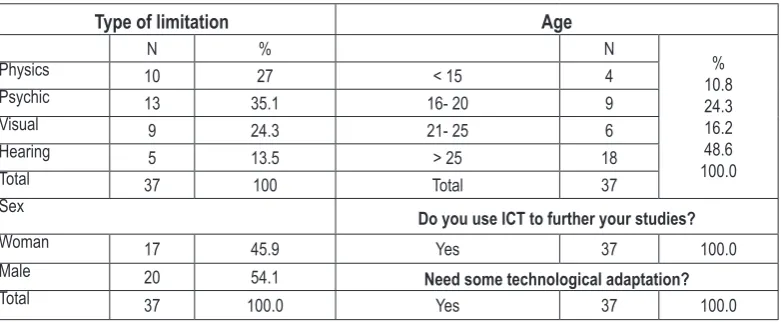
in the study are included 37 students coming from the university of alicante (n=19) and from secondary education schools (n=18) also from alicante. of these, 45.9% were female and 54.1% were male (table 1). these students were classified into two groups, according to their stage of educational study. this was done intentionally through the formal consent of thethis was done intentionally through the formal consent of the participants. although there were more students with need, only these 37 students responded. all of them were previously known.
Table 1. Demographic data.
Type of limitation Age
N % N
% 10.8 24.3 16.2 48.6 100.0
Physics 10 27 < 15 4
Psychic 13 35.1 16- 20 9
Visual 9 24.3 21- 25 6
Hearing 5 13.5 > 25 18
Total 37 100 Total 37
Sex Do you use ICT to further your studies?
Woman 17 45.9 Yes 37 100.0
Male 20 54.1 Need some technological adaptation?
the data collection instrument was designed ad hoc to meet the objectives of the study.he data collection instrument was designed ad hoc to meet the objectives of the study. the questionnaire was divided into 3 blocks. the first to examine the social demographic aspect of the students; the second to explore the use, availability and attitudes of the students with disability towards ict; and finally the third to understand the perception these students have with regards the predisposition and support of the teachers. the questions used were closed with yes/no answers and likert format with 5 alternative answers (1 = none, 2 = little, 31 = none, 2 = little, 3 = somewhat, 4 = enough, and 5 = very much).).
the study consisted of a questionnaire presented to a group of students. this was intentionally done between april 2010 and october 2010. a formal consent was obtained from the participants. the initial contact was made directly through an interview with these students. once the procedure was explained we organised a meeting with them to fill out the questionnaire along with a social demographic profile. the time needed to carry out the study was approximately 30 minutes per person and the application of the study was explained to those interviewed.
Design
the investigation is based on a quasi-experimental basis as had control of the type of participants. also, the study was not done at random as the students belonged to a specific context and were grouped according to the type of educational course.
Data Analysis
in relation to the descriptive data of the variables used in the study, were obtained frequencies, percentages and descriptions of the study in each of the variables (mean and typical deviations). descriptive analysis was performed on these frequencies and valid percentages. at the same time we also carried out different multivariate analysis of co-variance (mancoVa) according to the independent variables of the educational course (secondary school or university) matching this to the type of special needs (physical, psychological, visual or auditory) with the gender used as a co-variant to control its effect.
after, was used ancoVa’s multivariates in the significant results. the level of statistical significance of acceptance or rejection of the hypothesis of the study was p > 0.001and p > 0.05.
Results of Research
the results of the social demographic profile of the participants can be seen in table 1 where we describe the data in relation to the age, sex and type of disability.
in the 21st century Volume 35, 2011 153
Figure 1: Measures for Perceptions of ICT and teacher support.
the results from mancoVa were significant (lambda de Wilks 7, 22, f = 15.86, p < 0.001) in relation to the differences in the range of questions regarding the educational course. the same thing occurred regarding the type of disability (lambda de Wilks 21.63, f=1.85, p < 0.05). however, the gender interaction between the type of disability and the educational course was significant.
the result was also significant in the education cycle when analyzing the dimensionscycle when analyzing the dimensions we found in the different significant statistics. What is essential is the capability of using new technology [t (35) = - 10.27, p < 0.001], and to this purpose was signaled out those students with a higher average in their studies. With regards the questions relating to the support given by teachers, we found that the university students from this study were unhappy with this support in comparison to those from secondary education. for this reason there is a significant result in answer to the question: “do teachers help you to understand and adapt your disabilities in order to follow your studies? [t (35) = 8.452, p < 0.05], and to the question: “does your teacher help you to use the icts?” [t (35) = 2.003, p < 0.05], and finally, to the general question of: “do you feel you have the support of the teachers?” [t (35) = 2.032, p < 0.05].
Table 2. Perceptions of ICT and support teacher training by stage.
Perceptions of ICT and support of teacher Formative stage M SD t
How do you feel ready to help of new technologies in
your career? UniversityInstitute 3.543.38 0.520.58 0.852
Do you think that new technologies can help you track
your career? UniversityInstitute 4.154.38 0.800.58 -0.971
importance of using ICT in the studies UniversityInstitute 1.924.13 0.490.68 -10.277**
Do teachers help you to understand and adapt your
disabilities in order to follow your studies? UniversityInstitute 3.151.79 1.771.1 8.452*
Does your teacher help you to use the ICTs? UniversityInstitute 3.002.08 1.781.02 2.003*
Do you feel you have the support of the teachers? UniversityInstitute 2.922.00 1.061.7 2.032*
problem (table 3): (table 3):
Table 3. Perceptions of ICT and support of teachers according to type of prob-lem.
Perceptions of ICT and support of teacher
Type of problem
Physical Psychic Visual Hearing Total F
M SD M SD M SD M SD M SD
How do you feel ready to help of new technologies in your career?
3.40 0.70 3.38 0.51 3.56 0.53 3.40 0.55 3.43 0.55 0.184
Do you think that new tech-nologies can help you track your career?
4.10 0.88 4.31 0.63 4.33 0.50 4.60 0.55 4.30 0.66 0.637
Importance of using ICT in the
studies 3.30 1.25 3.62 1.19 3.00 1.32 3.40 1.34 3.35 1.23 0.432
Does your school support resources to help you?
3.90 0.74 3.85 0.38 4.00 0.50 4.20 0.45 3.95 0.52 0.585
Do teachers help you to understand and adapt your dis-abilities in order to follow your studies?
1.60a 1.26 1.85b 1.52 3.22ab 1.20 3.00 1.58 2.27 1.50 3.05*
Does your teacher help you to use the ICT?
1.80
ac 1.03 1.69bd 1.32 3.44ab 1.01 3.60cd 0.89 2.41 1.38 7.14*
Do you feel you have the support of the teachers?
1.70
ac 1.06 1.62bd 1.33 3.44ab 1.01 3.40cd 0.55 2.32 1.38 7.45*
(aa, bb ...) pairs of equal letters indicate statistically significant differences between their means; (**) < 0.001 significance level, (*) < 0.05 significance level.
the results indicate significant differences in the significant levels from the question in the significant levels from the question referring to “do teachers help you to understand and adapt your disabilities in order to follow your studies?” when comparing physical (m = 1.6, sd = 1.26) and psychological (m = 1.85, sd = 1.52) disabilities with that of visual disability visual (m = 3.22, sd = 1.20), [f (3, 36) = 3.05, p < 0.05].
in the same way, in answer to the question “does your teacher help you to use the ict?” found statistically significant differences when comparing those students with physical (m = 1.8, sd = 1.03) and psychological (m = 1.69, sd = 1.31) disabilities to those with visual (m = 3.244, sd = 1.01) and auditory (m = 3.44, sd = 1.01), [f (3, 36) = 7.14, p < 0.05] disabilities.
in the 21st century Volume 35, 2011 155 sd =1.33) problems had statistically significant differences in comparison to those with visual (m = 3.44, sd = 1.01) and auditory (m = 3.40, sd = 0.55), [f (3, 36) = 7.45, p < 0.05] problems.
Discussion
the existence of disabled students in superior level education is an increasing phenomenon (eches & ochoa, 2005; Konur, 2006; suri�, 2011). this has been observed over the last two decades where the educational integration of such students at pre university level, is on the increase. but the transition stage from secondary education to university has proved to be difficult for this type of student. this is because they have been looked after and given more support in the schools and institutes over the years but when they arrive at university level, where these students start a different stage in their education, this support is not available. considering that these students must confront a new phase in their education level, which requires more independence, and are without the necessary support given to them previously.
such things as ambient conditions, motivation, self-conception and self-esteem influence the end result, success or failure, in their educational studies. there is also the complexity of the particular age group of these students.
one example of this is reflected in the results of this study, in which the different levelexample of this is reflected in the results of this study, in which the different levelthe different level of teacher support detected by disabled students in secondary education in comparison to that in the university, where many students were unhappy with the support.
this is reflected in the use of ict. results indicate that students study the technologies used to pursue their studies. they have no problem using this technology and are fully aware of its importance in their academic world. however, there remains the problem of the lack of support on the part of the teacher to handle, use and adapt this technology, notwithstanding the availability of such modifications in the various educational centers.
depending on the type of disability we noticed, in general, little support on the part of the teaching staff. this lack of suitability relates not only to the physical structures or architecturally, but also in regards to normative regulation, strict curriculum and the organization of the teaching profession (susinos & rojas, 2004), which can be one of the major obstacles to the integration of these students (somekh, 2008).
as larrivee (1982) pointed out, even though the law can impose integration, the way in which the teacher responds to the need of his/her students can be variable.
this is a much more compelling aspect of success in the integration than any administrative or curriculum strategy. for this reason the support of the teaching profession is of vital importance to arrive at a positive educational response to diversity. this is not to take away the other very important aspects mentioned previously such as the organization and the use of technological resources (nachmias, mioduser & forkosh-baruch, 2008).
apart from the perception of support to the type of disability displayed by the student, were also observed differences in those students with visual disability who obviously received more teacher support. this is understandable, as a visually disabled student requires more adjustment and support in order to follow the class work and the teacher will be more aware of the student’s disability. this situation follows the same pattern for the rest of the studies both in the classroom and at home. however, when dealing with physical disability students, for example someone in a wheelchair, we normally worry about the physical surroundings such as stairs and access to the classroom. We tend to forget the necessity of these particular disabled students when they need to take notes or use a normal keyboard.
the technological resources needed to follow their studies with success.
these results are consistent with other studies showing a tendency to support pupils with very obvious and yet other needs remain invisible (dengra, dur�n & Verdugo, 1991).
Conclusions
the importance of this investigation in the educational world is clear, as it is obvious that there exist strong obstacles in obtaining total integration for disabled students in educational centers.
the necessity for secondary education schools along with universities to have at their disposal a special service that facilitates the study work and daily relationships of students with the different areas of the educational domain, prior to the incorporation of these disabled students to universities. this service would act as a support to the student with special needs when dealing with the university teachers, personnel and administrative staff.
it would also help with services within the ambient of the university; public administration and associations or entities that support disabled people, their fellow students and family members. the university also needs to set up training courses for the teaching staff on how to support and confront the limitations and needs of these disabled students.
References
adell, J. (2003). recursos en la era de la información. Cuadernos de Pedagogía, 326, 102-105.
alcantud, f., avila, V., & asensi, m. c. (2000). La Integración de estudiantes con discapacidad en los estudios superiores. Valencia: universitat de Valencia estudi General.
arnaiz, p. (2003). Educación Inclusiva: Una escuela para todos. archidona: aljibe.
blackstone, t. (2008). Education and Training in the Europe of Knowledge. retrieved 15/05/2009, from http://www.uniroma3.it/downloads/297_lezione%20blackstone.doc
dengra, r., dur�n, r., & Verdugo, m. a. (1991). Estudio de las variables que afectan a las actitudes de los maestros hacia la integración escolar de niños con necesidades especiales. anuario español e iberoamericano de investigación en educación especial. madrid: cepe.
echeita sarrionandia, G. (2006). Educación para la inclusión o educación sin exclusiones. madrid: narcea.
eches, s., & ochoa, t. (2005). students with disabilities: transitioning from high school to higher education. American Secondary Education, 33, 6-20.
ertmer, p. a. (2005). teacher pedagogical beliefs: the final frontier in our Quest for technology integration? Educational Technology, Research and Development, 53, 25-40.
Galanouli, d., murphy, c., & Gardner, J. (2004). teachers perception of the effectiveness of ict-competence training, Computers and Education 43, 63-79.
Green, l., & engelbrecht, p. (2007). an introduction to inclusive education [una introducción a la educación inclusiva.]. in: engelbrecht, p.; Green, l. (comps.). Responding to the challenges of inclusive education in southern Africa, (pp. 2-9). pretoria: Van schaik.
in the 21st century Volume 35, 2011 157
Konur, o. (2006). teaching disabled students in higher education. Teaching in Higher Education, 11,
351- 363.
Kozma, r. b. (2003). technology and classroom practices: an international study. Journal of Research on Technology in Education, 36, 1-14.
larrivee, b. (1982). factors underlying regular clasroom teachers´attitude toward mainstreaming.
Psychology in the Schools, 19, 374-379.
luque, d. J., rodr�guez, G., & romero, J. f. (2005). accesibilidad y universidad. un estudio descriptivo.
Intervención Psicosocial, 14, 209-222.
mart�n-labora, r. (2005). Las nuevas tecnologías en la educación. madrid: fundación auna.
mitchell, d. (2005). Contextualizing inclusive education: evaluating old and new international paradigms: La educación inclusiva en su contexto: evaluación de paradigmas internacionales nuevos y antiguos. londres: routledge/falme
mominó, J. m., sigalés, c., & meneses, J. (2008). La Escuela en la Sociedad Red. Internet en la Educación Primaria y Secundaria. barcelona: ariel.
montero, l. (ed). (2007). O valor do envoltorio. Un estudo da influencia das TIC nos centros educativos. Vigo: Xerais.
nachmias, r., mioduser, d., & forkosh-baruch, a. (2008). innovative pedagogical practices using technology: the curriculum perspective. in J. Voogt & G. e. Knezek (eds.). International handbook of information technology in primary and secondary education. part one. ny: springer.
rose, r. (2007). curriculum considerations in meeting special needs. in l. florian (ed.), The SAGE Handbook of Special Education. london: saGe.
s�nchez montoya, r. (2002). Ordenador y discapacidad. madrid: cepe.
skidmore, d. (2004). Inclusion: the dynamic of school development: la dinámica del desarrollo escolar. londres: open university press.
somekh, b. (2008). factors affecting teachers´ pedagogical adoption of ict. in J. Voogt & G. e. Knezek (eds.). International Handbook of Information, Technology in Primary and Secondary Education (pp. 449-460). ny: springer.
soto pérez, f. J., & rodr�guez V�squez, J. (coords.) (2004). Tecnología. Educación y Diversidad: Retos y Realidades de la Inclusión Digital. murcia: consejer�a de educación y cultura.
suri�, r. (2011). percepción del profesorado sobre su capacitación en el uso de las tics como instrumento de apoyo para la integración del alumnado con discapacidad. Profesorado, revista de curriculum y formación del profesorado, 16, 299-314.
susinos rada, t., & rojas pernia, s. (2004). notas para un debate sobre los servicios de apoyo en la universidad española. Revista de Educación, Nº 334 (Ejemplar dedicado a: Temas actuales de Enseñanza),
pp. 119-130.
thomas, l. (2008). On the Same Page. Personal Communication to Jennie Duke. brisbane: Qld.
tondeur, J., braak, J., & Valcke, m. (2007). “towards a typology of computer use in primary education”.
Zhao y frank, K. a. (2003). “factors affecting technology uses in schools: an ecological perspective”.
American Educational Research Journal, 40, 807-841.
Zuber-sherritt, o. (2007). desarrollo profesional y del liderazgo en educación superior a través del aprendizaje en la acción y de la investigación acción. Revista Internacional Magisterio. Educación y Pedagogía, 26, 30-33.
Advised by Laima Railienė, University of Siauliai, Lithuania
received: September 17, 2011 accepted: October 15, 2011
Raquel Suriá Martínez Dr., Department of Communication and Social Psychology, Faculty of Economics and Business, University of Alicante, Campus of San Vicente del Raspeig, A.P. 99-03080 Alicante, Spain.
E-mail: [email protected]