LAN D SCA PE
R E V I E W
A
S O U T H E R N H E M I S P H E R E
J O U R N A L O F
L A N D S C A P E A R C H I T E C T U R E
T H E M E
Landscape Architecture’s Big Questions
CONTRIBUTORS
Simon Swaffield, Why Landscape Architecture?
James Taylor, Landscape Architecture in the Developing World: The Growth of Informal
Settlements
Gloria Aponte, What are the Big Questions for Landscape Architecture Now?
Beatriz Fedrizzi, What are the Big Questions for Landscape Architecture Now?
Paula Villagra, What are the Big Questions for Landscape Architecture Now?
Bonj Szczygiel, What are the Big Questions for Landscape Architecture Now?
Richard Weller, The Big Question is ...
Mick Abott, Activating Landscape
VO L U M E 14 ( 1 )
ISSN 2253–1440
Published December 2011
© Edition: School of Landscape Architecture, Lincoln University. © Text and illustrations: individual contributors, unless otherwise noted.
1 L A N D S C A P E R E V I E W 1 4 ( 1 ) P A G E S 1 – 3
Jacky Bowring is an Associate Professor of Landscape Architecture. School of Landscape Architecture, Environment, Society and Design Faculty, PO Box 84, Lincoln University, Lincoln 7647, Canterbury,
Aotearoa New Zealand. Telephone: +64–3–325–3838, extn 8439
Fax: +64–3–325–3857
Email: [email protected]
KEY WORDS
Landscape architecture research Landscape architecture publication Landscape architecture discourse Landscape architecture knowledge
Landscape Architecture’s
Big Questions
j a c k y b o w r i n gEDITORIAL
W
ith this issue, a new era begins for Landscape Review. Now an open access,subscription-free, digitally published journal, Landscape Review is taking up the challenges and opportunities involved in the sharing of knowledge in the 21st century. The journal began 16 years ago and, since 1995, 26 issues have been produced, which includes the proceedings of the two Languages of Landscape Architecture conferences and the Council of Educators in Landscape Architecture conference, all held at Lincoln University.
Perhaps the two most important developments are the geographical realignment of the journal and the establishment of the Editorial Advisory Board. The geographical home for the journal is now the southern hemisphere, recognising the need to elevate this area of the globe into the international landscape architectural discourse. Landscape Review welcomes submissions from around the globe, but at the same time aspires to amplify the voices from the south. The Editorial Advisory Board membership reflects this alignment, including representatives from the southern hemisphere, as well as others who have a special interest in this area or a particular focus on publishing. The board members are listed at the end of this article and will also appear on the Landscape Review homepage.
This issue also seeks to fuel landscape architecture’s research and publication engine by asking board members to respond to the question, ‘What are the big questions for landscape architecture now?’. The responses provide a vivid image of the diversity of thought within landscape architecture, offering a spirited rallying call to academics and professionals alike. The breadth of landscape architectural thinking is represented within these short essays, with topics ranging from artistic practice to experience to education to the health of the discipline and the need to engage in meaningful communication.
Founding editor of Landscape Review Simon Swaffield asks a big question for the discipline – why? While many of us might quickly make a presumption about our discipline’s indispensability, it is vital to pause and carefully interrogate just why landscape architecture matters. Swaffield reminds us of the underpinnings of landscape architecture, and its delicate yet strategic position within a web of disciplines. And, most of all, the why question resides not simply in the land itself, but in the people – landscape architecture’s ‘why’ is firmly rooted in humanity.
2 J A C K Y B O W R I N G
the developing world, demonstrating the potency of landscape architecture in the improvement of wellbeing through design. Also, landscape architects have other skills to bring to such a setting, such as using drawing to find out children’s perspectives on the environment, which in turn provides cues for how to better enhance their future prospects through landscape interventions.
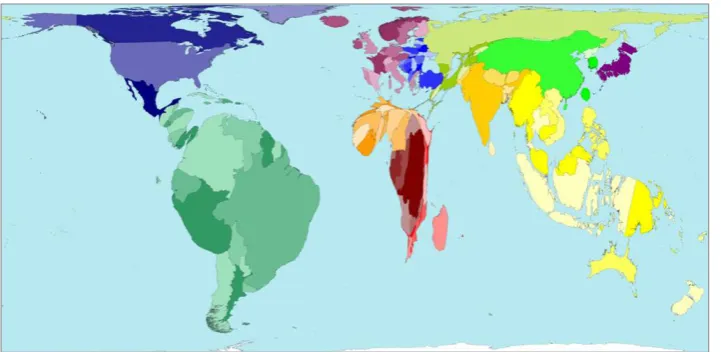
Gloria Aponte manifests graphically the issues the southern hemisphere is facing. Aponte’s images show that the dramatic contrasts between the two hemispheres in terms of biodiversity and technology are in themselves worth a thousand words. She goes on to highlight the nature of the problems that these imbalances create, asserting the need for locality as the core to an effective response. Within the local connections to landscape, Aponte argues, we can find the kind of wisdom that is needed to address the issues the profession faces. One of the keys to ensuring the questions are answered effectively is to work together, sharing knowledge at the same time as respecting distinctive differences.
The integration of knowledge is also a concern for Beatriz Fedrizzi. Concerned about the ways in which landscapes offer health benefits, Fedrizzi calls for knowledge sharing. This needs to happen, she argues, between disciplines and because of better client input into the design process. Paula Villagra demonstrates how such exchanges might take place. Villagra describes how a recent seminar in southern Chile on landscape architecture provided a focus for asking many questions – including those at the core of the profession. Echoing Swaffield’s ‘why’ question, Villagra reports that the questions in southern Chile are fundamental, such as the core challenge, ‘What is landscape architecture?’.
Implied in these questions is the urge to examine very nature of landscape architecture, including the enormous breadth of the discipline. Bonj Szczygiel’s piece amplifies the role of art in landscape architecture. While we might often be attentive to concerns about environmental health, Szczygiel argues that the critical component is art. In reminding us of the legacy of publishing in landscape architecture and the fields of research that have been identified as important to the discipline, Szczygiel explains how without aesthetics we cannot make the link between the environmental aspects of what we do and the central concern with ‘everyday human experience’.
As a manifestation of the concern with art, Richard Weller’s graphically arresting piece raises many points while saying little in conventional language. As Weller has suggested, his 1,000 word graphic is like ‘a bunch of flowers’; a fitting analogy for a work that references landscape architecture, a profession whose language is often that of plants. The graphic has an ecological sensibility, resonating with notions of order and diversity, and it manifests the kinds of ruptures that come with mutation or natural disasters. However, it is also provocative, on one hand highlighting the absurdity of writing merely 1,000 words on such a weighty topic, and on the other hand meeting the challenge with something that is in itself designed. We often forget, as researchers in landscape architecture, that we are nothing without design.
3 J A C K Y B O W R I N G
root about experience, with its original sense (aisthesis) being connected to the multi-sensory nature of existence. It is within this rich terrain that Abbott places landscape architecture, pointing to the potentiality of phenomenology as a way in which to frame this engagement with our surroundings. Through this, we can be within the environment that sustains us, not observing from the objective distance of the scientist.
All of the pieces prompt reflection. They might resonate with readers’ perspectives or they might raise more questions and debate. The point is, of course, to stoke the fire that is the discourse of landscape architecture. We look forward to your contributions and responses, and hope that the next phase of Landscape Review’s publication will be as fruitful as its founding years.
A very warm welcome to the Editorial Advisory Board:
Mick Abbott, Department of Applied Sciences, University of Otago, Dunedin, New Zealand
Gloria Aponte, School of Architecture and Design, Universidad Pontificia Bolivariana, Medellín, Colombia
Beatriz Fedrizzi, Faculdade de Agronomia, Universidade Federal do Rio Grande do Sul, Porto Alegre, Brazil
Gini Lee, Melbourne School of Design, University of Melbourne, Melbourne, Australia
Simon Swaffield, founding editor of Landscape Review, School of Landscape Architecture, Faculty of Environment, Society and Design, Lincoln University, New Zealand
Bonj Szczygiel, editor of the new journal As Built: A journal of design critique, Department of Landscape Architecture, Stuckeman School of Architecture and Landscape Architecture, Pennsylvania State University, United States of America
James R Taylor, School of Environmental Design and Rural Development (Landscape Architecture Programme) and chair of the International Federation of Landscape Architecture’s Education and Africa Committee, University of Guelph, Canada
Christopher Vernon, School of Architecture, Landscape and Visual Arts, University of Western Australia, Perth, Australia
Paula Villagra, Instituto de Arquitectura y Urbanismo, Universidad Austral de Chile, Valdivia, Chile
4 L A N D S C A P E R E V I E W 1 4 ( 1 ) P A G E S 4 – 6
Simon Swaffield is Professor of Landscape Architecture.
School of Landscape Architecture, Faculty of Environment, Society and Design, PO Box 84, Lincoln University, Lincoln 7647, Canterbury, Aotearoa New Zealand.
Telephone: +64–3–325–3804 Fax: +64–3–325–3854
Email: [email protected]
KEY WORDS
Landscape outcomes Legitimacy
Value-added Creative
Why Landscape Architecture?
s i m o n s w a f f i e l dREFLECTION
T
he big question in the discipline of landscape architecture hides within adeceptively short and simple word – why? The question may be asked by others outside the profession – why should landscape architecture be engaged and what value does it bring to a project, public policy, a university or society? We may ask a ‘why’ question ourselves – why do we propose this design process?
That design expression? This landscape classification? That policy? In short,
what is the distinctive contribution we, as landscape architects, are making to the wellbeing of the world in which we live and work? Why landscape architecture?
This is not a new question, of course. Different generations of landscape architects and planners have asked the same or similar questions and answered in various ways.
Landscape architecture has been universally motivated by a desire to stimulate and satisfy the senses and intellect (Jellicoe and Jellicoe, 1995) but also to:
• ‘improve’ property (Loudon, 1840 – on the work of Humphrey Repton);
• refresh the body and spirit (Hubbard, 1922 – on FL Olmsted’s writings);
• create ‘landscapes for living’ in our homes, cities and workplaces (Eckbo, 1950);
• ‘design with nature’ when planning cities and regions (McHarg, 1969);
• shape ‘new lives, new landscapes’ for a modern world (Fairbrother, 1970); and (most ambitiously)
• recover landscape as ‘an agent of culture’ (Corner, 1999).
In countries where landscape is deeply embedded as a cultural construct – particularly in northern Europe – the answers to ‘why landscape architecture’ are typically about how landscape should be managed, not whether it is worthy of attention.
5 S I M O N S W A F F I E L D
Different policy imperatives, such as energy availability and costs, food security and quality, urban management and renewal, poverty and social justice, water quality and availability, climate change adaption, and human health and
wellbeing, all place pressing and often conflicting pressures upon public policy
formation, land management and project design. Their resolution will require knowledge and skills well beyond our discipline. Landscape architects will need to be both energetic and strategic in providing a compelling rationale for engagement with ‘our’ knowledge and practices, showing what added-value we can contribute to meeting these overarching imperatives.
In a study of landscape architect’s motivations, Ian Thompson (1999) identified
a familiar triad of values – ecology, community and delight – but a robust value proposition for the discipline requires transformation of these landscape ‘feel good’ codes into more tangible outcomes.
Paul Selman (2006) has acutely drawn a distinction between creating policy
‘for’ landscape – typically expressed as protection of a specific landscape or
landscapes in general – and making policy ‘through’ landscape to achieve other goals that are characteristically more central to the concerns of government and citizens, such as public health. This distinction can be helpful in articulating the value of a landscape perspective.
An outcome approach asks us to consider and then explain the likely ‘consequences’ of our involvement for others. Not what we aspire to, or interesting things we have learnt, or what actions we would like to undertake, or plans we
will design and implement, but what tangible benefits will accrue to our clients,
communities and wider society.
What will be the effect of our involvement on community health and wellbeing,
or on the condition of ecosystems, or on efficiency of resource use? Outcomes do
not have to be instrumental – it may be that our most distinctive and valuable contributions are to help enable collective action and strengthen identity, to inspire and educate, to challenge and empower.
Indeed, one of the most enduring values of our discipline is the creation of possibility – to explore how the future might be through design projections and landscape scenarios. The attraction of this type of contribution is illustrated by the widening range of disciplines and professions that are adopting landscape-based concepts and techniques to promote ‘their’value propositions (Waldheim, 2006). We must not only ‘recover’ landscape as a cultural agent but also reclaim its creative potency as the core of our discipline.
In relaunching Landscape Review as a journal with a reinvigorated ‘southern’ focus, a key editorial challenge will be to ensure the material we publish communicates the ‘value’of the new landscape-based knowledge that is being shared. Landscape Review has always had a commitment to plain language – to speak clearly to power, truth and possibility. We need to share and apply landscape knowledge, ideas and insights in accessible and compelling ways that directly connect our discipline with the multiple and frequently contested needs of wider society in an ever more uncertain future.
6 S I M O N S W A F F I E L D
REFERENCES
Corner, J (ed) (1999) Recovering Landscape: Essays in Contemporary Landscape Theory, New York: Princeton Architectural Press.
Eckbo, G (1950) Landscapes for Living, New York: Dodge.
Fairbrother, N (1970) New Lives, New Landscapes: Planning for the 21st Century, London: William Clowes & Sons.
Hubbard, TK (1922) Frederick Law Olmsted: Landscape Architect 1822–1903, New York: GP Putnam’s Sons.
Jellicoe, G and Jellicoe, S (1995) The Landscape of Man: Shaping the Environment from Prehistory to the Present Day,London:Thames and Hudson.
Loudon, JC (1840) The Landscape Gardening and Landscape Architecture of the Late Humphrey Repton, Esq, London: Longman and Co.
McHarg, I (1969) Design with Nature, New York: Doubleday.
Selman P (2006) Planning at the Landscape Scale, Abingdon, UK: Routledge.
Thompson, I (1999) Ecology, Community and Delight: Sources of Value in Landscape Architecture, London: E & FN Spon.
7 L a n d s c a p e r e v i e w 1 4 ( 1 ) p a g e s 7 – 1 0
James Taylor is Professor Emeritus in Landscape Architecture, School of Environmental Design and Rural Development (Landscape Architecture Programme), University of Guelph, Guelph, Ontario, NIG 2W1, Canada. Telephone: +519– 763–7145 Fax: +519–767–1683
Key words Informal settlement Slums
Housing Slum upgrading Environment
Landscape architecture
Landscape architecture in the
developing world: The growth
of informal settlements
j a m e s t a y l o r
refLecTion
o
ur societies are facing many issues that should be addressed by the landscapearchitecture profession. if we assume that challenges such as global warming, decaying infrastructure, depleting water resources, deforestation, ageing populations and human obesity are already on our radar screens, are there other issues yet to come to light that we should be considering in our education, research and practice?
There are now 7 billion people on the planet, and global agencies are projecting continued population growth. Most of this growth, however, will not be in the developed world.1 By 2030, there will be 7 billion people in the developing world alone and only 1 billion in the developed world (Unfpa, 2011). at present, over half of the world’s citizens live in cities and urban migration will continue. By 2050, a large part of the new settlements in urban areas will be of an informal nature. already, over 30 percent of the world’s population live in informal housing settlements otherwise known as slums, barrios or favelas. Many cities in the northern hemisphere, such as caracas, Mexico city, Mumbai and Lagos, have high proportions of barrios or favelas. for most of these cities, as many as half of their settlement areas are informal in nature. caracas is closer to 80 percent (davis, 2006). The southern hemisphere is experiencing similar phenomena. figure 1 shows the main centres of informal settlements, with examples of major cities that are experiencing invasive informal settlement including rio de Janeiro, sao paulo, Jakarta, nairobi and Johannesburg.
christian werthmann (2009) concludes that the number of slum dwellers will double by 2030 to reach over 2 billion. if landscape architects are looking for where the potential ‘market’ (and the need) is, it will not be in places like the United states of america or parts of europe where there is an oversupply of housing and some cities are actually experiencing depopulation. This is also true in parts of Japan and russia.
8 j a m e s t a y l o r
The profession of landscape architecture is growing rapidly in the developing world as evidenced by the doubling of professional educational programmes over the past decade and as observed through my work with the international federation of Landscape architects education committee. This growth ranges from the dramatic rise in china2 to more modest incremental increases in africa and Latin america. do we have the numbers, knowledge and sensibility to engage in leading issues such as the improvement of informal housing? in china, which is experiencing great growth in the profession, landscape architects are involved in urban development. Their work, however, is in the context of traditional ‘formal’ settlements. in other developing countries, such as india, venezuela and most of those in africa, landscape architecture barely exists as a profession and is generally unprepared to meet pressing challenges of rapid urbanisation. can landscape infrastructure and the profession be part of the solution?
on further examination, it is important to note several initiatives in recent years that demonstrate relevance. for example, in 2004, a team of landscape architecture students from a swedish university helped conduct a situational analysis of the informal settlement of Kisumu, Kenya. The students mapped conditions and made observations for improving landscape, drainage and other settlement infrastructure, which served as the basis for further work on the Un-Habitat cities without slums programme (UnHsp, 2005). in sao paulo, Brazil, paulo pellegrino, professor of landscape architecture at the federal University of sao paulo, serves on a multidisciplinary working group to protect and enhance water sources for the city. He has undertaken studies and design studios to restore green infrastructure in response to the impact of informal settlements on the watershed.
christian werthmann and John Beardsley of the Harvard graduate school of design in cambridge, Massachusetts, led the dirty work initiative, which was concerned with the question of how life in informal cities can be improved through design (werthmann, 2009). Their studio, in cooperation with authorities
Figure 1: Major centres of informal settlement (en.wikipedia.org/wiki/ Slum, 15 November 2011).
9 j a m e s t a y l o r
and experts in sao paulo, examined and developed strategies for infrastructure development for an informal settlement adjacent to a major reservoir that represented an important source of water for the city. Thirteen tactics were developed to demonstrate designs for improving greening and drainage functions within the favela environment. This project was the winner of an american society of Landscape architects award in 2010.
professor Lucia costa, from the newly formed master’s programme in landscape architecture at the federal University of rio de Janeiro, Brazil, is engaged in work on the improvement of favela communities in that city. she concentrates on improving people’s awareness of natural water courses and restoring their function.
in 2007, as a recent graduate from the University of guelph, ontario, canada, sarah Mccans became an international intern and was based with the Urban poverty and environment programme initiative in africa (Mccans, 2008). Her fieldwork was done in Kampala, Uganda, and was directed toward children and youth. she worked with children through drawing as a medium to identify environmental issues. This information supported participatory planning directed toward improving the children’s communities.
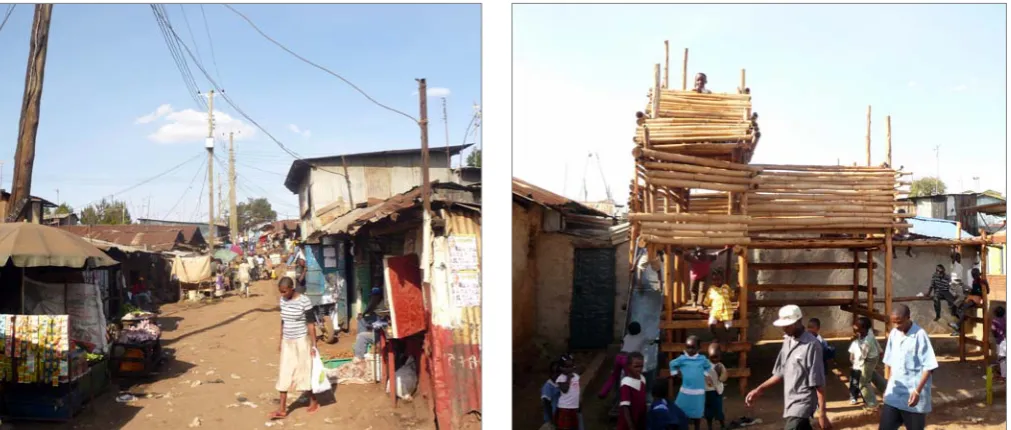
Kibera is the largest informal settlement in sub-saharan africa. i had the opportunity to tour one of the 13 villages that are home to nearly 1 million residents just 2 kilometres from downtown nairobi (figure 2). The Kounkuey design initiative is a non-governmental organisation working along with numerous others to effect improvements. Their Kibera public space project 01 has made great progress in providing for open space, according to expressed community needs, that has been reclaimed from garbage dumps. construction of playgrounds, football fields and public gardens and a reclaimed floodplain area have strengthened the sense of community and increased the level of social interaction (figure 3).
in conclusion, the growth of educational capacity in the discipline, and the examples of the role of landscape architects described above, point to the future potential of the profession. The issue of informal urban growth, as well as global
Figure 2: (left) Informal settlement in Kenya (James Taylor).
10 j a m e s t a y l o r
warming, decaying infrastructure, depleting water resources and deforestation all present opportunities for curriculum development, research and practice in the developing world.
noTes
1 it is generally accepted that the developed world includes australia, Japan and new Zealand as well as all countries in europe and north america. The developing world includes all countries in africa, asia (except Japan), Latin america and the caribbean, and oceania (except australia and new Zealand).
2 in a presentation by the chinese delegation to the international federation of Landscape Architects Asia Pacific Symposium on Education held in Putrajaya, Malaysia, in March 2011, it was reported that there are over 300 professional programmes in landscape architecture in china.
references
davis, M (2006) Planet of Slums, London: verso.
Mccans, s (2008) Kampala through children’s eyes, Landscapes/Paysages 10(4), pp 30–31. Unfpa (2011) 7 Billion Actions, United nations population fund www.7billionactions.org (last accessed 24 november 2011).
UnHsp (2005) Situation Analysis of Informal Settlements in Kisumu, nairobi: United nations Human settlement programme, Un-Habitat.
11 L A N D S C A P E R E V I E W 1 4 ( 1 ) P A G E S 1 1 – 1 4
Gloria Aponte is Director of the Master Programme in Landscape Design, School of Architecture and Design,
Universidad Pontificia Bolivariana,
Medellín, Colombia.
Telephone: +57–4–448–8388, extn 13622
Fax: +57–4–250–2080
Email: [email protected]
KEY WORDS Zenú culture Abundance risk Urban–rural borders
What are the Big Questions for
Landscape Architecture Now?
g l o r i a a p o n t eREFLECTION
T
he earth seems to be spinning faster every day and, along with this, largeamounts of information seem to surround us every minute. In the midst of this frenetic situation, and in certain measure because of it, our landscapes are the subject of transformations that are not always desirable and that in some cases are unsound.
In the context of the southern hemisphere, these trends highlight the following three questions.
1) Do we need to copy, or at least follow, northern hemisphere tendencies to solve our landscape troubles?
2) How should we deal with our misguided tendency to divide the world into biological and technological areas, and consequently fractioned solutions?
3) How should we deal with landscapes in the fast-moving urban–rural borders in our expanding cities?
In attempting to answer to these questions, I will outline the problems related to each of them.
1) Based on Benjamin Hennig’s research at the University of Sheffield in 2005, and worldmapper1 cartograms, figures 1 and 2 show there are
conspicuous differences between the northern and southern hemispheres in two relevant matters: Figure 1 shows the difference in biodiversity and, in contrast, Figure 2 shows the difference in technology development and investment.
12 G L O R I A A P O N T E
Figure 2: Technology development and investment. (© Copyright SASI Group (University of Sheffield) and Mark Newman (University of Michigan). Used under Creative Commons licence.)
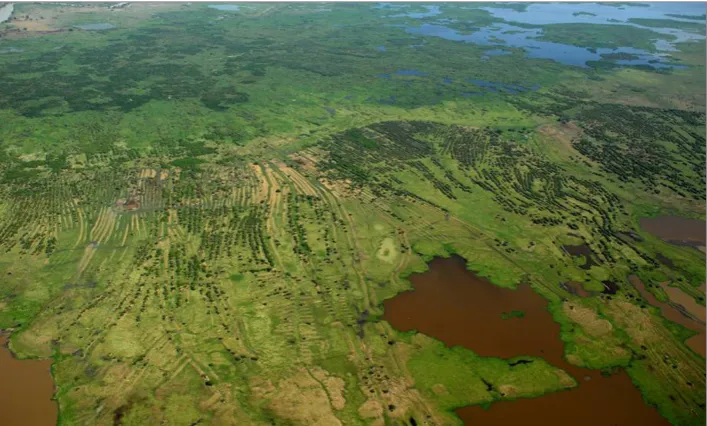
Figure 3: Pre-Hispanic Zenú ridge
system in Colombia. (Banco de la República de Colombia.) In relation to the contrast between richness and available tools, usually a lack
of resources and some sort of crisis stimulate the development of strategies to cope with survival needs. The history of a great part of the northern hemisphere has followed this pattern. In contrast, the richer southern hemisphere, perhaps, suffers from so-called ‘abundance risk’. This is the incapacity of an area to deal with its own richness and, what is worse, to fail to realise that such richness and abundance are finite. The results of this are seen clearly in everyday landscapes and, less obvious but latent, in particular landscapes carefully designed to compete in the fast and globalised world of the present.
In every way, local landscape design solutions are needed. ‘Locality’ is one of the outstanding conditions of sound landscape management.
13 G L O R I A A P O N T E
It is time to rediscover ourselves in relation to the Earth and our environment. It is time to go back to the indigenous belief that we are part of nature, not her kings, and to behave accordingly by sharing, receiving and giving, profiting from it while letting evolution occur at its own pace.
2) Modern specialisation has led professionals, committed to habitat development, to accommodate themselves in different corners. Here, they attempt to establish their own realms, and it is usually difficult to get them to leave the comfortable situation in which they are the undeniable authority. Although the present generalisation of the trend and need for interdisciplinary and trans-disciplinary work are abundant and widespread, getting these concerns embedded in the minds of general professionals takes more than one generation to achieve.
The defensive attitude, where some disciplines prefer not to be questioned by other disciplines, has driven us to intellectual isolation and/or rivalry. The idea of not ‘invading’ the property of others keeps us separated from dialogue and joint work. In this way, specialists become even more specialised and forget the roots of their knowledge.
Technology has been drawn from nature. Nature has always inspired solutions. Ask Newton, for example! We do not need sophisticated technologies to face our landscape troubles.
On the other hand, the now prevalent immediatist attitude impedes the practice of tranquil but long-lasting landscape solutions. Everything has to be done NOW!
Yet nature observation is needed now more than ever to return professionals to local, sound and simple ways of acting, ways that also remind us of the convenience of being able to wait for natural processes.
3) In physical terms, from the point of view of planning and urbanism, landscape is frequently seen as a two-dimensional matter or a spot on a map. It is a beneficial but rare achievement when landscape is seen, treated and developed as a three-dimensional phenomenon.
The most difficult challenge for engineers, designers and architects, however, is to recognise the fourth dimension of landscape: time. This dynamic applies to work with living things. Although perceptions of time relentlessly invade our lives and consciousness – as suggested at the beginning of this paper – societies are not aware enough and our professionals not trained enough to deal with complex landscape dynamics.
Urban–rural borders are spaces where this lack of training is much evident. These are the spaces where more refined skills are required from landscape professionals to achieve successful development. The professional’s first task is to underline the issues involved in these spaces for all actors involved, but especially for planning and development authorities that are usually pressed by administrative periods and deadlines.
14 G L O R I A A P O N T E
Constructing landscapes that highlight natural features and resources (instead of sophistication and foreign ways of behaving) is a valuable activity, gaining a landscape that not only is nice to look at but also reflects the nature that underlies and always will underlie human location, activities, settlements and architectural artefacts.
This approach will surely reward us with a variety of benefits besides a gratifying habitat, and perhaps with stronger feelings of identity, while minimising natural menaces, conserving the landscape’s richness and singularity, and being inexpensive to implement.
Landscape architecture professionals in southern hemisphere countries need to undertake research in the discipline that will allow them to share knowledge and to work together, and to acknowledge differences while recognising and respecting others.
NOTES
15 L A N D S C A P E R E V I E W 1 4 ( 1 ) P A G E S 1 5 – 1 6
Beatriz Fedrizzi, Faculdade de Agronomia, Universidade Federal do Rio Grande do Sul, Rua Bento Gonçalves 7712, 90650-970 Porto Alegre RS, Brazil.
Telephone: +55–51–3308–3900 Email: [email protected]
KEY WORDS
Landscape architecture education Landscape architecture research Environmental psychology Health design
Healing gardens
What are the Big Questions for
Landscape Architecture Now?
b e a t r i z f e d r i z z iREFLECTION
T
he big question for landscape architecture now is how to apply results from landscape design research to the discipline. Research in landscape design is undertaken in different fields at different universities, but sometimes it appears not to be a part of undergraduate education.How can research be integrated into landscape design through using academic techniques and skills in practice? Designers need to understand how and why developmental patterns and spaces are created and how they support different activities. They need to know how to describe these patterns and spaces, how they improve the ecological or economic viability of a space and form, and how they are used, modified and perceived. Designers need to evaluate and document the successes and failures of such developmental patterns and spaces.
How can more client input, through individual or group participation, be used for landscape design? An important research area in landscape architecture that can help in this understanding is environmental psychology. How can research results in environmental psychology be applied to landscape design?
Research in environmental psychology attempts to understand the inter-relationship between humans and their environment. This kind of research studies people–environment interactions and uses the knowledge gained to help solve a variety of design-related problems. This knowledge should be integrated into the landscape architecture curriculum because it will help the professional to design with a better understanding of a client’s perceptions. It should be undertaken for the purpose of informing future practice, policy, theory and education.
It is essential that we infuse scientific rigour into our curricula. Our universities expect it and accreditation demands it. An important example of research in landscape architecture is investigation in health design. Designing for health can accomplish many positive effects, either separately or in combination. Different names have been given to nature-based treatment efforts, but the most widespread is ‘healing gardens’.
The health effects of gardens or natural environments are caused by their restorative influence on cognition, emotions and an individual’s ability to make sense of (or find meaning in) things (Figure 1). The garden or natural environment may aid an individual’s healing process by helping them to:
• achieve a degree of relief from physical symptoms or an awareness of those symptoms
16 B E A T R I Z F E D R I Z Z I
So how can planning and design disciplines worldwide integrate the research results of health design and healing gardens into practice? If we teach landscape architecture students to apply such research results in their professional lives, projects in all kinds of areas could be as successful as healing gardens and they could be everywhere – around our homes, on the way to work, in school playgrounds and on university campuses, outside hospitals, in prisons, in rich and poor areas. Such projects could be seen from the windows of all buildings. This would lead to more sustainable, beautiful, comfortable cities.
I hope that this field of work will grow and mature, generating significant results for the discipline of landscape architecture.
17 L A N D S C A P E R E V I E W 1 4 ( 1 ) P A G E S 1 7 – 1 9
Paula Villagra is a Senior Lecturer, Instituto de Arquitectura y Urbanismo, Facultad Ciencias de la Ingeniería, Universidad Austral de Chile, Edificio Ernst Kasper, Campus Isla Teja, Valdivia, Región de Los Ríos, Chile. Telephone: +56–63–293464/221277 Fax: +56–63–293045
Email: [email protected]
KEY WORDS
Natural disasters Communication Interdisciplinary work Way of life
Field of action Raising awareness
What are the Big Questions for
Landscape Architecture Now?
p a u l a v i l l a g r aREFLECTION
I
n 2011, the Institute of Architecture and Urbanism at the Universidad Australde Chile conducted the first seminar on landscape architecture in southern
Chile. It was entitled ‘Landscapes of the South: State of the art and challenges’. After listening to attendees and speakers from different disciplines and areas of
work, I realised that many issues relating to the field of landscape architecture urgently need to be clarified. It is unclear, for example, what we mean by
‘landscape’, what the scope of the landscape architect’s role is and, especially, what the difference between architecture and landscape architecture is. For southern hemisphere countries like Chile, where the discipline is fast emerging, similar questions arise. What is the difference between landscape and nature? What is the difference between landscape architecture and landscaping? What does the landscape architect do? What is landscape architecture?
The lack of opportunities in Chile for landscape architects and non-landscape architects to meet to discuss these issues has contributed to the creation of a fragile environment, where the country’s resources are being used more and more frequently and with low sensitivity to their longevity. Environmental laws focus on protecting only what is at stake or what is useful to us. The landscape is beyond classification and, therefore, beyond any kind of protection by the state. These two facts constantly reinforce the lack of recognition of the landscape as part of our culture, thereby promoting its misuse and violation. For this reason, it is urgent that we keep organising seminars and events where landscape architects can interact with others, especially in areas where landscape architecture is emerging as a discipline.
These events, however, should consider more than concepts and historical facts. It is essential to broaden the scope of questions to cover current issues, such as the increasing number of earthquakes, tsunamis, volcanic eruptions and floods that have destroyed areas in many countries within the past few years. These natural disasters have led me to change my way of thinking, researching, teaching and promoting the discipline of landscape architecture in my country. The first question that I pose is related to landscape architecture as a response to the force of nature. How do we introduce the notion of landscape architecture in the planning of human settlements that are prone to natural disasters?
18 P A U L A V I L L A G R A
the criteria used by landscape architects in the diagnostic process of human settlements and in city planning. We need to learn to communicate and engage others with the objective of inspiring conservation and care of the landscape.
The landscape should be understood as a place, region or territory where nature and its dynamics interact harmoniously with a society, its laws and its requirements. Hence, our relationship with the landscape should be not just theoretical but also practical, tangible, visible and possible, and it should be supported with energy and insistence. Landscape architecture must not succumb to the laws of urban planning, politics and economics, but rather should include, interact and coexist with these realms. Landscape architecture should be able to enthuse a large number of disciplines with the scenic beauty of a landscape as well as with the laws of natural science that bring a landscape to life.
The following question arises from this urgency to clarify issues and relates to the level of impact of landscape architecture. How does landscape architecture become a comprehensive field of action? To begin with, landscape architects should learn to place the scope of their work – whether it is practical, academic or in research – in relation to national and international agencies. The landscape architect must be able to have a conversation with politicians, state representatives, investors and, at the same time, the community. From another perspective, professionals from diverse backgrounds should begin to ‘untie’ themselves and let their work be permeated by the landscape. Such reciprocity should allow other professionals, who are not landscape architects, but whose work is related to this area, to cross the boundaries of their disciplines and understand the effect they have on the landscape, both positive and otherwise. This is not an easy task. The way we act as professionals is strongly influenced by the training we receive. Nowadays, few careers include the notion of landscape within their subject areas and even fewer train their students to learn the way their discipline interacts with the landscape.
Ensuring that the criteria and concepts used in the field of landscape architecture pervade the work of other professionals is complex, but I have the conviction it is possible. In this regard, the answer to the next big question may be the most difficult of all but, if accomplished, may lead landscape architecture to be more than just a discipline: it may become a way of life. How does landscape architecture’s approach to design and planning reach the community? I believe, in this case, it is vital to start teaching about landscape architecture at an early stage. Our actions as professionals are influenced by the values we acquire when we are young and by our past experiences. Therefore, turning landscape architecture into a way of life requires patience. It requires asking ourselves how we can prepare future generations for an adult life linked to nature, where people care for and protect the environment independently of their career choices.
The aim of educating in this way is to raise people’s awareness of their natural surroundings and, as such, to treat them with respect. It may be a new way to see and feel; ultimately, it is a new way to contemplate our surroundings. We need to create ways of working with the community to allow this new approach to survive and thrive and not to succumb to the ills of globalisation.
19 P A U L A V I L L A G R A
20 L A N D S C A P E R E V I E W 1 4 ( 1 ) P A G E S 2 0 – 2 2
Bonj Szczygiel is Associate Professor at the Department of Landscape Architecture, Stuckeman School of Architecture and Landscape Architecture, Pennsylvania State University, 431 Stuckeman Family Building, University Park, Pennsylvania 16801, United States of America.
Telephone: +1–814–863–8596 Email: [email protected]
KEY WORDS Landscape architecture Artful design
Public engagement
What are the Big Questions for
Landscape Architecture Now?
b o n j s z c z y g i e lREFLECTION
R
eflecting on the profession’s past as a way to consider the future, I am reminded of the fairly tumultuous ride that took place in the United States in the 1970s with the rise of scientific-based design, the McHargian eco-revolution. Soon thereafter Steven Krog’s pivotal article appeared in Landscape Architecture magazine (1981) the title of which asked the question ‘Is It Art?’. It was a pithy article, filled with declarations such as: ‘Except for an occasional twitch, I fear the art in landscape architecture is experiencing suspended animation’ (p 373). His historically famous conclusion was the suggestion that functional planning applications could not coexist with an artful design discipline. The topic was prominently taken up four years later with Catherine Howett’s article ‘Landscape Architecture: Making a Place for Art’ (1985), in which she suggests that the march toward institutionalisation (educational standards/degrees, accreditation, licensure) was the main culprit and that ‘new departments were more often associated with agriculture, architecture, and engineering than they were with art, and the curriculum leading to a degree in landscape architecture has tended to emphasize scientific and technical knowledge as a necessary precondition of good design’ (p 59).I sense we are in the midst of a similar scenario today in which design emanates from, or is driven by, science. Of course, who could possibly argue against the importance of understanding the very complex situations of wetland mitigation, brown field restoration, intelligent storm water management? In fact, it seems ethically irresponsible not to do so given the stressed state of the global environment today. As I see students come into our programme wanting to make a difference, to have a positive impact on the myriad of environmental challenges and woes, I am filled with admiration, and hope.
And yet there is a slight, nagging whisper of a question in my mind as I see the seminars, studios, colloquia, swirling in widely varying scales, programmatic requirements and specialised technologies: Where is the art?
21 B O N J S Z C Z Y G I E L
of scholarship in landscape architecture so as to guide the journal’s future direction (Gobster et al, 2010). Of the five recommendations from that forensic session, two encouraged diversity: of subject matter and of contributors. That same report suggested ‘enormous’ opportunities for future publication in such areas as landscape planning/ecology; environmental psychology; conservation/ restoration ecology and public health (pp 63–64). But more importantly, to me, was the opportunity to heighten the profession’s value to society at large that, ‘[m]aking LJ more demonstrably relevant to society and to other disciplines in the natural and social sciences and in the arts and humanities is a fundamental way to demonstrate this value’ (p 52).
So, let me retreat to my original observation – keeping in mind that the LJ recommendations were reflective of desired future trends in ‘publishing’ by and for landscape architects – to apply these observations to pedagogical activities. If there is perceived value in embracing all the arts and humanities (to enhance diversity of new knowledge) and if we are to indeed be relevant to society (not just regarding our ability to mediate environmental disasters) we need to find ways of reaching out to a large populace, to heighten awareness of the sculpted land, to engage citizens of our cities, in the way that Bxybee Park (Hargreaves Associates) had done in southern California in the late 80s; and in the way Christo and Jeanne-Claude’s ‘The Gates’ in Central Park brought people together in 2005; and in the way Field Operations is coalescing a diverse community today with the Highline in New York City. These are but a few artful, expressive experiences, some declaratively ART, others quietly wonderful, sometimes playful, reincarnations of worn existing urban spaces.
The marriage of artfulness and environmental responsibility (aka ‘science’) seems a frontier ripe for further investigation. Certainly Joan Nassauer’s long interest in ‘cues to care’ in the function of aesthetics as related to natural plantings and public perception has been with us since ‘Messy Ecosystems, Orderly Frames’ was published in 1995. But she, in collaboration with various colleagues, has recently explored the complex relationship between aesthetics and ecology, while admitting that ‘some would argue that aesthetics has little … to do with the ecology of landscapes’ (Gobster, Nassauer and Daniel, 2007, p 961). This research goes on to explore the necessary component of human–environment interactions as understood from an environmental psychology perspective – an attempt to view objectively what some deem measurable components.
Another research team has conducted case studies for effective storm water management, but also evaluated the designs for their aesthetic value (Echols and Pennypacker, 2008). They coined the phrase ‘artful rainwater design’ (p 268). But, in particular, it is their attention paid to the public relations opportunities that I feel is intriguing – being mindful of the message sent to the public. This is less an objective, quantifiable approach, but one that holds aesthetics and public perception in an imperfectly measurable, but no less salient, equal balance.
22 B O N J S Z C Z Y G I E L
REFERENCES
Echols, S and Pennypacker, E (2008) From Stormwater Management to Artful Rainwater Design,
Landscape Journal 27(2), pp 268–290.
Gobster, PH, Nassauer, JI and Daniel, TC (2007) The Shared Landscape: What does aesthetics have to do with ecology? Landscape Ecology 22, pp 959–972.
Gobster, PH, Nassauer, JI and Nadenicek, DJ (2010) Landscape Journal and Scholarship in Landscape Architecture: The next 25 years, Landscape Journal 29(1), pp 52–70.
Howett, C (1985) Landscape Architecture: Making a place for art, Places: A Quarterly Journal of Environmental Design 2(4), pp 52–60.
Krog, S (1981) Is It Art? Landscape Architecture 71(3), pp 373–376.
23 L A N D S C A P E R E V I E W 1 4 ( 1 ) P A G E S 2 3 – 2 3
Richard Weller is Winthrop Professor of Landscape Architecture at the University of Western Australia and Director of the Australian Urban Design Research Centre, GPO Box 2729, Cloisters Square, Perth, Western Australia, 6850.
Telephone: +61–8–9226–0777 Email: [email protected]
The Big Question is ...
r i c h a r d w e l l e r
REFLECTION
24 L A N D S C A P E R E V I E W 1 4 ( 1 ) P A G E S 2 4 – 2 6
Mick Abbott is Senior Lecturer and Master of Design Programme Director, Environmental Design, Department of Applied Sciences, PO Box 56, University of Otago, Dunedin 9054, Aotearoa New Zealand.
Telephone: +64–3–479–5796 Fax: +64–3–479–3066
Email: [email protected]
KEY WORDS Interaction
Landscape behaviours Phenomenological perspectives Design
Activating Landscape
m i c k a b b o t tREFLECTION
L
andscape, in the fields of anthropology and human geography, has been takingan increasingly phenomenological turn. Issues of meaning and representation have been giving way to those of interaction and engagement, with a focus on understanding the manner in which people’s experiences are directly shaped by landscape, just as the individual and collective activities of people directly shape a landscape’s qualities.
For both the landscape designer and the field of landscape architecture this phenomenological shift presents exciting possibilities as landscapes become
increasingly understood, and designed, as an array of behaviours.
Rather than the production of meaning-full form (such as the Garden of Australian Dreams in Canberra), landscape’s abundance directly depends on the richness of the activities undertaken. In this regard, the shifting role of the landscape designer is to determine what activities to prompt and what artefacts, environments, services and systems might best support those activities.
If that is the opportunity, then, for the discipline, it is also an imaginative challenge. To get a sense of these latent difficulties just review any series of competition entries – for instance the Highline or Urban Voids competitions. Once we have stripped away the dog-walking, balloon-carrying, phone-talking, child-skipping, café-stopping, roller-skating, hand-holding and generally flaneur-style behaviours of promenading there is often very little else happening.
This tendency to consider landscape as a stage from which to observe and be observed is in stark contrast to the very real ecological, environmental and still very landscape-based issues of this century. Here, think of climate change, rising flood plains, environmental degradation, habitat loss, impacts of mineral extraction, energy production and industrialised manufacturing, food production and food waste, urban sprawl, greater interconnectedness and so on. Into such a milieu a key question for landscape architecture is whether the discipline can design innovative activities and behaviours that will bring into play the instrumental dimensions of landscape so that these issues are substantively addressed. And what roles can landscape’s phenomenological dimensions play in initiating and supporting positive, imaginative and plausible futures?
25 M I C K A B B O T T
a daily commute to one in which I am not just beholding a landscape, or just more aware of what goes on, but instead touching, tasting and digesting it. Compare this with the manner of landscape interactions produced by the centrally purchased produce made available by a nation-wide supermarket.
Understanding these types of visceral and experiential dimensions of landscape has been an ongoing project for anthropologists and human geographers. These researchers have worked through an intimate investigation of personal behaviours to identify how behaviour opens up a broader range of landscape qualities.
Hayden Lorimer (2005, p 84) in a sustained examination of landscape-based practices notes:
... the focus falls on how life takes shape and gains expression in shared experiences, everyday routines, fleeting encounters, embodied movements, precognitive triggers, practical skills, affective intensities, enduring urges, unexceptional interactions and sensuous dispositions. Attention to these kinds of expression, it is contended, offers an escape from the established academic habit of striving to uncover meanings and values that apparently await our discovery, interpretation, judgement and ultimate representation. In short, so much ordinary action gives no advance notice of what it will become. Yet, it still makes critical differences to our experiences of space and place.
In such a frame, instead of analysing specific sites, the focus is to consider practices as the primary drivers for the landscapes that emerge. As Lorimer states, it is ‘to make sense of the ecologies of place created by actions and processes, rather than the place portrayed by the end product’ (2005, p 85).
Such work (and also that of Tim Ingold, Nigel Thrift, David Crouch, Claire Waterton, John Wylie and, to some extent, Doreen Massey) challenges a close consideration of all the instrumental activities we undertake, and in particular the conversational way that landscapes shape behaviour and behaviour shapes landscape. Such interactions are far more nuanced, grounded and potent than those that occupy the conceptual imagery in many landscape design productions. And yet, while the insights of these anthropologists and human geographers are strong, it is as if – just as the experiential potential of landscape is beginning to open up – their discipline constrains their taking the next step.
For instance, Wylie concludes a key study with a call for a ‘geopoetics’ – a term loosely defined as a landscopic creativity – that ‘would be about working explicitly with expressive vocabularies and grammars in order to creatively and critically knit biographies, events, visions, and topographies into landscape’ (2006, p 533). Yet while this work identifies an opportunity for a creative and phenomenologically rich engagement of landscape, it struggles to suggest just what behaviours to foster, and through what means these could be prompted – designed no less.
It is in this gap that a key challenge can be found for the discipline of landscape architecture: as we grapple with answering just what is the greatly broadened scope of activities that individuals, groups and society should be undertaking in landscape. And with it, what are the ways we should move, inhabit and sustain
ourselves within landscapes, such that the activities we undertake bring us within
26 M I C K A B B O T T
REFERENCES
Lorimer, H (2005) Cultural Geography: The busyness of being more-than-representational,
Progress in Human Geography 29(1), pp 83–94.