Graduate Theses and Dissertations
2016
Investigating Semantic Alignment in Character
Learning of Chinese as a Foreign Language: The
Use and Effect of the Imagery Based Encoding
Strategy
Carol Xiang Lam
Follow this and additional works at:http://pilotscholars.up.edu/etd
This Doctoral Dissertation is brought to you for free and open access by Pilot Scholars. It has been accepted for inclusion in Graduate Theses and Dissertations by an authorized administrator of Pilot Scholars. For more information, please [email protected].
Recommended Citation
Xiang Lam, Carol, "Investigating Semantic Alignment in Character Learning of Chinese as a Foreign Language: The Use and Effect of the Imagery Based Encoding Strategy" (2016).Graduate Theses and Dissertations. 1.
The Use and Effect of the Imagery Based Encoding Strategy
by
Carol Xiang Lam
A dissertation submitted in partial fulfillment of the requirements for the degree of
Doctor of Education in
Learning and Leading
University of Portland School of Education
Abstract
For learners of Chinese as a foreign language (CFL), character learning is frustrating. This research postulated that this difficulty may mainly come from a lack of semantic understanding of character-denoted meanings. Language theories support that when a learner’s semantic meaning increases, the orthographic structures that represent the underlying meanings also improve.
This study aimed to reveal CFL learners’ cognitive abilities and processes in visual-semantic learning of Chinese characters. Particularly, this study investigated the process by which English-speaking adolescent CFL learners, at the beginning to intermediate level, made mental images of character-denoted meanings to visually encode and retrieve character forms. Quantitative and qualitative data were gathered from image making questionnaires, writing, and reading tests, after learning characters in three commonly-used teaching methods (i.e., English, pictorial, and verbal). The data were analyzed based on a triangulation of the literature from Neuro-Semantic Language Learning Theory, scientific findings in cognitive psychology, and neuroscience.
The study found that participants’ semantic abilities to understand character-denoted meanings emerged, but were still restricted in familiar
orthographic forms. The use of the imagery strategy as a semantic ability predicted better performances, most evidently in writing; however, the ability in using the
imagery strategy to learn characters was still underdeveloped, and needed to be supported with sufficient contextual information. Implications and further research in visual-semantic learning and teaching characters were suggested.
Acknowledgements
I owe a great deal of gratitude to Dr. Ellyn Arwood, the chair of my
dissertation committee and a professor for the core courses of my doctoral program. Her profound thinking in human development and cognition has deepened and refined my thinking. Her expertise in guiding adult learners has elevated me to be a scholar and educator toward a new direction – neuroeducation – that deserves a whole life to work for.
I would like to thank Dr. John Watzke and Dr. Kimberly Ilosvay, my
committee members and professors, who offered many invaluable suggestions and assistance to strengthen the experiment design and language use in this dissertation. Special thanks also go to Dr. Nichole Ralston who helped to modify some of the instruments used in this study.
My heartfelt gratitude would surely go to many professors and cohort peers in this program. The warm and intellectual ambiance they have created in the
program brought forth growing efficacy and intellectual thoughts in me. Last but not least, I would like to deliver my sincere thanks to the teachers and students who participated in this study. Mr. Hongsheng Fang and Ms. Liye Zhou offered their precious time in and outside of their classes, and helped all the way to collect data and evaluate student performances in writing. Without these teachers and their sweetest students, this study would not be possible.
Dedication
This dissertation is dedicated to my husband, James. I herein express my deepest love and appreciation to his strongest support and sacrifice for me in this graduate program. I also appreciate his belief in me to reach what I am searching and working for.
Table of Contents Abstract………..………...………...iii Acknowledgements………...………...…… v Dedication……….……..… vi List of Tables……….…….…...x List of Figures………..……xi 1. Introduction………...1 1.1 Overview……….1
1.2 Statement of the Problem………6
1.3 Purposes of the Study………..9
1.4 Research Questions………...…………....10
1.5 Summary of the Chapters………..…11
2. Literature Review………...…….13
2.1 The Chinese Language and Character………...……15
2.1.1 An Alphabetic Language vs. a Logographic Language…….…….15
2.1.2 The Chinese Character……….………...20
2.1.3 Learning Chinese as a Foreign Language (CFL) in the US..….….24
2.2 Deep and Surface Structures in Chinese Character Acquisition………...27
2.2.1 Deep and Surface Structures in Semiotics………...29
2.2.2 Structures vs. Semantics in Language Learning………..34
2.2.3 Levels of Deep Structures: Concrete vs. Abstract Meanings…...37
2.3 Neuro-Semantic Language Learning………...……..40
2.3.1 The Neuro-Semantic Language Learning Theory………...…40
2.3.2 The Viconic Language Methods………...…………..43
2.3.3 The Brain Mechanisms of Semantics………..…...45
2.3.4 Semantic Knowledge and Semantic Features……….50
2.3.5 Semantic Memory………...54
2.4 Writing as a Visual-Semantic Encoding Process………....58
2.4.1 Writing at an Early Learning Stage……….59
2.4.2 Visual Imagery and Perception in Reading and Writing………....63
2.4.3 The Dual Visual Pathways for Semantic and Perceptual Writing………...67
2.5.1 Universal Neural Networks and Specificities………..73
2.5.2 Native Chinese Speakers and Their Challenges…………...……...78
2.5.3 Character Acquisition by CFL Learners………...…... 85
2.5.4 The Imagery-Based Encoding Strategy(IBES) by CFL Learners………....90
2.5.5 Challenges of Using IBES for Semantic Encoding in CFL Learning………..……….94
3. Methodology………99
3.1 Research Design………...100
3.2 Participants………...…..101
3.3 Role of the Researcher………..……..102
3.4 Materials………...103
3.4.1 Character Database………..103
3.4.2 The Learning Material………...…...105
3.4.3 Character Writing Sample………...…106
3.5 Methods………...…106
3.5.1 Character Writing Evaluation………..…106
3.5.2 Measures and Instruments………...……109
3.5.3 The Sample Study………...….114
3.6 Procedures………...………115
3.7 Data Analysis………..121
4. Results………...…………123
4.1 Demographic Information and Chinese Learning Strategies………...124
4.2 The Use of IBES in the Teacher-Select and Student-Select Sessions in the Main Study ………...……..127
4.3 Performance of Writing and Reading Tests by Method across Studies………...……...……..137
4.4 Factor Analyses of the Use of the Imagery-Based Encoding Strategy ………...………...144
4.5 Summary……….151
5. Conclusion and Discussion………153
5.1 A Neuro-Educational Model in CFL Learning and Research………....154
5.2 The Use of IBES in Character Semantic Encoding………158
5.2.1 The Use of IBES in the Baseline Data………...…….158
5.2.2 The Use of IBES in the Main Study………....161
5.2.3 The Use of IBES by Chinese Proficiency………...166
5.2.4 The Use of IBES by Character Type………...…167
5.3 The Effects of IBES on Character Semantic Encoding………...169
5.3.2 The Effects of IBES on Reading Performance………...…. 175
5.4 Summary of the Hypotheses………...180
5.6 Implications of the Research………....…..181
5.7 Limitations………..185
References………...……….….189
Appendices………...…….226
Appendix A: Examples of the Character Database………..…...…..226
Appendix B: Baseline Character Writing Samples………..….228
Appendix C: Demographic and Strategy Use Questionnaire….…………..230
Appendix D: Character Proficiency Test………..…………...….233
Appendix E: Image Making by Teaching Method Questionnaire……….…235
Appendix F: Image Making by Character Questionnaire………...……….238
Appendix G: Character Writing Sheet………..………240
Appendix H: Semantic Test…….………...…….…..242
Appendix I: Old-New Character Identification Test………...…...…...244
List of Tables
Table 2.1 Xushen’s Six Types of Character Formation Methods
in Shuowen Jiezi………...….21 Table 2.2 Nine Basic Strokes, Stroke directions, and Examples
of Character Structure and Stroke order………..23 Table 3.1 Grading Scheme for Character Writing by Component……….107 Table 3.2 Spearman’s rho Correlation Analysis of Inter-rater Reliability of Character Writing Evaluation Based on Character Writing by Component Scheme ………....………..108 Table 3.3 Summary Chart of the Research Questions and Measures
for Data Collection ………..………..…...110 Table 4. 1 Summary of the Participants’ Demographic and Strategy Use……..125 Table 4.2 Summary of Means, Standard Deviations, p-Value,
and Percentages for the Participants’ Perceived Use of
IBES by Teaching Method………...…128 Table 4.3 Repeated Measures ANOVA and Bonferroni Pairwise
Comparisons of the Effect of Method on the Writing
Performance across Three Study Phases ………..……....139 Table 4.4 Repeated Measures ANOVA and Bonferroni Pairwise
Comparisons of the Effect of Method on the Reading
Scores across Three Study Phases ……….….142 Table 4.5 Spearman’s rho Correlation Coefficients of the Strengths between IBES Perception and Writing/Reading Performance…………..146 Table 4.6 Chi-square Values of IBES Perception Related to
List of Figures
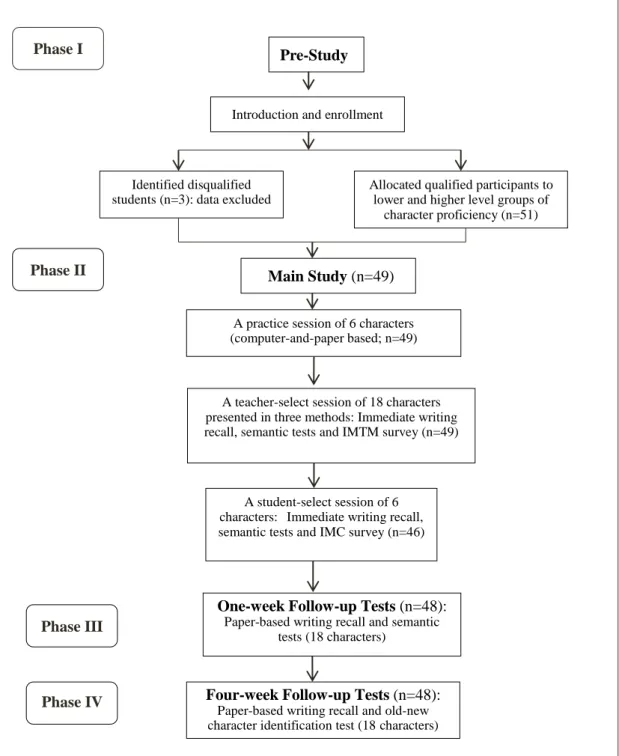
Figure 2.1 A Functional Model of Reading and Writing in Chinese………83 Figure 3.1 Summary and Flow of the Study Procedures………...……….116 Figure 3.2 Schematic of Learning, Writing, and Reading Tests
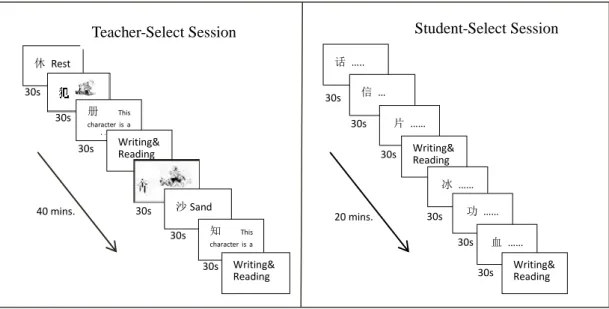
of 24 Characters...118 Figure 4.1 Student-Select Methods of Learning 6 Characters
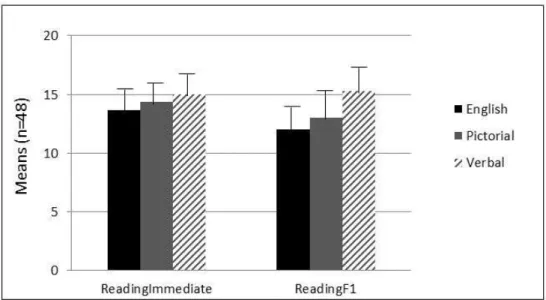
and Self-Report IBES Use……….131 Figure 4.2 Performance of Writing across Phases for 18 Characters Shown in the Teacher-Select Session……….…….138 Figure 4.3 Performance of Reading across Two Phases for 18 Characters……141 Figure 5.1 A Neuro-Educational Model for the Study of
Chapter One: Introduction Overview
English and Chinese languages represent two of the most mature language networks which use writing systems in alphabetic and logographic forms,
respectively. An alphabetic language such as English is an auditory or sound-based system in which written forms (i.e., letters) represent spoken language (Arwood, 2011). Conversely, a logographic language such as Chinese is a visual language with written forms (i.e., characters) representing underlying meaning. In view of these differences, it should be reasonable to foresee that learning Chinese
characters in an English auditory world may pose great challenges to learners of Chinese as a foreign language (CFL). The greatest challenge may come from character reading and writing; or, in other words, whether the CFL learner is able to relate character forms to the character-denoted meaning (i.e., semantic encoding of character forms) for literate communication.
This dissertation aimed to explore this challenge by looking into how English speaking CFL learners, at the beginning to intermediate level, used a
visual-semantic strategy to learn characters. In particular, the researcher
investigated the use and effect of the student-perceived imagery-based strategy to semantically encode and retrieve character forms (i.e., the imagery-based encoding strategy; IBES). The results are explained under the framework of the
Neuro-Semantic Language Learning Theory (NLLT; ibid) with scientific supports from current findings in cognitive psychology and neuroscience studies about language. It was hoped that investigating direct semantic access to character learning, opposite to auditory access, may help to reveal students’ visual-semantic learning abilities and reduce challenges stemmed from linguistic and cultural discrepancies.
Although using imagery methods of teaching and learning Chinese characters was not a recent idea, investigating this issue within a neuro-semantic framework was a new approach to addressing the challenge. In addition, by building
interrelations among disciplines from language theories, cognitive psychology, and neuroscience, this dissertation developed a neuro-educational model to investigate the cognitive processes in the acquisition of characters by CFL learners. In the meantime, it provided data towards applying the model to further research. Generally, the results and implications may be applied to understanding the underlying knowledge for all languages and learning processes.
Learning Chinese as a foreign language has grown exponentially in the past 20 years (Williams, 2010; 2013). In America, the requirements on Chinese literacy have been raised to a national standard in primary and secondary schools (see ACTFL, 2012). Despite a growing number of CFL learners, some common
difficulties in reading and writing characters continue to be reported amongst these learners (Tan, Spinks, Eden, Perfetti, & Siok, 2005; Williams, 2010, 2013). The difficulties encountered by CFL learners have been attributed to spatially-arranged
orthographic structures (e.g., Ke, 1996; Lu, Hallman, & Black, 2010), insufficient phonetic information of the character, and negative transfer of the learner’s first language (L1). For example, research in character learning strategies showed that CFL learners carried the phonetic strategy predominantly used in their alphabetic native language to learn Chinese characters (Williams, 2010; 2013).
The current study posited that the dominant use of the phonetic strategy may be because of a lack of semantic knowledge of the character; i.e., the underlying meanings or ideas which are represented by the character forms and spatial
configurations. The literature from the semiotic viewpoint of language may support the validity of this assumption in view of the original connections and relative transparency between the deep structure (i.e., meanings) and surface structure (i.e., orthographic forms) of Chinese characters (see Lakoff 1969; Pierce, 1931-58). Therefore, a directional hypothesis of this study was that understanding character meaning represented by the corresponding forms might help with meaning-form integration and lead to a better memory of the character. However, as stated earlier, the challenge is that CFL learners might not be able to understand the meanings denoted in a character, due to differences between the learner’s semantic
knowledge acquired in English L1 and character meanings evolved from the Chinese context. So, the semantic ability of the learner to align existing semantic knowledge to the meanings of the Chinese character was considered instrumental in character learning (e.g., the concept brightness/明 is linked to the sun/日 and the moon/月 in the Chinese character).
Previous studies on visually encoded (i.e., information integration and
consolidation) and retrieved (i.e., recall) character forms by making mental images of character and component meanings did not explain the interconnection between meanings and images, or the mechanism of semantic representation (e.g., Kuo & Hooper, 2004; Wang & Thomas, 1992). The current study attempted to build the bridge between meanings and visual images. Research in neurobiology showed that visual form images can be generated from semantic representations that access stored visual information about the object or experience (Gardini, De Beni,
Cornoldi, C., Bromiley, & Venneri, 2005; Kosslyn, 1994; Lloyd-Jones & Vernon, 2003). As described in NLLT, semantic knowledge or concepts are made up of images integrated from layers of semantic features (mostly visual features) acquired from sensory inputs. The visual features of a Chinese character were assumed to be represented by the components of the character (Law, Yeung, Wong, & Chiu, 2005). So, visually encoding and retrieving characters by making images of the meanings of the character and components were taken as a feasible semantic strategy to help to integrate images of meanings and forms, and code the
information into semantic memory, a relatively longer memory (Squire, 1987; Tulving, 1972; Yee, Chrysikou, & Thompson-Schill, 2014).
To explore the cognitive processes of semantic-imagery encoding and retrieval in character learning, this study analyzed the results of the students’ reading and writing data of newly-learned characters by examining the basic components. The results distinguished character reading from writing in terms of
the learners’ cognitive abilities and processes. Writing for semantic meaning
activates the imagery networks (see Kosslyn, 1994; Mazard, Laou, Joliot, & Mellet, 2005). Imagery differs from perceptual processes in the recruitment of extended semantic networks and requirement of richer encoded information or semantic elaboration (Cui et al., 2007; Heikkila, Alho, Hyvonen, & Tiippana, 2015; Olivetti Belardinelli et al., 2009). In consistency with the literature, character writing in this study was found to have activated significantly more imagery processes than reading, which was suspected to have involved more of the perceptual processes for newly-learned characters. In other words, this study supported that writing may help the learner consolidate or elaborate semantic circuits of a concept while accessing visual information to generate mental images. Nevertheless, imagery and perception interrelate to each other just as the writing and reading processes interrelate. Studies of native Chinese learners also revealed that character writing plays an essential role in Chinese reading acquisition as the deconstructing process supports the formation of connections among orthographic, semantic, and phonological units of the writing system (Tan, Hoosain & Siok, 1996; Tan & Siok, 2005; Tan et al., 2005), and may be associated with the quality of character encoding in long-term memory (Shu, 2003). Thus, it is believed that CFL learners would also benefit from mastering basic character writing on their way to higher reading skills.
This dissertation was an application of cognitive theories and findings in psychology and neuroscience in the study of language to a genuine educational
setting to help to solve a difficult learning problem – Chinese character acquisition by CFL learners. In facing the reality that neuroimaging techniques were
unavailable in this research, the researcher utilized existing scientific literature and theories as the underpinnings to explain the empirical results of character learning, and attempted to reveal the participants’ cognitive abilities underlying the learning process. Although the literature contents, which included many various pieces from multiple fields, may not seem to be the most connected and easiest to follow, the researcher believed that integrating these fields and connecting the related theories and research findings should be a desirable path to study a language function (i.e., to use language to think and act), considering the distributive and synergistic cognitive capacities of the human brain. In other words, instead of studying isolated structures such as orthographic forms, as numerous language studies did by using empirical methods, a better way to study language acquisition may be to look at it as a language function; that is, to study about the underlying thinking processes represented by the language structures. Educational studies of language and cognitive abilities of student learning should be predictable to be increasingly influenced by integrated data from interdisciplinary theories and findings. The current dissertation was made to run as an example.
Statement of the Problem
Character learning is deemed to be the most laborious and many times
discouraging work in the entire Chinese learning process for non-native learners. A body of literature has been focused on the structure and configuration of character
orthographic forms. Studies suggested that the structural complexity or density of a character significantly impacts visual perception and production of characters (Ke, 1996; Lu, Hallman & Black, 2010). Lin and Collins (2012) found that orthographic regularity and consistency played an important role in character reading. In
addition, knowledge in stroke order might be an issue. Research showed that character recognition improved when stroke order was demonstrated in animation (e.g., Chang, Stafura, Rickles, Chen, & Perfetti, 2014; Nakamura et al., 2012). Based on the literature, practical teaching and learning methods were suggested. For example, Chung (2003; 2007) and Lee and Kalyuga (2011) and suggested ways to reduce cognitive load when presenting characters with their prompts (e.g., the English equivalent and phonetic transcription). Some researchers also proposed that explicit instruction of character components may be more effective in
character learning, but often it was not emphasized in classroom instructions (Taft & Chung, 1999).
Williams (2010, 2013) also found that learning strategies might pose a problem. His research showed that English speaking CFL learners at
high-intermediate level depended on underdeveloped phonological knowledge to access characters, rather than using learned semantic components. Previous literature accorded with this result, indicating transfer of phonetic knowledge in English to character learning among CFL learners (e.g., Bassetti, 2006; Everson, 1998; Lin & Collins, 2011). In comparison, native Chinese speakers relied on visual information or semantic components extensively in reading Chinese texts
(Chikamatsu, 1996; Hao, Chen, Dronjic, Shu, & Anderson, 2013). The Chinese L2 learners, however, did not use the semantic and phonetic components of characters sufficiently (Zhang, 2009).
Pertaining to character-denoted meanings, Chinese characters are unique in the connections between component meanings and characters. In light of this
uniqueness, some CFL educators argued that a plausible way of teaching characters is to use pictures or motion pictures to interpret the connections between
component meanings and characters (e.g., Gu, 2006; Lu, 2011; Tan, 1998; Wang & Zheng, 2005; Zhang, 2005). It was suggested that using pictures to improve
semantic understanding of basic characters (mainly pictographs) may improve students’ conceptual understanding of the components and their ability to apply the knowledge to complex characters (Gu, 2006).
However, research results in using pictures to teach and learn characters are inconclusive. Research on beginning Chinese learners has revealed highly positive effects in the character form and semantic recall with picture support, compared to those without this support (Lu, 2011; Luk & Bialystok, 2005). Conversely, other research has revealed using pictures to learn to be unreliable (e.g., Hamilton & Geraci, 2006; Kuo & Hooper, 2004). Wang and Thomas (1992) pointed out that for a better effect of Chinese character retention, mnemonic images must be
learner-generated, while teacher-supplied encodings may only prove immediate benefits in the classroom.
to types of characters (e.g., ideographs or compounds and characters with concrete or abstract meanings), types of visual supports (e.g., static or motion), and levels of cognitive demands (e.g., contents in a picture). For example, Kuo and Hooper (2004) found that characters with concrete meaning produced higher scores in reading than those with abstract meaning, because characters with concrete
meaning gave rise to better visualization in the learner. However, few of the studies addressed the problem of the inconsistent results of visual support from the
learner’s semantic understanding of the images that may help with generating mental images of the character meanings to visually encode character forms. Therefore, this dissertation is more concerned with the learners’ semantic abilities in character learning; that is, using the imagery strategy to align the meaningful features learners acquired in English and those meaningful features contained in Chinese characters for character meaning-form encoding. However, due to English L1 interference (mainly from phonetics), it was unknown whether or not CFL learners at the beginning level are able to use IBES for character encoding. What was also worthwhile to know was how the learners use IBES to learn character meanings for character form encoding and retrieval.
Purposes of the Study
As previously mentioned, this study investigated the ways in which English speaking CFL learners at the beginning to intermediate level of Chinese used IBES to visually encode and retrieve character forms. Learners who perceived to have generated their own mental images or incorporated supplied images to associate
characters with meaning during character learning and recall were considered to be carrying out the semantic-imagery strategy, IBES. The use and effect of IBES were compared among three commonly-used teaching methods; i.e., characters
presented with English translation (i.e., English), characters presented with
pictorial presentation (i.e., pictorial), and characters explained by verbal instruction (i.e., verbal). In particular, this study aimed to find out which of the teaching methods led to a higher employment rate of IBES, and better performances in character reading and writing. Several other possible factors (i.e., gender, Chinese proficiency, and character type) were also tested in the current context for their effects on the student-perceived IBES.
Two major assumptions were held in the process of this investigation. The first assumption was that making mental images of a character form connected with the learner’s semantic knowledge may enhance understanding of the character and help with meaning-form integration for semantic memory. The second
assumption was that CFL learners’ existing conceptual knowledge of newly learned characters may not automatically connect to character forms; so, it is necessary that semantic features be modified or aligned to facilitate mental representation, recognition, and semantic encoding of characters.
Based on the assumptions, the major hypothesis for this study was that the CFL learner’s ability to align meanings with the Chinese character should predict a better performance in character reading and writing. As this study focused on the visual-semantic processing of Chinese characters, it bypassed the phonetic
pathway (at least in Chinese) to process characters. Research Questions
Based on the research purposes, three questions were addressed to guide the study. These questions were considered general guiding questions from which further sub-questions were derived for the measurements in data analysis and result discussion.
1. Did any of the three commonly-used teaching methods, i.e., English, pictorial, and verbal, result in a higher employment rate of the imagery-based encoding strategy by adolescent CFL leaners at the beginning to intermediate level?
2. Did any of the three teaching methods, i.e., English, pictorial, and verbal, lead to better performance in character writing and reading?
3. Did the three factors, i.e., gender, Chinese proficiency, and character type, affect student-perceived use of the imagery-based encoding strategy?
Summary of the Chapters
Chapter Two provides a review of the literature. The literature covers cultural-linguistic studies and theories of language systems; the theories and scientific findings in cognitive psychology related to language acquisition; and, neuroscience about semantic processes and networks, as well as imagery
mechanisms. The researcher attempted to bring together literature from multiple disciplines for the purpose of understanding the cognitive processes of semantic adaptation and visual image making toward character acquisition by CFL learners.
Chapter Three presents research methodology with the information of the participants, the materials and instruments used in the study, the procedures, and grading criteria developed for cognitive analyses of character writing. Chapter Four presents the results in consistency with the research questions. In addition, the qualitative data are also summarized. Chapter Five discusses the results linked to the literature. A neuro-educational model for character learning analysis is
proposed in this chapter. Following the conclusions, the researcher also discusses implications of this research for teaching applications and gives suggestions for future research based on the data from this dissertation.
Chapter Two: Literature Review
The previous chapter introduced the problems facing the researchers and educators in CFL teaching and learning, as well as the purposes and research questions of this dissertation. Chapter Two provides a review of the literature. To meet the current study purpose, studying character learning based on CFL learners’ semantic abilities through visual imagery encoding strategy, the literature was tied to theories and findings from extended but interrelated disciplines or fields that can be mainly placed into three literature modules: theories of language studies in semantic knowledge and acquisition, cognitive neuro-scientific findings in semantic networks and imagery pathways, and psychological studies of semantic memory and imagery effects in character learning. The first module sets the theoretical foundation of this research to examine the nature of semantics (i.e., meaning) in language acquisition based on the most prominent classical and contemporary models. The second module provides cutting-edge research findings that substantiate the theories in the first module and meanwhile provide evidence for the analysis of the research results in Chapter Five, Discussion and Conclusion. The third module places part of the literature into the methodology of the current study on the imagery-encoding strategy in character learning. The three modules of literature are linked and juxtaposed, forming a new triangulation model for
learning by CFL students. The triangulation model will be discussed in Chapter Five.
In this chapter, the theories and findings of the three modules are also discussed together with relevant information that the researcher found significant to understanding the current problem. Therefore, instead of arranging this chapter into three sections corresponding to the three modules, the researcher arranged the contents into five scholarly topics, thus five sections, which may help to organize subtopics in a logical flow and bring together theories and findings of related topics with complementary information drawn from different disciplines and research areas.
This chapter begins with an introduction of the Chinese language and
character, in comparison with the alphabetic English language. The second section examines the relationships of deep and surface structures in character acquisition from the viewpoint of semiotics, the theoretical foundation of the current research. The third section introduces the Neuro-Semantic Language Learning Theory (NLLT), which not only serves as a major theoretical framework in this research, but also, together with scientific findings in semantics and imagery, provides methods for the analysis of the research results. The fourth section focuses on cognitive processes of character learning with an emphasis on the distinction between imagery and perceptual processes in writing and reading. The fifth section looks at character learning by native Chinese and CFL students, as well as the effects of using the imagery strategy to learn characters.
The Chinese Language and Character
An alphabetic language versus a logographic language. Though recent neurological studies have verified universal brain networks shared by all human languages, specific pathways and processing strategies vary from language to language, and even differ in units of the same language (see Bolger, Perfetti, & Schneider, 2005; Nakamura et al., 2012). English and Chinese, in particular, which represent two distinct linguistic systems as well as their cultures, vary in a wide array of aspects, linguistically and functionally, compared to languages of their own groups. These differences, undoubtedly, result in cognitive gaps and conceptual vagueness where improper translations occur and difficulties of learning these languages loom large. Understanding some discrepancies may help learners of the two languages to acquire meta-linguistic knowledge beyond the surface forms, so as to initiate strategies necessary in the target language. In the following, a list of these differences between English and Chinese from linguistic and cultural points of view is briefly introduced. While viewing these differences as language specific, it is better to bear in mind that language specificity and universality coexist with historical preferences and cultural conventions of the people who use it.
First, in general structure, English is an alphabetic language while Chinese is considered as a logographic language. This classification is based on their distinct writing systems in which the modern English is represented by 26 Roman letters and Chinese by 560 logographemes as their basic functioning units (Han, Zhang,
Shu, & Bi, 2007). English follows prescribed spelling rules that temporally string letters representing spoken sounds into lexicons or words separated by spaces. These letters and combinations of letters represent the sounds people utter to make meanings. Chinese is composed by a multilayer stroke system, from which
logographs are built and packed in square-shaped characters, spatially arranged about the same size. Logographemes, the smallest blocks in a character (ibid.), are an orthographic form that can contain the semantic meanings of an object or idea. A majority (65.6%) of Chinese words are two-character words (Chen, Tseng, Huang, & Chen, 1993). In other words, characters are higher-level morphemic meanings with a fixed set of logographemes. In order to avoid any confusion, all the logographemes are referred to as components in this dissertation.
Second, at the semantic-phonetic level, English follows a morphophonemic system, as compared to Chinese which follows a morphosyllabic system.
Morphophonemic system in English refers to the interaction between morphemes, the smallest meaning unit, and the phonemes within them. As the functional meaning (e.g., parts of speech) of a morpheme changes, the phonemes change accordingly under morphophonemic rules, such as sleep and slept, produce and
production, knife and knives. Assumptions about this system are that
morphophonemic representations are the key access to English reading; and, by learning a series of morphophonemic rules, learners convert deep semantic
meanings to surface productions in written or oral forms (Leong & Joshi, 1997). In Chinese, a similar relationship occurs between characters and their corresponding
syllables. Chinese characters start to combine morphemes and sounds together upon visually independent orthographic forms. Each character is pronounced as a syllable constituted by separated consonant-vowel clusters (a monosyllabic language system). This morphosyllabic system differs from the morphophonemic system in that the character-syllable relationship is fixed, but entirely arbitrary. The only exception is that the phonetic components in some compound characters provide some phonetic clues to character pronunciation (see the following section in detail).
Third, English pronunciation is stress-based versus Chinese a tone-based language. In English, every word with more than one syllable is pronounced with regularly-arranged stressed and unstressed patterns. Together with adjacent words in a sentence, this stress-unstress alternation forms recognizable rhythms that native speakers expect from the sound patterns which carry meanings in a prosodic flow. As stress changes, meaning changes accordingly, such as the verb-noun conversion in many two-syllable words (e.g., the verb content means feel happy; the noun content means substance). Conversely, in the Mandarin Chinese
suprasegmental (prosodic) system, meanings are conveyed in four tones or voice inflections – high, rising, low-rising, or falling – on top of each syllable (Taylor, 2001). The sound transcription of Chinese phonetics with the combination of syllables and tones is called Pinyin. For all the 20,000 characters in the Chinese character corpus, each character shares the same sound (or Pinyin transcription) with several other characters – called homophones. As a result, meanings of speech
production must be distinguished either through contextual environments or by referring to specific characters. That is how Chinese people from various dialect areas are able to communicate with each other.
Fourth, English is a time-based language as opposed to Chinese a
visual-spatial language (Flaherty, 2003; Yim-Ng, Varley, & Andrade, 2000). This difference is manifested not only in the surface form in speech production and orthography, but also in the use of vocabularies and grammar. As aforementioned, English letter sounds merge into rhythmic patterns to convey and interpret
meanings. Chinese characters are represented with specific spatial layouts of the components so as to be recognized and distinguished in meaning (Yim-Ng et al., 2000). Time is a property of English represented by a variety of temporal words (e.g., first, then, when, etc.), as well as by the structure of the language and the use of specific ways to assign meanings (Arwood, 2011). In Chinese, temporal
meanings are commonly expressed by spatial words. For example, the characters, 上 and下meaning up and down, are also used in the words to mean morning and afternoon. In addition, explicit temporal words in many cases are omitted to avoid redundancy in contexts, such as the omission of when and while at the sentence level.
Fifth, corresponding to the sound-and-time based language features English is a low context language. In contrast, Chinese is a highly contextual language in relation to its visual character features. By low context, it means that English does not require much set-up or context for the listener to be able to understand the
meaning of a word or utterance (Arwood, 2011). The listener can understand a word without a context. In contrast, the Chinese language is highly dependent on the context due to its irregular character-sound relationships. The inclusive culture, e.g., philosophy within characters, individuals within groups, and time within space, may contribute to the development of this highly contextual language, or vice versa. The context-dependent differences in English and Chinese can be understood in the studies of visual field sensitivity. A number of studies in cultural psychology found that East Asians represented by Chinese speakers are
significantly more sensitive to surrounding areas for holistic processing of a visual space, while Westerners represented by English speakers tend to focus on central visual areas for analytic processing of a visual space (Chiao & Immordinao-Yang, 2013; Park & Huang, 2010). The differences in visual field sensitivity might be considered a direct issue in learning the visual language for English-speaking CFL learners.
In the above, the researcher listed five linguistic and cultural differences that are prevalently noticed or studied. These differences, undoubtedly, reveal cognitive gaps from both the structural and conceptual levels between people of the two languages, and might be predicted to cause difficulties for all CFL learners in Chinese character learning, as some of the difficulties have been discussed in the previous chapter. In the following, the researcher will describe, in more detail, the Chinese character used within the Chinese.
The Chinese character. Chinese characters have been in existence for over 5,000 years (Tan, 1998). It is believed that characters were formed originally from humans’ imitations of footprints of birds and beasts (Gu, 2006). It was in the 25th century B. C. that Cang Jie, a governmental historical recorder, transformed
drawings into character forms for the purpose of recording government matters and administration (Wieger, 1965). In the earliest scripts, characters represented
concrete objects and natural phenomena (Gu, 2006). Complex meanings were expressed by adding and embedding components into existing scripts to form a unified square-shape character. For example, the character 塞 (to obstruct) is made up of three components from the top to bottom, including a house with a roof and a wall made of bricks (the top), two hands pressing on the wall (the slanting lines in the middle), and a pile of earth which stops rain or wind from coming into the house (the bottom). Not surprisingly, some people describe Chinese characters as paintings (Wang & Zheng, 2005) and some others describe them as stories that can be broken down into components with story formats (Williams, 2010).
With the evolvement of Chinese characters in shape and connotative meanings, several other ways of character formation emerged. Xushen (58
A.D.-147 A. D.), the first Chinese lexicographer, categorized Chinese characters in six types, which are still considered the most accepted methods for character categorization and structure analysis. All of the 9353 characters in Shuowen Jiezi
(100 A.D.), the first Chinese etymological dictionary compiled by Xushen (Serruys, 1984), fall into these six types: pictographs, indicatives, ideographs,
semantic-phonetic compounds, transformed cognates, and phonetic loan characters (Lu, 2011). Table 2.1 illustrates the six types of character formation methods.
Table 2.1.
Xushen’s Six Types of Character Formation Methods in Shuowen Jiezi (100-121 A.D.). Types Formation Methods Examples
1. Pictographs 2. Indicatives 3. Ideographs 5.Transformed cognates 6. Phonetic loans
Note. The slash (/) separates a Chinese sound on the left and an English meaning on the right. Adapted from “The Effect of Instructional Embodiment Designs on Chinese Language Learning: The Use of Embodied Animation for Beginning Learners of Chinese Characters,” by M. P. Lu, 2011, doctoral dissertation.
Pictographs were created from images or pictures of objects.
水(water),火(fire)
雨(rain)
Indicatives are usually formed
with symbols indicating
functional meanings.
大(big), 小(small),
上(up), 下(down)
Ideographs usually combine
several pictographs to denote complex ideas.
明(bright)=日(the sun)+
月 (the moon); 森
(forest)= triple木 (wood)
4.Semantic-phonetic Compounds
Compounds are composed of two of more components or characters. One of them suggests the meaning, and the other provides the pronunciation cue for the character. 洋(ocean)=氵(water)+羊 (yáng/sheep); 装 (pack)= 壮 (zhuàng/strong) + 衣 (clothing)
These characters usually borrow the shape of an existing character and carry a similar meaning.
老(old) 考(old)
These characters are borrowed from an old character with similar pronunciation, but the old ones are lost in meaning.
来(come) 来 (grain in the old meaning)
When writing characters, native Chinese usually follow precise rules to compose characters in a hierarchical order; single strokes into block-like and square-shape components which are arranged into characters. These rules mainly include knowledge of stroke types, stroke directions, length or position of strokes in relation to others, stroke orders, and placement of components. For example, native Chinese speakers may know that a typical semantic component, usually called a radical, is placed on the left of a compound in the left-right structure. Beginning learners typically learn by practicing writing with a grid as a guide (Chen, 2005). Misplacing these components result in confusion, non-characters, or characters of totally different meanings. There are four basic structures in Chinese characters: left-right (e.g., 好), top-down (e.g.,要), outside-inside (e.g.,问), and symmetrical (e.g.,坐).
After analyzing the structure, a skilled native writer starts to deconstruct parts or components into intricate strokes, and write the strokes in conventional orders and directions. For a right-handed person, strokes are drawn from top to bottom and from left to right. Theoretically, there are nine basic strokes, from which seventeen are derived and used (Tan, 1998; Wieger, 1965). Table 2.2 illustrates the nine basic strokes, stroke directions, and examples of characters composed by conventional stroke orders.
Chinese characters have undergone thousands of years of evolvement from as many as eighty-four strokes in one character to nowadays an average of eight strokes (Shi, 2012; twelve strokes for traditional characters). Above ten strokes, it is viewed as difficult in writing (Lu, 2011). Due to simplifications over time, many
Table 2.2.
Nine Basic Strokes, Stroke Directions, and Examples of Character Structure and Stroke Order
Stroke Type Writing Direction
1.
一
The horizontalLeft-Right: 明 ( bright) = 日 + 月
Up-Down:美(beauty)=羊 + 大
Outside-Inside:困(confine)=口+木
2.
丨
The vertical3.
丿
The downward to the left
4. The downward to the right
5.
丶
The dot6.
㇀
The upward
7.
亅
The hook
ㄱ
The horizontal turn9.
ㄴ
The vertical turn
Examples of Character
Structure and Stroke order
Note. Adapted from “What’s in a Chinese Character?” by H. P., Tan, 1998. Copyright 1998 by New
Chinese characters used at present have lost their etymological meanings or left little traces of their formation methods; instead, many have become more like arbitrary symbols packed in square shapes. Despite the simplification, a large number of characters today, especially the most basic and frequently used ones, still bear more or less traces of the actual objects or original meanings (Gu, 2006). These basic characters, a large number of them, evolved into building blocks or components of contemporary scripts with the original meanings of the basic characters being layered down in the current meanings. In this sense, learning characters through their underlying meanings of these components can be
instrumental, especially for CFL learners, due to the benefits from recognizing and understanding the meaning-related blocks. In the following, the researcher will review the current status of Chinese learning and methods of character teaching in ordinary classrooms in the United States.
Learning Chinese as a foreign language in the United States. As China has become the second largest trade partner of the United States since 2006, the number of learners of the Chinese language has been dramatically growing in elementary, secondary and higher education classrooms. According to an ACTFL report, the enrollment of Chinese, as a foreign language, in American public schools increased three-fold from 2005 to 2007 (ACTFL, 2015). There is a 100% increase of Chinese programs in two years in the US (Shao, 2015). In some states such as Colorado, Chinese has surpassed all other languages as students’ first choice for foreign language learning (Lofholm, 2012).
Recognized as a less-commonly-taught critical language for the U.S. economy and national security (National Security Education Program, 2016), Chinese programs have been broadly funded (Zhang, 2009). Teacher training programs and seminars have attracted thousands of Chinese teachers annually across the US. Starting from 2004, the Chinese government, through The Confucius Institute Headquarters (generally called Hanban), has launched a global campaign to promote the Chinese language and culture by sponsoring overseas Chinese programs and dispatching native Chinese teachers. The United States has been its largest recipient, hosting 100 Confucius institutes and 384 Confucius classrooms in 2015 (Confucius Institute Headquarters, 2015).
A “Chinese Fever” has emerged (Liu, 2008). Textbook books and materials in Chinese character teaching and learning have surged in the market; and, various approaches to character teaching and learning have been suggested. In general, there are books centering on stroke order and structure building writing (e.g., Mathews & Mathews, 2006; Zhe, 2014), or on etymological meanings of basic characters illustrated with pictures (e.g., Tan, 1998; Zhang, 2005). Also, there are attempts at adapting the etymological meaning of characters to the modern shapes, for which newly-designed illustrations are used to integrate components into logical meanings (e.g., Gu, 2006; Matthews & Matthews, 2007). Matthews and Matthews (2007) described this new method as “telling an imaginary story.” This method, parallel with the study methods in this research, may indicate a possibility that visual-semantic strategy may be applicable to characters of different types and
origins; and, CFL students can learn in this way, if they are given sufficient meaningful information of the character.
Software tools for character learning are rare, though some researchers designed stroke animation (Shi, 2012) and graphic animation programs to learn basic characters (Li, 1996; Lu, 2011). Most of the character writing on the computer is done by using phonetic-character transcription on word processors, which leads to fewer character errors. Students, however, often regard Chinese writing as stroke-by-stroke character formation (Kang, 2011). They find it useful to practice character writing on cellphone applications (e.g., PLECO, a mobile phone dictionary) which identify strokes and components that they can then convert to intended characters.
Despite newly developed technology and methods, it seems that few of the approaches have been effectively applied to everyday classrooms. Chinese is still regarded as the most difficult language in terms of literacy acquisition for learners of CFL. It is estimated that, using the same amount of time, learning Chinese from level 1 to level 2 equals three times more than learning other languages such as French, Dutch, and Swedish (Lu, 2011). Zhang (2009) reported that ninety-percent of the students who quit after first-year Chinese quit because of the difficulties in learning characters. This setback has caused a long-term debate on whether characters should be introduced at the beginning level of Chinese learning (Kang, 2011). Having recognized the common difficulties in Chinese reading and writing, ACTFL has allowed a one-year delay on reading and writing skills for CFL
students compared to students learning Spanish, French, and German (ACTFL, 2012). There is not a consensus on a desirable way to teach characters. At present, the traditional way of translation and rote memorization is still the dominant method in beginning and intermediate CFL classrooms (Lu, 2011). Up to now, it is not yet certain whether it is CFL learners’ lack of abilities in acquiring the visual language or the traditional way of teaching that has caused the delay of literacy in Chinese. However, at present, it is time that people drew more attention to more meaningful methods for character teaching and learning in everyday classrooms; the visual-semantic way should be worth serious studies. The following section may give some fundamental knowledge about the relationships of character meanings and forms. Understanding these relationships should be essential to the acquisition of the language.
Deep and Surface Structures in Chinese Character Acquisition
Deep and surface structures are the concepts borrowed from the generative grammar theory proposed by Noam Chomsky(1972; 2013) in his book, Studies on Semantics in Generative Grammar. In this book, Chomsky defines surface
structures as the structures mapped into phonetic representations by the
phonological rules. Deep structures are the post-lexical structures (including some grammar) which are mapped into semantic representations by the semantic rules. This definition of deep structures received criticisms of mapping the grammar structures to semantics, equating to say that grammar pre-exists semantics. The later generative transformational theorists reversed the process, indicating that
through transformational rules deep structures can be transformed into surface structures (Lakoff, 1969). That is to say, semantic meanings generate and transform into surface forms, which will be later discussed in this section.
Applying these linguistic notions to the Chinese character, surface structures should be regarded as the structures mapped into orthographic representations by the orthographic rules, i.e., the strokes and configuration rules of the strokes to a character form. The deep structures of a character entail the underlying semantic meanings and the rules that constitute the meanings. The semantic rules, which users of the Chinese language should be aware, include the constituent meanings of a character or phrase, and the placement of the constituents that carries the
semantic relationships with other constituent meanings (e.g., where the radical is positioned in a compound). Though Chinese texts are not a concern in this study, they also follow these rules (see the transformative rules in generative semantics; Chomsky, 1972, 2013).
This section only uses these two concepts as the general terms representing similar terms used by different scholars or theorists to analyze the deep and surface structures in Chinese characters. To be more specific, the researcher analyzes the relationships of character deep and surface structures under the framework of semiotics. Although semiotics did not directly use the terms, deep and surface structures, the discipline can be taken as a methodology that deals closely in language studies, especially in language acquisition, for analyzing
applicable to the analysis of the Chinese symbolic system.
Deep and surface structures in semiotics. Semiotics sets the theme for investigating the necessity of symbolic cognition in general. It refers to the study of signs and symbols to their referents, and particularly in language (Jakobson, 1980). Two dominant models of signs are credited to two prominent figures in semiotics: the linguist Ferdinand de Saussure (1857-1913) and philosopher Charles Sanders Peirce (1839-1914). Although these models have been applied to various fields and linguistic levels, the analysis in this section is limited to the way in which these models can be applied to basic language units such as the character. Saussure (1959) in his Course in General Linguistics introduced a dyadic sign model, which is composed of a signifier and a signified. The signifier refers to the orthographic or phonic component of a word, equivalent to surface structures. The signified is the ideational component that connects with the concept, paralleling deep structures. The sign is the whole that results from the association of the surface structures with the deep structures. They are two distinct but correlated planes, neither pre-existing the other (Chandler, 2014). Rather than proclaiming a logical relationship between the two components of a sign, Saussure emphasized the arbitrariness; i.e., there is no direct connection between the sound (or the orthographic form) and the concept. He also posited that their association comes into being only through conventions and uses. According to him, no sign makes sense on its own but only in relation to other signs (Saussure, 1983).
linguistics in analyzing linguistic structures especially for alphabetic languages. However, this principle can only be loosely applied to the logographic Chinese in which referent meanings gave rise to orthographic forms of the character. Even for modern scripts, research showed that half of the simple characters are iconic in reference to their concepts that can direct the reader to their meanings (Luk & Bialystok, 2005). Nevertheless, the interpretation of the same character may vary person by person. Even for some non-arbitrary characters, the same sign can be interpreted in multiple ways and generate multiple meanings. For CFL learners, this sign system can be totally arbitrary until they have learned to associate deep semantic meaning or deep structures with corresponding surface structures and have acquired the rules that constitute the layers of each structure level. Saussure’s arbitrary principle of signs received many criticisms. Later, he introduced the concept of relative arbitrariness (Saussure, 1983); that is, there is a degree of arbitrariness among signs.
In terms of language systems, Saussure emphasized the operation of the arbitrary principle upon each language system, because exact equivalents for words between one language and another seldom exist (ibid.). Reality, using words as the arbitrary units for analysis, could be divided up into arbitrary categories by every language and the conceptual world (Chandler, 2007). People may perceive and therefore conceive the world in great difference due to meanings that have previously been assigned in different environments to similar concepts. In other words, the arbitrariness may not just occur between surface and deep structures,
but also within the acquisition of meanings for the deep structure. The concepts in deep structures and how the deep structures are related to surface structures are founded on social and cultural conventions (ibid.).
About the same time to Saussure’s dyadic model of signs, Peirce formulated a triadic model. In this model, a sign is made up of three components which he called the representamen, object, and interpretant (Merrell, 2001). The
representamen is the form which the sign takes. The interpretant is best understood as the interpretations made to the sign. What the sign stands for is its object or referent (Peirce 1931-58). According to Peirce, the object can never be identical to the real object, but only certain features of an object are signified (see Merrell, 2001).
Relating these three concepts to the previous semiotic concepts, the representamen is similar in meaning to the signifier or surface structures
(Silverman, 1983). The interpretant on the basis of the object is similar in meaning to the signified or deep structures. The relationship of the three sign components can be best illustrated in Chinese character examples. For the surface form 羊 (the representamen), it connects the learner to some ideas related to the animal class which they have learned previously (the interpretant), and then activates an
obscure image of a sheep with the horns but not the complete features of the sheep (the object).
The beauty of the triadic model lies in the developing process of a sign. The meaning of a sign is not contained within it, but arises in its interpretation
(Chandler, 2007). The interpretant relates to and mediates between the
representamen and the object. As a result of such mediation, the sign takes on value, meaning, as the interpretant interrelates and participates with other signs (Merrell, 2001). An interpretant serves to further generate more developed signs of the object; which, through some features, generates an additional interpretation. This process leads to an infinite chain of signs. The most important part in this process, according to Pierce, is the interpretant (Peirce, 1931-58), or interpretation from which the meanings of a sign can further refine in meaning. To apply this principle to character learning, one can see a developing process at multiple levels, such as from radicals to characters. The most important step in this process
depends on the interpretant (i.e., the learner’s interpretation) to mediate among signs.
In Peirce’s view, there are three kinds of signs (Peirce, 1894). First, there are the likenesses, or icons; a type in which the form is perceived as resembling or imitating the object, e.g., the Chinese pictographs. Second, there are indications, or indices, the type in which the form is directly connected in some way (physically or causally) to the object or ideas, such as radicals in Chinese characters. Third, there are symbols, or general signs, which have become associated with their meanings by usage, e.g., many simplified characters such as 义 (righteous). Peirce (1894) noted a regular progression in the three orders of signs: icons,
indexes, and symbols, which are referred to as firstness, secondness, and thirdness. Such a progression is apparent in the evolution of Chinese characters from the
most primitive iconic signs towards the symbolic signs. It is the symbolic mode that is granted a greater status (Chandler, 2013). Peirce (1931-58) noted that symbols are the only general signs essential to reasoning, so he called the symbol parts of signs “concepts”. It is only out of symbols that a new symbol can grow, and by thoughts and use with people, meaning grows across time (Pierce, 1894). For both Saussure’s dyadic model and Pierce’s triadic model of signs, all these kinds of signs can be generally classified into deep and surface structures, which are distinct but interrelated planes. Semantic deep structures give rise to and determine the function or semiotic value of the surface structures. Furthermore, interpretations of deep structures grow into more developed deep structures and so on, in the process by which meanings arise. Unlike Saussure’s model, Pierce’s model does not support the notion of absolute arbitrariness among signs. They differ in how arbitrary (or transparent) the signs are in relation to reality and how “the use” of the signs are interpreted (Chandler, 2014). Hence, within the
framework of semiotics, it is reasonable to argue that in learning a foreign
language such as Chinese, developed deep structures in the learner’s mind account for a developed representation on the surface structures. This suggests that the underlying meanings are culturally distinct; and, as such, influence interpretation of the surface forms. Likewise, the differences between Chinese and English, at the surface level, represent the underlying semantic difference. Both the deep and surface structures could be responsible for the difficulty that English speakers have in learning the characters of Chinese.
Structures vs. semantics in language learning. Structuralism has dominated academic fields, especially linguistics, in the 20th century. Language structures, including words, sounds, sentences, parts of speech, and so forth (Arwood, 2011), are prevalently used in language classrooms for parsing, distinguishing, and analyzing language patterns up to the present. Structuralism in linguistics was founded upon Saussure’s semiotic model of the arbitrariness of signs (see
Matthews, 2001). The assumption is that signs are interrelated with each other by conventional use. Coupled with the doctrines of behavioral psychology from the 1940s, structural linguistics became a dominant theory applied in second language learning classrooms. In this model, learning a language aims to condition learners to make the right association between stimuli and the desired responses (e.g., seeing and naming). Behaviorists declared that only behavior observed can be described and explained as the valid account of learning (Rachlin, 1994). In this paradigm, memory consolidation is mainly realized through drillings and repetitions. Semantics, the study of meaning, is ignored in this process (Ellis, 1999). It is believed that language could be dismantled into small pieces or units, described scientifically, contrasted, then added up again to form the whole (Brown, 2006).
These surface units are drilled in response to models; and, this type of paradigm prevails in current CFL classrooms where characters including orthography, phonetics, and English equivalents are learned through times of mechanical drilling and copying (Kang, 2011; Lu, 2011). Though studies have
yielded positive results of stroke modeling and repetition in learning Chinese characters (e.g., Chang et al., 2014; Nakamura, et al., 2012), the long-term effect of structural training in learner performance and learning-related affective issues were not considered. More focused studies should be needed in these aspects (Anderson, 2011).
In contrast with structural linguistics, a learning paradigm with an emphasis on semantics is committed to meaning and contextual, or relational, information in language learning (Arwood, 2009). It is Pierce’s notion of pragmaticism1,
analyzing the relationships of three components of signs, that has built the
foundation of nowadays language studies with a focus on meaning (Arwood, 1983). As described in the previous section, Pierce’s notion of meaning, different from linguistic structures such as isolated words, is a dynamic process of an infinite interpretation of signs derived from the original object (Arwood, 1983; 2011). In Peirce’s view, things are not viewed from the parts (the specifics) to the whole, but rather should be taken as a complex that bears the relation of the whole to the parts (Foster, 2011); i.e., the meaning and context predetermine the structure. The term pragmaticism itself means the whole is greater than the sum of the parts (Arwood, 1983). That is to say, meaningfulness of the language naturally came before structures or surface forms. In the same vein in language acquisition (both in L1 and L2), ideas or the meanings of a sign (i.e., sounds or orthographic forms)
1 Pierce labeled his own theory “pragmaticism”, distinguishing from the theory of pragmatism proposed by William James, due to their differential treatment in the study of logic of signs (Apel, 1981).
invoke the acquisition of the sign in relation to other signs.
Character learning should also consider the pragmatic operation of learning: from contextual meanings comes the acquisition of the orthographic form based on conventional use. It is not only because character forms represent the underlying meanings, but because Chinese characters cannot be isolated or used out of context. Homonyms and synonyms constitute a large reservoir of the character inventory, and even semantically independent two-character “words” many times must be interpreted in situational contexts. As mentioned previously, Chinese is a
high-contextual language. So, mechanically memorizing the form and sound of a character, most of the time, leads to incorrect associations. Errors in Chinese learning, including those by native children and CFL learners, usually originate from a lack of semantic processing of characters (Weekes, Yin, Su, & Chen, 2006).
In short, meaning is not a static entity. The deep structures of meaning constantly develop as the meaning or semantic relationship that forms concepts refines in changing contexts, uses, and forms. Therefore, it is not difficult to infer that the meaning of multi-layered deep structures results in learning at various levels that require different amount of cognitive resource; hence, different learning results.
Among levels of meanings that affect learning results, two types of meaning – concrete and abstract meanings – have been distinctly identified and studied for their effects in learning (e.g., Bleasdale, 1987; Romani, McAlpine, & Martin, 2008; Walker & Hulme, 1999). Character learning should also be affected in the levels of