This is the author’s version of a work that was submitted/accepted for pub-lication in the following source:
Biggs, Sarah E.&Biggs, Herbert C.(2012) Safety culture research in the construction sector : interlocked projects in safety competency and safety effectiveness indicators. In Boustras, G. & Boukas, N. (Eds.)Proceedings of the 1st International Conference on Safety and Crisis Management in the Construction, Tourism and SMEs Sectors, Brown Walker Press, EUC Cultural Center, Nicosia, Cyprus, pp. 352-363.
This file was downloaded from: http://eprints.qut.edu.au/48271/
c
Copyright 2011 [please consult the author]
Notice: Changes introduced as a result of publishing processes such as copy-editing and formatting may not be reflected in this document. For a definitive version of this work, please refer to the published source:
Safety culture research in the construction sector: Interlocked
projects in safety competency and safety effectiveness indicators
SARAH E BIGGS and HERBERT C BIGGS
Centre for Accident Research and Road Safety - Queensland Queensland University of Technology
130 Victoria Park Road, Kelvin Grove QLD 4059, Australia
ABSTRACT
Safety culture is a concept that has long been accepted in high risk industries such as aviation, nuclear industries and mining, however, considerable research is now being undertaken within the construction sector, with varying levels of success. The current paper discusses three recent interlocked projects that have had some success in the Australian construction industry. The first project examined the development and implementation of a safety competency framework targeted at safety critical positions across first tier construction organisations. Combining qualitative and quantitative methods, the project: developed a matrix of safety critical positions (n=11) and safety managements tasks (SMTs; n=39); mapped the process steps for their acquisition and ongoing development; detailed the knowledge, skills and behaviours required for all SMTs; and outlined organisational cultural outcomes that could be anticipated in a successful implementation of the framework. The second project extended research on safety competency and leadership to develop behavioural guidelines for leaders to drive safety culture change down to second tier companies. This was designed to assist smaller construction companies to customise their own competency framework and develop implementation guidelines that match their aspirations and resources. The third interlocked project explored the use of safety effectiveness indicators (SEIs) as an industry-relevant assessment tool for reducing risk on construction sites. With direct linkages to safety competencies and safety management tasks, the SEIs are the next step towards an integrated safety cultural approach to safety and extend the concept of positive performance indicators (PPIs) by providing a valid, reliable, and user friendly measurement platform. Taken together, the results of the interlocked projects suggest that safety culture research has many potential benefits for the construction industry, particularly when research is conducted in partnership with industry stakeholders. Suggestions are made for future research, including further application and testing of the safety competency framework and aligning SEIs across construction projects of varying size, location and design.
INTRODUCTION
Workplace safety incidents are a significant global issue, and in particular, the construction industry is over-represented in workplace injury and death statistics. Despite mechanization, the industry remains labour-intensive and workers are exposed to dynamic, high risk environments on the various projects and construction sites. The International Labour Organisation [1] reports that at least 60,000 fatal accidents occur each year at construction sites worldwide, equivalent to one death every ten minutes. Furthermore, one out of every six fatal workplace accidents takes place at a construction site, and this is increased in industrialised countries, where construction site fatalities account for 25-40% of all workplace fatalities.
In Australia, there were 40 fatalities recorded in the preliminary data for 2008–09, which was the highest number of fatalities of all industries. This corresponds to a fatality rate of 5.9 fatalities per 100 000 employees, which is more than twice the rate of 2.3 for all industries [2]. In addition, the construction industry accounted for 11% of all serious workers’ compensation claims, equating to 40 employees each day requiring one or more weeks off work because of work-related injury or disease.
The economic and social costs of workplace safety incidents are considerable, and in the past governments, industry, and academia have responded to the problem with legislative and compliance-based responses, and a focus on engineering controls and management systems. Following several major disasters in the nuclear, oil, and mining sectors, safety culture has been identified as a critical concept for organisations in reducing workplace safety incidents. Construction industry organisations have also recognised the importance of cultural influences on safety performance, in particular through the ability of organisational members to effectively implement and continuously improve relevant safety management systems.
Whilst definitional and conceptual variations exist within the safety culture field, it is generally understood that an organisation’s safety culture reflects the values, attitudes, competencies and behaviours of individuals and groups in relation safety [3]. Safety culture is considered a complex, multidimensional construct [4] and this can make it difficult to operationalise at a business level. However, within organisations, some members are suggested to have more influence than others in the development of safety culture [5], and the identification and training of these members is critical to the success of organisational culture improvement strategies. Much of the literature deals with the importance of leadership and management commitment to safety; however it is vital to translate that importance into meaningful frameworks that guide organisations through the practical process of improving safety culture and related safety outcomes.
During 2004-2010, a series of research projects were undertaken in Australia to develop a more comprehensive understanding of the safety issues and challenges in the construction sector. These endeavours enabled the development of a Construction Safety Competency Framework, an implementation process and Practical Guide to Safety Leadership, and an exploratory development of a new type of lead indicator entitled Safety Effectiveness Indicators. All three research foci are briefly described as follows.
CONSTRUCTION SAFETY COMPETENCY FRAMEWORK
Developing safety culture and improving safety performance are current challenges for the Australian construction industry. Although there have been improvements in occupational health and safety performance over the past 20 years, the injury and fatality rate in the Australian construction industry remains a matter of concern. Current research has identified that positive safety culture is correlated with positive improvements to traditional ‘lag’ indicators such as injury and time off work [6], [7]. The problem for industry is how to create and maintain a positive safety culture in different organisations.
Key to the proposed element of research was the establishment of a compendium that lists all roles within a construction site that are in a position to drive the site’s safety culture. By identifying the people who have a primary role in the development and maintenance of the safety culture it is then possible to target training interventions to these people. Toole [8] has provided a useful guide to identifying safety critical positions within the construction industry. The author has proposed that “accidents” are a result of eight factors: lack of proper training; deficient enforcement of safety rules; lack of safety equipment; unsafe work methods; unsafe site conditions; failure to use proper safety equipment; poor attitudes held towards safety; and isolated unavoidable causes. Therefore, it should be possible to identify safety critical positions by identifying all people who have an influence over those preventable factors. The benefits of this approach include being able to collect information about safety critical roles that are not traditionally seen as primary “safety roles”. For example, through focus group consultations using the Toole model as a guide, it may become apparent that a key person influencing site safety culture is the person who “mans” / controls access to the site – a role that may not be recognised for its importance. After identifying safety critical roles it is vital to detail the competencies that make a person skilful in that role.
Recent investigations into construction site safety culture [9], [10], have provided an opportunity through which the industry could focus on this issue. This research, with significant input from industry, developed the Construction Safety Competency Framework which identified 39 Safety Management Tasks and 11 Safety Critical Positions which are crucial to understanding which ‘critical’ safety position holders in an organization are responsible for what safety task. Specific safety positions were ranked with either a 1 or a 2 indicating the level of proficiency and understanding, respectively, the position occupant needed to demonstrate on each of the safety tasks; a score of 1 indicated a full understanding was required, while a score of 2 indicated that working knowledge was necessary. The safety critical positions within the industry that have a significant impact on safety culture were mapped, and the behaviours and competencies required to successfully drive a positive site safety culture were identified. Essentially, the Competency Framework identified, in detail, what process should be followed when completing particular tasks; the knowledge, skill and behaviours required to complete the task effectively; and what cultural outcomes should be achieved if the task is completed effectively. The Framework also provided some initial recommendations to industry on training, mentoring and employee motivation. The Competency Framework proved to be a useful tool in developing safety culture; however feedback from industry indicated that further resources were necessary for industry personnel to be able to adopt the recommendations put forward in the framework. In addition to an easier implementation process requiring fewer resources, there was also an industry articulated need for better options for defining and measuring lead indicators.
PRACTICAL GUIDE TO SAFETY LEADERSHIP
The development of the Construction Safety Competency Framework [10] formulated comprehensive implementation guides for the Safety Management Tasks and Safety Critical Positions identified in the Framework. The outcomes have the potential to enhance current safety skill and behaviour acquisitions in 1st tier construction companies (principal contractors) and greatly assist the strategic development, planning, and implementation of these skills and behaviours in 2nd tier construction companies and associated contractors and sub-contractors.
In order to develop a useful implementation guide for the Framework, it was important to firstly identify the sections of information that would help industry to begin to implement the Framework in a systematic and efficient way. It was also important to highlight the fact that the Framework should be customised to meet the needs and level of safety competency already within the organisation. To this end, preliminary development of the guides commenced, a brief ‘how-to-implement’ document was conceived, and industry participation was sought. Following feedback from industry and corporate partners, several modifications to the original development of the guides were made to the final version.
Of the 11 Safety critical positions that were identified in the Framework, four super-ordinate categories or Framework Implementation audiences were created. These categories aimed to collapse the 11 positions into more workable categories for the presentation of the information. It was thought that not all companies would employ staff to fill each of the 11 individual positions identified in the Competency Framework, especially in smaller organisations. For parsimony, the 4 categories were: a) Senior Managers (inclusive of CEO’s and Senior Managers); b) Safety Professionals (inclusive of National Safety Managers, Regional Safety Managers and State Safety Managers); c) Engineers and Project Managers (inclusive of Engineers, Project Managers and Construction and Operations Supervisors), and d) Construction Site Managers (inclusive of Site Managers, Foreman and Site OSH Advisors).
Following the initial focus group which indicated that the organisation had been attempting to implement the Framework, it was decided to solicit case studies from organisations who were already working down that pathway. Therefore, several 1st tier organisations were approached and agreed to provide examples or case studies as to how they initially tackled the task of beginning to map and implement the Competency Framework within their organisations. In keeping with the notion of customising the Competency Framework to suit pre-existing safety matrices and internal structure within organisations, each company began the implementation in different ways. It is believed that the ‘tip sheet’ and ‘industry case studies’ will vastly improve the understanding and accessibility of the Framework, particularly for 2nd tier organisations where such information fulfils both an informatics and mentoring function.
The importance of the focus groups with industry professionals cannot be underestimated. Not only do they provide valuable and knowledgeable feedback about the usefulness of the information to industry, but the participants also become stakeholders with ownership of the finished product. Their input helps shape the finished product and therefore the authors can be more confident that their product will be both accepted and valid for industry use.
The final guide in actuality looks quite different to the original guide sent to industry for comment. Although the premise of aiding companies to customise the Framework to suit their individual needs stays intact, the presentation of the guides has changed.
The presentation focus now is on the steps necessary to customise the Framework and therefore draws more heavily on an operational flowchart contained in the original document. This flowchart identified 8 steps to implementation, including: Understanding safety culture; Identify safety critical positions; Customise the task and position matrix; Plan, adapt the competency specifications; Use a step wise approach, and; Implement and show continuous improvement. The final guide includes a substantial unpacking of these flowchart steps, defining them, identifying why each step is important, and detailing how the company can implement this step in their organisation. Furthermore, each step contains action ‘tick boxes’ to complete and are illustrated using one or more case study excerpts from industry activity.
The guide contains two workbook style components which can be used to start to implement the Framework in a workshop, pen and paper style manner. Firstly, the action lists from each of the 8 Framework flowchart steps are consolidated into one action document to help prompt organisational personnel and identify subsequent steps. Second, several questions and a blank matrix were included that will help organisations perform a current status health check on their company. The questions help identify whether an organisation 1) already has a safety management task in their organisational documentation or not, 2) already has a position holder responsible for a safety management task or not, and, 3) already has a training program providing education (rather than training) in particular safety management tasks or not. Following this exercise, the organisation can begin to complete the ‘blank matrix’, a matrix from the original Competency Framework with the safety critical positions list removed so that companies can identify, in the context of their own organisation, which position is responsible for each task.
SAFETY EFFECTIVENESS INDICATORS
Other than lost time injuries (LTIs) or similar ‘negative’ ‘lag’ performance indicators, reliable, comparable and easily undertaken performance indicators are not available. An evaluation of Positive Performance Indicators (PPIs) as an OHS performance measuring tool, based on a brief overview of its limited uptake in Australian industry, suggests that it does not reliably measure OHS performance. There is a clear need to accurately measure safety performance on construction sites in order to improve industry performance.
These measurements have the obvious inherent problem in that they can only be compiled after something has gone wrong, thus a negative measure – one of failure, rather than performance. Another contributing factor to poor OHS in the construction industry is the various State and Federal laws that govern OHS throughout Australia. These can be confusing and lead to inconsistencies between the safety regimes between states, and between and within construction companies.
Establishing a credible, accurate and timely standard for allowing industry-wide measurement of OHS performance remains the key to moving forward in improving OHS by the Australian Government [11]. Referred to as lead indicators, they aim to recognise signals before an incident happens. This would give a way to improve safety before an event occurs, thus reducing the lag indicator rates. At present the only tool actively used to measure lead indicators are Positive Performance Indicators (PPIs). PPIs measure the actions an organisation has taken to manage and improve OHS performance. Views on the effectiveness of PPIs have varied, but there has been limited uptake by industry, which suggests they do not reliably measure OHS performance [12]. A major problem with PPIs is they measure how often an event occurs, rather than how effectively it is undertaken. There has been a general lack of consistent uptake in the industry as a whole, and lack of convergence and guidance in the literature.
The challenge for a new framework of lead indicators is to develop reliable, comparable and constant indicators that measure safety performance without the drawbacks commonly attributed to PPIs: The indicators must be easily measured, comparable for benchmarking purposes within sections of an organization and across industries without being subject to random variation. For the construction industry specifically, they must be able to be implemented uniformly from project site to project site notwithstanding the disparate sectors of the industry, the variability of the work undertaken and the diverse risk contexts these generate. Further, they must be simple to implement so that they are not capital and human resource intensive: They must not be so complex that they are time-consuming to administer and collate and they must measure effectiveness instead of simply measuring a number of event s which have no demonstrated effect on safety performance.
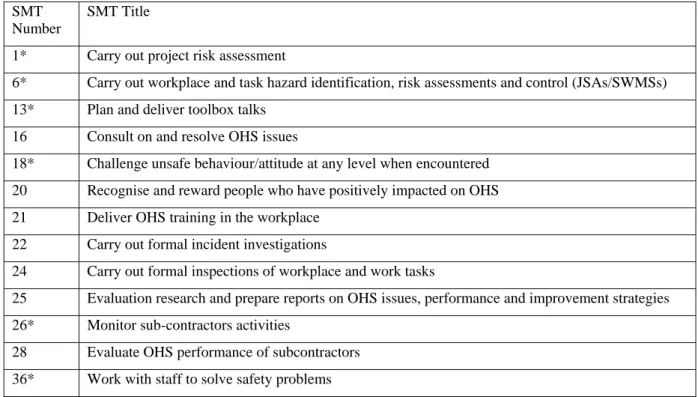
The concept of Safety Effectiveness Indicators (SEIs) assisted the development of 13 of the original 39 Safety Management Tasks (SMTs). Resource constraints restricted both the pilot study and the follow on field trials to a total of 13 SMTs.
Table 1. List of all 13 SMT’s across Pilot and field trials. (*SMTs used in pilot) SMT
Number
SMT Title
1* Carry out project risk assessment
6* Carry out workplace and task hazard identification, risk assessments and control (JSAs/SWMSs) 13* Plan and deliver toolbox talks
16 Consult on and resolve OHS issues
18* Challenge unsafe behaviour/attitude at any level when encountered 20 Recognise and reward people who have positively impacted on OHS 21 Deliver OHS training in the workplace
22 Carry out formal incident investigations
24 Carry out formal inspections of workplace and work tasks
25 Evaluation research and prepare reports on OHS issues, performance and improvement strategies 26* Monitor sub-contractors activities
28 Evaluate OHS performance of subcontractors 36* Work with staff to solve safety problems
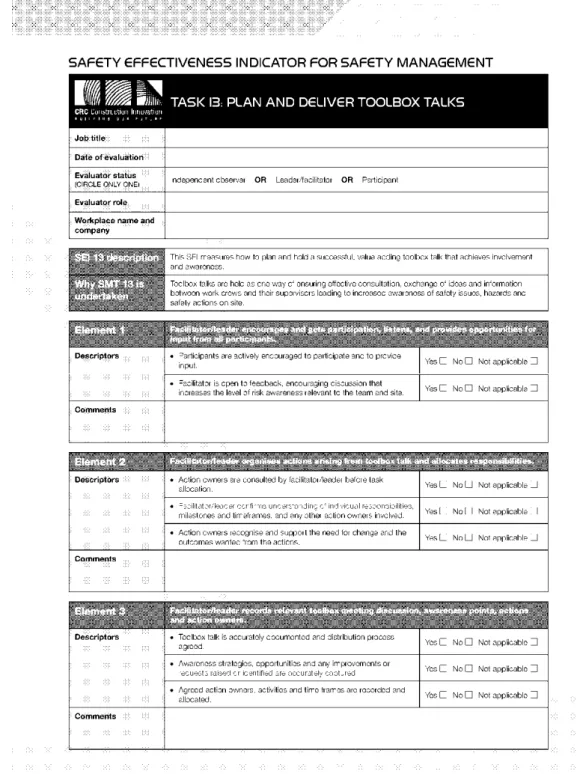
A Workbook was distributed for the Pilot with project history and information, user instructions, and individual SMT pages. Each SMT page was composed of the SMT title, spaces for name of evaluator, date and which status the evaluator considered him, or herself. This was followed by a description of the SMT and why it should be undertaken. Below this was the measurement scale, which was broken into different elements. The number of elements used ranged from 2 to 5. Each element was constructed of 2 statements on the extremities of a 4 point Likert scale.
Feedback forms were distributed and Focus groups were conducted to receive feedback from all participants in the pilot trials. Of the comments received back via the feedback from, the changes requested were: language/wording to be simpler and less complicated; less repetition between elements; and simplification of scales. Of the focus groups held the major changes requested were: language to be made more comprehensible; include additional space for qualitative comments; and clear separation of each SEI commentary and rating process.
The final worksheet for each SEI incorporated feedback and focus group comments and was structured in a similar fashion for each SEI. An example of an SEI for “Plan and Deliver Toolbox Talks” is at Figure 1. The initial reaction by participant organizations was favourable to the use of the SEI process. The SEI workbook was considered by all participants as an excellent tool as it “offers consistency across the industry”, and they would like to see it “applied across industry” The final SEI measures are seen to be simple to use and robust in their applicability across the sector. In line with National harmonization of industrial legislation in Australia, the overall aim is to develop a uniform series of measures across Australia and across construction environments.
Figure 1. Plan and deliver toolbox talks
CONCLUSION
The three interlocked projects in safety competency and safety effectiveness indicators briefly described in this paper have been a milestone development in construction safety in Australia. The outcomes of this research have been endorsed by Australia’s Federal safety Commissioner and many organisations have incorporated the outcomes into their organisational practices. For example, Sydney Water, the water supplier for metropolitan Sydney, only accepts contractor tenders from organizations that have a developed and articulated Safety Competency Framework and the Department of Transport and Main Roads in the State of Queensland matches critical roles and required Safety Management Tasks across all of its staff and contractors and trains deficiencies accordingly. More research, however, is recommended, particularly in longitudinal studies on Safety Effectiveness Indicators, to better understand how these may assist in lead indicator predictions and planning for the construction industry.
REFERENCES
[1] International Labour Organisation. (2005). Facts on safety at work. Retrieved from http://www.ilo.org/public/portugue/region/eurpro/lisbon/pdf/wdshw.pdf
[2] Safe Work Australia. (2010). Work-related Traumatic Injury Fatalities, Australia 2008-9. Retrieved January 12, 2011, from http://www.safeworkaustralia.gov.au/NR/rdonlyres/30699D00-464C-4168-9C96-C1F30C86B888/0/AnnualNotifiedFatalitiesReport20082009.pdf
[3] Advisory Committee for Safety in Nuclear Installations (ASCNI). (1993). Third Report: organizing for safety. ACSNI Study Group on Human Factors. HMSO: London.
[4] Guldenmund, F.W. (2000). The nature of safety culture: a review of theory and research. Safety Science, 34, 215-257. doi:10.1016/S0925-7535(00)00014-X
[5] Glendon, A. I., & Stanton, N. A. (2000). Perspectives on safety culture. Safety Science, 35, 193-214. [6] Dodsworth, M., Connelly, K.E., Ellett, C.J. & Sharratt, P. (2007). Organisational climate metrics as safety, health and environment performance indicators and an aid to relative risk ranking within industry. Process Safety and Environmental Protection. 85, 1, 59-69.
[7] Silva, S., Lima, L.M. & Baptista, C.S. (2004). OSCI: An organisational and safety climate inventory. Safety Science, 42, 205-220.
[8] Toole, T. M. (2002) Construction site safety roles. Journal of Construction Engineering and Management, 128 (3), 203-210.
[9] Biggs, H. C., Sheahan, V. L., & Dingsdag, D. P. (2006). Improving industry safety culture: The tasks in which safety critical position holders must be competent. Proceedings of the CIB W99 International Conference on Global Unity for Safety and Health in Construction. Tsinghua University, Beijing, China, 28-30 June 2006, PP. 181-187. Tsinghua University Press: Beijing, ISBN: 7 302 13236 4.
[10] Dingsdag, D. P., Biggs, H.C., Sheahan, V. L. and Cipolla, D. J. (2006) A Construction Safety Competency Framework: Improving OSH performance by creating and maintaining a safety culture, Cooperative Research Centre for Construction Innovation, Brisbane: Icon.Net Pty Ltd, ISBN 978-0-9775282-9-5. 1- 66. doi:10.1016/j.ssci.2007.06.008
[11] Federal Safety Commissioner’s 2005-2006 Progress Report. (2006). Achieving World-class Safety in the Australian Building and Construction Industry. Office of the Federal Safety Commissioner. Commonwealth of Australia.
[12] Dingsdag, D.P., Biggs, H. C., and Cipolla, D. (2008). Safety Effectiveness Indicators (SEIs): Measuring Construction Industry Safety Performance, Clients Driving Innovation: Benefiting from Innovation. Third International Conference, CRC for Construction Innovation, 12-14 March 2008 Surfers Paradise Marriott Resort & Spa, Gold Coast, Queensland, Australia.