Yang, D.-C., & Li, M.-N. (2013). Assessment of Animated Self-Directed Learning Activities Modules for Children’s Number Sense Development. Educational Technology & Society, 16 (3), 44–58.
Assessment of Animated Self-Directed Learning Activities Modules for
Children’s Number Sense Development
Der-Ching Yang
1*and Mao-Neng Li
21Graduate Institute of Mathematics and Science Education, National Chiayi University, Taiwan, R.O.C. // 2
Department of Education, National Chiayi University, Taiwan, R.O.C. // [email protected] // [email protected]
*Corresponding author
(Submitted April 02, 2012; Revised November 16, 2012; Accepted December 25, 2012) ABSTRACT
The purpose of this study was to examine the relative effectiveness of two different learning modes; namely, a computer animation self-directed learning approach and a paper version of the self-directed learning approach, to 5th-graders’ number sense development. Two 5th-grade classes, 30 students each, were selected from a public elementary school in southern Taiwan and randomly assigned to the computer animation experimental group [CAEG] and the paper-version group [PAG]. The major finding indicated that students in the CAEG group had better performance on number sense and showed more frequent uses of number sense than students in the PAG group. Implications for the uses of computer animation self-directed learning activities are discussed.
Keywords
Computer animation activities, Learning modes, Number sense, Self-directed learning approach
Introduction
Number sense has been considered as one of the most important topics in mathematics education (Dunphy, 2007; Jordan, Glutting, & Ramineni, 2010; National Council of Teachers of Mathematics, [NCTM], 2000; Verschaffel, Greer, & De Corte, 2007; Yang & Tsai, 2010). However, several number sense studies showed that not only middle and elementary school children (Markovits & Sowder, 1994; McIntosh, B. Reys, R. Reys, Bana, & Farrel, 1997; Menon, 2004a; Reys & Yang, 1998; Yang & Li, 2008) but also preservice teachers performed poorly in solving problems related to number sense (Menon, 2004b; Yang, Reys, & Reys, 2009). Mathematics educators have found that children’s inflexibility in handling number sense problems may be related to the inappropriate design of mathematics textbooks and the rule-based instruction of school mathematics (Markovits & Sowder, 1994; Menon, 2004a; Reys & Yang, 1998; Yang & Li, 2008). For example, previous studies showed that traditional instruction, which focuses primarily on standard written computation rather than conceptual understanding, may result in children’s difficulties in using number sense flexibly and efficiently (Menon, 2004a; Yang & Li, 2008). Helping children develop number sense has been highlighted in school mathematics by many reports and studies (Bobis, 2004; Dunphy, 2007; McIntosh et al., 1997; NCTM, 2000). Seeking an effective learning material that would facilitate children’s development of number sense is an urgent issue for current mathematics education.
Previous studies and reports have strongly suggested that technology should be integrated into mathematics teaching and learning, since technology is a promising means for providing conceptual understanding (Dick, 2007; Inamdar & Kulkarni, 2007; NCTM, 2000; Ruthven, 2007; Vulis & Small, 2007; Yang & Tsai, 2010; Zbiek, Heid, Blume, & Dick, 2007). For example, NCTM (2000) highlights that the integration of technology into mathematics classroom settings can enhance children’s mathematics learning and promote conceptual understanding. In addition, Olive and Lobato (2008) state that “providing technological tools that enable children to enact their own mathematical operations can be a very powerful aid to children’s learning” (p. 43). Technology can provide dynamic visualization, immediate feedback, and interactivity that can help children learn mathematics effectively (Gegner, Mackay, & Mayer, 2009; Suh & Moyer-Packenham, 2007). Therefore, it is reasonable to believe that technology should play a key role in helping children learn mathematics.
Accordingly, the purpose of this study was to examine the effectiveness of computer animation self-directed learning number sense-based activities compared with a corresponding paper-version approach. The specific research questions are as follows:
• Are there any significant differences in students' performance on number sense across the two self-directed learning approaches after the experiment?
• Are there any differences in methods used by students to solve number sense problems across the two self-directed learning approaches after the experiment?
44
ISSN 1436-4522 (online) and 1176-3647 (print). © International Forum of Educational Technology & Society (IFETS). The authors and the forum jointly retain the copyright of the articles. Permission to make digital or hard copies of part or all of this work for personal or classroom use is granted without fee provided that copies are not made or distributed for profit or commercial advantage and that copies bear the full citation on the first page. Copyrights for components of this work owned by others than IFETS must be honoured. Abstracting with credit is permitted. To copy otherwise, to republish, to post on servers, or to redistribute to lists, requires prior
Background
Number sense framework
What is number sense? Number sense refers to an individual’s general understanding of numbers, operations, and the relationship between number and operation, and the ability to handle daily-life situations that include numbers (Markovits & Sowder, 1994; Reys & Yang, 1998; Yang & Tsai, 2010). During the past two decades, due to the importance of number sense, several research studies and reports have been produced (Markovits & Sowder, 1994; NCTM, 2000; Reys & Yang, 1998; Verschaffel et al., 2007; Yang & Li, 2008; Yang & Tsai, 2010). Even though these studies and reports defined number sense from different perspectives, they have included the following major common components: (a) Understanding the basic meanings of numbers; (b) recognizing number size; (c) Being able to use multiple representations; d) Recognizing the relative effect of operation on numbers; and e) Being able to judge the reasonableness of a computational result via estimation or mental computation (Markovits & Sowder, 1994; NCTM, 2000; Reys & Yang, 1998; Verschaffel et al., 2007; Yang & Tsai, 2010). These common components of number sense were used in this study.
The significance of number sense in elementary school mathematics education
Why is number sense development for elementary school students so important? There are three reasons for its significance. First, number sense is a way of thinking that promotes sense-making and directs problem solving in a flexible and efficient way (Dunphy, 2007; Yang & Li, 2008). For example, when children were asked to find the answer to 25×96÷(16×5), children tended to use paper-and-pencil to compute the answer: 25×96 = 2400, 16×5 = 80, and then 2400÷80 = 30. It is often difficult for children to discover the relationships among these numbers, for example, firstly, we can mentally compute 25 ÷ 5 = 5 and 96 ÷ 16 = 6 and then 5 × 6 = 30, which is more flexible and efficient way to find the answer. Hence, the answer could be found easily: 5×6 = 30. Second, number sense plays a key role in mathematics achievement for elementary school children. For example, Jordan, Glutting, and Ramineni (2010) showed that number sense could make an important contribution to mathematics achievement. Moreover, the study of Yang & Li (2008) revealed that number sense is significantly correlated with fifth graders’ mathematics achievement. Third, several studies have suggested that overemphasis on written computation may limit children’s mathematical thinking and understanding, whereas number sense can induce a process of meaningful learning (Yang & Li, 2008). Therefore, it promotes conceptual understanding and flexible ways of problem solving. For example, when asking children to decide which of 2/5 or 4/7 is larger, students usually use paper- and-pencil (first finding the common denominator, calculating the numerators, and finally comparing the numerators), which is often a meaningless process. A child with good number sense should quickly discover that 2/5 < 1/2, and 4/7 > 1/2. Therefore, the answer is 2/5 < 4/7.
Computer technology and mathematics learning
The progress of computer technology has changed the learning style of human beings (NCTM, 2000; Ministry of Education in Singapore, 2009), including playing an important role in mathematics teaching, learning, and evaluation (Ruthven, 2007; Zbiek et al., 2007). Several studies have indicated that children’s learning outcomes can be improved through the mode of virtual manipulative computer learning (Moyer, Niezgoda, & Stanley, 2005; Reimer, & Moyer, 2005; Suh & Moyer- Packenham, 2007). Mathematics virtual manipulation is defined as an interactive (acting and responding to each other), web-based, virtual representation of a dynamic object that presents opportunities for children to construct mathematical knowledge (Moyer, et al. 2005; Suh & Moyer-Packenham, 2007). Hence, children may have greater opportunity to learn when the manipulation occurs on computers, and that may advance their mathematical understanding (Chan, Tsai, & Huang, 2006; Isiksal & Askar, 2005; Yang & Tsai, 2010).
In recent years, many studies have shown that technology integrated into mathematics teaching and learning can efficiently and effectively help children develop better conceptual understanding of mathematics (Bennison & Goos, 2010; Dick, 2007; Ruthven, 2007; Suh & Moyer-Packenham, 2007). For example, Suh and Moyer- Packenham (2007) indicate that a virtual environment can enhance students’ ability to connect visual and symbolic representations, support and direct the process of a mathematics algorithm step by step, and provide rapid feedback as well as opportunities for self-examination. Zbeik et al., (2007) indicate that technology-integrated mathematics
learning and instruction can promote students’ representational fluency. Moreover, previous studies also suggested that multiple representations can help children develop better understanding of mathematics (Goldin, 2002; Tripathi, 2008). Hence, multiple representations with the applications of modern technology through dynamic visualization appear promising in children’s mathematics learning.
Animation and number sense related studies
Due to the importance of number sense, several studies have demonstrated that children’s number sense can be promoted by integrating well-designed number sense activities into mathematics classrooms or by including realistic activities focusing on number sense (Griffin, 2004; Yang & Wu, 2010). Since technology has been regarded as an important and effective learning tool for helping children develop better understanding of mathematics (Bennison & Goos, 2010; Dick, 2007; Reimer & Moyer, 2005; Ruthven, 2007; Suh & Moyer- Packenham, 2007), technology should be a relevant tool for promoting children‘s number sense. However, few studies via technology have focused on helping children develop number sense (Hudson, Kadan, Lavin, & Vasquez, 2010; Su, Marinas, & Furner, 2010; Yang & Tsai, 2010). For example, the study of Su et al. (2010) showed that web-based tools could be used to reinforce primary school children’s number sense. In addition, the study of Yang and Tsai (2010) applied the technology-based environment to help teacher’s teaching and student’s learning in number sense. Their findings indicated that “integrating technology into number sense teaching and learning not only could promote students’ number sense, but also had a positive effect on student’s attitudes towards the improvement of number sense” (p. 112).
In addition, several studies suggested that students may learn more from multimedia-based learning environment due to multimedia messages including words and visuals than what traditional teaching modes can do (Gegner, Mackay, & Mayer, 2009; Mayer, 2003). Even though, Clark & Mayer (2008) state that “to illustrate how things work, a series of still visuals is likely to lead to as good or better understanding of the process than animation” (p. 8), unless carefully designed toward the fostering of conceptual understanding (Clark & Mayer, 2008). They provided several evidence-based studies to support their suggestions, but these experiments did not focus on mathematics related topics (Clark & Mayer, 2008; R. Mayer, Hegarty, S. Mayer, & Campbell, 2005). Furthermore, several previous studies (Forster, 2006; Philpot, Hall, Hubing, Flori, Oglesby, & Vikas, 2003; Stoffa, 2004; Taylor, Pountney, & Malabar, 2007) commented that animation might be an aid in mathematics teaching and learning and helping students understand mathematics. For example, the study of Forster (2006) indicated that it is essential to get technology integrated into the assessment, examinations, and classroom mathematics practices if we want to optimize students’ mathematics learning. The findings of Taylor et al.’s (2007) experiment showed that animated learning materials could act as an aid in helping mathematics teaching and learning for students at undergraduate level. In addition, the results of these studies showed that animated learning materials including dynamic figures, words, and visuals could help children develop mathematical concepts. This indicates that the well-designed animation activities can be a more effective learning tool than static visualization.
Previous literature reviews have shown that animation can play an important role in students’ mathematics learning. For example, Taylor et al. (2007) studied on undergraduate students’ mathematics learning. Forster (2006) examined high school students’ mathematics learning via animation activities. However, little research has been conducted regarding the use of animation to improve number sense at the primary school level. Consequently, this study was to investigate the effectiveness of animation to support number sense self-directed learning for fifth-graders, compared to static paper-version group and traditional textbook learning group. These animated activities emphasized understanding and potential applications of number sense in order to help children develop number sense in a dynamic and effective manner.
Method
Research designA quasi-experimental pretest-posttest design was used to investigate the effects of different self-directed learning formats on children’s development of number sense. Specifically, two intact classes were randomly assigned to a computer animation experimental group (CAEG) and a paper-version group (PAG). They learned number sense by themselves via different presentations of learning materials in a different form of organization without a teacher’s
instruction. Teachers acted merely as a classroom manager and a material provider, ensuring that the student’s self-directed learning opportunities ran smoothly. Each treatment group followed a different guided self-self-directed learning approach and was given the same amount of self-directed learning time. Each treatment condition was implemented during seven class periods (30 minutes each) over consecutive 4 weeks. The pretest was given in the 1st week. During 7 class periods (30 minutes per period) in the next 2 weeks, self-instruction focused on each of the learning formats using different structural modules of instructional materials. The posttest was administered in the last week.
Participant
Sixty students in two fifth-grade classes were selected from an elementary school in Taiwan. These students’ average age was about 10.8 years old. The two classes were randomly assigned to one of the self-directed learning groups (CAEG and PAG). The CAEG group included 30 students (16 boys and 14 girls) and the PAG group included 30 students (16 boys and 14 girls).
Treatments
Two independent variables, self-directed learning materials-presentation formats and self-directed learning approaches were manipulated across each treatment condition. There were two formats for presenting self-directed learning materials: the animation version (for CAEG) and the paper version (for PAG).
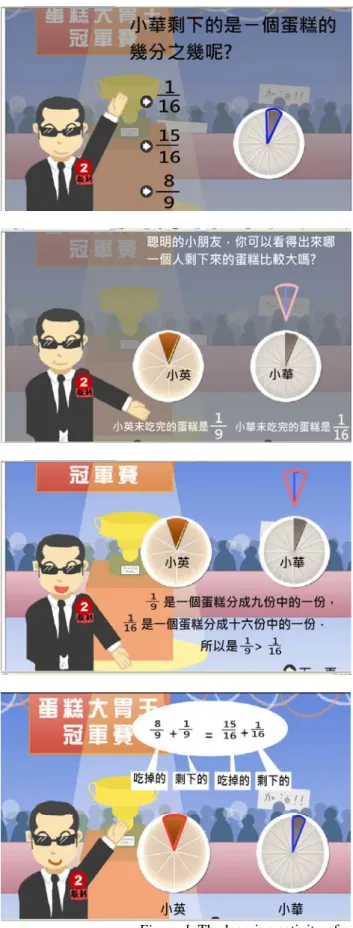
To help participants develop number sense, seven self-directed learning units were designed for different types of self-directed learning. One activity from each unit was provided during each of the seven class periods. For the CAEG group, seven computer animated self-directed learning activities based on the lessons in the textbook used at the elementary school, were designed by the researchers and were number sense oriented (Griffin, 2004; Yang & Wu, 2010). These seven animated self-directed learning activities focused on conceptual or relational understanding. During the processes of animation activities, one example was presented through dynamic visualization, audio, interaction, and questions to lead students in learning number sense related concepts. Immediate feedbacks on students’ selections were presented on the screen. If student answers were incorrect, the screen showed “Your answer is incorrect, please try it again!” After the example, students were asked to take a quiz which includes several questions. The testing results were displayed to let the students know their performance. Take fraction comparison for example, one of the examples used for CAEG group is described as follows:
A3. Speed eating activity for CAEG: Mary ate 8/9 of a cake and John ate 15/16 of the same size of the cake. Who ate more cake?
For the CAEG group, a series of computer animated learning activities for problem A3 is shown and explained clearly in Figure 1.
Note. a indicates visual display of the item in Chinese characters (English version: Which fraction is the best to represent the remained part of cake not eaten by Jane?)
b indicates an item options.
The following example pictures are presented in a similar way.
Figure1. The learning activity of problem A3 for the CAEG Group
Which fraction is the best to represent the remained part of cake not eaten by Tom?
My smart kids, can you tell me whose remained piece of cake is larger, Jane or Tom?
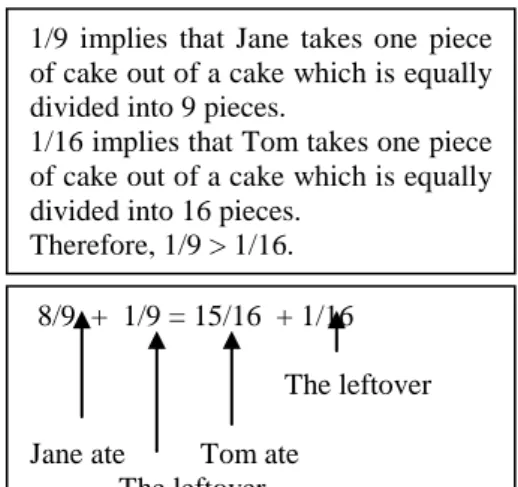
1/9 implies that Jane takes one piece of cake out of a cake which is equally divided into 9 pieces.
1/16 implies that Tom takes one piece of cake out of a cake which is equally divided into 16 pieces.
Therefore, 1/9 > 1/16.
8/9 + 1/9 = 15/16 + 1/16
The leftover The leftover Eaten by Jane Eaten by Tom
Figure 1 presents the question posed on the screen. A piece of a cake was left and Jane ate the other pieces as shown in the first picture. Which fraction is best to represent the left part? A piece of a cake was left and Tom ate the other pieces as shown in the second picture. Which fraction is best to represent the leftover part?
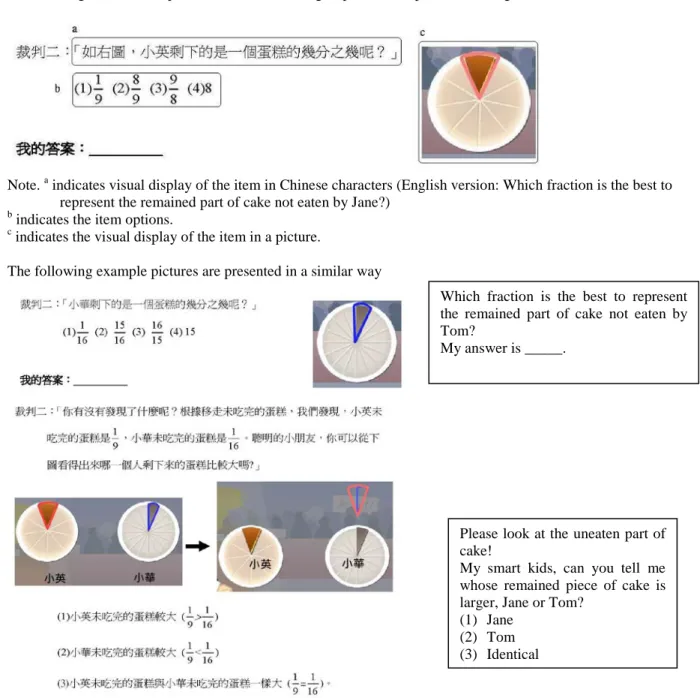
The seven paper-version activities for the PAG group were transferred from the seven computer animated activities created for the CAEG group and they were also number sense oriented. As to the seven self-directed learning units for the students in the PAG group, they were literally just a printed version of the computer-based materials, including the same visual display of the item in Chinese words, the item options, and the same visual display of the item in a picture, with no moving animations. The contents for the activities in both groups were the same except the activities used in the PAG were individually exposed to self-directed learning activities printed on the paper, without any animation. Contrast, one of the corresponding items used for the CAEG group is exemplified as follows:
For the PAG group, the corresponding paper-version of the computer animated learning activities for problem A3 is shown in Figure 2. Those questions used in CAEG group were also presented in Figure 2.
Note. a indicates visual display of the item in Chinese characters (English version: Which fraction is the best to represent the remained part of cake not eaten by Jane?)
b indicates the item options.
c indicates the visual display of the item in a picture.
The following example pictures are presented in a similar way
Which fraction is the best to represent the remained part of cake not eaten by Tom?
My answer is _____.
Please look at the uneaten part of cake!
My smart kids, can you tell me whose remained piece of cake is larger, Jane or Tom?
(1) Jane (2) Tom (3) Identical
Figure 2. The learning activity of problem A3 for the PAG. group
The contents of the self-directed learning activities across two different self-directed learning groups were the same. The major difference between the two groups was the self-directed learning formats of the activities used for each group. For the CAEG group, they learned number sense by themselves through seven animated number sense-based activities, which were designed by the researchers. Each animated self-directed learning activity consisted of a series of animated pictures. Each student individually completed these animated activities inside a computer classroom. The main themes of the seven activities are described in Appendix 1.
Instruments
The pretest and the posttest involved the same test; namely, a web-based, two-tiered test for fifth-grader’s number sense, designed by the Yang (2010). This test includes five number sense components as defined in the number sense framework with eight items for each component. The value for Cronbach’s α was .80. The difficulty indices for the test items were set between .28 and .68, and the discrimination indices were between .25 and .77. Additionally, the construct reliability index derived from SEM analysis was .801, reflecting that the instrument’s internal and construct reliability were satisfactory.
The test’s examined validity covered the content validity, specialist validity, and construct validity. To ensure the designed items were representative and not beyond the curriculum scope usually taught to 5th-graders in Taiwan, three elementary school teachers and two mathematics educators were invited to review the items. All agreed that the 40 test items were representative and appropriate in terms of item content for 5th-graders involved in this study. An exemplified item is presented in Appendix 2.
Procedure
This study was conducted in three stages:
• During the pretest, all of the students were asked to individually complete the 50-minute, computerized pretest in a computer classroom using the web-based testing platform.
• During the learning treatment stage, the students in the CAEG group were asked to individually complete the computer animated units in the computer classroom. The students in the PAG were asked to individually read the seven units of the paper-version that were adapted from the computer-animated units and thus included the same content as the units studied by the students in the CAEG.
• The posttest was conducted 1 week after the learning treatment ended. During the posttest, all of the students were asked to complete individually the 50-minute, computerized posttest in a computer classroom using the same web-based testing platform.
1/9 implies that Jane takes one piece of cake out of a cake which is equally divided into 9 pieces.
1/16 implies that Tom takes one piece of cake out of a cake which is equally divided into 16 pieces.
Therefore, 1/9 > 1/16. 8/9 + 1/9 = 15/16 + 1/16
The leftover Jane ate Tom ate
Scoring and data analysis
The web-based, two-tier test for number sense was composed of 40 multiple-choice items. For each test item, the students were required to provide their choice for the correct answer and a reason for their answer selection. This scoring design improves score validity because it identifies genuine understanding of the problem. Due to the unique features of this test, the scoring scheme for the pretest and the posttest is detailed as follows (see Table 1):
Table 1. Scoring Scheme for the Number Sense Test
Answer Correct
4 points 4 points 4 points 4 points
Wrong 0 point Reason NS-Based 4 points Rule-Based 2 points Misconceptions 1 point Guess 0 points
Total 8 points 6 points 5 points 4 point 0 points
We believe that the correct reason (reflecting number sense application) is of equal importance as that of the correct answer, because appropriate use of number sense is a good indicator of effective mathematical thinking. Therefore, students receive the same number of points for each: 4 points for the appropriate application of number sense and 4 points for the correct answer.
Results
Learning effect on different learning modes
Table 2 reports the descriptive statistics and the results of the repeated t test between the pretest and the posttest for the two groups. Results indicate that there is a statistically significant difference between the pretest and the posttest (t value = –6.401, p < .01) for the computer-animated experimental group (CAEG). The mean gain from pretest to posttest for the CAEG group was 33.46, indicating a positive effect on students’ number sense performance. The data also show that the mean scores on the posttest for the PAG increased 5.84 points. The repeated t-test results indicate that there was no statistically significant difference between the pretest and posttest means for the PAG group (t = –1.717, p > .05). These results indicate that number sense learning via integrated technology is more beneficial to the students in the CAEG group than students learning number sense without the aid of technology in the PAG group.
Table 2. Descriptive Statistics and Repeated t-tests
Group Pretest Mean (SD) Posttest Mean (SD) t p CAEG (n=30) 137.37 (53.74) 170.83 (54.49) -6.401 .000** PAG (n=30) 131.63 (47.16) 137.47 (53.30) -1.717 .097 **p < .01
In order to reduce the threats of initial pre-exiting difference between groups and self-growth, an ANCOVA for the two groups was conducted with the pretest as a covariate. Before the ANCOVA was done, the homogeneity test of equal slopes between groups was examined. Because p > .05, the result F(1, 58) =3.629 (p = .062) indicates that the
assumption of equal slopes is tenable, thus permitting the use of ANCOVA. Table 3 reports the results of the ANCOVA analysis.
Table 3. Summary of ANCOVA for Two Groups Source Type III Sum of
Squares df Mean Square F p Partial η
2 Pre Group 134993.821 11633.641 1 1 134993.821 11633.641 229.624 19.789 .000** .000** .801 .258 Error 33509.812 57 587.891 Note.R2 = 0.819 (adjusted R2 = 0.813). ** p < .01
After adjusting the pre-existing difference between groups, the result of the ANCOVA is an F-value equal to 19.789 (p = .000, η2 =.258). This result indicates that there is a large effect (η2 > .14, based on Cohen’s criterion) and also a statistically significant difference (α = .05) between the CAEG and PAG groups after the experiment. In other words, after the individual self-directed learning (using animation vs. paper version), the students in the CAEG group using computer-animated activities performed better on number-sense items than students in the paper-version group. In fact, participation in the computer-animated experimental group greatly enhanced the development of students’ number sense ability. In addition, the R2 value (.819) indicates that the individual learning accounted for 81.9% of the total variation in the learning effect for the computer-animated experimental group. This implies that the technology integrated into the individualized number-sense learning had a significant impact on number sense performance, surpassing the self-directed learning through paper version.
Problem-solving methods used within different learning modes
Table 5 reports the percentages of different methods of problem solving selected by students from different groups before and after the treatment. Data suggested that uses of the number-sense-based method increased much more for students in the CAEG (35.4% - 25.3% = 10.1%) than for students in the PAG (25.1% – 23.9% = 1.2%) group. This suggests that computer-animated learning is more effective than a paper-version learning approach in the development of number sense. At the same time, data also showed that the students in the CAEG group with incorrect answers decreased form 50% to 38.6% after the experiment. However, there is just a little decrease for students with incorrect answers from 51.7% to 49.2% in the PAG group after the experiment.
Table 5. Percentage of Different Methods Used to Solve Test Items Before and After the Experiment
Methods Groups CAEG PAG
Pre-test Post-test Pre-test Post-test
Correct NS-based 25.3% 35.4% 23.9% 25.1% Rule-based 14.2% 15.1% 14.1% 15.7% Misconception 10.2% 10.8% 9.2% 8.6% Guessing 0.3% 0.1% 1.1% 1.4% Incorrect 50.0% 38.6% 51.7% 49.2%
Discussion
This study provided evidence of more effective self-directed learning of number sense through computer-animated activities with fifth graders in a public elementary school in southern Taiwan. The most important finding was that students in the CAEG group that received self-directed learning computer-animated number sense activities performed better on a number sense assessment than students in the PAG group who read a paper-version activities based on the same content as the computer-animated activities. This implies that children can develop number sense through self-directed learning in animation-based environments. This finding supports the statement of the NCTM (2000) that “technology can help students learn mathematics” (p. 25) and “students’ engagement with, and ownership of, abstract mathematical ideas can be fostered through technology” (p. 25). It also supports the findings of several earlier studies that technological tools can help to foster children’s mathematics learning (Chan et al., 2006; Dick, 2007; Inamdar & Kulkarni, 2007; Zbiek et al., 2007). Moreover, these findings also suggest that students in the CAEG group were more effective in their uses of number sense-based skills in solving problems than the students in the PAG group. Interestingly, we found that the students in the CAEG group who individually manipulate the animation activities applied much more uses of number sense than the students in the PAG group after the experiment. Rather, they highly decreased the incorrect responses than the students in the PAG group after the experiment. This finding strongly supports the results of an earlier study of Su et al. (2010) that web-based tools could be used to reinforce primary school children’s number sense. It also supports the finding of Yang and Tsai (2010) that student’s number sense could be improved through the technology-based environment.
The students in the CAEG group performed better on number sense than students in the PAG group because students in the CAEG group have developed better conceptual understanding on number and operations under animated-based learning environment that included clearer words and pictures than the paper-version group mode. The key
factors of CAEG group have better performance and use of number sense due to these animation activities bring dynamic visualizations, interactivity, and immediate feedback. This finding is consistent with the earlier studies (Gegner et al., 2009; Mayer, 2003). In fact, this study also proved that animated and number sense-based self-directed learning materials may be more effective than static visuals to promote children’s number sense. These animated learning materials included dynamic visuals and words that made an appeal to student’s attentions when they were manipulating these activities. This finding also supports previous studies that animation activities can be an aid in mathematics learning and helping students develop better understanding on mathematical concepts (Forster, 2006; Philpot, Hall, Hubing, Flori, Oglesby, & Vikas, 2003; Stoffa, 2004; Taylor, Pountney, & Malabar, 2007). Furthermore, in reviewing the number sense-based animation activities used in this study, they are consistent with the Mayer’s principles when learning is better (Clark & Mayer, 2008). For example, these activities include relevant visuals and words rather than words only (Multimedial principle); texts in the activities have close connection with the visuals (Contiguity principle); visuals used in the activities are clearly explained by audio rather than by words (Modality principle); learners can mentally interact and get feedback via on screen learning agents (Personalization principle); key concepts of number sense are introduced first and then the exercises are presented (Pretraining principle); and contents are presented in a series of dynamic visuals which the learners can control the rates of access (Segmenting principle) (Clark & Mayer, 2008). Therefore, it is reasonable to believe that the finding of this study is different from the statement of Clark & Mayer (2008) that animation did not help compared to similar static visuals. However, this study is consistent with their suggestion that carefully designed animations toward the fostering of conceptual understanding are possible to have better performance than still visuals (Clark & Mayer, 2008).
Conclusions
Although our self-directed learning experiment lasted for only seven class periods (30 minutes for each period) for three different groups of classes from only one school in Taiwan, the improvement made by the fifth graders in the computer-animation group is apparent and worthy of attention. Although generalizations of the present study may be limited, the results do provide some important contributions. Thus, further research studies should focus on long-term treatment and include a broader range of students in the studies.
First, the major contribution of the current study is that students’ number sense can be promoted effectively by students themselves, if appropriate technology-enhanced learning activities are provided. The present study is different from an earlier study by Yang and Tsai (2010) that student’s number sense could be promoted via teacher’s instruction and the use of technology. These animated and number-sense-based activities emphasized understanding and potential applications of number sense and they allow students to self-study at any time through web-based or CD-based self-directed learning in order to help children develop number sense in an interactive and effective manner. Moreover, these animation number sense activities can be learned by students without the aid of teachers. It is also different from earlier non-technology-based studies (Griffin, 2004; Markovits & Sowder, 1994; Verschaffel et al., 2007; Yang & Wu, 2010) that children’s number sense can be improved by appropriate “teacher-directed learning” in a traditional school mathematics classroom. Therefore, this study demonstrates three potentially helpful characteristics of the learning environment: number-sense-based, self-directed learning and animation-based. Second, even though many studies and reports (Dick, 2007; Inamdar & Kulkarni, 2007; Lin, 2008; NCTM, 2000; Ruthven, 2007; Vulis & Small, 2007; Zbiek et al., 2007) have suggested that technology integrated into mathematics teaching and learning has a positive effect on children’s mathematics performance, no study has focused on the effect of technology on number sense performance of elementary school children when self-directed learning via computer-based activities. This study initially shows that the appropriate use of technology can be a helpful learning tool for developing children’s number sense.
Third, without teacher’s teaching in class, children can develop number sense through self-directed learning. In cases in which children need more opportunities to learn and school cannot provide additional teaching time, these computer-animated number-sense activities could be a good substitute for developing their number sense. As earlier studies (Yang & Li, 2008; Yang & Wu, 2010) have suggested, an opportunity to learn plays a role in helping children develop number sense; providing children with ubiquitous access to these self-directed learning animated activities via the world-wide web would allow students to learn more about number sense whenever time is available to them. Consequently, these self-directed learning activities can serve as supplementary learning materials for helping children develop number sense at school or at home.
Finally, several factors caused the students learned more in the animated learning mode. First, animation activities through the use of computer can reinforce students’ learning motivation. This supports the finding of previous studies that the integration of technology into mathematics classes has a positive effect on learning and motivation (Isiksal & Askar, 2005; Lin, 2008; Olkun, Altun, & Smith, 2005; Yang & Tsai, 2010). Second, the audio, words and visual display can simultaneously enhance the learning of number sense. This supports the finding of earlier studies that students may learn more from multimedia-based learning environment due to multimedia messages including words and visuals than what traditional teaching modes can do (Gegner et al., 2009; Mayer, 2003). Third, learning by doing is a good approach to promote students’ learning. During manipulating the computerized activities, students will focus their attentions on the animation. Thus, it facilitates their number sense development.
In summary, the present study demonstrates that the integration of technology into number sense learning by appropriately utilizing multimedia allows learners to study visually, interactively, and effectively. However, the development of computer-animated number-sense activities is a complicated and time-consuming process. It requires the collaboration of mathematics educators who are specialists in number sense, computer programmers who are well experienced in writing such programs, and computer-animation designers. Therefore, to further the development of these animated activities, it may be necessary to have an educational center that can organize and design these computer- animated activities for self-directed learning.
Implications and practical applications
The use of computer-animated, self-directed learning number-sense activities was successful in helping children enhance their number-sense performance and increase their uses of a higher order learning skill: number sense. The animated self-directed learning units for number sense can be made easily accessible at school or at home to any interested students through a web site on the world-wide web. Students can self-learn online without additional teachers’ preparation or instruction time. These technology-based learning activities can also serve as supplemental learning materials in order to offer students extra opportunities to explore and develop number sense.
Limitations
There are two main limitations of the current study. The first is that due to limited time and resources available, merely two intact classes were involved in the study. Therefore, generality of its results may need additional empirical evidences in other school settings. The second limitation relates to the extent to which the main aspects of number sense were investigated in the study. Only five aspects of number sense were covered, generality of the result to uncovered aspects of number sense may not be valid.
Acknowledgements
This paper is a part of a research project supported by the National Science Council, Taiwan with grant no. NSC-100–2511-S-415–008 –MY3. Any opinions expressed here are those of the authors and do not necessarily reflect the views of the National Science Council, Taiwan. The authors also express their gratitude for the comments given by the Editor(s) and the two anonymous reviewers in assistance with the development of this article.
References
Bennison, A., & Goos, M. (2010). Learning to teach mathematics with technology: A survey of professional development needs, experiences and impacts. Mathematics Education Research Journal, 22(1), 31-56.
Bobis, J. (2004). Number sense and the professional development of teachers. In A. McIntosh & L. Sparrow (Eds.), Beyond written computation (pp. 160–170). Perth, Western Australia: Mathematics, Science & Technology Education Centre, Edith Cowan University.
Chan, H., Tsai, P., & Huang, T. Y. (2006). Web-based learning in a geometry course. Educational Technology and Society, 9(2), 133–140.
Clark, R. C., & Mayer, R. E. (2008). Learning by viewing versus learning by doing: Evidence-based guidelines for principled learning environments. Performance Improvement, 47(9), 5-13.
Dick, T. (2007). Keeping the faith: Fidelity in technological tools for mathematics education. In G. W. Blume & M. K. Heid (Eds.), Research on technology and the teaching and learning of mathematics: Syntheses, cases, and perspectives. Vol. 2: Cases and perspectives (pp. 333–339). Greenwich, CT: Information Age.
Dunphy, E. (2007). The primary mathematics curriculum: Enhancing its potential for developing young children’s number sense in the early years at school. Irish Educational Studies26(1), 5–25.
Forster, P. (2006). Assessing technology-based approaches for teaching and learning mathematics, International Journal of Mathematical Education in Science and Technology, 37(2), 145-164.
Gegner, J. A., Mackay, D. H. J., & Mayer, R. E. (2009). Computer-supported aids to making sense of scientific articles: cognitive, motivational, and attitudinal effects. EducationTechnology Research Development, 57(1), 79-97.
Goldin, G. A. (2002). Representation in mathematical learning and problem solving. In L. D. English (Ed.), Handbook of international research in mathematics education (pp.197–218). Mahwah, NJ: Erlbaum.
Griffin, S. (2004). Building number sense with number words: A mathematics program for young children. Early Childhood Research Quarterly, 19(1), 173–180.
Hudson, S., Kadan, S., Lavin, K., & Vasquez, T. (2010). Improving basic math skills using technology. (Unpublished master's these). Saint Xavier University, Chicago, Illinois.
Inamdar, P., & Kulkarni, A. (2007). “Hole-in-the-wall” computer kiosks foster mathematics achievement—A comparative study. Educational Technology & Society, 10(2), 170–179.
Isiksal, M., & Askar, P. (2005). The effect of spreadsheet and dynamic geometry software on the achievement and self-efficacy of 7th-grade students. Educational Research, 47(3), 333-350.
Jordan, N. C., Glutting, J., & Ramineni, C. (2010). The importance of number sense to mathematics achievement in first and third grades. Learning and Individual Differences, 20(2), 82-88.
Lin, C. Y. (2008). Beliefs about using technology in the mathematics classroom: Interviews with pre-service elementary teachers. Eurasia Journal of Mathematics, Science & Technology Education, 4(2), 135–142.
Markovits, Z., & Sowder, J. T. (1994). Developing number sense: An intervention study in grade 7. Journal for Research in Mathematics Education, 25(1), 4–29.
Mayer, R. (2003). The promise of multimedia learning: using the same instructional design methods across different media. Learning and Instruction, 13(2), 125-139.
Mayer, R. E., Hegarty, M., Mayer, S., & Campbell, J. (2005). When static medial promote active learning: Annotated illustrations versus narrated animation in multimedia instruction. Journal of Experimental Psychology: Applied, 11(4), 256-265.
McIntosh, A., Reys, B. J., Reys, R. E., Bana, J., & Farrel, B. (1997). Number sense in school mathematics: Student performance in four countries. Perth, Australia: Edith Cowan University.
Menon, R. (2004a). Elementary school children’s number sense [www document]. International Journal for Mathematics Teaching and Learning. Retrieved from http://www.cimt.plymouth.ac.uk/journal/default.htm
Menon, R. (2004b). Pre-service teachers’ number sense. Focus on Learning Problems in Mathematics,26(2), 49–61.
Ministry of Education in Singapore. (2009). Secondarymathematics syllabus. Singapore: Ministry of Education. Retrieved from: http://www.moe.edu.sg/education/syllabuses/sciences/files/maths-secondary.pdf
Moyer, P. S., Niezgoda, D., & Stanley, J. (2005). Young children’s use of virtual manipulatives and other forms of mathematical representations. In W. J. Masalski & P. C. Elliot (Eds.), Technology-supported mathematics learning environments. Sixty-seventh yearbook of the National Council of Teachers of Mathematics. Reston, VA: NCTM.
National Council of Teachers of Mathematics. (2000). Principles and standards for school mathematics. Reston, VA: Author. Olive, J., & Lobato, J. (2008). The learning of rational number concept of using technology. In M. K. Heid & G. W. Blume (Eds), Research on technology and the teaching and learning of mathematics: Research syntheses (Vol. 1, pp. 1-53). Charlotte, NC: Information Age.
Olkun, S., Altun, A., & Smith, G. (2005). Computers and 2D geometric learning of Turkish fourth and fifth graders. British Journal of Educational Technology, 36(2), 317-326.
Philpot, T., Hall, R., Hubing, N., Flori, R., Oglesby, D., & Vikas, Y. (2003). Animates instructional media for stress transformations in a mechanics of materials course. Computer Applications in Engineering, 11(1), 40-52.
Reimer, K., & Moyer, P. S. (2005). Third-graders learn about fractions using virtual manipulatives: A classroom study. Journal of Computers in Mathematics and Science Teaching, 24(1), 5–25.
Reys, R. E., & Yang, D. C. (1998). Relationship between computational performance and number sense among sixth- and eighth-grade students in Taiwan. Journal for Research in Mathematics Education,29(2), 225–237.
Ruthven, K. (2007). Embedding new technologies in complex ongoing practices of school mathematics education. International Journal for Technology in Mathematics Education13(4), 161–167.
Stoffa, V. (2004). Modeling and simulation as a recognizing method in education. Educational Media International, 41(1), 51-58. Su, H. F., Marinas, C., & Furner, J. M. (2010). Connecting the numbers in the primary grades using an interactive tool. Australian Primary mathematics Classroom, 15(1), 25-28.
Suh, J. M., & Moyer-Packenham, P. S. (2007). Developing students’ representational fluency using virtual and physical algebra balances. Journal of Computers in Mathematics and Science Teaching, 26(2), 155–173.
Taylor, M., Pountney, D., & Malabar, I. (2007). Animation as an aid for the teaching of mathematical concepts. Journal of Further and Higher Education, 31(3), 249-261.
Tripathi, P. N. (2008). Developing mathematical understanding through multiple representations. Mathematics Teaching in the Middle School, 13(8), 438–445.
Verschaffel, L., Greer, B., & De Corte, E. (2007). Whole number concepts and operations. In F. K. Lester, Jr. (Ed.), Second handbook of research on mathematics teaching and learning (pp. 557–628). Charlotte, NC: Information Age.
Vulis, M., & Small, M. (2007). Why teaching business mathematics with technology might be very important in today’s mathematics education. International Journal for Technology in Mathematics Education, 13, 212–213.
Yang, D. C. (2010, January). The design and application of web-based two-tier test for number sense. Paper presented at the 8th Annual Hawaii International Conference on Education, Hawaii, U.S.A.
Yang, D. C., & Li, M. N. (2008). An investigation of 3rd grade Taiwanese students’ performance in number sense. Educational Studies, 34(5),443–455.
Yang, D. C., Reys, R. E., & Reys, B. J. (2009). Number sense strategies used by pre-service teachers in Taiwan. International Journal of Science and Mathematics Education, 7(2), 383–403.
Yang, D. C., & Tsai, Y. F. (2010). Promoting sixth graders’ number sense and learning attitudes via technology-based environment. Educational Technology and Society, 13(4), 112-125.
Yang, D. C., & Wu, W. R. (2010). The study of number sense realistic activities integrated into third-grade math classes in Taiwan. The Journal of Educational Research,103(6), 379–392.
Zbiek, R. M., Heid, M. K., Blume, G. W., & Dick, T. M. (2007). Research on technology in mathematics education: A perspective of constructs. In F. K. Lester Jr., (Ed.), Second handbook of research on mathematics teaching and learning (pp. 1169–1207). Charlotte, NC: Information Age.
Appendix 1
The self-learning process for two groups
Schedule for sequences Class period CAEG PAG
L1: Decimal problems 1 Animated A1 PV A1
L2: Calculator & Estimation 1 Animated A2 PV A2
L3: Comparing fractions 1 Animated A3 PV A3
L4:
2
1
as a benchmark 1 Animated A4 PV A4
L5: Estimation & Measurement 1 Animated A5 PV A5
L6: Fraction problems 1 Animated A6 PV A6
L7: Fraction & Decimal 1 Animated A7 PV A7
Note. Animated A1: Animated self-learning Activity1 PV A1: Paper version self-learning Activity1
Appendix 2
An exemplified itemStep1: Students are required to choose an answer.