BEHAVIOURS, TEAM LEADER EMOTIONAL INTELLIGENCE AND TEAM COMMITMENT: AN EXPLORATORY STUDY
JJ
STRAUSSAssignment in partial fulfilment of the requirements for the degree of Master of
the Arts at the University of Stellenbosch.
MR AF SCHLECHTER PROF AB BOSHOFF DECEMBER 2004
DECLARA liON
I,
the undersigned, hereby declare that the work contained in this assignment is my own original work and that I have not previously in its entirety or in part submitted it at any university for a degree.J
ABSTRACT
An exploratory study conducted in six 24-hour manufacturing plants, using the
responses of 178 employees on a composite questionnaire, investigated the
relationships
between
transformational
leadership
behaviours,
team
leader
emotional intelligence and team commitment.
Exploratory Factor Analysis (EFA)
and Confirmatory Factor Analysis (CFA) were conducted on The Swinburne
University Emotional Intelligence Test (SUEIT), the
Multi-Factor Leadership
Questionnaire (MLQ), and the Team Commitment Questionnaire of Bennett and
Boshoff.
The results of a Pearson correlation analysis, Stepwise Multiple
Regression and Structural Equation Modelling (SEM) analysis indicated that there
are
small
but
significant
relationships
between
team
commitment
and
transformational leadership behaviours, as well as between team leader emotional
intelligence and team commitment. A significant relationship was found between
transformational leadership behaviours and team leader emotional intelligence.
OPSOMMING
In 'n eksploratiewe studie wat in ses 24-uur vervaardigingsaanlegte onderneem is en
wat die antwoorde van 178 werknemers op 'n saamgestelde vraelys ontleed het, is
ondersoek
ingestel
na
die
verwantskap
tussen
transformasionele
leierskapgedragspatrone,
emosionele
intelligensie
van
spanleiers
en
spanverbondenheid.
'n Eksploratiewe Faktor-Analise (EFA) en Bevestigende
Faktor-Analise (BFA) is uitgevoer op die Swinburne Universiteit Emosionele
Intelligensie Toets (SUEIT), die Multi-Faktor Leierskap Vraelys (MLV) en die
Spanverbondenheid Vraelys van Bennett en Boshoff. Die resultate van die Pearson
korrelasie analise, Stapsgewyse Meervoudige Regressie- en Struktuur Vergelykings
Modelering (SVM) -analises het aangedui dat daar klein maar beduidende
verwantskappe
tussen
spanverbondenheid
en
transformasionele
leierskapgedragspatrone sowel as tussen spanleier emosionele intelligensie en
spanverbondenheid bestaan.
'n Beduidende verwantskap is gevind tussen
transformasionele leierskapgedragspatrone en spanleier emosionele intelligensie.
ACKNOWLEDGEMENTS
This assignment would not have been possible without the support, encouragement and consideration of many people. I should like to express my sincerest gratitude and appreciation to:
• The Heavenly Father, for giving me the courage to finish this assignment;
My supervisor, Mr A.F. Schlechter, for being enthusiastic and supportive when I needed it most;
Prof A.B. Boshoff for his input. Thank you for your wisdom and professionalism;
The management team of the organisation in which this study was conducted, for authorising the study and providing ongoing support, especially my colleague, Mr Anton Christie, for his understanding and motivation;
My husband. Thank you for your unconditional support and understanding. dedicate this assignment to you;
All family and friends for their unlimited support and interest. I came to know what true friendship is.
INTRODUCTION 1
TEAMS 2
Teams and Leadership 4
LEADERSHIP , 6
Modern Leadership Theory 7
EMOTIONAL INTELLIGENCE 10
Emotional Intelligence and Leadership 12
Emotional Intelligence and Teams 14
TEAM COMM ITMENT 15
THE RELATIONSHIP BETWEEN TRANSFORMATIONAL LEADERSHIP BEHAVIOURS, TEAM LEADER EMOTIONAL INTELLIGENCE, TEAM COMMITMENT, TEAM PERFORMANCE AND
ORGAN ISATIONAL PERFORMANCE 18
RESEARCH QUESTIONS AND PROPOSITIONS 19
Research Question One: 19
Proposition One 20
Proposition Two 20
Proposition Three 20
Research Question Two: 20
Proposition Four 20
Proposition Five 20
Proposition Six 20
Research Question Three: 20
Proposition Seven 21
METHOD 21
Sample 21
Measuring Instruments 21
Transformational Leadership 22
Emotional Intelligence (EI) 22
Team Commitment 23
Data collection 24
Statistical Analyses 25
DISCUSSION 36
LIMITATIONS AND RECOMMENDATIONS FOR FUTURE RESEARCH .40
IMPLICATIONS FOR MANAGEMENT ..41
INTRODUCTION
The rapidly changing competitive environment, in both the local and global arenas,
has introduced the need for organisations across all business sectors to take a
stronger proactive and innovative stance.
Now, more than ever
before,
organisations must be able to adapt quickly to technological innovation and the ever
changing demands of markets and stakeholders. Organisations need to become
global players and be globally competitive in order to succeed. Prinsloo, Moropodi,
Siabbert and Parker (2000) point out that, even though competitiveness is essential,
South African companies perform dismally when compared to those in other
developing and developed countries. This fact is confirmed by the World Economic
Forum Global Competitiveness report for 2000, in which South Africa is still ranked
thirty-third out of a total of fifty countries in terms of competitiveness (Sowinski,
2001). Bendix (2001) points out that, while South African organisations realise that a
change towards greater competitiveness is required, they often approach this
challenge in an ad hoc fashion. The picture that emerges is one that challenges
South African organisations to transform fundamentally in order to become
competitive and attain world-class status.
Peters (1989) is of the opinion that organisations, in order to be globally competitive,
need to structure more around teamwork. Teams contribute to greater creativity,
flexibility, productivity, commitment and participation in a diversity of large and small
operations (Katzenbach, 1998; Peters, 1989).
Furthermore, Carlos and Taborda
(2000) highlight that there cannot be effective teamwork without effective leadership.
Leaders must display transformational leadership behaviours to ensure that people
within the organisation are motivated, committed, developed and rewarded to
produce outstanding results that, in return, will result in organisational success and
global competitiveness (Carlos
&Taborda, 2000).
These demanding leadership
skills, however, require leaders to be emotionally intelligent, as this is a foundational
element of leadership effectiveness (Prati, Douglas, Ferris, Ammeter
&Buckley,
2003).
The present study aims to investigate the three organisational behavioural constructs
that are discussed above, namely transformational leadership behaviours, team
leader emotional intelligence and team commitment, as well as the relationships
between them. Previous studies have shown that at least two positive relationships do exist between these constructs: 1) transformational leadership behaviours and team leader Emotional Intelligence (El) (Ashkanasy & Tse, 1998; Barling, Slater & Kelloway, 2000; Prati et aI., 2003; Sosik & Megerian, 1999), and 2) leadership behaviours and team commitment (Brief & Aldag, 1980; Nijhof, De Jong & Beukhof, 1998). The researcher could, however, not find any studies in the literature that either investigated or confirmed the relationships between threse constructs that are the focus of this study.
TEAMS
Katzenbach (1998) states that a team is a small number of people (between two and twenty five individuals) with complementary skills who are committed to a common purpose, have a set of specific and measurable performance goals, and an approach for which they hold themselves mutually accountable. Skill requirements in a team include technical or functional expertise, problem solving, decision-making skills and interpersonal skills (Hick, 1999; Katzenbach, 1998).
The fundamental distinction between teams and other forms of working groups lies in performance. A working group relies on the individual contributions of its members for group performance, but a team strives for something greater than its members are able to achieve individually (Robbins, 1998). In short, an effective team is always worth more than the sum of its parts. Companies across the economic spectrum are making use of teams: self-directed work teams, product design teams, sales account teams, cross-functional teams, process redesign teams (Katzen bach & Smith, 1994; Robbins, 1998); strategic teams, management teams, project teams, co-ordination teams, "think tank" teams, work teams (Woodcock & Francis, 1994); problem-solving teams (Robbins, 1998); virtual teams (Duarte & Snyder, 1999); council, steering committee, functional off-site teams, self-managed teams, task forces or ad-hoc groups and process improvement teams (Cronje
&
Du Toit, 1999). Katzenbach and Smith (1994) and Kreitner and Kinicki (1995) conclude that all teams can be divided into three basic categories, namely: 1) teams that recommend things - task forces or project groups, 2) teams that make or do things -manufacturing, operations, or marketing groups, and 3) teams that run things -groups that oversee some significant functional activity.The benefits of group functioning were identified in the 1920s by researchers at the
Industrial Fatigue Research Board (IFRB) in Britain (Wyatt, Fraser
&
Stock, 1929).
The effect of group functioning on morale and productivity are key elements in the
findings of the Hawthorne studies, which commenced in Chicago in 1924
(Whitehead, 1938).
However, the contemporary concept of teamworking as a
management technique dates from the 1950s, when Trist and Bamforth (1951)
invented the concept and practice of composite autonomous group functioning by
studying long wall mining methods.
They discovered clear indications of higher
productivity and job satisfaction among those workers who were given more control
over their jobs. The Quality of Work Life (QWl) movement during the 1960s and 70s
eagerly embraced teamwork in the form of autonomous group functioning (Wellins,
Byham
&Wilson, 1991).
The movement also embraced the job enrichment
techniques of Herzberg (1966, 1968) and Hackman and Oldman (1976). By the late
1970s, autonomous group working appeared to have some global reach and
generated a significant volume of published output.
Teamwork was 'discovered'
again in the 1980s when self-directed teams became popular.
Walton (1985)
describes the shift from a 'culture of control' to a 'culture of commitment' in which
'teams are the basic accountable unit'. Since then, organisations have realised that
empowered teams provide a way to accomplish organisational goals and meet the
needs of a changing work force (Procter
&Mueller, 2000).
"Teams and good performance are inseparable, you cannot have one without the
other" (Katzenbach, 1998, p.36). Some of the benefits of teams that have been
documented for organisations include increased productivity; improvements in
quality; enhanced morale; more flexible responses to customer demands; reduced
costs
of
supervision;
innovation;
leaner
plant
structures;
and
substantial
improvements in production cycle time (Harris, 1992; Parker
&Wall, 1998; Procter
&Mueller, 2000).
It was also found that teamwork may have a positive impact on
employees by promoting learning and increased individual performance; strategic
understanding and proactive role orientations; job satisfaction; reduced strain; less
absenteeism; and reduced employee turnover (Harris, 1992; Procter
&Mueller,
2000).
Katzenbach and Smith (1993) believe that six elements constitute a
discipline that must be adhered to by groups that seek real team levels of
performance: 1) small size, 2) complementary skills, 3) common levels of member
commitment to performance purpose, 4) a set of performance goals, 5) a clear working approach, and 6) a strong sense of mutual accountability. Research has shown that many of the benefits associated with teams are related to the level of an individual's commitment to both the organisation and to his or her work team (Becker, 1992; Bishop & Scott, 1997; Bishop, Scott & Casino, 1997; Katzenbach & Smith, 1993).
As teams mature, they pass through different stages of development. Wellins et al. (1991) identify four stages: 1) getting started, 2) going in circles, 3) getting on course and 4) full speed ahead. Cronje and Du Toit (1999) identify four stages along a task behaviour dimension, namely 1) orientation, 2) organisation, 3) open data flow and 4) problem solving. In a manner similar to the stages of task behaviour, the team also progresses through four phases of process behaviours: 1) dependency, 2) conflict, 3) cohesion and 4) interdependence (Cronje & Du Toit, 1999). Cronje and Du Toit (1999) also identify a further four recognised stages for team development: 1) immature group, 2) fractionated group, 3) sharing group and 4) effective team. Eales-White (1995) identifies the stages as confusion, conflict, co-operation and commitment, while Woodcock & Francis (1994) distinguish between six stages of team development: 1) ritual sniffing, 2) infighting, 3) experimentation, 4) effectiveness, 5) maturity and 6) degeneration. Moxon (1993) adapted a model of four team development stages by Tuckman. He calls this stages 1) forming, 2) storming, 3) norming and 4) performing. Different team experts have called these stages different things, but the point being made is the same: Teams mature and evolve over time (Wellins et aI., 1991) and the process of team development is ongoing and complex (Lewis, Goodman & Fandt, 1998).
Teams and Leadership
Several researchers have found team leadership to be crucial for successful team performance (Boss, 1978; Larson & LaFasto, 1989; Sweeney & Allen, 1988; Thamhain
&
Wilemon, 1988). Findings reported by Avolio, Waldman and Einstein suggest a "substantial relationship between organisational behaviour factors, such as leadership, and 'hard criteria,' such as a firm's financial performance" (1988, p.78).Katzenbach (2000, p.88) states: "A real team is never leaderless." Williams (1998), Wilson, George and Wellins (1994) support this view, adding that no matter how advanced the team is, there is still a need for leadership to enable the team to be optimally successful. In fact, "teams need more coaching, guidance, and attention in their early stages than the same individual contributors would need in a traditional structure" (Wilson et aI., 1994, p.6). The role of leadership in the team development stages of forming, storming, norming and performing, as discussed above, differ in each of the stages. The role of the leader during the four different stages can be summarised as: 1) forming - the leader defines purpose; 2) storming - the leader clarifies rules and emotions; 3) norming - the leader involves team members and 4) performing - the leader empowers team members (Gibson, Ivancevich & Donnelly, 1994). The role of the team leader thus emerges as one of the most important aspects for organisations in promoting teamwork, for teams can easily lose sight of the company's objectives (strategic directions) without leadership (Procter & Mueller, 2000).
Several authors have written about potential behaviours that are important for effective leadership in team-based organisations. Kozlowski, Gully, Salas and Cannon-Bowers (1995) suggest behaviours such as: developing shared knowledge among team members; acting as a mentor; instructing others; providing information; monitoring performance; promoting open communication; providing goals; and allocating resources efficiently. Des (1995) identify skills such as the ability to lead participative meetings; listening skills; the ability to handle conflict; team building; and decision-making as skills needed for democratic leadership. Fisher (1993) and Temme (1995) reinforced the aspect of facilitating and coaching by stating that team leaders need to create a high-expectations climate through coaching and developing others. Research done by Kolb (1995) indicated that team members felt that providing autonomy and being open to new ideas were behaviours that aided team performance. Members also felt that integrating the team and consideration for members were important leader behaviours to enhance team performance. Effective team leadership is therefore important to ensure natural rewards of increased productivity, higher quality, thriving innovation and the positive dynamic relationship shared by all employees (Lewis, 1999).
According to Wellins et al. (1994), the ideal situation is that teams do not contain designated leadership positions. Team members must rather take leadership roles as needed and each team must develop its own structure of shared leadership. An example of such teams are self-managing or self-directed work teams where employees handle the day-to-day responsibility to manage themselves; handle job-assignments; make production related decisions; and take action on problems (Kirkman
&
Rosen, 1999). Critics of the team-leader concept argue that it prescribes multiple roles for individuals that are difficult to reconcile, such as expecting them to be trainers and leaders as well as co-ordinators, and that there is a contradiction between designating one person as responsible for a work group and expecting the group members to make decisions (Emery, 1992). Hackman (1986) argues that teams require first-level supervision until they are 'ready for self-management'. In sum, the central theme to the theory of teams is that increased decision making by teams lead to greater job satisfaction and improved performance (Williams, 1998).LEADERSHIP
Leadership theory suggests that leadership behaviour has profound effects on subordinates, including how they relate to both the leader as well as to each other (Flood, Hannan, Smith, Turner, West & Dawson, 2000; Knutson & Miranda, 2000). More than 75% of employees in any organisation - no matter what or where the survey was completed or what occupational group was involved - report that the worst or most stressful aspect of their job was their immediate supervisor (Knutson &
Miranda, 2000).
The field of leadership is complex and at times a mystery. Many research results are contradictory and inconclusive and confusion about the subject is often experienced (Yuki, 2002). Bass (1990) writes that there are almost as many definitions of leadership as there are people who attempted to define the construct. The ways in which leadership has been defined vary on the one hand from that of leadership conceived as the exercise of influence or persuasion, as personality traits, in terms of interaction or a relationship, as behaviour, and results, to leadership as an instrument of goal achievement, on the other hand (Blunden, 1989). Bass (1990), Gordon (1987), Gray and Starke (1977), Hodgetts and Kuratko (1991), Hollander (1978), Kellerman (1984) and Lassey (1976) all define leadership as a process of
influence of a leader on a group to direct their efforts toward the attainment of organisational objectives. Fiedler and Chemers (1974) highlight the fact that leaders cannot exist in isolation, as there can be no leader without a follower. They view leadership as a complex relationship between leaders and their followers, where the leader-member interactions involve the exchange of psychological or economic factors. According to Larwood (1984), the leader is not necessarily the person who is assigned to the position of leader in the group.
Modern Leadership Theory
Although there is a variety of frameworks that explain leadership effectiveness, most theories can be classified into one of three traditions: 1) trait, 2) behavioural, or 3) contingency theories (Ayman, 1997; Stott & Walker, 1995; Yuki, 2002). The trait approach builds on the belief that effective leaders are born with and will possess certain innate qualities or characteristics such as intelligence, social maturity and breadth, inner motivation and human relations attitudes (Ayman, 1997; Kayworth & Leidner, 2002, Yuki, 2002). According to Kayworth and Leidner (2002) much research has been done to identify the traits, no clear suggestions were made with regard to traits consistently associated with great leadership. Conversely, Robbins (1994) states that six traits consistently differentiate leaders from non-leaders. These traits are: 1) drive and ambition, 2) the desire to lead and influence others, 3) honesty and integrity, 4) self-confidence, 5) intelligence and 6) in-depth technical knowledge related to the area of responsibility. Although there is some merit to the trait approach, it fails to take into account actual leader behaviours, as well as the contingency aspects of leadership that include situational and environmental factors (Bass, 1990; Horner, 1997).
In contrast, the behavioural approach stresses that effective leadership can be characterised in terms of specific sets of observable activities that can be used as a basis of comparison for leadership effectiveness. In other words, the leader acts in a way that demonstrates his or her role as a leader (Ayman, 1997; Kayworth & Leidner, 2002; Yuki, 2002). These include examples of behaviours and activities such as providing meaningful goals; building confidence and commitment; strengthening the mix and level of skills; creating a supportive environment; developing trust; acting as a role model; selection of effective team members; acting
as a coach and advisor; and creating and communicating a clear vision (Jessup, 1990; Katzenbach & Smith, 1993; Wade, Mention & Jolly, 1996). Studies at Ohio State University and the University of Michigan challenged the assumption made by Likert that leadership behaviour varies on a continuum anchored by authoritarian behaviour at one end and democratic behaviour on the other; where democratic behaviour led to leadership effectiveness (Yunker & Hunt, 1976). Blake, Shepard and Mouton (1964) developed a nine by nine grid of managerial behaviours or a two-factor model of leadership behaviour similar to that found at Ohio State and Michigan. On one axis of the grid was a continuum labelled concern for people while the other axis was labelled concern for production. They later added a third variable, that of flexibility. By determining the intersection of where a leader is on each continuum, one of five basic leadership styles was determined. Blake and Mouton (1969) implied that the best style is one that has a high concern for production as well as people. The impact of the studies was in part the notion that leadership was not necessarily an inborn trait, but instead that effective leadership methods could be taught to employees and that leadership behaviour is a manifestation of a leader's style which might vary considerably among leaders (Hersey
&
Blanchard, 1969; Saal & Knight, 1988). In spite of its popularity, the behavioural approach to leadership still presumes one best style of leadership and fails to take into account the various contingencies that might occur in leadership contexts, such as group characteristics and nature of task. More recent developments in leadership behavioural complexity theory suggest that the ability to perform multiple, contrasting leadership behaviours in a given situation may be a better indicator of effective leadership (Kayworth & Leidner, 2002). One such theory that provides a theoretical base for the type of leadership that can answer to and manage the new roles of the modern corporate leader is called the transformational paradigm (Bass, 1985; Carlos & Taborda, 2000; Oelofsen, 2002).This theory was first formulated by Burns in 1978, and further developed by Bass in 1985 (Yuki, 1994). Steyrer (1998, p.807 -808) describes transformational leadership as: "The conveyance of values and meaning by means of exemplary action, as well as the articulation of an inspiring vision." Bass and Avolio (1995), identified behaviours that are characteristic of transformational leaders. They use idealised influence, better known as charisma, to provide a strong vision and a sense of
mission for the organisation.
They use inspirational motivation to be optimistic,
enthusiastic and to promote attainable goals for the future. Through individualised
consideration, they show interest in the well-being of all subordinates.
They are
aware of all strengths and weaknesses among employees and allocate work
accordingly. Transformational leaders appeal to and identify with subordinates on an
emotional level and show that they are dedicated to their followers. They also use
intellectual stimulation to encourage subordinates to constantly re-examine their
work and to revisit old problems. They encourage changes in thinking and listen to
any idea, even if such ideas may seem foolish at first (Ayman, 1997; Yuki, 2002).
Due to the fact that subordinates value transformational leadership behaviours, it
was found to be significant and positively related to reported satisfaction with
leadership, effective decision-making and overall team effectiveness (Bass, 1985,
1997; Carlos
&
Taborda, 2000; Flood et aI., 2000; Oelofsen, 2002).
The contingency approach to leadership evolved from the trait and behaviour
theories of leadership and assumes that there is no one best style of leadership
(Ayman, 1997; Kayworth
&Leidner, 2002; Yuki, 2002). These theories are based on
the assumption that the effects of one variable on leadership are contingent with
other variables (Horner, 1997).
Fiedler (1967) provided the first and most
comprehensive contingency theory of leadership. He believed that effective group
performance depends on an appropriate match between the leader's style of
interaction with employees and the degree to which the situation gives the leader
control and influence.
He believed that leadership style is innate and can be
assessed through an instrument called the least-preferred co-worker (LPC)
questionnaire, which indicates whether the leader is task- or relationship - focused.
His work led to the conclusion that it was best to match leaders with specific
situations and that improvement in effectiveness could come only by changing the
situation to fit the leader (Fiedler, 1967). House (1971) developed another model
called the path-goal theory.
In essence, this theory suggests that leaders are
primarily responsible for helping followers develop behaviours that will enable them
to reach their goals or desired outcomes.
Four leadership behaviours and two
situational variables are suggested.
The leadership behaviours are: 1) the
supportive leader, 2) the participative leader, 3) the achievement-orientated leader,
and 4) the directive leader. The situational variables are 1) the environment and 2)
,"
personal characteristics of the employee, including experience and ability. Research
supports the notion that, "employee performance and satisfaction are likely to be
positively influenced when the leader compensates for things lacking in the
employee or the work setting" (Robbins, 1994, p.146).
One problem with
contingency-based theories of leadership is that they may be overly simplistic and
fail to take into account that multiple leadership styles may be applicable across a
broad range of circumstances (Robbins, 1994).
An underlying premise of behaviour theory is that anyone can be an effective leader
if he or she masters certain skills and knowledge. This view was also popularised by
Hersey and Blanchard (1969) in their life-cycle leadership theory that suggests that
the level of development of the followers determines leadership style. Unfortunately
this theory only took one situational variable, that of the development level of
followers, into account. In 1973, Vroom and Yetton developed a theory of leadership
whereby a decision tree is followed, so that a conclusion can be drawn about how
the leader should go about making the decision to be most effective (Vroom
&
Yetton, 1973). Other leadership theories that emerged out of this work include the
vertical dyad linkage theory, also known as the leader-member exchange theory in
which Graen (1976) categorised employees into two groups: 1) the in-group and 2)
the out-group. The relationship between the leader and each group is different, thus
affecting the type of work the members of each group are given.
Research has
generally supported this theory as its value deals with the investigation of each
follower's relationship with the leader, as opposed to general or average leadership
style. Due to the fact that there is not one leadership theory without a number of
criticisms and flaws, Yuki (1994) developed the Multiple Linkage Model by combining
the positive elements of earlier theories.
He suggests that, over a long period of
time, leaders can act to influence the intervening variables in the work situation by
modifying the situation. The broad and varied body of work on leadership, therefore,
suggests that there are many styles of leadership or appropriate ways to lead.
EMOTIONAL INTELLIGENCE
The concept of emotional intelligence (EI) has its origin in the concept of social
intelligence that was first identified in 1920 by Thorndike.
He defined social
intelligence as ... "the ability to understand and manage men and women, boys and
girls - to act wisely in human relations" (Walker & Foley, 1973, p.840). Gardner (1983) postulated that social intelligence, on the one hand, consists of a person's interpersonal intelligence - one's intelligence to deal with others and the ability to make distinctions among the moods, temperaments, intentions and motivations of other individuals, and, on the other hand, a person's intrapersonal intelligence -one's intelligence in dealing with oneself, and the ability to symbolise complex and highly differentiated sets of feelings (Gardner, 1983). In later years EI gained further popular attention through the work of Goleman who defined it as, "abilities such as being able to motivate oneself and persist in the face of frustrations; to control impulse and delay gratification; to regulate one's moods and keep distress from swamping the ability to think; to empathise and to hope" (1995, p.34). Saloveyand Mayer (1990, p.189) fully defined the construct as, "the ability to monitor one's own feelings and emotions, to discriminate among them, and to use this information to guide one's thinking and actions."
According to the definition by Goleman (1995), EI consists of four fundamental capabilities: 1) self-awareness, 2) self-management, 3) social awareness, and 4) social skill. Each capability, in turn, is composed of specific sets of competencies. The competencies of self-awareness are emotional self-awareness, accurate self-assessment and self-confidence. Self-management competencies are self-control, trustworthiness, conscientiousness, adaptability, achievement orientation and initiative. Social awareness has empathy, organisational awareness and service orientation as competencies. Finally, the competencies related to social skills are visionary leadership, influence, developing others, communication, catalysing change, managing conflict, building bonds and teamwork and collaboration (Goleman, 2000). Salovey and Mayer (1990) support three of these fundamental capabilities, namely using feedback in social situations, self-awareness and self-regulation. According to these researchers, one who is emotionally intelligent is well skilled in these abilities.
EI models can be classified into three categories: 1) ability models, which focus on the relationship of emotion and intelligence as a skill, 2) trait models, which are embedded within the personality framework and 3) mixed models, which describe a construct including mental abilities, dispositions, and traits (Cobb
&
Mayer, 2000;Petrides & Furnham, 2000; Salovey & Mayer, 1990). The ability-based model of Mayer & Salovey (1997) and the mixed model of Bar-On, Taylor & Parker (1997) and Goleman (1995) are currently garnering the most attention and study. The primary difference among the constructs is that Mayer and Salovey's (1997) model focus exclusively on the intersection of emotion and cognition, whereas both Bar-On et al. (1997) and Goleman (1995) have models of EI that include personality traits such as trust, optimism and altruism. Mayer and Salovey's (1997) construct of EI has received the most rigorous testing and support of the three models, and is the only model that has an accompanying ability measure of the construct.
Emotional Intelligence and Leadership
Research on more than 500 organisations by the Hay Group and Goleman (1998) shows that emotional intelligence - not IQ - is found to be the single most important factor for superior performance at every level from entry-level jobs to top executive positions. Goleman (1998), with regard to managers, states: "Since everyone is in the top 10% or so of intelligence, IQ itself offers relatively little competitive advantage". Goleman, Boyatzis and McKee (2002) argued that EI is a critical component of leadership effectiveness, particularly as leaders deal with teams. Emotionally intelligent leaders serve as a benefit to teams in two ways. Firstly, leaders motivate team members to work together towards team goals, and, secondly, leaders serve as a transformational influence over team members. In this manner, leaders challenge the members of the team to work towards increasing team effectiveness and performance, facilitate team member interaction dynamics, build interpersonal trust and inspire team members to implement a vision (Prati et aI., 2003). Research by Goleman (1998) found that EI accounts for over 85% of outstanding performance in top leaders. Watkin (2000) also found that divisions in organisations whose senior managers had a critical mass of EI, outperformed annual earnings goals by 20%.
David McClelland found that leaders with strengths in a critical mass of six or more emotional intelligence competencies, as identified by Goleman, were far more effective than peers who lacked such strengths (Goleman, 2000). Furthermore, Goleman (1995) identified several aspects of emotional intelligence that are important to establishing strong and effective emotional relationships. Those
aspects include self-awareness, self-motivation, empathy and emotional management. Researchers found that the greater the emotional intelligence of leaders, the better they are at managing strong relationships using emotion, and the better able they are to demonstrate effective performance (George, 2000; Goleman, 1998; Lewis, 2000; Sosik & Megerian, 1999).
George (2000) listed four aspects of EI, which provide leaders with the ability to motivate and transform team members. These four aspects are: 1) the ability to accurately appraise others' emotions as well as effectively portray personal emotion, 2) the ability to predict emotional reactions in various scenarios, 3) the ability to recognise that emotions are useful in the influence of behaviour and 4) cognition of others and the ability to manage emotions. George (2000) and Lewis (2000) argue that the positive emotions of a team leader with a high level of EI can elevate the team's emotional state, and inspire members to invest themselves in the team and perform with more enthusiasm. This affective commitment has been shown to increase the motivation of team members (Ashforth
&
Humphrey, 1995). Emotionally intelligent leaders also evaluate team members' emotional situations in order to discourage detrimental interactions. By constructively resolving conflicts and establishing a relationship of cooperation and trust between members, the leader contributes to the collective motivation of team members (George, 2000). Heise (1989) and Lewis (2000) indicated that, if a team leader violates the established norm of emotional control, team members might perceive the leader as vulnerable, weak or ineffective. Goleman (1998) and Lewis (2000) both found that a leader's lack of emotional control was related to leader ineffectiveness.As mentioned earlier, transformational leadership is vIsionary, strategic and inspirational in nature and aims to enable, rather than coerce people to perform. Ashkanasy and Tse (1998) examined EI in relation to charismatic or transformational leadership and concluded that successful transformational leaders have high EI. Barling et al. (2000), Prati et al. (2003) and Sosik and Megerian (1999) identify characteristics or behaviours of transformational leaders that overlap considerably with behaviours of individuals considered to have high levels of EI. Emotionally intelligent leaders use charisma to influence team members in such a way that their beliefs are accepted without question, and followers invest emotionally in achieving
the organisation's mission (Feyerherm
&Rice, 2002).
Emotionally intelligent
individuals who are self-motivated feel more secure to face situations with
confidence.
Personal efficiency is also necessary to attract and motivate team
members, as discussed in the previous section. A further behaviour characteristic of
the transformational leader is intellectual stimulation.
The emotionally intelligent
leader is able to stimulate team members' intellectual, as well as professional
development.
This is achieved by the leader's management of conflict between
team members and nurturing of strong, supportive member relationships.
Finally,
the emotionally intelligent leader allows a certain amount of individualised focus for
each team member so that each feels important and necessary to the team overall.
The display of these behaviours by the team leader creates an atmosphere of
empowerment in the team (Barling et aI., 2000).
In line with this, Koberg, Boss,
Senjem and Goodman (1999) reported that the empowerment of team members can
be linked to increased intrinsic value of work team outcomes, increased job
satisfaction of team members, as well as decreased intent to quit and overall
increased team effectiveness and performance.
Riggio and Pirozzolo (2002)
conclude that the possession of emotional intelligence is both a core and necessary
component of the personal charisma demonstrated by leaders to enlist, direct, and
facilitate the dedication of individual effort and team performance.
Emotional Intelligence and Teams
Emotion in the workplace affects the outcomes of teams (Barsade
&Gibson, 1998;
Druskat
&Wolff, 2001b).
Druskat and Kays (1999, p.3) define group emotional
intelligence (GEl) as "a shared set of group norms that shape members'
interpretation and response to stimuli that elicit emotion."
Feyerherm and Rice (2002) found that teams with higher collective EI (i.e. where
individual team members have higher individual EI scores) outperformed those with
lesser collective EI, therefore the most effective teams are emotionally intelligent
ones (Druskat and Wolff, 2001a).
Rapisarda (2002) found that the degree of
emotional competence demonstrated by members of a team determine whether
member interactions build cohesiveness and high performance or not.
Team
members with a high level of EI contribute to the overall EI of the team.
Such
members recognise the roles to which they have been assigned within the team
relationship, and act in accordance with those roles. These individuals, being more prone to empathetic behaviour, are better able to form strong relationships, and a cohesive support system is thereby established within the team. The cohesiveness of the team facilitates trust and innovative expression, as well as efficient decision making and overall improved performance. EI also serves as a suppressor of social loafing situations. Accordingly, these characteristics allow the EI team to function more effectively (Prati et aI., 2003).
TEAM COMMITMENT
According to Morris, Lydka and O'Creevy (1993), there is no consensus over the definition of organisational commitment. Organisational commitment can, however, be defined as the relative strength of an individual's identification with and involvement in a particular organisation (Morris et aI., 1993). Research also distinguishes between three dimensions of organisational commitment: 1) affective commitment - which is characterised by at least three factors: a) a strong belief in and acceptance of the organisation's goals and values, b) a willingness to put in effort for the organisation and c) the desire to maintain membership in the organisation (Mowday, Porter
&
Steers, 1982); 2) continuance or behavioural commitment - which is based either on the material benefits to be gained from remaining with the particular organisation or on the anticipated costs and drawbacks of leaving (Meyer&
Allen, 1984); and 3) moral or normative commitment - which reflects an employee's obligation or responsibility to the organisation and is based on his/her internalisation of norms and identification with organisational authority (Allen & Meyer, 1990). An employee's "profile of commitment" is therefore the degree to which he or she is committed to the various salient foci that exist in the work environment (Becker & Billings, 1993). Individuals may experience a high level of commitment to one of these foci and not the other, or neither (Becker & Billings, 1993; Bishop & Scott, 1996). Team commitment can be defined similarly because teams develop goals and values that members may accept; members may choose to exert varying degrees of effort on the team's behalf, and members may have varying levels of desire to maintain their team membership (Becker & Billings, 1993).Prior research also supports the notion that commitment to the organisation and commitment to a work team is related to a number of desired employee outcomes.
For example, organisational commitment has been linked to extra role behaviour (Gregersen, 1993; Shore
&
Wayne, 1993); job performance and satisfaction (Gallie & White, 1993; Lawler, Mohrman & Ledford, 1995; Mathieu & Zajac, 1990); and lower employee turnover (Bishop et aI., 1997; Mathieu&
Zajac, 1990), whereas team commitment has been linked to extra role behaviour (Becker & Billings, 1993); desired team and organisational related outcomes (Becker & Billings, 1993; Mathieu & Zajac, 1990); and team performance (Bishop & Scott, 1997; Bishop et aI., 1997; Scott & Townsend, 1994). Lawler et al. (1995) and Nijhof et al. (1998) found improvement of quality and client-centered ness, improvement of organisational communication and a larger willingness to change to be the main effects of commitment. Withdrawal phenomena such as absenteeism, turnover, and intention to quit have been linked to low levels of both organisational commitment (Mowday et aI., 1982) and team commitment (Becker & Billings, 1993). Moreover, organisational commitment has also been found to be a stress moderator. Employees who have positive attitudes and are committed to the organisation are less distressed by occupational distressors and therefore perceive less stress (Begley & Cazjka, 1993). However, excessive team commitment can evolve into group ethnocentrism and can prompt dysfunctional competition and conflict between teams (Hackman, 1986). Such circumstances may prompt teams to "act only in their own behalf, mindless of the welfare of '" the company as a whole" (Osburn, Moran, Musselwhite & Zenger,1990, p.124).
Literature dealing with commitment identifies a number of antecedents to commitment in the workplace, specifically organisational commitment, that are also related to employees' tasks and roles and relationships between and among employees and their supervision (Mowday et aI., 1982). Steers (1977) grouped antecedents of organisational commitment into three categories: 1) personal characteristics, 2) job-related factors and 3) work experience. Bishop and Scott (1996) suggest that it may be possible to influence an employee's profile of commitment by focusing attention on specific antecedent variables like task interdependence, intersender role conflict, resource-related role conflict, satisfaction with leadership, and satisfaction with co-workers. Organisational as well as team commitment research suggest that, in general, task interdependence (Mathieu & Zajac, 1990; Morris & Steers, 1980); satisfaction with leadership (Brief & Aldag,
1980; Nijhof et aI., 1998); and satisfaction with co-workers (Brief & Aldag, 1980) have positive influences on organisational and team commitment while role conflict variables influence it negatively (Bishop & Scott, 1996; Morris & Koch, 1979).
Cheung (2000) and Eisenberger, Hutington, Hutchison and Sowa (1986) point out that employees' commitment to the organisation is also influenced to the extent to which they believe that the organisation values their contribution and cares about their wellbeing. Cheung (2000), Holland (1985) and O'Reilly, Chatman and Caldwell (1991) imply that management can increase employees' commitment by providing them with a supportive climate which takes care of their wellbeing; accepts their opinion; provides them with encouragement, adequate information, good working conditions; and formulates clear and reasonable goals. DeCottiis & Summers (1987, p.452) support this view: "Organisational climate has its source in the individual's experiences with the structures and processes of an organisation. From these discrete experiences, the individual derives meaningful modal perceptions of the organisation that serve as cues for adapting his or her behaviour to organisational demands. It may be that climate perceptions affect an individual's perception of the congruence between organisational goals and his or her own goals, and, hence, his or her role involvement." DeCottiis and Summers (1987) cited various instances of climate dimensions such as trust, cohesiveness and autonomy being associated with commitment. Their results indicated that climate explained 43% of the variance in organisational commitment. Roodt (1997) argued that the use of climate as a predictor could possibly enhance organisational commitment predictor models. His findings, that climate dimensions such as identity, rewards and standards explain 56% of the variance in organisational commitment, supported that of DeCottiis and Summers (1987). Isaksen and Lauer (2002, p.77) applied collaborative climate to teamwork, and stated that: "Productive teamwork does not just happen. It requires a climate that supports co-operation and collaboration. Organisations desiring to promote teamwork must provide a climate within the larger context which support co-operation." For example, Isaksen and Lauer (2002) found that a climate of fairness in teams caused team members to believe that their own interests and those of the team coincide. Colquitt (2002) found similar results with the measurement of procedural justice climate in teams. Characteristics of such teams were team performance and low absenteeism.
THE RELATIONSHIP BETWEEN TRANSFORMATIONAL LEADERSHIP BEHAVIOURS, TEAM LEADER EMOTIONAL INTELLIGENCE, TEAM
COMMITMENT, TEAM PERFORMANCE AND ORGANISATIONAL PERFORMANCE
Team leadership, as discussed above, was found by several researchers to be
crucial for successful team performance, no matter how advanced the team
(Katzenbach, 1998; Williams, 1998; Wilson et aI., 1994). According to Gibson et al.
(1994) and Avolio et al. (1988), a leader can make a difference in terms of end result
factors like financial performance, goal attainment and individual growth and
development. According to Bass (1985,1997) and Flood et al. (2000), for leaders to
be successful in the future, they need transformational leadership behaviours.
These behaviours are positively related to reported satisfaction with leadership,
effective decision-making
and overall team
effectiveness and
performance.
Goleman et al. (2002), argued that EI, which is found to be related to successful
transformational leaders (Ashkanasy
&
Tse, 1998), is the single most important
factor for leadership effectiveness and effective performance (Sosik
&
Megerian,
1999; George, 2000; Lewis 2000).
According to Goleman et al. (2002) emotionally intellegent leaders benefit teams in
that they motivate team members to work together towards a team goal and serve as
a transformational influence over team members. George (2000) and Lewis (2000)
further argue that high levels of EI in the leader elevate the team's emotional state
and inspire members to perform with more enthusiasm. These behaviours by the
team leader create an atmosphere of empowerment in the team (Barling et aI.,
2000), which may lead to increased intrinsic value of work team outcomes, increased
job satisfaction of team members, as well as decreased intent to quit and overall
increased team effectiveness and performance.
Research supports the notion that commitment to a team is related to a number of
desired employee outcomes. It is suggested that satisfaction with leadership, as one
antecedent of commitment in the workplace, has a positive influence on team
commitment (Brief
&Aldag, 1980; Nijhof et aI., 1995). Team commitment, on the
other hand, was found to be related to team performance and, in turn, to
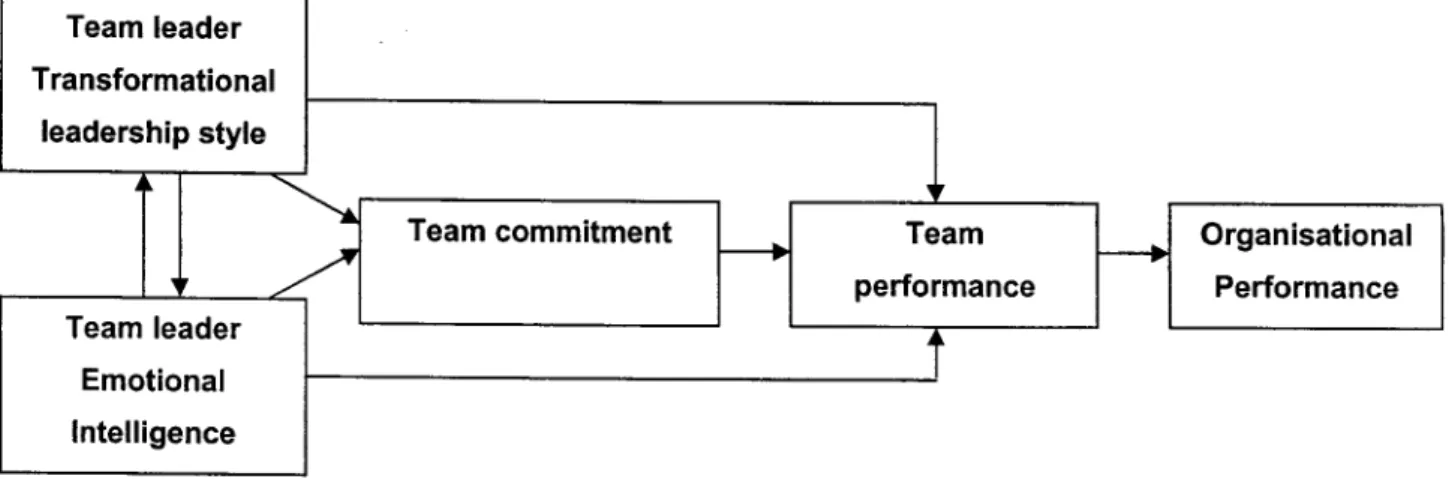
organisational performance (Bishop & Scott, 1997; Bishop et aI., 1997; Scott & Townsend, 1994). A model that integrates these relationships is proposed below.
Team leader Transformational leadership style Team leader Emotional Intelligence
Team commitment Team
performance
Organisational Performance
Figure 1: Proposed model integrating the relationships between transformational leadership behaviours, team leader EI, team commitment, team performance and organisational performance.
The present study attempted to partially validate this model by investigating the relationship between the three constructs that are the focus of this study, Le. Transformational Leadership behaviours, Team Leader Emotional Intelligence and Team Commitment. The aim of this study can thus be described as follows:
The present study aims to investigate Transformational Leadership
behaviours and Team Leader Emotional Intelligence and Team
Commitment, and the relationships between them.
RESEARCH QUESTIONS AND PROPOSITIONS
In accordance with the aim of the study and the proposed relationships that are believed to exist between the concepts as stated above, the following research questions and propositions were formulated.
Research Question One:
Do the manifestations of the three organisational behaviour constructs in question exist in the same form within a South African sample, as in the original conceptualisation by the author/s of the scales that were designed to measure these constructs?
Proposition One
The multi-factor leadership questionnaire of Bass and Avolio (1995) is transferable to a South African organisational cultural setting and it is possible to demonstrate acceptable construct validity and reliability in this setting.
Proposition Two
The Swinburne University Emotional Intelligence Test (Palmer & Stough, 2002) is transferable to a South African cultural organisation setting and it is possible to demonstrate acceptable construct validity and reliability in this setting.
Proposition Three
The Organisational Commitment questionnaire of Allen and Meyer (1990) as adapted by Bennett and Boshoff (personal communication, 5 November 2003) to measure team commitment, is transferable to a South African cultural organisation setting and it is possible to demonstrate acceptable construct validity and reliability in this setting.
Research Question Two:
How are the three organisational behaviour constructs in question related?
Proposition Four
There is a significant positive correlation between Transformational Leadership Behaviours and the level of Team Commitment.
Proposition Five
There is a significant positive correlation between Team Leader Emotional Intelligence and the level of Team Commitment.
Proposition Six
There is a significant positive correlation between Transformational Leadership Behaviours and Team Leader Emotional Intelligence.
Research Question Three:
Proposition Seven
The proposed conceptual model describing the relationships between Transformational Leadership behaviours, Leader Emotional Intelligence and Team Commitment adequately fits the data.
METHOD
Sample
The research was conducted in six 24-hour manufacturing plants. Two of the plants are located in the Western Cape, two plants in the Free State and two plants are in Kwazulu Natal. These plants were selected because all of them have implemented a programme called "Mission-Directed Work Teams". "Mission-Directed Work Teams" is an organisation intervention that aims to achieve high and continuously improving levels of Quality, Speed, Cost and Morale. A total of 25 teams from the six plants were selected to take part in the survey. A total of 178 completed responses were received: 60 (34%) from Plant One, 42 (23%) from Plant Two, 19 (11 %) from Plant Three, 23 (13%) from Plant Four, 24 (13%) from Plant Five and 10 (5,6%) from Plant Six. The sample consisted of 45 females and 133 males. The average age of the respondents was 36,66 (SO = 9.63) years old. The race distribution in the obtained sample was: African (N=49), White (N=52), Asian (N=19) and Coloured (N=58). Three respondents had a Primary School qualification, 52 respondents had a qualification of between Grade 8 and Grade 10, 79 respondents had passed Grade 12, 42 respondents had a Post school certificate or diploma and two respondents had a degree. The respondents represented the following occupations: 55 employees in administration, 74 shop-floor workers, 33 supervisors and 16 heads of departments. The respondents had an average of 8,82 (SO = 7.72) year's service to the company and have been reporting to their current supervisor or line manager for an average of 3,44 (SO = 3.25) years.
Measuring Instruments
The following instruments were used to measure the three constructs that comprised the focus of this study.
Transformational Leadership
Transformational Leadership behaviours were measured with the Multi-Factor Leadership Questionnaire (MLQ) (Form 5-45) developed by Bass and Avolio (1995). According to Pillai, Schriesheim & Williams (1999), the MLQ is the most widely used measurement for transformational leadership characteristics. Only the transformational subscale was used for the purposes of this study.
The 20 items of the MLQ in the transformational leadership sub-scale used in the study involved idealised influence (eight items), inspirational leadership (four items), intellectual stimulation (four items) and individualised consideration (four items). The internal consistency reliability measured by the Cronbach alpha coefficients for the transformational leadership sub-scale was found to be 0.93 for idealised influence, 0.72 for inspirational motivation, 0.81 for intellectual stimulation and 0.75 for individualised consideration (Hartog & Van Muijen, 1997). Lowe, Kroeck and Sivasubramaniam (1996) reported similar Cronbach alpha coefficients for these dimensions. They reported alpha coefficients to be 0.92 for charisma, 0.86 for intellectual stimulation and 0.88 for individualised consideration (Hartog
&
Van Muijen, 1997).Emotional Intelligence
(EI)Emotional Intelligence was measured with the Swinburne University Emotional Intelligence Test (SUEIT), which is a self-report inventory that indexes the way people typically think, feel and perform with emotions at work. The Organisational Psychology Research Unit of the University of Swinburne developed the SUEIT through the search for answers to what the most definitive dimensions of the construct could be. The development of the instrument was based on a number of different models and measures of emotional intelligence that were developed since the early 1990s, and included such measurement scales as those of Bar-On (1997); Cooper & Sawaf (1997); Goleman (1995) and Mayer & Salovey (1997).
A factor analytic study with a representative sample of the general population (N=310) was done in Australia. Six of the predominant measures of emotional intelligence were included in this battery: 1) the Mayer, Salovey, Caruso Emotional Intelligence test (MSCEIT; Mayer, Salovey & Caruso, 1999); 2) the Bar-On
,
~.
Emotional Quotient Inventory (Bar-On, 1997); 3) the Trait Meta-Mood Scale (Salovey, Mayer, Goldman, Turvey & Palfai, 1995); 4) the twenty-item Toronto Alexithymia Scale-II (TAS-20; Bagby, Taylor & Parker, 1994); 5) the scale by Schutte, Malouff, Hall, Haggerty, Cooper, Golden & Dornheim (1998) and 6) the scale by Tett, Wang, Gribler and Martinez (1997). Each of the scales was factor analysed separately. The component score coefficients were used to form factor-based scores for each of the dimensions identified for each test. These dimensions were again used as "items" for the principal component analysis resulting in five factors having eigenvalues greater than one, a result that matched the scree criterion and accounted for 58% of the total variance. The derived empirically based model of emotional intelligence consists of 64 items and five factors were identified: 1) Emotional recognition and expression; 2) Understanding emotions; 3) Emotions direct cognition; 4) Emotional management; and 5) Emotional control.
The 360. version of the SUIET was used for the purposes study. Participants were requested to indicate, on a five-point scale (1= very seldom, 2= seldom, 3= sometimes, 4= often, 5= very often), the extent to which the 64 statements (items) were true of the way their direct supervisor or line manager typically thought, felt and dealt with emotions at work. The overall scale reliability (the standardised Cronbach alpha) of the questionnaire was 0,88 while the indices for the sub-scales were found to be: 1) Emotional recognition & expression:
a
= 0,73; 2) Understanding of emotions external:a
= 0,83; 3) Emotions direct cognition:a
= 0,63; 4) Emotional Management:a
= 0,72; and 5) Emotional control:a
= 0,72. The full-scale reliability and most sub-scales were high with the exception of the Emotions direct cognition sub-scale (Palmer&
Stough, 2002).Team Commitment
Allen and Meyer (1990) developed their Organisational Commitment Scale (OCS) in an attempt to reconcile the various conceptualisations of organisational commitment. The OCS reflects a three-dimensional approach to commitment and purports to measure 1) affective, 2) calculative and 3) normative commitment. The affective
component of organisational commitment refers to employees' emotional attachment to, identification with, and involvement in the organisation. The continuance
leaving the organisation. The normative component refers to employees' feelings of obligation to remain with the organisation.
A total of 51 items were originally generated according to the authors' conceptualisation of organisational commitment. Some of these items were modified versions of those used in other scales, while the authors wrote other items. The 15 items of the Organisational Commitment Questionnaire (Mowday, Steers & Porter, 1979) were added to these items - resulting in a total of 66 items. Responses to all 66 items were made on seven-point Likert scales ("Strongly disagree" to "Strongly agree"). A series of decision rules were then employed for purposes of item selection. Items were eliminated under the following conditions: when the endorsement proportion was greater than 0.75; when the item correlated less with its keyed scale than with one or both of the other scales, and when the content of the item was redundant with respect to other items on the scale. Finally, 24 items were retained that loaded on three dimensions of eight (8) items each.
Becker (1992) believed that employees were committed to teams and departments, rather than to the organisation in general. This view led Bennett and Boshoff (personal communication, 5 November 2003) to reword the 24 items of the Allen and Meyer (1990) Organisational Commitment Scale to change the referent subject of the items from "the organisation" to "the team". They further developed an additional
11 items to the scale to measure the same three dimensions conceptualised by Allen and Meyer (1990). The adapted Team Commitment Scale was thereafter completed, under supervision of the researchers, by 600 middle managers from 50 organisations. The overall scale reliability (the standardised Cronbach alpha) of the questionnaire was 0.89, while the Cronbach alpha coefficients for the sub-scales were found to be: 1) Affective Commitment:
a
=
0.98; 2) Continuance Commitment:a
=
0.87; and 3) Normative Commitment:a
=
0.87. Data collectionThe members of the 25 teams received a composite questionnaire that consisted of a covering letter, a biographical section and the three measuring instruments. The covering letter briefly explained the reason for the survey and how to complete the questionnaires. The Human Resources Manager who was personally present while
respondents completed the questionnaires during working hours guaranteed complete confidentiality and anonymity. Respondents evaluated their commitment to their team and the perceived emotional intelligence and perceived transformational leadership behaviours of their supervisor/line-manager. Of the 320 questionnaires distributed, 178 (55,62%) completed questionnaires were collected and were used for the purposes of this study.
Statistical Analyses
The following statistical analyses were done on the data collected with each of the measurement scales: 1) Exploratory Factor Analysis (EFA) using SPSS Version 11, 2); Confirmatory Factor Analysis using L1SREL Version 8.53, 3); Pearson Correlation Coefficient, using SPSS Version 11, 4); Stepwise Multiple Regression Analysis, using SPSS Version 11; and 5) Structural Equation Modelling, using L1SREL Version 8.53.
Exploratory Factor Analysis (EFA)
Each measurement scale was first subjected to Exploratory Factor Analysis (EFA) to identify a minimal set of variables or factors that accounted for a major portion of the total variance of the original items. The EFA was conducted by means of the Principal-Axis Factoring extraction method, utilising a Direct Oblimin rotation. The scree plot and the Kaiser criterion, which specifies that only factors with eigenvalues of 1.00 or greater than 1.00 should be retained, were used as guides to determine the number of factors. After every round of EFA, the factor loadings in the rotated structure matrix were inspected. An item was rejected if it had a loading of ::::;;0.30on a factor or when it cross-loaded, i.e. if the item loadings differed by
::0.25
across factors. The EFA was then repeated and all items that did not comply with the above criteria were rejected until a acceptable factor structure was obtained.Confirmatory Factor Analysis (CFA)
The final factor structures of the measurement models as obtained from the EFA and the original measurement model were imposed on the data using Confirmatory Factor Analysis (CFA). This was done to determine which model best fitted the data collected from the sample. The maximum likelihood (ML) method was used to estimate all models.
Pearson Correlation Coefficient
To measure the extent of the association between the various constructs and the
underlying dimensions, Pearson's product moment correlation coefficients were
computed. Cohen's (1988) guidelines were used to interpret the values obtained: 1)
Small (r
=
+/-0.10 to +/-0.29); 2) Medium (r
=
+/-0.30 to +/-0.49); and 3) Large (r
=
+/-0.50 to +/-1.00).
Stepwise Multiple Regression
Stepwise Multiple Regression was used to determine how well the various sets of
variables were able to predict particular dependant variables.
Structural Equation Modelling
Structural Equation Modelling (SEM) was used to analyse the proposed model to get
an idea of how consistent the data was with the complete hypothesised or proposed
model.
SEM is able to test the complete model with multiple dependent and
independent variables simultaneously. A structural model including all the constructs
and their underlying dimensions was drawn up and studied with this statistical
technique.
The individual items were used as predictors of the various latent
variables. The maximum likelihood (ML) method was used to estimate all models.
RESULTS
Exploratory Factor Analysis
Multi-Factor Leadership Questionnaire (MLQ)
The first round of EFA on the 178 responses to the 20 items of transformational
leadership behaviours was performed.
After inspecting the scree plot and the
eigenvalues it was decided that a single factor existed. All of the items conformed to
the selection criteria, thus no items were rejected.
For the final factor, the
eigenvalue = 10.34 and 51.70% of the variance were explained (see Table 1). The
Cronbach alpha coefficient for the instrument was found to be 0.95.
Table 1
Factor Structure of Multi-Factor Leadership Questionnaire
Questionnaire number 011 019 08 07 017 09 06 020 014 016 D12 04 D18 013 05 03 01 02 015 010 Transformational leadership .831 .788 .784 .770 .768 .762 .742 .740 .733 .733 .731 .723 .693 .685 .677 .666 .589 .529 .520 .444
Swinburne University Emotional Intelligence Test (SUEIT)
The first round of EFA of the data collected with the SUEIT was performed using all 178 responses to the 64 items. After inspecting the scree plot and the eigenvalues obtained, it was decided that a two-factor solution would be most appropriate. The following items were eliminated after two rounds of EFAs: Round one - C10, C12, C42, C8, C28 and Round two - C3. This led to obtaining the final acceptable factor structure that contained 58 items. The EFA yielded two factors with eigenvalues exceeding 1,0: Factor 1: eigenvalue
=
9.75, explaining 16.81 % of the total variance and Factor 2: eigenvalue = 6.54, explaining 11.29% of the total variance. The two factors together explained 28.10% of the total variance. The Cronbach alpha coefficient for the instrument as found in this study was 0.75 and for the factors as follows: Factor 1:a
=
0.72, Factor 2:a
=
0.80. Table 2 shows the final factor structure for the whole sample. After inspecting the items that loaded meaningfully on the two factors, they were identified as follows: EI factor one = Understanding and displaying emotions, EI factor two = Perception and control over emotions.Table 2
Factor Structure of SUEIT Questionnaire
Questionnaire number C36 C40 C5 C4 C48 C43 C45 C62 C38 C24 C47 C41 C18 C44 C51 C34 C64 C19 C63 C54 C56 C53 C30 C1 C29 C13 C21 C2 C17 C15 C20 C33 C60 C31 C11 C59 C57 C32 C49 C14 C46 C9 C23 C55 C25 C16 C6 C50 C39 C58 C35 C22 C7 C37 C52 C61 C27 C26
Understanding and displaying emotions -.613 -.595 -.565 -.552 -.545 -.541 -.536 .526 -.514 .504 .497 -.494 .485 -.466 -.462 -.458 -.458 -.453 -.443 -.439 -.436 -.425 .421 -.407 -.403 -.394 .393 -.389 -.376 -.355 -.347
Perception and control over emotions
.676 .656 .639 .632 .628 .624 .606 .592 .552 .546 .545 .524 .514 .499 .484 .465 -.451 .441 .437 -.432 .429 .387 -.376 .361 -.350 .310 -.300
Team Commitment Questionnaire
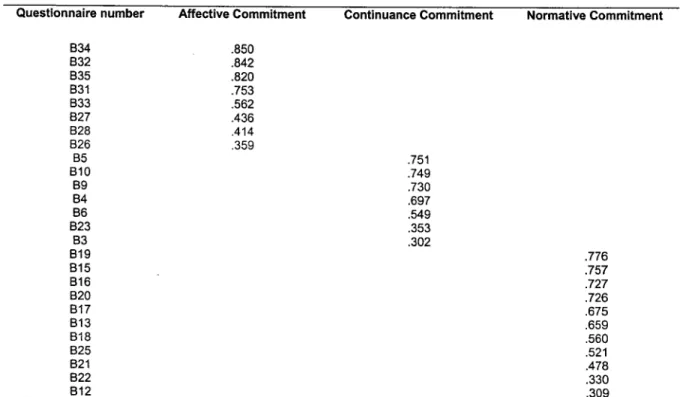
The first round of EFA of the responses to the Team Commitment Questionnaire was performed using the 178 responses to the 35 items. After inspecting the scree plot and the eigenvalues it was decided that a three-factor solution would be most appropriate. The final factor structure was obtained after three rounds of EFA, eliminating the following items: Round one - 829, 88, 87, 82, 830, Round two - 824 and 81 and Round three - 814 and 811. The final factor structure therefore contained 26 items. The EFA yielded three factors with eigenvalues exceeding 1,0: Factor one: eigenvalue
=
6.45, explaining 24.79% of the total variance; Factor two: eigenvalue = 4.51, explaining 17.36% of the total variance; and Factor three: eigenvalue=
1.86, explaining 7.17% of the total variance. The three factors together therefore explained 49.32% of the total variance. The Cronbach alpha coefficient for the instrument in this study was 0.85 and for the factors as follows: Factor one:a
=
0.85, Factor two:
a
=
0.80 and Factor three:a
=
0.87. Table 3 shows the final factor structure for the whole sample. After inspecting the items that loaded meaningfully, the three factors were identified as follows: Factor one=
Affective Commitment,Factor two = Continuance Commitment and Factor three = Normative Commitment.
Table 3
Factor Structure of Team Commitment Questionnaire
Questionnaire number 834 832 835 831 833 827 828 826 85 810 89 84 86 823 83 819 815 816 820 817 813 818 825 821 822 812 Affective Commitment .850 .842 .820 .753 .562 .436 .414 .359 Continuance Commitment .751 .749 .730 .697 .549 .353 .302 Normative Commitment .776 .757 .727 .726 .675 .659 .560 .521 .478 .330 .309