SELF-ADAPTIVE AUTHORISATION
INFRASTRUCTURES
a thesis submitted to The University of Kent
in the subject of computer science for the degree
of doctor of philosophy.
By
Christopher Michael Bailey March 2015
Traditional approaches in access control rely on immutable criteria in which to decide and award access. These approaches are limited, notably when handling changes in an organisation’s protected resources, resulting in the inability to ac-commodate the dynamic aspects of risk at runtime. An example of such risk is a user abusing their privileged access to perform insider attacks.
This thesis proposes self-adaptive authorisation, an approach that enables dy-namic access control. A framework for developing self-adaptive authorisation is defined, where autonomic controllers are deployed within legacy based authorisa-tion infrastructures to enable the runtime management of access control. Essential to the approach is the use of models and model driven engineering (MDE).
Models enable a controller to abstract from the authorisation infrastructure it seeks to control, reason about state, and provide assurances over change to access. For example, a modelled state of access may represent an active access control policy. Given the diverse nature in implementations of authorisation infrastruc-tures, MDE enables the creation and transformation of such models, whereby assets (e.g., policies) can be automatically generated and deployed at runtime.
A prototype of the framework was developed, whereby management of access control is focused on the mitigation of abuse of access rights. The prototype implements a feedback loop to monitor an authorisation infrastructure in terms of modelling the state of access control and user behaviour, analyse potential solutions for handling malicious behaviour, and act upon the infrastructure to control future access control decisions.
The framework was evaluated against mitigation of simulated insider attacks, involving the abuse of access rights governed by access control methodologies. In addition, to investigate the framework’s approach in a diverse and unpredictable environment, a live experiment was conducted. This evaluated the mitigation of abuse performed by real users as well as demonstrating the consequence of self-adaptation through observation of user response.
Acknowledgements
I would like to express my thanks and gratitude to my supervisor, Rog´erio de Lemos. Through all the challenges, hard decisions, and deadlines, he has always been there to encourage me, and offer his support, insightful knowledge, and friendship. Without his guidance this thesis would not have happened.
Many thanks to the members of the thesis panel, Eerke Boiten and Julio Hernandez-Castro, for their useful feedback and advice. In particular, my thanks goes to David Chadwick, who has supported me greatly in my understanding of authorisation infrastructures, as well as providing invaluable support throughout the Ph.D.
A special thanks goes to my fianc´ee Charlotte Pilbeam. Words cannot express how grateful I am for her love, support, and the sacrifices she has made on my behalf. I’d also like to express my thanks to my parents, my brother, and my grandparents, for all the support they have given me, their patience, and belief in me when times were hard. My thanks also goes to my future mother-in-law and father-in-law for their support, and providing myself and Charlotte with a roof over our heads, enabling our future.
I would also like to thank Lionel Montrieux, Michel Wermelinger, and Yijun Yu for their collaboration and advice on model verification. Carlos Eduardo da Silva for his advice and help in understanding model driven engineering. Kristy Siu for her advice and help in understanding identity management. And, Sally Fincher and Andy King for their advice and professional support. Not forgetting my friends Andy Mannering, Phil Stevens, Davin McCall, Matthew Mole, Dan Knox, and Michael Berry, in their support and advice throughout the Ph.D. I’d also like to thank all of the anonymous participants who voluntarily took part in a crucial experiment, enabling the evaluation of this thesis.
Finally, my thanks goes to the Engineering and Physical Sciences Research Council in supporting me with a Ph.D. research grant, and all of the supporting staff within the School of Computing, University of Kent.
Abstract ii
Acknowledgements iii
List of Tables x
List of Figures xii
List of Publications xiii
1 Introduction 1 1.1 Research Problem . . . 2 1.2 Research Approach . . . 3 1.3 Thesis Contributions . . . 4 1.4 Thesis Structure . . . 5 2 Literature Review 6 2.1 Introduction . . . 6 2.2 Access Control . . . 8
2.2.1 Role Based Access Control . . . 9
2.2.2 Attribute Based Access Control . . . 10
2.2.3 Extensible Access Control Markup Language . . . 11
2.2.4 Authorisation Infrastructures . . . 12
2.2.5 Federated Identity Management . . . 15
2.3 Insider Threat . . . 17
2.3.1 Classifying and Characterising Insider Threat . . . 18
2.3.2 Methods of Insider Threat . . . 20
2.3.3 Detection and Mitigation . . . 21
2.3.4 Mitigating Insider Threat through Access Control . . . 23
2.4 Self-Adaptation . . . 25
2.4.1 Reference Models for Self-Adaptive Systems . . . 26
2.4.2 Classifying Self-Adaptive Systems . . . 30
2.4.3 Triggering Adaptation . . . 32 2.4.4 Decision Theory . . . 33 2.4.5 Rainbow Framework . . . 34 2.5 Self-Protection . . . 36 2.5.1 Intrusion Response . . . 36 2.5.2 Architectural-Based Self-Protection . . . 37
2.5.3 Self-Protection in Access Control . . . 38
2.6 Summary . . . 41
3 Self-Adaptive Authorisation Framework 42 3.1 Introduction . . . 42
3.2 Self-Adaptive Authorisation Framework . . . 43
3.2.1 Objectives . . . 44
3.2.2 Motivation for Self-Adaptation . . . 45
3.2.3 SAAF Conceptual Design . . . 48
3.2.4 Scope of Attacks . . . 50
3.3 Target System and Environment . . . 51
3.4 Adaptation Process . . . 56 3.4.1 Models (Knowledge) . . . 56 3.4.2 Monitoring . . . 59 3.4.3 Analysis . . . 64 3.4.4 Planning . . . 68 3.4.5 Execution . . . 70 3.5 Classifying SAAF . . . 72 3.5.1 Approach Position . . . 72 3.5.2 Approach Characterisation . . . 73 3.6 Evaluating SAAF . . . 75 3.7 Related Work . . . 76 3.8 Summary . . . 81
4 Model Driven Self-Adaptive Authorisation 82 4.1 Introduction . . . 82
4.2 Background . . . 83
4.2.1 Model Driven Engineering . . . 83 v
4.3.1 Controller Architecture . . . 88
4.3.2 Scope of Observation and Control . . . 90
4.3.3 Modelling the State of Access Control (Monitoring) . . . . 93
4.3.4 Detecting Malicious Behaviour (Monitoring) . . . 95
4.3.5 Analysing Behaviour and Solutions (Analysis) . . . 96
4.3.6 Mitigating Behaviour (Planning and Execution) . . . 101
4.4 Authorisation Infrastructure Integration . . . 103
4.5 Preliminary Analysis of SAAF . . . 105
4.5.1 Chemical Researcher Insider Attack . . . 105
4.5.2 Adaptation Scenario . . . 106
4.5.3 Adaptation Results . . . 110
4.5.4 Scalability of Verification . . . 112
4.5.5 Prototype Discussion . . . 113
4.6 Summary . . . 114
5 Simulating Insider Threat 115 5.1 Introduction . . . 115
5.2 Case Study: LGZLogistics . . . 116
5.2.1 Context and Architecture . . . 117
5.2.2 Access Control Model . . . 118
5.2.3 Subject Behaviour . . . 119
5.3 Defining Malicious Changeload . . . 120
5.3.1 System and Environment Models . . . 121
5.3.2 System and Environment State . . . 122
5.3.3 Operational Profiles . . . 124
5.3.4 Change Types and Changes . . . 125
5.3.5 Scenarios and Changeload . . . 130
5.4 Case Study: Changeload . . . 135
5.4.1 Violations . . . 135
5.4.2 Identifying Change Types and Change . . . 137
5.4.3 Malicious Changeload . . . 138
5.5 Experiments . . . 141
5.5.1 Deploying the SAAF Controller . . . 141
5.5.2 Executing LGZLogistics Changeload . . . 144
5.5.3 Experiments Execution . . . 146
5.5.4 Summary of Results . . . 152
5.6 Experiment Discussion . . . 154
5.6.1 Evaluation Approach . . . 155
5.6.2 Detection and Adaptation . . . 156
5.6.3 Federation Challenges . . . 159
5.7 Summary . . . 160
6 Evaluating SAAF through Gamification 161 6.1 Introduction . . . 161
6.2 Objective and Scope . . . 162
6.3 The Game of Snakes and Ladders . . . 164
6.3.1 Game Design . . . 165
6.3.2 Vulnerabilities . . . 167
6.4 Deployment . . . 170
6.4.1 Self-Adaptive Authorisation Infrastructure . . . 170
6.4.2 SAAF Controller Configuration . . . 172
6.4.3 Logs . . . 175
6.5 Experiments . . . 177
6.5.1 Experiment Execution . . . 177
6.5.2 Observed Environment Change . . . 180
6.5.3 Detection and Mitigation . . . 182
6.6 Evaluation of Hypotheses . . . 186
6.6.1 H1. Adaptation mitigates malicious subject activity . . . . 186
6.6.2 H2. Experience enables sophisticated attacks . . . 190
6.6.3 H3. Subject behaviour changes post adaptation . . . 191
6.6.4 Summary Conclusion on Hypotheses . . . 193
6.7 Evaluating SAAF: Success and Limitations . . . 195
6.7.1 Success and Limitations of Performed Experiments . . . . 195
6.7.2 Consequences of Self-Adaptive Authorisation . . . 198
6.8 Summary . . . 199 7 Conclusions 201 7.1 Thesis Contributions . . . 201 7.2 Discussion . . . 202 7.3 Limitations . . . 203 7.4 Future Work . . . 205 vii
A.2 LDAP Metamodel . . . 214
A.3 PERMIS Metamodel . . . 214
A.4 Scope of Observation . . . 216
A.5 Scope of Control . . . 217
A.6 Behaviour Policy . . . 218
A.7 Solution Policy . . . 221
A.8 Preliminary Analysis Results . . . 223
B Simulating Malicious Changeload 226 B.1 Change Instantiations . . . 226
B.2 Federated Adaptation . . . 230
B.2.1 Automating the Management of Identity Providers . . . . 230
B.2.2 SimpleSAMLphp Identity Provider Effector . . . 233
B.3 Simulation Experiments . . . 235
B.3.1 Controller Configuration . . . 235
B.3.2 Adaptation under Normal Load: Solution Selection . . . . 236
B.3.3 Adaptation under High Load: Summary of Results . . . . 238
C Gamification Analysis 241 C.1 Guidance to Players . . . 241 C.2 Game Data . . . 243 C.3 Player Behaviour . . . 245 Bibliography 249 viii
List of Tables
2.1 XACML components . . . 12
3.1 Target system and environment probe types . . . 55
3.2 Target system effector types . . . 56
3.3 Example adaptation constraints as test cases for RBAC core . . . 59
3.4 Example criteria of behaviour . . . 65
3.5 Quality dimensions of solution selection . . . 69
3.6 Comparison of solutions related to governance of access and miti-gation of malicious behaviour . . . 78
4.1 Verification and adaptation results . . . 111
5.1 Exp1: Adaptation with normal load (time in milliseconds) . . . . 148
5.2 Exp3: Adaptation with normal load (contractor IdP effector failure) 151 6.1 High level statistics of game related data . . . 180
6.2 Authentication and authorisation statistics . . . 181
6.3 Violation statistics . . . 182
6.4 Adaptation trace of an persistent weak attack game . . . 187
6.5 Adaptation trace of an immediate strong attack game . . . 188
6.6 Adaptation trace of mitigation post game completion . . . 189
6.7 Changes in participant behaviour post-warning . . . 192
6.8 Changes in participant behaviour post-deny of access . . . 192
A.1 Prototype behaviour rule types . . . 219
A.2 Prototype actions for ABAC authorisation infrastructures . . . 222
A.3 Calculated subject impact per stage of the simulated case study . 223 A.4 Solutions with cost and minimum impact . . . 224
A.5 Solution selection and ranking . . . 224
B.1 Behaviour rules (violation types) . . . 236
B.2 Solutions with cost and minimum impact . . . 236
B.3 Exp1: Solution selection and ranking . . . 237
B.4 Exp3: Solution selection and ranking . . . 239
C.1 Permitted game authorisation requests . . . 244 C.2 Observed game actions . . . 244 C.3 Number of players detected of injection attacks versus number of
previous games played and detected violations . . . 245
List of Figures
2.1 Role Based Access Control Model [97] . . . 9
2.2 General authorisation infrastructure model . . . 13
2.3 A simple example of a PERMIS authorisation infrastructure . . . 15
2.4 Conceptual view of federated / collaborative access . . . 17
2.5 CADA generic feedback loop [22] . . . 26
2.6 Oreizy et al. self-adaptive reference model [107] . . . 27
2.7 MAPE-K reference model for autonomic computing [73] . . . 28
2.8 Three layer reference model for self-managing systems [77] . . . . 29
2.9 Reflective reference model for self-adaptive systems [2] . . . 30
2.10 Rainbow framework [53] . . . 35
2.11 Adaptive risk management and access control architecture [9] . . . 39
3.1 SAAF conceptual design . . . 49
3.2 Attack points on self-adaptive authorisation . . . 50
3.3 Causal connection of access control model to target system . . . . 57
3.4 Monitoring stage (normal and exceptional flow) . . . 60
3.5 Gauge generation (detection of environment change) . . . 63
3.6 Analysis stage (normal and exceptional flow) . . . 64
3.7 Example solution hierarchy in mitigating malicious behaviour . . 66
3.8 Solution verification via model level adaptation . . . 67
3.9 Planning stage (normal and exception flow) . . . 68
3.10 Execution stage (normal and exception flow) . . . 71
4.1 The 3+1 MDE architecture [15] . . . 84
4.2 Exemplified model transformation pattern [67] . . . 85
4.3 Extended rbacDSML metamodel [8] in MOF . . . 87
4.4 SAAF controller prototype . . . 88
4.5 SAAF ABAC metamodel defined in Ecore . . . 91
4.6 Transformation of implementation specific models to ABAC . . . 94
4.7 SAAF controller model verification . . . 99
4.10 Centralised authorisation infrastructure . . . 104
4.11 Deployed state of access (RBAC) . . . 107
4.12 Stage 1 Taint Flow . . . 110
4.13 Scalability of model verification . . . 113
5.1 LGZLogistics authorisation infrastructure architecture . . . 117
5.2 LGZLogistics subject attribute permission assignments . . . 118
5.3 LGZLogistics valid attribute assignments . . . 119
5.4 Example architecture model for an authorisation infrastructure. . 121
5.5 Self-adaptive federated authorisation infrastructure . . . 142
5.6 Executing changeload experimentation profile [24] . . . 145
5.7 Baseline (i) normal load, (ii) high load . . . 146
5.8 (i)Exp1 normal load, (ii) Exp2 high load . . . 148
5.9 (i)Exp3 normal load, (ii) Exp4 high load . . . 151
6.1 Activity flow of the game resource . . . 166
6.2 Screenshot of the implemented Snakes and Ladders game . . . 166
6.3 Game experiment authorisation infrastructure . . . 171
6.4 Percentage of detected violations by type . . . 183
6.5 Breakdown of violations and mitigations . . . 184
6.6 Total mitigation time versus model size . . . 185
6.7 Trace of a persistent weak violation profile against mitigation . . . 187
6.8 Trace of an immediate high severity violation against mitigation . 188 6.9 Trace of a mitigated malicious player post game completion . . . 190
6.10 Violations and games played prior to injection attacks . . . 191
6.11 Number of detected violations versus number of turns to win a game193 A.1 LDAPIdentity metamodel defined in Ecore . . . 214
A.2 Simplified PERMIS Metamodel defined in Ecore . . . 215
B.1 SimpleSAMLphp Identity Provider Effector . . . 234
C.1 Player participation declaration . . . 241
C.2 Advice to participants . . . 242
C.3 Games Instructions . . . 243
C.4 Trends in game and player behaviour . . . 246
List of Publications
The following publications are all original in contribution and relevant to this thesis, where the author of this thesis has been the main contributor.
1. Bailey, C., Chadwick, D. W. and de Lemos, R. (2014). Self-adaptive fed-erated authorization infrastructures. Journal of Computer and System Sci-ences, 80(5), pp. 935-952, Special Issue on Dependable and Secure Comput-ing (Chapter 3 and Chapter 5)
2. Bailey, C., Montrieux, L., de Lemos, R., Yu, Y. and Wermelinger, M. (2014). Run-time generation, transformation, and verification of access control mod-els for self-protection. InProceedings of the 9th International Symposium on Software Engineering for Adaptive and Self-Managing Systems, New York, NY, USA: ACM, SEAMS 2014, pp. 135-144 (Chapter 4)
3. Bailey, C., Chadwick, D. W., de Lemos, R. and Siu, K. W. (2013). Enabling the autonomic management of federated identity providers. In Proceedings of the 7th IFIP WG 6.6 International Conference on Autonomous Infras-tructure, Management, and Security: Emerging Management Mechanisms for the Future Internet - Volume 7943, Berlin, Heidelberg: Springer-Verlag, AIMS’13, pp. 100-111 (Chapter 5 and Appendix B)
4. Bailey, C. (2012). Application of self-adaptive techniques to federated au-thorization models. In Proceedings of the 34th International Conference on Software Engineering, Piscataway, NJ, USA: IEEE Press, ICSE ’12, pp. 1495-1498, Doctoral Symposium (Chapter 3)
5. Bailey, C., Chadwick, D. W. and de Lemos, R. (2011). Self-adaptive au-thorization framework for policy based RBAC / ABAC models. In Pro-ceedings of the 2011 IEEE Ninth International Conference on Dependable, Autonomic and Secure Computing, Washington, DC, USA: IEEE Computer Society, DASC ’11, pp. 37-44 (Chapter 3)
Introduction
A critical concern for organisations surrounds the assurances of confidentiality, integrity, and availability of their computer based resources. To provide such assurances, organisations utilise access control to protect against unauthorised access. Current approaches, such as Role Based and Attribute Based Access Control (RBAC and ABAC) [58, 97], rely on the assessment of immutable criteria before awarding access.
Whilst RBAC and ABAC approaches are capable of protecting from unautho-rised access, they do not take into account the dynamic aspects of risk at runtime, due to uncertainty in user behaviour. A number of approaches in improving access control have been proposed in response to such concerns. These include dynamic access control methods that consider risk [83], trust [12], and usage [109], as part of the criteria for accessing resources, whereby they seek to enable a fine granularity of control. However, such approaches introduce complexity into the definition of access control, potentially restricting access unnecessarily, or introducing errors. Moreover, to be effective, these approaches must accommodate every possible abuse at time of defining the criteria for access.
Regardless of adopting a fine grained approach to access control, abuse of access is still possible. Any form of access, no matter how restrictive, presents the risk of attacks due to uncertainty in user behaviour. To accommodate for this risk, organisations employ a range of methods [92] to monitor and audit access within their systems and resources. Traditionally, human administrators are relied upon to actively identify and drive changes in access control in response to detected abuse, natural organisational change, or identified errors in the criteria for access. However, as evident by recent scandals [10, 20, 141], much more could be done.
Implementations of access control (e.g., authorisation infrastructures [32]), 1
CHAPTER 1. INTRODUCTION 2
must be capable in handling the dynamic aspect of risk at runtime, driven by the uncertainty in user behaviour. It is therefore necessary for such systems to actively observe how access rights are being used, in order to infer whether the current criteria and assignment of access are enabling a user to conduct malicious activity.
1.1
Research Problem
Authorisation infrastructures [32] consist of integrating independent systems for implementing access control. These include systems to facilitate storage of user access rights; user authentication; the issuing, release, and validation of user access rights; decision for access; and enforcement of access control decisions. As such, no one system exhibits a complete view of the configuration of access.
It is therefore challenging for human administrators to maintain a true aware-ness of the configuration of access, particularly within a runtime environment. With no complete view of access, obtaining assurances [57] against changes made to mitigate the abuse of access is limited. This potentially enables erroneous changes that cause a greater impact to the organisation over identified abuse.
In addition, and as evident in case studies of historic insider attacks [27], the use of human administrators alone is inefficient in mitigating abuse in a timely manner. Improving on access control methodologies is one solution, yet such approaches [12, 66, 83, 109] are unable to actively mitigate abuse, since they are constrained to a static definition of the criteria for access control at runtime. Given these problems, this thesis considers the following research question.
How can access control be managed to handle unpredictable changes in user behaviour at runtime?
Enabling the management of access control presents several challenges. First, authorisation infrastructures that implement access control contain a multitude of systems in which an access control methodology is achieved. There are many diverse implementations that can exist within an authorisation infrastructure [81, 112, 114], and as such, a challenge concerns how a single solution can integrate, observe, and adapt such a variety of systems at runtime.
Second, an authorisation infrastructure may be owned by a single organisation (i.e., centralised), or multiple organisations (i.e., federated [93, 140]), where access
to resources is assigned by multiple third party organisations. As a result, observ-ing and obtainobserv-ing a unified perception of the configuration of access is challengobserv-ing, due to the need to operate across multiple management domains.
Third, given the nature of change against the criteria and assignment of access, a certain degree of assurance is required. As with the need to verify the definition of an access control model against requirements at development time [57], it also becomes necessary to verify any changes in the definition of access control at runtime.
1.2
Research Approach
Given the current limitations in access control, the approach presented in this thesis proposes a framework that enables the automated management of access control through self-adaptation.
The framework observes and controls authorisation infrastructures at runtime, via the automated adaptation of access control policies and user privileges. The framework defines a means for adapting the criteria and assignment of access depending on the presence of insider threat (related to the abuse of access control). The framework has been implemented as a prototype consisting of an autonomic controller, configurable within RBAC and ABAC authorisation infrastructures.
The approach is demonstrated as a reactive means to handling insider threat. This is an important contrast to how existing approaches aim to handle malicious behaviour in access control. Rather than deploying restrictive access control poli-cies that attempt to preempt malicious behaviour, this approach positions the automated adaptation of access control in response to malicious behaviour.
The approach relies on self-adaptation [121] and model driven engineering [16] as a means to achieve automated management of authorisation infrastructures. Applying self-adaptive techniques to authorisation infrastructures enables the in-frastructure to observe, reason, and act on its own configuration of access control. Through the use of a feedback loop [22], it is possible to employ a clear separa-tion of concerns between the decision for access, and decision for a management change, therefore reducing the complexity in the criteria for access that dynamic access control approaches introduce.
Model driven engineering (MDE) [16] enables a self-adaptive system to ab-stract and generate models of its own system and environment state, such as the runtime state of access in terms of the configuration of access control. Models are
CHAPTER 1. INTRODUCTION 4
important in enabling the reasoning of environment and system state, as well as the adaptation of system state. For instance, model transformation [126] enables the conversion of one model (e.g., a particular implementation of an RBAC access control policy) to another (e.g., a homogeneous model of RBAC). Through model transformation, a self-adaptive solution is therefore able to observe and adapt diverse implementations of access control.
Finally, in order to evaluate the approach, the framework is deployed within a centralised (single organisation) RBAC authorisation infrastructure, and a fed-erated (multi-organisation) ABAC authorisation infrastructure. The framework is then evaluated in terms of simulating case studies of insider threat, as well as evaluated within a live experiment using gamification [60]. The latter demon-strates a novel approach to evaluating self-adaptive systems under diverse and unpredictable change.
1.3
Thesis Contributions
The goal of this thesis is to design and evaluate a framework for the runtime management of access control. In pursuit of this goal, this thesis presents several contributions.
1. The definition of a framework to enable the automated management of au-thorisation infrastructures through self-adaptation, capable in mitigating the abuse of access by adapting access control policies and user privileges at runtime.
2. An approach to generating and transforming a model of the state of access, causally connected to the configuration of access control within distributed and complex systems at runtime.
3. A means to automating the management of federated identity providers [93], in order to mitigate the abuse of access given the existence of multiple man-agement domains.
4. A novel approach to evaluating self-adaptive systems through gamifica-tion [60], enabling the generagamifica-tion of data representative of change (e.g., abuse of access) that is diverse and unpredictable.
1.4
Thesis Structure
The rest of this thesis is structured as follows. Chapter 2 presents a literature review aimed at scoping the thesis’s research problem and reviewing related work. The literature review discusses the following topics: traditional methods in access control, insider threat, recent approaches in access control with respect to insider threat, self-adaptive software systems, and self-protecting software systems.
Chapter 3 proposes the Self-Adaptive Authorisation Framework (SAAF), a framework for enabling the automated management of authorisation infrastruc-tures. It presents the conceptual aspects of the approach, notably the role of au-tonomic controllers in observing and adapting authorisation infrastructures. The approach is also classified with respect to a recent taxonomy of self-protecting systems [150], leading to a discussion of the approach and related work.
Chapter 4 describes the implementation of a SAAF autonomic controller pro-totype, deployable within RBAC and ABAC authorisation infrastructures. A major focus of the chapter is on the role of models at runtime, and defining a means in which the controller can be integrated with diverse implementations of authorisation infrastructures. A preliminary experiment then demonstrates miti-gation of a historic case of insider threat, simulated within an RBAC authorisation infrastructure.
Chapter 5 presents a formal definition of change within authorisation infras-tructures. The formal approach is used to drive the simulation of a fictitious insider attack within a federated ABAC authorisation infrastructure. Several ex-periments are discussed in this chapter, evaluating the prototype’s ability to mit-igate insider attacks given limitations in the observation and control of federated authorisation infrastructures.
Chapter 6 seeks to complement the previous evaluation by deploying SAAF within a real user environment. In this chapter, an online game has been devel-oped for emulating an organisational resource, protected by a centralised RBAC authorisation infrastructure. The prototype controller is deployed and evaluated in detecting and mitigating malicious behaviour conducted by players of the game, at real time, whereby the prototype is faced with diverse and unpredictable change. Lastly, Chapter 7 presents the conclusions of the thesis by stating the achieve-ments, limitations, and identification of future work.
Chapter 2
Literature Review
2.1
Introduction
Modern organisations are facing increasing security threats, where their intellec-tual property, systems, and resources are at risk to internal and external attacks. This had led to the use of a wide range of security controls in order to provide assurances in the fundamental aspects of security: the CIA triad of confidentiality, integrity, and availability [115].
Confidentiality refers to the prevention of unauthorised access to information and systems (e.g., a top secret document is not disclosed to the public). Integrity aims to assure information and systems remain accurate, and behave as expected (e.g., software has not been tampered with to act maliciously). Lastly, availability seeks to assure that information and systems remain available when needed (e.g., an authorised employee is not hindered in accessing a critical system).
Various controls exist for organisations to maintain assurances in confiden-tiality, integrity, and availability. These range from administrative procedures (e.g., definition of security policies) to technical solutions, such as physical con-trols (e.g., electronic door locks and alarms), authentication and access control systems, network security, application security, and encryption. As such, an or-ganisation may employ several layers of control in order to prevent or mitigate security threats. For instance, an organisation may utilise firewalls to prevent access to their network from wide area networks, and deploy intrusion detection systems [120] to identify external attacks. Additionally, an organisation may in-stall anti-virus tools to maintain the integrity of inin-stalled applications, and access control systems to prevent unauthorised access to confidential resources.
This research focuses on access control, with the intent on improving the man-agement of access control in light of a particular type of security threat: insider threat. Specifically, the goal is to extend access control in order to handle preva-lent insider threats that modern organisations are victim to, by introducing a greater degree of automation.
Access control, where an organisation seeks to govern user access to electronic resources (e.g., systems, hardware, and data), refers to how a user is identified, the privileges a user has, the constraints of access a user is subject to, and how access is decided. It is considered the enabling technology for users to gain access to resources, in which a user can exhibit insider threat. Insider threat refers to the potential of a user within an organisation to cause damage against that organ-isation, in terms of theft, sabotage, and fraud. Users who abuse their privileges to carry out insider threat can be mitigated through active management of access control (i.e., removal or assignment of access). However, current solutions in ac-cess control are limited in automating such a proac-cess, relying on manual practices to identify and respond to such threat.
A solution to automating the management of access control is self-adaptation. Self-adaptation, where a system is capable of observing and adapting itself, is considered due to the ability for a system to reason about its own state, identify non-conventional states, and adapt its state to protect, manage, or repair. Self-adaptation can be applied to existing approaches in access control to improve upon the handling of insider threat, through active adaptation of access control rules and user privileges. This enables a direct response to an ever changing and dynamic environment (i.e., the organisation, its users, and its resources).
In this chapter, a literature review explores the topics of access control and self-adaptation, along with their relation to the mitigation of insider threat. It is structured as follows. Section 2.2 provides a core overview of access control. Common access control models within industry are highlighted, as well as emerg-ing models attainemerg-ing increased interest in the security research area. Section 2.3 introduces insider threat, highlighting different types of attacks, and current ap-proaches used for detection and mitigation. In Section 2.4, an overview of self-adaptation and self-adaptive software systems is presented, discussing prevalent self-adaptive reference models, challenges in realising self-adaptation, and an ex-ample self-adaptive solution. Section 2.5 discusses relevant work on self-protection and their application to mitigating insider threat. Lastly, in Section 2.6, a sum-mary of the literature review is given.
CHAPTER 2. LITERATURE REVIEW 8
2.2
Access Control
Access control is the government and restriction of access to a resource [130], where a resource could be anything from a software system (web application, database) to an electronic device (electronic door lock, mobile phone). Through well structured access control policies (rules), assignment of user access rights, and precise separation of duties, an organisation garners a certain level of protec-tion from unwanted access. By definiprotec-tion, access control mitigates the potential damage from malicious insiders by limiting a user’s scope of access.
Access control embodies two concepts: identities and permissions. An iden-tity is a digital representation of a subject (a user), where a subject could be a human being, a system, or even a process [12]. An identity contains information about the subject, particularly relevant for authentication [110] where a subject must identify themselves (e.g., entering in a username and password, or use of biometrics [117]). Most importantly, an identity contains a set of subject access rights (i.e., privileges). Access rights represent a subject’s right of access to a re-source, used in conformance to a set ofpermissions. Permissions define the access right(s) required in order to obtain access to a resource. Once a subject invokes the required access right(s) to a resource, the subject is said to be authorised.
Access control models seek to classify and define how access is governed, in terms of how permissions are expressed, who can define permissions, and what an access right looks like. The Mandatory Access Control [75] (MAC) model enables subjects with a set of access rights to access resources in conformance to centrally specified permissions (i.e., defined by security administrators). In contrast, the Discretionary Access Control [75] (DAC) model enables subjects in a similar sense to MAC to access resources, yet, permissions can be specified by the subjects themselves in relation to the resources that they own. Additionally, the Bell-LaPadula model (BLP) [11] awards access based on labelled classifications, such as Top Secret orPublic, and a subject’s level of security clearance.
Arguably, the most adopted [102] access control model in industry is Role Based Access Control (RBAC) [97]. RBAC introduced the notion of roles, where a role is assigned a set of permissions that enable access to a resource. Finally, Attribute Based Access Control (ABAC) [152] presents a more generic view of the RBAC, where instead of roles, attributes (e.g., hgender,malei) are used in order to collate and assign permissions.
The rest of this section addresses RBAC and ABAC. This includes the discus-sion of the eXtensible access control markup language (XACML) [101]; the role of authorisation infrastructures in implementing access control; and the notion of federation, where access control is implemented across multiple organisations.
2.2.1
Role Based Access Control
The Role Based Access Control model is the culmination of works by Ferraiolo et al. [49] and Sandhu et al. [123] that led to a National Institute of Standards and Technology (NIST) RBAC standard [97]. The RBAC standard is defined by three layers, each layer extending the layer prior with additional features. The layered approach provides flexibility for organisations to adopt the standard, whereby not all functionality may be necessary. These layers are referred to as
Core, Hierarchical, and Constrained.
Figure 2.1: Role Based Access Control Model [97]
RBAC Core (Figure 2.1) defines the minimum requirements to conform to the RBAC standard. It defines the fundamental elements that must exist within an RBAC implemented access control system, namely, subjects (identities), roles,
resources, actions, permissions, and sessions. Subjects are assigned a set of roles, where a role may define a job function within an organisation (e.g., operations manager). Roles are assigned permissions, where each permission details the ability for a subject to execute anaction (e.g., print) on aresource (e.g., printer). Asubject’s session captures a set ofroles that thesubject has currently activated. RBAC Hierarchical extends RBAC Core by introducing the ability for roles
to inherit permissions of another role (role hierarchy, Figure 2.1). The RBAC standard defines inheritance by stating that a role1 inherits from role2 only if
CHAPTER 2. LITERATURE REVIEW 10
RBACConstrained extends RBACCore and RBACHierarchical by introduc-ing constraints in regards tosubjects and roles. Constraints are used to prevent a
subject from abusing business functions within their position of power. For exam-ple, a constraint may exist that prevents a subject who is astudent from marking their own work, as a member of staff. The RBAC standard defines two types of constraints: Static Separation of Duties (SSD), and Dynamic Separation of Du-ties (DSD), as labelled in Figure 2.1. SSD refers to the restriction of subject role assignment, meaning if a subject owns role1, they may not ownrole2. DSD refers
to the restriction of which roles a subject may activate within a session. This means, if a subject has activated role1 but also has been assigned role2, access to
permissions assigned to role2 are denied.
There are many proposals that extend RBAC, highlighting not only RBAC’s popularity in industry, but also in the research area. Kalam et al. extend RBAC to include the notion of organisations in Organisation Based Access Control (Or-BAC) [69]. Introducingorganisations enables the specification of RBAC rules rele-vant to an organisation, where there are many sources of authority (SOAs) sharing access. Similar work by Demchenko et al also address the problems caused by mul-tiple sources of authority, proposing Role Based Access Control for Distributed Multidomain Applications (RBAC-DM) [44]. Demchenko highlights limitations of RBAC in collaborative environments (containing multiple SOAs), and addresses them via the use of multi-domain authorisation sessions (where an RBACsession
can span across several organisations). Lastly, Bertino et al.’s GEO-RBAC [13] in-troduces the notion of location, where a subject’s geographical location influences the activation of a subject’s assigned roles. GEO-RBAC addresses the need for spacial aware access control, where subjects may only access a resource depending on their location.
2.2.2
Attribute Based Access Control
Attribute Based Access Control (ABAC) is a recent development in access control, garnering increased attention from the research community. There are a number of proposals [58], critiques [122], and implementations [32, 93, 101]. ABAC can be considered a natural progression from the RBAC model, whereby instead of
permissions assigned to roles, permissions are assigned to attributes of a sub-ject. An attribute is defined as a tuple hAttributeType,AttributeValuei, where
by identities (e.g., email address, gender, etc.), andAttributeValue represents the value of the attribute. For example, an attribute for a subject’s identity with first name John is described as: hfirstName,Johni.
ABAC implementations and proposals have put forward additional criteria for access control, as opposed to simply replacing the notion of roles in RBAC with attributes. Notably, environment conditions are considered in order to provide additional context to a subject’s request for access. For example, a subject re-questing access outside of normal office hours should not be granted access, despite having the necessary attributes to gain authorisation to the resource. The inclu-sion of environment conditions has the ability to expand the criteria necessary to award access, and further protect an organisation’s resources from attacks (e.g., credential stealing attacks [128], by blacklisting IP addresses).
Sandu states that the leap from RBAC roles to the use of attributes offer a number of benefits [122]. This highlights the fact that ABAC unifies many access control models, such as attributes used forroles (RBAC), location (GEO-RBAC), and security labels (Bell-LaPadula). However, the resulting benefits of ABAC come with complexity. Organisations now have to be more specific when utilising ABAC, as access rights could be represented as anything a subject, resource, or environment might own. This has the potential to lead to conflicting access control policies, or increased challenges when managing access, due to no clear representation of an access right.
2.2.3
Extensible Access Control Markup Language
The eXtensible Access Control Markup Language (XACML) standard [101] is used to define a plethora of access control policies, primarily enabling the specifi-cation of ABAC and RBAC policies [100]. The purpose of XACML is to provide an extensible format that organisations can use for specifying access control rules, as well as a format in which access requests and decisions can be conveyed. The extensible characteristics of XACML enables integration between independent ac-cess control systems, whereby common terminology is used. In addition to the markup language, XACML promotes separation of access control from resources (i.e., a resource relies on an external service to perform access control decisions). Separating access control decisions allows for centralised management, removing redundancy in access control rules that are typically specified and interpreted locally at each resource.
CHAPTER 2. LITERATURE REVIEW 12
XACML describes a set of conceptual components necessary to implement separation of access control from resources (Table 2.1). These components are the enabling factors of access, whereby in real systems [48, 148] that implement such components, access control can easily be monitored, and managed, in a centralised manner. This removes the need for each of an organisation’s resources to implement access control, and for administrators to replicate access control rules in a redundant fashion.
Component Description
Policy administration point (PAP) The source of authority / system that issues access control policies
Policy decision point (PDP) Evaluates access requests against policies to provide access decisions
Policy enforcement point (PEP) Makes access requests and enforces access decisions
Policy information point (PIP) Contains subject identity information (attributes)
Table 2.1: XACML components
2.2.4
Authorisation Infrastructures
An authorisation infrastructure [32] is a loose term for a collection of services and mechanisms that implement an access control model. There are a number of varying terms for authorisation infrastructures, such as the ones defined by authentication and authorisation infrastructures (AAIs) [81], XACML’s reference authorisation architecture [101], and privilege management infrastructures [31]. Chadwick et al. [32] define an authorisation infrastructure as follows:
Definition 1 (Authorisation Infrastructure [32]) “Authorisation infras-tructures manage privileges and render access control decisions, allowing applications to adjust their behaviour according to the privileges allocated to users.”
Key to this definition and other variations is the existence of independent ser-vices that facilitate the management of subject access rights (identity services), and access control decisions (authorisation services). Examples of authorisation services include the axiomatics policy server [4], PERMIS standalone authori-sation service [114] (both of which utilise the XACML standard to define access
control policies), and the community authorisation service (CAS) [112]. Examples of anidentity serviceinclude directory services, such as the Lightweight Directory Access Protocol [76] (LDAP). Other forms of identity services include creden-tial issuing services (such as SimpleSAMLphp [131] and the Shibboleth identity provider [93]). These types of identity services not only maintain a subject’s ac-cess rights (privileges), but can be configured to decide what acac-cess rights can be issued and released to given services across multiple domains.
General Model for Authorisation Infrastructures
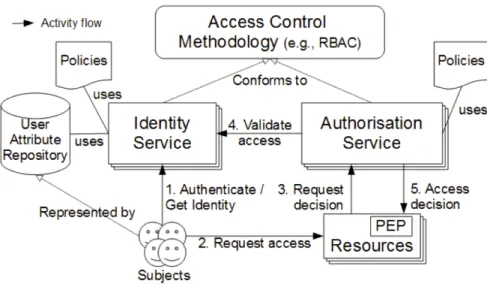
To abstract from varying implementations of authorisation infrastructures, Fig-ure 2.2 defines a general model of an authorisation infrastructFig-ure. Based on existing implementations [32, 81, 101], identity services may authenticate sub-jects, and maintain, assign and release a subject’s access rights (i.e., privileges) to authorisation services based on policies (e.g., Shibboleth’s attribute release policy [93]). Authorisation services may validate and evaluate a subject’s ac-cess rights against a set of policies (e.g., PERMIS’s acac-cess control and credential validation policies [114]).
Figure 2.2: General authorisation infrastructure model
The combination of both identity services and authorisation services results in the implementation and conformance to an access control methodology (e.g., RBAC [97]). Policies within authorisation services are used to define the con-straints of access (i.e., RBAC role permission assignments), whereas policies and subject attribute repositories (e.g., LDAP [76]) withinidentity services contain or define what subjects have in terms of assigned privileges.
CHAPTER 2. LITERATURE REVIEW 14
Associated with policies and access rights is the notion of source of authority
(SOA) and issuer [32]. An SOA is the owner of a resource that establishes the rules of access (as policies) to their resources. An issuer is the identity service or person that issued a subject a set of access rights, which are either stored in an attribute repository as unsigned or signed attributes [64], or are generated at time of request [99].
The key facet of authorisation infrastructures, highlighted by the general model, is the use of services to implement and provide access control, exter-nal to an organisation’s resources. This implies a separation of duties between provisioning of functionality within resources, and the assessment of right to ac-cess [32, 81, 101]. Specifically, acac-cess control is implemented by services that provide the following functionality:
1. Authentication and disclosure of subject information, such as access rights and subject identifiers (identity services)
2. Evaluation of access rights against access control rules, and decision of access (authorisation services)
3. Coordination of access requests and enforcement of access control decisions (policy enforcement points - PEPs)
With reference to the flow of communication in Figure 2.2: to obtain authorisa-tion, subjects (users) authenticate (1) with a givenidentity servicethat maintains a set of access rights for each subject. The authenticated subject can then request (2) access to a particular resource. The resource’s policy enforcement point (PEP) communicates with an authorisation service (3), which can first validate (4) the subject’s set of access rights (i.e., ensure they are legitimate), and then decide upon access. The authorisation service sends a response back to thePEP with a message indicating if authorisation should be granted or denied (5).
PERMIS Authorisation Infrastructure
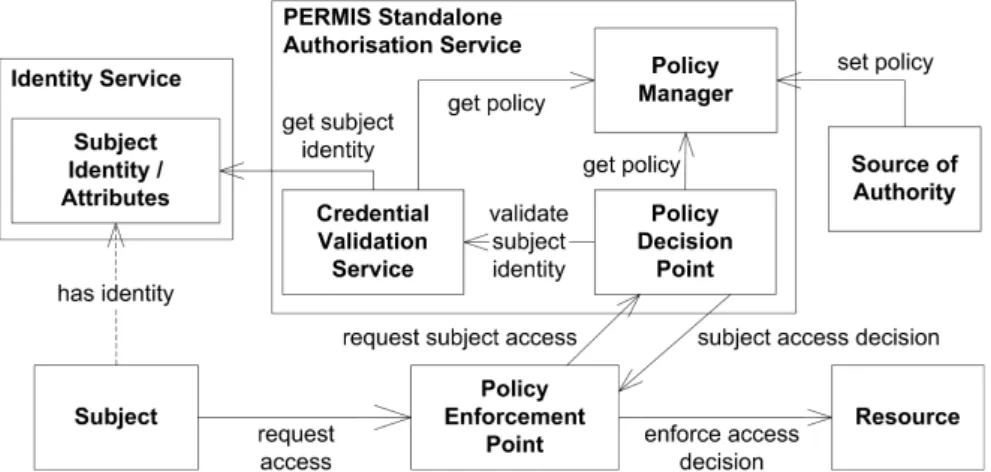
An example of an authorisation infrastructure is PERMIS [32]. PERMIS is a modular based authorisation infrastructure that implements an RBAC / ABAC model. Figure 2.3 portrays one configuration of a PERMIS authorisation infras-tructure, tailored for use within a single organisation. Specifically, the figure details a PERMIS standalone authorisation service interacting with a resource’s policy enforcement point (PEP) and an identity service, to govern access.
Figure 2.3: A simple example of a PERMIS authorisation infrastructure
The authorisation service’s role is to analyse requests made through a re-source’s PEP, validate them and assess whether or not access should be granted. Access control decisions are governed by policies defined by sources of authority (SOAs). Policies are written and stored as XML files using either PERMIS’s own proprietary schema, or the XACMLv2 schema. A policy contains a set of rules conforming to RBAC / ABAC, such as permission assignments, environment con-straints, and role hierarchies. Subject access rights are specified either as plain text attributes or in the form of an X.509 Attribute Certificate (AC) [64], often referred to as a credential. A credential is a digitally signed access right, signed by the administrator who issued the access right to the subject, and stored within an identity service (e.g., LDAP).
Components within the PERMIS authorisation service interpret policies and subject credentials in order to generate access control decisions via its Policy De-cision Point (PDP). The credential validation service (CVS) is a novel concept of PERMIS, whereby the authorisation service has the ability to validate a sub-ject’s set of credentials to ensure whoever issued the credential, is a trusted issuer. The PDP assesses the subject’s set of valid attributes (once validated) to check if the subject meets all the requirements for access (defined within a PERMIS authorisation policy), thus granting / denying access.
2.2.5
Federated Identity Management
Federated identity management (or federated access) is the sharing of access across multiple management domains (organisations). Various access control models are
CHAPTER 2. LITERATURE REVIEW 16
suitable for federated access control [44, 58, 69, 139], demonstrated by several im-plementations [32, 93, 131]. The International Telecommunications Union (ITU) defines federated identity management [63] as follows.
Definition 2 (Federated Identity Management [63]) “A set of functions and capabilities (e.g., administration, management and maintenance, discovery, communication exchanges, correlation and binding, policy enforcement, authenti-cation and assertions) used for: assurance of identity information (e.g., identi-fiers, credentials, attributes); assurance of the identity of an entity (e.g., users / subscribers, groups); and enabling business and security applications.”
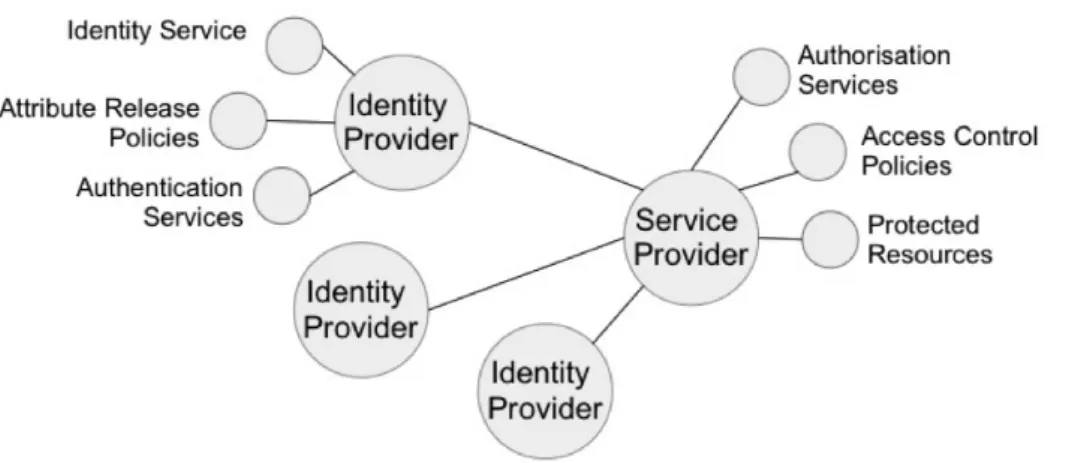
Basically, federated identity management is the management of identities across multiple organisational domains. Subjects are capable of using their identi-ties / privileges to access resources owned by organisations other than their own (a service provider) so long as these are issued by a trusted third party organisation (an identity provider). Each service provider maintains their own set of access requirements to their resources, and identity providers maintain their subject’s set of access rights (as identities) that can be used to access such resources.
Figure 2.4 shows a high level overview of a federated environment, containing a service provider (SP) and several identity providers (IdPs). Subject identities managed by an identity provider can be assigned a set of attributes that are stored within an identity service (e.g., simpleSAMLphp [131]). Subjects can use their attributes to gain access to a service provider’s resources given that the service provider trusts the identity provider. To control the release of attributes, some identity providers may define attribute release policies [93] to prevent certain types of information from being released to service providers. When an identity provider releases a subject’s set of attributes, it is typically in the form of a signed certificate [64] or assertion [99], indicating what attributes the subject owns, who assigned the attributes, and how long the attributes are valid for. To control access, each service provider within the federation manages their own set of permissions defined in access control policies. The service provider ultimately decides upon access through the use of authorisation services (which provide access control decisions local to the organisation).
A problem that arises from federation of access control, is that service provider organisations will likely face large and unknown user bases. Coupled with the fact that identity providers do not have to release personal or meaningful identifiable information (e.g., e-mail address, name, etc.) about their subjects (often opting to
Figure 2.4: Conceptual view of federated / collaborative access
use a uniquely generated persistent (PID) or transient ID (TID) instead [131]), a service provider may find it challenging to manage access at a federated level. This requires identity providers to cooperate with service providers, where currently no efficient medium exists to facilitate management change between federated organisations.
2.3
Insider Threat
Insider threat refers to an organisation’s risk of attack by their own users or em-ployees. It is fast becoming a prominent topic that organisations need to address, as highlighted by recent scandals in the media [10, 20, 143]. The CERT Guide to Insider Threats (Cappelli et al.) [27] defines malicious insider threats as the following.
Definition 3 (Insider Threat [27]) “A malicious insider threat is a current or former employee, contractor, or business partner who has or had authorised access to an organisation’s network, system, or data and intentionally exceeded or misused that access in a manner that negatively affected the confidentiality, integrity, or availability of the organisation’s information or information systems.”
A common characteristic of insider threat is that malicious insiders utilise their knowledge of their organisation’s systems, and their assigned access rights, to en-able attacks. This places a malicious insider in a fortuitous position, whereby the insider (as an authorised user) can cause far greater damage than an external attacker, simply due to their access rights [28]. Authentication, access control,
CHAPTER 2. LITERATURE REVIEW 18
and authorisation infrastructures provide critical security measures in enabling confidentiality, integrity, and availability to an organisation’s resources. How-ever, unless additional measures are put into place, malicious insiders can abuse these security measures, as the scope of such systems assume that if a user has authenticated, and has the required access rights, access to resources should be given.
There has been a significant amount of research in methods to detecting insider threat. These range from the use of honeypots [132] that store fake information to entice and catch out malicious insiders, to characterising insider attacks [98] based on analysis of historical attacks, as well as the development of detection tools [61] that enable the identification of abnormal activity within an organisation. Whilst there are a number of novel techniques [14, 37] that enable the detection of insider threat, there is little research that utilises such techniques within an automated solution [30, 136]. Many existing approaches require analysis by human agents to identify and execute resultant actions to mitigating attacks, and few tackle the potential abuse of access.
The rest of this section discusses the classification of insider threat, as well as current methods of insider threat, techniques in detecting and mitigating insider attacks, and related advancements in access control.
2.3.1
Classifying and Characterising Insider Threat
Capelli et al. [27] classify three forms of insider threat: sabotage, where malicious users attempt to damage or corrupt organisational resources,theft, where resources are stolen and distributed, and fraud, where activity is covered up or information is used to commit crimes, such as falsifying money transfers.
Characterising attacks within these classifications has led to a variety of mod-els of insider threat, such as CERT’s Management and Education of the Risk of Insider Threat (MERIT) models [26]. A set of MERIT models exists for char-acterising sabotage attacks [90], and theft attacks [89]. These MERIT models outline the characteristics pertaining to different classification of attacks, identi-fying stark differences in social and technological factors that have led to an attack occurring. For example, sabotage attacks were more technically sophisticated in comparison to theft, suggesting that insiders committing sabotage were advanced computer users. A contrasting example looks at the sociological factors behind an attack, such as fraud attacks were often committed by low-level employees over
long periods of time until caught. By contrast, data theft is often committed by highly educated personnel (e.g., scientists, engineers) who steal information prior to resignation [27, 141].
As opposed to a characterisation model per classification of threat, Nurse et al.’s approach opts for a unifying model [79, 98]. Their approach is capable of describing all classifications of threats, presenting a usable model to facilitate detection and mitigation, to what is already a challenging problem. With ref-erence to this model, insider attacks are clearly characterised by catalysts, actor characteristics, attack characteristics, and organisation characteristics.
Catalysts and actor characteristics refer to behavioural and psychological events pertaining to the malicious insider in question. For example, an actor characteristic is the insider’s attitude to work (i.e., loyalty, uncaring), their per-sonality (i.e., introvert, or share traits within the dark triad of behaviour [65]), previous historical behaviour (i.e., breaking policy, physical altercations, rule vi-olations) and psychological state (i.e., are they disgruntled about past events). Nurse et al. claim that a mix of social and technical factors precipitates the mo-tivation to carry out an attack, and a major tipping point to this are catalyst
events. For example, redundancy, demotion, or moving to a competitor.
Many of these factors are difficult to identify from a technological standpoint, especially in forming an assessment of psychological state that leads to the execu-tion of an attack. However, previous research utilises these factors in an attempt to predict the likelihood of insider threat. For example Kandias et al. [71] monitor a user’s technological activity and couple this with psychometric testing to indi-cate stress. Whilst the approach is novel, and shows promise in terms of outlining focused monitoring strategies, psychometric testing is not always a practical or time-relevant activity to carry out. That is to say, psychometric testing can give a general awareness of an attacker’s personality, but does not account for recent events that impact an attacker’s mood or motivation.
Attack characteristics and organisation characteristics refer to technological factors. For example, an attack characteristic refers to the type of attack the in-sider carries out (e.g., abuse access rights, deletion of backups), which are linked to the classification of attack. Within the attack itself, there exists a set of attack steps that are indicative of the actions performed againstorganisation characteris-tics. For example, an attack step will target a particular organisation resource, via exploiting a vulnerability (i.e., within the resource itself, security configurations, or lack of security measures). These characteristics provide concrete evidence
CHAPTER 2. LITERATURE REVIEW 20
of an insider attack, and are essential when considering a reactive approach to detecting malicious insiders.
Lastly, various methods exist in which to describe insider attacks. Attack trees [91, 118] seek to model high level attacks that define a set of attack paths to achieve a desired goal (e.g., discover the scope of an access control policy). This approach is useful in defining high level attacks, such as network intrusions, yet is limited in the modelling of abuse of access (due to the diversity of user behaviour). Rather than define a set of attack steps that model abuse of access, process models [17, 47] can be used to identify where abuse could occur. This can guide the deployment of relevant mitigative solutions in protecting resources, but also enable the detection of attacks. For example, Bishop et al. [17] have demonstrated the use of process models in identifying insider sabotage attacks within a system workflow. Similar approaches have also been shown to work at runtime in detecting the sabotage of executing software, whereby software infected with malware has been automatically repaired based on modelling execution norms [113].
2.3.2
Methods of Insider Threat
There are a variety of methods of insider threat that organisations are vulnerable to, some of which are identified by the 2013 Vormetric Insider Threat Report [104]. The report identifies that the abuse of privileged user access rights was seen as the forefront method of concern for organisations, which remains a focal point of this research. However, it is worth considering other methods of insider threat in order to scope what this research does not intend to address.
Theft of physical devices is a major concern for organisations, typically aligned with data theft. For example, there have been cases where a laptop or USB device has been used as a vessel to transport confidential documents outside of an organisation [54]. It is arguable that as devices become smaller, and the popularity of tablet devices rises, the ability for employees to steal, or even lose them outside of the organisation, increases.
Another method of insider threat concerns application vulnerabilities. An ex-ample of this method is an employee installing a seemingly innocent application on their workstation. The application has not been approved by the organisation’s user platforms team and as such is seen as an insider threat once installed. An insider threat exists as the application may contain malicious code that compro-mises the integrity of the organisation’s network, or carry out credential stealing
attacks [128] to allow an external attacker to gain entry. This activity is of-ten referred to as accidental or uninof-tentional insider threat [138], where through direct or indirect action an employee creates a risk despite no intentional mal-ice. Organisations attempt to mitigate such risks through implementing a change management control procedure [68], which guides any changes to an organisation’s network, systems, and software.
A second example related to application vulnerabilities is the risk from dis-gruntled employees leaving back door access via in-house developed applications. This example is often used to commit sabotage [27], where an employee has cre-ated a security hole within an application to by-pass security controls (such as firewalls and access control systems). This begs the question can any applica-tion within an organisaapplica-tion be trusted, and is it possible to increase the trust in applications as non-malicious?
Clearly there are many approaches to address when mitigating insider threat, indicating there can be no single solution. It is therefore necessary to adopt a layered approach to provide a high coverage in mitigation of insider threat. For example, physical security is needed to mitigate theft of physical devices, change management to prevent unsolicited applications from being installed, and intru-sion detection to cover the possibility of back-door vulnerabilities left by disgrun-tled employees. In addition, incorporating recent approaches in understanding data flow and execution in deployed applications [17, 113] can greatly improve upon the trust organisations have in their applications.
2.3.3
Detection and Mitigation
Insider threat presents a unique scope of attacks which are arguably more chal-lenging to detect when compared to external attacks, such as network intrusion or deployment of malware. These conventional attacks are obvious in terms of ‘attack steps’ performed, making it less of a challenge to detect. Whilst such attacks are entirely possible of a malicious insider, they are not representative of the attacks that many organisations consider to be most vulnerable from, being the abuse of privileged access rights by the employees of an organisation [104].
As such, detection and mitigation approaches are still within their infancy in terms of application in industry. Detecting attacks, such as the abuse of access, is traditionally done through auditing of logs (e.g., access control logs, server logs, etc). This continues to be a prevalent method in detection [54]. A problem
CHAPTER 2. LITERATURE REVIEW 22
with traditional methods is that they are highly reliant on human analysis, where detected attacks may go unchallenged, or responded to in an incorrect or untimely manner. To improve upon this, a number of automated solutions exist within the scope of detection of insider attacks, in a runtime environment.
Intrusion detection systems (IDSs) were introduced as a means of identifying attacks, as well as flaws within an organisation’s deployed security systems. The concept of an IDS is well known, with a number of approaches available [43]. Primarily, IDSs are concerned with identifying and notifying administrators of attacks and ongoing attacks. However, they also provide the basis to detecting malicious insiders. IDSs are useful in identifying insider attacks, but often are seen as separate to existing security systems (i.e., independent). Here, administrators must act on alerts from the IDS by instigating responses via other security systems (e.g., access control systems) to halt or prevent identified attacks.
IDSs can be categorised by signature / pattern based or anomaly based detec-tion. Signature based detection utilises information about historical attacks (e.g., a repeated pattern observed in network traffic). For example, SNORT [120], is capable of detecting the rate at which a user accesses a node on a network, or a sequence of packets sent across a network. anomaly based detection makes use of thresholds / rules that classify activity based on a set of heuristics to identify anomalies. PAYL [144] takes a statistical approach to measure activity against a pre-defined norm, triggering alerts when the measure exceeds a given threshold. A signature based approach provides a stronger indication of an attack, as observed signatures of an attack can be matched precisely. However, the approach is lim-ited in detecting unknown attacks, and is only as accurate as the set of known signatures available. By contrast, anomalous based detection is capable of iden-tifying new and anomalous behaviour (that deviates from the norm). Whilst this is beneficial in detecting unknown attacks, detection is not as accurate, resulting with a greater likelihood of false positives.
A significant step to detecting the abuse of access is to consider user behaviour at an application level. Bertino et al. [14] discuss their anomaly based IDS ap-proach based on mining database trace logs and attributing behaviour (usage) of the (RBAC protected) database to a user’s role in an organisation. Doing so enables the profiling of normal behaviour per organisational role, in order to iden-tify anomalous behaviour within each role profile. Rather than utilise pre-defined rules to classify behaviour, Bertino et al. make use of a machine learning clas-sifier [46] to identify normal and anomalous behaviour. Here the characteristics
of an activity are compared to a perception of normal behaviour for the role. A machine learning approach reduces the need for a set of complex detection rules, or fine grained security measures to mitigate insider threat. However, such an ap-proach requires the organisation to have a clear understanding of different attack profiles associated to roles, to train classification of behaviour [86]. This in itself can be just as complex as defining a set of detection rules.
2.3.4
Mitigating Insider Threat through Access Control
As discussed previously, the potential for the abuse of privileged access rights is seen as a major vulnerability for organisations in being susceptible to insider threat [104]. This thesis positions that whilst access control seeks to provide as-surances in confidentiality and availability of an organisation’s resources, it also presents vulnerabilities given the fact that users can abuse their access. Tradi-tional approaches can no longer be seen as enough to assure confidentiality of resources, as no assumption is made about how a user is utilising their access. It is therefore important to consider user behaviour alongside the traditional assign-ment of user privileges, prior to awarding access.
To this end, a number of recent methods extend access control away from the traditional mechanisms presented by RBAC and instead enable dynamic qualities. These dynamic access control approaches [18, 19, 66, 109] incorporate mechanisms from detection based systems, as well as expand upon the criteria of access to decide upon access.
Usage Control (UCON) [109] builds upon traditional access control models whereby obligations and conditions are used to assess a subject’s usage of a re-source, as part of an access decision. A novel aspect of UCON is its ability to capture a subject’s state within a resource, and use this as a contributing factor within the access decision. Whilst the UCON model is sophisticated in identifying and managing a subject’s usage, it only allows for a transient solution to man-aging insider threat. For example, a subject could invalidate usage requirements for a particular resource, but go on to access other resources despite being seen as a threat. In addition, the UCON approach to access control has the poten-tial to become complex, with usage rules woven with traditional access control rules on a per resource basis. Lastly, whilst UCON extends access control to con-strain access, its view of usage is scoped only to user access of protected resources. To build an accurate picture of insider threat, additional dimensions should be
![Figure 2.5: CADA generic feedback loop [22]](https://thumb-us.123doks.com/thumbv2/123dok_us/10974407.2985466/39.892.247.735.442.701/figure-cada-generic-feedback-loop.webp)
![Figure 2.6: Oreizy et al. self-adaptive reference model [107]](https://thumb-us.123doks.com/thumbv2/123dok_us/10974407.2985466/40.892.327.645.712.1028/figure-oreizy-et-al-self-adaptive-reference-model.webp)
![Figure 2.10: Rainbow framework [53]](https://thumb-us.123doks.com/thumbv2/123dok_us/10974407.2985466/48.892.287.686.166.468/figure-rainbow-framework.webp)