Product Pricing Based on Activity-Based Costing
Lin Chen1 Yi he1 Zhilin Qiao2*1.School of Management, Northwestern Polytechnical University, Xi’an 710072, China 2.School of Economics and Finance, Xi’an Jiaotong University, Xi’an 710061, China
* E-mail of the corresponding author: [email protected]
Abstract
Activity-based costing could provide relatively accurate cost information and better serve the enterprise’s product pricing decision. Through the analysis of cost behavior on activities, it divides product costs into unit level, batch level, product-sustaining level and facility level activity costs, which can avoid the overlapping between the costs caused by dividing the costs into variable cost, activity cost and fixed cost. On this base, product pricing model is established based on the information of activity based costing. Case study shows that different pricing methods get different prices, which will provide different product-mix pricing decisions for enterprises.
Keywords: Activity-based costing, Pricing decisions, Cost behavior
1. Introduction
With rapid development of advanced manufacturing technology and continuous improvement of service consciousness, the difference between product quality and service level gradually reduced, and the product price becomes one of the primary factors influencing product sales(Siming Chen, 2012). In the numerous factors which influence product price, cost is the basic factors which can be control by the enterprise. Therefore, the accurate cost information is the foundation of product pricing decision. However, with the progress of social productivity and a higher level of market demand, great changes have taken place in the manufacturing environment, which results in serious information distortion provided by traditional cost method, and cannot satisfy the demand of the enterprise’ product pricing management any more. The emergence of activity -based costing makes a very good up for the deficiency of traditional cost method in the aspect of cost accounting. It can provide relatively accurate cost information and better serve the enterprise’s product pricing decision (Roger V Dickeson, 2001). At present, there is little study on activity-based costing’s application in pricing decision. Usually product cost is divided into variable cost, activity cost and fixed cost. Due to the overlapping between those three costs, the cost basis of product pricing is not accurate. According to the product's cost behavior analysis, product cost can be divided into unit level, batch level, product-sustaining level and facility level activity costs. Because there is no overlapping between those four costs, it can provide more accurate cost basis information for pricing.
On this basis, this paper sets up absorption cost-plus pricing model and variable cost-plus pricing model based on activities with the same expected rate of return. At the same time, it divides variable cost-plus pricing model into unit level cost-plus pricing model, unit and batch level cost-plus pricing model, and unit, batch and product-sustaining level cost-plus pricing model.
2. Literature Review
2.1 Research of Activity-based Costing
Activity-based costing theory is dated from Cooper & Kaplan. In the 1990's, the researches mainly discussed how to allocate the actual cost of the previous period. After that, activity-based costing was more widely used in the enterprise operation management. At present, the researches of activity-based costing focused on theoretical research, applied research and combination application of activity-based costing and advanced management, such as ① Theoretical research of activity-based costing. Robert C Kee (2001) explained how to integrate activity cost model into short-term variable cost model of one activity. At the same time, he described how to determine the optimal portfolio using the action activity cost model. ② Applied research of activity-based costing. Coopers & Lybrand accounting firm had done a questionnaire survey in a rally in which the institute of certified public accountants and a large number of senior managers participate. The results of the survey showed that there was a time when foreign enterprises were keen on activity-based costing, and in that time the error rate of cost information reduced by an average of more than 35%. ③Combination application of activity-based costing and advanced management. Those advanced management include value engineering, strategic cost management, business process reengineering, and enterprise resource planning and so on. Matte Seaman et al. (2009) considered that the information provided by activity-based costing could make the product-profit analysis more accurate.
In china, Chunming Guo and Yanan Shen (2006) estimated parameter cost with activity-based costing, and introduce the radial basis function neural network method to establish estimation model based on activity. So
it strengthened the recognition and feedback control of cost information. Jianjun Yang and Xiaoxia Gu (2010) took the perspective of strategic positioning and product profitability diagnosis of enterprise to expound the advantage of activity-based costing. Case study discussed activity-based costing and traditional cost method under new manufacturing environment. Chengli He and Yun Chen (1999) took the activities as the object of cost control, and emphatically discussed activity cost control theory from the view point of business process reengineering.
2.2 Research of Product Pricing
In the 1970s and 1980s, with the change of economy and market, western scholars launched a series of new model in terms of product pricing. These pricing models took factors such as product variety, market volatility, and periodic competition into the account and become more diversity and practicality. Andreas Hinterhuber (2004) considered that key factors influencing pricing decision were enterprises, customers, competitors and established the value-based pricing model. Russell·S·Winer (2001) believed product pricing was impacted by many factors, such as product life cycle stage, enterprise pricing goal, substitutes, competitors, production capacity, the reference price, perceived quality, and the policy makers.
In china, scholars have also conducted many studies in terms of product pricing, and discuss the pricing model from different angles and means. Chaoxiao Zhang and Yongjian Pu (2002) took market skimming, market penetration, product line pricing strategy, and game theory into the discussion of new product pricing model. Xuening Zhang and Weixi Liang (2004) proposed multi-product and multi-objective grey situation pricing method by analyzing characteristics of price decision of modern marketing enterprise and comparing traditional multi-product and single objective pricing. Lu Huang and Ying Jiang (2002) studied multiple pricing models on the basis of differentiating information product version to achieve the cognitive differentiation of information product value to customer.
Nowadays, enterprise production mainly relies on order driven, and the key for enterprise to obtain orders is how to carry on the quotation based on customer's demand. Therefore, it is of great significance to do the research on the contents and train of cost estimation for realizing the quotation based on customer's demand and getting orders. Thereby, some scholars began to divert the research direction of product pricing to cost estimation. Due to activity-based costing could provide relatively accurate product cost information, some scholars introduce it into product pricing study. But traditional product cost is usually divided into variable cost, activity cost and fixed cost, which result in overlapping between these costs. Through the analysis of cost behavior on activities, the paper divides product costs into unit level, batch level, product-sustaining level and facility level, which will avoid that problem. And on this basis, product pricing model is established based on activity-based costing to provide better decision support for enterprise product pricing.
3. Model of Activity Cost Behavior
Activity-based costing divides activities into unit level, batch level, product-sustaining level and facility level (Yaoyao Chen,2005). So costs can also be divided into unit level, batch level, product-sustaining level and facility level activity costs.
(1) Unit level activity cost: unit level activity refers the activities that serve unit product. When produce one unit product, the unit level activity will occur once time. Unit level activity cost changes in proportion to product volume
(2) Batch level activity cost: batch level activity refers the activities that serve every batch or many batches of products. Batch level cost depends on product batch, rather than the number of units in each batch of products. Usually, batch level activity cost changes in proportion to product batch.
(3) Product-sustaining level activity cost: product-sustaining level activity refers the activities that serve a certain product. Product-sustaining level activity cost changes with products varieties, not the number or batch of products.
(4) Facility level activity cost: facility level activity is used for ensuring that whole production systems run smoothly, not specifically serves a certain product.
Let n be the number of product categories. TCQi , TCBi , TCKi , TCMirespectively denotes unit level, batch level, product-sustaining level and facility level activity cost of i product(i =1~n). Through the above analysis, to any i product under activity-based costing, the cost behavior model can be expressed as:
i i i i i
TCQ
TCB
TCK
TCM
TC
=
+
+
+
(1) The total cost behavior model is expressed as:∑
=+
+
+
=
n i i i i iTCB
TCK
TCM
TCQ
TC
1)
(
(2)4. Product Pricing Model Based on ABC
The enterprise must guarantee the realization of reproduction to maintain its survival and development. Therefore, it is necessary to cover the cost and guarantee a certain profit when selling the products. Thus, product pricing should take product activity costs as the base, and also consider different situation to formulate most favorable price for the enterprise to keep its long term development. Cost-plus pricing can be expressed in the following formula:
P
b
P
=
+
∆
(3)where, P represents cost-plus price, b represents unit product cost, and ∆P represents the amount of cost plus. Generally, the amount of cost plus is determined by the preset markup percentage in the enterprise (Jiaojiao Ren, 2011), so formula (3) can also be expressed as:
)
1
(
R
b
P
=
×
+
(4) where, R represents the markup percentage.4.1 Absorption Cost-Plus Pricing Model Based on Activity
Under traditional cost method, the basis of absorption cost-plus method is the cost of production per unit product. The basis of absorption cost-plus pricing model based on activity will be the sum of unit level, batch level, product-sustaining level, and facility level activity cost (Liu Yan,2010). According to the model of activity cost behavior, full cost of i product will be TCQi+TCBi+TCKi+TCMi. So unit full cost will be (TCQi+TCBi+TCKi+TCMi)/ xi. Therefore, absorption cost-plus pricing model based on activity can be expressed as:
[
(TCQ
TCB
TCK
TCM
)/x
]
(1R
)P
i = i + i + i + i i ⋅ +(5) where, Pi represents the sale price of i product, xirepresents the volume of i product.
4.2 Variable Cost-Plus Pricing Model Based on Activity
Under traditional cost accounting method, variable cost of product will change linearly with the change of production volume in a certain range, and fixed cost will not change with production volume within a certain range. Under activity-based costing, unit level activity cost changes in proportion to product volume. Batch level activity cost changes with product batches. Product-sustaining level activity cost changes in proportion to the number of product’s varieties. Facility level activity cost does not change with the number of product, product’s batches, or product’s varieties. It can be seen that unit level activity cost, batch level activity cost, and product-sustaining level activity cost possess different degree of variable cost attribute, but facility level activity cost has the characteristic of fixed cost. Therefore, cost-plus pricing model based on activity could be divided into unit level plus pricing, unit and batch level plus pricing, and unit, batch and product-sustaining level cost-plus pricing (Touping Yang, Zhixue Liu, 2008). Because the aim of cost-cost-plus pricing is to achieve the enterprise’s expected return, the expected revenue and expected profits are the same even if the enterprise may conclude different prices by different cost-plus pricing models. So the markup percentage may vary from the different pricing model. Thus, without changing the expected return, different cost-plus pricing models based on activity can provide the enterprise different combination of products pricing (Xiaowo Tang, Debing Ni, 2002).
4.2.1 Unit Level Cost-plus Pricing Model
The basis of unit level cost-plus pricing is the unit level activity cost. Let r be the expected pre-tax rate of return,
h1 be the unit level markup percentage. Then
) 1 ( ) ( 1 1 1 r TCQ TCM TCK TCB r h n i i n i i i i + ⋅ + + + =
∑
∑
= = . The solving process is as follows:Total return of products
r TCM TCK TCB TCQ r TC R n i i i i i ⋅ + + + = ⋅ =
∑
=1 ) (At the same time,
∑
∑
= = + + − ⋅ = n i i i i n i i h TCB TCK TCM TCQ R 1 1 1 ) (So, ) 1 ( ) ( 1 1 1 r TCQ TCM TCK TCB r h n i i n i i i i + ⋅ + + + =
∑
∑
= =The unit level activity cost of unit i product will be expressed as TCQi/xi. Under unit level cost-plus pricing model based on activity, the sale priceof i product is:
∑
∑
= = + + + ⋅ + ⋅ = + ⋅ = n i i n i i i i i i i i i i TCQ TCM TCK TCB TCQ r x TCQ h x TCQ P 1 1 1 ) ( ) 1 ( ) 1 ( (6)4.2.2 Unit and Batch Level Cost-plus Pricing Model
The basis of unit and batch level cost-plus pricing model is the sum of unit level activity cost and batch level activity cost. Let h2 be the unit and batch level markup percentage. Then the formula will be:
(
)
) 1 ( ) ( 1 1 2 r TCB TCQ TCM TCK r h n i i i n i i i + ⋅ + + + =∑
∑
= = . The solving process is as follows:Total return of products
r TCM TCK TCB TCQ r TC R n i i i i i ⋅ + + + = ⋅ =
∑
=1 ) (At the same time,
(
)
∑
∑
= = + − ⋅ + = n i i i n i i i TCB h TCK TCM TCQ R 1 2 1 ) ( So,(
)
) 1 ( ) ( 1 1 2 r TCB TCQ TCM TCK r h n i i i n i i i + ⋅ + + + =∑
∑
= =The sum of unit level activity cost and batch level activity cost of unit i product can be expressed as (TCQi+TCBi)/xi. Under the unit and batch level cost-plus pricing model based on activity, the sale price of i product is:
∑
∑
= = + + + + ⋅ + ⋅ + = + ⋅ + = n i i i n i i i i i i i i i i i i TCB TCQ TCM TCK TCB TCQ r x TCB TCQ h x TCB TCQ P 1 1 2 ) ( ) ( ) 1 ( ) ( ) 1 ( ) ( (7) 4.2.3 Unit, Batch and Product-sustaining Level Cost-plus Pricing ModelThe basis of unit level, batch level and product-sustaining level cost-plus pricing model is the sum of unit level activity cost, batch level activity cost and product-sustaining level activity cost. Let h3 be the unit, batch and product-sustaining level markup percentage. The formula will be:
(
)
) 1 ( 1 1 3 r TCK TCB TCQ TCM r h n i i i i n i i + ⋅ + + + =∑
∑
= = . The solving process is as follows:Total return of products
r TCM TCK TCB TCQ r TC R n i i i i i ⋅ + + + = ⋅ =
∑
=1 ) (At the same time,
∑
∑
= = − ⋅ + + = n i i n i i i i TCB TCK h TCM TCQ R 1 3 1 ) ( So, ) 1 ( ) ( 1 1 3 r TCK TCB TCQ TCM r h n i i i i n i i + ⋅ + + + =∑
∑
= =The sum of unit level activity cost, batch level activity cost and product-sustaining level activity cost of unit i
product can be expressed as(TCQi+TCBi+TCKi)/xi. Under the unit, batch and product-sustaining level cost-plus pricing model, the sale price of i product is:
∑
∑
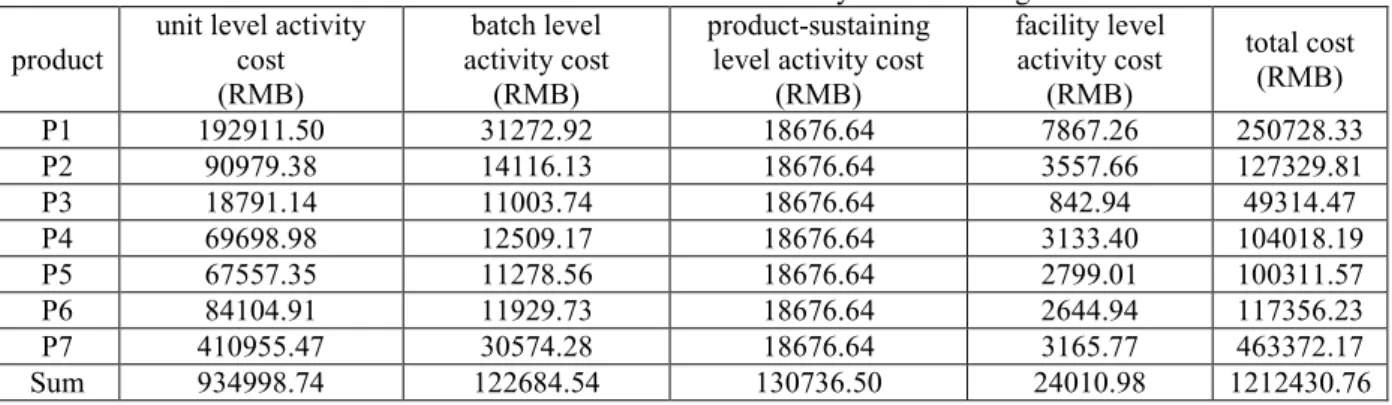
= = + + + + + ⋅ + ⋅ + + = + ⋅ + + = n i i i i n i i i i i i i i i i i i i i TCK TCB TCQ TCM TCK TCB TCQ r x TCK TCB TCQ h x TCK TCB TCQ P 1 1 3 ) ( ) ( ) 1 ( ) ( ) 1 ( ) ( (8) 5. Case StudyHC Company is a professional manufacturer engaged in research and development and manufacturing the multi-functional watt-hour meter. The company's products are divided into seven categories. They are set to P1, P2, P3, P4, P5, P6 and P7 (Shike Chen,2007). The products’ cost information under activity-based costing is shown in table 1a and 1b:
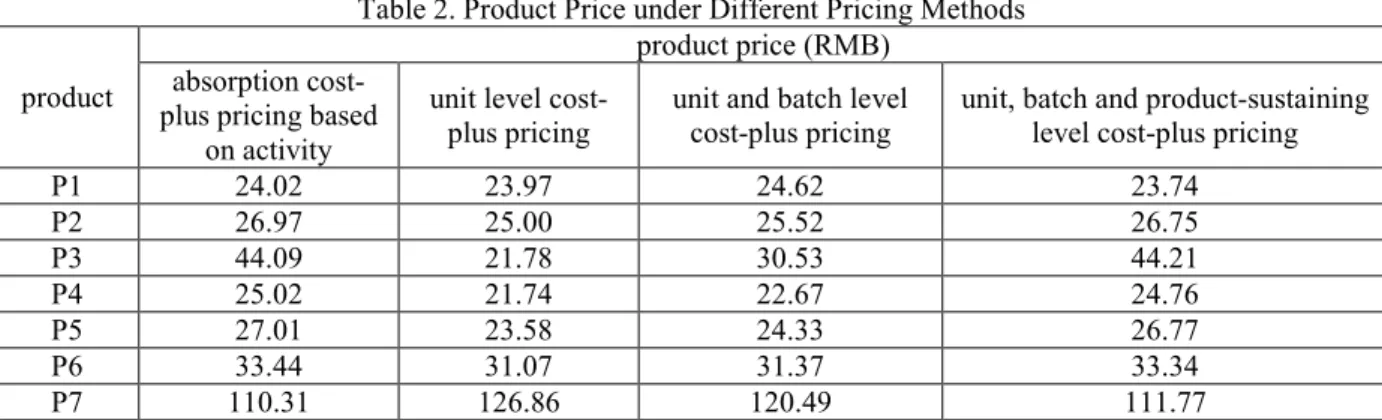
Assume that the company’s expected rate of return r =10%. The unit product price can be calculated with different pricing models based on the above information. The results are shown in table 2.
It can be seen that the price of the same product is different under absorption cost-plus pricing based on activity, unit level cost-plus pricing, unit and batch level cost-plus pricing, and unit, batch and product-sustaining level cost-plus pricing models. Different pricing model could provide different product-mix pricing for enterprises with the same expected return level.
For single product pricing, the enterprise could take full cost as the basis of product pricing, that is the sum of unit level, batch level, product-sustaining level, and facility level activity costs. It could use absorption cost-plus pricing to calculate the product price to ensure the enterprise get the expected revenue.
Table 1a. Product Cost Based on Activity-based Costing
product
unit level activity cost (RMB) batch level activity cost (RMB) product-sustaining level activity cost
(RMB) facility level activity cost (RMB) total cost (RMB) P1 192911.50 31272.92 18676.64 7867.26 250728.33 P2 90979.38 14116.13 18676.64 3557.66 127329.81 P3 18791.14 11003.74 18676.64 842.94 49314.47 P4 69698.98 12509.17 18676.64 3133.40 104018.19 P5 67557.35 11278.56 18676.64 2799.01 100311.57 P6 84104.91 11929.73 18676.64 2644.94 117356.23 P7 410955.47 30574.28 18676.64 3165.77 463372.17 Sum 934998.74 122684.54 130736.50 24010.98 1212430.76
Table 1b. Unit Product Cost Based on Activity-based Costing
product unit level activity cost (RMB) batch level activity cost (RMB) product-sustaining level activity cost
(RMB) facility level activity cost (RMB) unit cost (RMB) P1 13.69 2.22 1.33 0.56 17.79 P2 14.28 2.21 2.93 0.56 19.98 P3 12.44 7.29 12.37 0.56 32.66 P4 12.42 2.23 3.33 0.56 18.53 P5 13.47 2.25 3.72 0.56 20.01 P6 17.75 2.52 3.94 0.56 24.77 P7 72.47 5.39 3.29 0.56 81.71 Sum 156.52 24.11 30.91 3.91 215.45
Table 2. Product Price under Different Pricing Methods
product
product price (RMB) absorption
cost-plus pricing based on activity
unit level cost-plus pricing
unit and batch level cost-plus pricing
unit, batch and product-sustaining level cost-plus pricing
P1 24.02 23.97 24.62 23.74 P2 26.97 25.00 25.52 26.75 P3 44.09 21.78 30.53 44.21 P4 25.02 21.74 22.67 24.76 P5 27.01 23.58 24.33 26.77 P6 33.44 31.07 31.37 33.34 P7 110.31 126.86 120.49 111.77
However, from the view of variable cost method, it can make a contribution to the enterprise as long as unit price is higher than variable cost. So the enterprise can select appropriate cost as the basis of variable cost-plus pricing based on activity by analyzing product cost behavior under activity-based costing when to calculate the product price. The contribution created by accepting that price can be used to make up for the relatively fixed cost when the enterprise has spare production capacity. At the same time, when the enterprise wants to increase the competitiveness of its product by lower prices, it will expand the range of the acceptable prices by using the unit level cost, unit and batch level cost, and unit, batch and product-sustaining level cost as the basis of variable cost-plus pricing model, which is very helpful for making better product pricing decision and improving the enterprise’s ability to adapt.
For multi-product pricing, the enterprise can use different cost-plus pricing models based on activity to choose the price most suitable and closest to customers’ estimated price according to product cost behavior and customers’ estimation. It is a good help for the enterprise’s pricing decision and will promote the product sales and revenue.
6. Conclusion
Based on the analysis of cost behavior on activities, the paper divides product costs into unit level, batch level, product-sustaining level and facility level activity costs. It uses cost-plus pricing method and sets up the absorption cost-plus pricing and the variable cost-plus pricing models based on activity with the same expected rate of return. Then it divides the variable cost-plus pricing model based on activity into unit level cost-plus pricing, unit and batch level cost-plus pricing, and unit, batch and product-sustaining level cost-plus pricing models. With the case study on HC Company’s product pricing, we could draw the following conclusion: (1)It divides the product costs into unit level, batch level, product-sustaining level and facility level activity cost according to the analysis of cost behavior on activities, which will well avoid the overlapping between the costs in traditional cost method. Therefore, it will provide more accurate cost information for product pricing. (2)The product price may be different when using different pricing methods such as absorption cost-plus pricing model based on activity, unit level cost-plus pricing, unit and batch level cost-plus pricing, and unit, batch and product-sustaining level cost-plus pricing model. It will help the enterprise make its own suitable product price.
(3)Different pricing models can provide different product-mix pricing for enterprises with the same expected rate of return. Therefore, the enterprise could select the most suitable price based on activity and closest to customers’ estimated price by analyzing product cost behavior and the customer’s estimation. It provides a better gist for the product pricing decision making.
Acknowledgements
Financial supports from National Natural Science Fund (71201125), National Social Science Fund (09CJY038), Scientific Research Foundation for the Returned Overseas Chinese Scholars of State Education Ministry, National Natural Science Fund of Shaanxi Province (2013JQ9001),Soft Science Fund of Shaanxi Province (2009KRM073),Social Science Fund of Theoretical and Practical Issues in Shaanxi Province (2014Z035), Humanities Social Science and Management Fund of Northwest Polytechnical University (3102014RW0005) are greatly acknowledged.
References
Siming Chen. (2012). Discussing the importance and the strategy of enterprise product pricing, Learned Journal
Roger V Dickeson. (2001). Enter the world of Activity-Based Costing, Printing Impressions, Apr.
Robert C Kee. (2001) Evaluating the Economics of Short-and Long-Run Product-Related Decisions. Journal of
Managerial Issues, Summer.
Matte Seaman, Petre Somafia, Jari Parlance. (2009). Product Profitability Cause and Effects. Industrial
Marketing Management, 9,393-401
Chunming Guo, Yanan Shen. (2006). The model and method research of parametric cost estimation based on activity-based costing. Systems engineering and practice,2,55-61
Jianjun Yang, Xiaoxia Gu. (2010). Application of activity-based costing under the new manufacturing environment. Economic engineer, 4,247-249
Chengli He, Yun Chen. (1999). The control of activity cost based on business process reengineering. China soft
science,11,62-64
Andreas Hinterhuber. (2004). Towards value-based pricing-An integrative framework for decision making.
Industrial Marketing Management, 33, 765-778
Russell S.Winer. (2001). Marketing management. Beijing: Tsinghua university press, 310-315
Chaoxiao Zhang, Yongjian Pu. (2002). Research on new product pricing game model. Journal of Business
Economics, 24-28.
Xuening Zhang, Weixi Liang. (2004). Price decision of multiple products with multiple targets. Journal of
wuhan university of technology, 26(5), 162-165
Lu Huang, Ying Jiang (2002). Research on multiple prices pricing model of information products. Finance
Economics, 4, 63-66
Yaoyao Chen. (2005). New concept of cost behavior, activity-based costing. Learned Journal of Hunan Institute
of Technology, 8, 55-57
Jiaojiao Ren. (2011). Research on product pricing based on activity-based costing. Administrator, 22,103 Liu Yan. (2010). Talking about product pricing decision based on Activity-based Costing. Accountant, 12, 58-59 Touping Yang, Zhixue Liu. (2008). An inventory cost control model based on activity-based costing. Industrial
Engineering and Management, 4, 62-67
Xiaowo Tang, Debing Ni. (2002). Research on the complete set of product pricing method. Chinese Journal of
Management Science, 5, 47-51