Reducing the Class Coupling of Legacy Code by
a Metrics-Based Relocation of Class Members
Marvin Ferber1, Sascha Hunold1, Bj¨orn Krellner2, Thomas Rauber1, Thomas Reichel2, and Gudula R¨unger2
1
University of Bayreuth, Germany, {marvin.ferber,hunold,rauber}@uni-bayreuth.de
2 Chemnitz University of Technology, Germany, {bjk,thomr,ruenger}@cs.tu-chemnitz.de
Abstract. With the rapid growth of the complexity of software systems, the problem of integrating and maintaining legacy software is more rele-vant than ever. To overcome this problem, many methods for refactoring legacy code have already been proposed such as renaming classes or ex-tracting interfaces. To perform a real modularization, methods have to be moved between classes. However, moving a single method is often not possible due to code dependencies.
In this article we present an approach to modularize legacy software by moving multiple related class members. It is shown how to identify groups of class members with similar concerns. We present two different code patterns that the related members and their dependent classes must match to allow a relocation of the related members. We also demonstrate how our pattern-based approach for automated modularization of legacy software can be applied to two open source projects.
Key words: legacy software, class decoupling, pattern-based code refac-toring, code metrics
1
Introduction
Many software systems that undergo evolution for several years can become legacy when the costs and time to maintain the software grows incrementally. Programmers handle this problem known as code decay [1] with continuous refac-toring and system restructuring. Apart from the need for software analysis tools for an extensive system understanding [2], there is also the need for transfor-mation tools that support the programmer while restructuring the legacy code. An important restructuring task is the modularization (decoupling) of classes, which helps to reduce the systems’ complexity [3] and to adapt legacy systems to distributed environments [4].
In a coarse-grained modularization in object-oriented languages the basic el-ements are classes, which can be moved between packages. The operations to move classes between packages and preserve syntactic and semantic correctness are supported by most modern IDEs. To reduce class coupling, and to improve
class encapsulation and cohesion between class members, a finer-grained mod-ularization is desirable. This kind of modmod-ularization includes the relocation of member methods and variables into more appropriate classes and the splitting of oversized classes in order to separate inner class concerns or services [5]. Moving member methods and variables without preserving correctness and appropriate test cases is an error-prone task [6]. Since programmers are often not familiar with the software and the dependencies of relocated methods or variables in de-tail, they are not aware of possible side effects. Fully automated transformations that preserve the behaviour of the software are desirable but not available in general.
In this article we focus on refactoring and modularizing legacy classes by moving methods between classes. Since the methods that should be moved may depend on other members of the considered class, e.g., variables or other meth-ods, all related members have to be moved to preserve code integrity. We intro-duce the termMemberGroupas a set of related class members. AMemberGroup
represents an encapsulated concern of a class and is therefore independent from other class members. BecauseMemberGroups do not have dependencies to other members of the containing class, they can be relocated to other classes to reduce inter-class dependencies.
The article is structured as follows. In the next section we introduce the re-lated groups of member variables and methods calledMemberGroups. Section 3 outlines two MemberGroup patterns that can be relocated automatically. Pre-conditions and transformation rules for the relocation task are also given. In Sec-tion 4 we discuss metrics to support the relocaSec-tion task in order to reduce class dependencies. We show that the analysis and relocation ofMemberGroups can be integrated into reengineering toolsets like TransFormr[7]. We investigate the impact of the relocation ofMemberGroups on two open source applications and show the achieved improvements in Section 5. Related work is discussed in Section 6 and Section 7 concludes the article.
2
MemberGroups
in classes
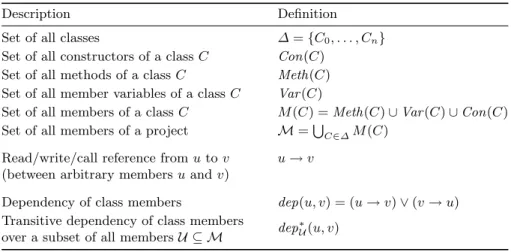
In this section we introduce the termMemberGroup as set of member variables and methods that represent an encapsulated concern of a class. To define such a group we describe a software system as a graph structure. Table 1 summarizes the nodes and edges that are necessary to describe all dependencies between the members of all classes of a software as a dependency graph.
The function dep(u, v) between two members u and v represents a depen-dency between u and v in the source code. If there is a dependency u → v or a dependency v → uthen dep(u, v) returns True. To take transitive depen-dencies into account, we introduce the function dep∗U(u, v), which indicates a
dep-relation betweenuandv over a subset of membersU ⊆ M. Thereforedep∗U
represents an undirected path in the dependency graph of the software system. With the definitions of Table 1 we define aMemberGroup MG(m) in a classC
Table 1.Elements of the graph structure used to model the software system.
Description Definition
Set of all classes ∆={C0, . . . , Cn} Set of all constructors of a classC Con(C)
Set of all methods of a classC Meth(C) Set of all member variables of a classC Var(C)
Set of all members of a classC M(C) =Meth(C)∪Var(C)∪Con(C) Set of all members of a project M=S
C∈∆M(C) Read/write/call reference fromutov
(between arbitrary membersuandv)
u→v
Dependency of class members dep(u, v) = (u→v)∨(v→u) Transitive dependency of class members
over a subset of all membersU ⊆ M dep ∗ U(u, v)
starting with a methodm∈Meth(C) as follows:
MG(m) ={m}
∪ {v∈Meth(C)∪Var(C)|depMeth∗ (C)∪Var(C)(m, v) = True}
∪ {u∈Con(C)| ∃t∈MG(m) withdep(u, t) = True}.
(1)
A MemberGroup MG(m) consists of the method m and contains all other member variables and methods of class C that depend onm. Additionally, all constructors belong toMG(m) if they have a dependency to a member of the existing group MG(m). As a result a constructor can belong to more than one
MemberGroup if the constructor initializes member variables or calls methods that belong to distinct MemberGroups.
The members of aMemberGroupdo not have dependencies to other members of the same class and represent a separate concern (or functionality) of the class. The internal state (value of the member variables) of aMemberGroup can only be modified using members of theMemberGroup. To relocate an entire Member-Group, several conditions have to be met, which are discussed in the next section.
3
Relocation of
MemberGroups
We describe two MemberGroup patterns, which can be applied in order to im-prove modularization of the source code. The relocation of “misplaced” Member-Groups is based on transformation rules, which are different for each pattern. Since it is not possible to relocate every arbitrary MemberGroup, some precon-ditions are necessary to restrict aMemberGroupbefore applying transformation rules. Thecommon pattern (Section 3.1) specifies aMemberGroup that is not restricted in its composition but in its usage inside the software system. In con-trast to the common pattern the strong pattern (Section 3.2) characterizes a
Table 2.Functions and sets of classes to defineMemberGroup transformation rules.
Description Definition
Type (class) of a variablev type(v)
Visibility of a memberu vis(u) (publicorprivate) Set of all types of parameters of a methodm Mpar(m)
Set of classes which have a member variable of typeS Mhas(S)
Set of classes in∆\ {S}which each referenceS
and are referenced by all classes of the setΨ Mref(Ψ, S) Set of possible target classes forMemberGroup MG(m) Mtar(MG(m))
MemberGroup that is restricted in its structure. To describe the patterns, the target classes for theMemberGrouprelocation, and the transformation rules, we define several terms outlined in Table 2, which are used in the following sections. The object-oriented concept of inheritance can lead to further restrictions because of possible dependencies between members of the ancestor class and members of the specialized class. AMemberGroup can not be relocated if mem-bers of this MemberGroup are overridden by members of descendant classes or if they contain dependencies to ancestor classes. This is similar to methods in a
MemberGroup that realize an interface. Other obstructive dependencies can be found between members of an inner class and aMemberGroup. In this case the restricted visibility of the inner class has to be taken into account when relo-cating theMemberGroup to another class. Even if relocation strategies in these contexts might be available, we focus on the relocation of members without these constraints in this article. The absence of dependencies caused by inheri-tance, interfaces, and inner classes concerning aMemberGroup are preconditions for the relocation of both patterns. Advanced programming techniques such as multithreading or reflection are not considered in this article.
To improve the modularization, a MemberGroup is relocated to a target class. After introducing the patterns a possible set of target classes is presented. These classes have to be determined according to the specific restrictions of the
MemberGroup pattern. The transformation process is done by a transformation functionmoveMG, which automatically relocates a MemberGroup from a source class to a target class if all prerequisites for the relocation are satisfied.
3.1 Moving common MemberGroups
To improve the modularization, a target class T has to be found to which a
common MemberGroup in class S can be relocated safely, i.e., preserving the behavior of the software system. Therefore, the software system has to be in-spected to locate possible target classes. A reference to a target class must exist in all classes that use thecommon MemberGroup (call methods or use member variables of the MemberGroup) of S. We assume that the source class S and the target class T are available as member variables in all classes that use the
common MemberGroup. This excludes possible source and target classes that are used as local variables or as parameters in a method call. All classes that contain a member variable of typeS and use acommon MemberGroup inS are denoted as setMhas(S):
Mhas(S) ={c∈∆ | ∃x∈Var(c) withtype(x) =S}. (2)
Mhas(S) is further inspected to find possible target classes that have to be
mem-ber variables of all classes ofMhas(S). The setMref(Ψ, S) withΨ as a subset of
∆contains classes that are used as types of member variables in all classes ofΨ and are not equal toS.
Mref(Ψ, S) ={t∈∆| t6=S and (∀v∈Ψ ∃x∈Var(v) withtype(x) =t)}.
(3) The setMtar(MG(m)) defines the set of possible target classes for the relocation
of acommon MemberGroup MG(m) located in the source classS. According to Equations (2) and (3) we define:
Mtar(MG(m)) =Mref(Mhas(S), S). (4)
A matching pair of member variables, one of type S and one of type T must be found to relocate thecommon MemberGroup. There can be multiple occur-rences and instantiations of the source and target types within the containing class. Thus, different cases have to be taken into account. For the number of occurrences of the source and target types we can distinguish four cases.V(1:1) specifies the case in which there is one occurrence of a member variable of the source and one of the target type in the containing class. In the V(1:n) case a member variable of the source type appears once and the target type occurs multiple times as member variable in the containing class (e.g., in an array). The casesV(n:1) andV(n:m) are accordingly defined.
In a related way the number of instantiations of member variables of the source and target types have to be taken into account. Multiple instantiations of the source class cause reinitializations of the member variables of the Member-Group. When relocating a MemberGroup its behaviour has to be preserved as well, e.g., a reinitialization of the source class must cause a reinitialization of the relocated MemberGroup in the target class. In an I(1:1) relation both member variables of typeS andT are instantiated once (e.g., in the constructor of the containing class). In anI(1:n) relationT is instantiated at least twice. The cases
I(n:1) and I(n:m) also exist.
Each individual case requires different relocation strategies to preserve the behaviour of the software. In the following we consider the case in which the source and the target types occur only once in all classes that use the common MemberGroup (V(1:1)). Additionally, we assume that both member variables are instantiated only once (I(1:1)).
One of the target classes that meet all preconditions is selected. We use code metrics to obtain a suitable candidate, which is described in Section 4. We summarize our preconditions for the relocation of acommon MemberGroup from a classS to a classT as follows:
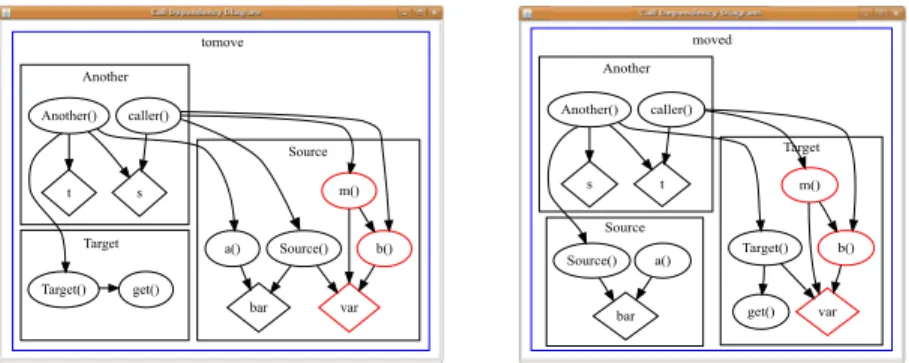
Fig. 1.TransFormrcall diagrams. Ellipses denote member methods and rhombi de-note member variables. Left: Relocatable common MemberGroup {m(Target), b(), var}in class Source. Right: RelocatedMemberGroup intoTarget.
a) If a constructor is part of theMemberGroup, it must be possible to move the
MemberGroup-dependent statements to the constructor of the target classT. Therefore these statements must not depend on other variables not available in the constructor of classT.
b) The source and target classes must be member variables in all the Member-Group referencing classes and are permitted to occur only once (V(1:1)). c) Both variables of typeS andT are supposed to be instantiated once (e.g.,
in the constructor of the referencing class) to meet theI(1:1) requirement. The algorithm moveCommonMG relocates a common MemberGroup MG from a given source class S to a target class T. The reference to our software graph (project P) is required to modify all references from the source class to the target class in all classes ofMhas(S).
1 fu nc ti on m o v e C o m m o n M G(source S, m e m b e r g r o u p MG, target T,
project P)
2 begin
3 r e s o l v e N a m e C l a s h e s(MG, T) ;
4 for each member M in MG:
5 if M in c o n s t r u c t o r s(S) : 6 m o v e C o n s t r u c t o r S t a t e m e n t s(S, M, T) 7 else: 8 m o v e M e m b e r(S, M, T) 9 r e p l a c e M e m b e r G r o u p R e f e r e n c e s(P, MG, S, T) ; 10 end
The transformation process consists of the following steps. As a pre-trans-formation step all name clashes between the target class T and the common MemberGroup M G, which will be relocated to T, are resolved (line 3). There-fore the function detects equal identifiers, uniquely renames them, and updates referencing statements. Although renaming is necessary to avoid name clashes, a huge number of automatic renamings may lead to unreadable code. To avoid
this effect, human interaction can be integrated in the renaming task. After-wards, all constructor statements (line 6) and members (line 8) of the common MemberGroup are moved to the target class by the methods moveConstructor-Statements and moveMember. Finally, all references to members of the com-mon MemberGroup of the original classS are updated to references to the re-located members in the extended classT by the method replaceMemberGroup-References (line 9). Fig. 1 shows the relocation of thecommon MemberGroup
{m(), b(), var}from classSourceto class Target.
3.2 Moving strong MemberGroups
The strong MemberGroup pattern presented in [8] defines a special type of
MemberGroups that consist of exactly one public methodmand a set of private members. Fig. 2 shows an example of astrong MemberGroup, emphasized in class
Source. Astrong MemberGroupcan be built upon the (common)MemberGroup
definition of Equation (1) defined as follows:
MGstrong(m) ={m:vis(m) =public}
∪ {v∈ {MG(m)\Con(C)} |v6=m:vis(v) =private}. (5) Possible target classes are taken from the parameters of the method m. The motivation for the relocation is a high cohesion between thestrong MemberGroup
and the class of the parameter as well as the removal of the class dependency between the source class and the class of the parameter. As a precondition for the possible target classes we require the type of the relevant parameter not to be an interface. The target classesMtar(MGstrong(m)) for the relocation of the strong pattern are given as:
Mtar(MGstrong(m)) ={p|p∈Mpar(m) and
pis not an interface or a primitive type}. (6) In thestrong MemberGrouppattern there is only one occurrence of variables of the source and target type involved (V(1:1)). To relocate astrong Member-Group to a target class inMtar the following preconditions have to be fulfilled
in order to preserve the behaviour of the software system.
a) Like in thecommon MemberGrouppattern, the dependent constructor state-ments ofstrong MemberGroups must be movable as well.
b) To keep the state of thestrong MemberGroupinside the target class, it must be guaranteed that source and target classes are not reinstantiated (I(1:1)). If a strong MemberGroup pattern is found and all previous preconditions are fulfilled, we can relocate theMemberGroup MGstrong(m) to the target classT ∈
Fig. 2.TransFormrcall diagrams. Left: Movablestrong MemberGroup{m(Target), b(), var}with exactly one publicly used method and the target class as parameter. Right: RelocatedMemberGroupwith decoupled classesSourceandTarget.
1 fu nc ti on m o v e S t r o n g M G(source S, m e m b e r g r o u p MG, target T,
project P)
2 begin
3 r e s o l v e N a m e C l a s h e s(MG, T) ;
4 for each member M in MG:
5 if M in c o n s t r u c t o r s(S) : 6 m o v e C o n s t r u c t o r S t a t e m e n t s(S, M, T) ; 7 else: 8 m o v e M e m b e r(S, M, T) ; 9 r e p l a c e P u b l i c M e t h o d P a r a m e t e r B y T a r g e t(MG, T) 10 r e p l a c e M e m b e r G r o u p R e f e r e n c e s(P, MG, S, T) ; 11 r e m o v e P u b l i c M e t h o d P a r a m e t e r(P, MG, T) ; 12 end
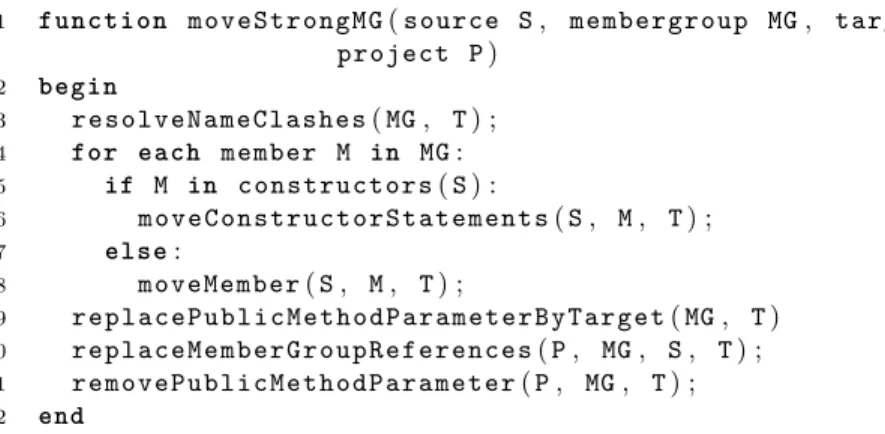
Similar to the relocation algorithm for thecommon MemberGroup the func-tion moveStrongMG resolves overlapping identifier names and moves the mem-bers and dependent constructor statements (lines 3–8). After the relocation of the strong MemberGroup the formerly used variable of type T, passed to the method m as parameter, is unnecessary. The occurrences of the parameter in-side the strong MemberGroup are redirected to the target type (line 9). The relocation has to be propagated to the referencing classes of the public method m. All references to classes that used thestrong MemberGroupinside the source class S are replaced by references to the target class (line 10). Finally, the for-merly used parameter in the methodmcan be removed in all occurrences of the method m(line 11).
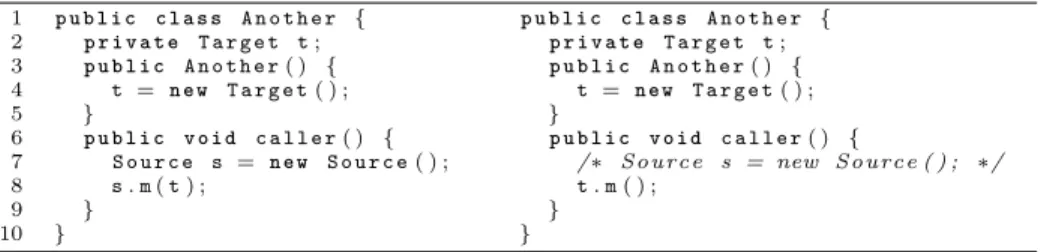
Fig. 3 displays the source code of classAnother (illustrated in Fig. 2). The class is shown before (left) and after (right) the relocation of thestrong Member-Group. Line 8 contains the result of the relocation function: Method mand all other members of the MemberGroup are relocated to parameter class Target
followed by the removal of the parameter of m. An additional improvement can be achieved if the reference to the source class becomes unused in a class that originally invoked the publicly used methodmof the relocatedstrong
Member-1 p u b l i c c l a s s A n o t h e r { 2 p r i v a t e T a r g e t t; 3 p u b l i c A n o t h e r( ) { 4 t = n e w T a r g e t( ) ; 5 } 6 p u b l i c v o i d c a l l e r( ) { 7 S o u r c e s = n e w S o u r c e( ) ; 8 s.m(t) ; 9 } 10 } p u b l i c c l a s s A n o t h e r { p r i v a t e T a r g e t t; p u b l i c A n o t h e r( ) { t = n e w T a r g e t( ) ; } p u b l i c v o i d c a l l e r( ) {
/∗ Source s = new Source ( ) ; ∗/
t.m( ) ; } }
Fig. 3. Source code of classAnother following the example of Fig. 2. Left: Original source code. Right: Resulting source code after moving of mfromSourceinto Target with additional unused reference toSource(line 7).
Group (line 7). In this case an additional class dependency between the classes
Another and Source can be removed, which leads to another modularization improvement.
4
Metrics and tools for analyzing and relocating
MemberGroups
We leverage code metrics to select an appropriate target class from a set of possible classes for the relocation of aMemberGroup (considered in Section 3). These metrics calculate the system improvement after the transformation by measuring the coupling between classes. A coupling between two classes exists if there is at least one dependency between members of both.
The Coupling Intensity (CINT) [9] is used to determine the number of inter-class dependencies, which can be removed by relocating theMemberGroup. From a set of possible target classes the class with the highest value of CINT is used as target class. The CINT metric of the MemberGroup MG(m) and the members of the target classT ∈Mtar is defined as follows:
CIN T(MG(m), T) =
{u→v |u∈MG(m) andv∈M(T)}
. (7)
This metric does not measure the overall number of removed class couplings, but it is used to estimate the system improvement in advance. The overall num-ber of resulting class couplings (see Equation (8)) depends on the actual depen-dencies to other classes of the source and target class. A class coupling between the source class and another class might be removed if only the MemberGroup
references this class. But the coupling remains if the source class has additional references to this class. In the same manner the number of class couplings of the target class might be influenced.
In order to measure the improvement of decoupling and modularization of the whole software after applying the transformations, we use the Class Cou-pling metric (CC) (c.p. the CouCou-pling Factor [10]), which indicates the number of dependent class pairs in relation to the maximum possible number of dependent
Fig. 4.Left:MemberGroupbrowser (in the tree view of the software), showing the list of allMemberGroupsin the selected software graph node and two constraints limiting the MemberGroup list, arranged below. Right: MoveMemberGroup dialog indicating the move possibilities.
class pairs. The CC is defined as follows whereasndenote the overall number of classes in the system:
CC = Pn−1 i=0 Pn−1 j=0,j6=ic(Ci, Cj) n2−n with c(Ci, Cj) = (
1, dependency between classesCi andCj, 0, otherwise.
(8)
We intend to search for “misplaced”MemberGroups using the defined patterns and try to relocate theMemberGroups to other classes that fit better. Consid-ering this, we state that a lower class coupling is an improvement in separation of concerns and modularization of a legacy software system.
To support the programmer in different reengineering and restructuring tasks we developed the toolsetTransFormr[7]. It extracts the software graph from the source code, based on abstract syntax trees, and offers transformation oper-ations. As part of this work, theTransFormrtoolkit was extended to support the analysis and transformation ofMemberGroups. This new module of
Trans-Formr is called the MemberGroup browser, see Fig. 4. The browser lists all
MemberGroupsin a selected software element and restricts the resulting Member-Group list with user-defined constraints. With these constraintsMemberGroups
of a software system that match the strong or the common pattern are deter-mined and it is detected whether a MemberGroup is movable or not. In the next section the presented patterns and metrics are applied to two open source projects to test their usability and benefit in a real world evaluation.
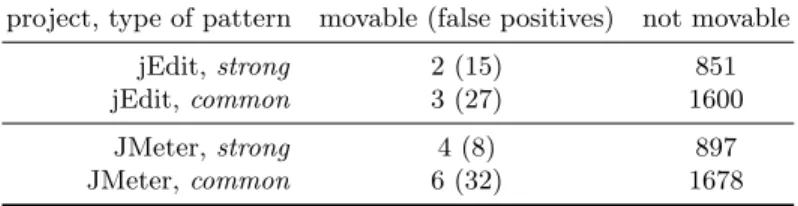
Table 3.Number of movable and not movable MemberGroups in analyzed projects. The parenthesized values denote the identified but even so not movableMemberGroups
(due to constraints not yet detectable by our toolset).
project, type of pattern movable (false positives) not movable jEdit,strong 2 (15) 851 jEdit,common 3 (27) 1600 JMeter,strong 4 (8) 897 JMeter,common 6 (32) 1678
5
Case study
In a case study we applied our approach forMemberGroupdetection and trans-formation on two open source projects written in Java: JMeter (version 2.3.2, 80 KLOC, 794 classes), a desktop application designed to test and measure per-formance of various network services, and jEdit (version 3.4, 95 KLOC, 940 classes), a cross platform text editor.
To measure the effect of applying the presentedMemberGroup patterns on the two projects, a software graph was constructed usingTransFormr. Based on the graphs we calculated the original coupling metrics and tested the pre-conditions to move all MemberGroups found with the MemberGroup browser. A small number of movableMemberGroups was found on which we applied the transformations from Section 3 for each pattern. In order to gain information about the code improvement, we recomputed the CC metric and recorded the removed and newly added class dependencies for each pattern.
Table 3 lists the number of movable and not movableMemberGroups with the specific pattern for JMeter and jEdit. As we can see the number of movable
MemberGroups is very low in relation to the number of the not movable groups. The main difficulty of thestrongpattern is the absence of an appropriate param-eter used as target class in the publicly used method. In about 90 % of the not movable MemberGroups the method had no parameters, the parameters were interfaces or primitive types, or were identified as external library classes. Addi-tional 8 % of the not movableMemberGroups do not have any dependencies to the target class, so no improvement of the decoupling between source class and target class could be expected. A few not movable MemberGroups have mem-bers, which could not be moved because of inheritance restrictions. In case of the common pattern, the most frequent cause that aMemberGroup cannot be relocated was due to inheritance of members. Another reason for not movable
MemberGroups was the assumption that the source and target classes are only used as member variables in all classes that use the MemberGroup. The source class of many not movable MemberGroups was additionally used as parameter or local variable, or the source class was never used as a member variable in all classes that use members of the MemberGroup. These causes sum up to about 95 % of all identifiedcommon MemberGroups in both investigated projects.
Table 4.Improvements in the number of pair couplings (p.c.). A lower number denotes coupling improvement and a higher number denotes a decline in the coupling.
project original p.c. strongp.c. common p.c. P jEdit 4453 4455 (+0.04 %) 4449 (−0.08 %) 4451 (−0.04 %) JMeter 3698 3694 (−0.1 %) 3697 (−0.03 %) 3693 (−0.14 %)
Since the toolsetTransFormrcannot yet detect whether a method realizes an interface or uses methods of an ancestor class of a library, some Member-Groupsare incorrectly marked as movable (false positives in Table 3). This prob-lem could be solved either by additionally inspecting all libraries with
Trans-Formr(possible for most open source projects) or by using sophisticated
com-piler tools (like Eclipse JDT) to detect the inheritance properties of methods. Despite the previously mentioned problems, we found that we can reduce the code coupling by relocating MemberGroups with the outlined patterns. Table 4 shows the results with the number of pair couplings in both projects and the improvement of the CC metric after applying both patterns. There is only a small improvement of the coupling in both projects because we could only relo-cate a small number of MemberGroups (see Table 3). In summary all relocated
MemberGroups lead to an improved modularization as dependencies between classes could be removed. Interestingly enough, the relocation leads to a higher coupling regarding thestrong pattern for jEdit. This is due to couplings of the relocated MemberGroup that had to be added to the couplings of the target class. Unfortunately, in the source class these couplings could not be removed since the source class contains further dependencies to these classes. But even in this case we could decouple source and target classes. The results show that an automated relocation ofMemberGroups can help to decouple software.
6
Related work
Restructuring and refactoring to improve the quality of software in the context of software evolution has been intensively studied. Fowler et al. introduce many refactorings and design patterns for object-oriented languages as solutions for common mistakes in code style in order to make the software easier to under-stand and cheaper to modify [6]. Tests support the proposed manual changes to verify the correctness afterwards. A case study in a close-to industrial environ-ment [11] also indicates that “refactoring not only increases aspects of software quality, but also improves productivity”. Mens and Tourw´e describe the need for automatic support but also state the limits and drawbacks of automated restructuring (e.g., untrustworthy comments, meaningless identifier names) [3]. They present transformation operations and discuss the behaviour preservation including the consistency of unit test results. In [5] an approach with evolution-ary algorithm usage is described. By simulating refactorings with its pre- and postconditions classifications are done. The variation, which improves the class
structure best, is chosen. With an open source case study the potential of the method is shown. The so-called search-based determination of refactorings is in-troduced in detail in [12]. A framework, which uses object-oriented metrics for detecting error-prone code for particular transformations, is proposed in [13]. After analyzing the impact that various transformations have on functional and non-functional software metrics, and by modeling the dependencies between de-sign and code features, the potential to enhance the target qualities and require-ments (soft-goals) for the new system can be shown. Automatic refactorings may also benefit from considering of antipatterns [14]. Brown et al. describe (in contrast to the various how-to-publications) common mistakes in every step of software engineering procedures and show better alternatives. These problem information can be used for metrics as well as for the manual choice of refac-toring tasks. The points-to analysis [15] was initially developed for structured programming languages. It still has its eligibility for object-oriented languages, as references-to analysis [16]. The (dynamic) knowledge of referencing objects can support complex refactorings. Some of our current restrictions may be eased by using reference analysis.
7
Conclusions
This article presents a pattern-based approach to relocate sets of member vari-ables and methods to automatically improve the modularization of legacy soft-ware systems. The key element of the described modularization of softsoft-ware is the so-calledMemberGroup, which represents a separate concern or a service in a class. The MemberGroup is independent of the rest of a class and can there-fore be relocated entirely to a target class. This relocation however has several constraints on the structure of a MemberGroup as well as on the referencing classes. We show which constraints have to be fulfilled in order to automatically apply the relocation operations on the legacy software without user interaction. We also demonstrate how the relocation of MemberGroups can be integrated into reengineering toolsets, such asTransFormr. In a case study the approach was applied to two open source systems and the results have shown that the au-tomatic relocation of MemberGroups can lead to less coupled legacy code (less code dependencies).
In future work we intend to enhance thecommon MemberGrouppattern with additional relocation strategies to rise the number of possibleMemberGroup re-locations. The integration of inheritance and language specific constructs like inner classes in the MemberGroup definition is also a promising goal for addi-tional options to modularize.
Acknowledgment
The transformation approach described in this article as well as the associated toolkit are part of the results of the joint research project called TransBS funded by the German Federal Ministry of Education and Research.
References
1. Eick, S.G., Graves, T.L., Karr, A.F., Marron, J.S., Mockus, A.: Does Code Decay? Assessing the Evidence from Change Management Data. IEEE Transactions on Software Engineering27(1) (2001) 1–12
2. Binkley, D.: Source Code Analysis: A Road Map. In: Future of Software Engineer-ing (FOSE), WashEngineer-ington, DC, USA, IEEE Comp. Soc. (2007) 104–119
3. Mens, T., Tourw´e, T.: A Survey of Software Refactoring. IEEE Transactions on Software Engineering30(2) (2004) 126–139
4. Serrano, M.A., Carver, D.L., de Oca, C.M.: Reengineering legacy systems for distributed environments. Journal of Systems and Software64(1) (2002) 37–55 5. Seng, O., Stammel, J., Burkhart, D.: Search-Based Determination of Refactorings
for Improving the Class Structure of Object-Oriented Systems. In: Proc. 8th An-nual Conf. on Genetic and Evolutionary Computation (GECCO), New York, NY, USA, ACM (2006) 1909–1916
6. Fowler, M., Beck, K., Brant, J., Opdyke, W., Roberts, D.: Refactoring: Improving the Design of Existing Code. Addison-Wesley Professional, Massachusetts (1999) 7. Hunold, S., Korch, M., Krellner, B., Rauber, T., Reichel, T., R¨unger, G.:
Transfor-mation of Legacy Software into Client/Server Applications through Pattern-Based Rearchitecturing. In: Proc. 32nd IEEE International Computer Software and Ap-plications Conf. (COMPSAC). (2008) 303–310
8. Hunold, S., Krellner, B., Rauber, T., Reichel, T., R¨unger, G.: Pattern-based Refac-toring of Legacy Software Systems. In: Proc. 11th International Conf. on Enterprise Information Systems (ICEIS). (2009) 78–89
9. Lanza, M., Marinescu, R., Ducasse, S.: Object-Oriented Metrics in Practice. Springer-Verlag New York, Inc., Secaucus, NJ, USA (2006)
10. Brito e Abreu, F., Carapu¸ca, R.: Object-Oriented Software Engineering: Measuring and Controlling the Development Process. In: Proc. 4th International Conf. on Software Quality (ASQC), McLean, VA, USA (Oct. 1994)
11. Moser, R., Abrahamsson, P., Pedrycz, W., Sillitti, A., Succi, G.: A Case Study on the Impact of Refactoring on Quality and Productivity in an Agile Team. In: 2nd IFIP TC 2 Central and East European Conf. on Software Engineering Techniques (CEE-SET), Revised Selected Papers, Poznan, Poland, Springer (2007) 252–266 12. O’Keeffe, M., ´ı Cinn´eide, M.: Search-based refactoring for software maintenance.
Journal of Systems and Software81(4) (2008) 502–516
13. Tahvildari, L., Kontogiannis, K.: Improving design quality using meta-pattern transformations: a metric-based approach. Journal of Software Maintenance16 (4-5) (2004) 331–361
14. Brown, W.J., Malveau, R.C., McCormick III, H.W., Mowbray, T.J.: Anti-Patterns: Refactoring Software, Architectures, and Projects in Crisis. First edn. John Wiley & Sons, Inc. (1998)
15. Rayside, D.: Points-To Analysis. Technical report, MIT Computer Science and Artificial Intelligence Laboratory, Cambridge, MA, USA (Nov. 2005)
16. Ryder, B.G.: Dimensions of Precision in Reference Analysis of Object-oriented Programming Languages. In: Proc. 12th International Conf. on Compiler Con-struction, Warsaw, Poland, Springer (2003) 126–137