i
Army Guide for the
Preparation of a Program
Product Data Management
Strategy (DMS)
8/31/2010
DISTRIBUTION STATEMENT A. Approved for public release; distribution is unlimited.
ii
1
Introduction ... 1
Table of Contents
1.1 Purpose ... 1 1.2 Requirement for DMS ... 12
DMS Process ... 4
2.1 Step 1 - Data & Data Rights Determination ... 5
2.2 Step 2 - Data & Data Rights Acquisition ... 11
2.3 Step 3 - Data Management & Use ... 16
3
Data Management Strategy and the Life cycle ...19
4
Data Management Strategy (DMS) Template ...27
Appendices ...32
Appendix A - Program Life cycle Data Requirements ... A-1
Appendices
Appendix B - Government Data Rights Procedures Background Information ...B-1
Appendix C - DFARS Contract Clauses for Data Rights ...C-1
Appendix D - Data Formats ... D-1
Appendix E - Data Delivery ... E-1
Appendix F - Data Storage and Maintenance ... F-1
Appendix G - Life cycle Access and Use of Data ... G-1
Appendix H - Required Resources and Risk Assessment ... H-1
Appendix I - DMS Worksheet Tool ... I-1
Appendix J - Acronyms ... J-1
List of Figures Figure 1 - Data Management Strategy Development Process ... 3Figure 2 - Complete DMS Creation Process... 4
Figure 3 - Hierarchical Breakdown of Product Data ... 6
Figure 4 - Work Breakdown Structure (WBS) Levels of DMS Attention ... 12
Figure 5a - Noncommercial Technical Data Rights ... 13
iii
Figure 5c - Commercial Technical Data Rights ... 14 Figure 6 - Acquisition Life cycle and Data Management Reviews ... 20 Figure 7 - Relationships of Different Types of Data ... A-3 Figure 8 - Components of DMS Development ... I-2 Figure 9 - Data Rights Tool Introduction ... I-3 Figure 10 - Data Life cycle Management Tool Introduction ... I-4
1
1
I
NTRODUCTION1.1
Purpose
This document provides the Program Manager (PM) and others involved in the acquisition and support of Army hardware and software, guidance in the proper preparation of a program-specific Data
Management Strategy (DMS). In preparing the DMS, Congressional and Department of Defense (DoD) policy states the PM shall evaluate and plan for the long-term needs for product data necessary to develop, acquire, manufacture, operate, support, maintain and dispose of their acquisition program; and the appropriate data rights required to assure the Government can utilize the data to the maximum legal extent. An Excel spreadsheet support tool has also been developed to be used in conjunction with this guide as a “worksheet” for analyzing the data and data rights requirements of the total acquisition program and its major subsystems/components.
1.2
Requirement for DMS
The requirement to prepare program Data Management Strategies originated in Office of the Secretary of Defense (OSD) Policy Memo, “Data Management and Technical Data Rights”, dated 19 July 2007. It has since been codified in the 8 December 2008 version of DoDI 5000.02, Enclosure 12, section 9, and in Department of Army Policy Memo, “Data Management and Technical Data Rights”, dated 1 April 2008, and was reaffirmed in DA Memo, “Data Management, Technical Data Rights, and Competition”, dated 8 January 2010.
These policy documents require ACAT I and II PMs to:
• assess the data required to design, manufacture, and sustain the system,
• assess the data required to support re-competition for production, sustainment or upgrade, • prepare a DMS.
Historically product support or acquisition program operating sustainment costs are approximately 70% of the total ownership cost of the system over its entire “cradle to grave” lifecycle. Lack of technical data significantly impedes the Army’s ability to maximize competition for both acquisition and
sustainment of the acquisition program. It also severely impacts the government enterprise’s ability to properly plan and execute effective and efficient sustainment strategies. This has led to the
government’s inability to reduce total ownership costs throughout its life cycle. Hence the value of the technical data across the government enterprise is critical for meeting key operating and sustainment Warfighter requirements.
To ensure maximum availability of competitive acquisition and product support alternatives throughout the life cycle of a system or component, PMs must make certain that all necessary product data and associated data rights are acquired at logical points in the life cycle process and are maintained for future use.
ACAT III PMs are not required to prepare DMSs for their programs, but are strongly encouraged to do so as it reflects a “best practice” for ensuring the Government understands what data, and associated
2
rights, are necessary to support the acquisition program throughout its life cycle. These same DMS issues arise in other common program documents such as a Justification and Approval (J&A).
The PM has primary responsibility for development and implementation of the DMS, but is encouraged to utilize a working level DMS Integrated Product/Process Team (IPT) to determine the long-term product data requirements of all functional areas that have roles in the weapon system life cycle. The DMS IPT should consist of personnel from the PM office, the associated Life Cycle Management Command (LCMC), associated Research, Development & Engineering Centers (RDECs), associated Software Engineering Centers, depots and other organizations as appropriate. A representative list of functional areas that should be represented in the DMS IPT include: engineering, logistics,
environmental, Environmental Safety and Occupational Health (ESOH), contracting, legal, quality assurance, program management, and data management.
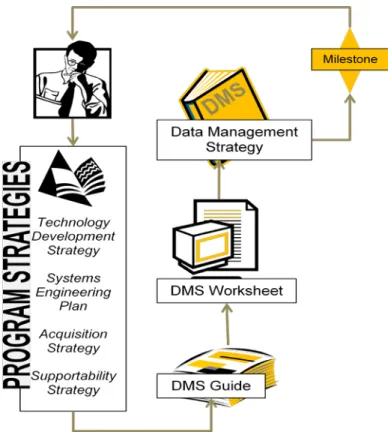
The DMS is to be integrated with the program Acquisition Strategy (AS), (or Technology Development Strategy (TDS) during the Materiel Solution Analysis phase), the Supportability Strategy (SS) (also referred to as the Life Cycle Sustainment Plan (LCSP)), the System Engineering Plan (SEP) and other program documents. Leveraging these program strategies, the PM and DMS IPT should use this guide and the companion DMS Worksheet (or equivalent) to conduct the detailed data, data rights, and data management analysis that will be synopsized in the DMS and submitted or updated for each Milestone Decision Review (MDR). Each DMS should be reviewed and approved by the same key program stakeholders that review and approve the AS and SS. DA Pamphlet 70-3 provides a list of these AS & SS stakeholders.
Figure 1 is a graphical depiction of the Data Management Strategy development process described above.
3
4
2
DMS
P
ROCESSPreparing a “good” DMS requires the PM and their staff to conduct a three step analysis.
Step 1 – Determination of the program’s life cycle data requirements and associated data rights requirements.
Step 2 – Determination of the contractual actions (contract clauses, Contract Data Requirements Lists (CDRLs), Data Item Descriptions (DIDs), negotiations, contractor assertions, etc.) needed to acquire the above data and data rights from contractors.
Step 3 - Determination of the Information Technology (IT) repositories/environment, access controls, and configuration management actions that must be funded over the acquisition life cycle to manage the data and enable the various authorized Army users to access and use the data for product support purposes.
Figure 2 below graphically depicts and summarizes this three step process. The remainder of this section provides detailed guidance needed to accomplish these three steps.
5
2.1
Step 1 - Data & Data Rights Determination
Determination of the program’s life cycle needs for data and data rights is dependent upon the program’s Technology Development Strategy or Acquisition Strategy, Supportability Strategy, and the program System Engineering Plan. The TDS and SEP are usually generated prior to Milestone A, and the AS and SS are usually generated prior to Milestone B (see DoDI 5000.02, Enclosure 4, “Statutory and Regulatory Information and Milestone Requirements”). In all cases the program’s plans for organic, sole source or competitive sourcing for life cycle functions and services will be a primary driver for determining the data and data rights required, so the DMS must be consistent with and support these other program management documents.
Life cycle functions can be divided into the basic categories of development, production, procurement, and sustainment. Since the Office of Management and Budget (OMB), Congress, and OSD have all called for increased use of competitive acquisition and logistics support approaches, the product data required for competition should be a primary (but not the sole) driver of data and data rights needs. The TDS or AS, SEP, and SS will describe which organization (organic Government, Original Equipment Manufacturer (OEM), or other contractor) is planned to perform those functions. Government
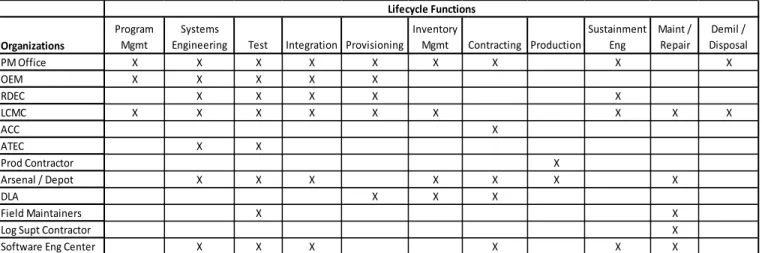
organizational performance of life cycle functions should be further segregated such that the PM understands which specific organizations will have needs for weapon system product data and hence should be participants on the DMS IPT. Table 1 is a representational example of the type of life cycle function allocation between organizations that could exist for a hypothetical weapon system.
Table 1 – Representational Allocation of Life cycle Function Responsibilities
Acronyms:
ACC = Army Contracting Command ATEC = Army Test & Evaluation Command DLA = Defense Logistics Agency
LCMC = Life Cycle Management Command LOGSA = U.S. AMC Logistics Support Activity OEM = Original Equipment Manufacturer PM = Program/Project Management
RDEC = Research, Development & Engineering Center
Organizations
Program Mgmt
Systems
Engineering Test Integration Provisioning
Inventory Mgmt Contracting Production Sustainment Eng Maint / Repair Demil / Disposal PM Office X X X X X X X X X OEM X X X X X RDEC X X X X X LCMC X X X X X X X X X ACC X ATEC X X Prod Contractor X Arsenal / Depot X X X X X X X DLA X X X Field Maintainers X X
Log Supt Contractor X
Software Eng Center X X X X X X
6 2.1.1 Data Categories / Definitions
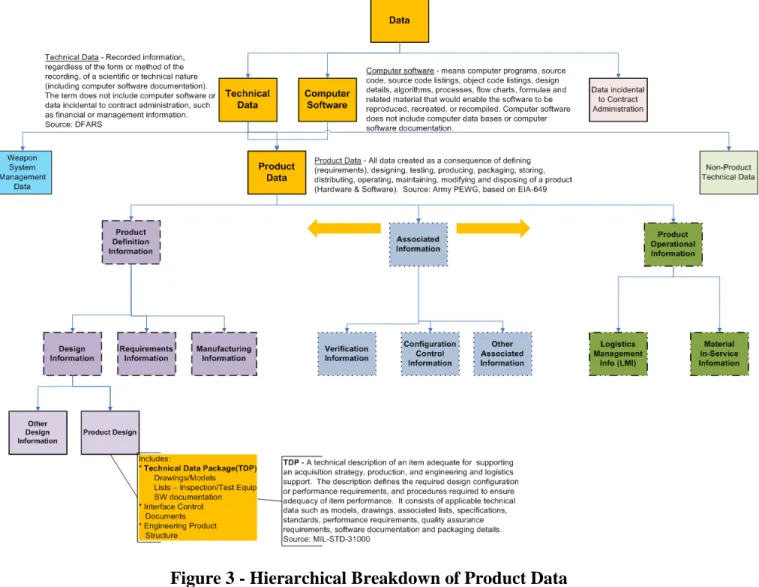
The universe of product related data needed by the various organizations to support the weapon system throughout its life cycle can be categorized into the following three major groups: Product Definition Information, Product Operational Information, and Associated Information. Figure 3 is a graphical representation of the categories of product data as defined by the Army Product Data and Engineering Work Group (PEWG).
Figure 3 - Hierarchical Breakdown of Product Data
The definitions of the three major categories of product data are below:
• Product Definition Information – information that defines the product's requirements, documents the product's design and attributes, and is the authoritative source for
configuration definition and control. Examples include: drawings, specifications, 3-D CAD models, analyses, trade studies, and information about designs not selected, requirements, manufacturing and depot overhaul/modification information.
7
• Product Operational Information – information that describes the operation and logistics support/sustainment of the weapon system. Examples include: field feedback information, records of maintenance actions, field deficiency reports, etc.), product identification information, technical manuals, ESOH/Hazardous Material information, and packaging, preservation, and transportation information.
• Associated Information – other product related data such as test results and proposed configuration changes that do not fit clearly into the other two categories
It is important to note that the types of product related data needed to support the weapon system
throughout the life cycle extend beyond just the Technical Data Package (TDP). All elements of product data depicted in Figure 3 should be considered for their utility and need for each subsystem and major subcomponent of the weapon system.
Also note that computer software is included in Figure 3 as data to be considered and planned for in the program DMS. The Defense Federal Acquisition Regulation Supplement (DFARS) defines computer software as: computer programs, source code, source code listings, object code listings, design details, algorithms, processes, flow charts, formulae and related material that would enable the software to be reproduced, recreated, or recompiled. Computer software does not include computer data bases or computer software documentation. While the DFARS segregates Computer Software and Technical Data as different entities, data rights are an important issue common to both.
The first step of the DMS analysis is for the PM and the DMS IPT to identify which elements of product data and computer software are needed by each organization to accomplish their mission functions. The “Data Management Sheet” tab of the DMS Excel support tool provides a checklist of product data elements to be considered in this step of the analysis.
More information about the categories and elements of product data is contained in Appendix A -
Program Life cycle Data Requirements.
2.1.2 Data Rights Needs and Options
Any product data that is intended to be used by other than the Original Equipment Manufacturer (OEM) will require sufficient rights for Government or other use, so an assessment of required level of data rights for each set of product data must also be conducted. The options for data rights in noncommercial technical data and noncommercial computer software as defined within the DFARS are:
• Unlimited Rights
• Government Purpose Rights
• Limited Rights (or Restricted Rights for Non-commercial Computer Software) • Special License Rights
When discussing the subject of Government data rights it must be remembered that the U.S.
Government is entitled to certain automatic and default rights because of statute or regulation. In these cases the Government “secures” these rights. If the Government requires data rights beyond these entitlements, then the Government can attempt to “acquire” the additional rights through negotiations and possible additional cost. While recognizing this important distinction, the single term “acquire” is
8
used relative to data rights throughout the rest of this guide. Information about the DFARS treatment of automatic and default rights, commercial technical data, and commercial computer software is contained in Appendix B - Government Data Rights Procedures Background Information.
2.1.2.a Unlimited Rights (UR) in Technical Data and Computer Software
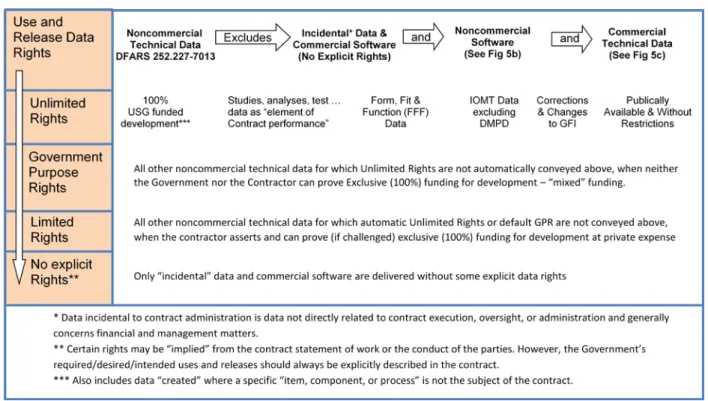
“Unlimited Rights” arise in certain types of data automatically upon contract award (e.g., Form, Fit, and Function (FFF) and installation, operation, maintenance, and training (IOMT)) and in most other data based upon exclusive (100%) Federal funding of development of the items, components, or processes (ICP) to which that data pertains. The Government may share this data with anyone for any reason.
2.1.2.b Government Purpose Rights (GPR) in Noncommercial
If the Government provides some, but not 100% of the funding for the item, component, or process, then the Government receives by default a "Government Purpose Rights" license in all data pertaining to that ICP except that data in which it has received automatic Unlimited Rights. If neither party (Government or OEM contractor) proves exclusive (100%) funding then “Government Purpose Rights” are the
default. The Government may share this data with third parties for any Government purpose after having that third party execute a DFARS Non-Disclosure Agreement (NDA).
Technical Data and Computer Software
2.1.2.c Limited Rights (LR) in Noncommercial
When the contractor has exclusively (100%) funded the development of a non-commercial ICP, the Government receives “Limited Rights” in the data for which the Government has not received automatic “Unlimited Rights.” With one exception for emergency repairs and overhaul, the Government may not share this data with third parties (to include support contractors).
Technical Data
2.1.2.d Restricted Rights (RR) in Noncommercial
When the contractor has exclusively (100%) funded the development of non-commercial computer software, the Government receives “Restricted Rights” in that computer software for which the
Government has not received automatic “Unlimited Rights.” With very limited exceptions listed in the DFARS, the Government may not share this data with third parties (to include support contractors).
Computer Software
2.1.2.e Special License Rights (SLR) in Technical Data and Computer Software
Where the above DFARS defined categories are insufficient to properly define an agreement of the parties as to data rights allocations, the parties may specifically negotiate “Special License Rights” that are defined in the contract. The Government may always attempt to increase its rights by negotiation (without coercion) to “Government Purpose Rights”, “Unlimited Rights” or even ownership rights. Always consult legal counsel when negotiating licenses.
2.1.3 Myths and Facts regarding Government Data Rights
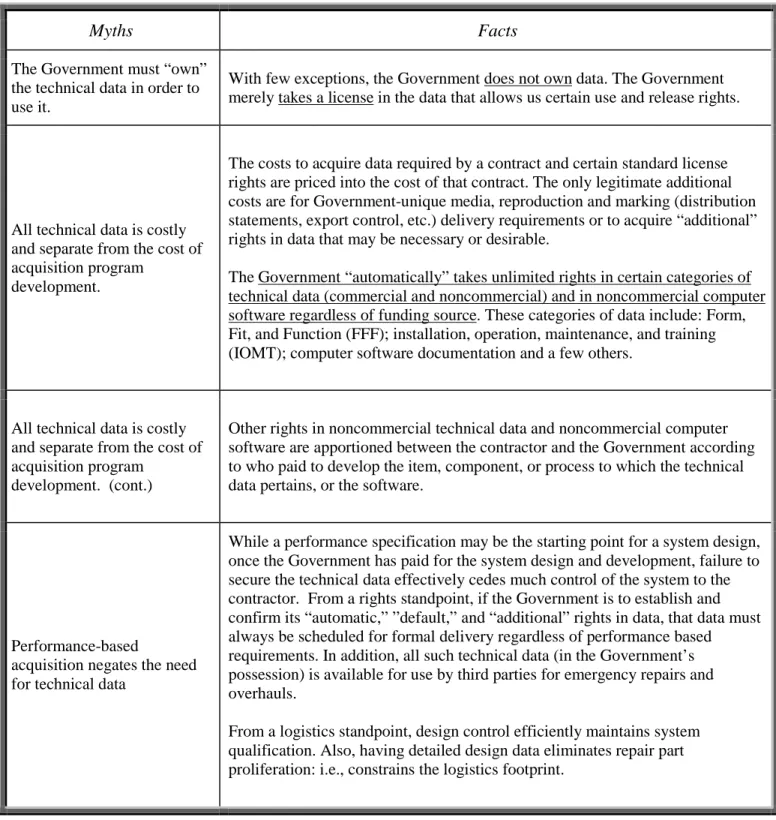
The area of Government data rights is probably one of the most misunderstood areas within acquisition. Several key “myths and misconceptions” about Government data rights are listed in Table 2 below. Please see Appendix B – Government Data Rights Procedures Background Information for specifics related to the following “myths and misconceptions”.
9
Table 2 -Myths and Facts about Data Rights
Myths Facts
The Government must “own” the technical data in order to use it.
With few exceptions, the Government does not own data. The Government merely takes a license
All technical data is costly and separate from the cost of acquisition program
development.
in the data that allows us certain use and release rights.
The costs to acquire data required by a contract and certain standard license rights are priced into the cost of that contract. The only legitimate additional costs are for Government-unique media, reproduction and marking (distribution statements, export control, etc.) delivery requirements or to acquire “additional” rights in data that may be necessary or desirable.
The Government “automatically” takes unlimited rights in certain categories of technical data (commercial and noncommercial) and in noncommercial computer software regardless of funding source. These categories of data include: Form, Fit, and Function (FFF); installation, operation, maintenance, and training (IOMT); computer software documentation and a few others.
All technical data is costly and separate from the cost of acquisition program
development. (cont.)
Other rights in noncommercial technical data and noncommercial computer software are apportioned between the contractor and the Government according to who paid to develop the item, component, or process to which the technical data pertains, or the software.
Performance-based
acquisition negates the need for technical data
While a performance specification may be the starting point for a system design, once the Government has paid for the system design and development, failure to secure the technical data effectively cedes much control of the system to the contractor. From a rights standpoint, if the Government is to establish and confirm its “automatic,” ”default,” and “additional” rights in data, that data must always be scheduled for formal delivery regardless of performance based requirements. In addition, all such technical data (in the Government’s possession) is available for use by third parties for emergency repairs and overhauls.
From a logistics standpoint, design control efficiently maintains system qualification. Also, having detailed design data eliminates repair part proliferation: i.e., constrains the logistics footprint.
10
Myths Facts
The contractor “said” the data was proprietary and too expensive
Generally speaking, the contractor must assert and be able to justify the data it claims as protected prior to each contract award. They also must make these assertions at the proper level of the product (top weapon system, subsystem, assembly, or component). The contractor has the burden of proving all assertions by maintaining and providing records
The data must be proprietary because it all had
“proprietary” stamped on each page or file
showing funding allocations. Legends such as “PROPRIETARY” or “COMPANY CONFIDENTIAL” are nonconforming legends for data pertaining to a noncommercial ICP/software and should be ordered removed.
Legends for which a proper assertion has not been made and incorporated into the contract also are “nonconforming.”
Upon receipt, all delivered data must be screened/sampled for nonconforming or unjustified markings and for conformance to other contract requirements and corrections required promptly. This is why “delivery” of the technical data is always recommended! Data should not be accepted prior to correction of technical and data rights defects. Doing so may waive Government rights.
The contractor modified some of the technical data we provided to them and now claim it is proprietary.
The Government has data rights in “corrections and changes” to Government Furnished Information (GFI) technical data or software provided to a contractor as Government Furnished Information (GFI), and retains its original rights in GFI. However, Government rights in “corrections and changes” in GFI that result from modification of an ICP or new development efforts may not be so straight forward.
Technical data “access” is sufficient
Mere access does not confirm rights!
Formal delivery via CDRL is required to confirm Government rights and obtain correct markings on the data.
By law, any enforceable right to see, access, or have a copy of data requires an OMB approved DID or FAR/DFARS Clause.
By contract terms, only “deliverable” data is subject to the DFARS Part 227 clauses requiring assertions, markings, and justifications.
Therefore, DoD cannot assume it has any useable rights in data that is informally provided unless such rights are explicitly granted by the contractor and reviewed by legal counsel. All data access provisions must be reviewed by counsel and the data rights in accessed information must be addressed in the contract.
11
Myths Facts
The Government should only “buy” rights to technical data it has a current defined need for.
The Government should always
The Government agreed in the past to restrict its rights in the technical data and
software.
aggressively pursue its “automatic” and “default” rights to certain technical data, as well as the other rights to which it is entitled at no additional cost. Since additional needs for the data may surface at a later time, there is no supportable rationale for “giving up” these rights to which the Government is legally entitled.
These agreements should not be considered binding upon the Government's prior or future data rights until reviewed by legal counsel.
The result of the analysis will be an understanding of what product data (and associated rights) you need and why you need it. In nearly every case the Government’s needs for using the product data can be met with Government Purpose Rights. The full analysis should be documented in the “Data Rights Sheet” tab of the DMS Excel support tool or something similar, and key results should be summarized and recorded in the DMS for Milestone Decision makers.
More information about the Government’s data rights options and procedures can be found in Appendix
B - Government Data Rights Procedures and Background Information.
2.2
Step 2 - Data & Data Rights Acquisition
Once the PM has completed the identification of the required product data and associated data rights needed to support the acquisition program throughout its life cycle, the next step is to identify actions to be taken to acquire the needed data and data rights. Generally recommended actions include:
• Use appropriate DFARS specified contract clauses (see Appendix C – DFARS Contract Clauses for Data Rights for a list of the clauses and types of contracts they should be used in) • Determine the desired format for each set of product data ordered via contract. Information
on data formats is located in Appendix D - Data Formats.
• Specify all requested data in the contract via the Contract Data Requirements List (CDRL) and appropriate Data Item Descriptions (DIDs)
• Require contractor to assert any intention to provide data with less than Unlimited Rights at time of proposal submission (this is automatically required in any contract containing DFARS 252.227-7017)
• Require documentation from the contractor to support all assertions • Negotiate (if needed) to acquire additional data rights
• Reach agreement on all data costs and data rights by time of contract award
• Deliver to the Government of all contractually ordered data so it can be reviewed to
determine compliance with contract requirements for data quality and data rights markings. Information on data delivery and verification can be found in Appendix E - Data Delivery.
12
Again, the “Data Management Sheet” tab of the DMS Excel support tool provides a place to document the program’s plans for many of these data acquisition decisions.
2.2.1 Data Rights Assertions
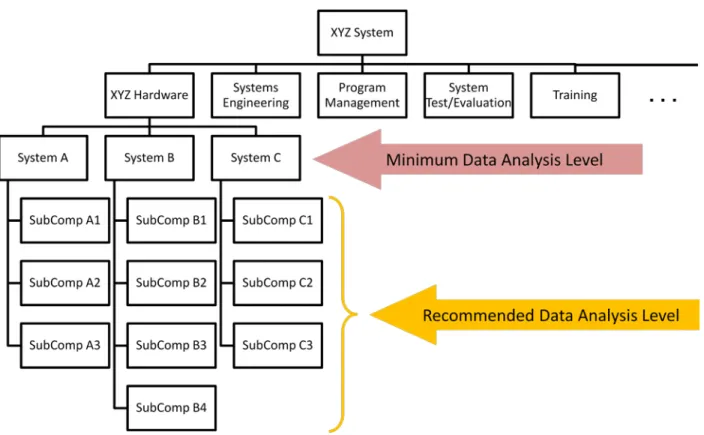
DFARS 252.227-7017 requires that, as part of their proposal, contractors provide assertions regarding any data identified in the Government’s Solicitation in which the contractor asserts the Government should take less than Unlimited Rights. These assertions should be identified at the appropriate Work Breakdown Structure (WBS) level (top system, subsystem, assembly, or component) and substantiated as appropriate. Figure 4 below shows a notional WBS for a generic acquisition program. The WBS provides a framework for specifying program objectives. It defines the program in terms of
hierarchically related, product-oriented elements and includes “other Government” elements (i.e., Program Office Operations, Manpower, Government Furnished Equipment (GFE), and Government Testing). Each element provides logical summary levels for assessing technical accomplishments, supporting the required event-based technical reviews, and measuring cost and schedule performance. Usually the Government develops the top three levels of the Program WBS and includes it in the solicitation. Bidding contractors build upon the Government program WBS and propose detailed WBS structures (known as Contract WBS) based on their development approach. The winning contractor’s Contract WBS together with the Government’s Program WBS becomes the complete WBS for the acquisition program. MIL-HDBK-881A “Work Breakdown Structures for Defense Materiel Items” provides more information about the proper development and uses of WBSs.
13
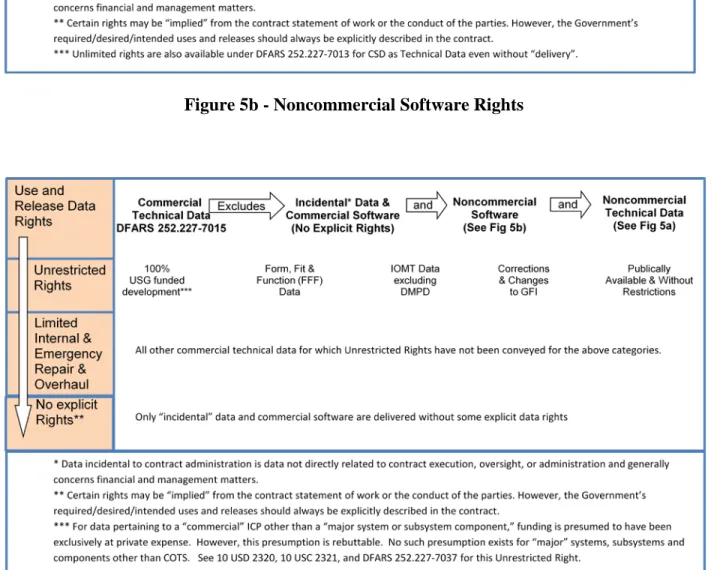
When evaluating OEM assertions of limitations on Government rights, the Government must compare the contractor claims against the guidance contained in the DFARS. Figures 5a, 5b, and 5c below visually demonstrate the relationship between the Government's license rights levels and certain categories of data. The initial DMS assumption as to existing and future data rights should be based upon the categories, levels and relationship shown in these figures. Refer to Appendix C – DFARS Contract Clauses for Data Rights for a better understanding of the DFARS clauses called out in the following figures.
14
Figure 5b - Noncommercial Software Rights
15
If the contractor’s assertions are determined to be valid, then the Government must compare those limited rights usages to the data rights and planned usages determined in Step 1 to identify any gaps between what is required and what the Government is legally entitled to at no additional cost. For each gap identified, appropriate actions must be planned to close the gap. Negotiations and
discussions will be required with the OEM to finalize the Government’s data rights situation. The results of the OEM assertions should be documented in the “Data Rights Sheet” tab of the DMS Excel support tool (or equivalent).
2.2.2 Risk Assessment / Risk Management – Part 1
Since it may not be possible to acquire all of the required product data and associated data rights at no additional cost to the Government, the PM should conduct a Risk Assessment & Management approach to the their data needs. The PM should:
• Assess the risks to the program and to the Army of not acquiring the desired product data or data rights due to cost or other considerations. See Appendix H - Required Resources and Risk Assessment for more details.
• Explore alternatives for acquiring the needed data rights for life cycle support from the OEM. Some, but not all, of the alternative actions include:
o Additional rights negotiations (ARN). The parties may negotiate for data rights beyond the automatic and default rights conveyed by the DFARS clauses. Such negotiations are subject to a statutory prohibition that the contractor cannot be compelled to relinquish such additional rights as a condition of being responsive to the solicitation or as a condition of award. In a competition, such negotiations within this prohibition are difficult and usually take the form of a voluntarily priced option (often a not-to-exceed price) to deliver all required data (commercial and
noncommercial) with not less than GPR. Generally, a competitive evaluation of such options is limited to the life cycle cost impacts to the program.
o Change Program Strategy(s). Adjust one or more of the program strategies to be consistent with the expected data rights.
o Use of Competitive Sourcing Proposals (CSP). This approach is unique to major systems and it authorizes a mandatory requirement in the solicitation for competitive sourcing proposals. A CSP does not require (nor prohibit) that the contractor offer additional data rights, but does require that the contractor propose a method by which the Government may competitively re-procure the system. The exact method for achieving such competition is left to the contractor to propose. One possible method to achieve this would be for the contractor to license additional suppliers.
o Physically and Functionally Interchangeable (PFI) ICPs. When the Government lacks sufficient data rights to competitively re-procure an item (or any sublevel of that item), the Government may describe a new replacement item by the use of Form Fit and Function (FFF) data. Such FFF for commercial and noncommercial items is “automatically” provided with unlimited rights.
16
o Reverse Engineering by or at the direction of the Government (REG)
o
. To fill in for missing data or insufficient data rights, an item may be reverse engineered to develop either a data package or a performance specification. By policy, such reverse
engineering is to be used as a last resort and only after obtaining Head of the Contracting Activity (HCA) approval.
Reverse Engineering by a third party (RET)
o
. The above noted policy and HCA approval regarding a Government effort to reverse engineer an item do not apply to such efforts by a contractor. There is a statutorily authorized program (See DoDI 4140.57) by which contractors can purchase or borrow such items for this purpose. Internal Government Use (IGU) of Limited Rights data
Comparative purposes and evaluating the first article of another contractor; . Many authorized uses of Limited Rights data can enable competition without disclosing or releasing Limited Rights/Restricted Rights data to third parties. This internal Government only use of data may be helpful in connection with reverse engineering efforts by the
Government or another contractor. Such uses include:
Internal evaluation of third party applications to a Government agency;
Validating a competitive copy or reverse engineering effort; and
Government oversight of another contractor’s performance.
Always consult with legal counsel when considering use of Limited Rights/Restricted Rights data to facilitate competition.
o Periodic competitions for subsystem upgrades where it employs one of the above solutions to conduct the new competition. The new competition may itself not lead to competitive rights.
• Discuss the risks of not acquiring product data and data rights that are not forecasted to be needed for the current TDS, AS and SS, but may be required if changes occur to any of these. For example, what are the risks to the Government of not acquiring certain product data and rights if the current planned AS calls for sole source procurement of all end items and spares from the OEM, and later a decision is made to break-out various spares for competitive procurement? By not acquiring the data and rights, has the program locked the Government into a course of action that would be costly or impossible to change at a later date.
More information about alternative ways to enable competition without having the desired level of data rights can be found in the Appendix B - Government Data Rights Procedures and Background
Information.
It is recommended that the DMS should report the key results of the OEM assertions and data rights gap analysis through level 3 of the WBS, with the entire detailed analysis included as an appendix.
2.3
Step 3 - Data Management & Use
In the final step of the DMS analysis process, the need for various Government (and possibly contractor) organizations to access and use the product data over the life cycle of the acquisition program must be
17
considered and planned for. The Defense Acquisition Guide (DAG), Sections 2.3.14.2 and 4.2.3.1.7, recommends PMs establish an Integrated Data Environment (IDE) that allows every activity involved with the program to cost-effectively create, store, access, manipulate, and exchange digital data. PMs are also encouraged to use existing IDE infrastructure (such as repositories operated by AMC LCMCs and/or RDECs) as appropriate. United States Code (U.S.C.) Title 40 subtitle III, U.S.C. Title 10 Sections 2223 and 3014, and U.S.C. Title 44 chapters 35-36 drive the DoD and Army policies for Information Resource Management and Information Technology. Army Regulation (AR) 25-1 applies to information technology contained in both business systems and national security systems (except as noted) developed for or purchased by the DA. This regulation implements the above Public Law as well as DoDD 8000.01 and sets the strategic path for Information Technology (IT) use.
The key considerations in developing a data management approach are:
• The Information Technology (IT) environment that will be used to store and manage the data. The choices are:
o Government repositories
o
– a combination of command specific repositories usually provided by the acquisition program’s Life cycle Management Command (LCMC) or Research, Development and Engineering Center (RDEC), and AMC or Army-wide enterprise
repositories such as the Logistics Modernization Program (LMP) and Logistics Information Warehouse (LIW).
Contractor repository – provided by either the OEM or a third-party contractor via an existing contract vehicle and a commensurate level of funding provided by the PM for the storage, maintenance and providing the Government access to the data.
Program-unique repositories are discouraged as long-term product data IT environments due to the high cost to the Army if multiple PMs establish and fund separate IT environments. They may also represent possible violations of the Clinger-Cohen Act if a program unique repository represents a duplication of an existing IT capability within the DoD and have not been certified by the appropriate Investment Review Board and the Defense Business System Management Council (DBSMC) (if $1M or more in cost). Program unique repository approaches also inhibit data access, sharing and reuse across the Army.
• Budgeting for maintenance and upkeep of the product data throughout the life cycle. Such maintenance activities include:
o Incorporation of configuration changes (to include changes due to obsolete parts or materials) o Technology or format refresh
• Access for Army users throughout the life cycle. This includes methods to be used to inform the organizations that will be involved in the various life cycle support activities what product data exists, where the authoritative copies are stored and maintained, and how they can access the data. More information about considerations to store and maintain the product data throughout the life cycle of the acquisition program and make it available for use by others can be found in Appendix F - Data
18 2.3.1 Risk Assessment / Risk Management – Part 2
The PM should continue their risk assessment & management approach in this step by assessing the risks to the program and to the Army of not budgeting and providing sufficient recurring funds for data maintenance and management. Information on considerations for resource requirements and risk assessments can be found at Appendix H - Required Resources and Risk Assessment.
19
3
D
ATAM
ANAGEMENTS
TRATEGY AND THEL
IFE CYCLEBefore the actual DMS format and content is discussed there are some key points that should be understood.
First, the DMS will only be a summary of the results of the detailed data, data rights, and data management needs analysis described above. The full analysis should be documented in the DMS worksheet, but the DMS itself will identify that the full analysis was performed, provide an overview of the results of each step of the analysis, and highlight any risk issues that were identified and any actions required by decision authorities to mitigate those risks.
Second, a DMS is required for each Milestone Decision Review (MDR) and the Full Rate Production (FRP) Decision Review (DR), but the contents and focus of the DMS are different for each. As the program moves from Milestone (MS) A through MS C and FRP DR there is an escalating amount of data to be addressed in the DMS. Though not an official MDR point, the transition within the Engineering and Manufacturing Development Phase from the Integrated System Design effort to the Systems Capability and Manufacturing Process Demonstration effort may be a good time to re-assess and update the program DMS.
After MS A, each successive DMS takes on a dual nature. It will both:
1) Describe the planned approaches and actions for the upcoming life cycle phase, and 2) Report on the actual results of the actions from the just completed phase
The latter information is necessary to inform MS decision makers of any changes to the DMS that may have occurred from the strategy approved at the prior MS. For example, at MS A a program’s DMS may have indicated an intent to acquire Unlimited Rights to the required data sets, but as a result of the Technology Development Phase contract negotiations the contractor may have asserted legitimate claims to proprietary data which now limit the Government’s data rights. As a result, the DMS for the next MS should identify these occurrences and describe the new data strategy and any risk mitigation approaches.
20
Figure 6 - Acquisition Life cycle and Data Management Reviews
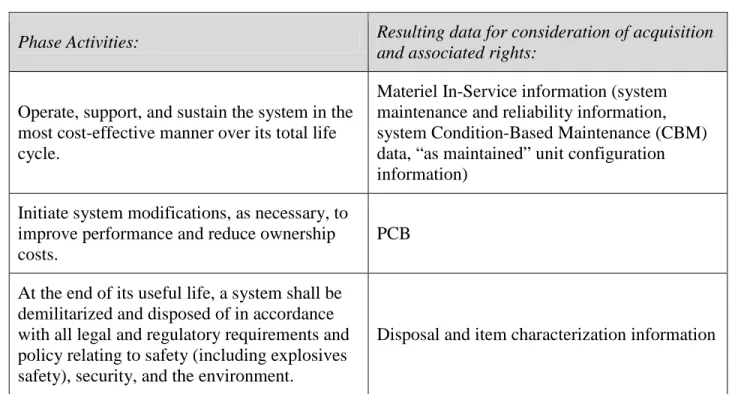
Below are excerpts from DoDI 5000.02 that highlight key activities to be accomplished at each life cycle phase and the resulting product data from each activity.
Phase Activities:
Materiel Solution Analysis Phase
Resulting data for consideration of acquisition and associated rights:
Identify and document the recommended materiel solutions to move forward in development
Descriptions of each potential materiel solution considered
21 Phase Activities:
Technology Development Phase
Resulting data for consideration of acquisition and associated rights:
Develop technology approaches and associated prototypes (preferably two or more) to reduce technical risk, validate designs and cost estimates, evaluate manufacturing processes, and refine requirements.
• Technology developed in S&T • Technology procured from industry
Product definition information associated with each design/technology under consideration. This includes:
• Design information (drawings, specifications, CAD models, engineering studies, engineering analyses, trade studies, simulations and models)
• Requirements
• Preliminary Manufacturing information (preliminary manufacturing process planning and evaluations)
Plan for life cycle sustainment of each proposed technology (follow and adjust Life-Cycle Support Planning). Life cycle
sustainment considerations include: supply, maintenance, transportation, sustaining engineering, data management, configuration management, Human Systems Integration (HSI), environment, safety (including explosives safety), and occupational health, protection of critical program information and anti-tamper provisions, supportability, and interoperability.
Planning for life cycle sustainment of each candidate technology (logistics management information (LMI))
Conduct Preliminary Design Review (PDR) of all candidate designs to select the
recommended design & technology approach. • Successful PDR establishes the
Allocated Design Baseline for that design
Acquisition program Allocated Configuration Baseline (total system and major component level specifications, drawings and interfaces)
22 Phase Activities:
Engineering & Manufacturing Development (EMD) Phase
Resulting data for consideration of acquisition and associated rights:
Develop a system or an increment of capability • Define system and system-of-systems
functionality and interfaces, complete hardware and software detailed design, and reduce system-level risk.
• Integrated System Design activities shall include the establishment of the product baseline for all configuration items.
Acquisition program Product Configuration Baseline (PCB) and documentation of EMD efforts. This includes:
• Design information (drawings, specifications, CAD models, engineering studies, engineering analyses, trade studies, simulations and models)
• Requirements documents • Manufacturing information
(manufacturing process planning)
• LMI
• Test & QA information (test reports, test plans)
• Configuration Control information (ECPs, Waivers, ERRs)
• Other associated information Ensure operational supportability with
particular attention to minimizing the logistics footprint.
LMI
Conduct successful Developmental Test and Evaluation (DT&E) and Operational Test & Evaluation (OT&E).
Test Reports
Conduct CDR to establish the acquisition program product configuration baseline.
Acquisition program Product Configuration Baseline (total system specifications, drawings, models and interfaces) plus the studies and analyses that supported the design
23 Phase Activities:
Production & Deployment Phase
Resulting data for consideration of acquisition and associated rights:
Conduct Low Rate Initial Production (LRIP) (if part of the approved Acquisition Strategy)
• The purpose of LRIP is to complete manufacturing development in order to ensure adequate and efficient
manufacturing capability and to produce the minimum quantity necessary to provide production or production-representative articles for IOT&E, establish an initial production base for the system; and permit an orderly increase in the production rate for the system, sufficient to lead to full-rate production.
Manufacturing information (manufacturing process plans, work instructions, statistical process control metrics, process capability studies, but only if required for organic manufacturing or rebuild activities) Adjustments to the Acquisition program Product Configuration Baseline as a result of LRIP or production activities.
• Configuration Control information (ECPs, Waivers, ERRs)
• Design, manufacturing and logistics information from the Engineering and Manufacturing Development Phase needs to be updated.
Begin Full Rate Production
Final Acquisition program Product Configuration Baseline
Adjustments to the Acquisition program Product Configuration Baseline as a result of production activities.
• Configuration Control information (ECPs, Waivers, ERRs)
• Design, manufacturing and logistics information from the Engineering and Manufacturing Development Phase needs to be updated.
Apply Item Unique Identification (IUID) to all applicable acquisition program components.
Materiel In-Service information (IUID, “as produced” configuration information)
24 Phase Activities:
Operations & Support Phase
Resulting data for consideration of acquisition and associated rights:
Operate, support, and sustain the system in the most cost-effective manner over its total life cycle.
Materiel In-Service information (system maintenance and reliability information, system Condition-Based Maintenance (CBM) data, “as maintained” unit configuration information)
Initiate system modifications, as necessary, to improve performance and reduce ownership costs.
PCB
At the end of its useful life, a system shall be demilitarized and disposed of in accordance with all legal and regulatory requirements and policy relating to safety (including explosives safety), security, and the environment.
Disposal and item characterization information
For a “new start” acquisition program, its first DMS will support the MS A decision and explain the product data and data rights needed and why they are needed, the actions planned to be taken to acquire the data and data rights, and the planned approach for long-term access and use of the data in its IT environment. The primary focus of the MS A DMS will be the actions to be taken in the Technology Development phase.
It should be noted that the types of product data of probable interest at MDR A will be very limited – focused on design related information to be acquired from contractors in the Technology Development phase of the life cycle. This includes proposed preliminary design approaches and the results of their requirements allocation process that will result in the approved Allocated Configuration Baseline at the end of the Preliminary Design Review (PDR). Since MDR B is the lead-in for the Engineering and Manufacturing Development (EMD) phase of the life cycle, where most of the detailed design and logistics support analysis will be conducted, the types of product data the PM has to consider and plan for is greatly increased. Midway through EMD, after successful completion of the Critical Design Review (CDR) occurs, a Post-CDR Milestone Review occurs to approve transition from the Integrated System Design phase to the System Capability and Manufacturing Process Demonstration sub-phases of EMD. At MDR C, most of the development activities should be nearly completed, and the product related data and associated data rights already specified in the EMD contract. At this point the DMS should be focused on confirming the completion of the data activities described in the MDR B DMS, and specifying any new activities that may be required, such as handling of engineering change proposals (ECPs) and field feedback information.
Table 3 summarizes how the depth and breadth of the DMS product data analysis increases through the MDRs. Each cell marked “X” represents a type of product data that is recommended for analysis for that particular MDR.
25
Table 3 - DMS Data Objects over Life cycle
Milestone A Milestone B Milestone C / FRP
1.0 Product Definition Information - - -
1.1 Design Information X X X
1.1.1 Product Design X X X
Technical Data Package (TDP) - General X X X
Interface Control Document X X X
Engineering Product Structure X X X
1.1.2 Other Design Information X X X
Functional Breakdown Descriptions X X X
Trade Study Reports (Trade-Offs) X X X
Design Selection Decision Document X X X
Engineering Analyses X X X
Models & Test Cases (Simulation) X X X
1.2 Requirements X X X
Capabilities Development Document (CDD) X X
Capabilities Production Document (CPD) X
TDP - System Specifications X X X
1.3 Manufacturing Information X X
Manufacturing Instructions X X
Manufacturing Process Routings X X
Depot Maintenance Work Requirements (DMWRs)
and National Maintenance Work Requirements (NMWRs) X
2.0 Product Operational Information - - -
2.1 Logistics Management Information X X X
2.1.1 Maintenance Planning Information/Technical
Publications X X X
2.1.2 Support & Test Equipment Information X X
2.1.3 Supply support Information X X
2.1.4 Manpower, Personnel & Training Information X X
2.1.5 Packaging, Handling, Storage, and Transportation
(PHST) Information X X
2.1.7 Environmental, Safety & Occupational Health
26 Milestone A Milestone B Milestone C / FRP
2.2 Material In-Service Information X
Field Feedback information (Maintenance Incidences) X
Demand Data from Field Requisitions X
Item Prognostics & Diagnostics Information X
Field Quality Deficiency Report Data X
Field Supply Deficiency Report Data X
Product Unit Configuration Information X
3.0 Associated Information - - -
3.1 Verification Information X X
Test Reports X X
Physical Configuration Audits X X
Functional Configuration Audits X X
3.2 Configuration Control Information X X
Request for Change X X
Request for Variance X
Configuration Control Board Decision X X
Product Configuration Management Status Accounting Data X
3.3 Other Associated Information X
Government Industry Data Exchange Program (GIDEP)
Notices X
Supplier Notices of Obsolete Parts X
27
4
D
ATAM
ANAGEMENTS
TRATEGY(DMS)
T
EMPLATEThe following template is recommended for use by all Army programs preparing DMSs. More detailed guidance for generating most of the DMS sections can be found in the appendices to this DMS Guide.
Date Data Management Strategy for the XXXXX Program
This document, together with the accompanying Excel worksheet support tool, constitutes the DMS for the (XXXXXX) program.
1. Description of Program
2. Program Acquisition and Logistics Support Strategies. The (XXXXX) system will be entering the (XXXXX) life cycle phase. The program’s planned acquisition strategy is:
The program’s planned logistics support strategy is:
3. Assessment of Program Life cycle Data Requirements.
The following types of product data will be required by the specified organizations to perform their respective life cycle functions:
(Specify each organization in a separate row below the major categories of product data along with
their corresponding life cycle functions and data needs. Some typical ones are provided in the list below, but add or delete to this list as required. Specify the product data required by each organization
28 Organization needing the
data
Their life cycle mission functions
Required Product Data PM Office R&D Center(s) LCMC OEM Production contractors Government Arsenals/Depots Other Army Programs ATEC LOGSA Field Maintenance personnel Performance Based Logistics (PBL) Providers Software Engineering Centers
4. Data Rights Approach and Gap Analysis.
The Government will need certain types of data rights for the product data associated with all weapon system subsystems and components in order to support the planned Acquisition Strategy and
Supportability Strategy.
The PM will require the development contractor(s) to assert any claims of limited or restricted rights for the Government as part of their contract proposal for this life cycle phase. All such assertions will be required to be substantiated by evidence of funding allocations and guided by DFARS requirements for types of technical data to which the Government will have “automatic” or “default” rights.
Based on existing knowledge and/or actual contractor data rights assertions, we anticipate or know of (check the appropriate choice below):
No gap between the data rights required and the data rights expected to be agreed to in the contract.
The following gaps between the data rights required and the data rights expected to be agreed to in the contract.
29 The DFARS defined categories of data rights are:
Unlimited Rights (UL)
Government Purpose Rights (GPR) Limited Rights (for Technical Data) (LR) Restricted Rights (for Computer Software) (RR) Special License Rights (SLR)
Acquisition program Subsystem or Component
Type of Government Data Rights Expected
Rationale for less than Government Purpose Rights
5. Risk Mitigation Approaches.
Based on the above anticipated mismatches, the following actions will be taken by the program to enable consistency between the program’s TDS or AS, SS, SEP, and DMS, and the data and data rights being acquired by the program:
6. Data Formats.
In order to minimize the costs of unique software applications, data maintenance, and data reformatting, and to enhance long-term data usage, the program has selected the following data format approaches: (Note: Examples of data format approaches would be specifying data formats that your organization (or others) is set up to deal with, or use of neutral file formats that can be read or used by multiple
applications.)
7. Data Delivery and Review.
In order to assure the content and quality of all contractually ordered data, and adherence to contractual agreements for data rights markings, the program has scheduled formal delivery of the specified
contractor generated product data to occur at the following points in the life cycle:
The method of delivery will be:
The delivered data will be reviewed via (design reviews, configuration audits, sample inspection at time of delivery, other (describe)) to ensure it meets content and quality requirements, to include data
30 8. Data Storage and Maintenance for Life cycle Use.
Since the organizations identified in Section 3 of the DMS have needs for access and use of the acquisition program product data, the following types of product data will be stored and maintained in the indicated IT systems with appropriate access provided.
Type of Product Data IT Storage & Management System
The maintenance of the data is expected to require an annual expenditure of $(XX,XXX) to keep the data current and accurate as a result of ECPs and other needs. This funding is a part of the current program budget.
9. Resource Requirements.
We require $ (XX,XXX) additional funds to acquire necessary rights to acquisition program product data needed for:
We require $ (XX,XXX) additional funds annually to manage and maintain the acquisition program product data over the life cycle. This includes funding required to store the data and maintain its currency.
If these funds are not provided the program will incur the following risks:
10. Merits of Priced Contract Option for later Acquisition of Data
(If applicable. If not applicable then use N/A)
Based on the data rights gap analysis assessment performed in Section 4 of the DMS it has been determined that the Government’s “automatic” and “ default” rights in data (confirmed prior to award) are insufficient to fully enable the preferred acquisition and/or logistics support strategy. Additional funding necessary to acquire the needed additional level of data rights is not currently available, and other negotiation options are insufficient, so a priced option for purchasing “additional” data rights at a later point in time when more funding may be available is considered the only viable option.
31 The merits of this approach include:
The risks of this approach include:
11. Program DMS POCs. The following POCs should be contacted if there are any questions about the information contained in this DMS:
POC Name Organization Phone E-Mail
32
A
PPENDICESThe following appendices provide additional guidance to assist PM offices and others in the proper preparation of a program DMS.
Appendix A - Program Life cycle Data Requirements ... A-1
Appendix B - Government Data Rights Procedures Background Information .... B-1
Appendix C - DFARS Contract Clauses for Data Rights ... C-1
Appendix D - Data Formats ... D-1
Appendix E - Data Delivery ... E-1
Appendix F - Data Storage and Maintenance ... F-1
Appendix G - Life cycle Access and Use of Data ... G-1
Appendix H - Required Resources and Risk Assessment ... H-1
Appendix I - DMS Worksheet Tool ... I-1
Appendix J - Acronyms ... J-1
A-1
Appendix A- Program Life cycle Data Requirements
PMs must develop an estimate for the data needed to support both short-term and long-term program needs to design, manufacture, and field the item, and then to sustain it throughout its life cycle. Included will be identification of the data needed to ensure that all future life cycle needs can be achieved by enabling competitive contracting strategies whenever possible.
Definition of Product Data
The OSD requirement for DMSs in the DoDI 5000.02, Encl 12, states the DMS must “assess the data required to design, manufacture, and sustain the system, as well as to support re-competition for
production, sustainment, or upgrades.” This definition of the scope of technical data to be addressed
within the DMS matches well with the definition for product data developed by the Army Product Data and Engineering Working Group (PEWG). The PEWG definition for Product Data (data related to a product) is “All data created as a consequence of defining (requirements), designing, testing, producing,
packaging, storing, distributing, operating, maintaining, modifying and disposing of a product.” The
PEWG has further delineated product data into segments containing:
• Product Definition Information - information that defines the product's requirements, documents the product's attributes, and is the authoritative source for configuration definition and control. Examples include:
– Actual product definition information (drawings, specifications, 3-D CAD models, (aka: the Technical Data Package (TDP)), etc. – the "As Designed" product configuration) – Design concept information (analyses, trade studies, and information about designs not
selected for use should be captured, retained and managed) – Requirements (Performance and Logistics Support)
– Manufacturing information (the "As Built" product configuration)
– Depot overhaul/modification information (the “As Modified” product configuration) • Product Operational Information - information used to operate, maintain and dispose the
product. Examples include:
– Field Feedback information (records of maintenance actions, depot overhauls /
modifications, field deficiency reports, etc. – the "As Maintained" product configuration) – Product identification information (part and unit identification)
– Technical manuals
– ESOH/Hazardous Material information,
– Distribution information (packaging, preservation, transportation)
• Associated Information - information generated as part of the product development and life cycle management process, but isn't clearly definable as either of the other two categories. Examples include:
– Configuration control information (ECPs, Waivers) – Test & QA information
A-2
Unfortunately, the definition of “technical data” used in the original OSD policy memo and DoDI 5000.02 citation does not match the definition contained in the Defense FAR Supplement (DFARS). Figure 7, below, shows a graphical representation of the relationship between the DFARS definition of “technical data”, the PEWG definition of Product Data, and a common misperception that the term “technical data” is really equivalent to just a TDP.
Due to the similarity in definitions between the OSD DMS policy memo and the PEWG definition of product data and the inconsistency with the DFARS definition of “technical data”, the term “product data”, as defined above, shall be used in lieu of the term “technical data” used in the OSD guidance.
A-3
A-4
Life cycle functions can be divided into the basic categories of development, production, procurement, and sustainment. Since the Office of Management and Budget (OMB), Congress, and OSD have all called for increased use of competitive acquisition and logistics support approaches, the product data required for competition should be a primary (but not the sole) driver of data and data rights needs. The TDS or AS, SEP, and SS will describe which organization (organic Government, OEM, or other
contractor) is planned to perform those functions. Government organizational performance of life cycle functions should be further segregated such that the PM understands which specific organizations will have needs for acquisition program product data and hence should be participants on the DMS IPT. Table 4 is a representational example of the type of life cycle function allocation between organizations that could exist for a hypothetical weapon system.
Table 4 – Representational Allocation of Life cycle Function Responsibilities
Acronyms:
ACC = Army Contracting Command ATEC = Army Test & Evaluation Command DLA = Defense Logistics Agency
LCMC = Life Cycle Management Command LOGSA = U.S. AMC Logistics Support Activity OEM = Original Equipment Manufacturer PM = Program/Project Management
RDEC = Research, Development & Engineering Center
Organizations
Program Mgmt
Systems
Engineering Test Integration Provisioning
Inventory Mgmt Contracting Production Sustainment Eng Maint / Repair Demil / Disposal PM Office X X X X X X X X X OEM X X X X X RDEC X X X X X LCMC X X X X X X X X X ACC X ATEC X X Prod Contractor X Arsenal / Depot X X X X X X X DLA X X X Field Maintainers X X
Log Supt Contractor X
Software Eng Center X X X X X X
B-1
Appendix B- Government Data Rights Procedures Background Information
General. Government license rights in technical data and computer software, as defined by DFARS and hereafter referred to as “Data,” are a bundle of “intellectual property” license rights which specifies what uses and releases the Government is authorized to make. The allocation of these rights between a Government contractor and the Government is specified in the standard DFARS contract clauses. The Government’s “automatic” and “default” rights in those DFARS clauses may be enlarged or decreased by specific negotiations recorded in the contract. With few exceptions, the Government does not own data. The Government obtains license rights in the data. This remains true even when the Government exclusively funds development costs. All standard DFARS licenses to technical data and software include the right of the Government to make modifications.
Data license rights: Automatic and Default (based on funding). Certain license rights in data arise automatically upon contract award and performance regardless of funding issues. These “automatic” rights in data include “unlimited rights” in: form, fit, and function (FFF) data; computer software documentation; and installation, operation, maintenance, and training (IOMT) data. Other “default” license rights (e.g., Unlimited and Government Purpose Rights) are created by direct Federal funding for the development of related items, components, or processes (ICPs). Delivery of data and contract procedures. The contract requirement for a formal delivery obligates the contractor to comply with three critical contract procedures regarding data rights: asserting; marking; and justifying. These procedures force the contractor to clarify its positions on data rights and highlight any areas of disagreement between the parties. Formal delivery of data is a critical step for securing the Government’s rights in data. This delivery must be scheduled in the contract by use of an approved Data Item Description (DID) or FAR/DFARS clause to be legally enforceable and to invoke critical contract procedures.
Data license rights categories. There are six potential data rights categories which are subject to the contract clauses that define and allocate data rights. Commercial computer software and certain data incidental to contract administration are not subject to these DFARS clauses and procedures. Government rights in commercial computer software must be separately negotiated using language which is consistent with a DFARS contract and Federal Procurement laws (See DFARS 227.7202-1 and Subpart 208.74). All such special negotiations should be reviewed by Government legal counsel. In all categories below, a basic copyright marking (name, year and symbol/word for copyright) by the contractor is allowed and such marking is not inconsistent with the stated license rights.
1. Unlimited Rights (UR) in Technical Data and Computer Software. There is presently no mandatory marking/legend for “Unlimited Rights” data. Data which is required to be delivered under the contract and which is unmarked (or marked only with a copyright) at delivery is generally presumed to provide “Unlimited Rights” to the Government. However, it is always best to have the status of unmarked data confirmed with the contractor or reviewed by Government legal counsel. “Unlimited Rights” arise in certain types of data automatically upon award (e.g., FFF and IOMT) and in most other data based upon exclusive (100%) Federal funding of the ICP to which that data pertains. The automatic unlimited rights in certain types of