Master of Arts in Liberal Studies (MALS) Student
Scholarship
Academic Departments and Programs
5-17-2008
From the Top: A Practical Approach to Ethical
Decision Making
Bonnie J. Stofer
Skidmore CollegeFollow this and additional works at:
https://creativematter.skidmore.edu/mals_stu_schol
Part of the
Leadership Studies Commons
This Thesis is brought to you for free and open access by the Academic Departments and Programs at Creative Matter. It has been accepted for inclusion in Master of Arts in Liberal Studies (MALS) Student Scholarship by an authorized administrator of Creative Matter. For more information, please [email protected].
Recommended Citation
Stofer, Bonnie J., "From the Top: A Practical Approach to Ethical Decision Making" (2008).Master of Arts in Liberal Studies (MALS) Student Scholarship. 49.
By
Bonnie J. Stofer
FINAL PROJECT SUBMITTED IN PARTIAL FULFILLMENT OF THE REQUIREMENTS FOR THE DEGREE OF
MASTER OF ARTS IN LIBERAL STUDIES
SKIDMORE COLLEGE 5/07/08
Table of Contents
Abstract . . . 2
Introduction . . . 3
The Importance of Ethical Decision Making . . . 6
The Need for a Practical Model . . . 13
The Proposed Model . . . . . . . ... 24
Case Study Application of the Model . . . 37
• J&J . . . 37
• Enron . . . 42
• Whole Foods Market . . . 47
• Summary of Case Studies . . . 52
Conclusions and Recommendations . . . 56
Appendix • A - Basic Business Virtues . . . ... . . 58
• B - Johnson & Johnson Credo . . . 60
• C-Enron Vision and Values . . . 62
• D - Whole Foods Market Declaration oflnterdependence . . . 63
Abstract
The lack of ethical decision making in organizations has resulted in corporate and individual financial trauma, bankruptcies, indictments and convictions of CEOs. Recent research shows that ethical decision making has not increased despite legislation to correct behaviors that led to the business failures of the past decade. The research indicates that unethical behaviors are abundant and that corporate cultures lack ethical support mechanisms. Theorists have created models to promote ethical decision making by focusing on a range of areas from communications to corporate culture and the actual decision making process. Although each is valid, what is lacking is a practical model that is easy to integrate into existing business processes. Thus, the purpose of this paper is to develop a practical model that moves ethics from philosophy to practice by defining the role of the CEO, infusing the decision making process into the organizational culture, and embedding the decision making into the strategic planning process.
Introduction
According to the 2007 National Business Ethics Survey® by the Ethics Resource Center, more than half of the employees surveyed observed ethical misconduct within their organization in the past year. While the number of ethics and compliance programs is increasing, only 38% of survey respondents indicated their company had a
comprehensive program. The survey also noted that the misconduct is not being reported to management, due in part to fear of retaliation. With low management awareness and few ethics and compliance programs in place, this situation is ripe for potential disaster (Ethics Resource Center, 1 997, p. 1 ).
This rate of misconduct is higher than before the implementation of the Sarbanes Oxley Act which mandates ethics and compliance activities of publicly traded companies. Despite the failings of Enron, W orldcom, and Arthur Andersen that spurred the
legislation, there is still much work to be done. For example, we are currently
experiencing the collapse of the sub-prime lending market - a situation that involves poor and potentially unethical decisions in a number of organizations. This has led to increased unemployment and home foreclosures, with the investment industry anticipating
significant layoffs in the coming months (Berman, 2008, March 1 1 ). Employees, customers, shareholders, and the general public are at risk of being hurt by decisions made and actions taken within corporations. Thus, decision making needs to improve and ethical behavior needs to increase. But how? What should business leaders do to ensure that they are not headed down the path of failures before them?
Leaders today have a plethora of ethics resources to help them out, from consultants, to books, to executive education programs. Determining a method to implement can be daunting considering the volume of theories and models, and the time challenges of remaining competitive in a fast-paced world. This paper will synthesize elements of several existing models to create a practical approach for leaders to use to evaluate a company's current approach to ethics and decision making, ultimately to help them eliminate unethical decision making. The proposed model will provide a structure to establish necessary changes, embed these changes in corporate culture, and ensure there are elements in place to reinforce positive and effective behaviors.
A literature review and case study analysis will demonstrate that embedding ethics into a corporate culture and decision making process starts at the top with a CEO' s commitment to making ethics a priority. While those at the top have a pivotal role, a comprehensive communications program is needed to address other stakeholders to ensure that these leaders have the support they need for long-term success. Ultimately, ethics is good for business, and this paper will propose an approach for leaders to use along with descriptions of cases where each component has been proven.
The paper will proceed in the following manner. First, the need for a practical approach will be articulated clearly leading to the establishment of criteria for the
proposed model. Then, each component of the proposed model, along with the supporting theories and research, will be laid out individually and then integrated into a
comprehensive whole. Once the model is introduced completely, several case studies are then used to analyze it and demonstrate how it helps to improve ethical decision making. The case studies include:
Johnson & Johnson - Praised for its company culture and ethical decision making prowess in the Tylenol situation
Enron-Once a praised company and "Best Place to Work," now bankrupt based
on its unethical decision making
Whole Foods Market-Praised for its culture, considered a "Best Place to Work" and currently being criticized because of the CEO ' s anonymous blogging.
Each company has been the subj ect of business, trade, and academic analysis, features a distinct culture, and exhibits a variety of decisions, activities, and
communications for analysis. The strength of Johnson & Johnson' s approach to ethics will provide a clear contrast to the approach to business and culture that existed at Enron. The unique business situation at Whole Foods Market will identify similarities and differences with the two other cases. On the surface, Whole Foods Market has had a history of rapid growth and many accolades from the business press similar to Enron in its early years. The proposed model will identify significant insights regarding culture, communications and decision making that could yield insight for future activities at Whole Foods Market.
After thorough analysis of the case studies, future research, usage and testing of the model are recommended.
The Importance of Ethical Decision Making
Ethics has a history in the realm of philosophy, yet it is very real in today's business world. The challenge of ethics in the business world starts with both its definition and philosophical roots. First, the definition of ethics creates a picture that seems obvious for many people. Consider the following definitions:
• "The discipline dealing with what is good and bad and with moral duty and obligation" (Merriam-Webster, 2004, p. 429)
• "the process of deciding what should be done" (Brown, 1 990, p. 2)
• "distinguishing between right and wrong" (Guy, 1 990, p. 5).
Most business leaders think of themselves as educated people with principles; in their minds they think they know right from wrong. The challenge comes in managing the daily interactions with others, the situations that occur, the flow of information, and the desire to be successful. Ethical decision making is important because it requires thinking about the implications of decisions - beyond the self, the present moment, the
immediate gain, and even what is currently known about any given situation. Ethics in business can be dismissed too easily as knowing the difference between right and wrong. It is simply not that easy, which is where the philosophy comes in.
There are several schools of thought regarding ethics that apply to the
consideration of the importance of ethical decision making - ends-based, rules-based, and care-based approaches. The ends-based approach, referred to as the "teleological"
approach, can be seen in our free market economy and the work of Adam Smith who believed that the pursuit of self-interest would ultimately serve the common interest
(Kaptein & Wempe, 2002, p. 27). This balancing of self and the collective is an
important aspect of our economy, our corporate approach to life, and our responsibility to the communities in which we live. Aristotle introduced this idea of "the ends" with his focus on actions to create the "good life." This included both the examination of the individual within the community and the ultimate importance of happiness, which is bigger than the idea of profitability or making money. The good life takes into
consideration the sense of self-worth, accomplishment, and connectedness that comes from being in a community. For Aristotle there were virtues that were at the center of both the individual and collective happiness that were to be practiced and reflected upon (Solomon, 1999, p. xxiv).
Jeremy Bentham later sought to apply a quantitative approach to the "ends." He advocated an approach that involved reflection on pain and pleasure, creating a metric to help ensure "the greatest pleasure for the greatest number" (Kaptein & Wempe, 2002, p. 57). His goal was to arrive at decisions based on the number of people who can benefit from the outcomes. This includes the concept of using punishment as a deterrent. In this way individuals would see wrong-doers punished, would decide to avoid that outcome, and ultimately society would benefit from a lower crime rate, and a greater number would be served.
The rules-based approach focuses on the actual rules that are followed in decision making and can be described as "deontological" from the Greek word for "obligation." Perhaps best known for this is Immanuel Kant's Categorical Imperative. An imperative is something that no matter what, we should follow it. The situation and the consequences do not have any bearing on this; the morality is within the actual rule. Kant applied an
absolute approach to the world, applying maxims or rules that he would want to be universal. He urged others to ask of a situation, "Can you also will that your maxim should become a universal law? Where you cannot it is to be rejected" (Kant, 1 964, p. 7 1 ). Acting in accordance with maxims is something that just should be done. For Kant, telling the truth, keeping your promises, and protecting your life are moral
responsibilities. These are non-negotiable and we all must obey them.
The care-based approach is where the good of the other is considered first as in The Golden Rule or the principle of reversibility. This approach is where one would "do to others what you would like them to do to you" (Kidder, 1 995, p. 25). Placing oneself in the position of another leads to a different perspective that can help increase the number of apparent options to lead to a decision. This sense of caring what happens to others encourages reflection on how an individual would handle a situation if it were done to him/her. Such an approach applies a humanistic, caring perspective to business situations and their potential outcomes.
It is important to understand each of these approaches as we consider the history and current status of ethical decision making in businesses and organizations. While the ends approach is one way to think about a situation, does that translate into the ends justifying the means? For Kant, the "means" is a critical element. Rules are rules and
must be followed. This rules-based thinking is a reality today with regulations, mandates, and reporting vehicles that are required of public companies within the Sarbanes-Oxley Act. So, where does that leave the Golden Rule and the concept of do unto others? As humans, we have the unique capacity for caring for others. Applying this care into a line of questioning can provide a perspective on decision making that is missing from both
striving for the ends and following the rules. Discussing each of these perspectives could yield a range of options for decision making.
For today's business leaders the singular focus on any one of the above
philosophical approaches would be ineffective. Despite our free market economy and our system of government regulations, imparting moral decision making through rules has not worked in the past.
Over the course of American history a number of business ethics scandals have resulted in harm to individuals, the economy, and the financial markets. From the 1 920's securities market scandals, to the 1 980's savings and loan crisis, to the business failures of 2000-2002, each crisis was followed by new legislation designed to regulate behavior (Rockness and Rockness, 2005). In each instance there was corporate fraud, unethical management behavior and inaccurate financial reporting mainly at the top of the organizations.
The Sarbanes Oxley Act of 2002, created after the failings of Worldcom, Enron, Arthur Andersen, and other companies, "takes a much stronger consequences approach to legislating ethical behavior than the U.S. has experienced in past regulations" (Rockness and Rockness, 2005, p. 45). That said, today we are experiencing the collapse of the financial markets stemming from decisions that led to the failure of the sub-prime lending market. These decisions range from poor business decisions, to high risk taking, and potentially unethical decisions. There is now much discussion over increasing the regulation of the financial industry to prevent this from happening again (Randall and Pulizzi, 2008, April 1 1 ).
Sarbanes-Oxley was not designed to be an approach to ethical decision making. Rather it is a set of mandates for compliance and financial reporting. While it cites the importance of the "tone at the top" in an ethical corporate culture, it does not mandate training on ethical workplace conduct or any mechanism for seeking ethics advice. The focus is on reporting and having documentation in place (Code of Ethics) instead of requiring proactive elements to help employees make ethical decisions (Ethics Resource
Center, 2007, p. 20).
Beyond the limited reach of Sarbanes Oxley, and the current state of our
economy, recent research also indicates that there is a need for improved ethical decision making. As mentioned at the outset of this paper, over 50% of the employees surveyed by the Ethics Resource Center observed ethical misconduct within their organization in the past year. Furthermore, in a recent survey managers were asked to rank the importance of 178 behavioral skills in their positions as a manager. Decision making ranked number 2 and ethics and integrity came in at number 14. Clearly, decision making is not aligned closely with ethics and the author noted that "Findings indicate that ethics is still considered one of the least important skills necessary in a manager' s daily work" (V elthouse and Kandogan, 2007, p. 151 ).
If managers do not consider ethical skills to be as important as other skills, where does ethics reside in the organization's culture? According to the Ethics Resource Center, only 9% of companies in the U.S. have strong ethical cultures (Ethics Resource Center,
2007, p. 9). This means that no matter how ethical an individual may be, or how strong
his/her ethical decision making capacity is, corporate cultures are not reinforcing an ethical approach to business. And as we know, culture is critically important in this
regard. For example the Ethics Resource Center (2007) noted that, "Strength of the enterprise-wide ethics culture is the single factor with the greatest impact on conduct" (p. 1 2). This should serve as a wake up call to business leaders across the country.
For ethics to exist in organizations, and to be taken seriously as a component of the culture, it needs to become a tool, moving out of the realm of philosophy and into the realm of practice. It needs to start at the top and affect all areas of the organization through its culture and processes. This will require defining ethics in a way that has meaning and relevance to the average employee.
In this regard, Kidder ( 1 995) defines ethics as "the stuff of life." He
acknowledges the struggles that exist with decision making and considers ethics as integral to decision making. "It's about the inner impulses, judgments and duties of people like you and me" (Kidder, 1 995, p. 63). For individuals, ethics should be considered a process, a way of judging a situation and choosing a behavior. This is the practical "stuff of life" that is needed in today's corporations.
The leaders of the organization are not the only ones making decisions.
Employees are empowered to make decisions and need to know how to do so, and a Code of Ethics alone does not provide sufficient guidance (Kidder, 1 995; Guy, 1 990; Brown,
1 990). To truly make an impact, employees need to practice decision making in a manner that is embedded in the positive DNA of the organization. This should include
consideration of the different approaches to ethics, exercising a thinking process that considers the outcomes, the rules, and the element of caring. In this way leaders can ensure that the values of the organization are considered and the objectives of the organization are met.
In summary, ethical decision making i s critical for the long-term viability of organizations, our economy, and our communities. The lack of ethical decision making in organizations has impacted millions of people's lives whether through unemployment, loss of retirement savings, or foreclosure on houses. This reduces the trust people have in both individuals and organizations to "do the right thing." Decisions need to be made in a way that will get the trust back. What is needed is a practical approach to ethical decision making. The development of such an approach follows.
The need for a practical model
Today's business leaders need to focus on meeting their customers' needs, ensuring resources for continued innovation, retaining and motivating staff, and
delivering the profit to fuel growth. Any approach to ethics must enhance the practice of business, not detract from it. Instead of taking valuable time to implement, it needs to be embedded in the approach to business, and instead of stressing the organization, it needs to empower it (Brown, 1 990).
As past ethical decision making failures illustrate, there is a need to increase ethical decision making throughout the entire organization. This can be done in a number of ways. One approach, for example, is to focus on the organizational culture as both a driver and influencer on the decisions that individuals make. The Ethics Resource Center research identified the need for cultural level support for ethical decision making, and the Sarbanes-Oxley Act notes the need for consideration of ethics within corporate cultures (Ethics Resource Center, 2007). Another approach is to focus on communications,
including the relationships and information flow that bridge organization-wide initiatives. Communications patterns convey the values, priorities, and processes of an organization. Implementing any kind of program or approach to business requires a communications plan to ensure a common understanding across the organization, and with outside audiences as well. A third approach is to focus on a decision making matrix for use in making ethical decisions. This standardizes a framework for use across the organization, for all types and sizes of decisions. It then becomes an institutionalized process.
Each of these three approaches are described in more detail below, including
identification of strengths and weaknesses based on the application of theory to practice.
Key aspects from each model will serve as the foundation for the development of criteria for a new, practical model.
1. The Cultural Approach
The cultural approach includes work done by Edgar H. Schein in which he defines and discusses the importance of corporate culture. Considered a classic, Organizational Culture and Leadership (1985), features a definition of culture that is used and quoted extensively in books on organizational development, leadership and ethics (Ellsworth, 2002; Brown, 1990; French & Bell, 1995; Burke, 2002; Frankel, 2006). Culture, he says,
1s:
"a pattern of basic assumptions - invented, discovered, or developed by a given group as it learns to cope with its problems of external adaptation and internal integration - that has worked well enough to be considered valid and, therefore, to be taught to new members as the correct way to perceive, think, and feel in relation to those problems." (Schein, 1985, p. 9)
According to Schein, there are three levels to cultures. The first level, artifacts and creations, includes the visible behavior patterns and outputs of the organization such as documentation and processes. The second level is the values of the organization, or "what
ought to be." Here it is the values that are practiced (versus the values that are preached)
which are important. Level three contains the basic underlying assumptions which are unconscious, taken for granted, and are the basis of behaviors (Schein, 1985).
While each level has its own unique purpose, the patterns of basic assumptions in a culture have a potency that Schein acknowledges is "visible" and "feelable." When we enter a new organization we see how people behave, note the consistency and acceptance of that behavior, and then accept that behavior as normal. This then becomes the behavior model for new members to follow. These patterns of assumptions reflect the values of the organization, whether or not they are stated values.
As we look at implementing an approach to ethics it is important to consider that the stated values of the organization may not be the ones that operate in the hallways, cubicles, and conference rooms. Plenty of organizations have publicized their values in the hopes of winning the attention and good favor of customers, potential employees, and staff, only to reinforce a different set of values through human resource strategies,
processes, communications, and reward mechanisms.
These different levels of culture noted by Schein have a distinct impact on the implementation of an ethical decision making approach. If a culture is not supportive of ethical decision making, or embraces contrary values, it will be extremely difficult for individuals to fight the good fight and make ethical decisions. In this case, ethical behavior would be outside of the cultural norms and perceived negatively. This is one reason why the ownership of and accountability for the culture needs to reside at the top of the organization with the CEO.
Schein acknowledges this reality and notes the important role of leaders in developing and reinforcing the corporate culture. This he says is done in five primary ways:
2) Leader reactions to critical incidents and organizational crises 3) Deliberate role modeling, teaching, and coaching by leaders
4) Criteria for allocation of rewards and status
5) Criteria for recruitment selection, promotion, retirement and excommunication (Schein, 1 985, p. 225)
Thus, leaders use structure, processes, and human resource strategies to establish and promote the culture. The culture sets the stage upon which individuals take action. To ensure individuals know how to act, the method for ethical decision making needs to be built into the culture. This will ensure that the individuals understand the thought process, how to evaluate information, and their role in doing so. In this way they will be able to make decisions in an ethical manner.
Another important aspect to corporate culture is the ability of an organization to learn, implement changes, and monitor the impact of change. As leaders of organizations consider their strategic plans and ability to achieve them, they should also consider their organization' s capacity for ethical decision making to achieve these goals. Stepping back and reflecting are keys to this learning. In Collective and Corporate Responsibility ( 1 984), French addresses this by examining the structure and learning of an organization. For him, it is not only the individuals who have a responsibility in decision making, but also the corporation because it is at that level that structures, processes and culture are designed to guide the individual behavior. This Corporate Internal Decision Structure is comprised of organizational flowcharts, corporate policies and procedural rules.
According to French, these processes become the foundation from which the organization can then be held responsible for its decisions. The "Principle of Responsive Adjustment"
requires that organizations adjust their course of action to avoid repeating negative events, basically demonstrating it has learned from its actions (French, 1 984, p. 1 58). Since the CEO and executives are the ones at the top responsible for the organization wide decisions and adjustments to behaviors, they are the ones responsible for ensuring organizational learning.
To truly take responsibility for this, CEOs and executives need to establish and maintain the structure, processes, and policies that will uphold and further their obj ectives in an ethical manner. An organization cannot absolve itself from the behaviors of those who are within it and must enact an element of reflection in order to be responsible. The
CEO of an organization must make ethics more than a Corporate Code of Conduct and implement an evaluation component that increases organizational learning.
2. The Communications Approach
The communications approach focuses on relationships and communications flow as a pattern for furthering ethical decision making. Relationships include those between the organization and society as the organization seeks to meet the needs of society through its defined mission and operating goals. It also includes the relationships within the organization as employees embrace their individual role in executing this mission. Communications plays an essential role in ensuring that the relationships between all parties are effective and that all involved are working toward the same goals in an integrated fashion. To achieve the sense of wholeness and integrity, the relationships between each group need to support the common purpose and provide the foundation for ethical decision making.
This consideration of these relationships and roles is at the heart of the work done by Brown in Corporate Integrity (2005). In this thorough analysis, Brown describes how organizations have cultural, interpersonal, organizational, social and natural dimensions that need to be considered as part of corporate integrity. For him, integrity is a sense of wholeness that includes doing the right thing along with having the "right relationships" with each of these dimensions. These relationships are apparent in the communication patterns.
Similar to the work by French, Brown encourages reflection. In this case reflection leads to the ability to improve the communication patterns. The ultimate communications pattern is one that promotes curiosity, centers on imagining an
abundance of resources (vs. fighting based on scarcity), and facilitates understanding the differences between people. This pattern, termed a "Cosmopolitan Communication" pattern, increases openness and fosters integrity (Brown, 2005, p. 52).
The description of this pattern seems to be relevant to today's workforce.
Businesses are becoming increasingly diverse communities, with members from a variety of ethnic, generational, and socio-economic backgrounds. Encouraging understanding and curiosity would provide a supportive environment that urges individuals to bring their best thinking to bear on any given situation; believing in the concept of abundance would foster new, potentially breakthrough thinking and ideas.
Brown's analysis of communications and its importance is thorough and insightful. He provides descriptions of how communication happens throughout an organization in verbal and non-verbal patterns, including structures, processes, roles, distribution of rewards and punishments (Brown, 2005). All of these elements become
part of the corporate culture and the way things get done. Where the emphasis is placed affects behaviors and decision making.
3. The Decision Matrix Approach
The decision matrix approach is another way to ensure ethical decision making. The specific models highlighted here provide a normative approach to guiding decisions using comprehensive models. The challenge with each of these is the level complexity that would make them difficult to implement.
In Working Ethics, 1990, Brown identifies that "ethics belongs in the decision making processes of organization"(Brown, 1990, p.xi). He advocates a decision making process that becomes a source of empowerment over one that is compliance and rule focused to control behavior. His "argumentative map" begins with four basic questions that provide the framework for ethical decision making.
Question
What should we do? What do we know? What does it mean? Why does it mean that?
Resource
People's policy proposals Their observations
Their value judgments Their basic assumptions
This questioning can fuel insightful dialogue that can help improve decision making through defining the ethical question, identifying a policy statement, defending the policy statement with observations and information, describing the value j udgments
involved, and identifying assumptions and any qualifiers that may affect the decision (Brown, 1990, p. 196-197).
From here, Brown uses a set of questions to determine whether the issue is one of ethics of purpose (based on Aristotle's principle of happiness as the highest good), ethics of principle (Kantian approach to universal rules with his Categorical Imperative), or ethics of consequence (utilitarian approach by Bentham and Mill based on considering the impact on the greatest number of people).
Strengths of Brown's analysis include his focus on creating a model that is positive and provides a sense of energy, embedding a decision making model into the corporate culture, and including an element of reflection. However, the model includes many cumbersome steps, confusing language (ie., the introduction of three types of ethics), and conceptual elements such as discussions of justice and rights which are theoretical and not easily applied to business situations.
Another way to think about ethical decision making is to examine the role of all stakeholders and the process of trying to meet all of their needs. The work of Kaptein and Wempe in The Balanced Company (2002) does just that with a focus on decision making through the lens of balance. They argue that ethical decision making can be achieved by balancing the expectations and interests of all corporate stakeholders, including
shareholders, customers, employees, suppliers, government, and others. Given the popularity of the stakeholder management theory, this concept is applicable to many businesses today.
The model identifies three ethical dilemmas that exist as fields of tension between the corporate objectives and the expectations, rights, and interests of other stakeholders.
They are:
Dilemma Description Example
Dirty Hands Tension between corporate • Decisions to relocate
objectives and other organization due to cheaper stakeholders overseas labor, or to lay off people for financial reasons • Inaction in financial dilemmas
could lead to greater distress that
could hurt the organization's long-term viability
Many Hands Tension between corporate • Priority of functional unit put objectives and the functional ahead of corporate objectives units • Leads to fragmented activities
and lack of integration Entangled Hands Tension between corporate • Managers having personal
objectives and private intimate relationships with
co-interests of employees workers or subordinates that
influence decision making
• Could lead to employees not acting in the best interest of the company
There are many situations that could present these ethical dilemmas. To help employees work through these situations there are numerous corporate qualities (i.e., clarity, consistency, achievability, sanctionability, visibility, discussability, and supportability) that need to be present to encourage employees to engage responsibly with the business. The ultimate goal is to have these qualities built into the corporate
then outlines how everyone in the organization should act based on these qualities and a set of principles. These principles can be translated into actions by employees:
• Openness - Transparency, honesty, receptivity, vulnerability
• Empathy - Putting oneself in other's shoes
• Fairness - Applying the same standards consistently
• Solidarity - Remaining loyal to a contractual relationship
• Reliability - Consistency between words and actions (Kaptein and Wempe, 2002, p. 23 8-245).
Like the Brown model, this is a complex model that integrates the philosophy of ethics with the stakeholder business theory. Contributing to this complexity is the extensive list of stakeholders that require balancing which would involve an unrealistic amount of time and energy. A practical model will instead provide focus to decision making, become an intuitive approach that reinforces the purpose and priorities of the organization, and ensure understanding of the individual's role in achieving the purpose.
In summary, these three different focus areas - culture, communications, and decision matrix - each contribute to a unique yet interconnected way of thinking about ethical decision making. While each contribution is important, none of the existing models completely encompass the cultural, individual, communications, and process needs that will ensure an easy to use approach to ethical decision making.
In the cultural focus, Schein ( 1 985) establishes the role of the CEO in creating and maintaining a culture through structure, processes, and human resource strategies. French ( 1 984) enhances the discussion of culture with his perspective on the need for organizational learning and corporate structure to support ethical decision making. Both
of these perspectives enhance the understanding of the critical role of the CEO, but neither provides a prescriptive approach for ethical decision making. In the
communications focus, Brown (2005) links the relationships existing within corporations to the process of communications. More specifically, he advocates open communications between the different dimensions of an organization, using the communications process as a way to drive behaviors and encourage ethical decision making. This process does not, however, establish a detailed way for individuals to work through ethical dilemmas.
The decision matrix focus reinforces the need for a structure and process that can be used organization-wide. Brown's model ( 1 990) encourages arguing the various positions to arrive at decisions while the Kaptein and Wempe (2002) model encourages balancing the interests of all stakeholders. While both of these models provide structure, they are both complicated and would be difficult to implement and evaluate within an organization.
The following section contains the criteria that were gleaned from these findings as well as the rationale for the specific components of the proposed model of ethical decision making.
The Proposed Model
Above all, an ethical decision making model needs to be practical, not only to use when making a decision, but to deploy across an entire organization. The previous
readings were considered in the development of the following criteria upon which the proposed model was designed.
1 ) Starts at the top - The CEO and the executive team must take an active role in establishing ethics as a priority for the organization. This includes establishing a vision for the organization and a culture that supports, enhances, and encourages ethical decision making along with open discussions of ethical issues. This will increase organizational and individual learning, and a comfort level in working through ethical dilemmas. The CEO and executive team serve as critical role models for the rest of the organization and the importance of this role should not be underestimated.
2) Embed the decision making approach into the culture - The culture of an organization encompasses a normative aspect that reinforces the values and the expected behaviors. Building an ethical decision making approach into the culture establishes ethics as a value. It also ensures widespread use of an approach that aligns decisions with the values of the organization. In this way, the organization can monitor its ethical decision making capacity as it reflects on the
implementation of its values in support of the strategic direction of the organization.
3) Make it simple to follow and evaluate -The ability to make ethical decisions is something that all employees need to be comfortable with. This will need to include training that is based on real-life situations that apply to a range of positions, levels, and functional areas. When it becomes relevant to employees and is reinforced within the culture, individuals will embrace it. When the
organization learns from its decisions through reflective evaluation, the decisions will improve.
These criteria were used to develop the proposed model and should also be considered as mandatory criteria for implementation. For instance, if a company wanted to implement the model without the CEO's complete buy-in and support, the model will fail and should not be implemented.
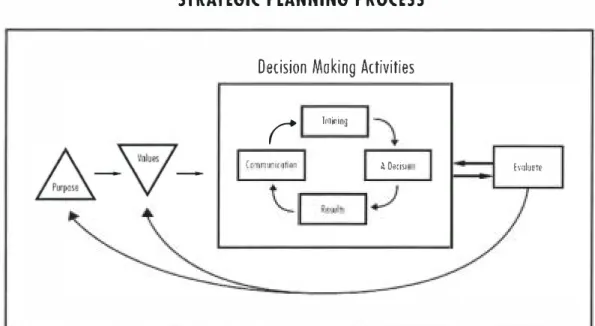
Figure 1: Proposed Model
STRATEGIC PLANNING PROCESS
/\_v=:l_
� - v ·
The Process
Decision Mak:ing Activities
f
I
TrainingI�
Cornmur.irnhon
I
A Dedsi Evol@teIn order to maximize practicality, this four component model is built into an existing process - the strategic planning process. Traditionally, strategic planning
experts have not included ethics in their models (Hosmer, 1994). This model leverages
the critical discussions about objectives and strategy to increase ethical decision making. This has a number of benefits.
1) Strategic planning involves identifying and aligning all organizational activity to achieve the purpose and live the values of the organization.
2) The CEO and executive team take an active role in strategic planning, approving the plans, monitoring the implementation, and communicating
activities and factors that affect the plans. This activity is critical to reinforce the importance of ethics as a strategic priority of the organization.
3) Strategic plans affect the entire organization, providing an organization-wide platform for deploying a new approach to decision making. This will ensure all employees are skilled and trained to make decisions that support the strategic direction of the organization.
4) The reflection that is critical to strategic plan evaluation will ensure that the topic of ethical decision making remains active, top of mind, and relevant to business activity.
Organizations without a formal strategic planning process can implement this proposed model as part of any type of action planning. The key thing is that when the business objectives, strategies, and tactics are discussed, the approach for decision making should be considered as a way to achieve the objectives. This will ensure that everyone who is making decisions is prioritizing the values of the organization appropriately and in a similar fashion.
The Components
There are four components to the model that are then linked into the strategic planning process.
1) Purpose of the organization to provide a motivational framework and context for decision making and doing business.
2) Values are clearly articulated that support the purpose and provide a
3) Decision making activities -a multi-step cycle that features four on-going
activities: communications, ethics training, decision making, and results. 4) Evaluation of the ethical decision making process and quality of decisions The theoretical background of each component, key implementation steps and rationale are now explained to provide insight for implementation.
1 -Craft the Purpose
The CEO and senior executives define the purpose for the organization and this becomes the ultimate goal of where the organization is headed. The purpose must be customer focused and motivational for all levels of the organization, its customers, and other stakeholders. This component is based on the work of Richard Ellsworth in Leading with Purpose (2002) which notes that the purpose of an organization is pervasive and affects "its rationale for existing, its strategy, its goals, its ways of managing, and the motivation and commitment of its people" (Ellsworth, 2002, p. 25).
The purpose answers the question "Why does the company exist?" It provides a framework, a goal, and the benefits to society that will guide strategic decisions, impact employee motivation, and affect the way the people are managed. Ellsworth contends that by appealing to the moral aspirations of people, they will find greater personal fulfillment which increases their commitment. By having this purpose grounded in serving the customers' needs, employees can find creative, innovative ways to continue their quest in this direction. The purpose then becomes a source of energy. It leads to the attraction and retention of talent. Corporations that align the corporate purpose with society's needs
have a greater space in which to apply resources, unleash the creativity of staff, and find solutions to the world's problems.
Ellsworth identifies a process of "Challenge Sessions" to ensure that the corporate purpose resonates with senior management and employees, reflects the actual direction of the company, and provides direction for employees for goal setting. These sessions start at the top of the organization and continue until all members of the organization have had some level of involvement. Clear and effective communication will ensure all know their role and expectations of this process (Ellsworth, 2002).
2 -Solidify the Values
The core values of an organization link the purpose to the behaviors and decisions of its employees. The values provide the ground rules for expectations, and are important in developing business strategy, creating human resource practices for recruiting, hiring and retaining staff, and establishing operational processes.
The foundation for this component is from A Better Way to Think About Business ( 1 999), in which Robert C. Solomon advocates a business focus that is bigger than just profits. He includes an Aristotelian aspect of living well which involves, "getting along with others, having a sense of self respect, and being part of something one can be proud of' (Solomon, 1 999, p. xxiii). This is clearly in alignment with Ellsworth's description of purpose in the first component of the model.
Solomon looks at business as a part of life and human community. It is a way of meeting the needs of others and connecting in relationships. At the center of this is a sense of wholeness or integrity that encompasses virtues, which he considers values in
action. "Integrity includes both one's sense of membership and loyalty and one's sense of moral autonomy" (Solomon, 1 999, p. 40). While individuals have virtues, so do
businesses.
The basic business virtues include honesty, fairness and trustworthiness. These provide the framework for mutual agreements and empowerment which make business possible. Beyond these mandatory virtues, each business has particular virtues that
connect its activities to its particular purpose in meeting society's needs. Identifying these and living by them enables organizations to develop their own "ethical style" (Solomon,
1 999).
Solomon provides a listing of more than 40 virtues, including the context for each, as well as descriptions of concerns, myths, usefulness of the virtue, excess and deficiency examples, and an acid test that provides a focus point (See Appendix A for samples). These descriptions are meant to be fuel for leaders in considering their organization' s purpose and actions. From here, CEO's should identify and define the particular values that will provide the guideposts for ethical decision making when faced with the tension between doing what's necessary and doing what's right. This will prepare employees for navigating through the decisions they make and the dilemmas they will confront as they take action to achieve the organization's purpose. These become the core organizational values that are lived and experienced as the corporate culture.
3 -Decision Making Activities
This is a multi-activity component that is designed to build off of the work done by the CEO and senior executives in solidifying the purpose and values. The first activity
is communications. The CEO and executives must clearly state and restate the
organization's purpose and its core values, and be equally clear on expectations regarding how employees should conduct themselves and make decisions for the organization. This is where the purpose, values, and ethics will come to life for employees, and will be recognized by all stakeholders as the organization's approach to doing business. Communications will build awareness, reinforce the importance of the purpose and values, and provide the frame of reference for the decision making steps that will be the core of the culture.
The second activity involves training all employees on a decision making
approach that will provide them with skills for handling ethical dilemmas. The approach selected for this model is used by the Institute for Global Ethics and is designed to enable the tough conversations that are inevitable when it comes to making decisions.
Introduced by Rushworth M. Kidder in How Good People Make Tough Choices ( 1 995), this model is based on a global research project that identified a set of common dilemmas that occur in decision making.
Kidder establishes four primary dilemmas that reflect "right versus right" situations that represent "the basic issues at the heart of so many ethical conflicts - the clashing of core values that make it hard for good people to make tough choices" (Kidder, 1 995, p. 1 1 3).
Dilemma One Short Term vs. Long Term
This involves considering self denial for the promise of the future. For
many companies, including publicly traded ones, this could manifest
itself in quarterly reporting requirements.
This involves examining the benefit to oneself or the consideration of
others in relation to the situation. This dilemma can arise in a variety of areas, for instance where people are asked to work as a team, but
may be compensated based on individual goals. Their effort may then
be focused on the self vs the team goal.
Dilemma Three Truth vs. Loyalty
Being truthful involves providing information that is accurate,
complete, and relevant, whereas loyalty is the identification of the self
with a cause. In identifying self with a cause, the cause becomes a lens through which information is shared which could result in
distorted or incomplete facts. This is seen in political campaigns and the media' s coverage of events.
Dilemma Four Justice vs. Mercy
Justice involves the absolute application of principles and being blind to any situational considerations, while mercy is never blind and entails care for the needs of an individual situation.
Once the particular dilemma is identified, discussion can focus on examining values of the particular ethical dilemma in the context of the organizational purpose, core values, and strategies. Focusing on the most common dilemmas, and the particular values that conflict in each, takes the personal element out of the decision making. The values are not personal. They aren't "my values" or "your values," they are values that should be discussed as they relate to the organization's purpose, values, and strategic direction. These discussions are one value vs another. Not right vs wrong, but right vs right.
Fueling the dialogue in this process are three principles that incorporate the philosophical approaches to ethics discussed earlier. Each of these principles should be discussed during decision making to work through both sides of each dilemma. This process provides insights that may yield additional information or ideas for working
through options. The different perspectives that individuals will have will help establish a common understanding that can be applied to the organization's purpose, values, and priorities to help guide the decisions. The principles are:
1 ) Do what is the best for the greatest number of people - Ends-based thinking. Based on the work of Jeremy Bentham and John Stuart Mill, this would include evaluation of the outcomes to arrive at a solution that would benefit the largest number of people.
2) Follow your highest sense of principle - Rule-based thinking.
Based on the work of Immanuel Kant and his Categorical Imperative, seeks to apply a universal rule to all similar situations. The key here is that if a decision is made one way today, that is the way it should be made forever more, becoming a rule that is enforced.
3) The Golden Rule - Care-based thinking.
This is where an individual cares enough about others to put his or herself in the other's shoes. This promotes another's interest above the self. This human aspect is then discussed for consideration of options (Kidder, 1 995).
While these dilemmas are important for each organization to consider and evaluate, Kidder provides his opinion for how to resolve each dilemma. In the choice between truth and loyalty, he would choose truth. Loyalty can be misguided as in those who were loyal to Hitler, Stalin, and Saddam Hussein. He would choose the community over the individual. Extreme consideration of the individual has damaged the sense of community, and community can encompass the individual, but the self does not contain
community. In choosing between short term and long term, he would select long term, because that includes the short term. And, Kidder would choose mercy over justice, because mercy entails a sense of compassion and love that can be absent from a strict sense of justice (Kidder, 1 995, p. 220-22 1 ).
The CEO and senior leadership team should work through their own
interpretation of how each dilemma applies to the corporate values and discuss a variety of real ethical situations to develop their skill sets. This will increase individual capacity for working through the dilemmas and will provide content for communications and training sessions. All employees should be trained in this model and then apply it to the decisions they make in the course of their daily activity. With this comes an increase in "ethical fitness" according to Kidder, and will result in confidence in identifying the dilemmas, working through the options, and making decisions based on a right vs. right approach (Kidder, 1 995).
The fourth activity is the result of the decisions made. While the process may increase the capability, the results contain the material for future learning. Kidder notes that, "This sort of feedback loop builds expertise, helps adjust the moral compass, and provides new examples for moral discourse and discussion" (Kidder, 1 995, p. 1 86). In this spirit, the results become material for senior executives and other managers to use when working with staff, and are crafted into case studies for future training. This increases the relevance of the training materials as they are real, live examples.
4 - Evaluate
In this component, the CEO and senior executives step back from the
implementation of the model and evaluate how well the activities align with the purpose and the values of the organization. Updates on communications, training, decisions, and the results are provided in regular updates on the strategic plan. Successes and failures are discussed to ensure that organizational learning happens. It is important that the conversations are open, and include reflection on the values that were in conflict, the resolution process, and the results from the decision. From here the communications and training activities are fueled with additional input to ensure the decision making process continues in alignment with the purpose and values.
This model is designed to be practical, yet comprehensive. It is designed to embed an ethical approach to decision making in a corporate a culture by starting at the top with defining the purpose and values. The approach is an easy one to implement, monitor, and learn from. It is based on theory, yet is not overly philosophical or difficult to understand. It uses existing processes including the strategic planning process, communications, and training components of an organization. It touches all employees and clarifies each person's role in making decisions by aligning the conversations around the options that will best deliver on the purpose and values of the company.
The practical nature of this model lends itself to analysis of its components via case studies. By examining case studies of a range of companies from different ethical situations, structures, industries and sizes, the strengths and applicability of the model will become apparent. It will also be possible to examine corporate structure, priorities,
and actions against the theory and practice of the model to see where the strengths and weaknesses of each company may exist.
Case StudvApplication of the Model
The following case studies were selected to provide a breadth of material for the application of the proposed model. Each organization provides a unique leadership approach, culture, business situation, and decision examples for evaluation. Johnson & Johnson is known as a strong and ethical culture with a solid leadership approach that spans decades. Enron's culture was known as being fast-paced, innovative, and
rewarding, yet their decision making and leadership from the top resulted in bankruptcy and criminal charges. Whole Foods Markets is a unique culture, known as a "Best Place to Work," and structured to provide team empowerment. The CEO's leadership style and some recent decisions have challenged the organization.
Johnson & Johnson
Johnson & Johnson is one of the world's largest healthcare providers with 250 companies, more than 1 22,000 employees and $53 .3 billion in sales and a growth rate of 5.6% in 2006 (Johnson and Johnson, 2007, p. 2). Well known for using its Credo as a guiding force, it was crafted in 1943 by General Robert Wood Johnson to ensure that the leadership and operating principles that he had used to grow the company were the ones that would be brought forward into new generations of management. Since that time the Credo, which outlines the purpose, values and integration of balance between
stakeholders, has served the company well. In 1982 and 1986 several deaths were blamed on the company's Tylenol pain reliever when the capsules were tampered with. In both situations, the Credo served as a set of guiding principles to help executives make
decisions, communicate with the public, and change manufacturing and packaging procedures (Nash, 1988, p. 1 55).
Strategic planning at Johnson & Johnson is guided by the Credo. The Credo unifies all strategies and activities of the 250 business units to ensure that the culture is pervasive in each business unit and that a common direction is at the core of all activity. The organization is proud of this approach. "Strategic planning is guided by the ethical principles embodied in Our Credo, unifying our people worldwide behind a set of common values and providing a constant reminder of the Company's responsibilities to all of its constituents" (Johnson & Johnson, 2008, Strategic Planning).
There are four strategic principles that are included in the strategic planning process. These principles guide the development and implementation of business strategies for acquisitions, marketing, sales, human resources and all functions of the organization. These principles have remained consistent for many years adding to the strength of the planning process.
• Adherence to the principles of Our Credo
• A broad base in human health care
• Commitment to decentralized management
• Emphasis on managing the business for the long term (Johnson &
Johnson, 2007, p. 2 ).
As the foundation for these principles, the Credo begins by identifying and
prioritizing who the company exists to serve. "We believe our first responsibility is to the doctors, nurses and patients, to mothers and fathers and all others who use our products and services." Employees, communities and stockholders are the other audiences. The
Credo identifies each audience and the principles of behaviors expected to be followed when dealing with each. See Appendix B for the complete Credo (Johnson & Johnson,
2008, Our Credo).
The Credo articulates the values with examples of behaviors. Fairness is
mentioned regarding each of the stakeholders. Respect, responsibility, charitability, and investing for the long term are also mentioned. This has become a platform for all operational areas including recruiting, hiring, training and retaining staff. All employees are trained on the Credo, an ethical decision making process and the policy on business conduct. This ensures that all staff are integrated in the central elements of the Johnson &
Johnson culture. Additionally, as part of the leadership development approach for senior executives, the company uses actual decisions made as case studies. This makes the
Credo relevant to the daily decisions employees face and demonstrates the importance of using it as the guiding principle (Fulmer, 200 1).
Johnson & Johnson Decision Making Process
Our Ethical Decision-making Process
1 . Recognize the moral issue
2. Discern the "right thing"
Review the Credo for guidance Review policy for guidance Examine the ethical issues
3 . Test the alternatives
4. Make the decision
5. Revisit and reflect on the decision
The Johnson & Johnson decision making model above provides specific guidance for employees. In the first step, the recognition of the moral issue provides the framework for discussion. The remaining steps build in the resources and discussion points for discerning the "right thing" to do with the Credo serving as the first point of guidance. The strength of this approach is the integration of the purpose and values found in the Credo which serves as a strong platform for aligning employee activities, decisions, and expectations. After decision making, there is reflection on the decision which can ensure individual and organizational learning takes place.
One example of the decision making process in action is the Tylenol crisis which tested the CEO's and management team's ability to stay focused and true to the Credo. When the company pulled its products off the shelves and re-designed the packaging to include tamper resistant seals it demonstrated its commitment to the guiding principles and the Credo. The decision was focused on ensuring the health and well-being of the customer, and ensuring the trust that customers, healthcare providers, and the community at large had in the company's ability market quality products. This decision was made with a long term view of the situation. In the short term, the company lost a lot of money and the share price dropped from $46 to under $39 (Harvard Business School, 1 992, p. 2).
During the crisis, James Burke, then CEO and chairman of Johnson & Johnson, met with the head of each television network alone, without a public relations team present, and without the network's reporters present. He explained what he knew and how he was going to be honest with them. He also met with the heads of the FDA and the FBI. This helped develop trust with each of the parties involved in this crisis - he trusted
them to do the right thing and he wanted them to trust him. By doing this Burke established the expectation that each media outlet and governmental agency had a responsibility "help the public get through this" (American Management Association, 1 996, p. 1 6).
Another example of decision making was described in the 2005 annual report.
The letter to the shareholders describes the decision to back away from the acquisition of Guidant Corporation. After having committed a significant amount of resources to the acquisition, the company decided "it was no longer in the best interest of our
shareholders to pursue this business opportunity" (Johnson & Johnson, 2006, p. 1 ). This clearly was a difficult decision for the company given its commitment to strengthening its medical device business. The transparency with which it was handled in an annual report is noteworthy. Other leaders in a different culture may have looked at this as a personal failure and avoided mention of it. Instead this decision was a good one based on the strategic principles of the organization.
Johnson & Johnson uses each step within the proposed model in an integrated fashion:
• Strategic planning includes using the Credo as a guide,
• The purpose and values as they apply to the different stakeholders are described in the Credo.
• Decision making activities, including communications, ethics training,
decision evaluation and integration of actual case studies, are built into communications and training, completing the loop on the model.
• Overall evaluation of the process, decisions, and outcomes are included within strategic planning and communications.
The strength of Johnson & Johnson's ethical approach to business, and its close alignment with the model, lends credence to the comprehensive nature, the different components, and the flow of the model. The established criteria for the implementing an ethical decision making model are present as well. The CEO and senior executives lead by example, the approach to ethical decision making is embedded in the culture, and it is an easy process for all employees to use as well as for management to evaluate.
Enron
Enron Corporation was formed in 1 985 with the merger of Houston Natural Gas and InterNorth a natural gas pipeline company. In 1 989 Enron's business model
expanded to include the trading of natural gas commodities. Through the 1 990's Enron was on a rapid growth track with a reputation for hiring the best and the brightest and providing an entrepreneurial environment that enabled employees to rise up quickly. By the end of 2000, Enron was the world's largest energy supplier with a published net
income of $ 1 .3 billion. The company at that point was taking its expertise in trading gas and electricity to the broadband market, and was predicting a tripling of market
opportunities over the next five years (Enron, 200 1 , p. 2). By the end of 200 1 , the company was in financial distress and filing for bankruptcy (Emshwiller and Smith, 2005, p. A l ).
In exploring Enron, the focus will primarily be on several actions by Kenneth Lay, former Chief Executive Officer and Chairman of Enron. As the top ranked officer of the company he held ultimate responsibility for the development and reinforcement of the
company's culture, business direction, and financial health. Other key players include Jeffrey Skilling, Chief Operating Officer, President, and short-term CEO of the company as well as Andrew Fastow, Chief Financial Officer.
Enron did not have a formal strategic planning process, and instead relied on employees to find new ways to solve problems, meet customer needs, and grow the business (Salter, 2005). Both Lay and Skilling were determined to get the most creative and strategic ideas from their staff. The approach they relied on provided individual incentives for ideas, strategies, and solutions that grew the business toward its immediate financial goals.
The purpose of the organization and the focus of the culture at Enron was heavily based on the notion of innovation and risk-taking. The vision of the company as
articulated in the Code of Ethics was:
"Enron's vision is to become the world's leading energy company - creating innovative and efficient energy solutions for growing economies and a better environment worldwide" (Enron, 2000, p. 4).
The values that were articulated to support this vision were respect, integrity, communication, and excellence (See Appendix C). While these are clearly stated and described in the Code of Ethics, the culture was focused on fostering the creativity, risk taking and innovation that was the driving force behind the corporate structure, business growth, strategies and operating policies (Niskanen, 2005; Hurt 1996).
The performance review system, geared to support innovation and individual reward, was a forced ranking process that created a bell curve with the top 20% receiving the largest bonuses and the bottom 20% being at risk for re-assignment and/or
termination. The process became known as "rank and yank" and it was clear throughout the organization that the way to succeed and thrive was to make money for the company (Brewer, 2007; Salter, 2005; Sims and Brinkmann, 2003).
This individualistic element was a pervasive aspect of the culture. Former Enron employee Lynn Brewer described how people wanted to make money for the company because that was what kept their jobs. The rewards for being "innovative" were
significant, and many employees took that as a signal that the way to get ahead was to be creative in finding profitable business solutions. As this increased, there was less scrutiny on the quality of the decisions and whether they could be maintained for the long term. This ultimately led to the existence of two categories of people, those who openly contributed to the corruption and those who were complacent toward it (Brewer, 2007).
Sims and Brinkmann (2003) analyzed Enron using the criteria established by Schein's five mechanisms that leaders use to reinforce aspects of culture - attention focusing, reaction to crises, role modeling, rewards allocation and criteria for hiring and firing. Their conclusion was that the culture, as driven from the top, focused on ambition for individual wealth, instant gratification, and greed.
The authors identified that the CEO's attention to the bottom line drove the company. When faced with the crisis of how to sustain the company's growth, the CEO and leaders focused on profitability instead of the values. The role modeling of the CEO and other leaders (Skilling and Fastow) was geared toward the creative financing and arrangements that would increase profitability. The allocation of rewards was based on the individual's ability to achieve the short-term profits and financial objectives. Employees were hired for their potential contributions; hiring traits were described as
"aggressiveness, greed, a will to win at all costs, and an appreciation for circumventing the rules" (Sims & Brinkmann, 2003, p. 251 ). Thus, upper management established a structure, decision making process, and culture that had nothing to do with the stated values of respect, integrity, communication, and excellence.
Several business decisions provide insight into how the purpose and values of the organization were considered in the decision making process. In 1999 Enron's board of directors agreed to waive the Code of Ethics to allow the company to enter into two partnerships that were managed by Fastow. This enabled Enron to increase its financial results through off balance sheet transactions. The board of directors believed that controls were put in place to ensure that these partnerships were properly managed.
When outsiders began questioning these special purpose entities and partnerships including the LJM partnership, Lay insisted that controls and procedures were adhered to. On October 23, 200 1 , he reported that Fastow, "Operated in the most ethical and
appropriate manner possible." Within 24 hours, Enron fired Fastow when the board of directors found out that Fastow had received more than $45 million from the partnerships (Emshwiller and Smith, 2005). After this event, Enron ended up re-stating its earnings for 1997-2000, significantly reducing the company's net income and shareholders' equity (Powers Report, 2002).
Ken Lay was Chairman and CEO at the time of the decision to waive the Code of Ethics, yet he never ensured that this decision was communicated publicly, or that any level of oversight was established to communicate back to the Board. Ultimately, the Powers Report, a special investigation report of the Enron Board of Directors (2002) noted that the LJM partnerships "should not have been undertaken in the first place"