Boston University
OpenBU http://open.bu.edu
Theses & Dissertations Boston University Theses & Dissertations
2018
The efficacy and safety of
bedaquiline in multi-drug resistant
tuberculosis
https://hdl.handle.net/2144/27440
BOSTON UNIVERSITY SCHOOL OF MEDICINE
Thesis
THE EFFICACY AND SAFETY OF BEDAQUILINE IN MULTI-DRUG RESISTANT TUBERCULOSIS
by
EDGAR LU
B.A., New York University, 2016
Submitted in partial fulfillment of the requirements for the degree of
Master of Science 2018
© 2018 by EDGAR LU All rights reserved
Approved by
First Reader
Stephanie Oberhaus, Ph.D.
Assistant Professor of Microbiology
Second Reader
Natasha Hochberg, M.D., M.P.H. Assistant Professor of Medicine
iv
THE EFFICACY AND SAFETY OF BEDAQUILINE IN MULTI-DRUG RESISTANT TUBERCULOSIS
EDGAR LU
ABSTRACT
Bedaquiline is a medication recently approved by the FDA for the treatment of multidrug resistant tuberculosis. Due to its recent nature, there exists little information on the efficacy and safety of the drug. A systematic review and meta-analysis was performed to collect what data exist on bedaquiline and assess its efficacy and safety relative to currently recommended regimens, and some specific medications used in those regimens for treating both multidrug resistant and extensively drug-resistant tuberculosis. Nine studies were collected from databases and direct journal searches and pooled to make a sample size of 950 patients receiving a treatment regimen containing bedaquiline. Of these 950 patients on bedaquiline-containing regimens, a high percentage had culture conversion at six months (84.13%, 95% CI = 72.53% - 92.98%), treatment cure (71.86%, 95% CI = 60.94% - 81.60%), and treatment success (70.80%, 95% CI = 61.57% -
79.24%), and a low percentage discontinued bedaquiline (3.65%, 95% CI = 1.98% - 5.81%), or died (6.56%, 95% CI = 4.15% - 9.45%), despite a high number of XDR-TB and HIV co-infected patients. Adverse events due to bedaquiline (21.39%, 95% CI = 11.66% - 33.11%), total severe adverse events (26.50%, 95% CI = 6.98% - 52.86%), hepatotoxicity (14.37%, 95% CI = 2.56 – 33.47%), and QT prolongation percentages (10.37%, 95% CI = 3.19% - 21.01%) were high, but did not lead to bedaquiline
v
option versus current alternative medications and, as part of a regimen, it is far more successful at treating multidrug-, and extensively drug-, resistant tuberculosis than conventional regimens. New treatment regimens only just being put into use, however, such as the Bangladesh regimen, still seem to be superior. More research, including randomized controlled trials, is required to identify how bedaquiline should be
incorporated into making multidrug resistant tuberculosis treatment more effective and safe.
vi
TABLE OF CONTENTS
TITLE………...i
COPYRIGHT PAGE………...ii
READER APPROVAL PAGE………..iii
ABSTRACT ... iv
TABLE OF CONTENTS ... vi
LIST OF TABLES ... viii
LIST OF FIGURES ... ix
LIST OF ABBREVIATIONS ... xi
INTRODUCTION ... 1
Complications in the Treatment of MDR-TB and Current Approaches ... 2
Bedaquiline ... 6
PUBLISHED STUDIES ... 10
Selection Criteria and Search Strategy ... 10
Study Quality Assessment ... 11
Data Collection Process ... 11
Statistical Analysis ... 12
RESULTS ... 14
vii
Study Population ... 16
Efficacy ... 19
Adverse Events and Safety ... 22
Heterogeneity and Meta-Regression ... 27
Publication Bias ... 29
DISCUSSION ... 32
Efficacy ... 32
Adverse Events and Safety ... 34
Strengths and Limitations ... 35
Conclusions ... 36
LIST OF JOURNAL ABBREVIATIONS... 38
REFERENCES ... 39
viii
LIST OF TABLES
Table Title Page
1 Medicines recommended for the treatment of RR-TB and MDR-TB
3
2 Characteristics of Included Studies 16
3 Demographic Characteristics of the 950 Patients with MDR-TB/XDR-TB
17
4 Heterogeneity Accountable through Covariates 28
ix
LIST OF FIGURES
Figure Title Page
1 Estimated incidence of MDR-TB/RR-TB in 2015 2 2 Estimated cost per patient treated for MDR-TB in 82
countries, 2015.
4
3 Structures of a Fluoroquinolone and Diarylquinoline 7
4 Structures of ATP Synthase and C-Subunit 7
5 Study Selection Process 14
6 Forest Plot of Culture Conversion for Individual Studies and the Pooled Population (Random Effects)
19
7 Forest Plot of Patient Cure for Individual Studies and the Pooled Population (Random Effects)
20
8 Forest Plot of Treatment Success, Individual and Pooled Populations (Random Effects)
21
9 Forest Plot of Adverse Effects due to Bedaquiline Usage in Individual and Pooled Populations (Random Effects)
22
10 Forest Plot of Bedaquiline Discontinuation in Individual and Pooled Populations (Random Effects)
23
11 Forest Plot of Severe Adverse Events in Individual and Pooled Populations (Random Effects)
x
12 Forest Plot of Hepatotoxicity in Individual and Pooled Populations (Random Effects)
25
13 Forest Plot of QT Prolongation in Individual and Pooled Populations (Random Effects)
26
14 Forest Plot of Deaths in Individual and Pooled Populations (Random Effects)
27
15 Funnel Plots of Calculated Proportions 30
xi
LIST OF ABBREVIATIONS
AE ... Adverse Event ALT ... Alanine Aminotransferase AST ... Aspartate Aminotransferase Bdq ... Bedaquiline CI... Confidence Interval DARQ ... Diarylquinoline DST ... Drug Susceptibility Testing DS-TB ... Drug-Susceptible Tuberculosis Fq ... Fluoroquinolone MDR-TB ... Multi-Drug Resistant Tuberculosis RR-TB………Rifampicin-Resistant Tuberculosis SAE ... Severe Adverse Event TB ... Tuberculosis TdP ...Torsades de Pointes WHO ... World Health Organization XDR-TB ... Extensively Drug Resistant Tuberculosis
1
INTRODUCTION
Tuberculosis (TB) is a major global health problem and one of the top contributors to morbidity and mortality each year. Despite a downward trend in the overall incidence of TB since 2005, an estimated 10.4 million new cases were reported in 2015.1 Mortality due to TB has also followed a similar trend, however, TB still claimed more lives than HIV/AIDS in 2015 at an estimated 1.4 million.1 In an effort to continue promoting these trends, the World Health Organization (WHO) announced in 2014 The End TB Strategy which outlines their plans to improve the treatment and prevention of TB up to 2035.2 Under this program, WHO aims to reduce the incidence and deaths due to TB by 90% and 95%, respectively.2 Multi-drug resistant TB (MDR-TB), however, is a major concern because of its potential to mitigate or even reverse the progress made in the TB epidemic. MDR-TB is identical to regular tuberculosis with respect to
transmission and pathogenesis, however, the Mycobacterium tuberculosis exhibits resistance to at least isoniazid and rifampin: two antibiotics that are part of the first-line of drugs making up the standard treatment for TB.1,3 WHO reported that nearly 4% of TB incidences globally, or 480,000 people, were estimated to have MDR-TB in 2015 and among those previously treated, this percentage increases to 21%.1,4 Most of these cases were centered around Asia and Eastern Europe, with China, India, and Russia accounting for nearly half of new cases that year (Figure 1). Of these 480,000 cases, approximately 9.5% were instances of extensively drug-resistant TB (XDR-TB), cases with MDR and resistance to any fluoroquinolone and at least one of the three second-line injectables.1,3
2
The resistance of MDR-TB and XDR-TB to standard treatment significantly hampers efforts to treat these cases effectively. Only 52% of MDR-TB and 24% of XDR-TB cases were treated successfully in 2013.1 In order to achieve the goals set by The End TB Strategy, significant advances must be made in the treatment of MDR-TB and XDR-TB.2
Figure 1: Estimated incidence of MDR-TB/RR-TB in 2015. New cases of MDR-TB/RR-TB are primarily centered around Asia and Eastern Europe but occur in Africa as well as certain parts of South America. Besides China, India, and Russia, other countries of note with high incidence rates include Indonesia, Nigeria, Pakistan, South Africa, and Ukraine with an incidence of over 20,000 cases of MDR-TB/RR-TB each. (Copied from WHO 2016).
Complications in the Treatment of MDR-TB and Current Approaches
Conventional treatments for MDR-TB, and by extension XDR-TB, place an enormous burden on healthcare systems globally. Without the ability to use isoniazid or rifampin, therapy is highly toxic, ineffective, expensive, and may require regimens that are up to four times as long as drug-susceptible TB (DS-TB).5,6 These disadvantages are
3
largely due to the medications that are used in place of those used for DS-TB.6 WHO recommends a combination of at least five drugs in its conventional longer regimen to treat MDR-TB (Table 1).6 A typical regimen following these guidelines consists of pyrazinamide, a fluoroquinolone from group A, a second-line injectable from group B, and two agents chosen from group C.6 In the event that a regimen of this composition cannot be made, medications from groups D2 and D3 may be used instead.6 Regimens made with these guidelines can either be standardized, where patients receive the same treatment, or individualized, where each patient is given a specific combination of medications based on the patient’s drug susceptibility testing (DST) to maximize effectiveness. Treatments administered under these guidelines have shown moderate success in treating MDR-TB, however, medications from groups B,C, and D3 have also been shown to have high rates of adverse events (AE) attributed to their use.5–7 Group B injectables, an indispensable component of these regimens, caused serious adverse events (SAE) in 7.3% of the patients treated.6,7 The usage of some medications, such as
ethambutol, have also shown little association with overall treatment success and, in the case of D3 agents, have been associated more with negative outcomes than with
treatment success.8,9 Additionally, the cost of these regimens can range from $2000-20,000 USD per patient, an increase of twenty-fold over what it costs to treat a DS-TB patient for the necessary treatment duration of 18-24 months (Figure 2).1 These factors may contribute to high rates of patient loss to follow-up seen in MDR-TB cases, where 13% were lost in one review of 31 TB programs.10
4
Table 1. Medicines recommended for the treatment of RR-TB and MDR-TB (Data taken from World Health Organization: WHO Treatment Guidelines for Drug-Resistant Tuberculosis)
Group - Classification Medication Name Abbreviations Group A – Fluoroquinolones Levofloxacin
Moxifloxacin Gatifloxacin
Lfx Mfx
Gfx
Group B – Second-line Injectable Agents Amikacin Capreomycin Kanamycin Streptomycin Am Cm Km S
Group C – Other Core Second-line Agents Ethionamide/Prothionamide Cycloserine/Terizidone Linezolid Clofazimine Eto/Pto Cs/Trd Lzd Cfz
Group D1 – Add-on Agents Pyrazinamide Ethambutol High-dose Isoniazid
Z E Hh
Group D2 – Add-on Agents Bedaquiline Delaminid
Bdq Dlm
Group D3 – Add-on Agents p-Aminosalicylic Acid Imipenem-cilastatin Meropenem Amoxicillin-clavulanate Thioacetazone PAS Ipm Mpm Amx-Clv T
5
Figure 2: Estimated cost per patient treated for MDR-TB in 82 countries, 2015.
While the cost per patient in some countries with small MDR-TB burdens might be low, most with large burdens such as Russia, South Africa, and Kazakhstan are exceedingly high. (Copied from WHO 2016).
In recent years, there have been multiple advancements in the treatment of MDR-TB that aim to improve the shortcomings of the conventional regimen. One particularly successful endeavor has been a treatment program introduced in Bangladesh known as the “Bangladesh regimen.”8 A standardized treatment program consisting of kanamycin, gatifloxacin, prothionamide, high-dose isoniazid, clofazimine, pyrazinamide, and
ethambutol, the Bangladesh regimen achieved success in 88% of patients with a treatment duration of only 9-11 months.11 The regimen is now the standard treatment recommended by WHO for the treatment of MDR-TB cases not treated before with second-line medications.6
6
While treatment regimens for MDR-TB have improved dramatically, there has been very little progress in developing the drugs that are used in them. Until recently, most of the medications used to treat MDR-TB were developed decades earlier.12 Bedaquiline and delaminid, both introduced under group D2, are drugs with novel mechanisms of action that have gained approval for conditional use.12,13 Due to their relatively new nature, however, there is little information regarding their efficacy and safety outside of phase II clinical trials and phase III trials that are still currently ongoing.12,13
Bedaquiline
Bedaquiline (Bdq), also known as Sirturo or TMC207, was discovered by Janssen Pharmaceutica in 2004 as part of a new class of drugs known as diarylquinolines
(DARQs).14 DARQs have highly specific 3’ chains and a unique target, making them fundamentally different in structure and function compared to other medications such as fluoroquinolones (Figure 3).14 DARQs exhibit antimycobacterial properties due to their inhibition of the ATP synthase protein in Mycobacterium tuberculosis and do so by binding the intramembrane portion of the protein, the F0 unit (Figure 4).15,16 Once bound, they mimic the Arg-186 residue of the F0’s a-subunit to interact with the c-subunit’s Glu-61 residue.15 This prevents protons from exiting the protein and ATP from being
synthesized.15 Of the DARQs, bedaquiline was evaluated to have the best
antimycobacterial properties of its class and, in 2012, obtained accelerated approval by the FDA specifically for use in MDR-TB patients as an oral treatment.14,17
7
Figure 3 – Structures of a Fluoroquinolone (Levofloxacin, Left) and a Diarylquinoline (Bedaquiline, Right) (Copied from Wikimedia Commons and Haagsma et al.)16,18
Figure 4 – Structures of ATP Synthase (Left) and C-Subunit (Right) The Glu-61 residue that is essential to the inhibiting activity of Bedaquiline is highlighted in red. (Copied from Haagsma et al.)16
8
Bedaquiline is currently recommended by WHO as an option only when a
standard regimen cannot be used, and only for adults with MDR-TB.12 Bedaquiline’s use in children or pregnant women is not advised due to the lack of evidence in regards to its efficacy and safety.12,17 The CDC recommends that the drug should never be used alone and should only be used in combination with at least three other TB medications.17 Bedaquiline is also primarily metabolized via CYP3A4 and has a long half-life of 4-5 months.17 Thus, drugs that alter the activity of CYP3A4 should be avoided and bedaquiline should be considered for discontinuation 4-5 months before other medications to mitigate the possibility of acquired resistance.17
There are several adverse effects associated with the use of bedaquiline. While the medication can cause headaches, nausea, chest pain, skin rashes, hemoptysis (the
coughing up of blood or blood-stained mucus), and arthralgia (joint pain), the primary concern with bedaquiline’s use is its cardiotoxicity.17 Bedaquiline can cause
drug-induced QT prolongation, a lengthening of the duration of ventricular depolarization and repolarization lasting longer than 500ms or 60ms above the patient’s baseline QT
interval.12,17,19 An increase in the QTc duration (QT interval corrected for heart rate) can dramatically increase a patient’s risk of torsades de pointes (TdP), a type of ventricular tachycardia; a QTc interval above 500ms increases this risk by approximately two to three fold.19 Torsades de pointes can sometimes resolve on its own but at other times it can lead to ventricular fibrillation and ultimately death.19 Patients with MDR-TB may be especially susceptible to QT prolongation and TdP because other medications, including fluoroquinolones and clofazimine, can also cause QT prolongation and are ubiquitous in
9
MDR-TB regimens.19 Hepatotoxicity is also a concern when taking bedaquiline.17 The CDC recommends the monitoring of aspartate aminotransferase (AST), alanine
aminotransferase (ALT), and bilirubin, and that other hepatotoxic medications be avoided during its use.17
This review seeks to consolidate and analyze the results of multiple studies on bedaquiline as part of an adult MDR-TB regimen. The primary objective is to evaluate the efficacy and safety of this medication in this context in comparison to currently recommended treatment regimens. Secondary objectives include the examination of bedaquiline’s potential as a viable replacement for other group D drugs in a regimen and as an agent that can further improve upon the Bangladesh regimen’s successes.
10
PUBLISHED STUDIES
This systematic review was conducted according to PRISMA (preferred reporting items for systematic review and meta-analyses) guidelines.20
Selection Criteria and Search Strategy
To obtain adequate data on the safety and efficacy of bedaquiline, studies needed to have samples of five or more patients, confirmed sputum cultures, DST, and reports on the efficacy and safety of the regimen used. Studies with fewer than 5 patients were excluded to minimize selection and reporting biases. Furthermore, studies had to follow WHO recommendations for the administration of bedaquiline on aspects including dosage and duration of treatment as well as WHO outcome definitions.21 PubMed, Web of Science, and EMBASE were used to search for studies that fit these criteria published between January 2004 and September 2017. The starting date was chosen because of bedaquiline’s discovery in 2004. To supplement these results, searches were also made in the European Respiratory Journal for additional studies on bedaquiline. Combinations of the terms “multi-drug resistant tuberculosis,” “bedaquiline,” “sirturo,” “TMC207,” “efficacy,” and “toxicity” and their synonyms were all used to compose these queries. “Sirturo” and “TMC207” were included as search terms because “Sirturo” is the
marketed brand name for bedaquiline by Janssen Pharmaceutica and “TMC207” was the drug’s name when it was still in development. Search results were limited to English articles conducted with human participants.
11
Study Quality Assessment
The McMaster critical review for quantitative studies was used to assess all studies.22
Data Collection Process
A form was created to collect the data from the studies included for analysis. Basic study information was collected and included first author name, year of publication, country of study, study design, and the presence of any control groups. Efficacy data included the number of patients on Bdq, dosage of Bdq used, duration of Bdq treatment, additional resistance to medications based on DST, number of XDR-TB cases, presence of HIV coinfection, and culture conversion status at the end of Bdq administration. HIV coinfection was included as an efficacy variable because it reduces the immune system’s ability to handle a TB infection which can negatively impact treatment outcome. Treatment outcomes were taken from studies that gave them or were assigned if sufficient information was given. Patients were labelled as cured if their sputum cultures were negative for the past month and on at least one previous occasion; patients who finished treatment but did not have negative cultures for at least a month were labelled as having completed treatment. Patients who did not complete their treatment, were lost to follow-up, or died were classified as failures. For safety, the number of patients who suffered from drug-induced QT prolongation and who died was extracted. If possible, the number of patients who experienced any adverse events, along with any information regarding the severity of those events according to the Division of
12
AIDS Table for Severity of Adverse Events, and hepatotoxicity data was recorded.23 Any grade 3 AEs or above were classified as severe adverse events (SAEs). QT prolongation was defined as a QT interval above 500ms or 60ms over the baseline. Only QT intervals corrected for heart rate using the Fridericia formula were accepted for analysis; QT intervals corrected with Bazzet’s formula were excluded because of the formula’s tendency to overestimate the number of patients with QT prolongation.24
Statistical Analysis
Statistical analysis was conducted using SPSS Statistics (Version 25, IBM Corp, Armonk, NY, USA), MedCalc (Version 17.9.7, MedCalc Software, Ostend, Belgium), StatsDirect (Version 3.1.11, StatsDirect Ltd, Cheshire, UK), and R (Version 3.42, The R Foundation For Statistical Computing, Auckland, New Zealand). Both individual study and pooled population results were analyzed using proportion meta-analysis and a 95% confidence interval (CI). A random effects model was adopted over a fixed effects model for calculated proportions. The I2 statistic and Quoran (Q) test were used to assess
heterogeneity between studies. For all calculations, statistical significance was set to p < 0.05. For certain aspects of the pooled population analysis, approximations of the mean and/or standard deviation were generated when data was presented as medians in source studies.25 For proportions with high heterogeneity, meta-regression was performed. The moderating variables tested were pre-XDR TB-fq resistance, XDR-TB, and HIV
coinfection. The use of clofazimine was also included as a covariate for the meta-regression of QT prolongation because of its potential to also cause QT prolongation.
13
Publication bias was evaluated by funnel plot observation, as well as Egger’s and Begg’s tests.
Risk of Bias
This review contains results from interim cohort analyses where patients have finished Bdq but may still be on a background regimen, a standard course of treatment used in conjunction with and following Bdq administration, as well as results from studies where treatment with both Bdq and the background regimen has concluded. Culture conversion status at six months, when Bdq treatment is supposed to end, was used as the primary measure of efficacy across these studies. At this timepoint, culture conversion is a strong predictor of treatment success, however, interim analyses are more likely to be published when results are positive.26,27 Thus, results may be skewed to be more positive than they actually may be.
Comparison Studies
Three studies were selected to act as comparisons for the efficacy and safety of Bdq. The first study was an individual patient data meta-analysis of 9,153 patients performed by Ahuja et al.9 The second study was a meta-analysis performed by Bastos et al. and was used to provide supplemental efficacy and safety information.7 Both informed WHO’s latest guidelines for treatment with their conclusions.6,7,9 The third study,
performed by Khan et al., was a meta-analysis of TB programs utilizing the shorter Bangladesh regimen that is one of the current methods used to overcome the limitations of MDR-TB treatment.8
14
RESULTS
Study Identification and Selection
A total of 973 records were identified in total: 970 obtained from database searches and an additional 3 added from the European Respiratory Journal (Figure 5). The elimination of duplicate articles removed 478 records from consideration, leaving 495 articles to be reviewed by titles and abstracts. From this pool, an additional 470 records were disqualified and 25 were selected for full text review. Of these articles, 16 were ineligible for various reasons such as the lack of DST reporting, and insufficient treatment duration, and the remaining 9 records were included in the following analysis. All included studies met the quality assessment guidelines set by the McMaster critical review form.
The studies included were largely composed of case series studies (n=4, 44%) (Table 2). Cohort studies, both prospective and retrospective, and phase 2 clinical trials made up the remainder (n=3, 33% and n=2, 22%). All studies were published in the past 3 years (2014-2017) and included patients from 27 countries on 5 continents. European countries were the most represented among these studies (n=15). The rest of the studies were conducted in Asia (n=6), South America (n=4), Africa (n=1), and Australia (n=1); there were no studies done in North America. All studies, aside from a phase 2 clinical trial by Diacon et al., included patients on an individualized background regimen in conjunction with Bdq.28 Besides Olaru et al., all studies also provided information about the composition of their background regimens.29
15
16
Study Population
In this analysis, a combined total of 950 patients with MDR-TB was treated with a bedaquiline-containing regimen between 2007 and 2016. The mean age of this
population was 36.2 years and there were more male (n=606, 64%) than female (n=344, 36%) patients (Table 3). A large percentage of patients had received prior TB treatment before being placed on a Bdq-containing regimen (82.6%). Additional DST results, where available, indicated that 38.1% of cases were MDR-TB without additional drug resistance. A portion of the population carried pre-XDR strains of TB: TB strains that were resistant to more medications than standard MDR-TB strains but not to the extent of being classified as XDR-TB. 20.1% of MDR-TB patients exhibited additional resistance to fluoroquinolones and 9.6% were resistant to second-line injectables. XDR-TB was present in 35.8% of patients. 17.6% of the patients were coinfected with HIV.
All patients were treated according to WHO’s interim guidelines for Bdq
administration.12,17 Patients took 400 mg of Bdq daily for the first two weeks followed by 200 mg three times a week for the following twenty two weeks, totaling a duration of roughly six months. Treatment with Bdq was used in conjunction with a background regimen that included fluoroquinolones (69.9%), ethionamide (66.8%), pyrazinamide (65.7%), aminoglycosides (61.3%), cycloserine (50.5%), clofazimine (38.3%), p-aminosalicylic acid (59.0%), and ethambutol (50.0%).
17
Study No.
Reference Year of Publication
Country of Study Study Design Control Group
Individualized Regimen
1 Olaru et
al.29
2017 Germany Retrospective Case Series No Yes
2 Pym et al.30 2015 China, South Korea, the
Philippines, Thailand, Estonia, Latvia, Russia,
Turkey, Ukraine, Peru, South Africa Prospective Phase II Clinical Trial No Yes 3 Guglielmetti et al.31
2014 France Retrospective Case Cohort
Study
No Yes
4 Udwadia et
al.32
2017 India Prospective Case Series No Yes
5 Borisov et
al.33
2017 Argentina, Australia,
Belarus, Belgium, Greece, India, Italy, the Netherlands,
Peru, Portugal, Russia, South Africa, Spain, Sweden, United Kingdom
Retrospective Case Series No Yes
6 Udwadia et
al.34
2014 India Prospective Case Series No Yes
7 Guglielmetti
et al. 35
2017 France Retrospective Cohort
Study
No Yes
8 Diacon et al.
28
2014 Brazil. India, Latvia, Peru,
the Philippines, Russia, South Africa, Thailand
Prospective Phase II Clinical Trial
Yes No
9 Ndjeka et
al.36
2015 South Africa Prospective Cohort Study No Yes
18
Variables Number (n/N (%))
Demographic Characteristics
Male 606/950 (64%)
Mean Age (Years) 36.2
Prior TB Treatment 655/793 (82.6%)A
Drug Resistance
MDR-TB – Fq and Injectable Susceptible 199/522 (38.1%)B
Pre-XDR TB – Fq Resistant 188/936 (20.1%)
Pre-XDR TB – Injectable Resistant 50/522 (9.6%)B
XDR-TB 340/950 (35.8%) Background Regimen Fluoroquinolones 626/895 (69.9%) Ethionamide/Prothionamide 251/376 (66.8%) Pyrazinamide 247/376 (65.7%) Aminoglycosides (Injectables) 493/804 (61.3%) Cycloserine/Terizidone 190/376 (50.5%) Clofazamine 343/895 (38.3%) p-Aminosalicylic Acid 183/310 (59.0%)C Ethambutol 188/376 (50.0%) HIV Coinfection 166/942 (17.6%)
Table 3 – Demographic Characteristics of the 950 Patients with MDR-TB/XDR-TB
ADiacon et al. and Ndjeka et al. did not report how many of their patients had received
prior TB treatment. BNumbers could not be generated for Borisov et al. due to different
methods of reporting DST. CDiacon et al. reported the usage of p-aminosalicylic acid
under “other drugs” which included amoxicillin-clavulanate and streptomycin and so could not be included.
19
Efficacy
Of the 950 patients treated with Bdq across all studies, culture conversion at the end of six months was available for 654 patients. 62 patients had negative sputum
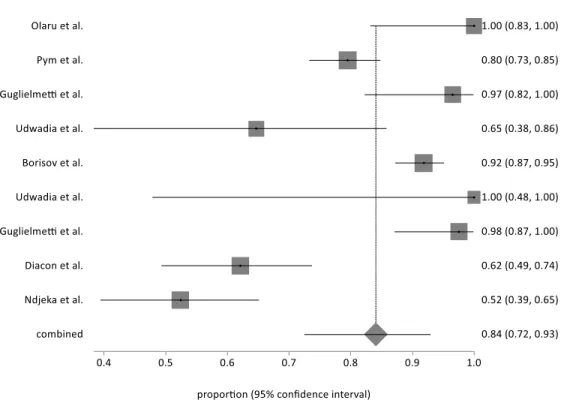
cultures at the start of treatment while 8 were not able to secure Bdq within one month of starting treatment. A reason was not given for why the latter 8 patients were not included for analysis and for the lack of culture conversion status in 213 other patients. The pooled population of all studies reported a combined sputum culture conversion percentage of 84.13% (95% CI = 72.53% - 92.98%) (Figure 6). The Quoran (Q) and I2 tests showed high heterogeneity across studies with a Q value of 88.02 (p < 0.0001) and
Figure 6 – Forest Plot of Culture Conversion for Individual Studies and the Pooled Population (Random Effects)
20
an I2 percentage of 90.91% (95% CI = 85.01% - 94.49%). Two studies, Olaru et al. and Udwadia et al. with a total of 25 patients, achieved 100% sputum culture conversion and all studies reported conversion in at least 50% of their patients. In comparison, only 62% of patients on conventional treatment converted by six months according to Bastos et al.: a statistically significant difference (p < 0.0001).
Treatment outcome data was available for 807 patients across 8 studies. Of these 8 studies, only 3 studies with 627 patients had complete outcome data, from patients who completed their full course of treatment. The remaining 5 were interim analyses in which all patients completed Bdq but most had not yet finished their background regimen. The
Figure 7 – Forest Plot of Patient Cure for Individual Studies and the Pooled Population (Random Effects) – Olaru et al. did not report patient treatment outcomes.
21
Figure 8 – Forest Plot of Treatment Success, Individual and Pooled Populations (Random Effects)
pooled population of 807 patients had a cure percentage of 71.86% (95% CI = 60.94% - 81.60%) (Figure 7). Heterogeneity was also high across studies with a Q value of 55.56 (p < 0.0001) and an I2 percentage of 87.40% (95% CI = 77.37% - 92.98%). Only one study, Udwadia et al., reported 100% cure (95% CI = 47.82% - 100.00%) for 5 patients. Another study, Udwadia et al., reported a cure proportion of less than 50%. Treatment success, a combined count of cured patients and patients with completed treatment, showed a similar percentage of 70.80% (95% CI = 61.57% - 79.24%) for the 627 patients where this data was available, as well as a similarly high I2 percentage of 78.58% (95% CI = 31.23% - 93.33%) (Figure 8). Bastos et al. reported 58% of patients in its study with
22
successful treatment, a statistically significant difference compared to both measures (p < 0.0001). Ahuja et al. reported similar treatment success rates for patients on ethambutol and any D3 medication at 52.64% and 53.92% respectively with overall success at 54%, all statistically significant (p < 0.0001). Khan et al. observed 83.0% of their patients with success, also statistically significant (p < 0.0001).
Adverse Events and Safety
The number of adverse events related to Bdq use was provided in 4 studies, a total of 686 patients. The pooled percentage of patients with Bdq-related AEs was 21.39% (95% CI = 11.66% - 33.11%) (Figure 9). Heterogeneity was high according to a Q value of 19.19 (p < 0.003) and an I2 percentage of 84.36% (95% CI = 60.81% - 93.76%). One study, Udwadia et al., reported no AEs attributable to Bdq use in the 5 patients in the study. None of the studies reported AEs due to Bdq in more than 40% of their patients.
Bdq discontinuation numbers were reported by 8 studies, a total of 854 patients. Bdq discontinuation was seen in only 3.65% of patients (95% CI = 1.98% - 5.81%) with a low reported heterogeneity of 32.88% (95% CI = 0.00% - 70.22%) in the I2 calculation and a Q score of 10.43 (p = 0.17) (Figure 10). All studies observed less than 10% of their subjects discontinuing Bdq treatment and 3 studies reported that none of their patients discontinued treatment. In contrast, in the study by Bastos et al., 6 patients discontinued ethambutol (1.12%) and 207 patients discontinued any group D3 medications (18.89%); both statistically significant (p = 0.0045 and p < 0.0001).
23
Figure 9 – Forest Plot of Adverse Effects due to Bedaquiline Usage in Individual and Pooled Populations (Random Effects) – Data was not available for Olaru et al., Guglielmetti, et al., Guglielmetti et al., Diacon et al., and Ndjeka et al.
The proportion of patients who suffered from at least one SAE in the pooled population of 468 was 26.50% (95% CI = 6.98% - 52.86%) (Figure 11). The Q score was 122.64 (p < 0.0001) and the I2 percentage was 96.74% (95% CI = 94.54% – 98.05%) indicating high heterogeneity. Udwadia et al. reported no SAEs throughout its TB regimen while Guglielmetti et al. had over 75% of its patients experiencing at least one SAE. Bastos et al. reported 6 patients with SAEs due to ethambutol (1.12%), a
statistically significant difference (p = 0.0007) when compared to Bdq. Khan et al. observed a statistically significant 18.1% of their patients experiencing SAEs.
24
Figure 10 – Forest Plot of Bedaquiline Discontinuation in Individual and Pooled Populations (Random Effects) – Diacon et al. did not provide treatment discontinuation data specific to bedaquiline usage.
The pooled proportion of hepatotoxicity was 14.37% (95% CI = 2.56 – 33.47%) out of 371 patients from 4 studies (Figure 12). A portion of patients from Guglielmetti et al. were excluded because they were administered Bdq for a longer period than
recommended.35 Heterogeneity was high across studies at 92.77% (95% CI = 84.71 – 96.57%). Ndjeka et al. reported no events of hepatotoxicity in its 91 patients while Guglielmetti et al. reported hepatotoxicity in half of their 12 patients.
QT interval data corrected with Fridericia’s formula were available for 7 studies and 687 patients. QT prolongation was experienced by 10.37% (95% CI = 3.19% - 21.01%) of patients (Figure 13). The Q value was 70.12 (p < 0.0001) and the I2
25
Figure 11 – Forest Plot of Severe Adverse Events in Individual and Pooled Populations (Random Effects) – Olaru et al., Guglielmetti et al., Borisov et al., and Udwadia et al. did not report this data or provided data from which AE grades could not be extrapolated.
percentage was 91.44% (95% CI = 84.94% – 95.14%), indicating high heterogeneity. The number of patients in each study experiencing QT prolongation did not exceed 33%. Udwadia et al. reported no QT prolongation among its patients and none of the 5 study subjects exceeded a QT interval of 420ms during Bdq treatment.
Of the 950 patients across all studies, 6.56% (95% CI = 4.15% - 9.45%) died during treatment or follow-up (Figure 14). There was low heterogeneity observed from a Q score of 15.50 (p = 0.05) and an I2 percentage of 40.9% (95% CI = 0.00% - 71.3%). Three studies, Olaru et al., Udwadia et al., and Udwadia et al., reported no deaths among
26
Figure 12 – Forest Plot of Hepatotoxicity in Individual and Pooled Populations (Random Effects) – Olaru et al., Udwadia et al., Borisov et al, Udwadia et al., and Diacon et al. did not provide hepatotoxicity information.
their samples. There were also two studies in which more than 10% of the study subjects died: Guglielmetti et al., and Diacon et al. In every study where deaths occurred and a specific cause of death was reported, most deaths were TB related. Both QT prolongation and torsades de pointes were ruled out as causes of death in all cases, suggesting that treatment with Bdq was not the cause of death. In comparison studies, Ahuja et al. reported 15.21% of patients died (p < 0.0001). Bastos et al. and Khan et al. reported 12% and 6.41% of their patients died, respectively (p <0.0001 and p = 0.8992).
27
Figure 13 – Forest Plot of QT Prolongation in Individual and Pooled Populations (Random Effects) – Olaru et al. and Guglielmetti et al. provided readings in QTcB instead of QTcF and were excluded.
Heterogeneity and Meta-Regression
Meta-regression analyses were performed to explain the significant heterogeneity observed in nearly all measures of Bdq’s efficacy and safety. XDR-TB and pre-XDR TB-FqR had statistically significant impacts on treatment success with R2 values of 100.00% and 94.01%, respectively (Table 4). XDR-TB was statistically significant for Bdq related AEs. HIV coinfection was statistically significant for hepatotoxicity (R2 = 64.65%). XDR-TB, pre-XDR TB-FqR, and clofazimine had statistically significant influences on QT prolongation (56.32%, 44.11%, 92.18%). For the occurrence of culture conversion at six months, treatment cure, and SAEs, none of the covariates could explain the high
28
Figure 14 – Forest Plot of Deaths in Individual and Pooled Populations (Random Effects) Covariates (R2% (p-value)) Study Proportions Pre-XDR TB-Fq Resistance XDR-TB HIV Coinfection Clofazimine Culture Conversion 0.00% (p = 0.5926) 7.02% (p = 0.1624) 5.39% (p = 0.1709) - Treatment Cure 9.23% (p = .3059) 0.00% (p = 0.6959) 0.00% (p = 0.3049) - Treatment Success 94.01% (p = 0.0120) 100.00% (p = 0.0026) 0.00% (p = 0.8381) - AEs due to Bdq 21.98% (p = 0.2179) 100.00% (p < 0.0001) 0.23% (p = 0.3583) -
29 G3/G4 AEs 31.83% (p = 0.0885) 0.00% (p = 0.6939) 36.93% (p = 0.1209) - Hepatotoxicity 0.00% (p = 0.2746) 0.00% (p = 0.5237) 64.65% (p = 0.0319) - QT Prolongation 44.11% (p = 0.0368) 56.32% (p = 0.0122) 0.00% (p = 0.2946) 92.18% (p < 0.0001)
Table 4 – Heterogeneity Accountable through Covariates
heterogeneity observed.
Publication Bias
Funnel plots were generated to assess the presence of publication bias (Figure 15). Plots for death and Bdq discontinuation did not show any signs of asymmetry. Plots for culture conversion, treatment cure, and QT prolongation showed some asymmetry indicating the possibility of publication bias. For Bdq related AEs, SAEs, and
hepatoxicity, asymmetry could not be assessed because of the low number of studies included. Begg’s rank correlation and Egger’s regression tests were run to provide a more objective view of all proportions and none showed any statistically significant publication bias (Table 5).
Bias Indicators (P-Value)
Study Proportions Begg’s Rank Correlation Egger’s Linear Regression Culture Conversion p = 0.1802 p = 0.3058
Treatment Cure p = 0.2751 p = 0.6695
AEs due to Bdq p = 0.75 p = 0.8608
30
Hepatotoxicity p = 0.75 p = 0.1187
QT Prolongation p = 0.3813 p = 0.0828
Death p = 0.7614 p = 0.471
Table 5 – Publication Bias Indicator Values – Values could not be calculated for treatment success.
31
Figure 15 – Funnel Plots of Calculated Proportions – Culture conversion, treatment cure, AEs due to Bdq, Bdq discontinuation due to AEs, G3/G4 AEs, hepatotoxicity, QT prolongation, and deaths from left to right. A funnel plot could not be generated for treatment success due to inadequate strata.
32
DISCUSSION
The recent nature of bedaquiline’s discovery and subsequent use in treating MDR-TB have made it both a prime topic for investigation and a challenge to gather meaningful data for analysis. As of this systematic review and meta-analysis, nearly all published studies were case series or cohort studies without control groups. Only one randomized controlled trial performed by Diacon et al. with a sample size of 66 was identified. Without many publicized randomized controlled trials, proportion meta-analyses were used to assess these studies. Using the large pooled sample size of 950 patients, however, it was possible to make robust observations regarding the efficacy and safety of bedaquiline in MDR-TB regimens.
Efficacy
Pooled proportions measuring bedaquiline’s efficacy showed marked improvement over conventional treatment. With respect to culture conversion at six months, treatment cure, and treatment success, there were statistically significant
differences (p < 0.0001) between patients on Bdq and patients on conventional treatment in studies by Ahuja et al. and Bastos et al. that greatly favored the usage of Bdq. The treatment improvements in the Bdq group over the conventionally treated groups were achieved in spite of a significantly higher percentage of XDR-TB patients, who have historically had much lower rates of culture conversion (19.60%), and treatment success (26.44%) than MDR-TB patients.7
33
The effectiveness of bedaquiline-containing regimens was also apparent when compared to other medications in the D class. Bdq-containing regimens showed statistically significant differences over regimens using ethambutol and other D3 medications (p < 0.0001) in the study by Ahuja et al. in treatment success. While the improvement seen may not have been entirely due to Bdq because of its use with a combination of drugs that may have also included ethambutol and/or D3 drugs, its role in improving treatment success is supported by its inclusion into a regimen usually upon previous treatment failure.
While bedaquiline-containing regimens were effective compared to conventional treatments, the Bangladesh regimen-based treatments reviewed by Khan et al. were still more effective than both conventional regimens with or without Bdq in terms of
treatment success with a statistically significant difference (p < 0.05). Bastos et al. indicated in their review that individualized treatments were generally more effective than standardized ones in conventional regimens. However, despite the individualized Bdq regimens used in most studies, Khan et al.’s study utilizing a standardized regimen reported a greater percentage of successfully treated patients. This difference could possibly be explained by the exclusion of all XDR-TB patients from the results or the low percentage of patients with HIV coinfection in Khan et al.’s review, however, the
magnitude of the effects produced by these covariates remains unclear. Thus, cautious interpretation of this result is advised.
Overall, bedaquiline-containing regimens seem to be extremely effective in the treatment of MDR-TB. Over 70% of patients receiving regimens including Bdq achieved
34
culture conversion at six months, an early indication of treatment success. Moreover, similar proportions in the pooled treatment cure and treatment success of patients implied that culture conversion was generally maintained throughout the regimen without much relapse occurring: a rare occurrence in MDR-TB treatment.7,37 It is clear that Bdq
regimens are more effective than conventional ones and should be considered over other group D medications in terms of efficacy, however, whether a Bdq regimen is more effective than the Bangladesh regimen remains to be seen.
Adverse Events and Safety
Bedaquiline, despite its high rates of favorable outcomes in treatment, carries significant risk like all other second-line medications for MDR-TB. In this review, Bdq-related adverse events were quite common, occurring in just over a fifth of patients. Although most of these events did not warrant the discontinuation of Bdq, the occurrence of severe adverse events should not be overlooked. Severe adverse events that could be attributed to Bdq included QT prolongation and hepatotoxicity; over 10% of patients experienced these severe adverse events over the course of their treatment. The number of patients with QT prolongation may be confounded with the administration of
clofazimine, a drug that also causes QT prolongation and was shown have a statistically significant effect in this review. Despite the non-insignificant rates of severe adverse events, however, death was not very prevalent among Bdq regimen cases across all studies. Moreover, none of the deaths that occurred were attributed to the usage of Bdq. Comparatively, death proportions were higher in studies by both Ahuja et al. and Bastos
35
et al. and were statistically significant (p < 0.001). Again, these percentages were achieved in spite of the high number of XDR-TB cases among the study subjects.
Bedaquiline’s measurements of safety indicated that it was neither the least, nor the most, safe when compared to other group D medications. Less than 5% of all patients discontinued Bdq, implying Bdq was generally well tolerated. Bastos et al. reported a much higher rate of discontinuation from group D3 medications where nearly a fifth of all patients had to discontinue, which was statistically significant (p < 0.0001). For ethambutol, however, Bastos et al. reported only 1.12% of patients discontinued the drug due to adverse events (p < 0.0001): an expected result because of ethambutol’s use as a first-line medication for DS-TB.
Khan et al. reported a similar percentage of discontinuation compared to Bdq containing regimens whose difference was not significant (p = 0.8992).
Strengths and Limitations
The primary strength of this study was its large study sample. As noted above, the size of the sample allowed robust observations to be made about bedaquiline-containing regimens. This sample size was achieved, however, through inclusion of non-randomized case series and cohort studies which puts the review at risk of reporting and selection bias and necessitated the use of proportions meta-analysis. Moreover, although the sample size was large, the number of studies was not. One study, Borisov et al., made up nearly half of the pooled sample size.
One of the largest limitations of this review has been the incomplete or
36
portion were interim analyses where treatment had not been completed. As a result, treatment outcomes, including treatment success, could not be calculated for most studies. Only a third of the studies reported hepatotoxicity information and half did not report severe adverse events or Bdq-related adverse events. DST and resistance patterns, although present and reported by every included study, were not reported in a way that allowed them to be pooled. Borisov et al., for example, reported the number of XDR-TB patients and Fq resistant pre-XDR patients but reported the number of injectable resistant pre-XDR patients by their individual medications.
Another major limitation in the study was the high heterogeneity present in many of the calculated proportions. Although the usage of a random effects model somewhat mitigated this, the small number of included studies made assessing sources of
heterogeneity extremely difficult because conclusive results could not be drawn from meta-regression. The further reduction in studies for proportions with incomplete reports made meta-regression even more unreliable for explaining observed heterogeneity.
Conclusions
The studies included in this review have shown bedaquiline to be an extremely effective treatment for MDR-TB. The rapid culture conversion, consistency from conversion to successful treatment outcome, and high rates of both, are remarkable improvements over conventional treatment efficacy and medications such as ethambutol and D3 drugs. The lower proportions of patient deaths compared to conventional
treatments and lower rates of discontinuation compared to D3 medications are also highly desirable. Ethambutol, while less effective than bedaquiline, should still be used when it
37
can be of benefit per WHO recommendations due to its relative safety. These aspects make bedaquiline a viable, and possibly the preferred choice, when prescribing a regimen for treating patients with MDR-TB who are not predisposed to QT prolongation or liver problems.
While bedaquiline-containing regimens have distinct advantages over conventional treatments, this is not the case with the Bangladesh regimen. The
Bangladesh regimen is superior in both efficacy and safety because studies reviewed by Khan et al. have shown a greater proportion of patients with successful treatment and a lower incidence of severe adverse events with a similar amount of deaths. The inclusion of bedaquiline, however, may make the regimen more effective and possibly even shorter, a possibility currently being explored by the STREAM trials.38
Publications reporting studies on the efficacy and safety of bedaquiline for treatment of MDR-TB have indicated a promising start, however, more studies are needed as its use increases. Randomized control trials need to be carried out, in addition to the standardization of DST, adverse event, and treatment outcome reporting. These efforts will help to identify how MDR-TB treatments can be made more effective and safe.
38
LIST OF JOURNAL ABBREVIATIONS
Am J Respir Crit Care Med American Journal of Respiratory and Critical Care Medicine
Ann Clin Microbiol Antimicrob Annals of Clinical Microbiology and Antimicrobials
BMC Med Res Methodol BioMed Central Medical Research Methodology
CDC Center for Disease Control and Prevention
Clin Epidemiol Clinical Epidemiology
Clin Infec Dis Clinical Infectious Diseases Eur Respir J European Respiratory Journal
Int J Tuberc Lung Dis International Journal of Tuberculosis and Lung Disease
J Am Heart Assoc Journal of the American Heart Association Lancet Respir Med The Lancet Respiratory Medicine
N Engl J Med New England Journal of Medicine
Pharm Ther Pharmacology and Therapeutics
PLOS Med Public Library of Science Medicine
PLOS One Public Library of Science One
39
REFERENCES
1. Floyd K, Anderson L, Dias HM, et al. WHO | Global tuberculosis report 2016. WHO. http://www.who.int/tb/publications/global_report/en/. Accessed April 18, 2017.
2. WHO | The End TB Strategy. WHO. http://www.who.int/tb/strategy/en/. Accessed September 8, 2017.
3. World Health Organization. WHO | Definitions and reporting framework for tuberculosis. WHO. http://www.who.int/tb/publications/definitions/en/. Published December 2014. Accessed April 18, 2017.
4. Matteelli A, Roggi A, Carvalho AC. Extensively drug-resistant tuberculosis: epidemiology and management. Clin Epidemiol. 2014;6:111-118.
doi:10.2147/CLEP.S35839.
5. Nathanson E, Gupta R, Huamani P, et al. Adverse events in the treatment of
multidrug-resistant tuberculosis: results from the DOTS-Plus initiative. Int J Tuberc Lung Dis Off J Int Union Tuberc Lung Dis. 2004;8(11):1382-1384.
6. WHO Treatment Guidelines for Drug-Resistant Tuberculosis, 2016 Update. Geneva: World Health Organization; 2016.
http://www.ncbi.nlm.nih.gov/books/NBK390455/. Accessed September 12, 2017. 7. Bastos ML, Lan Z, Menzies D. An updated systematic review and meta-analysis for
treatment of multidrug-resistant tuberculosis. Eur Respir J. 2017;49(3). doi:10.1183/13993003.00803-2016.
8. Khan FA, Salim MAH, Cros P du, et al. Effectiveness and safety of standardised shorter regimens for multidrug-resistant tuberculosis: individual patient data and aggregate data meta-analyses. Eur Respir J. 2017;50(1):1700061.
doi:10.1183/13993003.00061-2017.
9. Ahuja SD, Ashkin D, Avendano M, et al. Multidrug Resistant Pulmonary Tuberculosis Treatment Regimens and Patient Outcomes: An Individual Patient Data Meta-analysis of 9,153 Patients. PLOS Med. 2012;9(8):e1001300.
doi:10.1371/journal.pmed.1001300.
10. Johnston JC, Shahidi NC, Sadatsafavi M, Fitzgerald JM. Treatment outcomes of multidrug-resistant tuberculosis: a systematic review and meta-analysis. PloS One. 2009;4(9):e6914. doi:10.1371/journal.pone.0006914.
40
11. Van Deun A, Maug AKJ, Salim MAH, et al. Short, highly effective, and
inexpensive standardized treatment of multidrug-resistant tuberculosis. Am J Respir Crit Care Med. 2010;182(5):684-692. doi:10.1164/rccm.201001-0077OC.
12. The Use of Bedaquiline in the Treatment of Multidrug-Resistant Tuberculosis: Interim Policy Guidance. Geneva: World Health Organization; 2013.
http://www.ncbi.nlm.nih.gov/books/NBK154134/. Accessed September 12, 2017. 13. The Use of Delamanid in the Treatment of Multidrug-Resistant Tuberculosis:
Interim Policy Guidance. Geneva: World Health Organization; 2014.
http://www.ncbi.nlm.nih.gov/books/NBK299541/. Accessed September 12, 2017. 14. Andries K, Verhasselt P, Guillemont J, et al. A diarylquinoline drug active on the
ATP synthase of Mycobacterium tuberculosis. Science. 2005;307(5707):223-227. doi:10.1126/science.1106753.
15. de Jonge MR, Koymans LHM, Guillemont JEG, Koul A, Andries K. A
computational model of the inhibition of Mycobacterium tuberculosis ATPase by a new drug candidate R207910. Proteins. 2007;67(4):971-980.
doi:10.1002/prot.21376.
16. Haagsma AC, Podasca I, Koul A, et al. Probing the Interaction of the
Diarylquinoline TMC207 with Its Target Mycobacterial ATP Synthase. PLOS ONE. 2011;6(8). doi:10.1371/journal.pone.0023575.
17. Provisional CDC Guidelines for the Use and Safety Monitoring of Bedaquiline Fumarate (Sirturo) for the Treatment of Multidrug-Resistant Tuberculosis. https://www.cdc.gov/mmwr/preview/mmwrhtml/rr6209a1.htm. Accessed September 12, 2017.
18. Brenton. Structure of Levofloxacin.; 2014.
https://commons.wikimedia.org/wiki/File:Levofloxacin2DCSD.svg. Accessed December 3, 2017.
19. Li M, Ramos LG. Drug-Induced QT Prolongation and Torsades de Pointes. Pharm Ther. 2017;42(7):473-377.
20. Moher D, Liberati A, Tetzlaff J, Altman DG, Group TP. Preferred Reporting Items for Systematic Reviews and Meta-Analyses: The PRISMA Statement. PLOS Med. 2009;6(7):e1000097. doi:10.1371/journal.pmed.1000097.
21. Treatment of Tuberculosis: Guidelines. 4th ed. Geneva: World Health Organization; 2010. http://www.ncbi.nlm.nih.gov/books/NBK138748/. Accessed September 27, 2017.
41
22. Law M, Stewart D, Pollock N, Letts L, Bosch J, Westmorland M. Critical Review Form - Quantitative Studies. 1998.
https://www.unisa.edu.au/Global/Health/Sansom/Documents/iCAHE/CATs/McMas ters_Quantitative%20review.pdf. Accessed September 15, 2017.
23. National Institute of Allergy and Infectious Diseases, Division of AIDS. Division of AIDS (DAIDS) Table for Grading the Severity of Adult and Pediatric Adverse Events, Corrected Version 2.1. https://rsc.tech-res.com/clinical-research-sites/safety-reporting/daids-grading-tables. Published July 2017. Accessed September 16, 2017.
24. Vandenberk B, Vandael E, Robyns T, et al. Which QT Correction Formulae to Use for QT Monitoring? J Am Heart Assoc. 2016;5(6):e003264.
doi:10.1161/JAHA.116.003264.
25. Wan X, Wang W, Liu J, Tong T. Estimating the sample mean and standard
deviation from the sample size, median, range and/or interquartile range. BMC Med Res Methodol. 2014;14:135. doi:10.1186/1471-2288-14-135.
26. Kurbatova EV, Cegielski JP, Lienhardt C, et al. Sputum culture conversion as a prognostic marker for end-of-treatment outcome in patients with multidrug-resistant tuberculosis: a secondary analysis of data from two observational cohort studies. Lancet Respir Med. 2015;3(3):201-209. doi:10.1016/S2213-2600(15)00036-3. 27. Lu P, Liu Q, Martinez L, et al. Time to sputum culture conversion and treatment
outcome of patients with multidrug-resistant tuberculosis: a prospective cohort study from urban China. Eur Respir J. 2017;49(3). doi:10.1183/13993003.01558-2016.
28. Diacon AH, Pym A, Grobusch MP, et al. Multidrug-resistant tuberculosis and culture conversion with bedaquiline. N Engl J Med. 2014;371(8):723-732. doi:10.1056/NEJMoa1313865.
29. Olaru ID, Heyckendorf J, Andres S, Kalsdorf B, Lange C. Bedaquiline-based treatment regimen for multidrug-resistant tuberculosis. Eur Respir J.
2017;49(5):1700742. doi:10.1183/13993003.00742-2017.
30. Pym AS, Diacon AH, Tang S-J, et al. Bedaquiline in the treatment of multidrug- and extensively drug-resistant tuberculosis. Eur Respir J. 2016;47(2):564-574.
doi:10.1183/13993003.00724-2015.
31. Guglielmetti L, Le Dû D, Jachym M, et al. Compassionate use of bedaquiline for the treatment of multidrug-resistant and extensively drug-resistant tuberculosis: interim
42
analysis of a French cohort. Clin Infect Dis Off Publ Infect Dis Soc Am. 2015;60(2):188-194. doi:10.1093/cid/ciu786.
32. Udwadia ZF, Ganatra S, Mullerpattan JB. Compassionate use of bedaquiline in highly drug-resistant tuberculosis patients in Mumbai, India. Eur Respir J. 2017;49(3):1601699. doi:10.1183/13993003.01699-2016.
33. Borisov SE, Dheda K, Enwerem M, et al. Effectiveness and safety of bedaquiline-containing regimens in the treatment of MDR- and XDR-TB: a multicentre study. Eur Respir J. 2017;49(5). doi:10.1183/13993003.00387-2017.
34. Udwadia ZF, Amale RA, Mullerpattan JB. Initial experience of bedaquiline use in a series of drug-resistant tuberculosis patients from India. Int J Tuberc Lung Dis Off J Int Union Tuberc Lung Dis. 2014;18(11):1315-1318. doi:10.5588/ijtld.14.0284. 35. Guglielmetti L, Jaspard M, Le Du D, et al. Long-term outcome and safety of
prolonged bedaquiline treatment for multidrug-resistant tuberculosis. Eur Respir J. 2017;49(3). doi:10.1183/13993003.01799-2016.
36. Ndjeka N, Conradie F, Schnippel K, et al. Treatment of drug-resistant tuberculosis with bedaquiline in a high HIV prevalence setting: an interim cohort analysis. Int J Tuberc Lung Dis Off J Int Union Tuberc Lung Dis. 2015;19(8):979-985.
doi:10.5588/ijtld.14.0944.
37. Agyeman AA, Ofori-Asenso R. Efficacy and safety profile of linezolid in the treatment of multidrug-resistant (MDR) and extensively drug-resistant (XDR) tuberculosis: a systematic review and meta-analysis. Ann Clin Microbiol Antimicrob. 2016;15. doi:10.1186/s12941-016-0156-y.
38. Moodley R, Godec TR, STREAM Trial Team. Short-course treatment for multidrug-resistant tuberculosis: the STREAM trials. Eur Respir Rev Off J Eur Respir Soc. 2016;25(139):29-35. doi:10.1183/16000617.0080-2015.
43