Access to Cloud Storage
by
Olga Ohrimenko
A dissertation submitted in partial fulfillment of the requirements for the degree of Doctor of Philosophy in The Department of Computer Science at Brown University
PROVIDENCE, RHODE ISLAND May 2014
by The Department of Computer Science as satisfying the dissertation requirement for the degree of Doctor of Philosophy.
Date
Roberto Tamassia, Ph.D., Advisor
Recommended to the Graduate Council
Date
Michael T. Goodrich, Ph.D., Reader
Date
Anna Lysyanskaya, Ph.D., Reader
Approved by the Graduate Council
Date
Peter M. Weber, Dean of the Graduate School
This thesis would never have been possible without my Ph.D. advisor, Roberto Tamassia. Roberto has provided me with the best guidance I could ever hope for from an advisor. Besides the technical knowledge he shared with me over the wonderful three years that I have worked with him, he has been an inspiring mentor giving me advice on ethics in academia and research. Roberto, I especially enjoyed the white board meetings we had and the rushed spirit of deadlines. Thank you for your insightful comments on all my writings and presentations, and for always finding time to meet and talk to me. It has been an honor to be your student!
I would like to express gratitude to my wonderful thesis committee members, Michael Goodrich and Anna Lysyanskaya. I had the pleasure to collaborate with Michael from the very first days of this thesis. During this time he always shared not only his many ideas on oblivious algorithms but also his research enthusiasm and work ethics. Anna Lysyanskaya always found time to give me feedback on my presentations, academic advice and helped me to improve the cryptography side of several sections of this thesis.
Eli Upfal has indirectly mentored and overseen my Ph.D. over all five years I have been at Brown. Eli, I enjoyed meetings and courses that I have either taken or TAed with you. Every interaction has always been fun and I learnt something from you every time. I will greatly miss running into you in the halls of the CIT. Finally,
end of my Ph.D.
Christian Cachin, Seny Kamara, Claire Mathieu, Michael Mitzenmacher, Babis Papamanthou and Nikos Triandopoulos have been amazing collaborators and many projects I was involved in would not have been possible without their involvement. Thanks to Roberto, I also had an opportunity to work with and learn from wonderful Brown students including John Boreiko, Josh Brown, Esha Ghosh, Duy Nguyen and Hobart Reynolds.
Life inside and outside of the walls of the CIT was made fun with the help of Andrew, Aparna, Arjun, Carleton, Emanuel, Fabio, Justin, Layla, Matteo, Serdar, Silvia and Yuri. I have also been lucky to have Duana, Linda and Ulya and their remote support. Special thanks to my TG for always being there.
Finally, I would like to thank my family for undertaking an unpredictable journey to Australia which eventually allowed me to pursue a research career which may not have been possible otherwise.
This thesis was supported in part by the National Science Foundation under grants CCF–0830149, CNS–1012060, CNS–1228485, IIS–1212508 and OCI–072480, and a NetApp Faculty Fellowship.
I dedicate this thesis to my grandmothers, Maria and Zoya, who are no longer with us.
Cloud storage has emerged as the next generation of data storage where users can remotely store their data and leave its management to a third party, e.g., Amazon S3, Google Drive or Microsoft Azure. However, the fact that users no longer have phys-ical possession of their data raises new challenges in terms of data privacy. Storing the data in encrypted form is a key component in maintaining privacy against the storage provider. However, encryption alone is not enough since information may be leaked through the pattern in which users access the data. In this thesis, we describe algorithms that allow data-oblivious access to remotely stored data. That is, access patterns of such algorithms depend only on the size of the outsourced data and algorithm input, but not their content. Hence, such algorithms reveal nothing about the data they are processing.
We start by describing a general method that obliviously simulates user requests to outsourced data of size n and adds O(logn) overhead in the average case, suc-ceeding with very high probability. This method assumes a private workspace of sizeO(n) on the user side, for any given fixed positive constant, and does not main-tain a state between data requests. We then show how to deamortize our method to achieveO(logn) overhead in the worst case. Our deamortization technique is general and can be applied to several existing oblivious simulations.
The next oblivious simulation technique presented in this thesis improves over theO(logn) solution and demonstrates an interplay between system parameters such as latency, bandwidth, and the size of the user’s private memory. We show that if a user exchanges messages of size O(n1/clogn) with the storage provider, for some constantc≥2, and has access to private memory of the same size, then our method can achieve O(1) access overhead in the worst case with very high probability.
them oblivious without using the general oblivious simulation methods mentioned above. In particular, we show how one can access and perform a computation in an oblivious fashion on an externally stored graph. We also show that a number of classic graph drawing algorithms can be efficiently implemented in this framework while maintaining user privacy.
Acknowledgments iv
1 Introduction 1
2 Related Work 9
2.1 Oblivious RAM . . . 10
2.2 Oblivious Cloud Storage . . . 11
2.3 Multicloud Model . . . 13 2.4 ORAM Applications . . . 14 3 Preliminaries 17 3.1 Notation . . . 18 3.2 Adversarial Model . . . 18 3.3 Cryptographic Primitives . . . 19 3.4 Hash Tables . . . 21 3.5 Data-Oblivious Memory . . . 25 3.5.1 Definition . . . 25 3.5.2 Performance Measures . . . 29 3.6 Data-Oblivious Sorting . . . 30
3.7 Square-Root Oblivious Access Scheme [18, 21] . . . 31
4 The logn-Hierarchical Oblivious Access Scheme 35 4.1 Setup and Data Layout at the Server . . . 36
4.2 Oblivious Simulation of Data Requests . . . 39
4.2.1 Access Phase . . . 39
4.2.2 Rebuild Phase . . . 40
4.3 Analysis . . . 41
5 Constant Overhead Oblivious Access Scheme 51 5.1 The Oblivious Storage (OS) Model . . . 52
5.1.1 Client Private Memory . . . 52
5.2.1 Oblivious Sorting . . . 55
5.2.2 Oblivious Shuffle Model . . . 56
5.2.3 Security of Oblivious Shuffle . . . 58
5.3 The Melbourne Shuffle Algorithm . . . 60
5.3.1 Intuition . . . 60
5.3.2 Overview . . . 62
5.3.3 Algorithm . . . 63
5.3.4 Security Analysis . . . 68
5.3.5 The Melbourne Shuffle with Small Messages . . . 74
5.4 The Square-Root Based OS Solution . . . 76
5.5 The cth-Root Based OS Solution . . . 78
6 Deamortization of Oblivious Access Schemes 81 6.1 The Square-Root Scheme . . . 82
6.1.1 Setup . . . 83
6.1.2 Access Simulation . . . 84
6.2 The logn-Hierarchical Scheme . . . 87
6.2.1 Setup . . . 87
6.2.2 Access Simulation . . . 89
6.3 The Oblivious Storage . . . 94
7 Hiding Access Patterns of Graph Drawing Algorithms 96 7.1 Overview . . . 97
7.2 Compressed-Scanning Model . . . 99
7.2.1 Model . . . 99
7.2.2 Privacy Protection . . . 100
7.3 Graph Drawing Algorithms . . . 102
7.3.1 Euler Tours in the Compressed-Scanning Model . . . 103
7.3.2 Computation over Euler Tour Representations . . . 104
7.3.3 Drawing of Planar Acyclic Digraphs . . . 105
7.3.4 Treemap Drawings . . . 108
7.3.5 Series-Parallel Graphs . . . 109
7.3.6 Drawing Trees with Bounding Rectangles . . . 113
7.3.7 Analysis . . . 115
8 Conclusions 118
2.1 Comparison of Several Oblivious Simulation Methods where c ≥ 2, 0< < 1 and 0 < τ < 1. The ˜O notation hides polylog logn terms. The server storage with∗indicates temporary storage that is required during the rebuild phase while both solutions require onlyO(n) during the access phase. Hence, deamortized versions of these constructions require O(nlogn) storage during the access phase as well. . . 16
3.1 (a) The top of the figure represents a cuckoo hash table. Keys are placed in one subtable; the arrow for each key points to the alternate location for the key in the other subtable. Key G is inserted, leading to the movement of several other keys for G to be placed, as shown in the bottom of the figure. (b) Key G is to be inserted, but it cannot be placed successfully. (Seven keys have only six locations.) This leads to a failure, or if there is a stash, then G can be placed in a stash. . . 23 3.2 Memory layout of the storage provider during oblivious RAM
simula-tion, original version of the square-root solution [21]. . . 32 4.1 Illustration of the data structure stored at the server for oblivious
RAM simulation with O(logn) amortized access overhead. In the access phase of the simulation, all the items in the cache, C and the stash, S, a bucket in hash tables Hi, plus two items for each cuckoo
table Tj are read by the server. . . 37
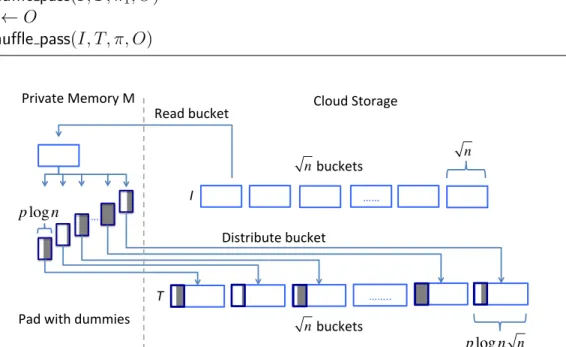
5.1 Illustration of the distribution phase of shuffle pass (Algorithm 5). Shadowed regions represent dummy values added to pad each batch to the size of plogn. The batches are encrypted, hence, one cannot tell where and how many dummy values there are in each batch. . . . 64 5.2 Illustration of the clean-up phase of shuffle pass Algorithm 5).
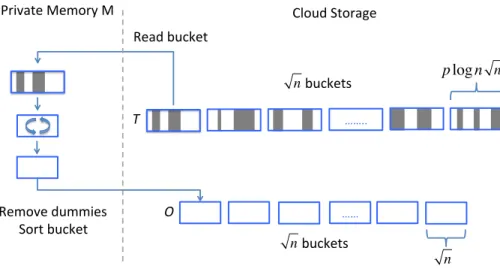
Shad-owed regions represent dummy values that are removed during the clean-up phase. . . 67 6.1 Memory layout of the data repository during oblivious RAM
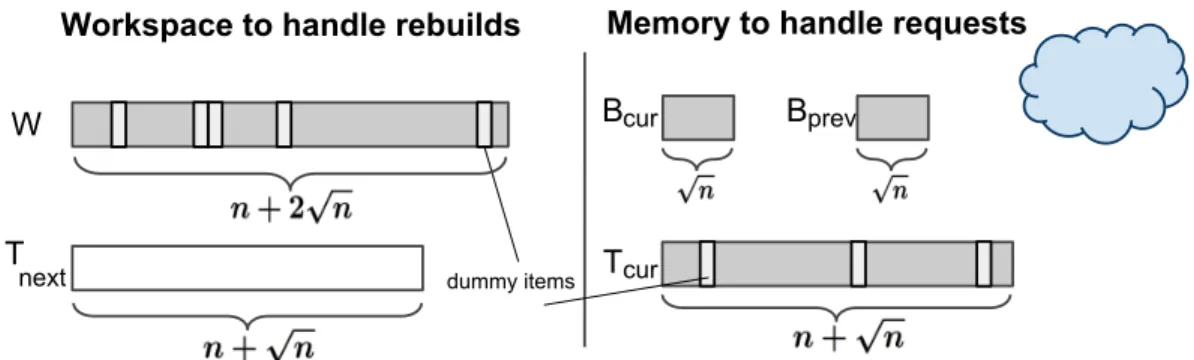
simula-tion of our deamortized version of the square-root solusimula-tion (Secsimula-tion 6.1). 83 6.2 Memory layout of the data repository during oblivious RAM
simu-lation of our deamortized version of the logn-hierarchical solution in Section 6.2. (See Figure 4.1 for comparison with the original solution.) 88 6.3 Sequence of accesses during oblivious RAM simulation: (a) original
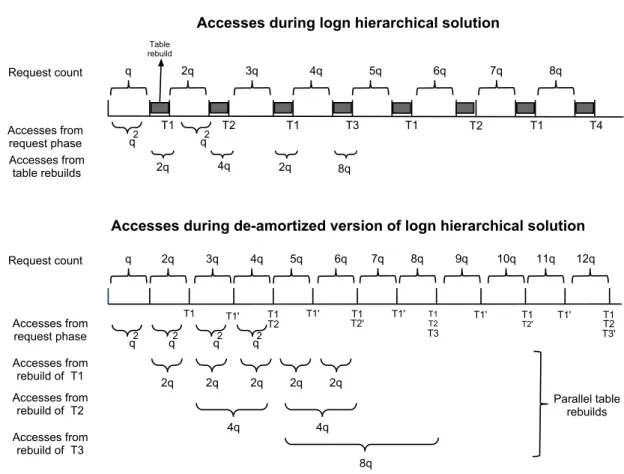
version of the logn hierarchical solution (Section 4); (b) our deamor-tized version (Section 6.2). The size of the cache is denoted by q, which is O(logn). . . 90
Outsourcing data to a remote storage provider like Amazon S3, Dropbox, Google Drive or Microsoft Azure has become a common alternative to data management for single users and companies. For example, in 2012 Amazon alone reported storing one trillion objects in their storage service Amazon S3 [4]. The popularity of storing data in the “cloud” is explained by its cost effectiveness, since clients pay only for the computational resources that they use, and reliability, a result of redundancy and resilience of multiple servers around the globe. However, the lack of physical possession of the data creates new challenges in ensuring privacy of the outsourced data since storage providers may have commercial interest in their customers’ data or inadvertently a third party may gain access to a user’s data. These concerns are not unfounded: for example in 2011 an error in Dropbox code led to temporary allowing unauthenticated access to their users’ data [14]
A key component for users to maintain the privacy of their data is to store the data in encrypted form using a key known only to the user. However, simply encrypting the data is not sufficient to achieve privacy since information about the data and the user may be leaked by the pattern in which the user accesses it. Consider the following example. A user outsources three encrypted records x, y and z. She then wishes to execute the following program:
read x
if x≥100 then read y
else read z
Although the value of x is encrypted, accessing the encrypted values of x and y reveals that x is greater or equal to 100. Similarly, accessing x and then z reveals that x <100.
In another example consider access pattern to a collection of documents out-sourced by a company where documents can be accessed by the company’s employ-ees, i.e., a multi-user scenario. By observing which documents the users access and comparing their access patterns, the storage provider can infer access control on the documents within the company, as well as the collaboration network of the employ-ees. Again notice that such information can be inferred even if all documents are encrypted.
Thesis Objective In this thesis, we are interested in designing data structures and algorithms that protect user privacy while storing and accessing data at the cloud storage provider. The information we are trying to protect is the content of the data and the pattern of access to the data. The latter includes hiding such information as frequency of accesses to individual data elements, whether the access is a read or a write, if the currently accessed item has been accessed before and when, and finally any dependencies between accesses (e.g, in the above example y is accessed when x ≥ 100). Storing data in an encrypted form is a key component for hiding the content of the data. However, one has to design other solutions to hide the access pattern. The access pattern depends on the application or the algorithm the customer of cloud storage uses to access her data. For example, if the user always reads all of her data and never updates any records, then a scan over encrypted data does not reveal anything to the storage provider other than that a request was made. However, only a minority of applications require accessing the whole data collection.
The pattern in which the user accesses her data may depend on the application the user is running, its input and outsourced data the user retrieves. If one knows a priori how the data is accessed, then one can design algorithms that make accesses without revealing the originally intended access locations. We refer to such
algo-rithms as data-oblivious algorithms, since anyone observing data locations accessed by these algorithms, besides the user herself, is oblivious to the data that the algo-rithms are operating on and what data is being requested. For example, Batcher’s sorting network [5] is a data-oblivious algorithm for sorting an array of elements. In other words, this algorithm sorts the array by accessing its elements independently of the underlying values. Moreover, this algorithm’s memory accesses are deterministic and depend only on the size of the array but not its values.
However, there are also cases when data accesses are not as predictable as, for example, in insertion sort. Therefore, we are interested in designing solutions that make every request to the data look independent of the elements being requested now or before. We refer to the schemes that take any sequence of requests and simulate them obliviously as oblivious simulation schemes.
Oblivious RAM Goldreich and Ostrovsky [21, 18] posed a problem similar to ours in the context of protecting software from illegitimate duplication and consequent redistribution. In particular, they consider inferences that can be made by an adver-sary observing interactions of the trusted CPU running the program with untrusted memory, i.e., a sequence of addresses accessed. They defineoblivious RAM (ORAM) as an interface between the CPU and the memory that hides the access pattern by accessing the memory in an oblivious manner. That is, the probability distribution of the sequence of (memory) addresses accessed during an execution depends only on the input length and is independent of the particular input. Goldreich and Ostro-vsky [21, 18] presented two oblivious RAM constructions with different performance guarantees, that we refer to as square root and hierarchical solutions.
Protecting the access pattern of a program using local memory versus accessing data from the “cloud” is similar from a theoretical point of view, however, several aspects of the problem change when one switches to the cloud setting. First, in the remote storage case, the user is a computer or a mobile device that has access to private memory. The size of the private memory is likely to be proportional to the size of the data that the user has outsourced, e.g., big documents are less likely to be accessed from mobile devices. Secondly, the number of roundtrips one has to make to the cloud provider to access the data becomes a bottleneck when accessing data that is stored in a different state or country. Finally, the size of the packets exchanged between the user and the cloud provider is no longer a single element and the cloud API supports a richer set of queries than RAM.
Desired Properties We are interested in designing solutions that are efficient and provably secure. For example, our schemes should not defeat the purpose of cloud computing by using private memory equal in size to the outsourced data. It is also desirable to minimize any overhead the oblivious scheme adds compared to the non-oblivious implementation of the same application. More specifically, if the user outsources n data records, then we wish to simulate a sequence of requests by adding a constant or sublinear inn access overhead. Cloud storage providers charge customers for storing the data as well as accessing it. Hence, oblivious schemes should also take into account the monetary cost they add. Oblivious schemes should also adhere to common security definitions and, hence, protect access privacy for any request sequence, even if the adversary can influence what this sequence may be. Informally, we wish to design schemes that make accesses to remote data storage depending only on publicly known parameters, such as the size of the outsourced data, the size of the user’s private memory, the number of requests in the original sequence, and the number of elements the user can exchange with the server. The
access pattern should not depend on the data outsourced nor the application that the user is running.
We view the storage server as anhonest-but-curious adversary, who correctly per-forms the storage and retrieval operations requested by the user, but is nevertheless interested in learning as much from her data as possible (indeed, some cloud com-puting companies are basing their business model on this goal). We do not consider timing side channel attacks that measure the time it takes for the user to make a request or process the received data. Hiding the length of the request sequence is also outside the scope of this thesis.
Thesis Contributions This thesis addresses several aspects of the problem of hid-ing access patterns. To this end, we incorporate multiple cryptographic primitives and various probabilistic data structures in order to build efficient and secure solu-tions. In particular, we develop two oblivious access schemes: the logn-hierarchical solution and the constant oblivious storage solution. Assume the outsourced data set consists of n elements. The former scheme improves over the known bound on the access overhead by adding O(logn) accesses for the oblivious simulation by in-troducing the idea of a common stash shared between multiple cuckoo hash tables. The latter solution exploits a tradeoff between network bandwidth and user private memory to achieve a constant access overhead. This solution introduces a recursive oblivious storage scheme that uses a novel algorithm for constructing a permuta-tion obliviously. We then observe that many oblivious schemes strive to minimize the amortized access overhead while leaving the worst case to take Ω(n) accesses, which may not be desirable in certain applications. We develop a deamortization technique for the logn-hierarchical solution and the square root solution of [18]. Fi-nally we consider the access pattern of graph drawing algorithms and study their
data-oblivious variants by performing scanning and computation over the Euler tour representation of a tree.
Thesis Outline The rest of this thesis proceeds as follows. In the next chapter, an overview of cryptographic primitives and data structures used in this thesis is presented. We also give the security definition of a data-oblivious algorithm and present the square root solution from [18, 21] as a warm-up for our oblivious schemes.
In the outline of the remaining chapters, we denote with n the size of the out-sourced data set.
In Chapter 4, we present our first oblivious simulation scheme. This scheme is based on a hierarchy of O(logn) hash tables, where the top hash tables are im-plemented as hash tables with buckets followed by cuckoo hash tables that share a common stash. This scheme incurs O(logn) access overhead since the simula-tion must access every level. We also present experimental results to show that the overhead of the scheme is small in practice. A preliminary version of this chapter appeared in [27].
The second oblivious simulation scheme is presented in Chapter 5. This scheme achieves constant overhead if private memory of size O(n1/clogn), for any constant
c≥ 2, is available to the client and if the client and the cloud storage provider can exchange messages consisting of O(n1/clogn) elements. This chapter is based on the
work presented in [26] and [40, 41]. An extension of the above construction that uses memory of size O(n1/c) is presented in [40, 41].
In Chapter 6, we present deamortized variants of the original square root solution, the logn hierarchical solution from Chapter 4 and constructions from Chapter 5.
This technique shows that by doubling the space overhead at the cloud provider, one can achieve O(logn) access overhead in the worst-case, avoiding the occasional O(n) downtime that was present in the original exposition of these methods. A preliminary version of this chapter appeared in [25].
We study several application-specific data-oblivious algorithms in Chapter 7. We consider the problem of drawing graphs that are stored remotely. Such algorithms involve traversing and performing computations on trees and graphs. We describe a computational model for this problem that we call compressed-scanning. Several graph drawing algorithms are adapted to fit the compressed-scanning model and shown to be data-oblivious. A preliminary version of this chapter appeared in [28].
Finally, we review the work related to oblivious RAM and more recent advances on oblivious cloud storage (OS) in Chapter 2. We also consider relevant concepts such as private information retrieval and oblivious transfer and show how they differ from oblivious RAM. We conclude the thesis and describe directions for future work in Chapter 8.
In this chapter we review work related to oblivious RAM, and its extension, oblivious storage, that supports a richer set of queries than the RAM model. Table 2.1 provides the comparison of different aspects of ORAM simulations. We also review oblivious storage schemes in a two-cloud model where storage providers are non-colluding. We end the chapter with the description of several applications of ORAM where privacy of the access pattern is vital for the security of these applications.
2.1
Oblivious RAM
Prior work on oblivious RAM addresses the trade-off between the size of the client’s memory, the size of the messages exchanged between the client and the server in a single roundtrip, the access overhead, and the space overhead at the storage provider, i.e., the additional space used beyond the n items.
Based on the assumptions about the client, oblivious RAM models can be clas-sified intostateless and stateful solutions. A stateless oblivious RAM is not allowed to keep a state between requests and hence can be used in a multi-user scenario. Stateful solutions assume that the user Alice keeps information in a private storage (which she maintains), which helps her perform her accesses obliviously in the remote storage.
Stateless oblivious RAM simulation was first proposed by Goldreich and Ostro-vsky in [21], who present a preliminary simple solution withO(√nlog2n) amortized access overhead, referred to as thesquare-root solution, and a more complex solution withO(log3n) amortized access overhead. Goodrich and Mitzenmacher [24] improve this result by giving a method with O(log2n) amortized access overhead with high
probability. Recently Kushilevitz et al. [34] show that techniques from [24] can be extended to obtain O(log2n/log logn) amortized access overhead. All the above stateless methods utilize a private memory of size only O(1) for Alice, an overly restrictive assumption in practice.
Other solutions [51, 53] improve the overall access overhead by assuming that a client has a workspace of non-constant size. Williams and Sion [51] achieve O(log2n) expected amortized access overhead and O(nlogn) space overhead with O(√n) private memory. Williamset al.[53] improve the method from [51] to achieve O(lognlog logn) amortized access overhead.
Damg˚ard et al. [11] and Ajtai [1] present stateless oblivious RAM simulations that do not access a random oracle nor make cryptographic assumptions about the existence of pseudorandom functions. Using different techniques Damg˚ard et al.[11] and Ajtai [1] show that amortized access overhead ofO(log3n) is possible for oblivi-ous RAM simulation without using random functions. The authors of [11] also show that a minimum ofO(logn) random bits are required for oblivious request simulation for a memory of size n.
2.2
Oblivious Cloud Storage
Bonehet al.[7] deviated from standard ORAM schemes by introducing theoblivious storage (OS) problem that, as they argue, is more realistic and natural than the ORAM simulation problem. They study methods that separate access overheads and the overheads needed for rebuilding the data structures on the server, providing, for example, O(1) amortized overhead for accesses with O(√nlogn) overhead for
rebuilding operations, assuming a similar bound for the message size and the size of the private memory on the client.
Stefanovet al.[47] study the oblivious storage simulation problem from a practi-cal point of view, with the goal of reducing the worst-case bounds for data accesses. They show that one can achieve an amortized overhead of O(logn) and worst-case performanceO(√n), with O(n) storage on the client, for a constant 0 < <1, and an amortized overhead ofO(logn) and similar worst-case performance, with a client-side storage of O(√n). The scheme of [44] provides a tree-based construction that uses ˜O(nlogn) server storage and incurs ˜O(log2n) overhead on each access when the client has access to O(n) private memory (the ˜O notation hides the polylog logn terms). Both schemes [47] and [44] can be modified using a recursive ORAM con-struction to require O(√n) and O(1) private memory, correspondingly, and instead incurring a logarithmic factor in their access overhead.
Path-ORAM is a simple oblivious construction proposed in [48] that makes O(logn) accesses to the server and uses a position map and a stash both stored at the client. The size of the position map is n but can be reduced by applying the recursive ORAM construction as in [47] and [44], while the size of the stash is logarithmic inn. With recursive construction, the method achievesO(log2n) access overhead and O(logn) client storage.
An interesting construction by Williams and Sion [52] achieves a constant over-head by using computation power of the server. Most oblivious constructions incur roundtrip overhead since they do not know where the item is in the construction (the exceptions are [47, 44, 48] where a position map is maintained). Moreover, they also cannot reveal to the server where the item was found since this reveals when items were updated last. Williams and Sion outsource the search procedure to the
server by encrypting all possible search paths for the item that one can take in the construction. The server then executes this search by working only on encrypted data and, hence, remains oblivious to where he finds the item. However, occasional reshuffle operation required by the solution adds a ˜O(log2n) amortized overhead.
The oblivious simulations described above consider a single-client scenario where all accesses, including read-only accesses, are processed sequentially. Extending these solutions to support parallel access is not trivial since they guarantee obliviousness by sequentially maintaining a state. The works of Stefanov and Shi [46] and Williamset al. [54] allow parallel access. The clients access oblivious storage of [46] via a load balancer that is responsible for scheduling client requests. On the other hand, the clients of [54] first access a log file of pending requests and then determine if they should send a request for a real or a fake item.
2.3
Multicloud Model
Lu and Ostrovsky [35] and Stefanov and Elaine Shi [15] consider the model of out-sourcing the data to two non-colluding storage providers, e.g, Amazon S3 and Mi-crosoft Azure. The construction of [35] splits a hierarchical ORAM construction between the servers such that the servers store alternating levels only. The sim-ulation proceeds as it does in the single-server case with accesses also alternating between the servers. However, when it is time to rebuild one of the levels at, the user uploads the data from one of the servers to another one according to a new pseudorandom function. This way the servers cannot correlate the accesses before rebuild and after since one server sees accesses to items before the rebuild and not af-ter, while another one sees only accesses after the rebuild. This construction achieves
O(logn) amortized access overhead by avoiding an expensive shuffle sort by simply uploading items from one server to another one. The construction of [15] uses [47] as the underlying ORAM construction at each server. The interaction between the servers is done directly, not via the client as it is in [35]. Hence, the client does not participate in the shuffling phase. The scheme of [15] achieves a constant overhead. The authors also propose how the clients can verify if shuffling was correct when one of the servers is malicious.
2.4
ORAM Applications
Lu and Ostrovsky [36] use ORAMs for garbling RAM programs. In their application, a client outsources the execution of a RAM program to a server and wishes to hide what type of computation is being executed. An ORAM scheme, similar to the one of [52], is used to hide the access pattern of the garbled program. Gordon et al.[29] use ORAM of [44] to securely outsource a computation of a program that can be executed in sublinear time on a RAM. As an application, they consider a server that stores a large datasetDand a client who has a small input x. The client then wishes to perform a private query on D with xas the input, e.g., a search query.
Oblivious RAM simulation has also been used to protect against traffic analysis in a networked file system [55]. Cashet al.[8] use ORAM to create a dynamic version of proofs of retrievability scheme where the storage supports updates. Their scheme allows the user to perform efficient reads, writes to outsourced storage, and provides an audit functionality for verifying that the server maintains the latest copy of her data. Williams et al. [54] propose an ORAM construction for outsourced filesystem application where multiple users can access the storage in parallel.
Recently, several hardware ORAM implementations have been proposed [37, 17, 43]. The works of [37] and [17] design the architecture for the hardware, while [43] is a simulator for a secure processor. All three are based on the Path ORAM construc-tion [48]. Optimizaconstruc-tions and extensions for incorporating Path ORAM in a secure hardware design, including integrity verification, are described in [43].
16
access phase. Hence, deamortized versions of these constructions requireO(nlogn) storage during the access phase as well.
User Memory Message Size Server Storage Amortized Access Overhead Worst-Case Access Overhead
Goldreich-Ostrovsky [21] √n O(1) O(1) O(n) O(√nlog2n) O(nlog2n)
Goldreich-Ostrovsky [21] logn O(1) O(1) O(nlogn) O(log3n) O(nlog3n) Shi et al. [44] (BST Bucket) O(1) O(1) O(n˜ logn) O(log˜ 2n) O(log˜ 3n)
Williams-Sion [52] O(logn) O(logn) O(n) O(log˜ 2n) O(log˜ 2n)
Williamset al. [53] O(√n) O(1) O(n) O(log2n) O(n)˜
Goodrich-Mitzenmacher [24] O(n1/) O(n1/) O(n) O(log2
n) O(n)
Stefanovet al. [47] O(√n) O(1) O(n) O(log2n) O(√n)
Stefanovet al. [48] O(logn) O(logn) O(n) O(log2n) O(log2n)
Kushilevitz et al.[34] O(1) O(1) O(n) O(log2n/log logn) O(log2n/log logn)
Bonehet al. [7] O(√nlogn) O(√nlogn) O(n) O(1) O(nlogn)
logn-hierarchical (Chapter 4, [27]) O(n) O(n) O(n) O(logn) O(n)
Deamortized √n (Chapter 6, [25]) O(1) O(1) O(n) O(√nlog2n) O(√nlog2n) Deamortized logn-hierarchical (Chapter 6, [25]) O(nτ) O(nτ) O(n) O(logn) O(logn)
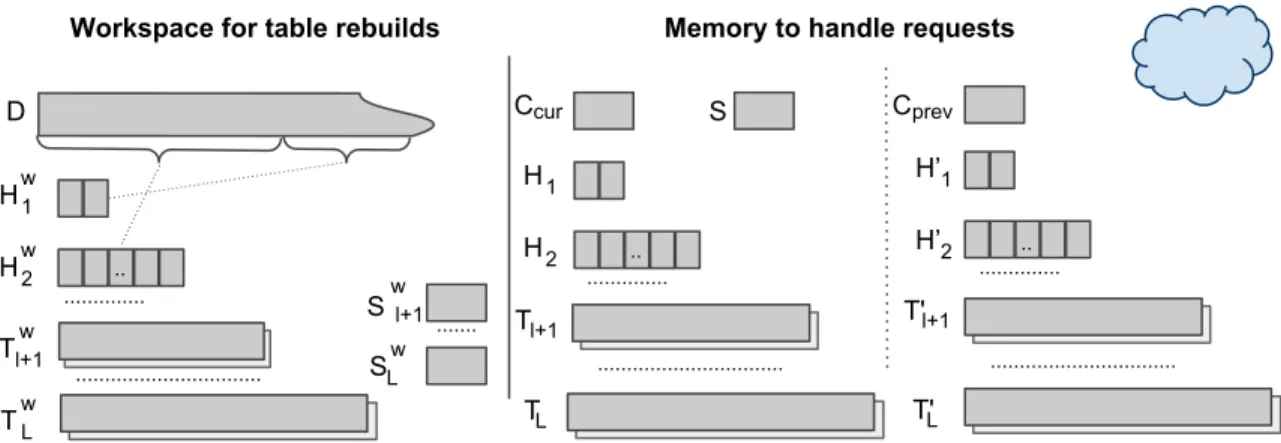
Constant overhead scheme (Chapters 5.4, 6, [40, 41]) O(√nlogn) O(√nlogn) O(nlogn)∗ O(1) O(1) Constant overhead scheme (Chapters 5.5, 6, [40, 41]) O(√cnlogn) O(√cnlogn) O(nlogn)∗ O(clogn) O(clogn)
In this chapter we describe tools and security definitions we use for our oblivious con-structions. We also give an overview of the square root oblivious RAM construction by Goldreich [18] as a warm-up for our solutions.
3.1
Notation
We refer to the user who wishes to store her data remotely with a storage provider Bob, as Alice. We use the terms user and client interchangeably. Alice has a dataset A of n elements, that we also may refer to as items. Each item consits of a pair (x, v), where x ∈ {0,· · · , n−1} is the key and v is the corresponding value. We sometimes refer to the storage provider as the server.
3.2
Adversarial Model
We consider a probabilistic computationally bounded adversary A who is limited to running in polynomial time in the size of the private keys and seeds used by the cryptographic primitives defined in Section 3.3. The adversary is honest-but-curious [20], in that he correctly performs all operations and does not tamper with the data. However, all of our solutions can protect data privacy in the malicious case as well, by simply extending the technique of Goldreich [21] and using message authentication codes [19].
In our scenario, the adversary A is either the storage provider, Bob, or anyone observing the interaction between Bob and user Alice.
3.3
Cryptographic Primitives
We let k ∈ N to denote the security parameter used in this paper. We now define the cryptographic tools we use in our constructions.
Negligible Function [19] A function ν : N → R is called negligible if for every positive polynomial pthere exists N such that for all k > N,
ν(k)< 1 p(k)
We will often say that undesirable events happen with negligible probability, that is with probability 1/2k, where k is the security parameter.
Computational Indistinguishability Two distributionsD1 and D2 are compu-tationally indistinguishable, if for every probabilistic polynomial-time (PPT) algo-rithm A there exists negligible function ν such that
|Pr[A(1k, D
1) = 1]−Pr[A(1k, D2) = 1]| ≤ν(k)
Here, input 1k means that algorithm A runs in time polynomial in security
param-eter k.
Semantically Secure Encryption (Enc-IND-CPA) We use a symmetric en-cryption scheme (Enckey,Deckey) where key← {0,1}k. We require this scheme to be
During this attack an adversary A is allowed to make queries to oracles Enckey
and Deckey on a polynomial number of sequences of l messages of his choice. After
this “warm-up” phase,Acomes up with two sequences,m0 andm1, oflmessages and gives them to a challenger. The challenger secretly picks a bit b and callsEnckey on
each message of sequence mb. LetC be the sequence of ciphertexts that correspond
tomb. The challenger givesCtoAwho continues queryingEnckey and Deckey on any
sequence of ciphertexts except those inC for a polynomial number of times. Finally, the adversary’s task is to guess bit b. We call the above game Enc-IND-CPA and say that A wins the game if he correctly guesses b. Then, (Enckey,Deckey) is said
to be secure if for all PPT adversaries, the probability of winning game Enc-IND-CPA is at most 1/2 +negl(k). We omit using key when referring to (Enc,Dec). For an intuition behind Enc-IND-CPA secure encryption scheme, consider encrypting a message padded with a different random nonce each time it is encrypted. Hence, re-encryptions of the same plaintext look different with very high probability.
Pseudorandom Function (PRF) [31] Let Fseed: {0,1}m → {0,1}m 0
be a fam-ily of efficiently computable functions keyed using a seed from the set Seeds(F) = {0,1}k. Then F
seed is a pseudorandom function if for all probabilistic
polynomial-time adversaries A, there exists a negligible function ν such that:
|Pr[AFseed(·)(1k) = 1]−Pr[AF(·)(1k) = 1]| ≤ν(n)
where F is chosen from the set of all functions mapping m-bit strings to m0-bit strings. For our purposes m will be at most m0.
Pseudorandom Permutation (PRP) [31] Let Rseed : {0,1}m → {0,1}m be
Seeds(R) = {0,1}k. ThenR
seedis apseudorandom permutationif for all probabilistic
polynomial-time adversaries A, there exists a negligible function ν such that:
|Pr[ARseed(·)(1k) = 1]−Pr[AR(·)(1k) = 1]| ≤ν(n)
where R is chosen from the set of all permutations on input of size m.
We will describe and prove security of our constructions assuming access to a truly random function F. However, in practice, we substitute access to F with an access to a pseudorandom function. Similarly, for pseudorandom permutations we will assume access to a truly random permutation.
Given an array A of n (key,value) pairs (x, v) where x ∈ [1, n], we denote the permutation π of A as B =π(A), where π =Rseed and B[x] =A[π(x)], ∀x∈ [1, n].
We will use the same notation whenAandB are encrypted. We refer to the original permutation ofA, as permutationπ0. For A, sorted usingx, π0 is the identity.
3.4
Hash Tables
We now describe variations of hash tables that we use for the oblivious constructions presented in this thesis.
Hash Tables Hash tables with buckets remedy the collision problem of regu-lar hash tables by allowing more than one item to be mapped to a location of a hash table, called bucket. Then, insertion of n items in a table with n buckets of size logn/log logn causes an overflow with probability 1/n [39]. However, our
con-struction uses hash tables of sizes ranging between O(logn) and O((logn)7) with buckets of size clogn/log logn to bound the probability of overflow to 1/nc (see
Section 4.3).
Oblivious Construction of Hash Tables Our schemes use hash tables as read-only look-up tables. Hence, after all items are inserted in a hash tableH, only read queries are issued toH. Moreover, all items to be inserted in H are known before H is built. The read phase for item with a key x is simple and consists of reading a bucket that corresponds to h(x) index, where h is a hash function used for the tableH. The construction ofHis trickier since our schemes require a data-oblivious version of this algorithm.
We use the data-oblivious construction of a hash table H from [21] which uses several calls to oblivious sorting. Its performance hence depends on client member and sorting algorithm used (see Section 3.6).
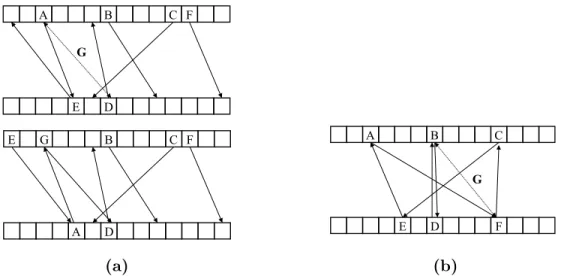
Cuckoo Hash Tables Pagh and Rodler [42] introduced a cuckoo hashing scheme consisting of two tables, each withm cells, with each cell capable of holding a single key. We make use of two hash functions h1 and h2 that we assume can be modeled as completely random functions. The tables store up tonitems, wherem =n(1 +ψ) for some constantψ >0, yielding a load of (just) less than 1/2; keys can be inserted or deleted over time as long as this restriction is maintained. An item with a key x that is stored in the hash tables must be located at either h1(x) or h2(x). As there are only two possible locations for a key, lookups take constant time. We insert a new item (x, v) in the cell h1(x). If the cell had been empty, the operation is complete. Otherwise, key y previously in the cell is moved to h2(y). This may in turn require another key to be moved, and so on, until a key is placed in an empty cell. We say
A B C F E D G E G B C F A D (a) A B C E D F G (b)
Figure 3.1: (a) The top of the figure represents a cuckoo hash table. Keys are placed in one subtable; the arrow for each key points to the alternate location for the key in the other subtable. Key G is inserted, leading to the movement of several other keys for G to be placed, as shown in the bottom of the figure. (b) Key G is to be inserted, but it cannot be placed successfully. (Seven keys have only six locations.) This leads to a failure, or if there is a stash, then G can be placed in a stash.
that a failure occurs if, for an appropriate constant c, after clogn steps this process has not successfully terminated. Suppose we insert an nth key into the system. It is known that:
• The expected time to insert a new key is bounded above by a constant (that depends on ψ).
• The probability that a new key causes a failure is Θ(1/n2) (also depends on ψ).
See Figures 3.1a and 3.1b for examples.
There are several natural variations of cuckoo hashing, many of which are de-scribed in a survey article by Mitzenmacher [38]. For our purposes, it suffices to understand standard cuckoo hashing, along with the idea of a stash [32].
A stash represents additional memory where keys that would cause a failure can be placed in order to avoid the failure; with a stash, a failure occurs only if the stash itself overflows. As shown in [32], the failure probability when inserting the nth key into a cuckoo hash table can be reduced to O(1/nc0+2) for any constant c0 by using a stash that can hold c0 keys. Using this allows us to use cuckoo hash tables for any polynomially bounded number of inserts and deletions using only a constant-sized stash. To search for an item, we must search both the two table locations and the c0 stash locations.
Similar to hash tables, we build cuckoo hash tables by a priori knowing all ele-ments to be inserted into the table. Hence, the life cycle of a cuckoo hash table in our construction is as follows: build a cuckoo hash table with a stash that can fit n elements and then query the table until the next rebuild is due, rebuild the table and the stash using a new pair of hash functions and possibly new elements, access until the next rebuild and so on. The number of times a table can be queried between the rebuilds will be defined in our constructions.
We use the construction of Goodrich and Mitzenmacher [24] to obliviously build a cuckoo hash table with a stash. This construction proceeds by building a bipartite graph, referred to as cuckoo graph, where a vertex in the first set corresponds to a cell of the first hash table of the cuckoo table and, similarly, a vertex in the second set corresponds to a cell in the second hash table. Hence, each vertex set is of sizem. For every element (x, v) to be inserted into the cuckoo table an edge (h1(x), h2(x)) is added to the graph. Since in our scheme all elements to be inserted are known, the corresponding cuckoo graph can be constructed. The next phase proceeds by finding connected components of the graph and cycles within each component. Com-ponents with cycles that cannot be avoided by removing one of the edges result in moving elements that correspond to cycle edges of this component to the stash. Each
step of this algorithm proceeds using several iterations of oblivious sorting within a MapReduce-like framework. For a detailed description of the construction we refer the reader to [24].
Hash Functions We note that for our constructions we will assume that hash functions used in the above data structures are truly random functions, which we can instantiate with calls to pseudorandom functions. The analysis of cuckoo hash-ing relies on logn-wise independent hash functions [42]. Random functions already posses this property since every new call to a function generates a value that is ran-dom and independent of previous calls, unless a call is made for the input that was queried before. A similar argument holds for PRFs.
3.5
Data-Oblivious Memory
In this section we first define the notion ofdata-obliviousness with a running example of a primitive oblivious RAM simulation algorithm. We then show how one measures performance of data-oblivious algorithms, followed by several data-oblivious sorting algorithms.
3.5.1
Definition
LetAbe an array consisting ofnelements where each elementA[i] is of equal size. We say thatAthat supports the query setQAdefined as follows. QAincludesread(i) and
We require that an element written bywriteis of the same size as the original element inA[i].
We also define a dataset A and a set of queries QA that is supported by A. A
query q∈ QA is executed using a call (A0, r)←apply(A, q) which returns a possibly
modified datasetA0and a replyrto the queryqaccording toA. We overloadapplyto be able to take a sequence α of operations and apply each operation in a sequence. The final result is then the result of the last query of α and the dataset A0 that captures changes of all queries in the sequence. For example, an array A defined above is also a dataset Awhere apply, depending on the query, either returns a read value or overwrites an existing value in A.
Definition 1 (RAM Simulation Algorithm). We consider an algorithm V that has access to a state δ and consists of two functions setup and simulate defined below.
• (Setup) Let A be the input array where QA is a set of virtual queries. The
setup function setup(A) returns a digest M and a dataset D (e.g., D could be a rearranged encrypted array A), where QD is a set of real queries.
• (Simulate) The execution function simulate(D, q) takes a virtual query q ∈ QA and the dataset D, and returns a tuple (D0, r, α) where r is an answer to
query q, i.e., (·, r) = apply(A, q), α is a sequence of all real queries that were applied to D by V, and D0 is a dataset that results from applying queries in α to D.
To distinguish between virtual queries to A and real queries to D, we refer to queries made toA as requests, and queries to D asaccesses.
Example For the above example D could simply be a copy of A. However, if a dataset owner wishes to hide the content of A she could encrypt A to produce a dataset D = {Enc(A[i]) | i ∈ {0, . . . , n−1}}. Then QD is also just a sequence of
read(i) andwrite(i,·) on the indices i, while the stateM stores the secret key of the underlying encryption scheme.
Example We now describe the above algorithm in the remote storage setting. The user possesses an array A that she wishes to outsource to a remote data storage provider. Instead of storing A with the storage provider, she stores D, e.g., the encrypted array A. When she wishes to accessA[i] she sends a query read(i) to the server and the server returns element D[i] back. The user keeps state M private since M contains the secret key of the encryption scheme she uses.
We adopt the indistinguishability security game from [50] that considers an ad-versary who can adaptively interact with the simulation algorithm on queries of his choice (IND-CQA Security Game).
Definition 2 (IND-CQA Security Game). A PPT adversary A provides the initial data array A. The algorithm V runs (D, M) ← setup(A). She then flips a secret random bit b and returns D to A. V keeps M private.
V andAthen engage in the following process, repeated polynomially many timest:
1. A gives V two queries q0, q1 ∈ QA.
2. V executes query qb, that is (r, α, D)←simulate(D, qb).
After t rounds, A guesses b.
Definition 3 (Data-Oblivious RAM Simulation Algorithm). We say that algorithm V is data-oblivious if A’s advantage in winning IND-CQA security game over a random guess is negligible in k, where k is the security parameter.
We note that an adversary A of the IND-CQA security game can first “train” himself by observing howVperforms on a single sequence of queries by settingq0 =q1 in each round. He can then challenge V on two difference sequences of requests by giving differentq0 and q1 in at least one round that follows the training phase. After observing the behavior of V based on the secret bit b she picked, A can continue interacting withV by settingq0 =q1 in each round, before making his guess aboutb.
The above game captures the security of a simulation algorithm against a curious server in the cloud storage model as follows. In this game, the inputs and outputs ofV that are revealed to the server in the cloud storage model are also revealed toA. However, the secret state M kept by the client, any updates to it and computations inside ofV are kept private, since in the cloud model they are also hidden and happen on the user side.
Example Let us continue with the above example and describe our first oblivious algorithm for accessing a dataset A (see Algorithm 1 for the pseudo-code). Here, in order to hide which index query q is accessing, V reads and rewrites the whole array regardless of the index of the query q. Hence, α always contains the same set of operations ofQD. Note that we re-encrypt every value to hide whether the query
was read or write. Recall that Enc and Dec are algorithms of a semantically secure encryption schemes, hence, re-encrytion of the same value will result in different
Algorithm 1 An oblivious algorithm for accessing an array A with O(n) access overhead.
setup(A): D←[n]
for ∀i∈ {0, . . . , n−1} D[i]←Enc(A[i])
end for simulate(D, q): α← {} e← ⊥ for ∀j ∈ {0, . . . , n−1} (·, z)←apply(D,read(j)) α←α.append(read(j)) if q=read(i) e←Dec(z) end if if q=write(i, y) z0 ←Enc(y) else z0 ←Enc(Dec(z)) end if (D,·)←apply(D,write(j, z0)) α←α.append(write(j, z0)) end for return (e, α, D)
ciphertexts. V is data-oblivious since regardless whatqb is, the access sequence α is
the same.
3.5.2
Performance Measures
We measure the overhead of a data-oblivious algorithm using several parameters:
Access overhead is the number of additional accesses V is required to do to ex-ecute query q obliviously, i.e., the length of the access sequence α. We will differentiate between average-case and worst-case access overhead.
Private memory sizemmeasures space required to be kept secret fromAto perform oblivious accesses, i.e., m=|M|. We distinguish between two types of private memory: state and scratch space. The former is used to keep permanent information that V requires every time she runs exec. The scratch space is used only while exec is running and is erased as soon as exec returns. We will be interested in sizes of both types of private memory.
Message size is the maximum number of items that can be requested from a dataset D in a single query q ∈ QD, which is also the maximum number
of items sent between the user and the server in a single operation.
Space overhead measures additional space required to store D versus storing the original array A.
Example We analyze the algorithm in Algorithm 1 using the above metrics. The algorithm has 2n access overhead since it is required to read and write n elements. Note that the user keeps the encryption secret key in the stateful part of M, while element e is stored in the scratch space during the data request. Hence, the size of private memory is constant. The message size is also constant since only one element of D is being read or written at a time. The size of D is the same as the size ofA, hence, there is no space overhead.
3.6
Data-Oblivious Sorting
Most algorithms are not data-oblivious since their efficiency depends on making optimizations based on the data-layout. For example, quick-sort is not oblivious
since the pattern in which it accesses the data depends on the value and the position of the chosen pivot value and relative order of the data to be sorted.
AKS network [2] and Batcher’s [5] sorting networks are examples of data-oblivious sorting. Their access pattern is independent of the data that is being accessed. AKS network sorts n elements in O(nlogn) accesses and Batcher’s sorting network in O(n(logn)2). However, the constant is high in the former algorithm [9], making the Batcher’s sorting network more efficient in practice.
In Batcher’s sorting network the data is accessed two elements at a time, swapped if necessary, and written back. Goodrich and Mitzenmacher [24] showed that the run-ning time of this algorithm can be improved significantly if more than two elements are read at a time. In particular, if m is the size of the private memory M where elements are read, sorting could be performed in O(mn(logmn)2) time. Hence, if the size of private memory is m=O(√n), then sorting can be done in O(n) time.
Goodrich [23] proposed a randomized data-oblivious Shellsort that runs in time O(nlogn) using client memory of sizeO(1). It differs from the above sorting network methods since it sometimes fails to produce the correct results, i.e., a sorted sequence. However, the probability of this happening is inverse of a polynomial in n.
3.7
Square-Root Oblivious Access Scheme [18, 21]
We present an overview of the square-root oblivious RAM simulation method [18] as a warm-up for our oblivious RAM schemes. We give enough details about the method for a reader to understand our de-amortized version provided in Section 6.1 and refer the reader to [18] for the full description.
T
B
dummy items
Figure 3.2: Memory layout of the storage provider during oblivious RAM simulation, original version of the square-root solution [21].
Data Layout Let A be the original dataset containing n items. The square-root solution stores a datasetD of sizen+ 2√nat the storage provider (aka server). Dis split into a buffer, B, and a table, T. The buffer B has size√n and is used to cache the last √n requests. Table T contains a random permutation of the n encrypted data items of A and √n dummy items. Every time the user sends a read request to the server we assume that she decrypts the result, and re-encrypts an item when writing it back. (See Figure 3.2.)
Each data item ofAis associated with a key (virtual address of )x,x= 1,· · · , n and each dummy item is given a keyn+dwhere d= 1,· · · ,√n. All items inT are ordered according to a pseudorandom permutation function π such that π(x) gives the location of the item with key x in T. (The full solution, which uses a binary search, is omitted in our description since the overall complexity of the request is O(√n).)
The user keeps the encryption key, the seed of the current permutationπ, and the counter of the number of requests made to the store, request count, in her private memory M. Hence, the size of the private memory is constant.
Request Simulation The square-root ORAM simulation method is outlined in Algorithm 2. The simulation of a data requests consists of two phases access and rebuild phases. The access phase consist of scanning buffer B and a read access to table T, followed by the write access to B. When the user writes to the last free cell of B, the user enters the rebuild phase which involves emptying B into T and rebuilding T. Note that table T has to be rebuilt after every √n requests. The rebuild phase consists of obliviously replacing the items in T for which there is a new instance in B, associating the keys of real and dummy items with tags from a new permutation π0, and sorting items in T according to π0. The rebuild phase takes O(nlog2n) accesses. Since the rebuild happens only once every √n requests, the amortized access overhead per request is O(√nlog2n): O(√n) accesses for the request phase and O(√nlog2n) accesses for the rebuild phase.
Analysis Requests are handled by scanning buffer B and accessing T. Due to the scheduled rebuilds, data items are associated with new tags every √n requests. Between the rebuilds, unique locations are accessed in T: either an item x is not present in the buffer and hence a unique location, π(x), is accessed, or a unique dummy item, π(n+ request count), is accessed.
Algorithm 2 Oblivious RAM simulation using the square-root approach [21]. Generate pseudorandom permutation functionπ
Initialize tableT by storing the n data items and √n dummy items according to permutationπ
request count←1
while true do {process a request} found ←f alse
Scan all the locations in buffer B. During the scan, if data item x is found, set found ←true.
if found then
Access location π(n+ request count) inT {dummy item}
else
Access location π(x) in T {data item x}
end if
Rewrite B, adding or replacing data item x request count←request count + 1
if request count>√n then
Generate pseudo-random permutation functionπ0
Construct a new tableT0 with π0 using items inT and B. clear B and setT ←T0, π←π0, and request count←1
end if end while
The
log
n
-Hierarchical Oblivious
Access Scheme
In this section we present a solution that improves over the square-root solution (Sec-tion 3.7) and achieves O(logn) amortized access overhead assuming the user has private memory of size O(n), for some constant >0. Similarly to the square-root
solution we use a buffer, called a cache, to record previous requests and avoid access-ing the same memory cells in case these items are requested again. However, instead of one cache our solution makes use of a hierarchy of caches, each implemented as either a hash table with buckets or a cuckoo hash table with a common stash.
4.1
Setup and Data Layout at the Server
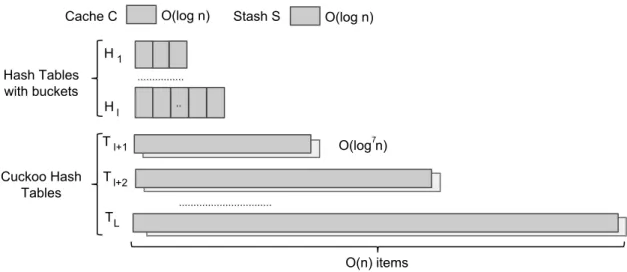
Following Definition 1, we describe the setup function and its output of dataset D, following the definition of an oblivious simulation scheme. Let n be the number of memory cells of the original datasetA. We view each such cell as an item consisting of a pair (x, v), where x ∈ {0,· · ·, n −1} is the index and v is the corresponding value. Our data structure D stored at the server has four components, illustrated in Figure 4.1. The first component is a cache of size αlogn, denoted by C. The second component is a hierarchy of hash tables with buckets of sizeclogn/log logn, H1, . . . , Hlwherec≥1 is a constant andl isO(log logn) (the choice forlwill become
evident from the analysis). H1can fit twice more elements thanC,H2 fits twice more elements than H1 and so on. The third component is a hierarchy of cuckoo hash tables, T =Tl+1, . . . , TL, where Tl+1 is suitable to fit twice more elements thanHl.
Each consequent table Tj+1 is twice the size of table Tj, and TL is the first table in
the sequence of size greater than or equal to n. Thus, L is O(logn). The fourth component is a stash, S, which is shared between all the above cuckoo tables. We refer to a hash table Hi and a cuckoo hash table Tj using indices i∈ {1, . . . , l} and
... T Cache C Stash S l+1 Tl+2 L TL Cuckoo Hash Tables O(n) items ... H1 Hl Hash Tables with buckets .. O(log n)7 O(log n) O(log n)
Figure 4.1: Illustration of the data structure stored at the server for oblivious RAM simulation withO(logn) amortized access overhead. In the access phase of the simulation, all the items in the cache,C and the stash,S, a bucket in hash tablesHi, plus two items for each cuckoo table Tj are read by the server.
The items in D are stored in the data structure in an encrypted form. We use a semantically secure encryption scheme. Recall that with this scheme re-rencyption of the same item is very likely to produce a different ciphertext (see Section 3.3). Hence, the server is unable to determine whether two ciphertexts correspond to the same item or not.
The items are placed in a hash table Hi according to a function fi, for i ∈
{1, . . . , l}. In particulate an item (x, v) is mapped to a bucket fi(x) in Hi. The
items are inserted in a cuckoo hash table Tj using two functions, h1j and h2j, for j ∈
{l+ 1, . . . , L}. Recall that in a cuckoo hashing scheme with a stash an item (x, v) is located in one of the two locations inTj,h1j(x) orh2j(x). We instantiate hash function
fi (and similarly h1j andh2j) with a family of pseudorandom functions parameterized
by a secret value, ki, for each hash table, Hi, such that value ki is not revealed to
the server. In particular,ki is stored in an encrypted form for each tableHi, so that
The content of the tables in the construction consists of real, fake and dummy elements. The real elements are the original elements from the dataset A with keys in the set {0, . . . , n−1}. The fake elements are added to every level of the construction and are used during the access phase to avoid querying real elements more than once from this level. We add 2i×αlognfake elements to leveliin the same manner for hash tables and cuckoo hash tables. A key of the fake element is in the range{n, . . . ,2i×αlogn−1}. Overall, each leveliis large enough to fit 2i+1×αlogn elements, fake and real. During the simulation we need to hide the number of real elements at every level. For this purpose, each table is padded with dummy elements such that table size is static and independent of how many real elements there are in the table. For example, hash table Hi has 2i+1×αlognlog logclognn cells, due
to clogn/log logn-sized buckets, but contains at most of 2i+1 ×αlogn elements. We fill empty cells with dummy elements and encrypt them as well. Similarly, a cuckoo hash table at level j contains two tables of size O(2j+1×αlogn) each but is required to store at most of 2j+1×αlognreal and fake elements. Once again, we use probabilistic encryption scheme which makes it hard for the adversary to distinguish whether a cell contains a real, a fake or a dummy element.
During the runtime we also keep a counter request count of the number of re-quests that have been done to the simulator. We will show that in order to simulate requests obliviously, clients need to know request count. However, since this counter is small it can be stored at the server encrypted and accessed every time a request is made, leaving the system stateless.
The data structure is initialized by storing all the n RAM items into cuckoo tableTL. However, the scheme can be adapted to the case when no items are stored
4.2
Oblivious Simulation of Data Requests
We split the sequence of accesses the algorithm produces in order to simulate a data request obliviously into two phases, an access phase and a rebuild phase.
4.2.1
Access Phase
Suppose the user calls for an access to memory item with a key x. The access phase consists of a search for x in the cache, C, then in the stash,S, and continues with sequential lookups in hash tables H1, . . . , Hl, followed by two lookups in every
cuckoo hash Tl+1, . . . , TL. The lookup in each table depends on whether the item
has been found in C, S or earlier tables, or not. If the item was not found in C or S, the bucket at location f1(x) is accessed in T1. The bucket is scanned in search for x. We follow the same strategy for the consequent hash tables until the item is found. If the item was not found in hash tables H1, . . . , Hl, cuckoo hash table Tl+1 is accessed in locations h1l+1(x) andh2l+1(x), and similarly for consequent Tj’s, if x is
not found in earlier tables.
Once the item is found, in eitherHiorTj we continue accessing consequent tables
but at random locations instead of following functions f and h. Note that although the item is found we have to continue accessing every table, since revealing at which level the item is found may reveal what item was being searched for. In Section 4.3 we show that accesses that result from looking for an item are indistinguishable from the ones that are random.
Once we have completed the access phase, which takes O(logn) time, we then switch to the rebuild phase. We begin by adding or replacing a copy of the found
item into cache C, possibly changing its value in the case of a write operation. To assure obliviousness, we exhaustively scan C in a sequential manner and re-encrypt and rewrite all its items. Thus, the server cannot distinguish which item was accessed and whether it was modified.
We note briefly that if the item is in the stash, we can obliviously remove it from the stash when placing it intoC, to help make sure the stash does not overflow. One natural approach is to have stash cells have an associated “clean” or “dirty” bit, which is encrypted along with the rest of the item. A clean cell can store an item; a dirty cell is currently being utilized. When an item is found and replaced into C, we can set the cell to clean in the stash.
4.2.2
Rebuild Phase
After adding enough items, cache C will eventually overflow. Specifically, let |C| = αlogn. We remedy the overflow by moving all the elements of C to hash table H1 after every αlogn requests, i.e., when request count mod clogn = 0. The moving down of elements cascades down through the hierarchy of hash tables at a fixed schedule by periodically moving the elements of level i−1 into Hi at the earliest
timeHi−1 could have become full. Now suppose that we are going to move elements into tableHi for the second time, then we instead move the elements into tableHi+1. Moreover, we continue applying this rule for i = 1,2, . . . l, until we are copying the elements into a table for the first time or we reach Hl. Once Hl is reached we move
elements toTl+1, and continue similar table cascade but for cuckoo hash tables. The cascade of rebuilds stops, onceTL is reached. Note that rebuilds ofTj tables need to
take into account elements from stash S, i.e., elements that did not fit in Tj−1 the last time it was built. Thus, the process of copying elements into a (cuckoo) hash
table occurs at deterministic instances, depending only on the number of requests r that have been specified by algorithm A so far.
In order to move m elements from level i, 0 ≤ i < l into a hash table Hi+1 obliviously, we use an algorithm of [24] to obliviously sort the items using O(m) accesses to the outsourced memory, assuming we have a private workspace of size O(n), for some constant 0 < < 1, and m ≥ logn, which is always true in our case. Constructing a cuckoo hash table Tj, l + 1 ≤ j ≤ L, is trickier and we use
another algorithm of [24] to obliviously construct a cuckoo table of size m and an associated stash, S0, of sizeO(logn) inO(m) time, with very high probability, while utilizing the private workspace of size O(n). Given this construction, we then read
S and S0 into our private workspace, remove any duplicates and merge them into a single stash S (which will succeed with very high probability, based on Theorem 5), and write S back out in a straightforward oblivious fashion. Note that in order to assure obliviousness in subsequent lookups, hash tableHi+1 (cuckoo hash tableTj+1) is rebuilt using a new pseudorandom function (two new pseudorandom functions) selected by the client by replacing parameter ki+1 (kj+1) with a new one.
4.3
Analysis
We first prove that hash tables and cuckoo hash tables used in the solution do not overflow with very high probability and, hence, can be safely used for oblivious simulation. We then show that access sequence appears to be independent of the data to the server and, hence, our construction is data-oblivious following Definition 3.
Lemma 4. LetH be a hash table withm buckets of size log logclognn for an arbitraryc≥e and m between Ω(logn) and O((logn)7). Then no bucket of H overflows after m
elements are inserted in an empty H with a very high probability is bounded by 1−1/nc0 where c0 is an arbitrary constant.
Proof. We use balls and bins analysis to bound the overflow event, since insertingm elements in m buckets is equivalent to throwingm balls into m bins and computing the maximum number of balls in any bin.
We want to prove that buckets of size s = log logclognn are enough to avoid overflow with very high probability. We use analysis similar to [39, Chapter 5], where the probability of having at least s balls in any bin is bounded by
ps =m
e
s
s
If s= log logclognn then
ps ≤ m
e log logn clogn
log logclognn
Since m is at most O((logn)7) in our case we bound the expression further:
ps ≤ log7n
e log logn clogn
log logclognn
≤ 2log log7n+log logclognnlog(
e log logn clogn )
Letc1 =c/e then:
ps ≤ 2
log log7n+log logclognnlog
log logn
c1 logn
≤ 2log log7n+clognlog loglog log logn n−
clognlogc1 logn
log logn
≤ 2log log7n+clognlog loglog log logn n−clogn
If log logn/log log logn ≥c then clog log loglog lognnlogn ≤logn. Otherwise, there is such a c2 < c that clog log loglog lognnlogn≤c2logn. Hence, there is a constant c0 =c−c2 that
m e s s ≤ 1 nc0
Lemma 5. Let Tl+1, . . . , TL be a sequence of cuckoo hash tables where Tl contains
O((logn)7) elements, |T
j+1| = 2|Tj| and |L| = O(logn). A stash of size O(logn)
shared between Tl+1, . . . , TL is enough to avoid overflows with very high probability.
Proof. The probability that the stash for a cuckoo hash table of size x cells (where xis Ω(log7n)) exceeds a total size sis x−Ω(s) [24]. Further, as long as the hashes for a cuckoo hash table at each level are independent, we can treat the required stash size at each level as independent, since the number of items placed in the stash at a level is then a random variable dependent only on the number of items appearing in that level.
Now consider any point of our construction and let Si be the number of items at
theith level that need to be put in the stash. It is apparent thatSihas mean less than
1 and tails that can be dominated by a geometrically decreasing random variable. This is sufficient to apply standard Chernoff bounds. Formally, let X1, X2, . . . , XL
be independent random variables with mean 1 geometrically decreasing tails, so that Xi =j with probability 1/2j for j ≥1. Then the calculations of [24] imply that the
Xi stochastically dominate theSi, and we can now apply standard Chernoff bounds
for these random variables. Specifically, noting that Xi can be interpreted as the
number of fair coin flips until the first heads, we can think of the sum of the Xi as
![Figure 3.2: Memory layout of the storage provider during oblivious RAM simulation, original version of the square-root solution [21].](https://thumb-us.123doks.com/thumbv2/123dok_us/1872401.2773303/43.918.342.632.112.325/figure-memory-storage-provider-oblivious-simulation-original-solution.webp)