PROJECT BASED LEARNING: HIGHER EDUCATION STUDENTS’
PERCEPTIONS
P. Alves
1, C. Morais
2, L. Miranda
3, M. Pereira
11
Research Centre in Digitalization and Intelligent Robotics (CeDRI), Instituto Politécnico de
Bragança (PORTUGAL)
2
Instituto Politécnico de Bragança, CIEC - University of Minho (PORTUGAL)
3Instituto Politécnico de Bragança (PORTUGAL)
[email protected], [email protected], [email protected], [email protected]
Abstract
The society’s social and technological context is in constant change, which causes the need to innovate and experiment changes in higher education, namely as far as teaching and learning strategies are concerned. In this paper, particular emphasis is given to the assessment of the teaching and learning strategy known as Project Based Learning (PBL).
Among the features characterizing this strategy, we highlight the possibility that students have of: learning by doing and by applying their own ideas, getting involved in real-world activities applicable to the world of work, researching questions and issues, discussing ideas, and elaborating and executing projects.
According to several authors, who will be cited in the article, the PBL methodology makes students more creative and constructive and helps them develop skills for researching and developing solutions to the problems they might face in their professional life, by learning to solve problems with increasingly higher levels of complexity.
Students’ perceptions on the project based learning strategy were obtained from a sample of subjects attending a course in software development in a Portuguese public higher education institution. This course started in the academic year of 2017/2018 and is integrated in a nationwide pilot project, included in the Portuguese Government initiative INCoDe.2030. The main aim of this course consists of training professionals in the field of computing programming who will develop skills to respond to the needs of the real world, as well as fomenting intervention projects within the community. The predominant methodological strategy in all the course units is anchored in Project Based Learning. The main aim of this paper is to assess the Project Based learning strategy, namely by identifying the students’ level of satisfaction and motivation with the strategy used, its strengths and weaknesses, aspects that can be improved, and the skills acquired.
The methodology used in this research work is a mixed one, with both qualitative and quantitative characteristics and with procedures associated with experimental research. The main data collection tool used was the survey. The results of this research provide the characterization of the Project Based Learning strategy from students’ perspective, and highlight indicators which enable the assessment of the referred strategy’s strengths and weaknesses as well as the reference to some skills acquired by the students, aiming to the eventual improvement of the strategy and its extension to other courses. Project Based Learning may constitute an approach which is well received by students and enables them to get involved into the paths of innovation and updating, needed to meet the demands of the 21st century.
Keywords: Teaching and learning strategies, Project Based Learning, Problem-Solving Based Learning, Professional skills.
1 INTRODUCTION
Our current society is characterized by change and innovation. Such change and innovation is visible in various contexts and from several stakeholders. As researchers and higher education teachers, it is our belief that the changes leading to new outlooks on society life as well as to changes in people and organizations’ life greatly depend on the methodologies used throughout the teaching and learning process, namely in the teaching of course units comprised in higher education courses. In this paper,
particular emphasis is given to the methodology of project based Learning (PBL), which will hereafter be referred to as the PBL methodology.
The main aim of this work is to assess the PBL methodology, based on the answers given by the students of a higher professional technical course in Software Development, a course run in a Portuguese public higher education institution. Such assessment was conducted based on the following specific goals: identify the strengths of this methodology; identify the aspects which can be improved; and assess the students’ level of satisfaction and motivation regarding the use of the PBL methodology. We currently live in a society driven and characterized by knowledge. As highlighted by Laar et al. [1], in the knowledge society, organizations operate within a global economy characterized by competition, economic interdependence and cooperation. Such economy, as well as the rapid changes to which it is subject, is highly dependent on information and communication technologies (ICT), which raises the need for students to be prepared to respond to new challenges.
According to Ribeiro and Mizukami [2], the project based learning methodology enables students to develop skills regarding knowledge, abilities and attitudes, encompassing not only hard skills but also the increasingly important soft skills. It is paramount for higher education institutions to adopt methodologies that enable their learners to respond efficiently to the society challenges and needs and to acquire skills to enter and respond successfully to the labor market.
A report by the World Economic Forum [3] highlights that the 10 skills considered to be most important for the labor market in 2020 are related to complex problem-solving, critical thinking, creativity, human resources management, cooperation, emotional intelligence, decision-making, mutual help; negotiation, and cognitive flexibility.
It is urgent that higher education institutions adopt methodologies which enable students to get involved in projects with activities that are applicable to real working contexts, where they can learn by doing, with aids and fundamental concepts introduced by the teacher, but where research and group discussions towards possible solutions are included, aiming to the implementation of those projects with students’ active and committed participation.
According to Segrelles, Martinez, Castilla and Moltó [4], both employers and students agree on the importance of developing and assessing, within the classroom, the potentials enabling students to acquire the skills needed to perform their future jobs. These authors also highlight that the implementation of academic degrees promoted by the European Higher Education Area is anchored in such skills, thus engaging teachers towards the creation of new curricula which incorporate innovative methodologies of active learning.
After the introduction to this paper, the following topics will be further developed: Project Based Learning (PBL), Methodology, Results, Conclusions, and References. In the section regarding Project Based Learning, we present the scientific fundaments of the PBL methodology, supported by studies on the topic and their respective authors; in the Methodology section, we describe the nature of this research work as well as the characteristics of the data collection tool and those of the sample of this study; in the Results section, we provide the main results obtained and a brief analysis of such results; in the Conclusions, the results are synthesized according to the goals defined for this research; in the References, we list the scientific sources supporting this study according the Vancouver system.
2 PROJECT BASED LEARNING (PBL)
The PBL methodology is based on the use of active learning techniques. According to Florida State University [5], active learning techniques are meant to help students make relevant connections between the several course materials and transform such materials into ideas that they can integrate into their own knowledge and long-term memory. In the same source, it is also stated that active learning shifts the focus from the teacher’s content distribution towards students, thus implying their active involvement with the material through active learning techniques. This way, students stop being passive receptors and actually acquire knowledge and develop skills, applying them meaningfully.
Therefore, active learning is a methodology which involves students in their own learning, preventing them from being mere spectators of teachers’ action and leading them to participate, experiment and engage in their own learning path.
Nieh and Chou [6] support the use of active learning techniques, namely so that students acquire the necessary skills to respond to the industry needs, adding that in the face of industry’s fast growth, the
students subject to traditional learning, which is stricter, memorized and prevents them from developing the capacity of learning autonomously, will have difficulties adapting to the industry needs. Also, students entering the sector should have not only experience in that sector but also the ability to solve practical issues, work in team and communicate.
According to Seman, Hausmannb and Bezerra [7], there are various ways of implementing active learning among which is project based learning, which has been applied successfully in several areas. Project based learning has become one of the main pedagogical models to respond to the challenges of the new century [8], being adopted in several educational contexts, both to increase motivation and to enable students to put what they’ve learned into practice [6] [9].
In the view of Krajcik and Blumenfeld [10], project based learning enables students to learn through practice, by applying ideas and getting involved in real-world activities similar to the professional tasks they might come to perform. Bender [8] suggests that using authentic projects based on one question, task or problem is highly motivating and engaging for students, who thus learn academic contents applied to the future working context.
Mahasneh and Alwan [11] claim that the students who learn in a PBL context become creative and constructive due to the almost unlimited range of projects, among which are the creation of a learning portfolio or the construction of a model from a diagram, thus admitting a large number of possibilities and options.
By bearing in mind students’ learning goals, teachers who use PBL create or adapt projects and highlight the essential elements of the project, including a challenging problem or question, sustained inquiry, authenticity, reflection, criticism and review, and turn the project into a public product [12].
Overall, the goals to be achieved through the PBL methodology are a simultaneous promotion of learners’ deep understanding of the content studied and the development of their high-order thinking [13].
In the PBL methodology, students’ work is organized around the search for solutions to a complex and badly-structured problem which encompasses authentic content based on a specific curriculum. Since the problem is presented to the students before they even learn the necessary contents to solve it, they work together to identify their learning needs and find information that is relevant to respond to those needs. Throughout the process, the teacher monitors and guides students’ progress, supervises and manages small groups’ work, keeping students’ focus on the essential and providing them with the necessary feedback. Finally, in order to help students deepen and strengthen their understanding of the concepts and abilities acquired, the teacher guides and involves them in continuous reflective activities such as keeping a diary of the activities, self-assessment and group meetings [13].
According to Bell [14], cooperation is also an important teaching and learning strategy, especially when used jointly with the PBL methodology. This methodology can be used as an innovative approach to involve students in authentic projects, enabling students to lead their own learning through inquiries and collaborative work in projects. Learners must be guided towards proposing, researching and developing solutions to problems which might come up in their professional life. They must be stimulated throughout their course to work on problems with increasing levels of complexity.
Dragoumanos, Kakarountas and Fourou [15] highlight the importance of the PBL methodology for students’ development of 21st century skills, including the acquisition of knowledge and the development of team work on a specific topic, during a long period of time. In order to develop the project, they need to learn to manage their time, have team spirit and other skills associated with communication.
The project based learning model developed by the Buck Institute for Education [12] is centered on the learner and is based on learning goals and key knowledge. So that students can achieve such goals, they need to acquire skills targeted towards success and be able to use their knowledge to think and analyze topical issues, solve new problems and contribute to civic dialogue.
According to Cavanaugh [16], project based learning refers to students’ involvement in conducting a project in a real-world context, through which they move towards the acquisition of knowledge and the development of skills related to that same project.
Bender [8] highlights that the focus on authentic learning experiences that students can have in the real world is a characteristic of almost all the experiences of project based learning, which increases students’ motivation to take an active part in the projects.
Motivation is higher in PBL than in traditional methodologies, team work improves relationships among students, the dialogue between students and teacher is more fluid, and all these factors result in a constructive work environment, in which learners monitor their own learning process [9]. Students are encouraged to work and learn autonomously [17], thus acquiring new skills for a more demanding and fast-evolving labor market.
The PBL methodology can constitute a methodology of some natural proximity between students and the labor market, due to the involvement that this latter may have in the definition of projects close to the real world as well as in the implementation of such projects, and due to the possibility that this methodology gives to develop both autonomous work and collaborative team work.
3 METHODOLOGY
With regard to the procedures conducted, this research work can be considered an experimental survey study. It is a mixed study, with some features close to qualitative research and others close to quantitative research [18]. The data were obtained through a questionnaire containing open-ended, close-ended and multiple choice questions.
The answers to the close-ended and to the multiple choice questions were treated using an approach close to quantitative studies, since these allow testing the relation between variables [19] and also quantify the variation of a phenomenon or situation [20]. The answers to the open-ended questions were not treated in this study and will be treated in further studies on this same topic, namely the PBL methodology. According to [21], the use of open-ended questions regarding a given topic allows the respondents’ free expression of their opinions and enables researchers to identify respondents’ perceptions, representations and subjective experiences regarding the topic under study.
This research work can also be considered as an exploratory study, with descriptive and interpretive features, as it may be extended to other courses run both in the institution where it was conducted and in other institutions.
The data used in this study were obtained through questionnaire, during the academic year of 2017/2018 and from a sample of 32 students attending a Higher Professional Technical course in Software Development run in a Portuguese public higher education institution.
Among the 32 students, 31 are male and one is a female. Their ages varied between 18 and 32 years old, with a mean age of 20.7, a median of 20, a mode of 18 and a standard deviation of 2.8. The students attended the 1st and the 2nd years of the course, with 18 of them (56%) in the 1st year and 14 (44%) in the 2nd year.
Given the reduced size of the sample and the way it was constituted, the results presented hereafter must not be generalized, but may rather represent indicators to be taken into account in further studies to be developed on the PBL methodology.
4 RESULTS
The results are presented as descriptive statistics so as to translate the perceptions of a group of 32 higher education students attending a course in Software Development regarding the guiding learning methodology which was privileged in this course, previously designated as PBL. Therefore, and given the characteristics of the sample, the data are presented in tables and charts and must be viewed as the results of an exploratory study, which provides indicators that may be significantly useful to the implementation of this methodology in other higher education courses and contexts.
The display of the results starts with a first analysis of the answers given by the sample subjects regarding the PBL methodology in terms of agreement and disagreement, by using a Likert scale with four options: totally disagree, disagree, agree, and totally agree. This was followed by a reassessment of the results based on the interpretation of the answers given in terms of students’ favorable and unfavorable opinions regarding the PBL methodology.
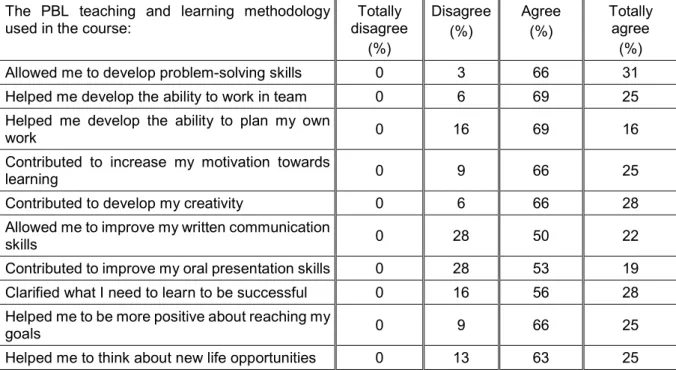
Table 1 shows the distribution of the sample subjects’ answers in terms of agreement and disagreement regarding their perceptions of the effects of the PBL methodology on skills and attitudes.
Table 1: Students’ perceptions of the PBL methodology regarding skills and attitudes (n=32) The PBL teaching and learning methodology
used in the course: disagree Totally (%) Disagree (%) Agree (%) Totally agree (%)
Allowed me to develop problem-solving skills 0 3 66 31
Helped me develop the ability to work in team 0 6 69 25 Helped me develop the ability to plan my own
work 0 16 69 16
Contributed to increase my motivation towards
learning 0 9 66 25
Contributed to develop my creativity 0 6 66 28
Allowed me to improve my written communication
skills 0 28 50 22
Contributed to improve my oral presentation skills 0 28 53 19 Clarified what I need to learn to be successful 0 16 56 28 Helped me to be more positive about reaching my
goals 0 9 66 25
Helped me to think about new life opportunities 0 13 63 25
Given the fact that these statements show a significantly high level of agreement, it is possible to infer that these students’ opinion is mostly favorable to the use of the PBL methodology in the teaching and learning process within the course they attend.
Considering that the students had to assess statements which were presented positively, we can infer that the agree and totally agree answers translate favorable opinions while the disagree and totally disagree answers translate unfavorable opinions regarding the PBL methodology.
Given the abovementioned convention, Figure 2 shows the distribution of opinions considered favorable and unfavorable.
Figure 2: Students’ perceptions regarding the PBL methodology (n=32)
0% 20% 40% 60% 80% 100%
Contributed to improve my oral presentation skills Allowed me to improve my written communication skills Clarified what I need to learn to be successful Helped me develop the ability to plan my own work Helped me to think about new life opportunities Helped me to be more positive about reaching my goals Contributed to increase my motivation towards learning Contributed to develop my creativity Helped me develop the ability to work in team Allowed me to develop problem-solving skills
The observation of Figure 2 allows the inference that the students assess the PBL methodology very favorably, namely with regard to the domains associated with the development of skills and attitudes like problem-solving skills, teamwork and individual work planning. Although this, the skills related with written and oral communication are not so improved. As far as attitudes are concerned, we can also observe strongly favorable opinions regarding motivation, creativity, being more positive and looking for new opportunities.
Taking into account that this research work was conducted based on data provided by students attending a course in Software Development, oriented towards solving specific community problems and meeting the needs of the labor market, and also bearing in mind the skills for the 2020 labor market defined by the World Economic Forum [3], the sample subjects were inquired so as to determine whether or not the PBL methodology prepares students for such demands. The distribution of answers regarding those skills is presented in Table 2.
Table 2: Skills for the 2020 labor market (n=32) The PBL methodology used in the
course enhances skills for: Totally disagree (%) Disagree (%) Agree (%) Totally agree (%)
Complex problem solving 0 6 59 34
Critical thinking 0 0 66 34 Creativity 0 3 63 34 Conflict management 0 9 59 31 Cooperation 0 0 75 25 Decision making 0 0 69 31 Mutual help 0 3 72 25 Negotiation 0 13 66 22 Listening to others 0 0 72 28
As shown in Table 2, the vast majority of students agree or totally agree that the PBL methodology provides them with the skills considered important by the World Economic Forum [3] for 2020. The most valued skills are: critical thinking, cooperation, decision making, listening to others, mutual help, and complex problem solving. On the other hand, although selected by a reduced percentage of students, the least valued skills were conflict management and negotiation.
Figure 2: Skills for the 2020 labor market (n=32)
0% 10% 20% 30% 40% 50% 60% 70% 80% 90% 100%
Negotiation Conflict management Complex problem solving Mutual help Creativity Listening to others Decision making Cooperation Critical thinking Favorable Unfavorable
Considering the format of the statements under analysis, we assume that the agree and totally agree answers translate students’ favorable opinions while the disagree and totally disagree answers translate unfavorable opinions. Therefore, Figure 2 shows the distribution of students’ opinions about the PBL methodology with regard to the way it prepares them for the labor market.
All the skills enhanced by the PBL methodology which were assessed in this study deserved widely favorable opinions from the students.
Cooperation is a key component of the PBL methodology since it enables students to make the most of each other’s perspectives and talents in order to create more efficient solutions to the given problems [13]. The results of this study are in accordance with this idea as shown by the value given to this skill in the students’ answers.
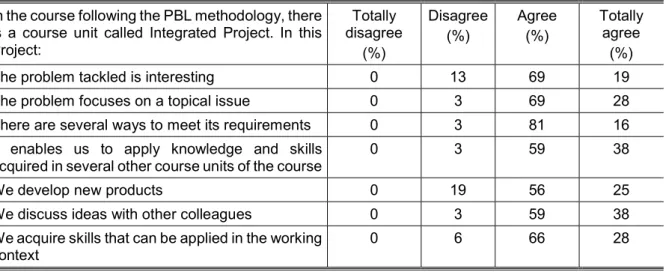
Besides the global assessment of the PBL methodology within the course in Software Development, This study also analyzed students’ opinions regarding one of the course units in the curriculum, called ‘Integrated Project’. The reason for assessing the PBL methodology in this course unit lies in the fact that this course unit is paramount to the creation of links between the educational institution and the companies as well as the community.
Table 3 below shows the distribution of students’ answers regarding the items assessed within this particular course unit.
Table 3: Assessment of the course unit Integrated Project In the course following the PBL methodology, there
is a course unit called Integrated Project. In this Project: Totally disagree (%) Disagree (%) Agree (%) Totally agree (%)
The problem tackled is interesting 0 13 69 19
The problem focuses on a topical issue 0 3 69 28
There are several ways to meet its requirements 0 3 81 16 It enables us to apply knowledge and skills
acquired in several other course units of the course
0 3 59 38
We develop new products 0 19 56 25
We discuss ideas with other colleagues 0 3 59 38
We acquire skills that can be applied in the working
context 0 6 66 28
From the data presented in Table 3, we can observe that the vast majority of the students agree or totally agree with the use of the PBL methodology in the course unit of Integrated Project, namely with respect to the aspects associated with the interest of the problem tackled, its topicality, the different ways to solve it, the use of several concepts learnt throughout the course, the ideas discussed and the value of integrating students in the world of work. The aspect least valued by the students in this course unit was the development of new products within the context of this course unit.
Within this whole assessment of the PBL methodology, students were also inquired about their level of acceptance of the methodology. The data regarding students’ perceptions indicate that they tend to value more the PBL methodology in the aspects associated with activities focused on skills privileging each one’s relationship with others rather than in individual skills. These indicators are evidenced when assuming that the agreement options are translated into favorable opinions and the disagreement options are interpreted as unfavorable ones, as shown in Figure 3.
The data in Figure 3 allows the deduction that learning by doing, knowledge sharing, teamwork and questioning are aspects which deserve an almost unanimous agreement among the sample subjects regarding the value they give to the potentialities of the PBL methodology. Although also showing a high level of agreement, above 70%, the development of individual autonomy is one aspect of the PBL methodology which was not so valued by the students.
Figure 3: Level of acceptance of the PBL methodology
In light of the results and indicators presented throughout this paper, it is possible to conclude that the PBL methodology deserves a high level of acceptance from the students who have used it in their learning process. These findings motivate researchers to develop further works in this area, extending this study to larger contexts and samples that might be representative of wider publics.
5 CONCLUSIONS
The main aim of this study was to assess the PBL strategy, namely the students’ level of satisfaction and motivation regarding the strategy used in the course they attend, the acquired skills, the strengths of this methodology, and the aspects which can be improved.
The analysis of the results enables the observation of a high level of satisfaction among the students towards the strategy adopted. The main strength found in the use of the PBL methodology was the students’ perception and acknowledgement of its importance to the development of skills and attitudes. As far as motivation is concerned, it is noteworthy that the PBL methodology enabled over 90% of the students to acknowledge the fact that this methodology led to an increase in their motivation towards learning and made them more positive towards achieving their goals. With regard to autonomy, we highlight that over 88% of the students showed to have enjoyed working autonomously.
This study also indicates that over 90% of the students consider that the PBL methodology enables the development of skills connected with critical and open mind thinking, collaborative work, listening to others, creativity, mutual help, problem solving ability and self organization.
Further strong aspects of the PBL methodology which stand out in this study are the acquired skills, the importance of learning by doing, knowledge sharing and the development of teamwork skills. The aspects least valued by the students were the capacity to work without the teacher’s support, the lack of preparation for the labor market, the written communication and oral presentation skills and the ability to develop new products, to manage conflicts and to negotiate.
The process of adaptation to the PBL methodology is a continuous one and this was the first contact that these students had with this methodology. Among the things that can be improved in PBL use, we highlight the need to tackle the aspects that students considered less well-achieved. This can be done by reflecting and changing methodologic procedures, so that PBL can better contribute to increasing students’ confidence and autonomy; promoting their collaboration with the community in problem solving processes; and improving their written and oral communication skills, thus ultimately providing students with better preparation to respond successfully to the needs and challenges of the labor market.
0% 20% 40% 60% 80% 100%
I feel more prepared for the labor market I managed to work without the teacher’s direct support I managed to solve the problems that came up I understood what was expected from me in the project I am more motivated towards learning I enjoyed learning autonomously I understood what I had to do I felt comfortable asking questions I enjoyed working with others I enjoyed learning through practice I enjoyed sharing knowledge with others
REFERENCES
[1] E. van Laar, A. J. van Deursen, J. A. van Dijk and J. Haan, “The relation between 21st-century skills and digital skills: A systematic literature review”. Computers in Human Behavior, 72, pp. 577-588, 2017.
[2] L. Ribeiro, M. Mizukami, “Uma Implementação da Aprendizagem Baseada em Problemas (PBL) na Pós-Graduação em Engenharia sob a Ótica dos Alunos”. Semina: Ciências Sociais e
Humanas, Londrina, vol. 25, pp. 89-102. 2004.
[3] World Economic Forum, The Future of Jobs. Global Challenge Insight Report. Accessed 12 January, 2019. Retrieved from: http://reports.weforum.org/future-of-jobs-2016.
[4] J. Segrelles, A. Martinez, N. Castilla, G. Moltó, Virtualized computational environments on the cloud to foster group skills through PBL: a case study in architecture. Computers & Education Journal. vol 108. pp 131-144
[5] Florida State University. Instruction at FSU: A guide to teaching and learning practices. Office of Distance learning, 7th edition. 2011. Accessed 12 January, 2019. Retrieved from:
https://distance.fsu.edu/instructors/instruction-fsu-guide-teaching-learning-practices. [6] T. Nieh and J. Chou, “A Project-based Learning Design for teaching and learning of
Mechatronics Engineering, The Riderless Bicycle as an Application”. in IEEE Global Engineering Education Conference, EDUCON2018, pp. 251-256, 2018.
[7] L. Seman, R. Hausmannb and E. Bezerra, “On the students' perceptions of the knowledge formation when submitted to a Project-Based Learning environment using web applications”, Computers & Education, vol. 117, pp. 16–30, 2018.
[8] W. Bender, Project-based learning: differentiating instruction for the 21st century. 1st edition. Corwin: Thousand Oaks, 2012.
[9] J. M. Requies, I. Agirre, V. L. Barrio and M. Graells, “Evolution of Project-Based Learning in Small Groups in Environmental Engineering Courses”. Journal of Technology and Science Education, vol. 8, no. 1, pp. 45-62, 2018.
[10] J. Krajcik, P. Blumenfeld, “Project-Based Learning”. in The Cambridge Handbook of the Learning Sciences (R. Sawyer, eds), Cambridge University Press, 2006.
[11] A. Mahasneh and A. Alwan, “The Effect of Project-Based Learning on Student Teacher Self-efficacy and Achievement”. International Journal of Instruction, vol.11, no. 3, pp. 511-524, 2018. [12] J. Larmer, J. Mergendoller and S. Boss, S. Setting the standard for project based learning.
Alexandria, VA: ASCD, 2015.
[13] P. A. Ertmer and K. D. Glazewski, Essentials for PBL Implementation: Fostering Collaboration, Transforming Roles, and Scaffolding Learning. Essential Readings in Problem-Based Learning: Exploring and Extending the Legacy of Howard S. Barrows (Walker, A., Leary, H., Hmelo-Silver, C., Peggy, E., eds). West Lafayette: Purdue University Press, 2015.
[14] S. Bell, “Project-based learning for the 21st century: Skills for the future”, Clearing House, no. 83, vol. 2, pp. 39–43, 2010.
[15] S. Dragoumanos, A. Kakarountas and T. Fourou, “Young technology entrepreneurship enhancement based on an alternative approach of project-based learning”. in Proceedings of Global Engineering Education Conference, EDUCON2017, pp. 351-358, 2017.
[16] C. Cavanaugh, “Project-based learning in undergraduate educational technology”. In: Proceedings of Society for Information Technology & Teacher Education International Conference, Atlanta, pp. 2010-2016, 2004.
[17] I. Chounta, S. Manske and H. Hoppe, “From Making to Learning: introducing Dev Camps as an educational paradigm for Re-inventing Problem-based Learning”. International Journal of Educational Technology in Higher Education, pp. 14-21, 2017.
[18] M. Marconi and E. Lakatos, Fundamentos de metodologia científica, São Paulo: Editora Atlas S. A, 2003.
[19] J. Creswell, Research design: Qualitative, quantitative, and mixed methods approaches (4th ed.), London: SAGE Publication Ltd, 2014.
[20] R. Kumar, Research methodology: A step-by-step guide for beginners, London: SAGE Publication Ltd, 2011.
[21] J. Amado, “Questionários abertos e composições”, In J. Amado (Coord.), Manual de Investigação qualitativa em educação (3.ª ed.), pp. 273-300. Universidade de Coimbra: Imprensa da Universidade de Coimbra, 2017.